


 Скачать презентацию Engineering Emergent Social Phenomena Laszlo Gulyas AITIA International
f0c4d52f8bf73fda9b2c807939809fa2.ppt
- Количество слайдов: 30
 Engineering Emergent Social Phenomena Laszlo Gulyas AITIA International Inc. lgulyas@aitia. ai
 Motivation § Software is not as it used to be. § Traditional methodologies are aimed at a single, monolithic program with well-defined and controllable input streams. § Today’s software is almost always situated in a dynamic environments. § Computers are networked, but even on a single computer, many programs are running simultaneously. § The software designer/engineer can no longer enumerate or control the state(s) of the environment. § More importantly, the expected behavior of the software is most often not independent of the non-controlled components. § For example, the success of an autonomous agent negotiating a deal on an auction site clearly depends on the performance of other similar agents, programmed by unknown parties. § We need methods, techniques and tools for engineering emergent complex (software) systems.
 Engineering from the Bottom. Up § Example: Generating robust networks L. Gulyas: “GENERATION OF ROBUST NETWORKS: A BOTTOM-UP MODEL WITH OPTIMIZATION UNDER BUDGET CONSTRAINTS “, 5 th International Workshop on Emergent Synthesis (IWES’ 04). § The problem: generating networks that are robust against random failures. § An agent-based model. § § § Agents connect to one another aiming to maximize their connectivity. Each agent can build a fixed number of links. Information about the existing network is costly, the agents optimize under budget constraints (i. e. , only based on information about a limited number of nodes). § Generates robust networks under a wide range of conditions. § The pattern of information access (determined by information pricing) is pivotal.
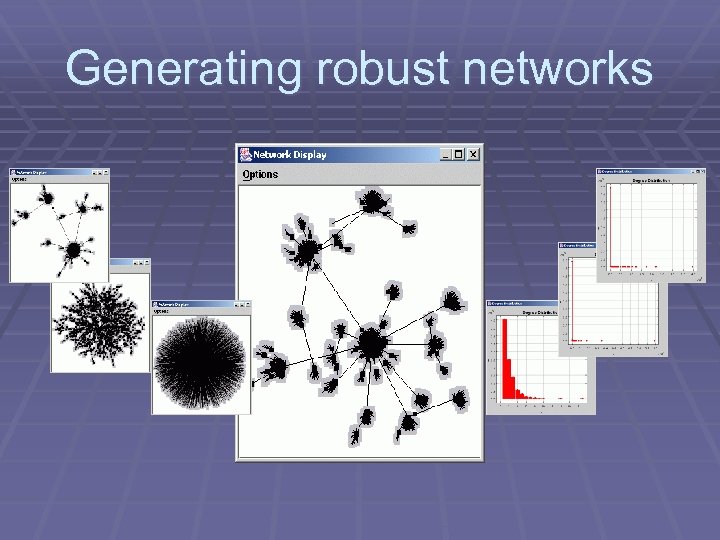 Generating robust networks
 Gaining Inspiration from Complex Social Systems § IT Tools for Social Science Modeling § Agent-Based Modeling and Simulation § Participatory Simulation § Novel Tools: MASS/FABLES
 Gaining Inspiration from Complex Social Systems § IT Tools for Social Science Modeling § Agent-Based Modeling and Simulation § Participatory Simulation § Novel Tools: MASS/FABLES
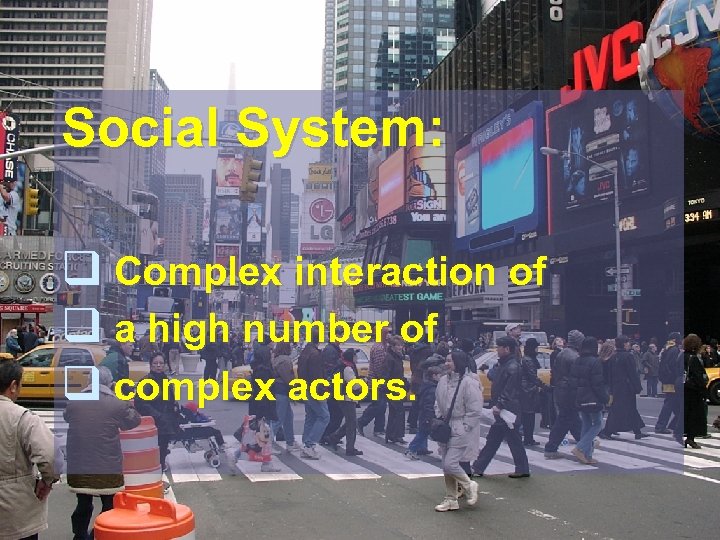 Social System: q Complex interaction of q a high number of q complex actors.
 Statistical Physics versus Social Sciences § People are not as simple as molecules, but molecules are also much more complex than suggested by thermodynamics… § Scientific Thinking Methodological simplification Modeling
 On Social Science Methods I. § Herbert Simon: “The social sciences are, in fact, the » hard « sciences. ” § Problems with experiments § Human subjects § Unique events. § Problem Complexity (e. g. , in GT) § The number of actors. § Interaction/communications topologies. (Everybody knows it all. ) § Dynamic populations. (Cannot exist. ) § Unlimited rationality. § Methodology § Equilibrium versus Trajectory.
 On Social Science Methods II. § Developments in IT technology enables novel approaches. § “In Silico” models and experiments § „If you didn’t grow it, you didn’t explain it. ” (J. M. Epstein) § Numerical simulations § Grounded in mathematics.
 Gaining Inspiration from Complex Social Systems § IT Tools for Social Science Modeling § Agent-Based Modeling and Simulation § Participatory Simulation § Novel Tools: MASS/FABLES
 Agent-Based Modeling (ABM) § One of the novel (in silico) methods. § Aims at creating complex (social) behavior “from the bottom up”. § Complex interactions of § A high number of § (Complex) individuals. § A generative and mostly theoretical approach: § Computational “thought experiments”, § Existence proofs, etc.
 Agent-Based Modeling (ABM) § Capable of § Studying trajectories. § Heterogeneous populations. § Dynamic populations. § Bottom-up approach cognitive limitations to rationality. § Explicit modeling of interaction topologies. § No explicit model for cognitive abilities & interaction topologies, no model.
 Main IT tools for ABM § Open-Source versus Proprietary. § Generality versus Ease of Use. § Component-based versus Custom code. § Major general-purpose OSS tools: Swarm Multi-Agent Modeling Language (MAML) Re. Past Santa Fe Institute, NM, USA Central European University, Budapest, Hungary University of Chicago, Argonne National Lab, IL, USA
 Swarm, 1996 § “Father of all ABM tools”. § Simulation package. § Object-oriented, discrete-event design. § Introduces the main concepts and “ABM design patterns”. § Experimental, hard-to-use system. § Strong user community. § Major impact in spreading the methodology.
 MAML, 1999 § First special-purpose programming language for ABM. § Layered over Swarm. § Thus following the main design and concepts. § Easier to use system. § Aspect-Oriented: separation of modeling and observational concerns. § Still, unfortunate “borrowing” of many problems from Swarm. (E. g. , installation's “hard way to heaven”. )
 Re. Past, 2001 § Re-designed and re-worked version of Swarm. § Maintains all the major concepts and patterns. § Simulation package in Java. § Easy to use, but still general system. § Growing user community § Major impact in showing the ‘maturity’ of ABM technology.
 Gaining Inspiration from Complex Social Systems § IT Tools for Social Science Modeling § Agent-Based Modeling and Simulation § Participatory Simulation § Novel Tools: MASS/FABLES
 Experimental Economics § Controlled laboratory experiments with human subjects. § The effect of human cognition on economic behavior. § Learning and adaptation. § Social traps (Tragedy of Commons, etc. ) § Typical tools: § Observation (Videotaping) § Questionnaires, etc. § An experimental approach.
 Participatory Simulation (PS) § A computer simulation, in which human subjects also take part. § Agent-based simulations are well suited: § Individuals are explicitly modeled, with § Strict Agent-Environment and Agent-Agent boundaries. § Bridges theoretical and experimental approaches. Can help both of them: § Testing assumptions and results of an ABM. § Generating specific scenarios (e. g. , crowd behavior) for laboratory experiments.
 General Purpose Participatory Architecture for Re. Past (GPPAR) § First toolset for participatory ABM. § Developed in 2003 at AITIA, Inc. , Budapest, Hungary. § Supports the transformation of any Re. Past model into a participatory simulation. § Distributed, web-based user interfaces.
 Example Application of GPPAR § Replication of a famous ABM in finance. § Replication of results is a most important step in science! § Conversion to a PS. § Partly as a demonstration of our General-Purpose Participatory Architecture for Re. Past (GPPAR). § Initial Experiments, testing: § § § Original results’ sensitivity to human trading strategies. Human versus computational economic performance. The effect of human learning between runs.
 Practices of ABSS REPLICATION above everything § Scientific experiments (tests and replicas) § True (uncontrolled) parallelism is ruled out. § Probabilistic models: § § § Pseudo RNGs Control over the seed Independent variables, Separate RNGs § Full specification § E. g. Standard practice of random choice among equal maxima.
 Practices of ABSS Generating and Handling of Results § Statistical nature of results: § One go is ‘no go’. § Sensitivity Analysis and Confidence Intervals. § Parameter Sweep § Non-Linear Dependencies § Tricks like Active Non-Linear Tests (ANTs)
 Practices of ABSS Separating Model and Observer(s) § Basic idea in science, § but in computational practice it’s only been around since Swarm (1994) § Several observers § § GUI Batch 1 Batch 2 … § Independence of the Observers’ RNGs from the Model’s RNGs.
 Gaining Inspiration from Complex Social Systems § IT Tools for Social Science Modeling § Agent-Based Modeling and Simulation § Participatory Simulation § Novel Tools: MASS/FABLES
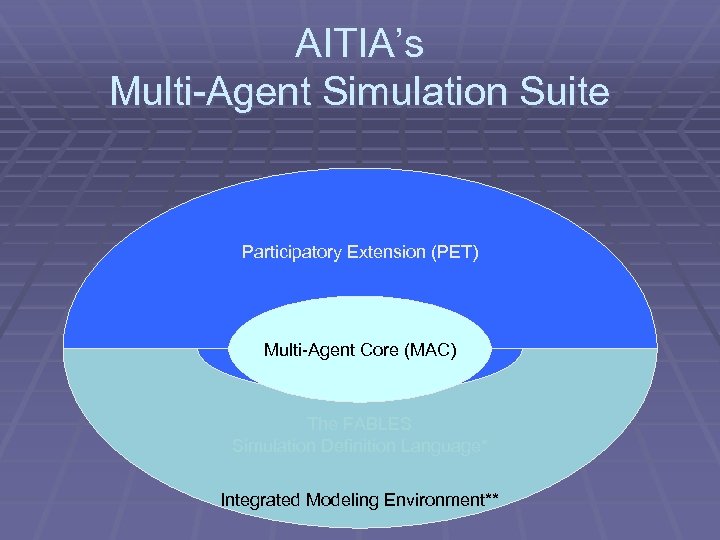 AITIA’s Multi-Agent Simulation Suite Participatory Extension (PET) Multi-Agent Core (MAC) The FABLES Simulation Definition Language* Integrated Modeling Environment**
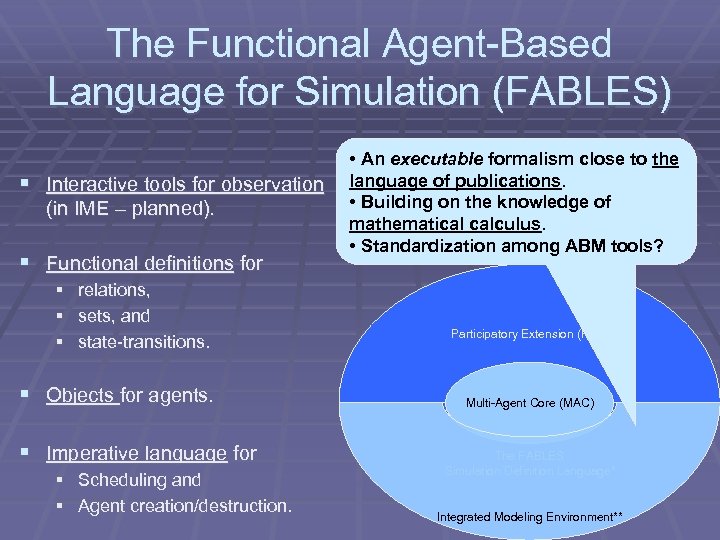 The Functional Agent-Based Language for Simulation (FABLES) § Interactive tools for observation (in IME – planned). § Functional definitions for § § § relations, sets, and state-transitions. § Objects for agents. § Imperative language for § Scheduling and § Agent creation/destruction. • An executable formalism close to the language of publications. • Building on the knowledge of mathematical calculus. • Standardization among ABM tools? Participatory Extension (PET) Multi-Agent Core (MAC) The FABLES Simulation Definition Language* Integrated Modeling Environment**
 Summary § Towards engineering complex (emergent) phenomena. § Inspiration from the practice of agent-based social simulation. § Overview of agent-based modeling & simulation § As a means to engineer emergent phenomena in complex software systems. § Older and Novel tools for ABM/S.
 Thank you! Comments are welcome at lgulyas@aitia. ai