


 Скачать презентацию Engineering Education in China GONG Ke
d324495e834e493a432a78aed90f2ec1.ppt
- Количество слайдов: 42
 Engineering Education in China GONG Ke
 • Staring of the engineering education in China • Blooming of Chinese engineering education • Challenges to the engineering education
 Starting of the Engineering Education in China 1895 - 1952
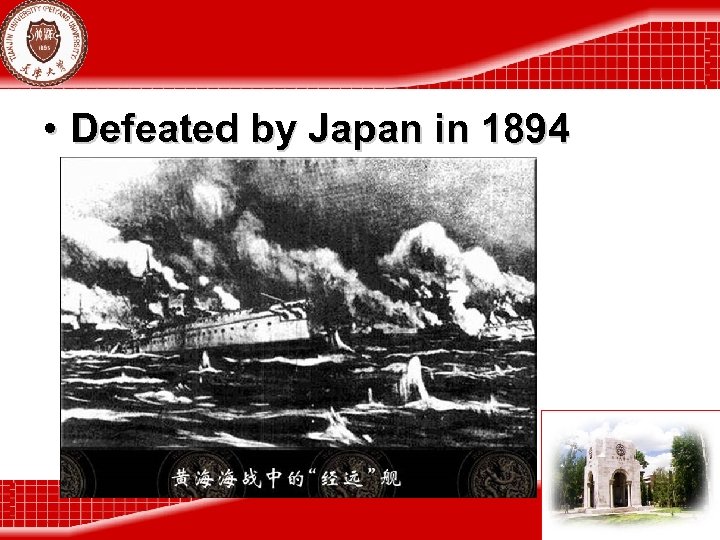 • Defeated by Japan in 1894
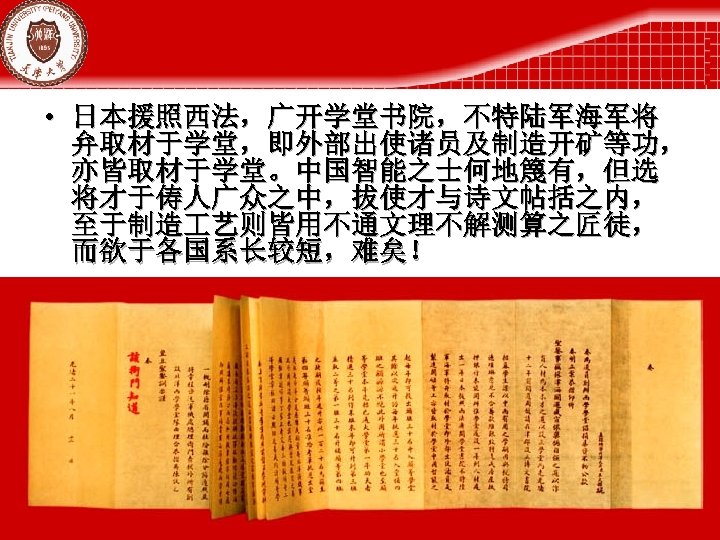 • 日本援照西法,广开学堂书院,不特陆军海军将 弁取材于学堂,即外部出使诸员及制造开矿等功, 亦皆取材于学堂。中国智能之士何地篾有,但选 将才于俦人广众之中,拔使才与诗文帖括之内, 至于制造 艺则皆用不通文理不解测算之匠徒, 而欲于各国系长较短,难矣!
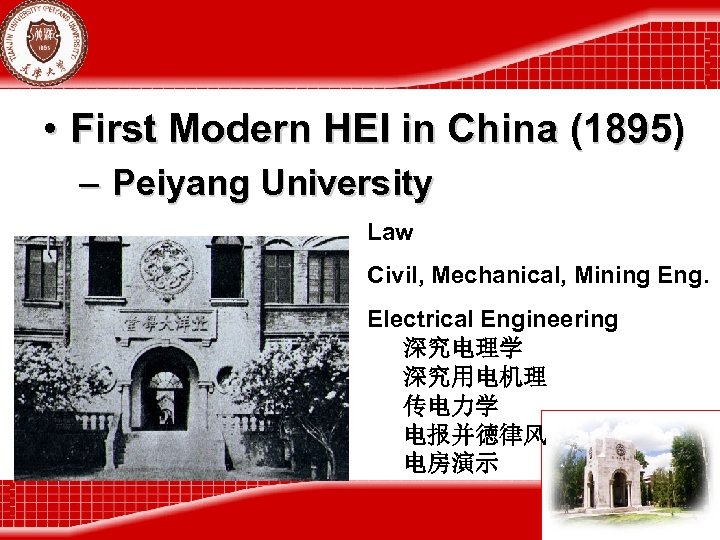 • First Modern HEI in China (1895) – Peiyang University Law Civil, Mechanical, Mining Eng. Electrical Engineering 深究电理学 深究用电机理 传电力学 电报并徳律风 电房演示
 • 上个世纪 20年代,北洋校长刘仙洲 就说:“各种 业以机械 业之应 用最为普遍,并最为现实社会所需 求,而各种电气 业之发展,亦有 一日千里之现象。……此两学门似 在急须添设之列。”
 • Start of EE education in China – Jiaotong University (1908) – Peiyang University (1932) – Tsinghua University(1932) – …… However, engineering education were in a very small scale before the war, not more than 5000 in total,EE’s students were a small part of it. E. g. 13 students had been enrolled in 1932 by Peiyang while 30 in 1949.
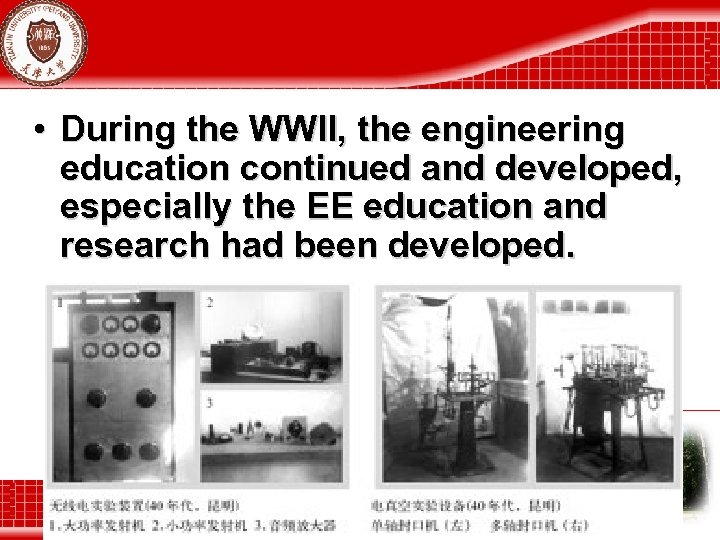 • During the WWII, the engineering education continued and developed, especially the EE education and research had been developed. Wind Tunnel
 • Summary of the 1 st period of EE education in China (-1952) – Small in scale – Active in international cooperation – Significant for further development
 Blooming of Chinese Engineering Education 1952 – 2000
 • Soon after the war, the People’s Republic of China was found in 1949. With the new start of industrialization, engineering education took a great leap into “booming period”.
 • From 1952 to 1955, the higher education system had been reconstructed to meet the urgent requirement of engineers in various industrial sectors. Many comprehensive universities turned to technical universities and large number of specialized technical institutes had been established.
 • In 1956, China has made its first plan for science and technology development, Semiconductor, Computer, Automation and Electronics are recognized as emergent development areas. In CAS, 4 institutes are established, and several industrial research institutes established.
 • “Semiconductor Physics and devices” had been established as new major in 1956. In 1960, the first Chinese silicon transistor is made in Tsinghua University
 • Electronic Engineering become an important “major program” provided in many universities, and professional HEI had been established in Beijing (BUPT), Chengdu and Xian. Tsinghua’s EE Dept. Established in 1952 and become the largest one since 1957.
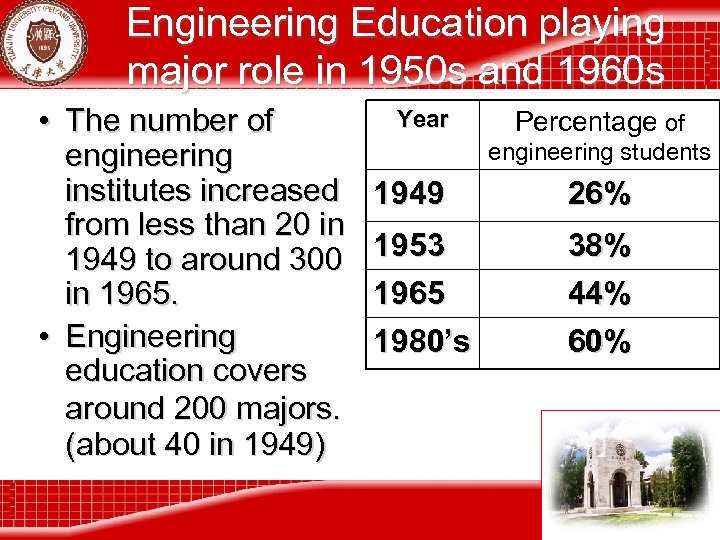 Engineering Education playing major role in 1950 s and 1960 s • The number of engineering institutes increased from less than 20 in 1949 to around 300 in 1965. • Engineering education covers around 200 majors. (about 40 in 1949) Year Percentage of engineering students 1949 26% 1953 1965 1980’s 38% 44% 60%
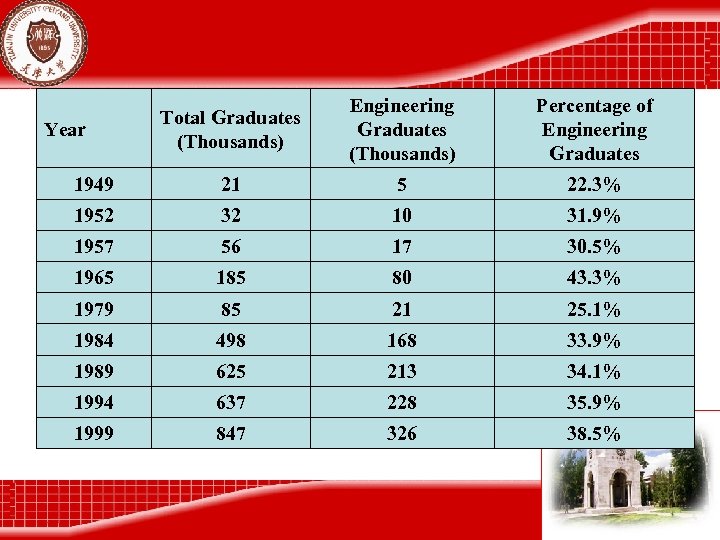 Total Graduates (Thousands) Engineering Graduates (Thousands) Percentage of Engineering Graduates 1949 21 5 22. 3% 1952 32 10 31. 9% 1957 56 17 30. 5% 1965 185 80 43. 3% 1979 85 21 25. 1% 1984 498 168 33. 9% 1989 625 213 34. 1% 1994 637 228 35. 9% 1999 847 326 38. 5% Year
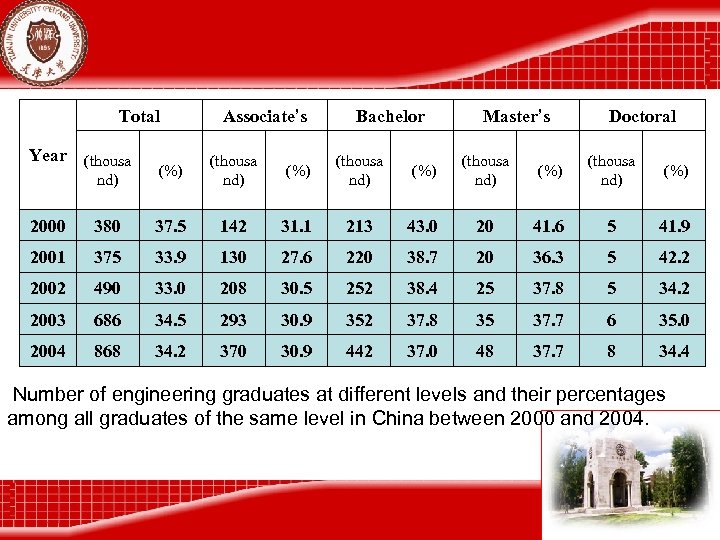 Total Year (thousa nd) Associate’s Bachelor Master’s Doctoral (%) (thousa nd) (%) 2000 380 37. 5 142 31. 1 213 43. 0 20 41. 6 5 41. 9 2001 375 33. 9 130 27. 6 220 38. 7 20 36. 3 5 42. 2 2002 490 33. 0 208 30. 5 252 38. 4 25 37. 8 5 34. 2 2003 686 34. 5 293 30. 9 352 37. 8 35 37. 7 6 35. 0 2004 868 34. 2 370 30. 9 442 37. 0 48 37. 7 8 34. 4 Number of engineering graduates at different levels and their percentages among all graduates of the same level in China between 2000 and 2004.
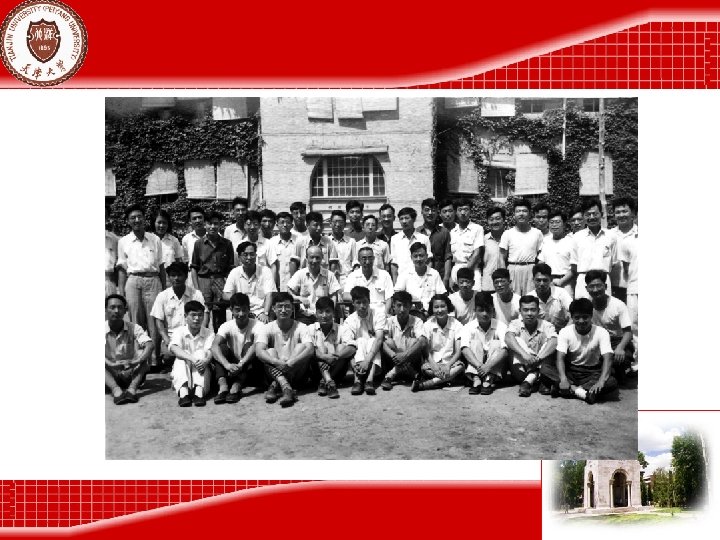
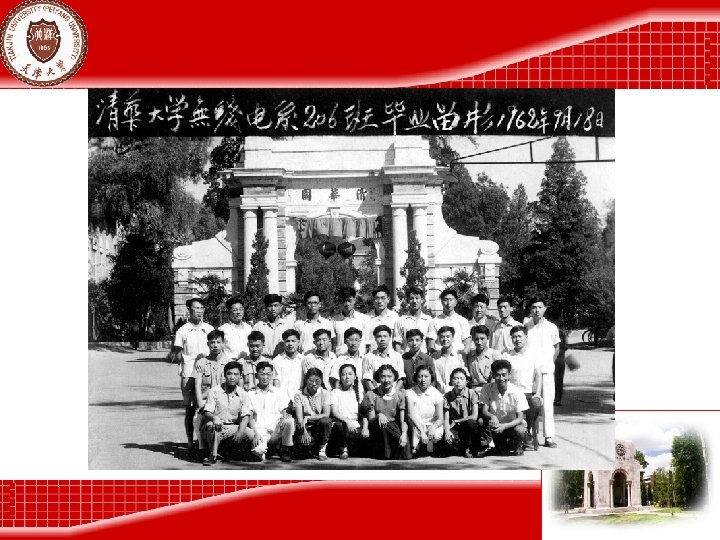
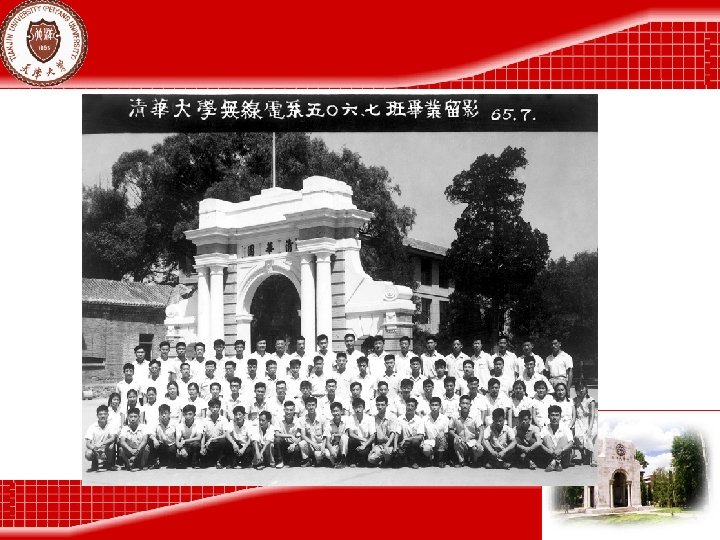
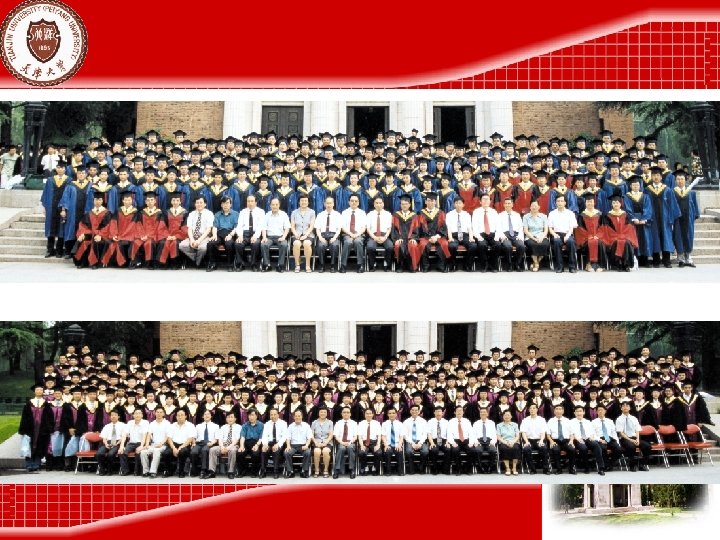
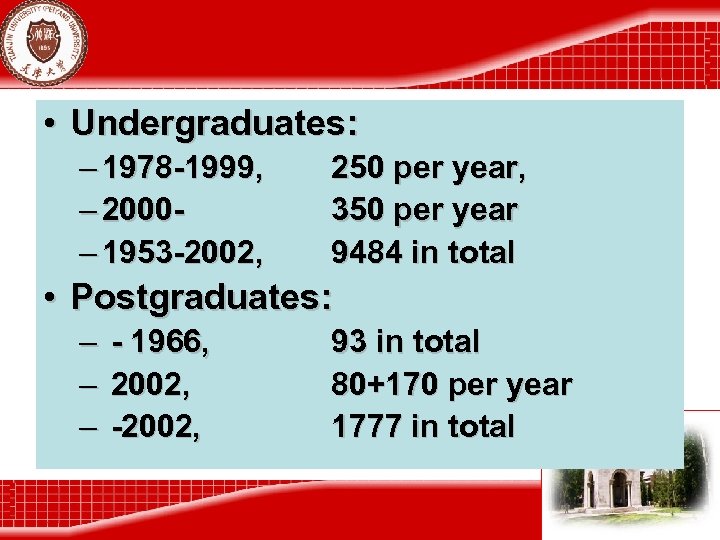 • Undergraduates: – 1978 -1999, – 2000– 1953 -2002, 250 per year, 350 per year 9484 in total • Postgraduates: – - 1966, – 2002, – -2002, 93 in total 80+170 per year 1777 in total
 • The courses before 1952: – Math, Physics, Eng. Drawing, Economics – Math, Electrical circuits, Applied Mechanism, Materials, Metallurgy, Thermal Engineering – Electronics, Telegraph & Telephone, Electrical Machine, Communication Network, Engineering Surveying – Electromagnetism, Radio Eng. , ….
 • Specialized courses after 1952: – Electrical power and rectification, Low frequency amplification, Pulse techniques, Transmitter, Receiver, Microwaves, Radio measurement, Material and devices – Television, Telecommunications, Radar, ….
 Challenges to the engineering education
 1/3 students in China taking engineering study • Now there are 20 mil. Students in Chinese Universities, 1/3 of them are taking engineering study. • In this “industrializing” country, there about 390 HEI mainly providing Engineering Education.
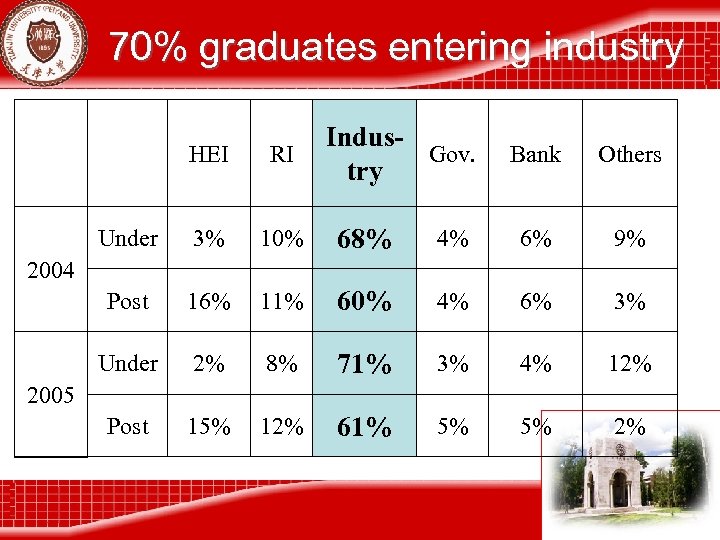 70% graduates entering industry Indus. Gov. try HEI RI Bank Others Under 3% 10% 68% 4% 6% 9% Post 16% 11% 60% 4% 6% 3% Under 2% 8% 71% 3% 4% 12% Post 15% 12% 61% 5% 5% 2% 2004 2005
 • It is ENGINEER playing key role in China’s industrialization. • It is ENGINEERING EDUCATION cultivating ENGENIEERS. • It is engineers, who shape the world. And, It is engineering education shapes the engineers.
 1. Sci-tech revolution putting new requirements to engineers • • • How to train engineers being able to adapt to the reconfiguration of industry and pioneering the new development? How to train engineers being able to continuing update their knowledge by themselves with the pace of fast development of high techniques? How to train engineers having better understanding to the new break-through in science in order to working innovatively to develop high techniques?
 2. Sustainable development putting new requirements to engineers • How to train engineers to have more consciousnesses of environment, energy, economics and to use the techniques properly? • How to train engineers to take more cares to the human-being and harmonization of nature and society?
 3. The globalization putting new requirements to engineers • How to train engineers in a more “global way” in order to help them better understand the global resources, markets, cultures and international issues? • How to train engineers having the ability of cross-culture communications and international cooperation?
 • The impact of globalization on Chinese engineering education is demonstrated by a variety of programs. By 2002, China had 712 joint education programs and institutes with foreign countries, 36 percent of which were in business administration, 19 percent in foreign language and literature, 13 percent in electrical engineering and information technology, and 10 percent in economics
 • China’s ICT industry grows at a rate faster than GDP growth by 2 -3 times, and contributes to annual GDP growth by 57%.
 • By 2006, there are 1867 HEI in China, among them 720 providing academic degree programs, 450 provide postgraduate programs. 70% of them have ICT programs.
 • By 2005, in all Chinese HEI, there are 2, 442, 000 students studying in Electronic Information relevant majors. • By 2006, there’re 36 Software Engineering Schools, and 9 IC Engineer Training centers.
 • In the fast growing IC design area, there’re 400 -500 design houses now in China, with about 20000 employees in total, only a few of them has more than 1000 employees.
 • Should the students be trained to: – Having more “vertical” knowledge about different system layers? – Having wide “horizontal” knowledge about relevant application areas? – With more solid fundamentals of advanced physics and math? – Grasping more advanced tools?
 • How can students be trained being more creative and innovative? • How can students be trained with strong ability to learning by themselves?
 • All these challenges are common to all universities, so that we should work closely together to bring the EE education into the new era.
 Thanks ! 30 -July-2008