


 Скачать презентацию Engineering Complex Adaptive Systems How are these
18cdee9873953dd6c252601badd3fdfe.ppt
- Количество слайдов: 29
 Engineering Complex Adaptive Systems
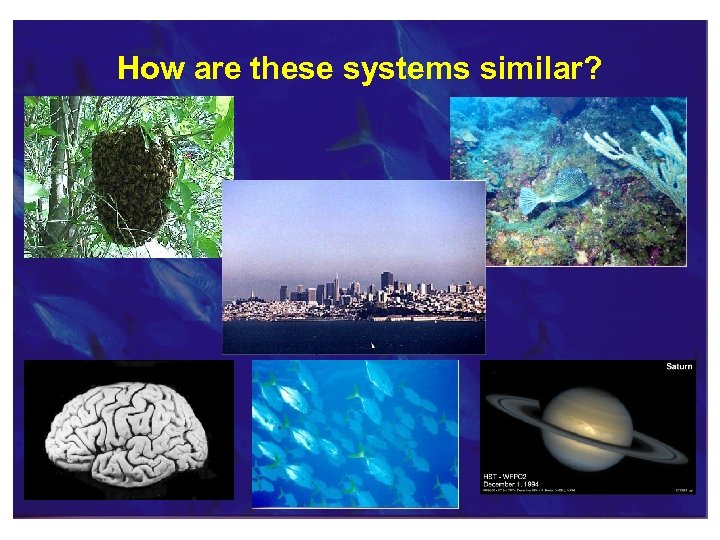 How are these systems similar?
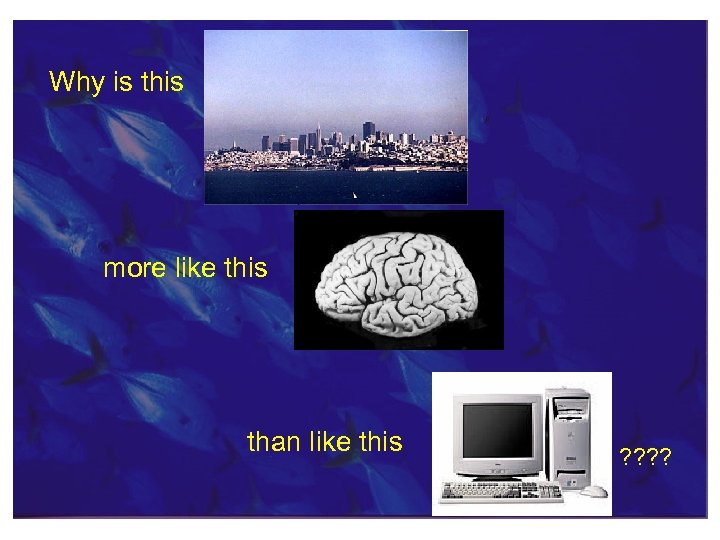 Why is this more like this than like this ? ?
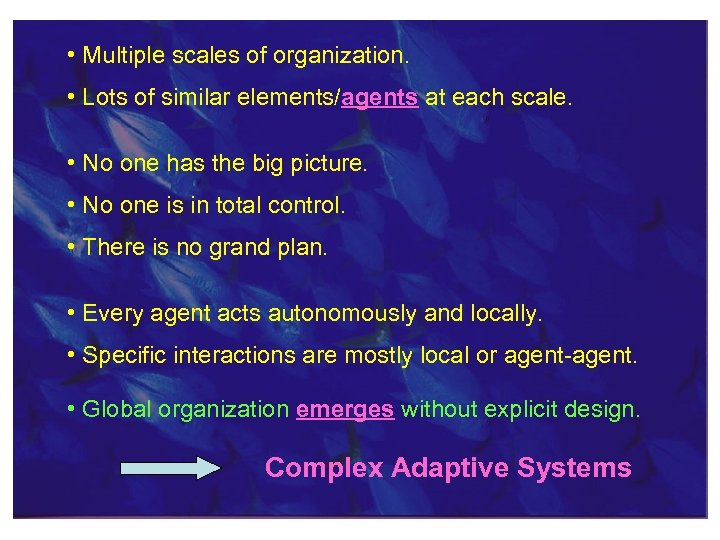 • Multiple scales of organization. • Lots of similar elements/agents at each scale. • No one has the big picture. • No one is in total control. • There is no grand plan. • Every agent acts autonomously and locally. • Specific interactions are mostly local or agent-agent. • Global organization emerges without explicit design. Complex Adaptive Systems
 Examples of Complex Adaptive Systems • Living organisms. • Nervous systems (brains). • Immune systems. • Ecosystems. • Insect colonies. • Human societies. • Cities. • Economies. • Markets. • The world-wide web.
 If we want to build artificial complex adaptive systems (and we do), perhaps we should learn from real, successful complex adaptive systems.
 Goals for Research on Complex Adaptive Systems To understand successful complex adaptive systems --- e. g. , brains, organisms, insect colonies, ecosystems, economies, etc. To use the principles derived from this study to design new, successful complex adaptive systems --- e. g. , selfconfiguring robots, smart structures, swarms of unmanned vehicles, self-organized networks, etc.
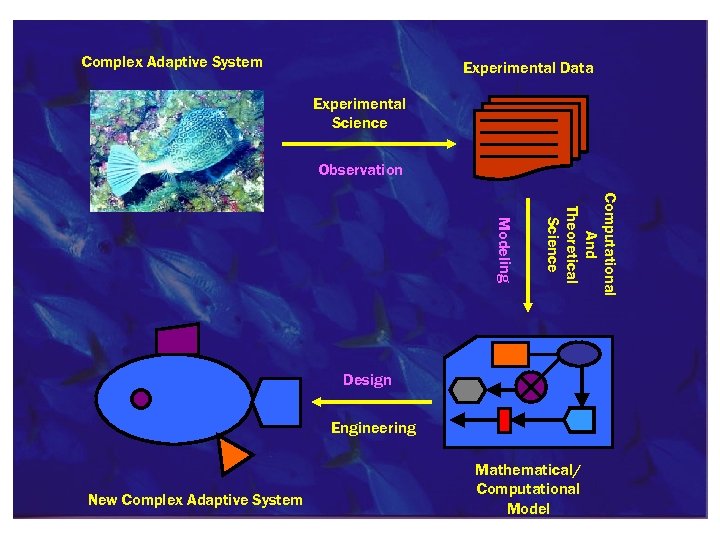 Complex Adaptive System Experimental Data Experimental Science Observation Computational And Theoretical Science Modeling Design Engineering New Complex Adaptive System Mathematical/ Computational Model
 Some Key Attributes • Self-Organized Order: Order emerges from the interaction of simple entities. Minimal pre-design, low cost, adaptivity, versatility. • Decentralization: All sensing, information processing, communication and control is local, with minimal central guidance. Scalability, robustness, flexibility, expandability. • Multiple Scales: Entities and processes at many spatiotemporal scales. Depth of representation and information processing • Self-Similarity (in many cases): The same structural motifs are present at many scales. Algorithmic economy, expandability
 Levels of Organization for Biological Systems Molecules (DNA, RNA, proteins, amino acids, messengers, etc. ) Subcellular structures (membranes, channels, organelles, etc. ) Cells (neurons, blood cells, skin cells, bone cells, etc. ) Cell Assemblies (pancreatic islets, central pattern generatrs, etc. ) Sub-organs and Sub-systems (cortex, spinal cord, arteries, etc. ) Organs (skin, brain, heart, stomach, liver, etc. ) Systems (nervous system, digestive system, immune system, etc. ) Organisms (plants, animals) Populations Ecosystems Biosphere
 Levels of Plasticity in Biological Systems Adaptation: Rapid change to accommodate variations in the environment. e. g. , change in pupil size with light. Learning: Gradual change in parameters to optimize behavior with respect to regularities in the environment. e. g. , classical conditioning. Development: Change in the structure and processes of a single organism over its lifetime. Evolution: Change in structures and processes over successive generations to maintain and enhance fitness, e. g. , invertebrate to vertebrate, reptile to bird.
 Self-Organization The spontaneous emergence of large-scale spatial, temporal, or spatiotemporal order in a system of locally interacting, relatively simple components. Self-organization is a bottom-up process where complex organization emerges at multiple levels from the interaction of lower-level entities. The final product is the result of nonlinear interactions rather than planning and design, and is not known a priori. Contrast this with the standard, top-down engineering design paradigm where planning precedes implementation, and the desired final system is known by design.
 Elements of Self-Organization Interacting components The components provide the substrate for organization of higher-level structures. Interaction/communication is necessary for creating linkages to assemble larger structures. Example components are molecules, cells, agents, etc. Example interactions are excitation, inhibition, sensing, attraction, repulsion, etc.
 Elements of Self-Organization Constructive processes Needed to build larger structures from the components, e. g. , reproduction, aggregation, crystallization, copying, growth, recombination, ramification, etc. Destructive processes Needed to tear down existing (possibly suboptimal or unwanted) structures to make room for new ones, e. g. , death, fragmentation, dissolution, division, mixing, turbulence, noise, etc.
 Elements of Self-Organization Autocatalysis/positive feedback Needed to reinforce and drive the construction of useful structures, e. g. , splits encouraging more splitting to create a complex branching structure. Homeostasis/negative feedback Needed to prevent runaway structure formation, e. g. , structures beyond a certain size becoming non-receptive to further addition or even unstable.
 Elements of Self-Organization Nonlinearity Needed to magnify some effects and squelch others in order to produce complex structure. Examples include thresholds, unimodal and multimodal dependencies, saturation, and amplification underlying the constructive, destructive and feedback processes.
 What is Emergence? The appearance of large-scale collective order that cannot be described completely in terms of the individual system components. e. g. , meaning from a collection of words, a society from a collection of individuals, a wave from a collection of particles, a picture from a collection of pixels. Emergence seeks to move beyond pure reductionism without resorting to metaphysical explanations, e. g. , in explaining phenomena such as intelligence and life. Complex adaptive systems exhibit spontaneous emergence at many levels of description.
 Why do we need to build complex adaptive systems? • To control other complex adaptive systems, e. g. , traffic networks, communication networks, biological systems, etc. • . To obtain systems with attributes such as intelligence, adaptivity, robustness, scalability, and flexibility for operation in complex, dynamic and uncertain environments e. g. , battlefields, disaster areas, hazardous regions, ocean floors, outer space, etc. • To create very large-scale or fine-grained systems where standard design, control, and analysis methods break down for capacity reasons, e. g. , sensor networks with millions of nodes, swarms of microsatellites, etc.
 Metaphors for Engineering • Clockwork - Structure and function by design. - Once built, ticks forever. • Computer - Structure by design. - Programmable functionality. • Biological Systems (Brains, Organisms, Insect Colonies, Ecosystems) - Adaptive rules. - Emergent structure. - Evolving functionality.
 Some Examples • • • Self-organized sensor networks. Smart matter / smart structures. Smart paint. Smart dust. Amorphous computers. Evolvable hardware. Self-shaping, self-repairing materials. Self-reconfiguring robots. Kilorobot or megarobot swarms.
 Some Enabling Technologies • • • MEMS (Micro-Electro-Mechanical Systems) Nanotechnology. Miniaturized wireless devices. Miniaturized power sources. Ad-hoc wireless networks. Very high-speed digital circuits. FPGA’s Micro-robots. Neural networks. Evolutionary algorithms.
 Traditional Top-Down Approach • Consider all possibilities. • Develop a very careful design. • Thoroughly test the design to verify performance. • Implement and test a prototype. • Carefully replicate the verified design to ensure reliability. This approach relies on anticipation of all eventualities, meticulous design, thorough testing, and exact replication to obtain the desired level of performance. It works best in well-understood, predictable and relatively simple environments --- no surprises please!
 Self-Organized Bottom-Up Approach • Provide the basic elements/components needed. • Let the components interact among themselves and with the environment to organize through an iterative process of creative exploration and selective destruction. This approach produces good designs by multi-scale, parallel, intelligent random search through the space of possibilities. It is appropriate --- necessary --- for large-scale complex systems operating in complex, dynamic, unpredictable environments, e. g. , the real world.
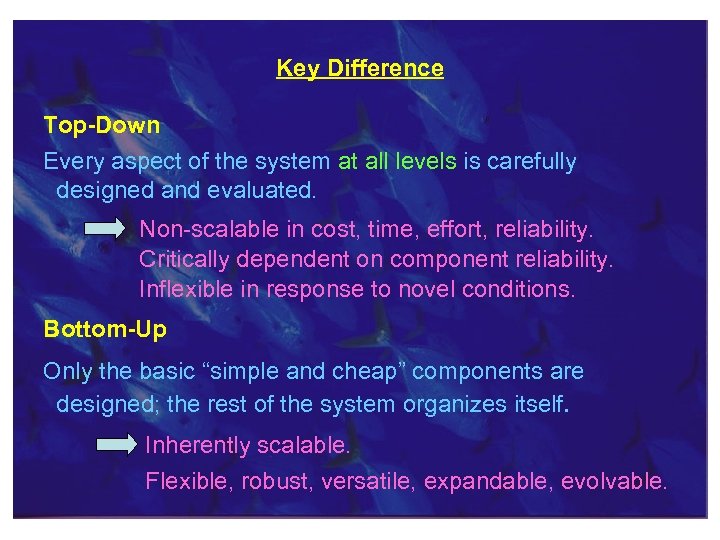 Key Difference Top-Down Every aspect of the system at all levels is carefully designed and evaluated. Non-scalable in cost, time, effort, reliability. Critically dependent on component reliability. Inflexible in response to novel conditions. Bottom-Up Only the basic “simple and cheap” components are designed; the rest of the system organizes itself. Inherently scalable. Flexible, robust, versatile, expandable, evolvable.
 This is a new kind of engineering We’re no longer designing the system. We’re engineering the possibility for the system to arise and change as needed. This will work for some applications and not for others. Do you want to ride in a self-organizing car? Do you want to cross a self-organizing bridge? Would you send a group of self-organizing robots to explore a planet?
 What do complex adaptive systems buy us? • Scalability: The system can grow much larger because no one needs to keep track of everything. • Flexibility: The system can change as needed simply by individual agents changing their behavior • Versatility: The system can be used in many different situations without redesign. • Expandability: More agents can be added to the system without redesign. • Robustness: The system can withstand changes and even loss of individual agents.
 But above all…. possibility In complex environments that change all the time, we cannot anticipate all situations We cannot pre-design a system that is always guaranteed to work So, - send in the agents. - give them the tools. - let them wander about, look, talk and do their thing. if the agents and their rules are good enough, organization will happen!
 However…. . engineered complex systems are also: • Unpredictable. • Open-ended. • Opaque. • Imperfect. • Imprecise. • Uncertain. Can we live with this?
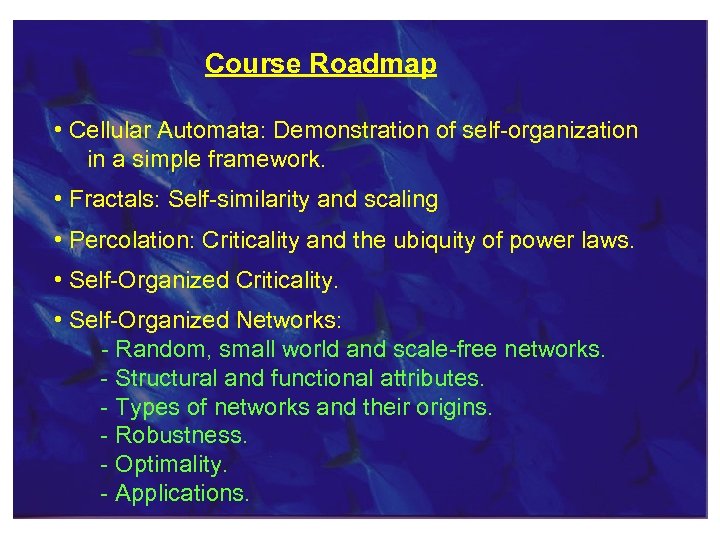 Course Roadmap • Cellular Automata: Demonstration of self-organization in a simple framework. • Fractals: Self-similarity and scaling • Percolation: Criticality and the ubiquity of power laws. • Self-Organized Criticality. • Self-Organized Networks: - Random, small world and scale-free networks. - Structural and functional attributes. - Types of networks and their origins. - Robustness. - Optimality. - Applications.