 Скачать презентацию Engineering Classrooms Before and After Innovation David Cordes
9c36741b21940c0a05fc77de548ba529.ppt
- Количество слайдов: 30



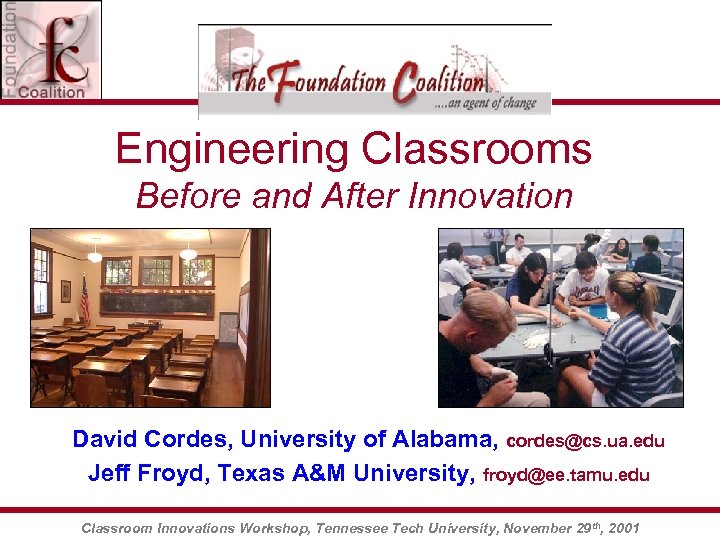
Engineering Classrooms Before and After Innovation David Cordes, University of Alabama, cordes@cs. ua. edu Jeff Froyd, Texas A&M University, froyd@ee. tamu. edu Classroom Innovations Workshop, Tennessee Tech University, November 29 th, 2001
Workshop Overview • Introduction (20 min) – Guidelines, what is an “innovative classroom”? • What Other Institutions Have Done (25 min) – Information dump • Classroom Transformation (30 min) – What do you do? How do you do this? • Other Issues and Considerations (20 min) – Items that can impact potential changes • Wrap-up (5 min) Classroom Innovations Workshop, Tennessee Tech University, November 29 th, 2001
Introduction: Basic Guidelines • Will operate in a team-based mode – The group knows more than any one person • Interrupt frequently – No pre-defined set of material that “must” be covered in this workshop • When looking at innovative classrooms, we will focus on – The use of technology in the classroom – Lower-division engineering courses Classroom Innovations Workshop, Tennessee Tech University, November 29 th, 2001
Introduction: Share information • Within your group: discuss the following question among yourselves What is an innovative classroom? (and could you recognize one if you saw it) Appoint a reporter to capture group results Classroom Innovations Workshop, Tennessee Tech University, November 29 th, 2001
An innovative classroom is. . . • • • Needs to accommodate a diversity of teaching styles Multi-media equipped PCs (functional) at every desk, for every student Hardware in the classroom (demonstration hardware) Flexible in setup (able to be re-arranged) Appropriate environment – seating (recliners), acoustical, quick escape pod for the teacher Internet connectivity Follows good design practices for classroom – good viewing angles, environmental controls, etc. Projectors for the PC, Elmo, etc. (multi-media) Virtual lab tools Classroom Innovations Workshop, Tennessee Tech University, November 29 th, 2001
Is this an innovative classroom? • NO – difficulty with sight angles, temperature control • YES – multi-media presentation, broken up in non-traditional seating arrangements • YES – we confirmed that • YES – same reasons • NO – inadequate resources, poor acoustics • Plants are nice Classroom Innovations Workshop, Tennessee Tech University, November 29 th, 2001
Part 2: What others have done Short (~25 minute) information dump • Background Information – one-page introduction to technology-enabled learning • Representative Foundation Coalition efforts – – – Arizona State University Rose-Hulman Institute of Technology Texas A&M University of Alabama University of Massachusetts-Dartmouth • Other sample initiatives – Drexel’s EE laboratories – RPI’s studio model Classroom Innovations Workshop, Tennessee Tech University, November 29 th, 2001
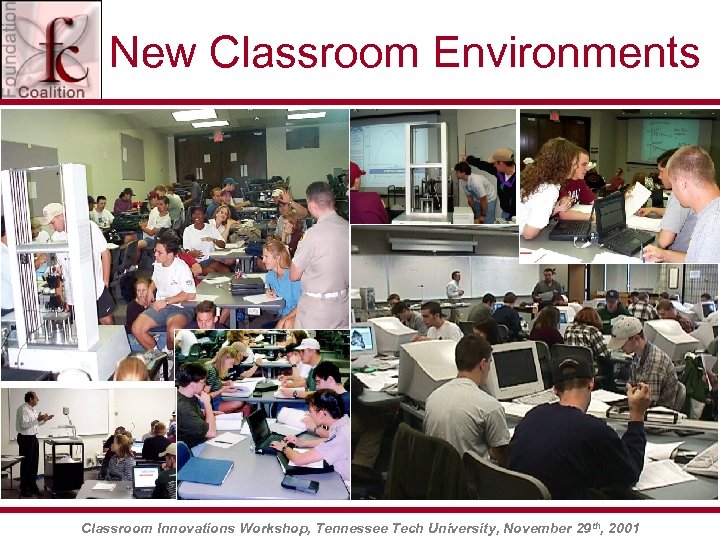
New Classroom Environments Classroom Innovations Workshop, Tennessee Tech University, November 29 th, 2001
Arizona State University • Philosophy – College focus on technology in classrooms, different classrooms for different needs, faculty training essential • Classroom layout & equipment – Hold 40 to 80 students, team-based seating, instructor has ability to project student work on main screens • Software & Applications – Wide variety, different rooms have different packages, all information available via the Internet • Audience – All fundamental engineering courses Classroom Innovations Workshop, Tennessee Tech University, November 29 th, 2001
Arizona State University Sample ASU Classroom Innovations Workshop, Tennessee Tech University, November 29 th, 2001
Rose-Hulman Institute of Tech • Philosophy – Completely networked campus environment • Classroom layout & equipment – Every student purchases a notebook computer as an entering student (model is specified by institution) – Over 20 classrooms have been equipped with network and power connections to support notebook computers • Software & Applications – Maple (calculus), Working Model & Maple (dynamics), Physics labs (Excel - data acquisition/analysis) • Audience – All engineering students and classes Classroom Innovations Workshop, Tennessee Tech University, November 29 th, 2001
Texas A&M University • Philosophy – Classroom technology must be scalable for large classes (~100) • Classroom layout & equipment – Remodeled about 10 classrooms for first-year and sophomore courses – One computer per two students – Departments have constructed their own classrooms, more are planned • Software & Applications – Microsoft Office, Maple, Auto. CAD, Eng. Equation Solver (EES), Internet – EE has students design, simulate, construct, measure and compare behavior of circuits. Class uses NI hardware and software. • Audience – Freshman and sophomore engineering students – Specialized classes in specific disciplines Classroom Innovations Workshop, Tennessee Tech University, November 29 th, 2001
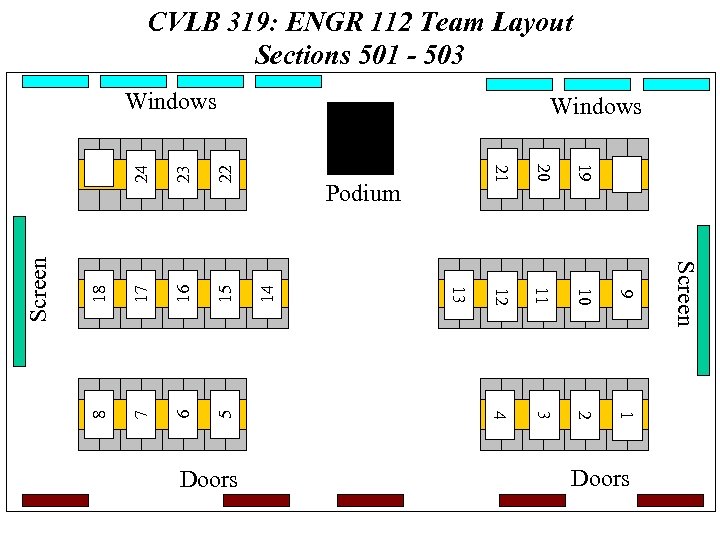
CVLB 319: ENGR 112 Team Layout Sections 501 - 503 22 16 15 6 5 14 23 17 7 24 18 1 Doors Screen 9 2 3 10 11 19 20 4 Podium 12 Doors 21 Screen Windows 13 8 Windows
University of Alabama • Philosophy – Technology in classrooms, classrooms convenient to students (one new classroom in “engineering dorm”) • Classroom layout & equipment – Remodeled six different classrooms – Tables for four, one computer per two students – Departments constructing their own classrooms • Software & Applications – Microsoft Office, compilers, FORTRAN, Maple • Audience – Freshman engineering students – All students in introductory computing sequence Classroom Innovations Workshop, Tennessee Tech University, November 29 th, 2001
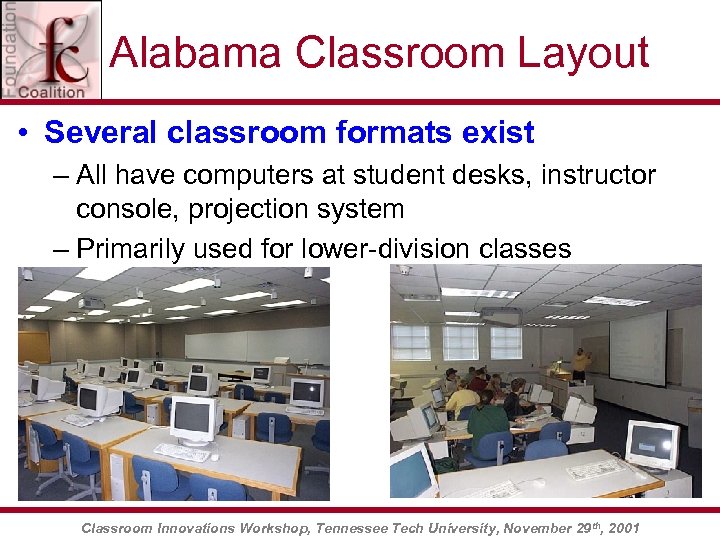
Alabama Classroom Layout • Several classroom formats exist – All have computers at student desks, instructor console, projection system – Primarily used for lower-division classes Classroom Innovations Workshop, Tennessee Tech University, November 29 th, 2001
University of Massachusetts-Dartmouth • Classroom layout & equipment – Remodeled three classrooms with tables that seat four students and have two computers (48 seats) • Software & Applications – Maple and Excel – Based on Studio Physics model (RPI), students perform physics and chemistry experiments in the classroom, acquire, display and analyze data • Audience – Freshman & sophomore engineering majors Classroom Innovations Workshop, Tennessee Tech University, November 29 th, 2001
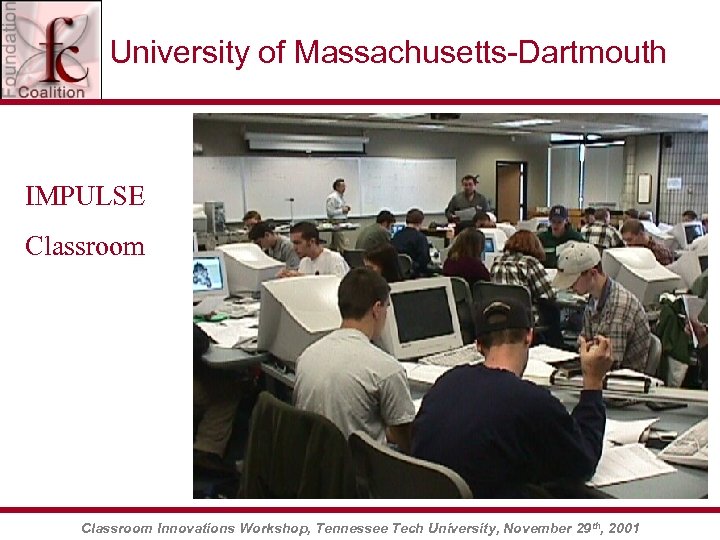
University of Massachusetts-Dartmouth IMPULSE Classroom Innovations Workshop, Tennessee Tech University, November 29 th, 2001
Rensselaer Polytechnic Institute (RPI) Studio Classrooms • Philosophy – studio environment – Integrate classroom (lecture) with laboratory (experiments, acquire/display/analyze data) • Classroom layout & equipment – Tables with two students (one computer) – Student • Using computer faces away from instructor • Listens to lecture facing away from computer • Audience – Mathematics, sciences, engineering students Classroom Innovations Workshop, Tennessee Tech University, November 29 th, 2001
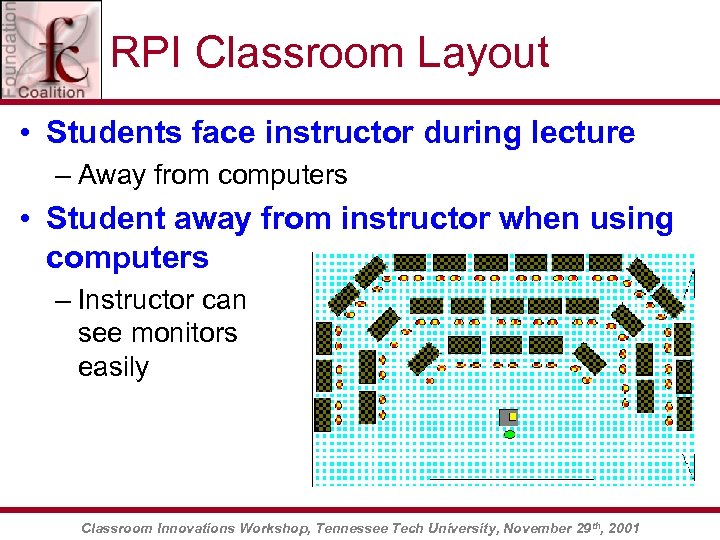
RPI Classroom Layout • Students face instructor during lecture – Away from computers • Student away from instructor when using computers – Instructor can see monitors easily Classroom Innovations Workshop, Tennessee Tech University, November 29 th, 2001
Drexel Classrooms http: //www. educatorscorner. com/education/case_studies/drexel. sht ml • Laboratory layout & equipment – Laboratory bench for two students (one computer) – Suite of measurement equipment with computer control – First-year and sophomore students • Perform experiments and laboratory projects for three hours/week • Philosophy – From the start students work with current equipment and explore stimulating physical phenomena • Audience – Engineering students Classroom Innovations Workshop, Tennessee Tech University, November 29 th, 2001
Part 3: Transformation • As a team, design your “ideal classroom environment” for the Fall of 2002 – Describe this classroom environment – Describe how your new activities would benefit students and their learning – Describe the resources (besides $$$) that would be required to realize your visions – Select a different reporter from last time Classroom Innovations Workshop, Tennessee Tech University, November 29 th, 2001
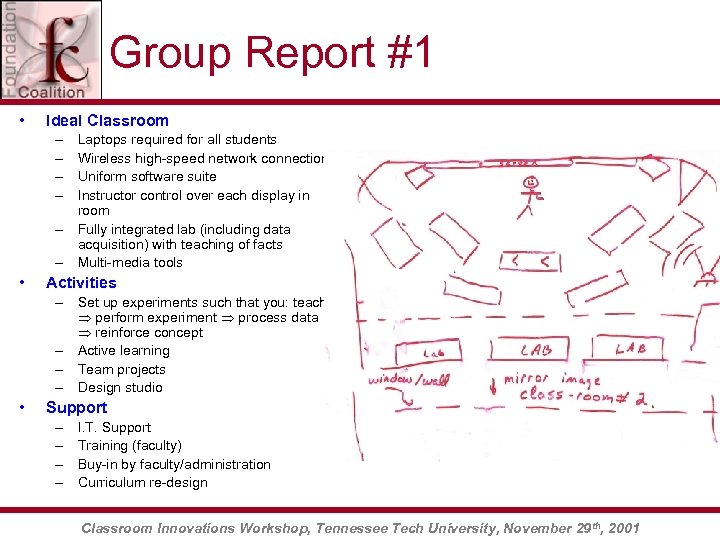
Group Report #1 • Ideal Classroom – – – • Laptops required for all students Wireless high-speed network connection Uniform software suite Instructor control over each display in room Fully integrated lab (including data acquisition) with teaching of facts Multi-media tools Activities – Set up experiments such that you: teach perform experiment process data reinforce concept – Active learning – Team projects – Design studio • Support – – I. T. Support Training (faculty) Buy-in by faculty/administration Curriculum re-design Classroom Innovations Workshop, Tennessee Tech University, November 29 th, 2001
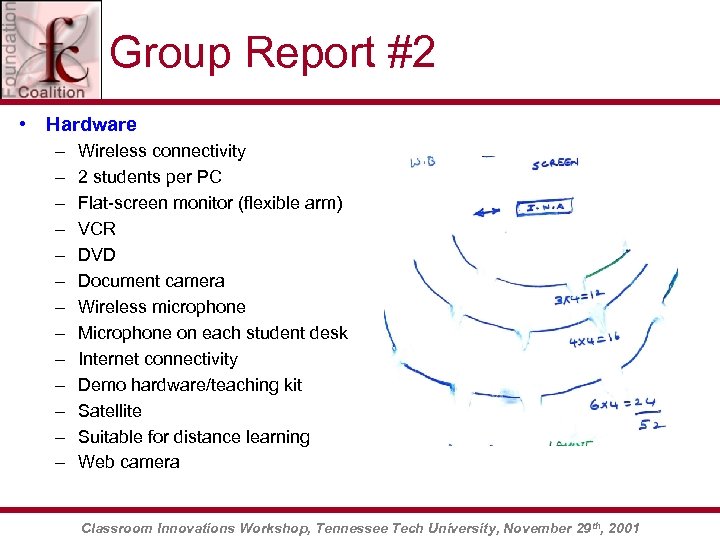
Group Report #2 • Hardware – – – – Wireless connectivity 2 students per PC Flat-screen monitor (flexible arm) VCR DVD Document camera Wireless microphone Microphone on each student desk Internet connectivity Demo hardware/teaching kit Satellite Suitable for distance learning Web camera Classroom Innovations Workshop, Tennessee Tech University, November 29 th, 2001
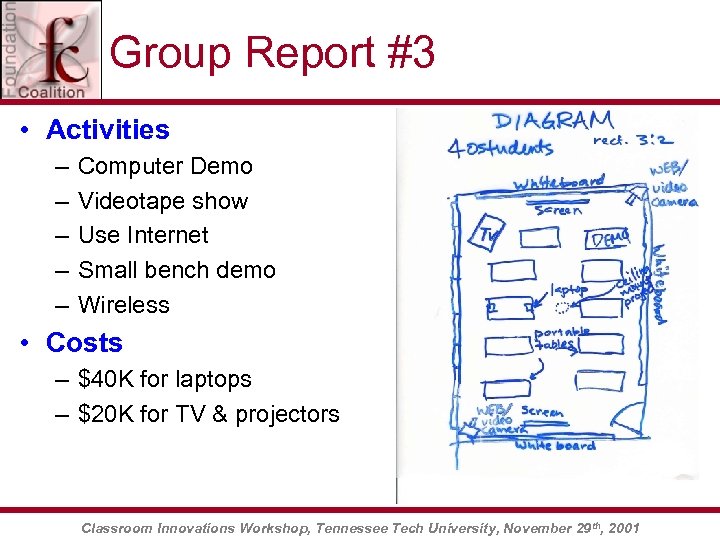
Group Report #3 • Activities – – – Computer Demo Videotape show Use Internet Small bench demo Wireless • Costs – $40 K for laptops – $20 K for TV & projectors Classroom Innovations Workshop, Tennessee Tech University, November 29 th, 2001
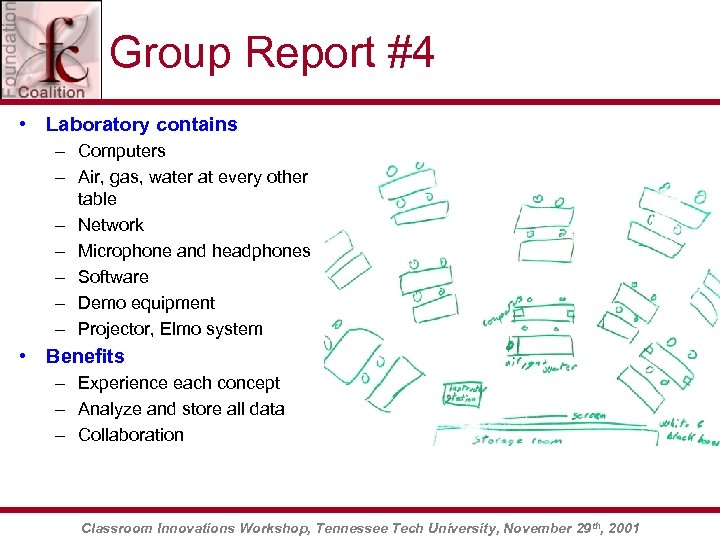
Group Report #4 • Laboratory contains – Computers – Air, gas, water at every other table – Network – Microphone and headphones – Software – Demo equipment – Projector, Elmo system • Benefits – Experience each concept – Analyze and store all data – Collaboration Classroom Innovations Workshop, Tennessee Tech University, November 29 th, 2001
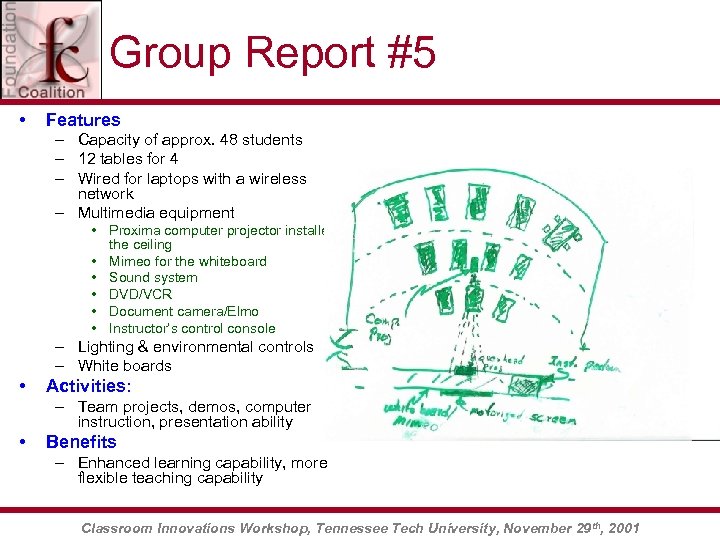
Group Report #5 • Features – Capacity of approx. 48 students – 12 tables for 4 – Wired for laptops with a wireless network – Multimedia equipment • Proxima computer projector installed in the ceiling • Mimeo for the whiteboard • Sound system • DVD/VCR • Document camera/Elmo • Instructor’s control console – Lighting & environmental controls – White boards • Activities: – Team projects, demos, computer instruction, presentation ability • Benefits – Enhanced learning capability, more flexible teaching capability Classroom Innovations Workshop, Tennessee Tech University, November 29 th, 2001
Additional Questions • What other questions regarding the use of technology in the classroom need to be addressed? – Ideas regarding technology for distance education – Impact on teaching workloads (and evaluations) – What about student feedback on “value added”? – Using computers in classroom (and exams), what issues arise as a result? Classroom Innovations Workshop, Tennessee Tech University, November 29 th, 2001
Other Critical Issues • Design & Utilization – Rooms available for renovation – Physical layout considerations – Equipment (cost, size, location, power, HV/AC) – Time (often takes more than one summer to build) – Faculty support and education & development – Scheduling of these rooms – Monitoring & after-hours access – Maintenance & upgrade time availability • Administrative – Institution’s computing policies – Software licensing – Purchase, replacement & upgrade costs – Support staffing – Clear plan for what inst. is doing with technology – Impact on T&P process – Want to assess results, how to best do this – How to get financial support from State or outside sources? Classroom Innovations Workshop, Tennessee Tech University, November 29 th, 2001
Resources • Relevant resources – Foundation Coalition • http: //www. foundationcoalition. org/ – Arizona State University • http: //www. eas. asu. edu/ceasrooms/ • http: //www. eas. asu. edu/~asufc/teaming. html – Texas A&M University • http: //coalition. tamu. edu/ – RPI Studio Classroom • http: //ciue. rpi. edu/studioteaching. html – Sigma Xi Resources • http: //www. sigmaxi. org/scienceresources/undergradedu. htm Classroom Innovations Workshop, Tennessee Tech University, November 29 th, 2001
End of workshop Questions? Classroom Innovations Workshop, Tennessee Tech University, November 29 th, 2001
Скачать презентацию Engineering Classrooms Before and After Innovation David Cordes
9c36741b21940c0a05fc77de548ba529.ppt