


 Скачать презентацию Engaging Students Through Cooperative Learning Ideas for Success
7f07c8b2f38f7a6130109d59a77326dd.ppt
- Количество слайдов: 51
 Engaging Students Through Cooperative Learning: Ideas for Success Laura Schulz Talent Development High Schools
 Three Musketeers: A TEAM Building Activity 1. Find three things that everyone on the team likes 2. Find three things that everyone on the team dislikes 3. Find one thing that is unique to each of the team members 4. Decide on a team name that has something to do with your collective likes and dislikes 5. Write your TEAM name on your “Table Tent”
 What makes a TEAM different than a group?
 What is a Team? Teams differ from groups because they include the following basic elements of cooperative learning: üGoals are shared üInformation is circulated üRoles are assigned üMaterials are managed üTeammates depend on each other to complete tasks successfully üStudents gain respect for each other’s contributions to the team
 Goal Setting: Why are we here today? – Think about what your expectations are for the professional development session today – Pair with another team member to discuss expectations – Share as a team your expectations – Set 3 goals your team wishes to accomplish during our session today – Write those 3 goals on the back of your team’s table tent
 Why Cooperative Learning?
 We Learn: • • 10% of what we read 20% of what we hear 30% of what we see 50% of what we both see and hear 70% of what is discussed with others 80% of what we experience personally 95% of what we teach someone else William Glasser
 Expectations in the Workplace: How have things Changed? Organizational Effectiveness Problem Solving Interpersonal Skills Computation Creative Thinking Oral Communication Career Development/Motivation Reading Teamwork Writing Listening Leadership
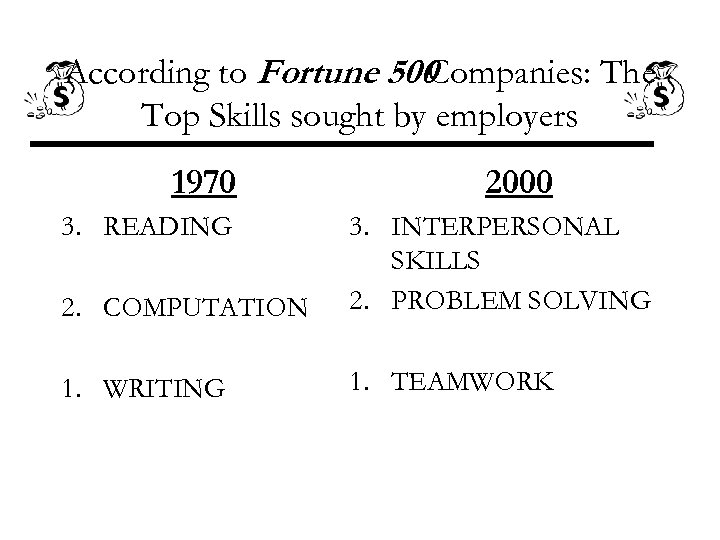 According to Fortune 500 Companies: The Top Skills sought by employers 1970 3. READING 2000 2. COMPUTATION 3. INTERPERSONAL SKILLS 2. PROBLEM SOLVING 1. WRITING 1. TEAMWORK
 Thinking about the subject or subjects you teach (Knowing the skills that are in demand in the workplace today) What jobs or careers are you preparing your students to hold? (Use chart paper to share some examples)
 BREAK TIME
 A History of Cooperative Learning Cooperative learning is not a new idea. ü The Talmud clearly states that in order to learn you must have a learning partner. ü In the first century, Quintillion argued that students could benefit from teaching one another. ü The Roman philosopher, Seneca advocated cooperative learning through such statements as, "Qui Docet Discet" (when you teach, you learn twice). ü Johann Amos Comenius (1592 -1679) believed that students would benefit both by teaching and being taught by other students.
 A History of Cooperative Learning ü In the late 1700 s Joseph Lancaster and Andrew Bell made extensive use of cooperative learning groups in England, and the idea was brought to America when a Lancastrian school was opened in New York City in 1806. ü Within the Common School Movement in the United States in the early 1800 s there was a strong emphasis on cooperative learning. ü In the last three decades of the 19 th Century, Colonel Francis Parker brought to his advocacy of cooperative learning enthusiasm, idealism, practicality, and an intense devotion to freedom, democracy, and individuality in the public schools. Parker's advocacy of cooperation among students dominated American education through the turn of the century.
 A History of Cooperative Learning ü John Dewey promoted the use of cooperative learning groups as part of his famous project method in instruction. ü In the late 1930's, however, interpersonal competition began to be emphasized in schools ü In the late 1960 s, individualistic learning began to be used extensively. ü In the 1980 s, schools once again began to use cooperative learning.
 What is Cooperative Learning? Cooperative Learning refers to a set of instructional methods in which students work in small, mixed-ability learning teams. The students in each team are responsible not only for learning the material being taught, but also for helping their teammates learn.
 Cooperative learning is the instructional use of small groups so that students work together to maximize their own and each other's learning (Johnson, & Holubec, 1993). Within cooperative learning groups students discuss the material to be learned with each other, help and assist each other to understand it, and encourage each other to work hard.
 Cooperative learning groups may be used to teach specific content (formal cooperative learning groups), to ensure active cognitive processing of information during a lecture or demonstration (informal cooperative learning groups), and to provide long-term support and assistance for academic progress (cooperative base groups) (Johnson, & Holubec, 1993). Any assignment in any curriculum for any age student can be done cooperatively.
 Benefits of Cooperative Learning ü Increased Achievement ü Increase in Positive Relationships ü Greater Intrinsic Motivation ü Higher Self-Esteem ü More “On-Task” Behavior ü Better Attitudes Toward Teachers and School
 Additional Benefits of Cooperative Learning… ü Students take responsibility for their own learning ü Students translate “teacher talk” into “student speak” for their peers ü Students engage in “cognitive collaboration. ” They must organize their thoughts to explain ideas to classmates ü Students have FUN learning ü Students social nature is used to their advantage
 Bonuses for High Achievers ü Higher levels of achievement ü Even greater retention of information due to “cognitive rehearsal” ü Development of key skills: üSocial üLeadership üCommunication üDecision Making üProblem Solving üConflict Resolution
 Basic Elements of Cooperative Learning ü Positive Interdependence ü Face-to- Face Interaction ü Individual Accountability ü Interpersonal And Small Group Skills ü Group Processing Taken from: Circles of Learning: Cooperation in the Classroom (Revised Edition) D. W. Johnson, R. T. Johnson and Edythe Johnson Holubec. Englewood Cliffs, NJ: Prentice. Hall, 1986
 Positive Interdependence Students must feel they need each other in order to complete the group’s task üMutual Goals üJoint Rewards üShared Materials and Information üAssigned Roles
 Face-to-Face Interaction üDiscussing üSummarizing üExplaining üElaborating üReceiving Feedback
 Individual Accountability Teams succeed when: üEvery member has learned the material üEvery member has helped complete tasks üFrequently teachers assess individual learning
 Interpersonal and Small Group Skills ü Communication ü Leadership ü Decision-making ü Conflict Management ü Active Listening ü Challenging Ideas Not People ü Compromising
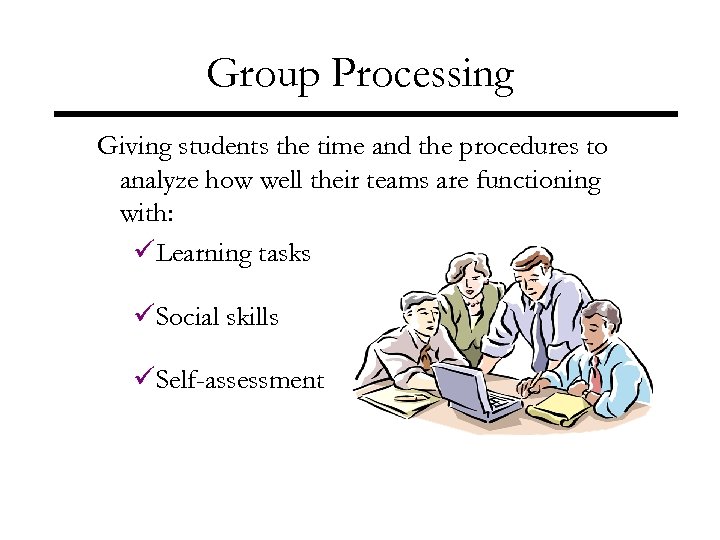 Group Processing Giving students the time and the procedures to analyze how well their teams are functioning with: üLearning tasks üSocial skills üSelf-assessment
 Sample Types of Activities Direct Instructional Activities present information to students or demonstrate skills Activities for Student Practice after direct instruction Cooperative Learning Instructional Activities brainstorming, note-taking pairs, cooperative writing and editing pairs Whole Lesson Formats involves teacher-directed and student directed strategies without other lesson components Movement Oriented Activities corners jigsaw
 Cooperative Note-taking Pairs Objective: To enable students to take something from one another’s notes to improve their own Directions In Brief: 1. Assign or allow students to select partners. 2. Teach 3. Stop every 10 minutes for sharing of notes.
 Cooperative Note-taking Pairs Check - in Directions in Brief 1. While teaching, stop periodically for a checkin. 2. Instruct students to skim their partners’ notes looking for: Ø information they missed Ø information partners have incorrectly noted 3. Students retrieve their own notes and make any needed changes.
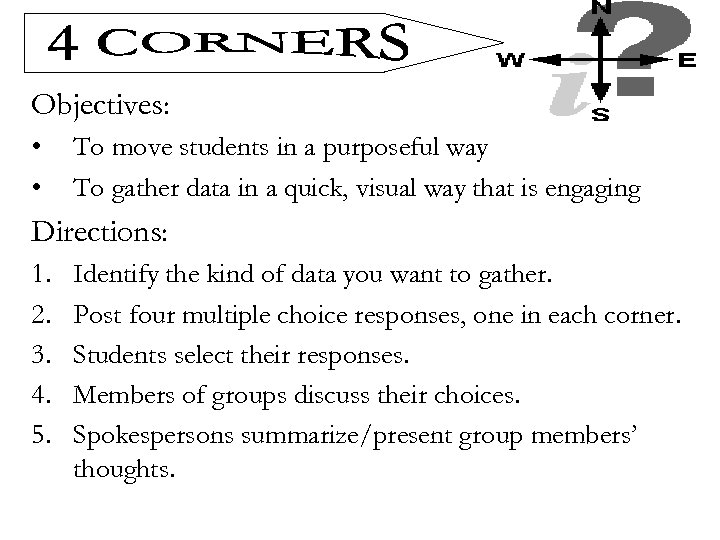 Objectives: • • To move students in a purposeful way To gather data in a quick, visual way that is engaging Directions: 1. 2. 3. 4. 5. Identify the kind of data you want to gather. Post four multiple choice responses, one in each corner. Students select their responses. Members of groups discuss their choices. Spokespersons summarize/present group members’ thoughts.
 SCARED
 Fearless
 Cautiously Optimistic
 Other
Other
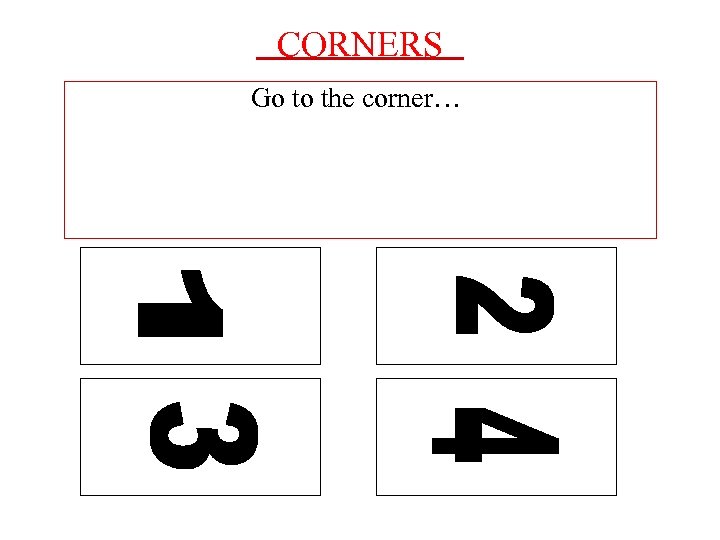 CORNERS Go to the corner…
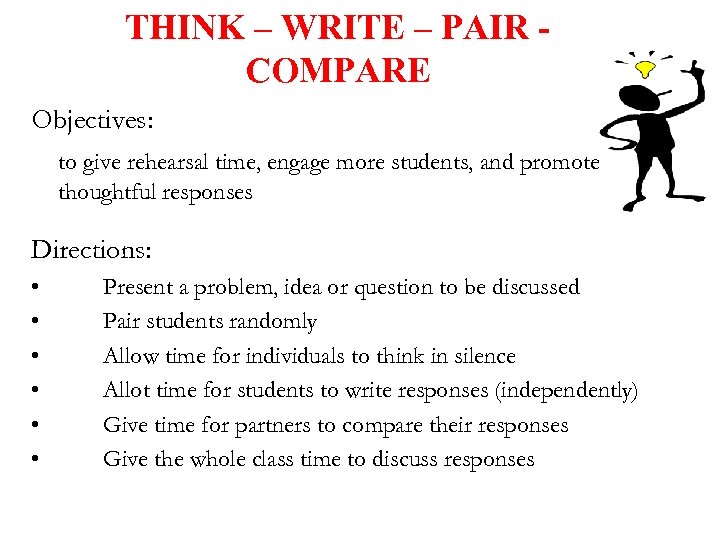 THINK – WRITE – PAIR COMPARE Objectives: to give rehearsal time, engage more students, and promote thoughtful responses Directions: • • • Present a problem, idea or question to be discussed Pair students randomly Allow time for individuals to think in silence Allot time for students to write responses (independently) Give time for partners to compare their responses Give the whole class time to discuss responses
 THINK – WRITE – PAIR - COMPARE Think of one way you could apply 4 CORNERS in your subject area(s).
 What are the Pros and Cons of using 4 Corners? PRO CON
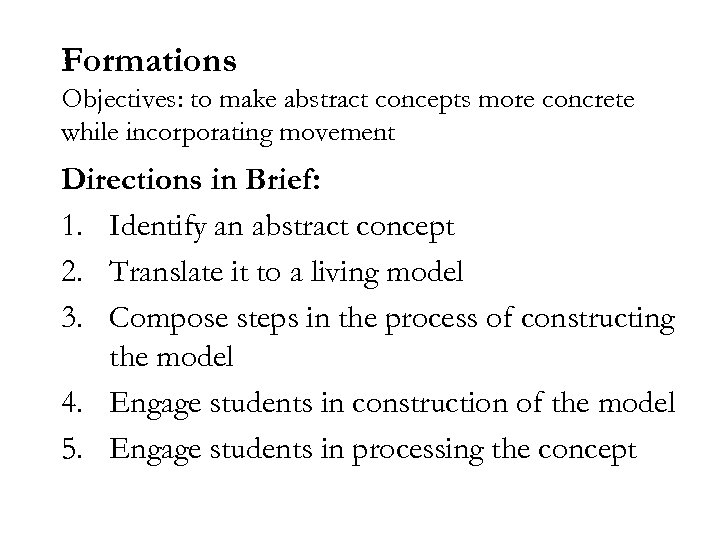 Formations Objectives: to make abstract concepts more concrete while incorporating movement Directions in Brief: 1. Identify an abstract concept 2. Translate it to a living model 3. Compose steps in the process of constructing the model 4. Engage students in construction of the model 5. Engage students in processing the concept
 Formations 1. Meet with others in your subject area 2. Decide upon one abstract concept and a formation that makes it concrete. 3. Be prepared to present your formation to your colleagues in other subject areas. Note: Every member of your group does not have to be a part of your formation
 Designing an 18 Week Plan • Identify essential skills and information to be taught using a variety of resources – Hawaii Standards – Curricula Frameworks from a variety of sources – In house resources such as teacher lessons, textbooks, etc
 Restructuring does not mean throwing out everything from “before block scheduling”. Incorporate the best of the “tried and true” methods, build adapt and reincorporate them in the new time frame.
 • List the most important concepts/skills you want students to understand before the end of the course • List effective activities now used to address each goal • Indicate which concepts you wish to address in more depth • Think of ways to contextualize each goal with reality based activities • Consider various strategies you might add to address each goal
 Design Weekly Lesson Plans • Provide a detailed outline of activities for each unit including possible materials, resources, strategies
 Design Daily Lesson Plans Include at least three activities which allow for: – The incorporation of movement – The inclusion of time for whole class, individual and group work – Changes in media
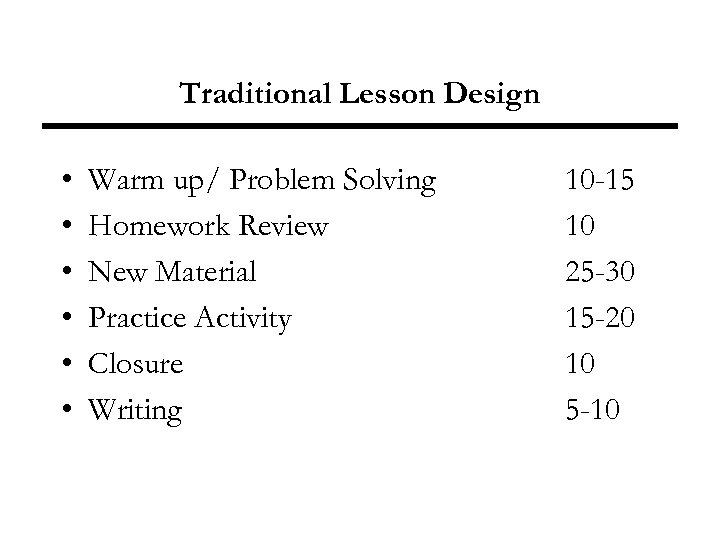 Traditional Lesson Design • • • Warm up/ Problem Solving Homework Review New Material Practice Activity Closure Writing 10 -15 10 25 -30 15 -20 10 5 -10
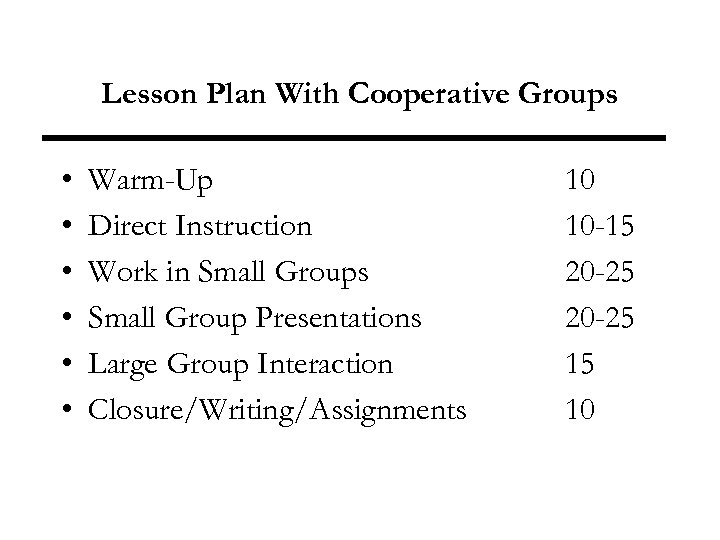 Lesson Plan With Cooperative Groups • • • Warm-Up Direct Instruction Work in Small Groups Small Group Presentations Large Group Interaction Closure/Writing/Assignments 10 10 -15 20 -25 15 10
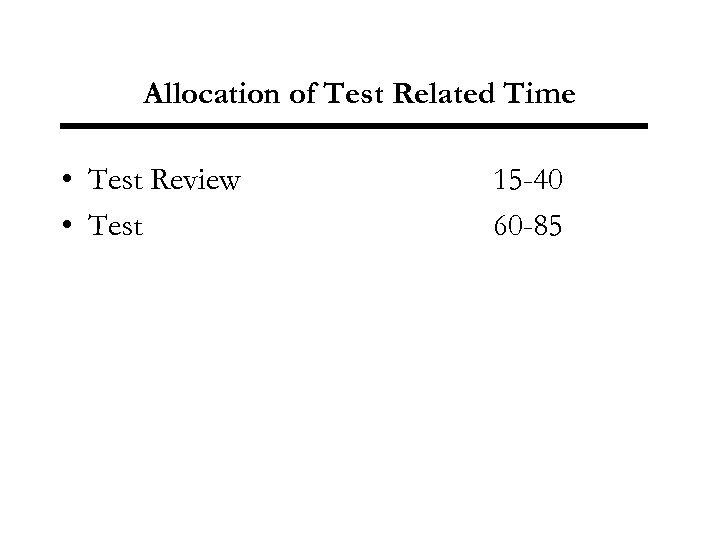 Allocation of Test Related Time • Test Review • Test 15 -40 60 -85
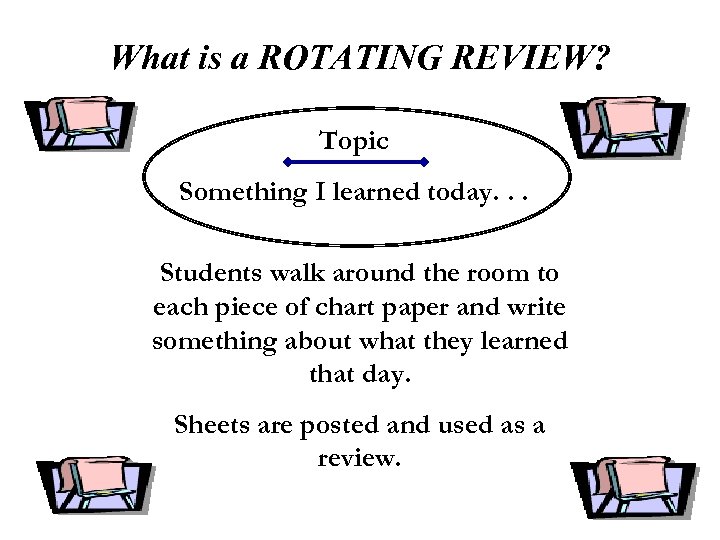 What is a ROTATING REVIEW? Topic Something I learned today. . . Students walk around the room to each piece of chart paper and write something about what they learned that day. Sheets are posted and used as a review.
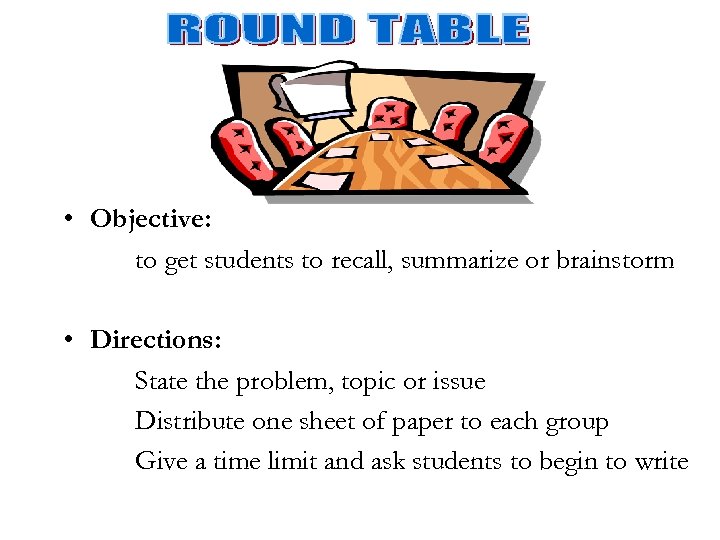 • Objective: to get students to recall, summarize or brainstorm • Directions: State the problem, topic or issue Distribute one sheet of paper to each group Give a time limit and ask students to begin to write
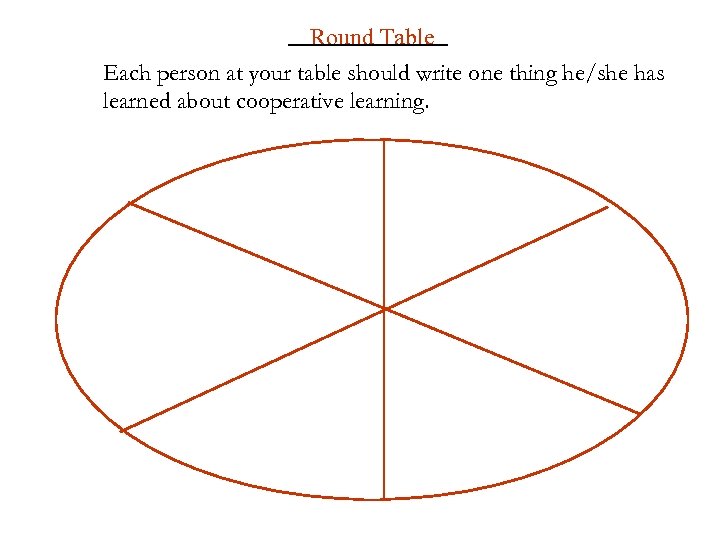 Round Table Each person at your table should write one thing he/she has learned about cooperative learning.