


 Скачать презентацию Engaging Motivating your Volunteers KRISTINA RICKETTS PH
c73fa86ba83af90ae777993f6b52036c.ppt
- Количество слайдов: 36
 Engaging & Motivating your Volunteers KRISTINA RICKETTS, PH. D. UNIVERSITY OF KENTUCKY
 Today’s Objectives To look at three different elements that affect volunteers and leadership: Motivation Situational Leadership Empowerment
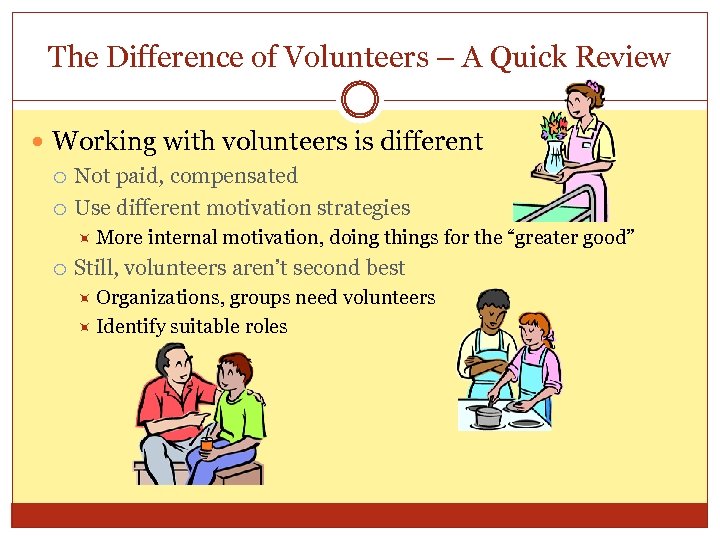 The Difference of Volunteers – A Quick Review Working with volunteers is different Not paid, compensated Use different motivation strategies More internal motivation, doing things for the “greater good” Still, volunteers aren’t second best Organizations, groups need volunteers Identify suitable roles
 People & Motivation People seek security Certain needs fundamental to existence Once these are met, focus on duties People seek social systems Relatedness, affiliation, interpersonal relations, belongingness, etc. People seek personal growth Advancement, need for achievement “What’s in it for me? ”
 Defining Motivation An inner force that drives individuals to accomplish personal and organizational goals To be moved to do something “…the inspiration to act” Two factors The level of motivation – how motivated someone is The orientation of motivation – what type of motivation inspires the individual Underlying attitudes and goals
 Basic Types of Motivation Intrinsic: doing something because it is innately interesting For the enjoyment of the activity Internal Extrinsic: doing something because it leads to a specific outcome External, Reward, Instrumental i. e. money, awards, acceptance, etc. Amotivation: lacking intention to act
 Let’s Think About… How are we defining leadership within our organization?
 Situational Leadership Originally developed in 1977 by Hersey & Blanchard, began as the Life Cycle Theory Definition Appropriate leadership style depends upon the readiness level of the followers/volunteers Model is broken down into leadership style and follower readiness Leadership style – behavior by the leader as perceived by the followers Readiness – follower competence and commitment
 Leadership Style Broken down into two behaviors Task behavior – the extent to which the leader engages in spelling out the duties/responsibilities of the group Directive behaviors Relationship behavior – the extent to which the leader engages in a multiway communication Listening, facilitating, supportive behaviors
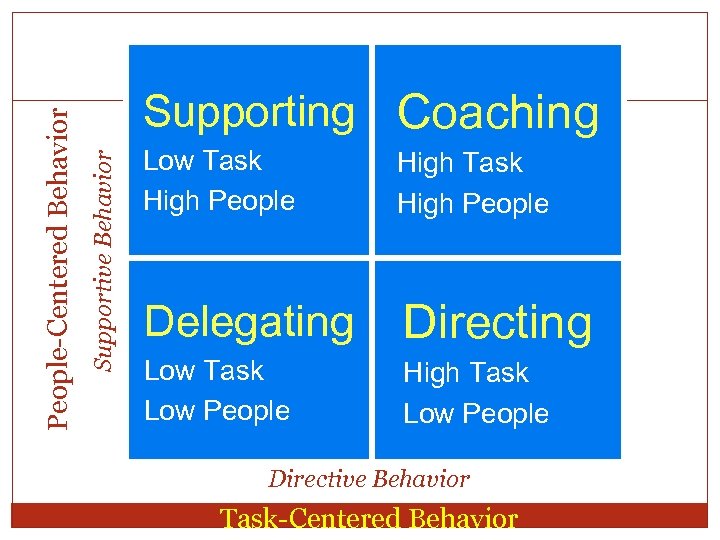 Supportive Behavior People-Centered Behavior Supporting Coaching Low Task High People High Task High People Delegating Directing Low Task Low People High Task Low People Directive Behavior Task-Centered Behavior
 Follower Readiness Which leadership style do you use? Follower development level (readiness) determines leadership style Competence – the knowledge, experience and skill an individual brings to a task Commitment – the extent to which an individual has the confidence, willingness, and motivation to accomplish a task
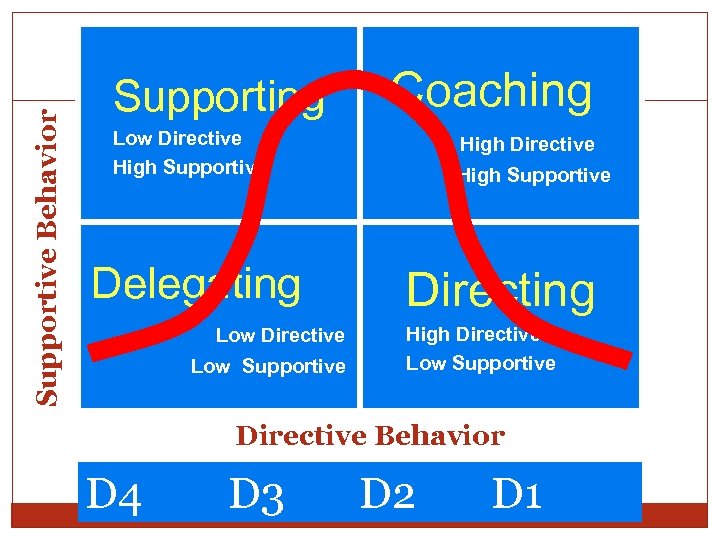 Supportive Behavior Supporting Coaching Low Directive High Supportive Delegating Low Directive Low Supportive High Directive High Supportive Directing High Directive Low Supportive Directive Behavior D 4 D 3 D 2 D 1
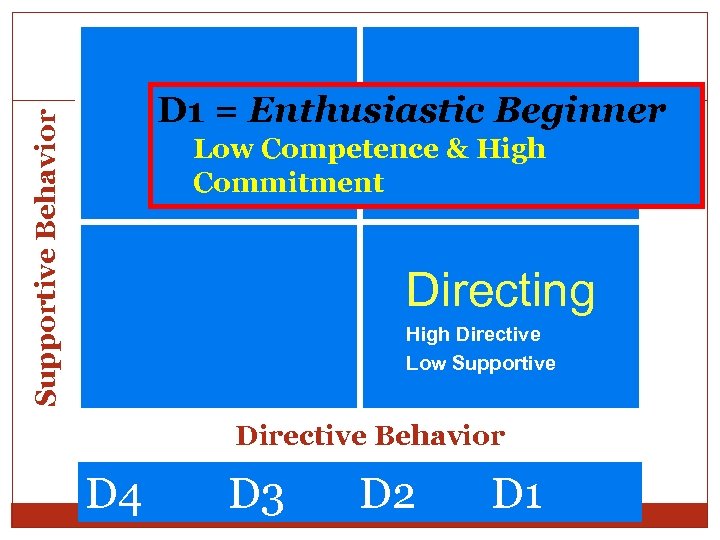 Supportive Behavior D 1 = Enthusiastic Beginner Low Competence & High Commitment Directing High Directive Low Supportive Directive Behavior D 4 D 3 D 2 D 1
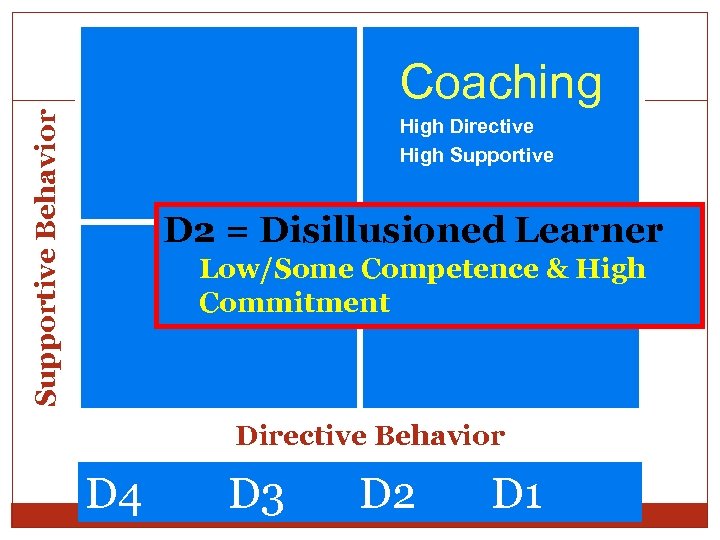 Supportive Behavior Coaching High Directive High Supportive D 2 = Disillusioned Learner Low/Some Competence & High Commitment Directive Behavior D 4 D 3 D 2 D 1
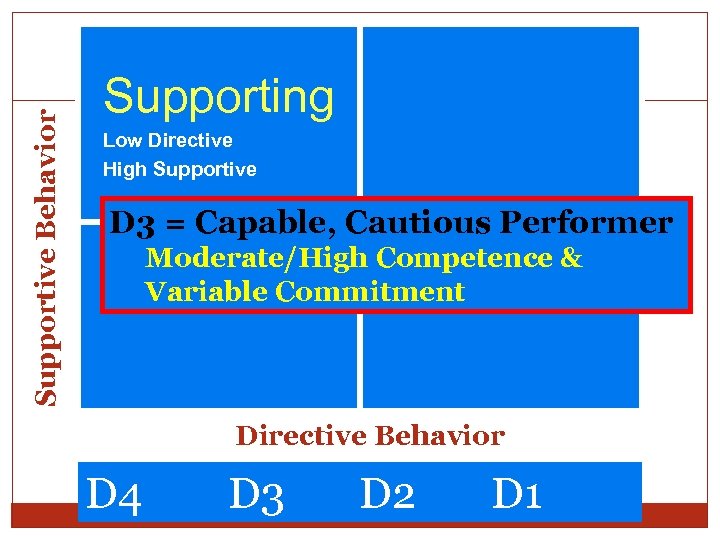 Supportive Behavior Supporting Low Directive High Supportive D 3 = Capable, Cautious Performer Moderate/High Competence & Variable Commitment Directive Behavior D 4 D 3 D 2 D 1
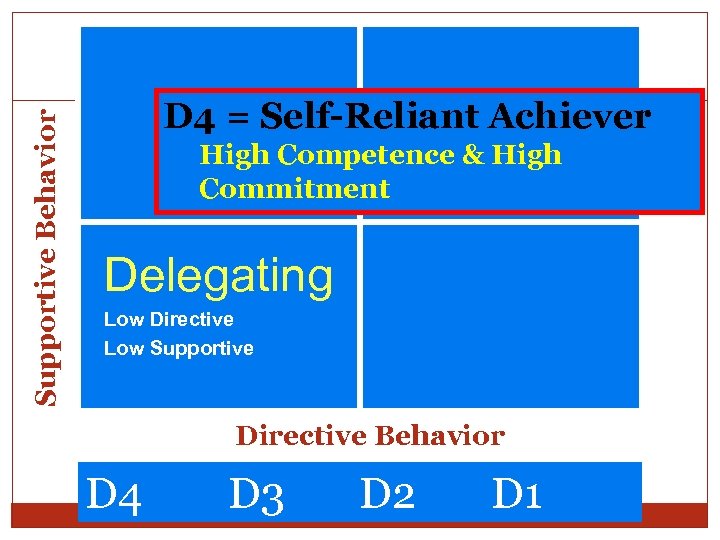 Supportive Behavior D 4 = Self-Reliant Achiever High Competence & High Commitment Delegating Low Directive Low Supportive Directive Behavior D 4 D 3 D 2 D 1
 Situational Leadership Skills The three skills of an effective team leader: Diagnosis – assessing individual/team needs Flexibility – the ability to use a variety of leadership behaviors Matching – the ability to use leadership behaviors that meet the individual's or team’s readiness/needs
 Situational Leadership A leader must be able to judge both the task (whether he/she needs to be task or relationship focused) and follower readiness appropriately While the leader probably has a preferred style, needs to be able to change according to the situation Bottom Line: It is the follower who determines the appropriate leader behavior
 Let’s Think About… What are you currently doing to empower your members or volunteers?
 Empowerment Defined Empowerment: to enable or permit, to give power to Sharing power with others Passing decision-making authority & responsibility from managers to group members Demonstrated through participative management, shared decision making, delegation Increases leaders power & influence Higher productivity, trust, self-efficacy
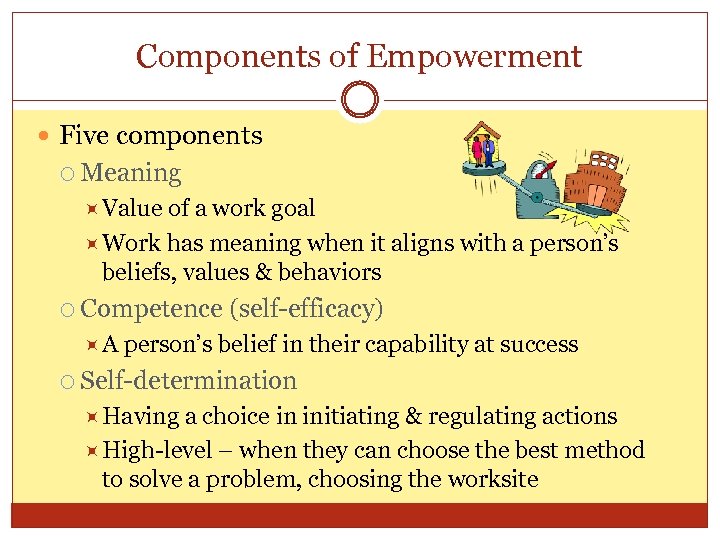 Components of Empowerment Five components Meaning Value of a work goal Work has meaning when it aligns with a person’s beliefs, values & behaviors Competence A (self-efficacy) person’s belief in their capability at success Self-determination Having a choice in initiating & regulating actions High-level – when they can choose the best method to solve a problem, choosing the worksite
 Components of Empowerment Five components Impact The degree to which the employee can influence strategic, administrative or operating outcomes Instead of “no choice” – having a say in the company’s future Internal Commitment Towards work goals Committed for individual motives – “buy in”
 Using Empowerment within Teams Empowering teams allows them to control decisions that impact their success Leaders should help the group in any way possible – particularly with unclear/complex tasks Delegation is necessary for true empowerment Working through issues/problems allows team to develop an identity and build needed structures
 Using Empowerment within Teams Advantages of team empowerment Helps to create group “buy-in” Defines individual roles Allows for individuals to speak out when making important decisions Sharing in the group’s “power” Generally, encourages personal success
 Empowering Practices So how do I empower my volunteers? Foster initiative and responsibility Specialized titles, individualized control, more responsibility Link work activities to organizational goals Aligned with strategic goals of organization Encourages identification with the group Being Provide a “partner” in the organization ample information
 Empowering Practices So how do I empower my volunteers? Allow group members to choose methods Explain what needs to be done – the group decides how to get there Encourage self-leadership Establish limits to empowerment More limits authority than before, but some issues are still off-
 Taking this Further… So if we are successful at motivating, empowering and leading volunteers, what are the issues? Where do they come from?
 Volunteers’ Perception of Barriers Volunteer target group may have different perceptions Image/culture of volunteering; Need to persuade volunteers that volunteering is worthwhile and has demonstrable values to individuals in the target group; Remove the barriers to information about volunteering and help people get started; Remove the barriers to the lack of awareness of voluntary opportunities.
 Overcoming the Barriers In addressing the barriers, you should consider highlighting: Personal benefits of volunteering; Demonstrate a commitment to equal opportunities; Ensure retention of volunteers by ensuring the tasks match the individual volunteer, they pay out of pocket expenses and provide necessary training and support.
 How do we retain & maintain good volunteers?
 Top 10 of Good Volunteer Maintenance 1. Be prepared 2. Before anything gets underway, be organized Clear chain of command Who do I answer to? One person, not committee Answer calls/emails promptly 4. Get to know each volunteer 3. Especially important to learn motivation, interests
 Top 10 of Good Volunteer Maintenance Try and include volunteer somewhere they feel they are making an impact 6. Appreciation!!! 5. 7. Can’t say thank you enough Try different ways Maintain ongoing communication Touch base often Don’t leave volunteers to do same job indefinitely – remember, motivation
 Top 10 of Good Volunteer Maintenance 8. Ask for ideas and feedback 9. Provide opportunities to makes changes, “opt out” Don’t forget verbal “Thanks for all you do” from different people Can’t stress appreciation enough 10. Make each individual feel like a valued and cherished part of the team Welcome, necessary, appreciated
 Discussion Questions What is the current state of volunteerism within your organization? How are volunteers currently utilized within your organization? Have you tapped/recruited potential leaders? Have you thought about leadership training? Specific skills needed?
 References Cookman, N. (2001). Volunteers – a way of encouraging active community participation? Library and Information Research News , 25(81), 8 -11. For more information, please contact: Kristina G. Ricketts, Ph. D. 713 Garrigus Building University of Kentucky Lexington, KY 40546 -0215 k. ricketts@uky. edu PH: 859. 257. 3767
 Questions?