


 Скачать презентацию Engaging Citizens and Consumers in Setting Health Priorities
0b8b04395aa52113d0e92e255ddec88c.ppt
- Количество слайдов: 39
 Engaging Citizens and Consumers in Setting Health Priorities Susan Dorr Goold MD, MHSA, MA Associate Professor of Internal Medicine Director, Bioethics Program
 Acknowledgments n n Marion Danis, MD – Department of Clinical Bioethics, Warren Magnuson Clinical Center, National Institutes of Health Media Research Lab, UM Comprehensive Cancer Center Matt Davis, MD, and Jeannie Thrall, Pediatrics; Andrea Biddle, UNC; Ellen Benavides and John Klein, Cirdan, Minnesota; Marge Ginsburg, Sacramento Health Decisions; Nancy Baum; Stephanie Marion-Landais Picker-Commonwealth Scholars Program, Robert Wood Johnson Foundation, Allina Foundation, California Healthcare Foundation, UM Biotechnology Development Fund
 Disclosure n As one of the inventors of CHAT, I, the University of Michigan, and the NIH benefit from royalties received from licensed uses of CHAT
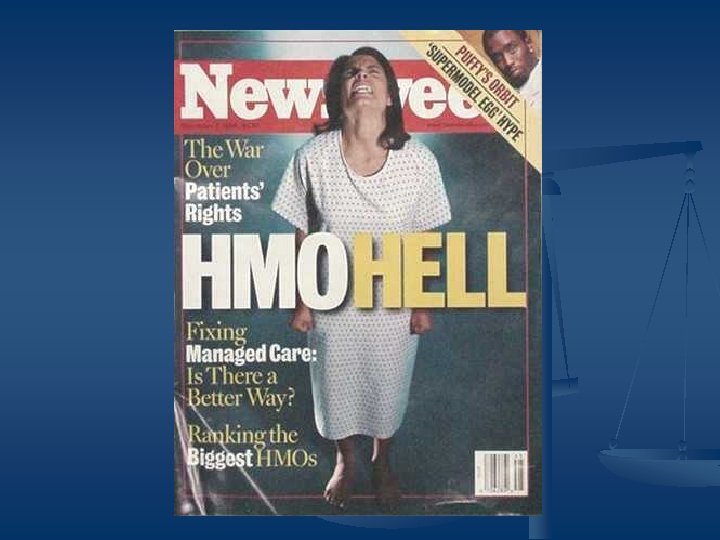
 Public Frustration n Purchasers search for ways to contain costs n Patients and citizens have lost power and control over healthcare decisions n How do we make allocation decisions more patient-centered?
 The Problem n Healthcare allocation decisions are politically, emotionally, intellectually and morally difficult
 Consumer Sovereignty Model Choice n Informed, prudent and imaginative consumers choose from several diverse alternative health insurance plans according to their own values and preferences n Variations: Consumer cost-sharing, consumer-directed health benefit plans n Like market allocation of other resources, this system would fairly distribute goods according to individual differences in how they value various types and features of health insurance
 Citizen Involvement Voice n Healthcare priority setting should reflect values and preferences of population n Population affected by decisions should be involved in decision making n Allocation decisions self-imposed, consent via participation
 Obstacles for Both Models Issues lack salience for the well n Consumers not well-informed n – – – n Purchaser is not consumer n n Issues complex, technical, intimidating, frightening Information needs are voluminous Need imagination Accountability to purchasers How involve citizenry - what method
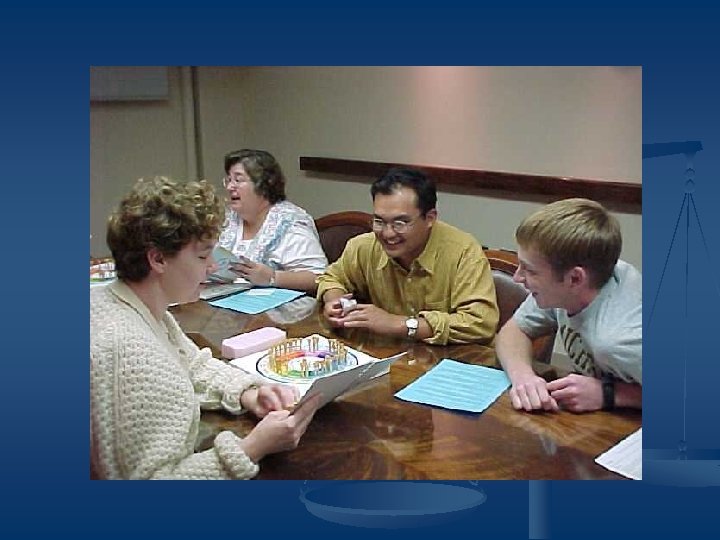
 CHAT Choosing Healthplans All Together© n Simulation exercise n n Participants design a hypothetical health benefits package, making trade-offs between competing needs for limited resources Group product group deliberation Overcome apathy, perceived irrelevance, and complexity, and moderate individual self-interest Goals n n n What health insurance features/benefits do citizens/consumers prefer? What reasons or values do citizens/consumers use to justify tradeoffs? Can CHAT be a “just enough” process for setting healthcare priorities?
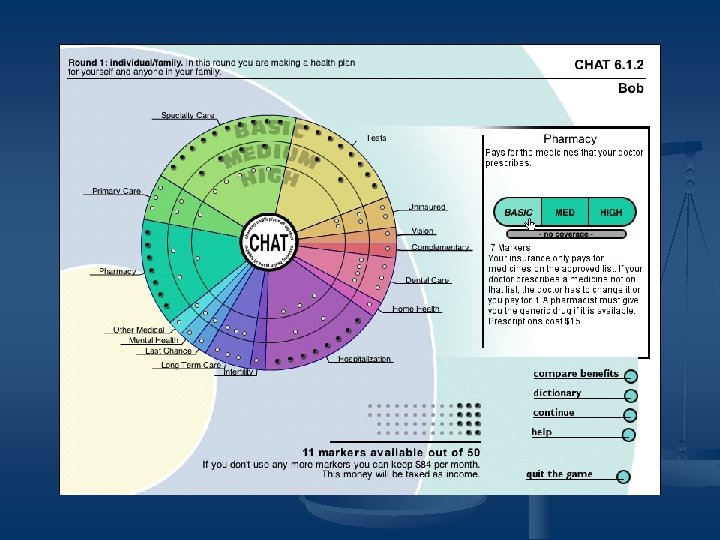
 Versions/Derivatives n n Board game (paper version) Software Group exercise - same time/place, laptops n Content (financials, benefit options) can be altered using Planner software and Survey Editor n Automated data collection n n Web CHAT (2005)
 The Exercise n Each round of play Choose healthplan benefits n Experience “health events” n Reflect out loud n n 4 Rounds of play Individual- choose benefits for self and family n Groups of 3 -choose for “neighborhood” n Entire group-choose for community n Individual-choose for self and family n
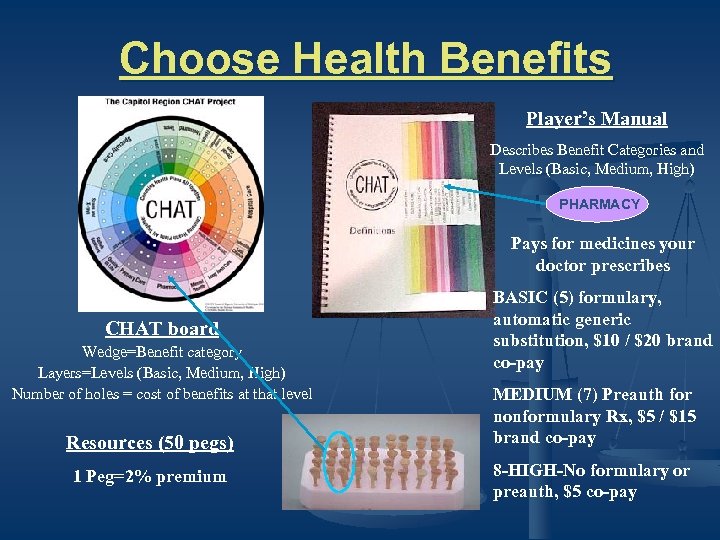 Choose Health Benefits Player’s Manual Describes Benefit Categories and Levels (Basic, Medium, High) PHARMACY Pays for medicines your doctor prescribes CHAT board Wedge=Benefit category Layers=Levels (Basic, Medium, High) Number of holes = cost of benefits at that level Resources (50 pegs) 1 Peg=2% premium BASIC (5) formulary, automatic generic substitution, $10 / $20 brand co-pay MEDIUM (7) Preauth for nonformulary Rx, $5 / $15 brand co-pay 8 -HIGH-No formulary or preauth, $5 co-pay
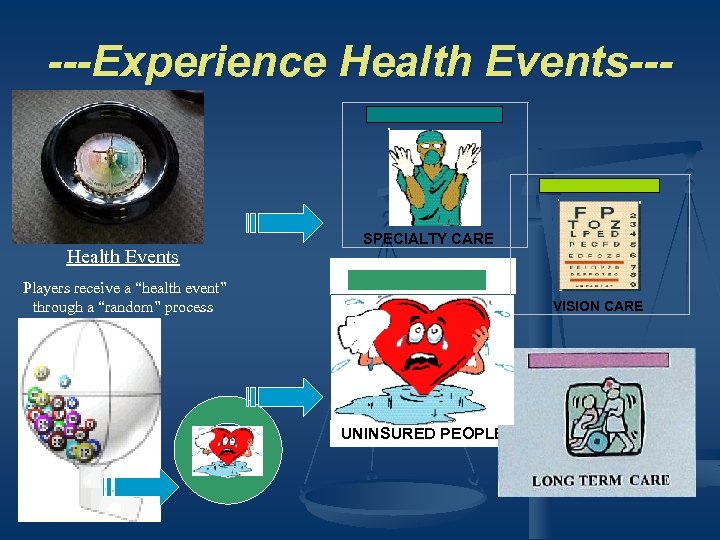 ---Experience Health Events--- Health Events SPECIALTY CARE Players receive a “health event” through a “random” process VISION CARE UNINSURED PEOPLE
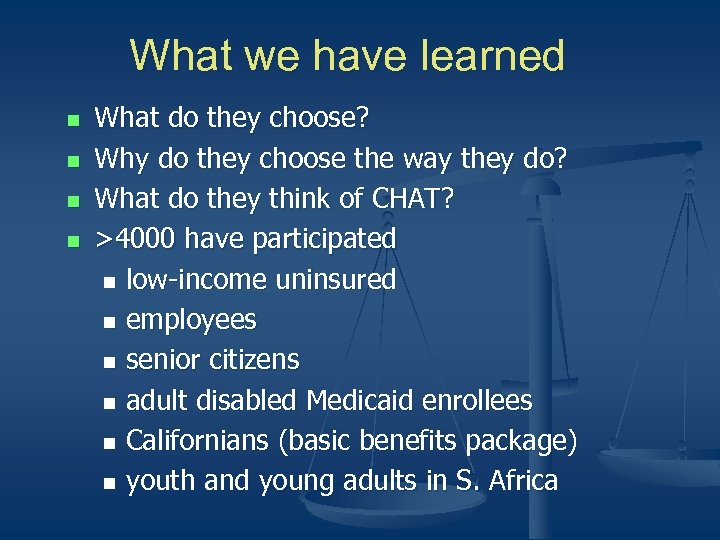 What we have learned n n What do they choose? Why do they choose the way they do? What do they think of CHAT? >4000 have participated n low-income uninsured n employees n senior citizens n adult disabled Medicaid enrollees n Californians (basic benefits package) n youth and young adults in S. Africa
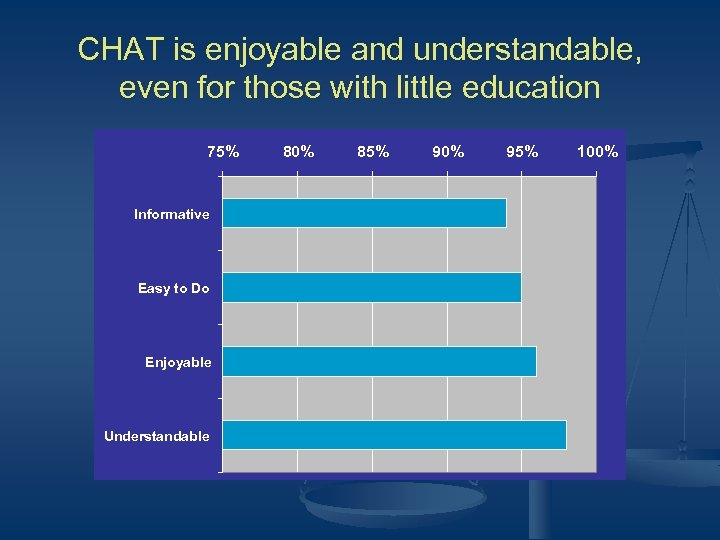 CHAT is enjoyable and understandable, even for those with little education 75% Informative Easy to Do Enjoyable Understandable 80% 85% 90% 95% 100%
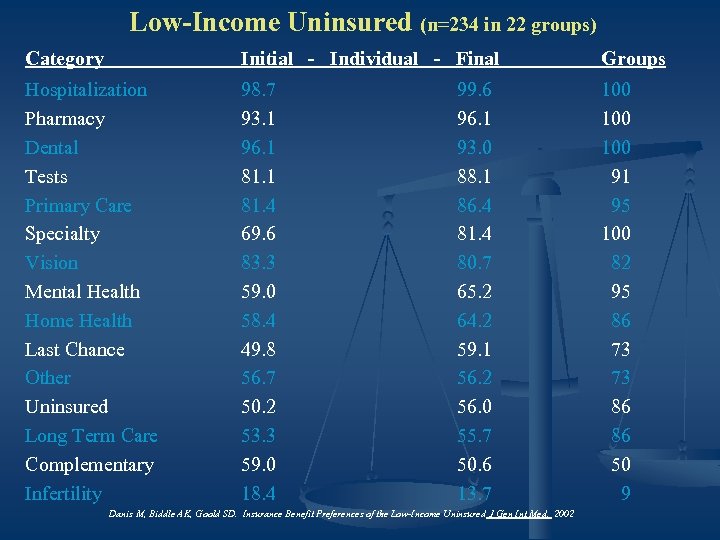 Low-Income Uninsured (n=234 in 22 groups) Category Initial - Individual - Final Groups Hospitalization Pharmacy Dental Tests Primary Care Specialty Vision Mental Health Home Health Last Chance Other Uninsured Long Term Care Complementary Infertility 98. 7 93. 1 96. 1 81. 4 69. 6 83. 3 59. 0 58. 4 49. 8 56. 7 50. 2 53. 3 59. 0 18. 4 100 100 91 95 100 82 95 86 73 73 86 86 50 9 99. 6 96. 1 93. 0 88. 1 86. 4 81. 4 80. 7 65. 2 64. 2 59. 1 56. 2 56. 0 55. 7 50. 6 13. 7 Danis M, Biddle AK, Goold SD. Insurance Benefit Preferences of the Low-Income Uninsured J Gen Int Med. 2002
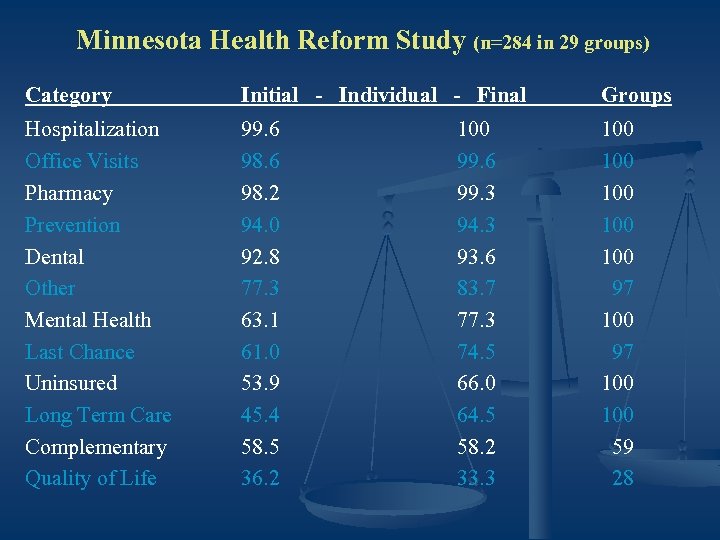 Minnesota Health Reform Study (n=284 in 29 groups) Category Initial - Individual - Final Groups Hospitalization Office Visits Pharmacy Prevention Dental Other Mental Health Last Chance Uninsured Long Term Care Complementary Quality of Life 99. 6 98. 2 94. 0 92. 8 77. 3 63. 1 61. 0 53. 9 45. 4 58. 5 36. 2 100 100 100 97 100 59 28 100 99. 6 99. 3 94. 3 93. 6 83. 7 77. 3 74. 5 66. 0 64. 5 58. 2 33. 3
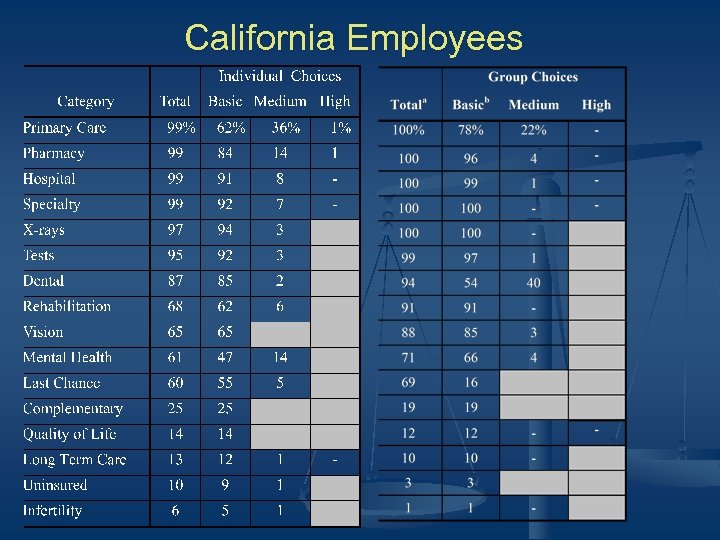 California Employees
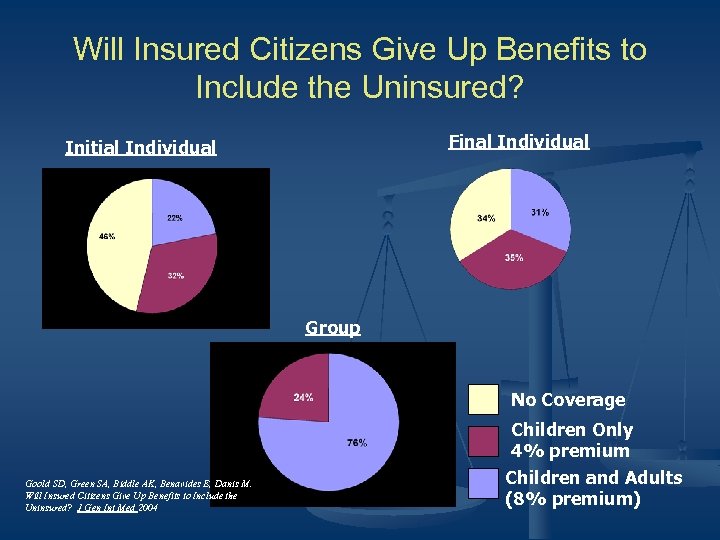 Will Insured Citizens Give Up Benefits to Include the Uninsured? Final Individual Initial Individual Group No Coverage Goold SD, Green SA, Biddle AK, Benavides E, Danis M. Will Insured Citizens Give Up Benefits to Include the Uninsured? J Gen Int Med 2004 Children Only 4% premium Children and Adults (8% premium)
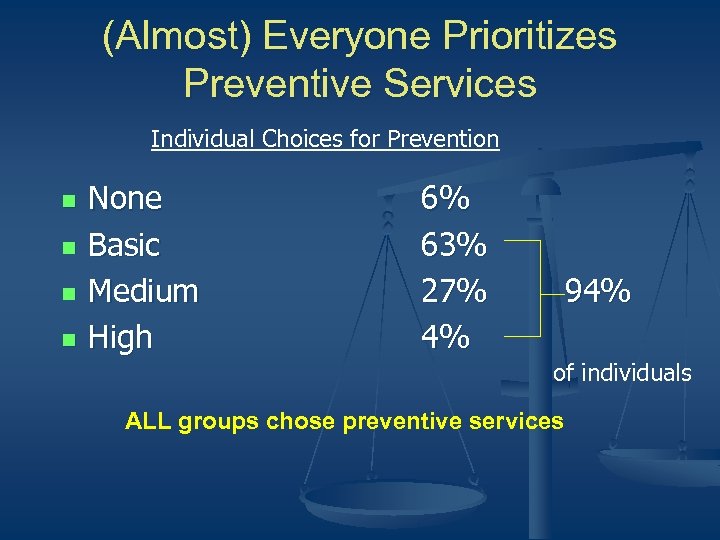 (Almost) Everyone Prioritizes Preventive Services Individual Choices for Prevention n n None Basic Medium High 6% 63% 27% 4% 94% of individuals ALL groups chose preventive services
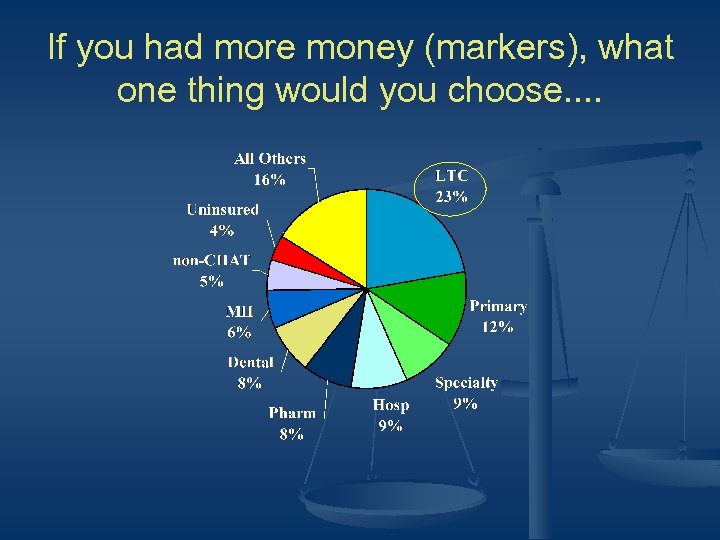 If you had more money (markers), what one thing would you choose. .
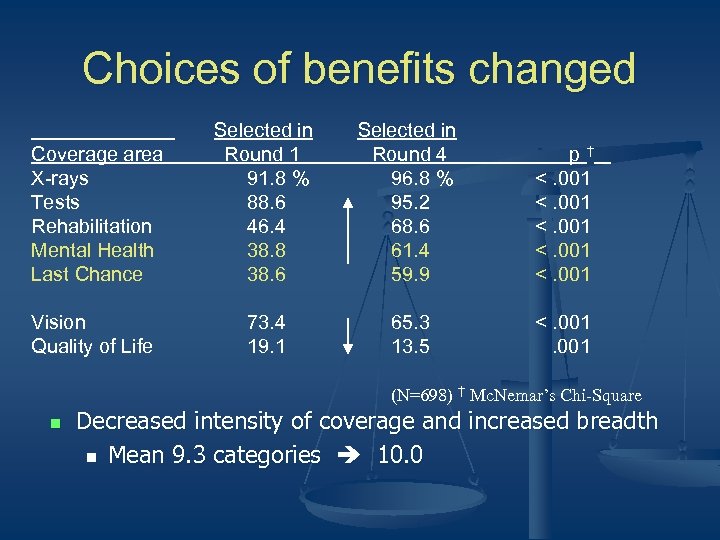 Choices of benefits changed Coverage area X-rays Tests Rehabilitation Mental Health Last Chance Selected in Round 1 91. 8 % 88. 6 46. 4 38. 8 38. 6 Selected in Round 4 96. 8 % 95. 2 68. 6 61. 4 59. 9 p† <. 001 Vision Quality of Life 73. 4 19. 1 65. 3 13. 5 <. 001 (N=698) † Mc. Nemar’s Chi-Square n Decreased intensity of coverage and increased breadth n Mean 9. 3 categories 10. 0
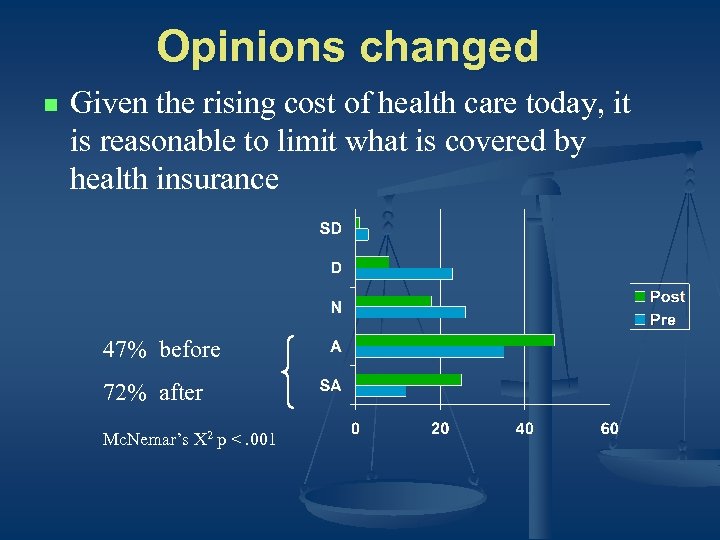 Opinions changed n Given the rising cost of health care today, it is reasonable to limit what is covered by health insurance 47% before 72% after Mc. Nemar’s X 2 p <. 001
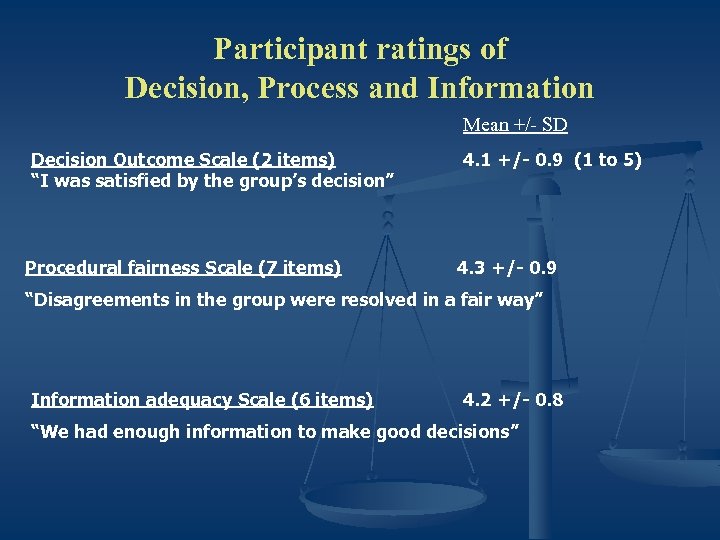 Participant ratings of Decision, Process and Information Mean +/- SD Decision Outcome Scale (2 items) “I was satisfied by the group’s decision” Procedural fairness Scale (7 items) 4. 1 +/- 0. 9 (1 to 5) 4. 3 +/- 0. 9 “Disagreements in the group were resolved in a fair way” Information adequacy Scale (6 items) 4. 2 +/- 0. 8 “We had enough information to make good decisions”
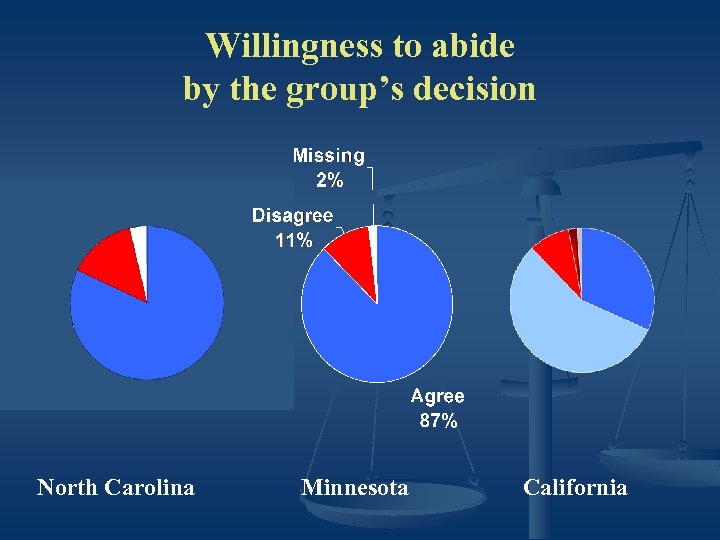 Willingness to abide by the group’s decision North Carolina Minnesota California
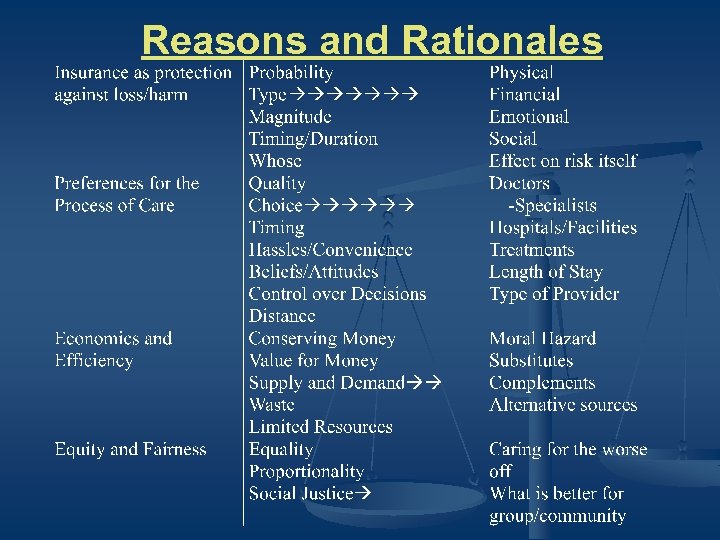 Reasons and Rationales
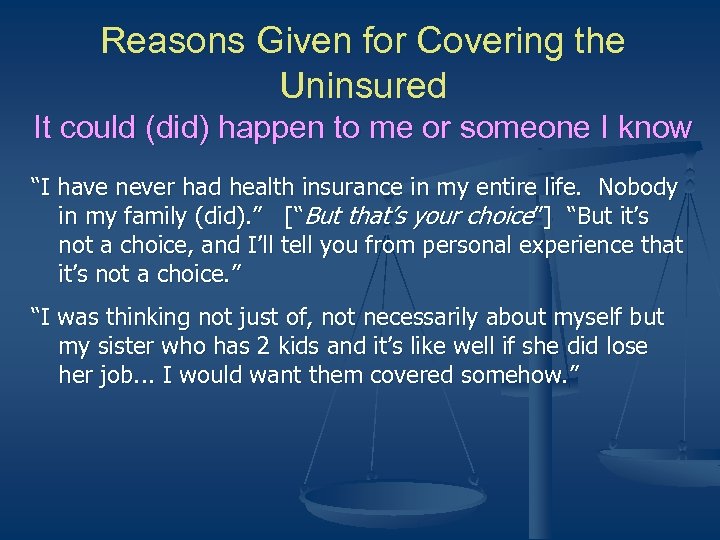 Reasons Given for Covering the Uninsured It could (did) happen to me or someone I know “I have never had health insurance in my entire life. Nobody in my family (did). ” [“But that’s your choice”] “But it’s not a choice, and I’ll tell you from personal experience that it’s not a choice. ” “I was thinking not just of, not necessarily about myself but my sister who has 2 kids and it’s like well if she did lose her job. . . I would want them covered somehow. ”
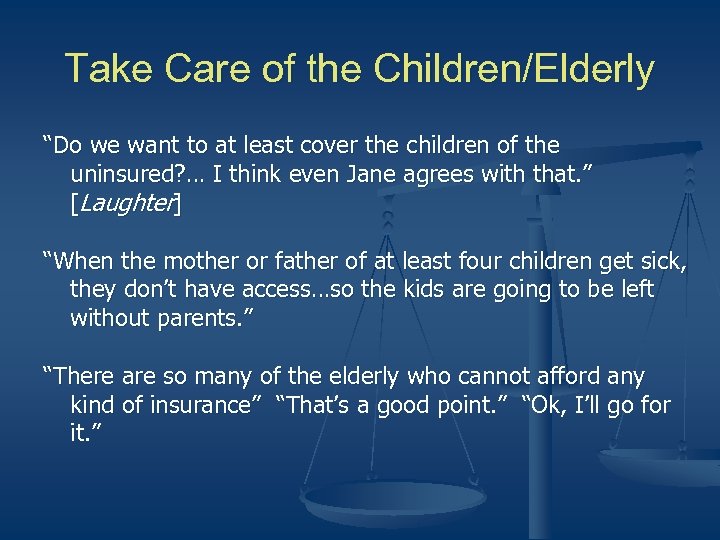 Take Care of the Children/Elderly “Do we want to at least cover the children of the uninsured? … I think even Jane agrees with that. ” [Laughter] “When the mother or father of at least four children get sick, they don’t have access…so the kids are going to be left without parents. ” “There are so many of the elderly who cannot afford any kind of insurance” “That’s a good point. ” “Ok, I’ll go for it. ”
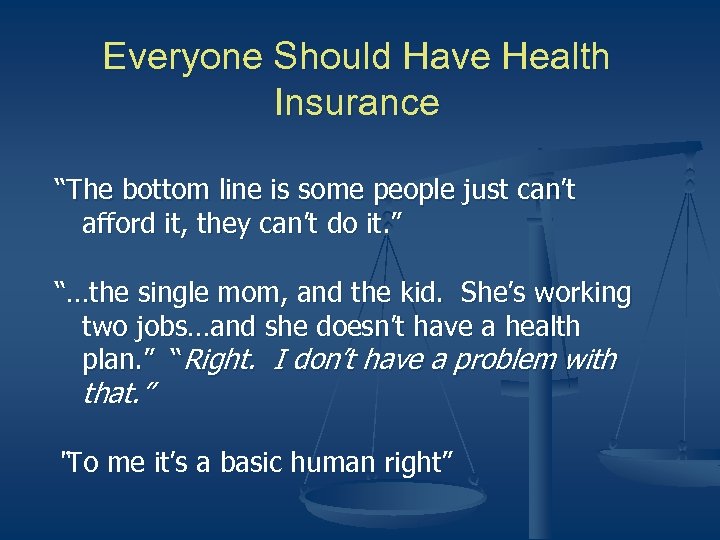 Everyone Should Have Health Insurance “The bottom line is some people just can’t afford it, they can’t do it. ” “…the single mom, and the kid. She’s working two jobs…and she doesn’t have a health plan. ” “Right. I don’t have a problem with that. ” “To me it’s a basic human right”
 Better (or Cheaper) for Society “Your children are well taken care of … and healthy, not abused, not as addicted, we have less violence…my world would be safer. ” “If we don’t insure these people they’re going to end up on welfare. ” “They get [hospital] bills…and they can’t pay. Who pays for that bill? ” “The hospital. ” “No, we do. It’s the people who are insured. ”
 Reason Given Against Covering the Uninsured: It’s Their Responsibility or Choice “…that Joe Blow needs insurance, can’t afford it, they understand that. But to John Doe who doesn’t want to pay…and would rather buy the new car…. ” “If Theresa as a single parent decides to stay home and care for her children, when she’s very capable of working…” “Insurance is not an entitlement. It is not an entitlement. And if it is, then I should have life insurance and…long-term disability and short-term disability and everything else. ”
 People Will Drop Their Current Insurance “. . . everybody would drop their insurance” “How do we slow that uninsured group from becoming half the population? ”
 People Will Move Here to Get Insurance “And let’s talk about another reality. If we’re going to cover the adults, we are opening the door to people from states right now that have no coverage what so ever. And that will be a drain…. Just like what’s happened with welfare. ”
 Preventive Services are not Controversial Preventive services choices not mentioned frequently in group discussions n Perceived as valuable and cost-effective n “I think prevention is real important because that’s where a lot of things begin and [you] catch everything …” n “[Prevention] is a low investment for a big return. ” n
 Summary n n Groups of employees and ordinary citizens can and will deliberate effectively about health priorities The CHAT exercise is viewed by participants as enjoyable, understandable, informative and fair n n Most participants would be willing to abide by the decisions made by their groups The exercise of prioritizing may make individuals n n more understanding of the needs of others and necessary tradeoffs more prudent
 Can CHAT be useful for the Community Meetings? n n What health care benefits and services should be provided? How does the American public want health care delivered? How should health care coverage be financed? What trade-offs are the American public willing to make in either benefits or financing to ensure access to affordable, high quality health care coverage and services?