


 Скачать презентацию Engaging a Class of a Thousand Students Jason
1fb7a3fd6199331afaf465195b06cf2f.ppt
- Количество слайдов: 19
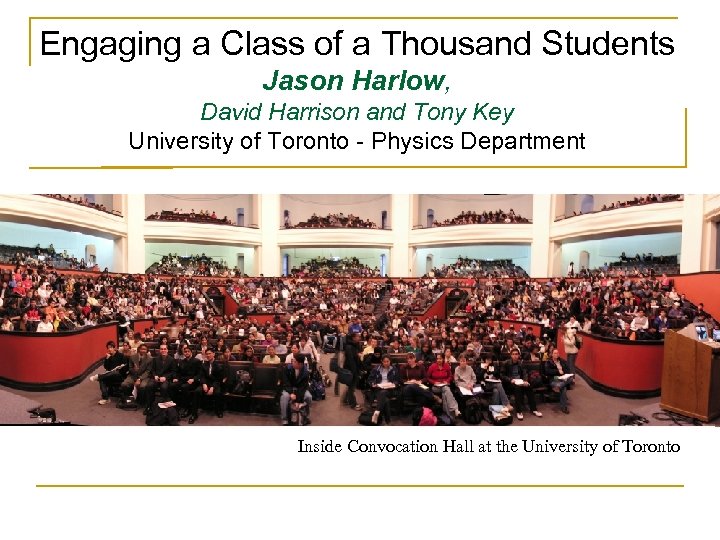 Engaging a Class of a Thousand Students Jason Harlow, David Harrison and Tony Key University of Toronto - Physics Department Inside Convocation Hall at the University of Toronto
 Talk outline n n n What we are doing to teach Physics to the masses How we try to engage and motivate students in a course they hate A Mini-Physics Lecture! Results of student surveys Future Plans, ideas
 Who we are: n Jason Harlow (me): Teaching-Stream Lecturer, hired August 2004. I teach 2 or 3 physics courses per year. n David Harrison: Senior Lecturer, has taught physics at U of T since 1972 n Tony Key: retired Professor, continues to teach Communication for scientists and introductory Physics All are members of the Physics Education group at U of T
 What we teach: n n n “Physics for the Life Sciences”, annual enrolment of 900 -1100 students. 26 weeks from September through April. One-hour lectures are held twice per week in Convocation Hall, an auditorium with 2000 seats Four professors take turns lecturing for about 6 weeks each (4 “quarters”). Before 2003/04, this class was split into five 200 -student sections
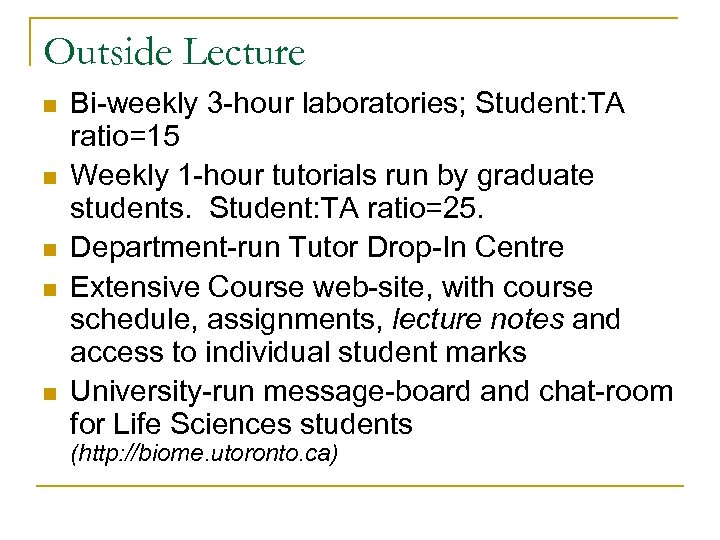 Outside Lecture n n n Bi-weekly 3 -hour laboratories; Student: TA ratio=15 Weekly 1 -hour tutorials run by graduate students. Student: TA ratio=25. Department-run Tutor Drop-In Centre Extensive Course web-site, with course schedule, assignments, lecture notes and access to individual student marks University-run message-board and chat-room for Life Sciences students (http: //biome. utoronto. ca)
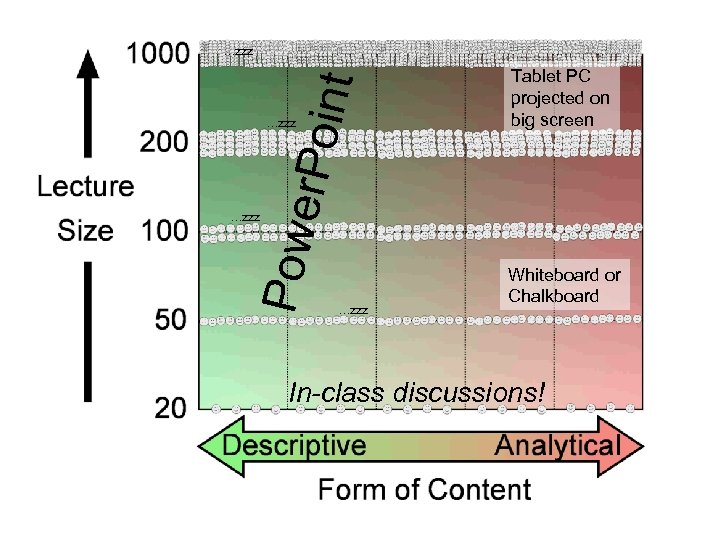 r. Poin t …zzz Powe …zzz Tablet PC projected on big screen …zzz Whiteboard or Chalkboard In-class discussions!
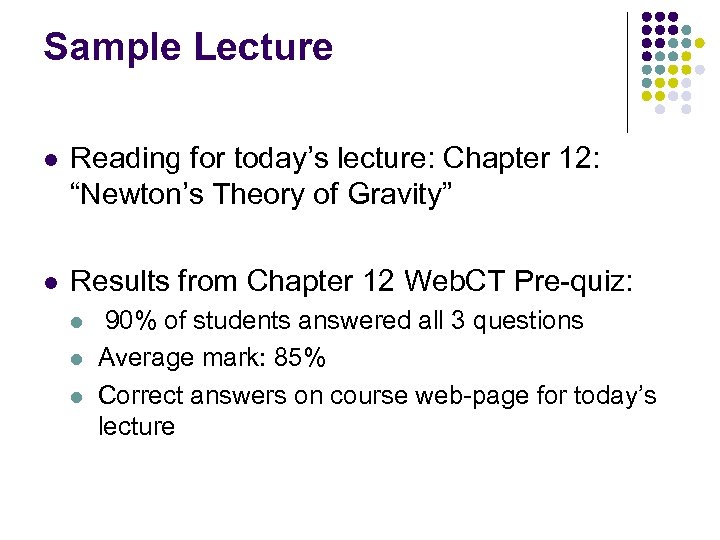 Sample Lecture l Reading for today’s lecture: Chapter 12: “Newton’s Theory of Gravity” l Results from Chapter 12 Web. CT Pre-quiz: l l l 90% of students answered all 3 questions Average mark: 85% Correct answers on course web-page for today’s lecture
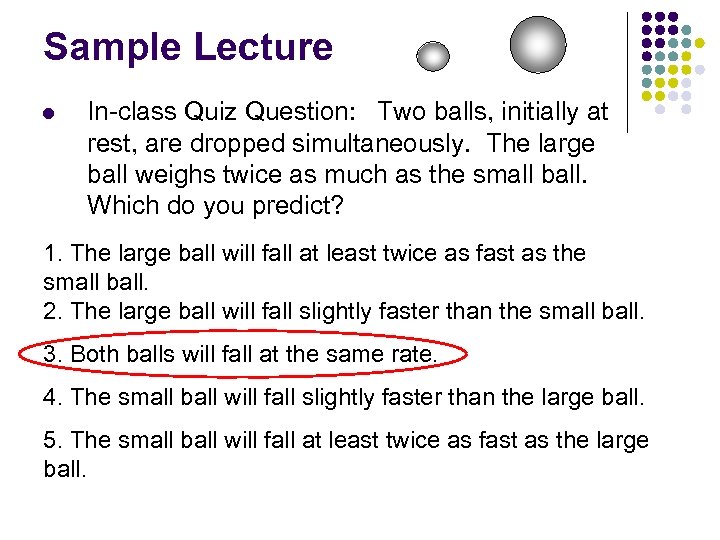 Sample Lecture l In-class Quiz Question: Two balls, initially at rest, are dropped simultaneously. The large ball weighs twice as much as the small ball. Which do you predict? 1. The large ball will fall at least twice as fast as the small ball. 2. The large ball will fall slightly faster than the small ball. 3. Both balls will fall at the same rate. 4. The small ball will fall slightly faster than the large ball. 5. The small ball will fall at least twice as fast as the large ball.
 Sample Lecture l Galileo said: “When air friction is very small, all objects fall with the same acceleration”. l Two masses connected by spider silk should fall at the same rate as either mass. l Galileo was convicted of heresy, died under house arrest in 1642
 Other things we tried… n n n Video cameras were pointed at demonstrations on stage, and a live image was projected on the main screen. We paid a “runner” to wander in lectures, collect written questions in class and pass them to the professor. The audio-component of lectures were recorded and posted on the course web-site in audio-streaming and. mp 3 format.
 Other things we tried… n n Tablet-PC notes were posted on the web after class, along with Power. Point slides. (this resulted in a mention on the front page of the Toronto Star!!) “Representative Assemblies” q q a. k. a. “Student Management Teams” weekly meetings with pizza ~10 students and professor discussion limited to issues of communication and facilities only – no discussion of course content
 Student Survey Results n n n Two surveys were done in 2004/05 about our teaching techniques. Surveys were done during tutorials. 669 students responded in October, 311 students responded in March For all questions, students chose a number from 1 to 7 where: q q q 1 means: totally useless 4 means: neutral 7 means: an invaluable aid to my learning
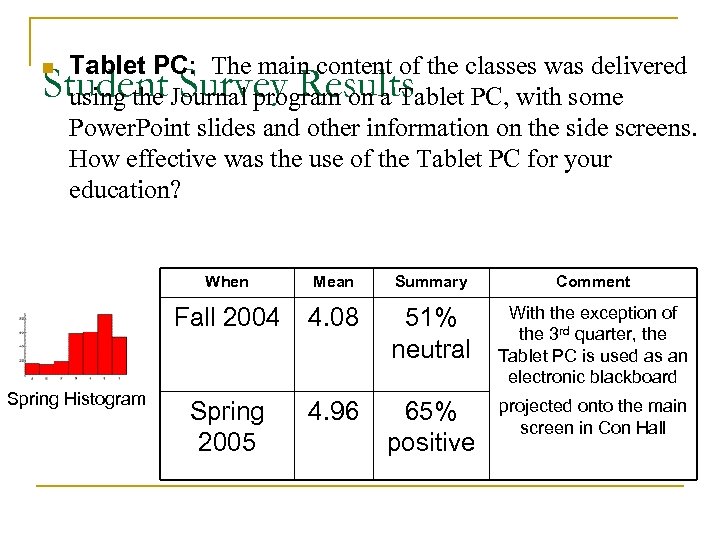 n Tablet PC: The main content of the classes was delivered using the Journal program on a Tablet PC, with some Power. Point slides and other information on the side screens. How effective was the use of the Tablet PC for your education? Student Survey Results When Summary Comment Fall 2004 Spring Histogram Mean 4. 08 51% neutral With the exception of the 3 rd quarter, the Tablet PC is used as an electronic blackboard Spring 2005 4. 96 65% positive projected onto the main screen in Con Hall
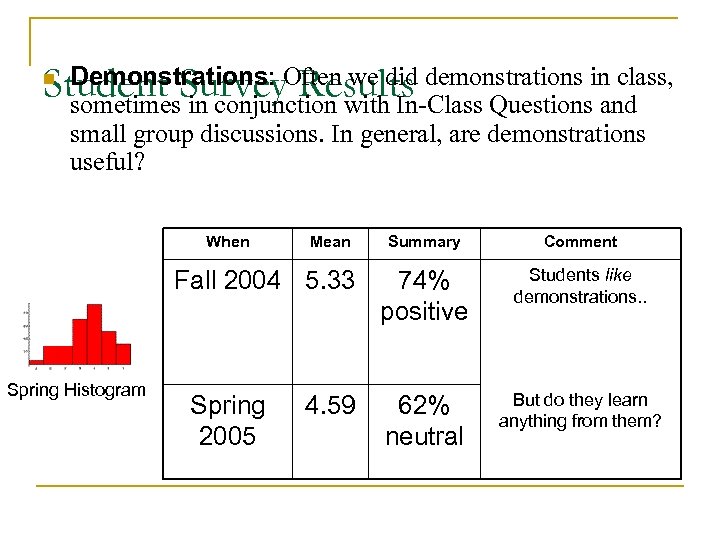 Demonstrations: Results we Student Survey. Often withdid demonstrations in class, sometimes in conjunction In-Class Questions and n small group discussions. In general, are demonstrations useful? When Mean Fall 2004 5. 33 Spring Histogram Spring 2005 4. 59 Summary Comment 74% positive Students like demonstrations. . 62% neutral But do they learn anything from them?
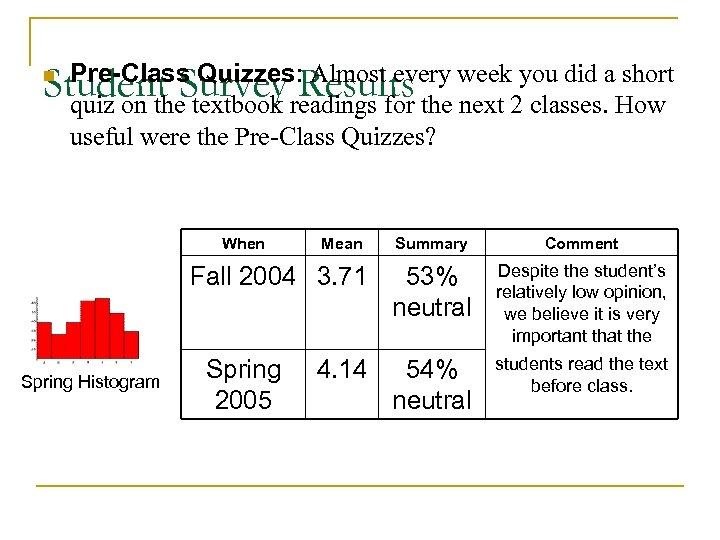 Pre-Class Quizzes: Almost every week you did a short quiz on the textbook readings for the next 2 classes. How useful were the Pre-Class Quizzes? Student Survey Results n When Mean Fall 2004 3. 71 Spring Histogram Spring 2005 4. 14 Summary Comment 53% neutral Despite the student’s relatively low opinion, we believe it is very important that the 54% neutral students read the text before class.
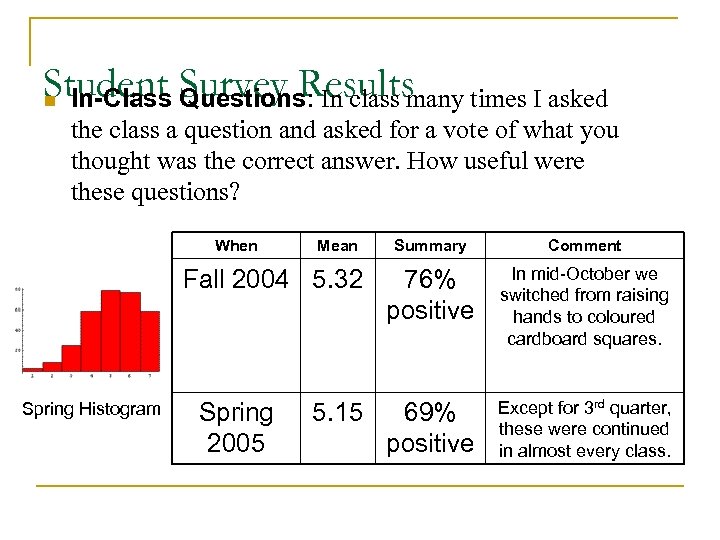 Student Survey Results times I asked n In-Class Questions: In class many the class a question and asked for a vote of what you thought was the correct answer. How useful were these questions? When Mean Fall 2004 5. 32 Spring Histogram Spring 2005 5. 15 Summary Comment 76% positive In mid-October we switched from raising hands to coloured cardboard squares. 69% positive Except for 3 rd quarter, these were continued in almost every class.
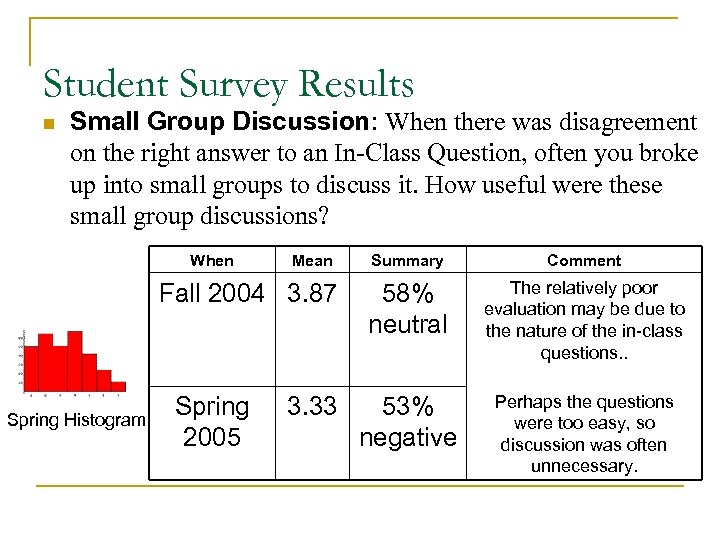 Student Survey Results n Small Group Discussion: When there was disagreement on the right answer to an In-Class Question, often you broke up into small groups to discuss it. How useful were these small group discussions? When Mean Fall 2004 3. 87 Spring Histogram Spring 2005 3. 33 Summary Comment 58% neutral The relatively poor evaluation may be due to the nature of the in-class questions. . 53% negative Perhaps the questions were too easy, so discussion was often unnecessary.
 Future Plans n n We will continue to teach the section of 1000 students together in one big room. U of T has distant plans to build a large lecture room. Radio Frequency Personal Response Systems to replace voting cards. More difficult in-class questions (CINQ database) More TA-training, different format for labs and tutorials.
 Thank You! n Please take the time to fill out the feedback form! -Jason Harlow jharlow@physics. utoronto. ca University of Toronto Physics http: //www. physics. utoronto. ca/~jharlow