 Скачать презентацию Engage Improving Teaching and Learning by Involving Faculty
fe192c40554c80e1a8b072768e3dacbd.ppt
- Количество слайдов: 1



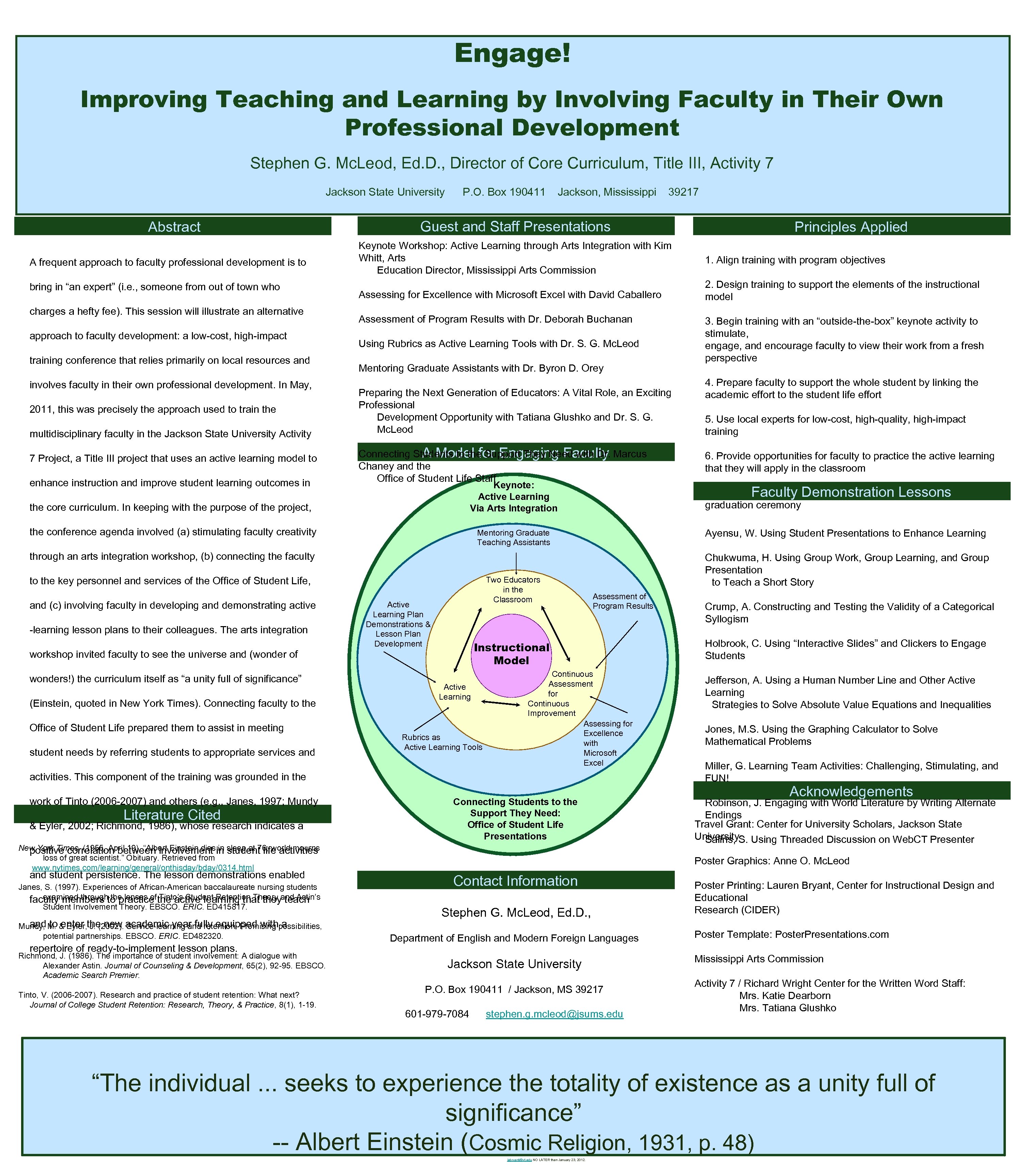
Engage! Improving Teaching and Learning by Involving Faculty in Their Own Professional Development Stephen G. Mc. Leod, Ed. D. , Director of Core Curriculum, Title III, Activity 7 Jackson State University P. O. Box 190411 Jackson, Mississippi 39217 Abstract Guest and Staff Presentations A frequent approach to faculty professional development is to Keynote Workshop: Active Learning through Arts Integration with Kim Whitt, Arts Education Director, Mississippi Arts Commission 1. Align training with program objectives Assessing for Excellence with Microsoft Excel with David Caballero 2. Design training to support the elements of the instructional model bring in “an expert” (i. e. , someone from out of town who charges a hefty fee). This session will illustrate an alternative approach to faculty development: a low-cost, high-impact training conference that relies primarily on local resources and involves faculty in their own professional development. In May, 2011, this was precisely the approach used to train the multidisciplinary faculty in the Jackson State University Activity 7 Project, a Title III project that uses an active learning model to enhance instruction and improve student learning outcomes in Assessment of Program Results with Dr. Deborah Buchanan Using Rubrics as Active Learning Tools with Dr. S. G. Mc. Leod Mentoring Graduate Assistants with Dr. Byron D. Orey Preparing the Next Generation of Educators: A Vital Role, an Exciting Professional Development Opportunity with Tatiana Glushko and Dr. S. G. Mc. Leod Connecting Students to the Support They Need with Dr. Marcus A Model for Engaging Faculty Chaney and the Office of Student Life Staff Keynote: Active Learning Via Arts Integration the core curriculum. In keeping with the purpose of the project, the conference agenda involved (a) stimulating faculty creativity through an arts integration workshop, (b) connecting the faculty and (c) involving faculty in developing and demonstrating active -learning lesson plans to their colleagues. The arts integration Two Educators in the Classroom Active Learning Plan Demonstrations & Lesson Plan Development wonders!) the curriculum itself as “a unity full of significance” (Einstein, quoted in New York Times). Connecting faculty to the Office of Student Life prepared them to assist in meeting student needs by referring students to appropriate services and Active Learning Rubrics as Active Learning Tools Assessment of Program Results Continuous Assessment for Continuous Improvement Assessing for Excellence with Microsoft Excel activities. This component of the training was grounded in the work of Tinto (2006 -2007) and others (e. g. , Janes, 1997; Mundy Literature Cited & Eyler, 2002; Richmond, 1986), whose research indicates a Connecting Students to the Support They Need: Office of Student Life Presentations New York Times. (1955, April 19). “Albert Einstein dies in sleep at 76; world mourns positive correlation between involvement in student life activities loss of great scientist. ” Obituary. Retrieved from www. nytimes. com/learning/general/onthisday/bday/0314. html and student persistence. The lesson demonstrations enabled Janes, S. (1997). Experiences of African-American baccalaureate nursing students examined through the lenses of Tinto’s Student Retention Theory and Astin’s faculty members to practice the active learning that they teach Student Involvement Theory. EBSCO. ERIC. ED 415817. and to enter the new academic year fully equipped with a Mundy, M. & Eyler, J. (2002). Service-learning and retention: Promising possibilities, potential partnerships. EBSCO. ERIC. ED 482320. repertoire of ready-to-implement lesson plans. Richmond, J. (1986). The importance of student involvement: A dialogue with Alexander Astin. Journal of Counseling & Development, 65(2), 92 -95. EBSCO. Academic Search Premier. Tinto, V. (2006 -2007). Research and practice of student retention: What next? Journal of College Student Retention: Research, Theory, & Practice, 8(1), 1 -19. 4. Prepare faculty to support the whole student by linking the academic effort to the student life effort 5. Use local experts for low-cost, high-quality, high-impact training 6. Provide opportunities for faculty to practice the active learning that they will apply in the classroom 7. Celebrate faculty achievement with a certificate and a Faculty Demonstration Lessons graduation ceremony Chukwuma, H. Using Group Work, Group Learning, and Group Presentation to Teach a Short Story Instructional Model workshop invited faculty to see the universe and (wonder of 3. Begin training with an “outside-the-box” keynote activity to stimulate, engage, and encourage faculty to view their work from a fresh perspective Ayensu, W. Using Student Presentations to Enhance Learning Mentoring Graduate Teaching Assistants to the key personnel and services of the Office of Student Life, Principles Applied Crump, A. Constructing and Testing the Validity of a Categorical Syllogism Holbrook, C. Using “Interactive Slides” and Clickers to Engage Students Jefferson, A. Using a Human Number Line and Other Active Learning Strategies to Solve Absolute Value Equations and Inequalities Jones, M. S. Using the Graphing Calculator to Solve Mathematical Problems Miller, G. Learning Team Activities: Challenging, Stimulating, and FUN! Acknowledgements Robinson, J. Engaging with World Literature by Writing Alternate Endings Travel Grant: Center for University Scholars, Jackson State University Salins, S. Using Threaded Discussion on Web. CT Presenter Poster Graphics: Anne O. Mc. Leod Contact Information Stephen G. Mc. Leod, Ed. D. , Department of English and Modern Foreign Languages Jackson State University P. O. Box 190411 / Jackson, MS 39217 601 -979 -7084 stephen. g. mcleod@jsums. edu Poster Printing: Lauren Bryant, Center for Instructional Design and Educational Research (CIDER) Poster Template: Poster. Presentations. com Mississippi Arts Commission Activity 7 / Richard Wright Center for the Written Word Staff: Mrs. Katie Dearborn Mrs. Tatiana Glushko “The individual. . . seeks to experience the totality of existence as a unity full of significance” -- Albert Einstein (Cosmic Religion, 1931, p. 48) labryant@vt. edu NO LATER than January 23, 2012.
Скачать презентацию Engage Improving Teaching and Learning by Involving Faculty
fe192c40554c80e1a8b072768e3dacbd.ppt