 Скачать презентацию Energyefficient Architecture and Bionics WHAT CAN ARCHITECTS LEARN
190703343f3a06e7199855350b280bf0.ppt
- Количество слайдов: 30



Energyefficient Architecture and Bionics WHAT CAN ARCHITECTS LEARN FROM NATURE? Dr. Karl-Heinz Oeller – Board of directors Internationales Bionik-Zentrum.
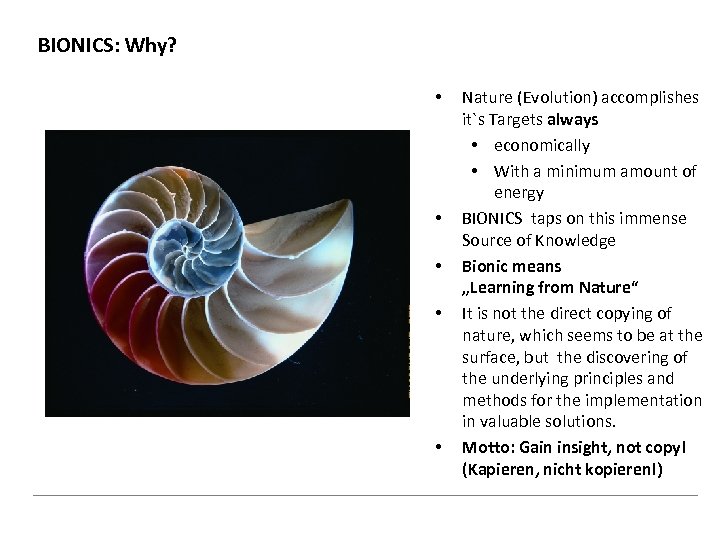
BIONICS: Why? • • • Nature (Evolution) accomplishes it`s Targets always • economically • With a minimum amount of energy BIONICS taps on this immense Source of Knowledge Bionic means „Learning from Nature“ It is not the direct copying of nature, which seems to be at the surface, but the discovering of the underlying principles and methods for the implementation in valuable solutions. Motto: Gain insight, not copy! (Kapieren, nicht kopieren!)
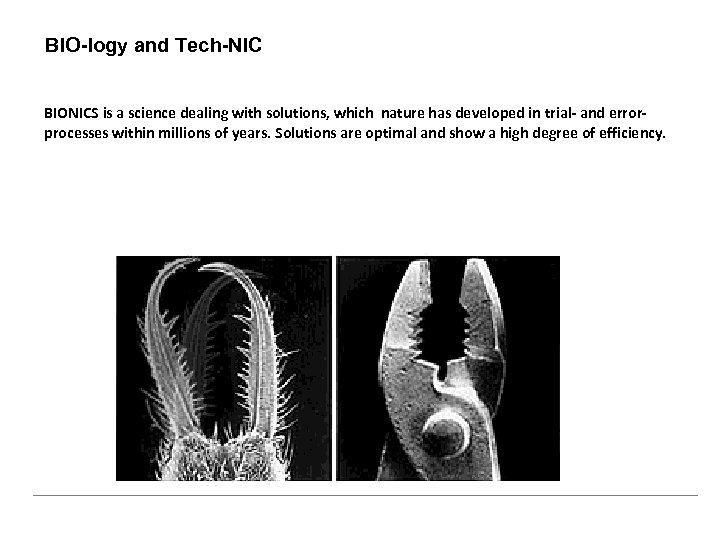
BIO-logy and Tech-NIC BIONICS is a science dealing with solutions, which nature has developed in trial- and errorprocesses within millions of years. Solutions are optimal and show a high degree of efficiency.
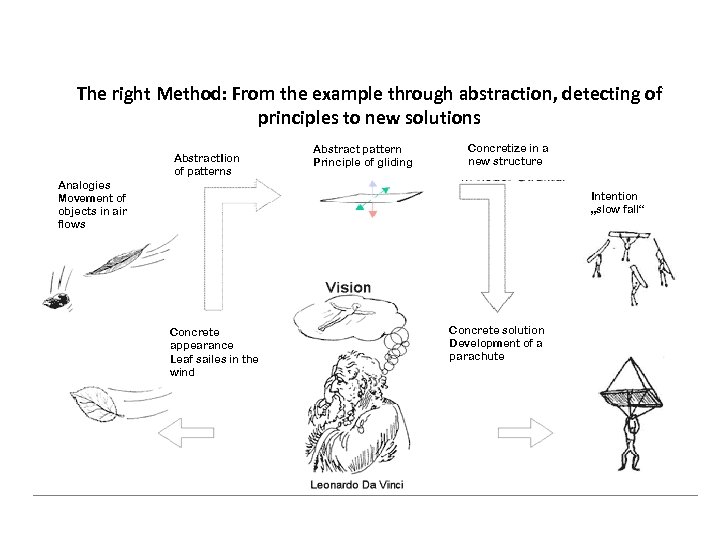
The right Method: From the example through abstraction, detecting of principles to new solutions Abstract. Iion of patterns Abstract pattern Principle of gliding Concretize in a new structure Analogies Movement of objects in air flows Intention „slow fall“ Concrete appearance Leaf sailes in the wind Concrete solution Development of a parachute
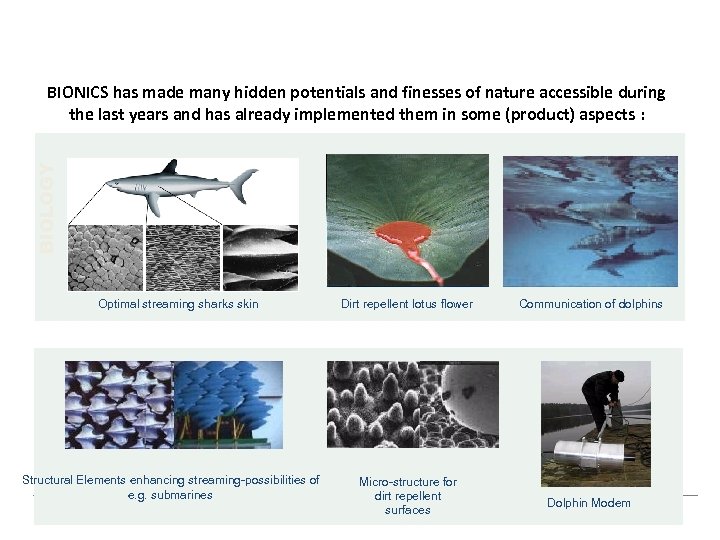
BIOLOGY BIONICS has made many hidden potentials and finesses of nature accessible during the last years and has already implemented them in some (product) aspects : Optimal streaming sharks skin Structural Elements enhancing streaming-possibilities of e. g. submarines Dirt repellent lotus flower Micro-structure for dirt repellent surfaces Communication of dolphins Dolphin Modem
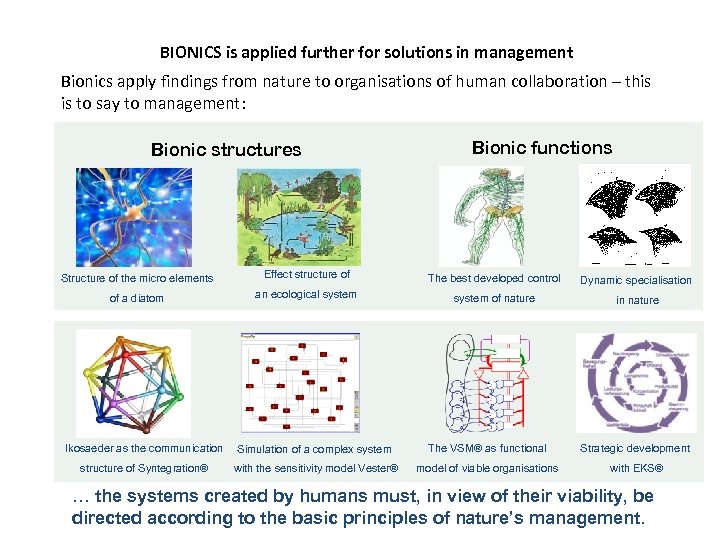
BIONICS is applied further for solutions in management Bionics apply findings from nature to organisations of human collaboration – this is to say to management: Bionic structures Bionic functions Structure of the micro elements Effect structure of The best developed control Dynamic specialisation of a diatom an ecological system of nature in nature Ikosaeder as the communication Simulation of a complex system The VSM® as functional Strategic development structure of Syntegration® with the sensitivity model Vester® model of viable organisations with EKS® … the systems created by humans must, in view of their viability, be directed according to the basic principles of nature’s management.
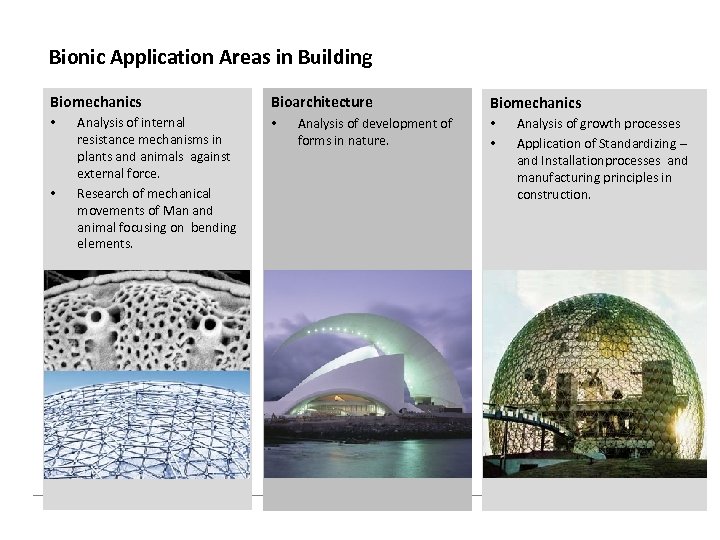
Bionic Application Areas in Building Biomechanics • • Analysis of internal resistance mechanisms in plants and animals against external force. Research of mechanical movements of Man and animal focusing on bending elements. Bioarchitecture • Analysis of development of forms in nature. Biomechanics • • Analysis of growth processes Application of Standardizing – and Installationprocesses and manufacturing principles in construction.
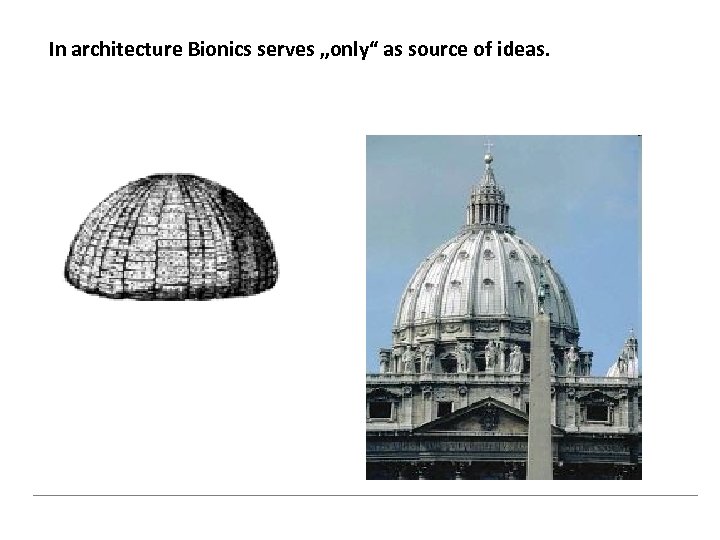
In architecture Bionics serves „only“ as source of ideas.
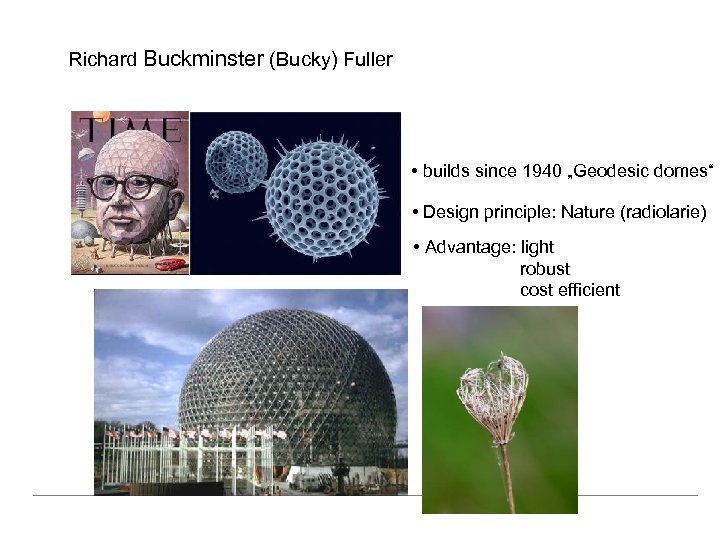
Richard Buckminster (Bucky) Fuller • builds since 1940 „Geodesic domes“ • Design principle: Nature (radiolarie) • Advantage: light robust cost efficient
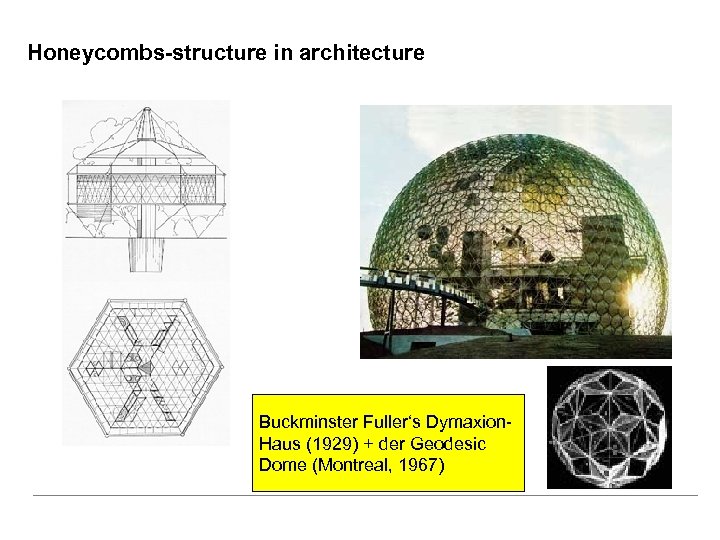
Honeycombs-structure in architecture Buckminster Fuller‘s Dymaxion. Haus (1929) + der Geodesic Dome (Montreal, 1967)
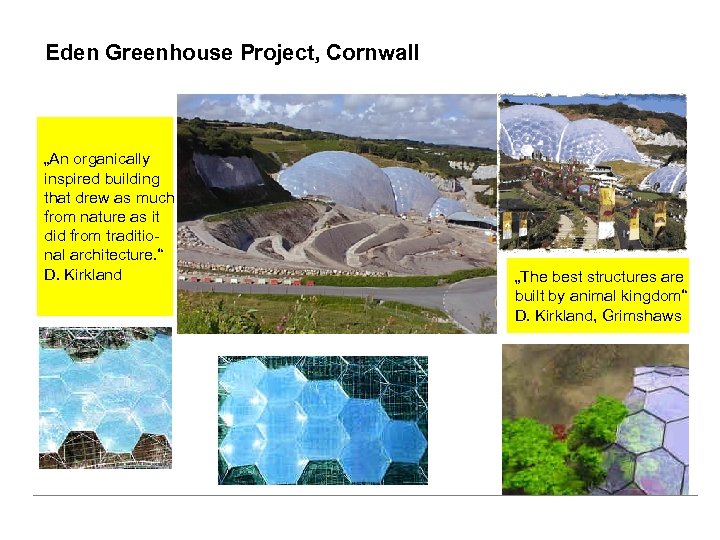
Eden Greenhouse Project, Cornwall „An organically inspired building that drew as much from nature as it did from traditional architecture. “ D. Kirkland „The best structures are built by animal kingdom“ D. Kirkland, Grimshaws
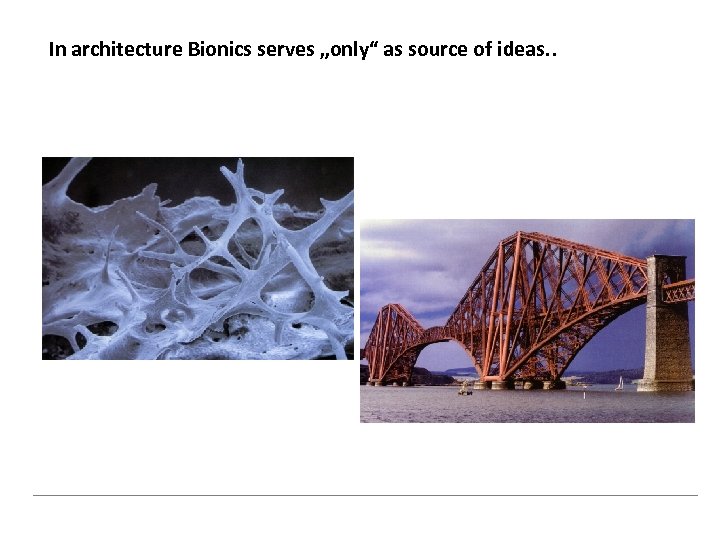
In architecture Bionics serves „only“ as source of ideas. .
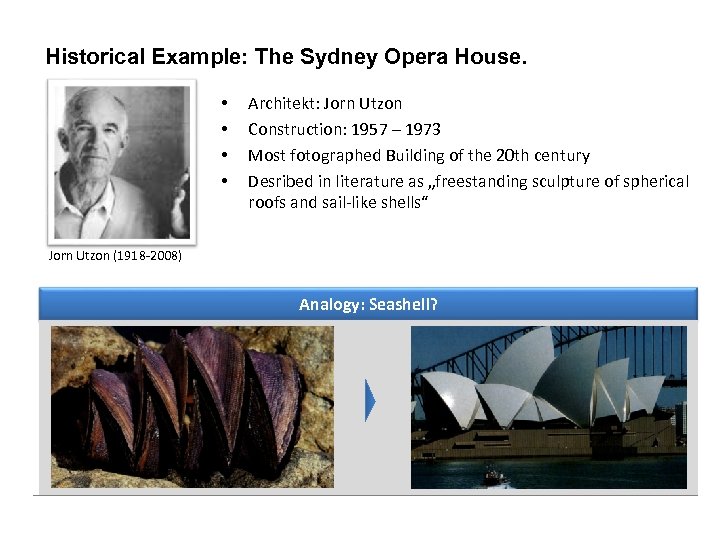
Historical Example: The Sydney Opera House. • • Architekt: Jorn Utzon Construction: 1957 – 1973 Most fotographed Building of the 20 th century Desribed in literature as „freestanding sculpture of spherical roofs and sail-like shells“ Jorn Utzon (1918 -2008) Analogy: Seashell?
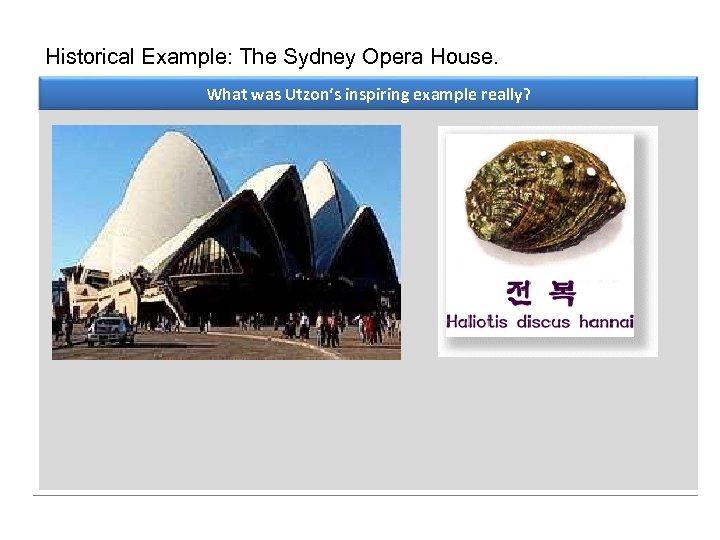
Historical Example: The Sydney Opera House. What was Utzon‘s inspiring example really?
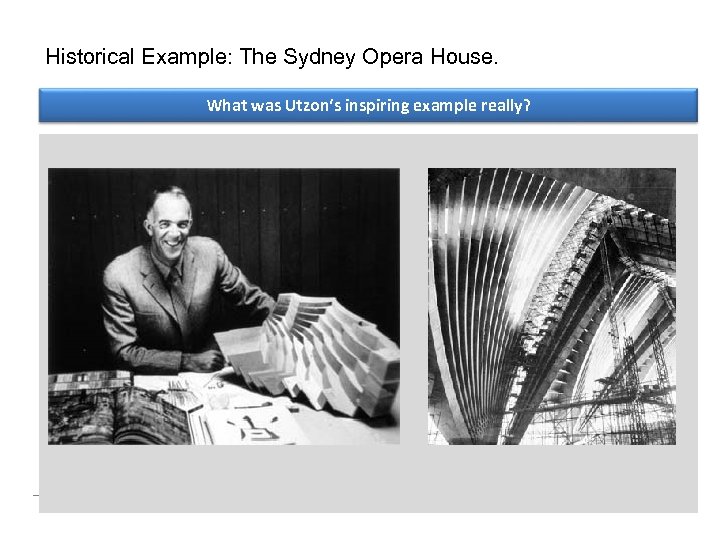
Historical Example: The Sydney Opera House. What was Utzon‘s inspiring example really?
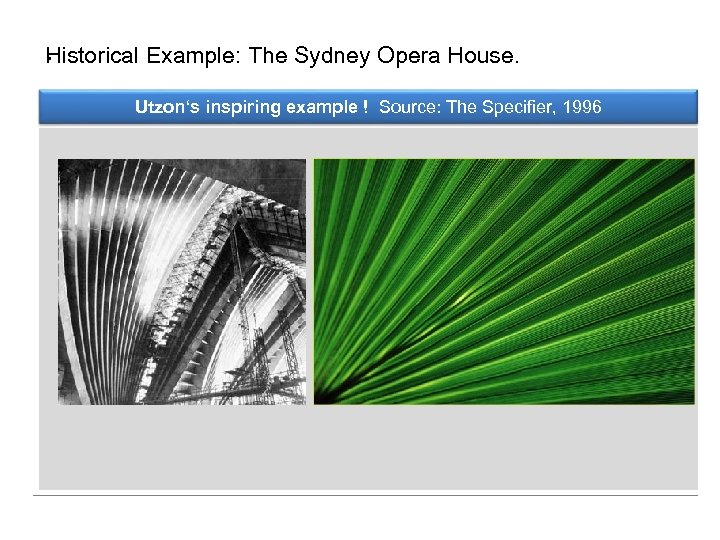
. Historical Example: The Sydney Opera House. Utzon‘s inspiring example ! Source: The Specifier, 1996
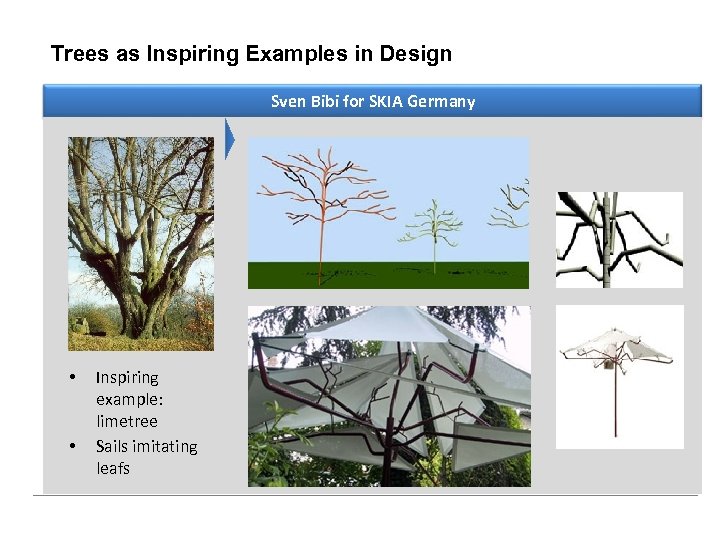
Trees as Inspiring Examples in Design Sven Bibi for SKIA Germany • • Inspiring example: limetree Sails imitating leafs
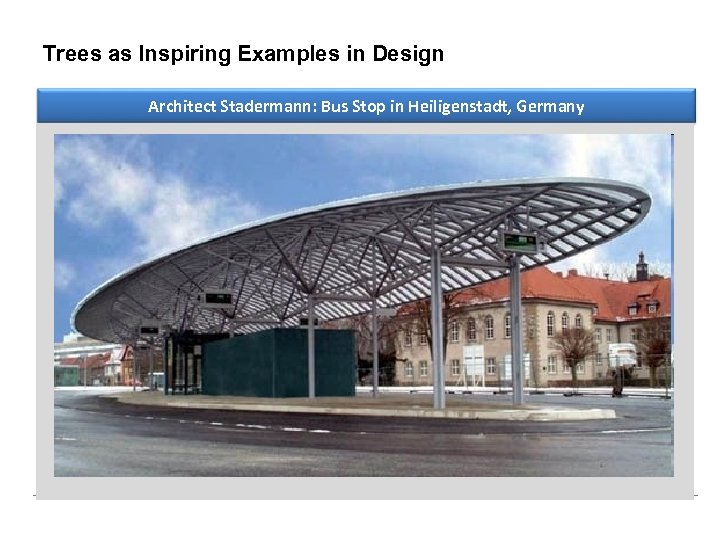
Trees as Inspiring Examples in Design Architect Stadermann: Bus Stop in Heiligenstadt, Germany
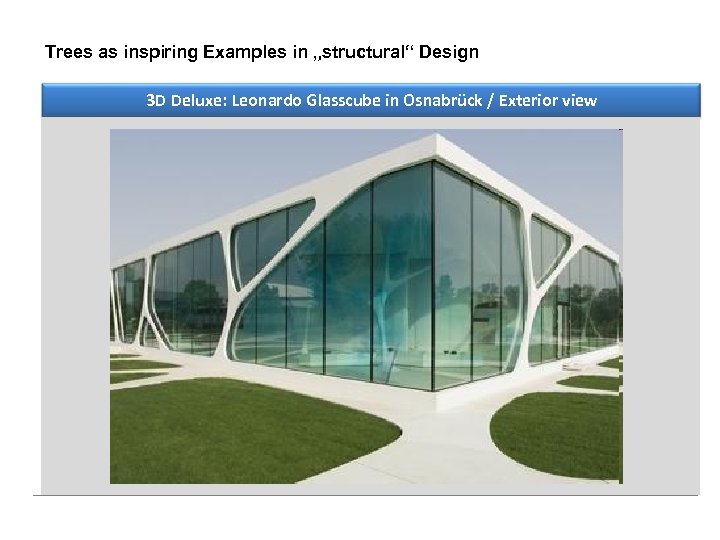
Trees as inspiring Examples in „structural“ Design 3 D Deluxe: Leonardo Glasscube in Osnabrück / Exterior view
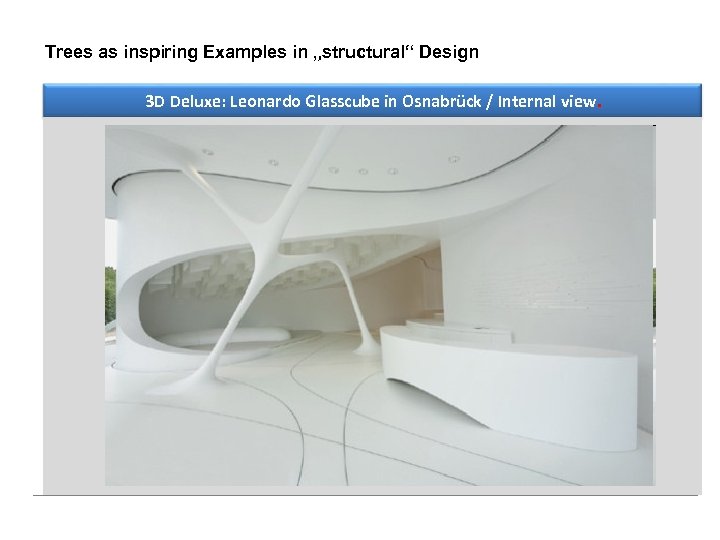
Trees as inspiring Examples in „structural“ Design 3 D Deluxe: Leonardo Glasscube in Osnabrück / Internal view.
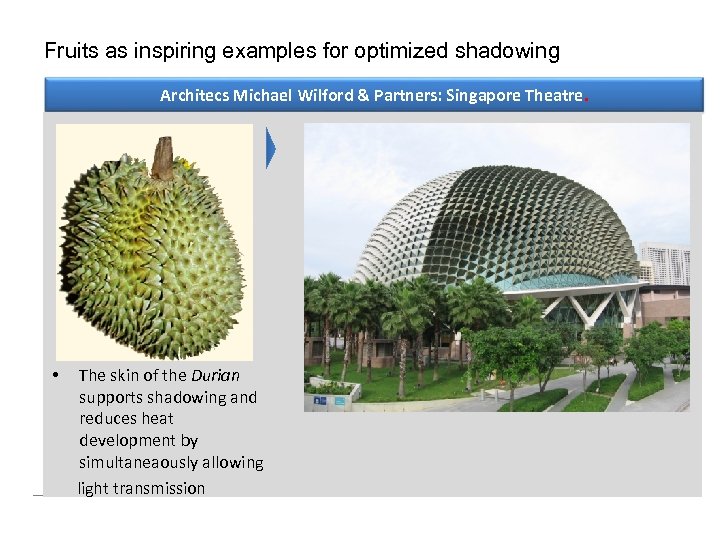
Fruits as inspiring examples for optimized shadowing Architecs Michael Wilford & Partners: Singapore Theatre. • The skin of the Durian supports shadowing and reduces heat development by simultaneaously allowing light transmission
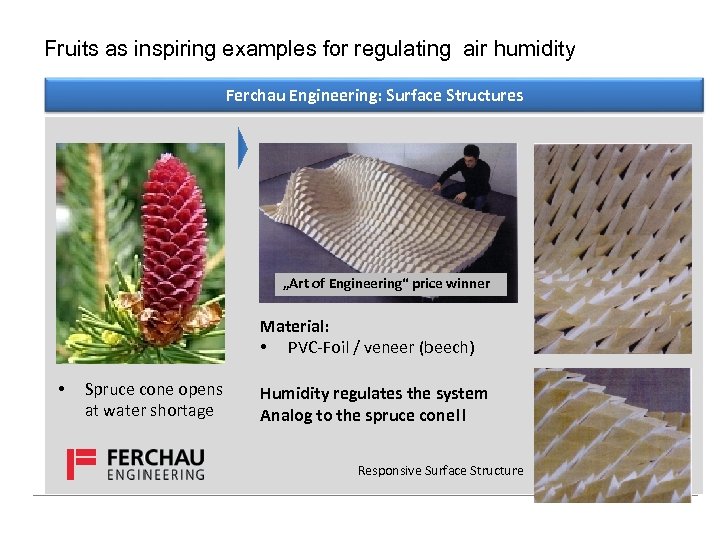
Fruits as inspiring examples for regulating air humidity Ferchau Engineering: Surface Structures „Art of Engineering“ price winner Material: • PVC-Foil / veneer (beech) • Spruce cone opens at water shortage Humidity regulates the system Analog to the spruce cone!! Responsive Surface Structure
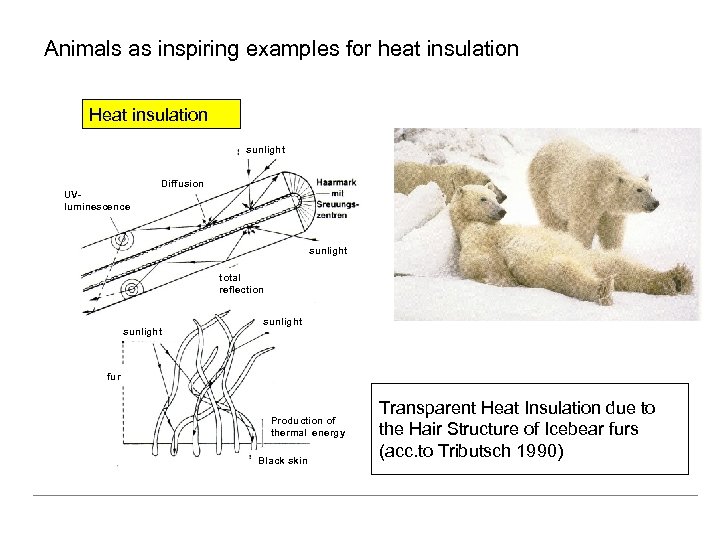
Animals as inspiring examples for heat insulation Heat insulation sunlight Diffusion UVluminescence sunlight total reflection sunlight fur Production of thermal energy Black skin Transparent Heat Insulation due to the Hair Structure of Icebear furs (acc. to Tributsch 1990)
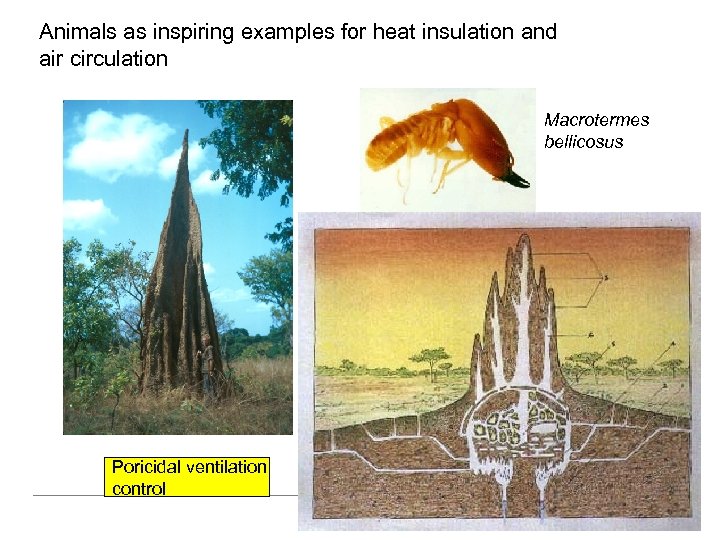
Animals as inspiring examples for heat insulation and air circulation Macrotermes bellicosus Poricidal ventilation control
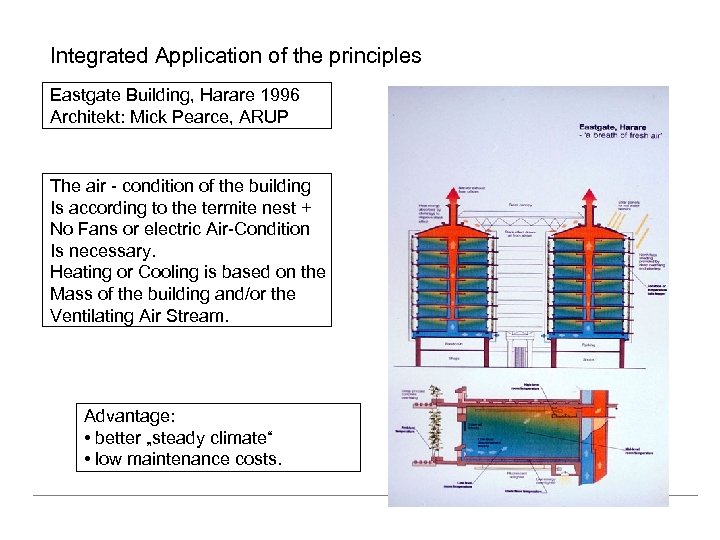
Integrated Application of the principles Eastgate Building, Harare 1996 Architekt: Mick Pearce, ARUP The air - condition of the building Is according to the termite nest + No Fans or electric Air-Condition Is necessary. Heating or Cooling is based on the Mass of the building and/or the Ventilating Air Stream. Advantage: • better „steady climate“ • low maintenance costs.
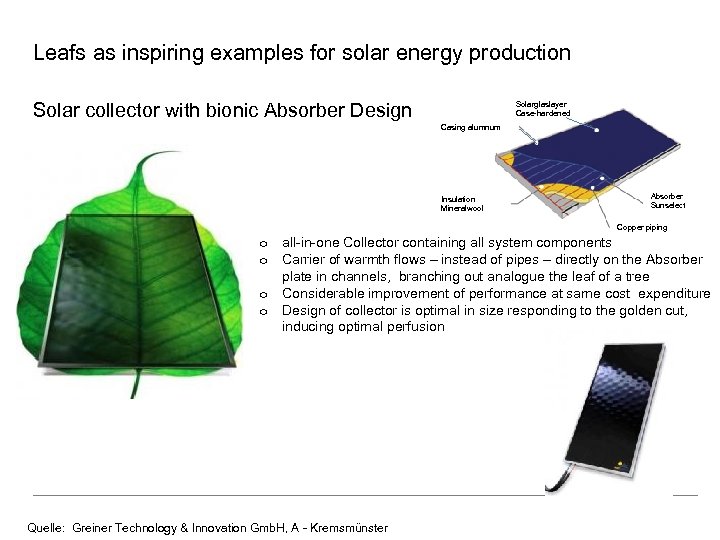
Leafs as inspiring examples for solar energy production Solar collector with bionic Absorber Design Solarglaslayer Case-hardened Casing alumnum Insulation Mineralwool Absorber Sunselect Copper piping o all-in-one Collector containing all system components o Carrier of warmth flows – instead of pipes – directly on the Absorber plate in channels, branching out analogue the leaf of a tree o Considerable improvement of performance at same cost expenditure o Design of collector is optimal in size responding to the golden cut, inducing optimal perfusion Quelle: Greiner Technology & Innovation Gmb. H, A - Kremsmünster
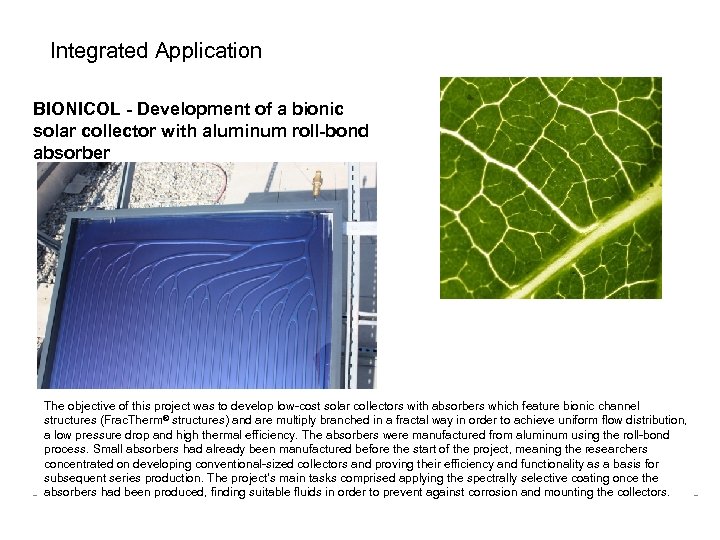
Integrated Application BIONICOL - Development of a bionic solar collector with aluminum roll-bond absorber The objective of this project was to develop low-cost solar collectors with absorbers which feature bionic channel structures (Frac. Therm® structures) and are multiply branched in a fractal way in order to achieve uniform flow distribution, a low pressure drop and high thermal efficiency. The absorbers were manufactured from aluminum using the roll-bond process. Small absorbers had already been manufactured before the start of the project, meaning the researchers concentrated on developing conventional-sized collectors and proving their efficiency and functionality as a basis for subsequent series production. The project’s main tasks comprised applying the spectrally selective coating once the absorbers had been produced, finding suitable fluids in order to prevent against corrosion and mounting the collectors.
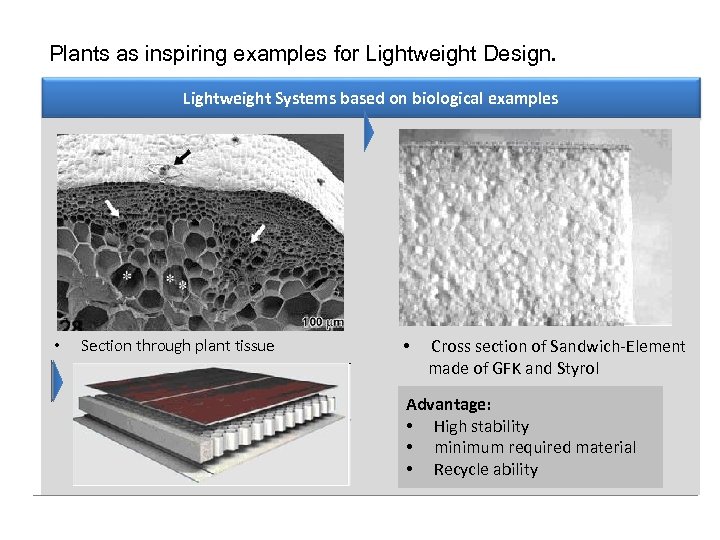
Plants as inspiring examples for Lightweight Design. Lightweight Systems based on biological examples • Section through plant tissue • Cross section of Sandwich-Element made of GFK and Styrol Advantage: • High stability • minimum required material • Recycle ability
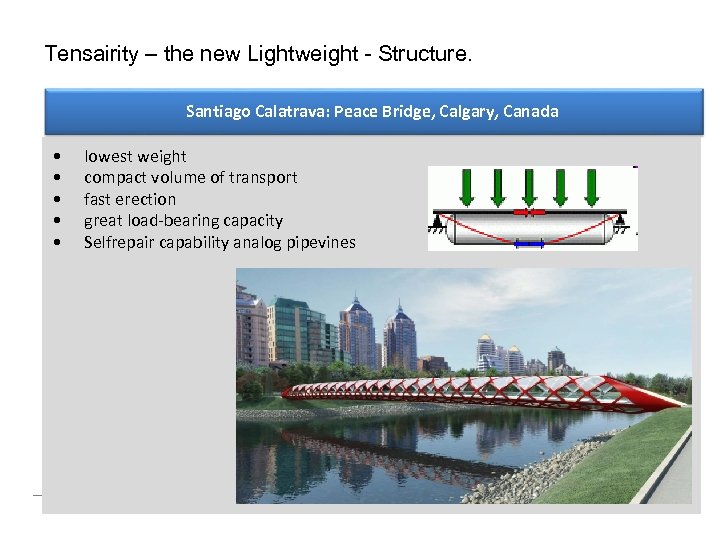
Tensairity – the new Lightweight - Structure. Santiago Calatrava: Peace Bridge, Calgary, Canada • • • lowest weight compact volume of transport fast erection great load-bearing capacity Selfrepair capability analog pipevines
Thank you for your attention. Contact: Dr. Karl-Heinz Oeller, Contact: directors, Internationales Bionik-Zentrum, Board of Markus Winter, energiewaechter Gmb. H E-Mail: mdw@energiewaechter. de E-Mail: kh. Oeller@gmx. at; +41 79 600 3819
Скачать презентацию Energyefficient Architecture and Bionics WHAT CAN ARCHITECTS LEARN
190703343f3a06e7199855350b280bf0.ppt