 Скачать презентацию ENERGY STAR FOR GRANTEES BOB PAQUIN Director Hud
54b0637af7b077b4dad40d3451a6fae0.ppt
- Количество слайдов: 55



ENERGY STAR FOR GRANTEES BOB PAQUIN Director Hud Community Planning and Development New England Office
ENERGY EFFICIENCY with CDBG & HOME SEPT 13 ’ 04 - updated Aug 20 ’ 07
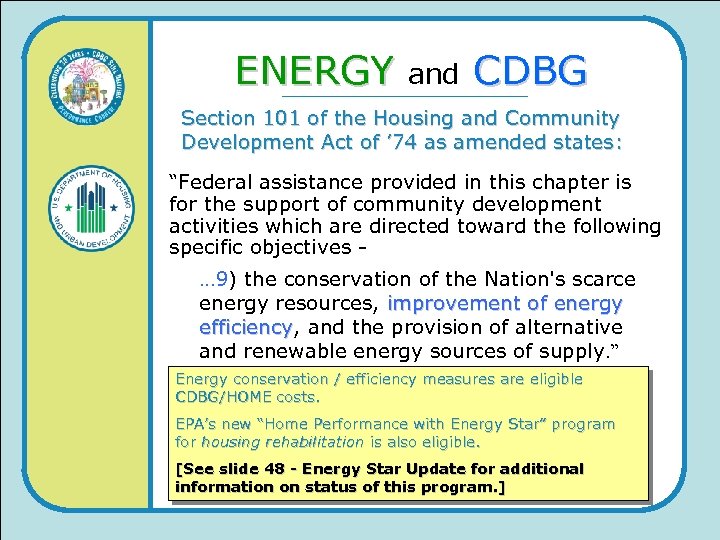
ENERGY and CDBG Section 101 of the Housing and Community Development Act of ’ 74 as amended states: “Federal assistance provided in this chapter is for the support of community development activities which are directed toward the following specific objectives … 9) the conservation of the Nation's scarce energy resources, improvement of energy efficiency, and the provision of alternative efficiency and renewable energy sources of supply. ” Energy conservation / efficiency measures are eligible CDBG/HOME costs. EPA’s new “Home Performance with Energy Star” program for housing rehabilitation is also eligible. [See slide 48 - Energy Star Update for additional information on status of this program. ]
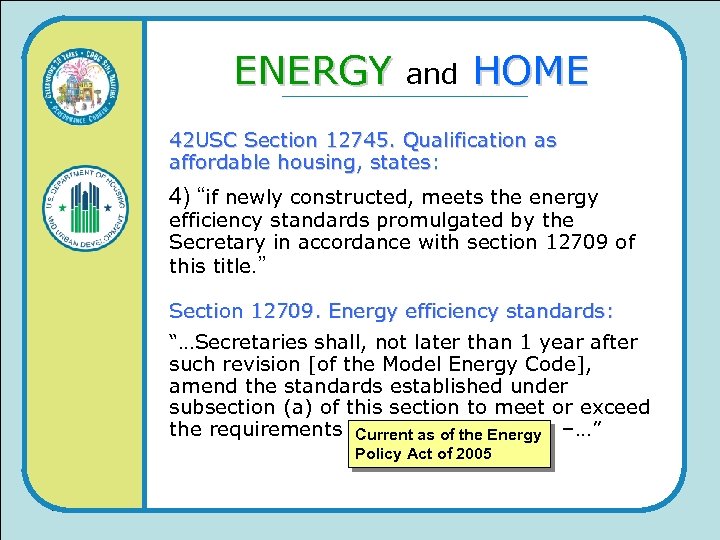
ENERGY and HOME 42 USC Section 12745. Qualification as affordable housing, states: 4) “if newly constructed, meets the energy efficiency standards promulgated by the Secretary in accordance with section 12709 of this title. ” Section 12709. Energy efficiency standards: “…Secretaries shall, not later than 1 year after such revision [of the Model Energy Code], amend the standards established under subsection (a) of this section to meet or exceed the requirements of such revised code –…” Current as of the Energy Policy Act of 2005
ENERGY and HOUSING means…
ENERGY STAR and HOUSING
ENERGY STAR As a HUD Grantee you play an important role in the development of quality affordable housing in your community. You decide in large measure what gets built, as well as where, when, and how it happens This presentation will help you build higher quality, more affordable housing while simultaneously reducing air pollution and the demand for energy
ENERGY STAR Now, before we go any further, lets clear up some potential confusion. WHAT ABOUT “GREEN” AND ENERGY STAR Through ENERGY STAR qualified homes and the ENERGY STAR Indoor Air Package, homebuyers can address two critical green home elements. Then, look to the wide variety of available green home programs to complete the picture with water-efficient products, renewable energy technologies, waste reduction, recycling, and sustainable land development practices http: //www. energystar. gov/ia/new_homes/G reen_Begins_with_ENERGYSTAR_Blue. pdf
ENERGY STAR By the end of this presentation you will know: What it is How it works Why it works How you can easily adopt it for your residential new construction projects.
ENERGY STAR A national goal of HUD, DOE, and EPA. Introduced by the EPA in 1992 as a voluntary market-based partnership to reduce air pollution through increased energy efficiency + In 1995, with the assistance of the Department of Energy (Do. E), the Energy Star standard was extended to the building industry by applying Do. E’s Home Energy Ratings System (HERS) Joint MOU with DOE and EPA signed by HUD in Sept. 2002 to increase HUD’s participation in Energy Star for its assisted housing programs.
ENERGY STAR Sets Energy Performance Standards for: Ø Electronic equipment (e. g. , computers) Ø Appliances Ø Buildings – Use for CDBG & HOME
APPLIANCES What Makes a Product ENERGY STAR? ENERGY STAR products are the same or better than standard products only they use less energy. To earn the ENERGY STAR they must meet strict energy efficiency criteria set by the EPA or the DOE. Since they use less energy, these products save you money on your electricity bill and help protect the environment by causing fewer harmful emissions from power plants. And you get the features and quality you expect. Some examples: Qualified refrigerators are at least 15% more efficient than the minimum federal efficiency standard. • Qualified TVs consume 3 watts or less when switched off, compared to a standard TV, which consumes almost 6 watts on average. • Office equipment that qualifies automatically enters a lowpower "sleep" mode after a period of inactivity. • Qualified light bulbs (CFLs) use two-thirds less energy than a standard incandescent bulb and must meet additional operating and reliability guidelines. • Qualified furnaces offer a rating of 90% AFUE or greater, which is about 15% more efficient than the minimum federal efficiency standard.
BUILDINGS ENERGY STAR BUILDING PERFORMANCE STANDARD Efficiency means total purchased house energy consumption – not only heating, cooling and hot water. [New in ’ 06] For residential single and multifamily new construction up to 3 stories. A system for achieving and verifying a certain level of performance with respect to energy efficiency Performance certified by independent third-party contractors ENERGY STAR is not a new building code, or specification… does not replace existing energy codes or building codes.
ENERGY STAR BUILDING PERFORMANCE STANDARD BENEFITS: Lower Utility Costs: Energy Star (ES) cost as much as 30 – 40% less per year to heat and power than standard homes. * These savings will increase as the cost of energy continues to rise Increased Comfort: § Even temperature throughout home § Eliminate drafts § Improved indoor air quality (Ventilation) Increased Durability: Eliminate water/mold problems by controlling moisture *May be 15% less when compared to some recent State Energy Codes.
ENERGY STAR Other Advantages: Independent 3 rd party inspection. * Higher quality construction. Adds value. [Appraisal Journal article, October 1998] Increased discretionary income for a tenant or owner/resident. Higher debt load for developer or a buyer. ** * Cost can be paid by CDBG. **See also FHA’s Energy Efficiency Program
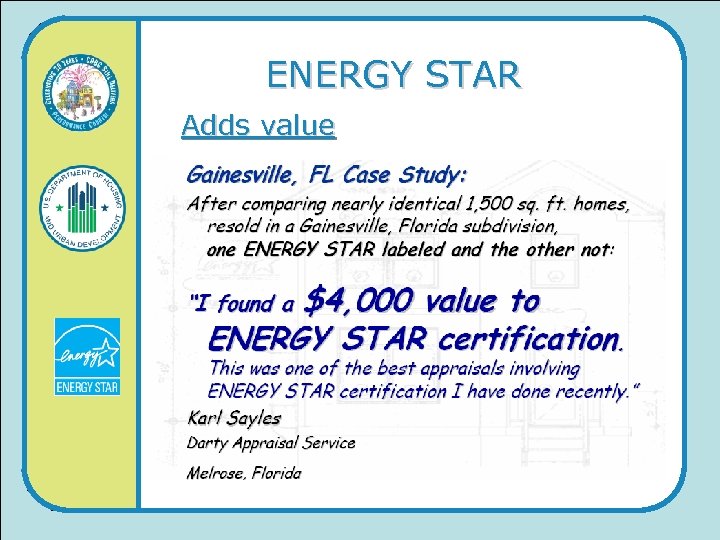
ENERGY STAR Adds value
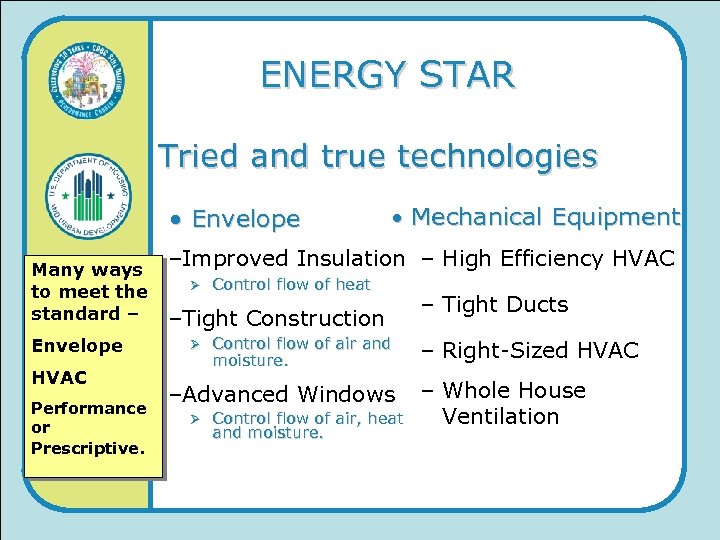
ENERGY STAR Tried and true technologies • Envelope Many ways to meet the standard – Envelope HVAC Performance or Prescriptive. • Mechanical Equipment –Improved Insulation – High Efficiency HVAC Ø Control flow of heat –Tight Construction Ø Control flow of air and moisture. –Advanced Windows Ø Control flow of air, heat and moisture. – Tight Ducts – Right-Sized HVAC – Whole House Ventilation
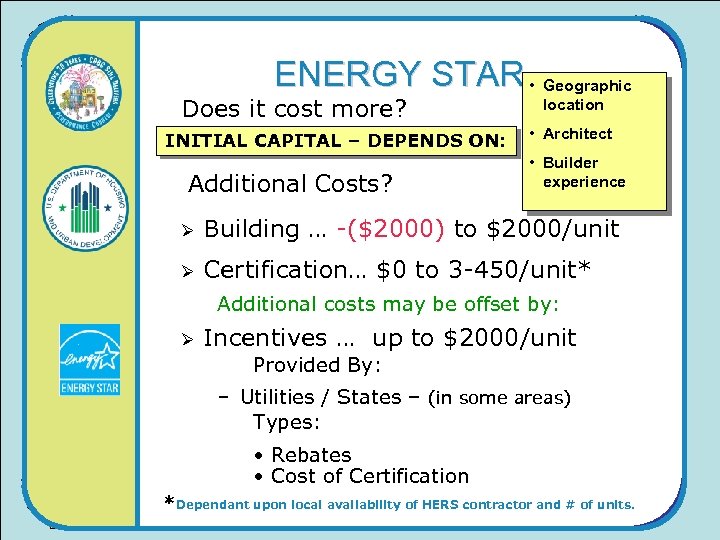
ENERGY STAR • Geographic Does it cost more? INITIAL CAPITAL – DEPENDS ON: Additional Costs? location • Architect • Builder experience Ø Building … -($2000) to $2000/unit Ø Certification… $0 to 3 -450/unit* Additional costs may be offset by: Ø Incentives … up to $2000/unit Provided By: – Utilities / States – (in some areas) Types: • Rebates • Cost of Certification *Dependant upon local availability of HERS contractor and # of units.
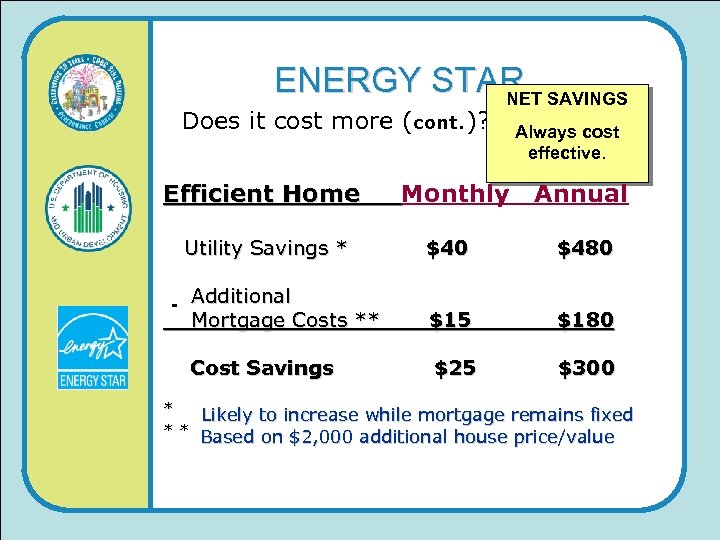
ENERGY STAR NET SAVINGS Does it cost more (cont. )? Efficient Home Utility Savings * - Additional Mortgage Costs ** Cost Savings Monthly Always cost effective. Annual $40 $480 $15 $180 $25 $300 * Likely to increase while mortgage remains fixed * * Based on $2, 000 additional house price/value
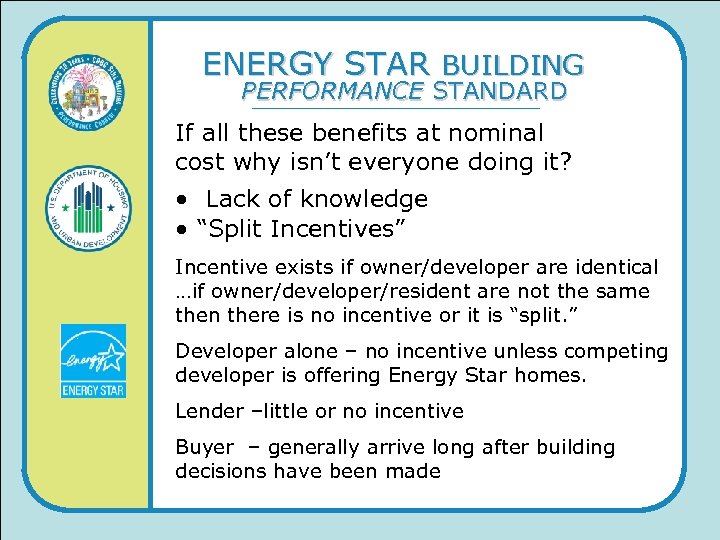
ENERGY STAR BUILDING PERFORMANCE STANDARD If all these benefits at nominal cost why isn’t everyone doing it? • Lack of knowledge • “Split Incentives” Incentive exists if owner/developer are identical …if owner/developer/resident are not the same then there is no incentive or it is “split. ” Developer alone – no incentive unless competing developer is offering Energy Star homes. Lender –little or no incentive Buyer – generally arrive long after building decisions have been made
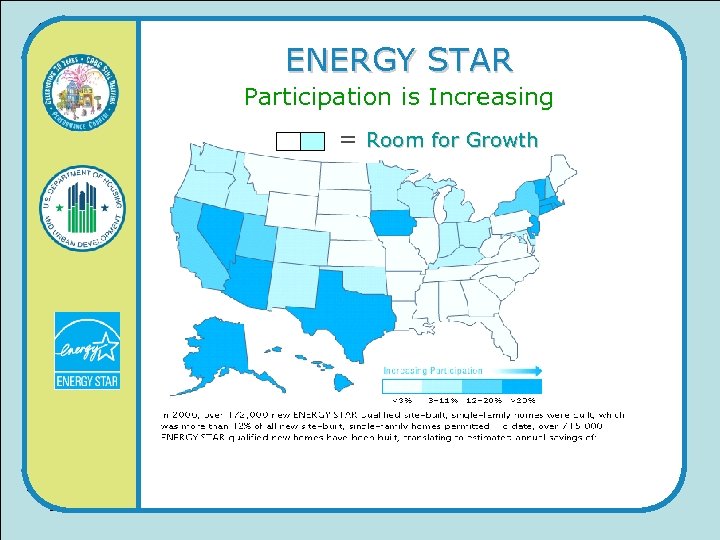
ENERGY STAR Participation is Increasing = Room for Growth
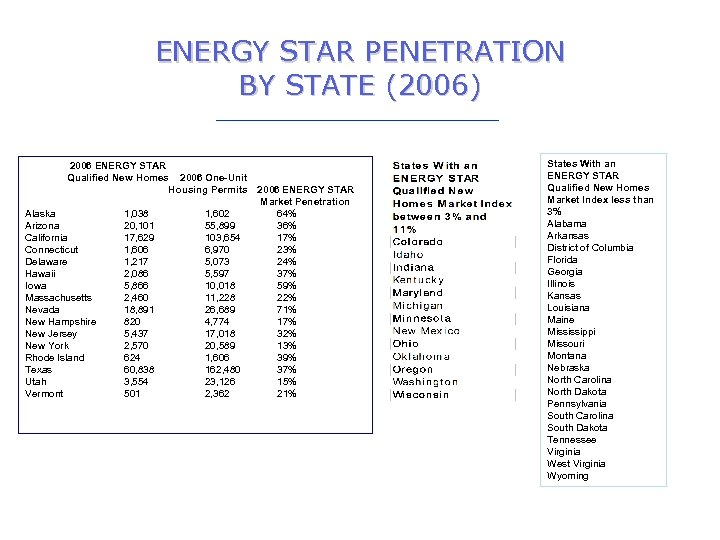
ENERGY STAR PENETRATION BY STATE (2006) 2006 ENERGY STAR Qualified New Homes 2006 One-Unit Housing Permits 2006 ENERGY STAR Market Penetration Alaska 1, 038 1, 602 64% Arizona 20, 101 55, 899 36% California 17, 629 103, 654 17% Connecticut 1, 606 6, 970 23% Delaware 1, 217 5, 073 24% Hawaii 2, 086 5, 597 37% Iowa 5, 866 10, 018 59% Massachusetts 2, 460 11, 228 22% Nevada 18, 891 26, 689 71% New Hampshire 820 4, 774 17% New Jersey 5, 437 17, 018 32% New York 2, 570 20, 589 13% Rhode Island 624 1, 606 39% Texas 60, 838 162, 480 37% Utah 3, 554 23, 126 15% Vermont 501 2, 362 21% States With an ENERGY STAR Qualified New Homes Market Index less than 3% Alabama Arkansas District of Columbia Florida Georgia Illinois Kansas Louisiana Maine Mississippi Missouri Montana Nebraska North Carolina North Dakota Pennsylvania South Carolina South Dakota Tennessee Virginia West Virginia Wyoming
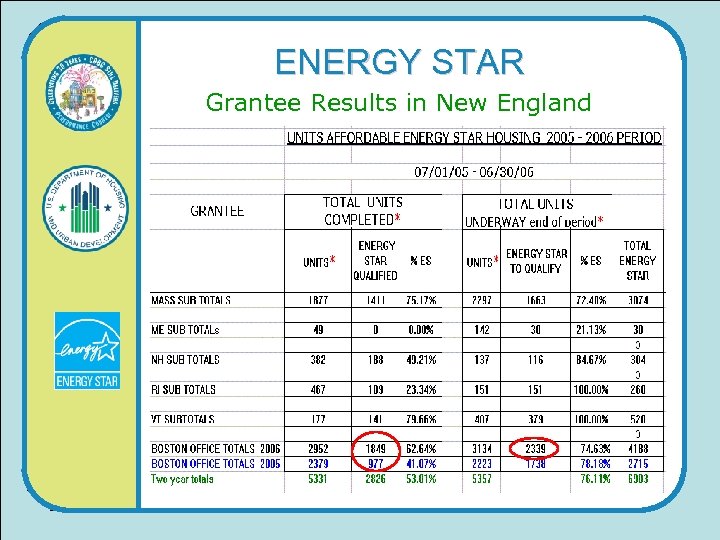
ENERGY STAR Grantee Results in New England
ENERGY STAR Participation is Increasing Why is participation increasing? Why does this program work?
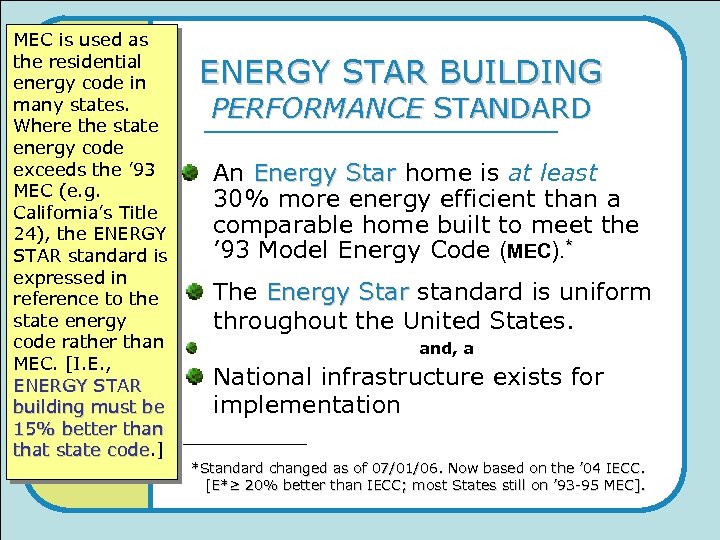
MEC is used as the residential energy code in many states. PERFORMANCE STANDARD Where the state energy code exceeds the ’ 93 An Energy Star home is at least MEC (e. g. 30% more energy efficient than a California’s Title comparable home built to meet the 24), the ENERGY ’ 93 Model Energy Code (MEC). * STAR standard is MEC is used as the residential energy code in many expressed in The Energy Star standard is uniform reference to the states. Where the state energy code exceeds the ’ 93 MEC throughout the United States. STAR (e. g. California’s Title 24), the ENERGY state energy code rather than standard is expressed in reference to the state and, a energy code rather than MEC. [I. E. , ENERGY STAR MEC. [I. E. , National 15% better than exists code. ] building must beinfrastructurethat statefor ENERGY STAR code implementation building must be 15% better than that state code. ] code ENERGY STAR BUILDING *Standard changed as of 07/01/06. Now based on the ’ 04 IECC. [E*≥ 20% better than IECC; most States still on ’ 93 -95 MEC].
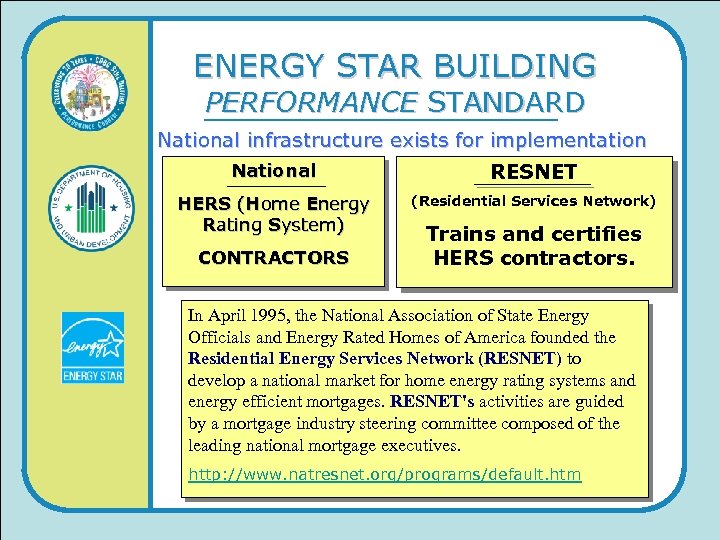
ENERGY STAR BUILDING PERFORMANCE STANDARD National infrastructure exists for implementation National RESNET HERS (Home Energy Rating System) (Residential Services Network) CONTRACTORS Trains and certifies HERS contractors. In April 1995, the National Association of State Energy Officials and Energy Rated Homes of America founded the Residential Energy Services Network (RESNET) to develop a national market for home energy rating systems and energy efficient mortgages. RESNET's activities are guided by a mortgage industry steering committee composed of the leading national mortgage executives. http: //www. natresnet. org/programs/default. htm
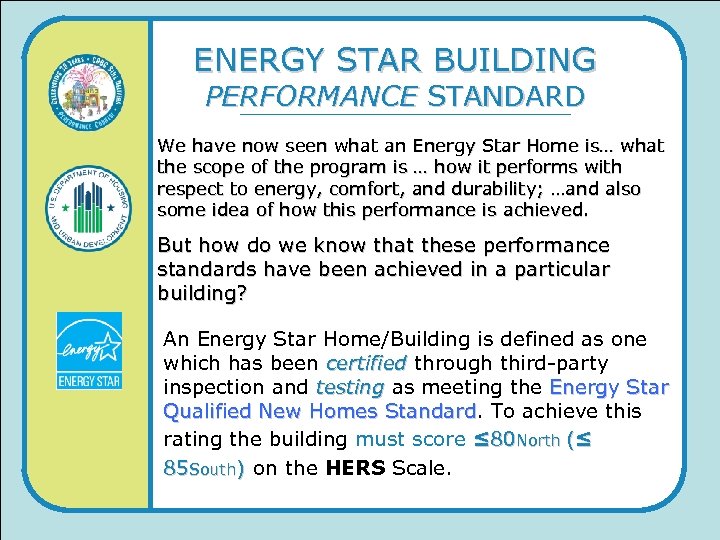
ENERGY STAR BUILDING PERFORMANCE STANDARD We have now seen what an Energy Star Home is… what the scope of the program is … how it performs with respect to energy, comfort, and durability; …and also some idea of how this performance is achieved. But how do we know that these performance standards have been achieved in a particular building? An Energy Star Home/Building is defined as one which has been certified through third-party inspection and testing as meeting the Energy Star Qualified New Homes Standard. To achieve this Standard rating the building must score ≤ 80 North (≤ 85 South) on the HERS Scale.
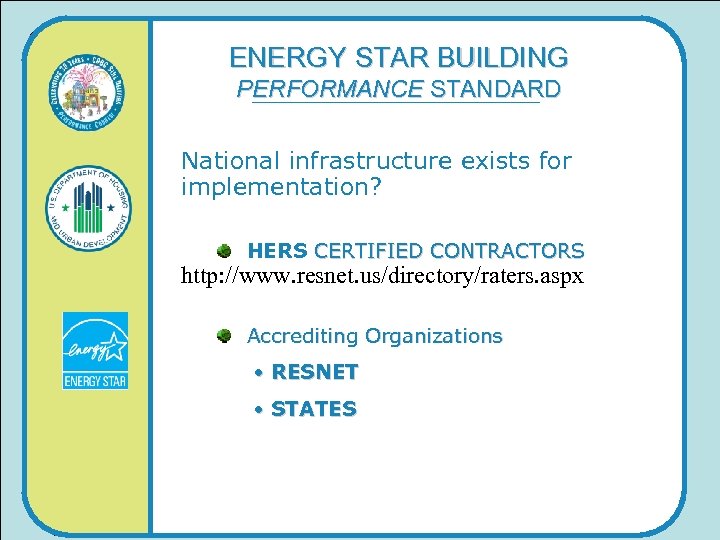
ENERGY STAR BUILDING PERFORMANCE STANDARD National infrastructure exists for implementation? HERS CERTIFIED CONTRACTORS http: //www. resnet. us/directory/raters. aspx Accrediting Organizations • RESNET • STATES
ENERGY STAR BUILDING PERFORMANCE STANDARD What do the HERS contractors do? Review builder’s plans for Energy Star performance. Evaluate and rate energy efficiency of buildings. Provide Independent 3 rd Party Inspections AND Testing.
ENERGY STAR HERS CERTIFIED CONTRACTORS Established and Governed Home Energy Rating Systems are currently governed by three national industry standards: 1) the National Association of State Energy Officials (NASEO) Technical Guidelines which prescribe the accepted methods and procedures for rating a home; 2) the Mortgage Industry Home Energy Rating System (HERS) Accreditation Procedures which prescribe the HERS methods and procedures for certification of HERS System by individual state governments and the national home mortgage industry: and 3) the RESNET Training and Certifying Standards which prescribe minimum competencies for Trainers and certified Raters.
ENERGY STAR HERS CERTIFIED CONTRACTORS Ratings and Evaluations Standardized Rating Method • HERS Score: A numeric value on the HERS Index between 0 and 100 indicating the relative energy efficiency of a given home as compared with the HERS Energy-Efficient Reference Home (EERH) as specified by the HERS Council Guidelines. The lower the score, the more efficient the home. A home with zero energy use (total energy consumption) scores 0. An Energy Star Home achieves a score of ≤ 80 North (≤ 85 South). The reference home has a score of 100. [The reference home meets ’ 04 IECC. Each point represents 1%]
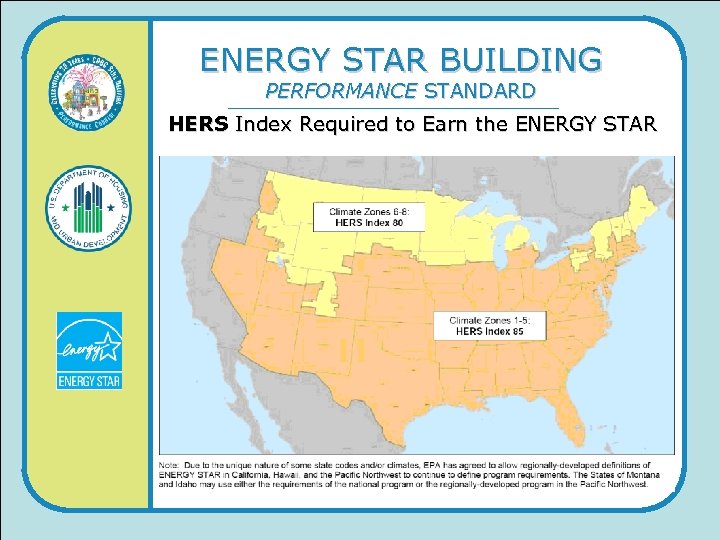
ENERGY STAR BUILDING PERFORMANCE STANDARD HERS Index Required to Earn the ENERGY STAR
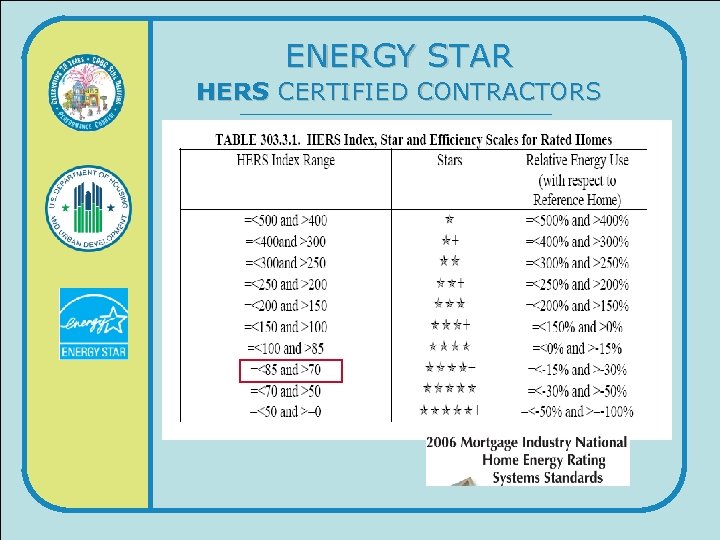
ENERGY STAR HERS CERTIFIED CONTRACTORS
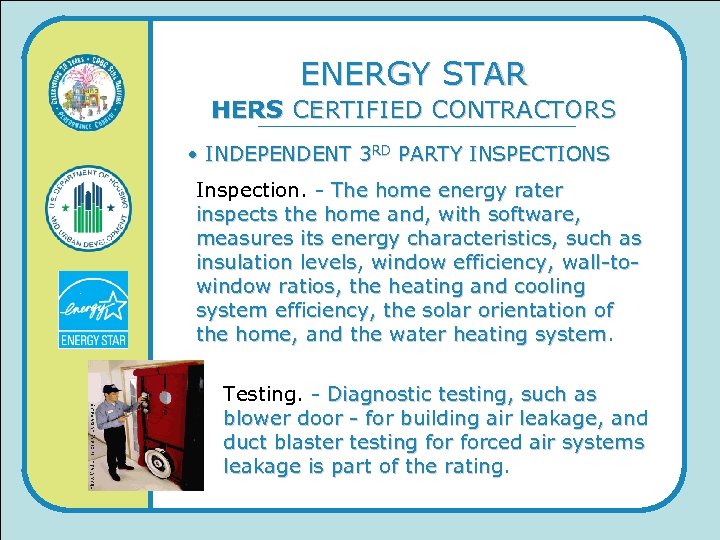
ENERGY STAR HERS CERTIFIED CONTRACTORS • INDEPENDENT 3 RD PARTY INSPECTIONS Inspection. - The home energy rater inspects the home and, with software, measures its energy characteristics, such as insulation levels, window efficiency, wall-towindow ratios, the heating and cooling system efficiency, the solar orientation of the home, and the water heating system Testing. - Diagnostic testing, such as blower door - for building air leakage, and duct blaster testing forced air systems leakage is part of the rating
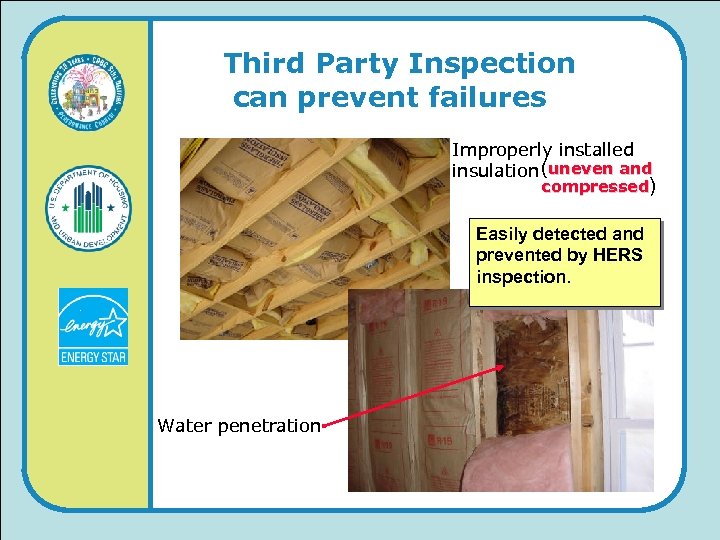
Third Party Inspection can prevent failures Improperly installed insulation (uneven and compressed) Easily detected and prevented by HERS inspection. Water penetration
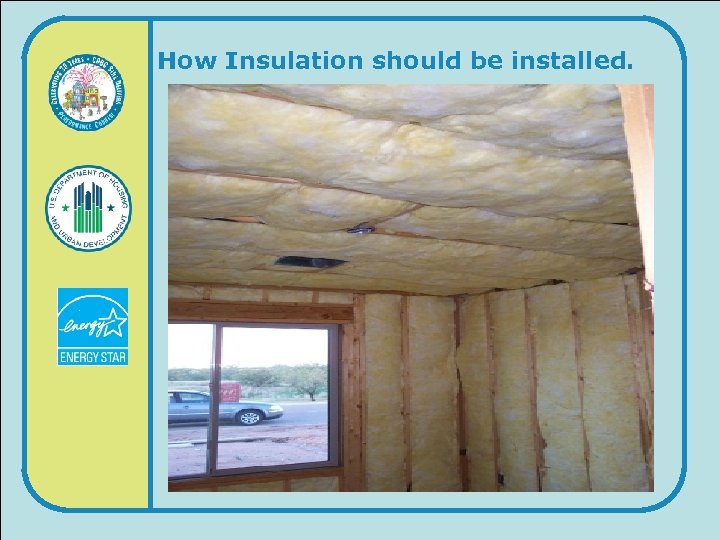
How Insulation should be installed.
ENERGY STAR • The value of most design features (e. g. counters, finishes) will become obsolete, while … • The value of energy efficient features (e. g. , comfort, health, durability higher resale value) increases over time.
ENERGY - CDBG & HOME EPA is beginning to roll out a program of standard protocols that relate to housing rehabilitation but it is operational in only a few states at this time. [See slide 48 Energy Star Update] Now how do we get all this into CPD’s housing programs? Before answering this question let’s remember that the Energy Star Building program applies at this time only to residential new construction and gut rehab up to three stories. Now to answer the question…
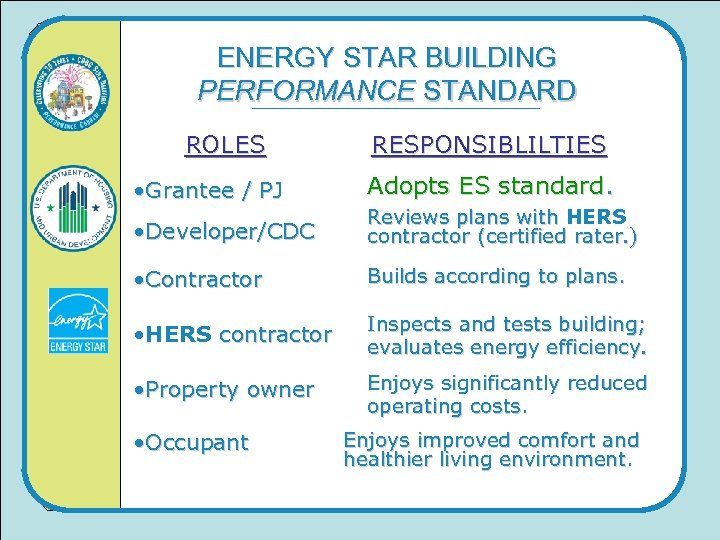
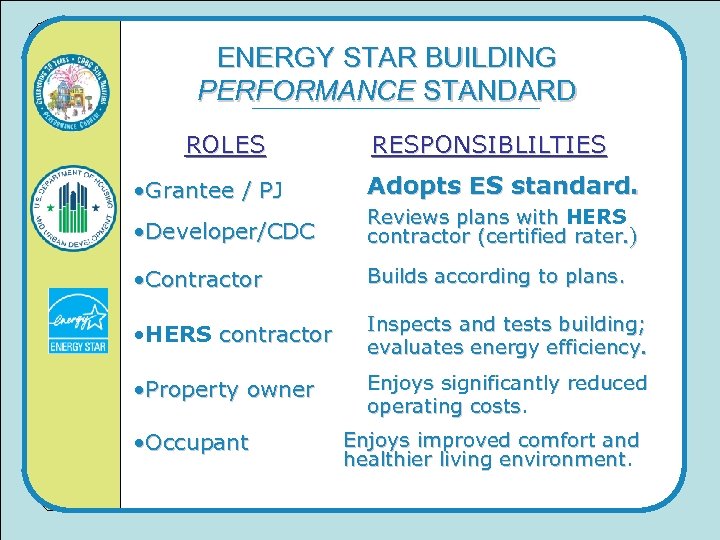
ENERGY STAR BUILDING PERFORMANCE STANDARD ROLES • Grantee / PJ RESPONSIBLILTIES Adopts ES standard. • Developer/CDC Reviews plans with HERS contractor (certified rater. ) • Contractor Builds according to plans. • HERS contractor Inspects and tests building; evaluates energy efficiency. • Property owner Enjoys significantly reduced operating costs • Occupant Enjoys improved comfort and healthier living environment
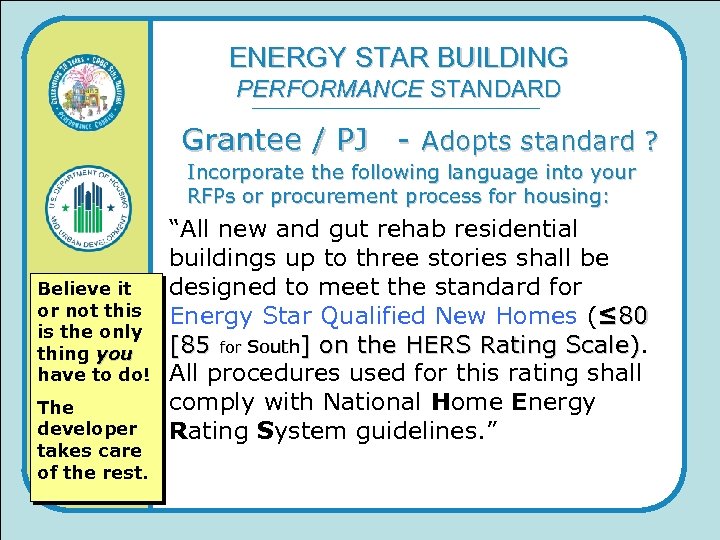
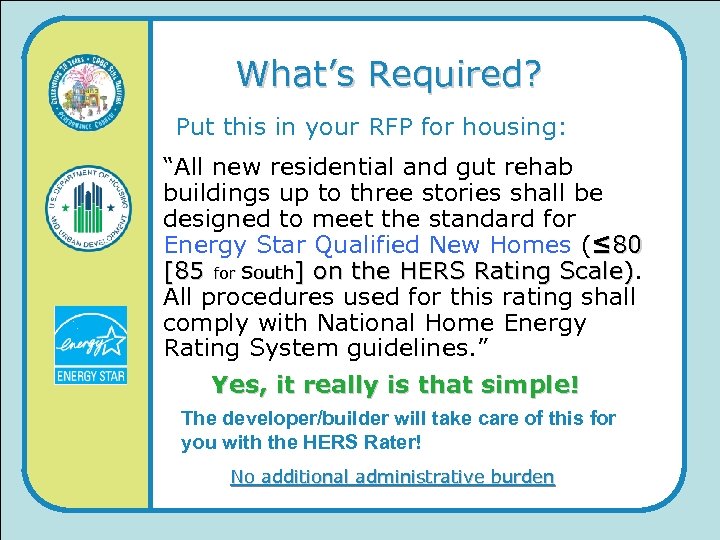
ENERGY STAR BUILDING PERFORMANCE STANDARD Grantee / PJ - Adopts standard ? Incorporate the following language into your RFPs or procurement process for housing: Believe it or not this is the only thing you have to do! The developer takes care of the rest. “All new and gut rehab residential buildings up to three stories shall be designed to meet the standard for Energy Star Qualified New Homes (≤ 80 [85 for South] on the HERS Rating Scale) All procedures used for this rating shall comply with National Home Energy Rating System guidelines. ”
ENERGY STAR You play an important role in the development of quality affordable housing in your community. You decide in large measure what gets built, as well as where, when, and how it happens. You represent the public interest in developing housing that is more durable, more comfortable, durable comfortable less expensive to operate, and more friendly to the environment… all proven features of … the ENERGY STAR building performance standard.
What’s Required? Put this in your RFP for housing: “All new residential and gut rehab buildings up to three stories shall be designed to meet the standard for Energy Star Qualified New Homes (≤ 80 [85 for South] on the HERS Rating Scale) All procedures used for this rating shall comply with National Home Energy Rating System guidelines. ” Yes, it really is that simple! The developer/builder will take care of this for you with the HERS Rater! No additional administrative burden
RECAP If you take away only the information on the next three slides you will have all you need to get started.
ENERGY STAR BUILDING PERFORMANCE STANDARD ROLES • Grantee / PJ RESPONSIBLILTIES Adopts ES standard. • Developer/CDC Reviews plans with HERS contractor (certified rater. ) • Contractor Builds according to plans. • HERS contractor Inspects and tests building; evaluates energy efficiency. • Property owner Enjoys significantly reduced operating costs • Occupant Enjoys improved comfort and healthier living environment
ENERGY STAR BUILDING PERFORMANCE STANDARD Grantee / PJ - Adopts standard Incorporate the following language into your RFPs or procurement process for housing: “All new and gut rehab residential buildings up to three stories shall be designed to meet the standard for Energy Star Qualified New Homes (≤ 80 [85 for South] on the HERS Rating Scale) All procedures used for this rating shall comply with National Home Energy Rating System guidelines. ” The developer/builder will take care of this for you with the HERS Rater!
ENERGY STAR BUILDING PERFORMANCE STANDARD National infrastructure exists for implementation. HERS CERTIFIED CONTRACTORS http: //www. resnet. us/directory/raters. aspx Accrediting Organizations • RESNET • STATES
ENERGY STAR BUILDING PERFORMANCE STANDARD The Heart of Energy Star These features distinguish the program: • Third-party review of plans • Third-party inspection of building at critical points in construction, e. g. , pre-drywall installation • Testing of building at end for a specific level of performance
ENERGY STAR BUILDING Let’s do it! + Leverage your role to great benefit for your residents, your community, and the nation – a large return for a minimum investment of your time. Make a positive difference!
ENERGY STAR UPDATE • EPA has updated the performance standard effective for all buildings (residential new construction up to three stories) permitted on or after July 1, 2006. [These changes are reflected in this presentation. ] • See this link for details: http: //www. energystar. gov/index. cfm? c=bldrs_lenders_raters. ho mes_guidelns 09 Logo also changed New logo
![ENERGY STAR UPDATE [Added as of 07/06]](https://present5.com/presentation/54b0637af7b077b4dad40d3451a6fae0/image-50.jpg "ENERGY STAR UPDATE [Added as of 07/06]")
ENERGY STAR UPDATE [Added as of 07/06]
![ENERGY STAR UPDATE [Added as of 07/06]](https://present5.com/presentation/54b0637af7b077b4dad40d3451a6fae0/image-51.jpg "ENERGY STAR UPDATE [Added as of 07/06]")
ENERGY STAR UPDATE [Added as of 07/06]
ENERGY STAR UPDATE …rehabilitation EPA’S NEW Home Improvement Program with Energy Star – a program for housing rehabilitation – is just beginning to be rolled out nationally. At present it is available in only a few states. “Home Performance with ENERGY STAR is managed locally by an ENERGY STAR partner (typically your utility company, state agency, or a local association). The managing partner trains and qualifies contractors and ensures they deliver quality work. The partner may also offer financial assistance. ” – EPA website
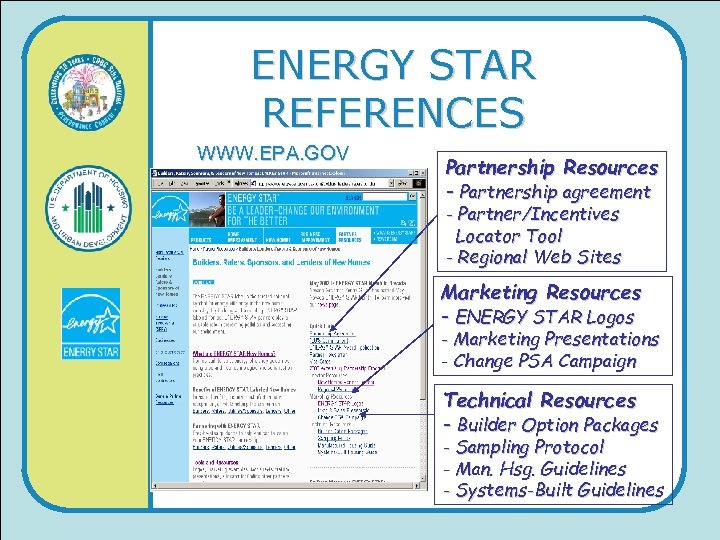
ENERGY STAR REFERENCES WWW. EPA. GOV Partnership Resources - Partnership agreement - Partner/Incentives Locator Tool - Regional Web Sites Marketing Resources - ENERGY STAR Logos - Marketing Presentations - Change PSA Campaign Technical Resources - Builder Option Packages - Sampling Protocol - Man. Hsg. Guidelines - Systems-Built Guidelines
![ENERGY STAR REFERENCES [New Energy Star standards for 2007] http: //www. energystar. gov/index. cfm?](https://present5.com/presentation/54b0637af7b077b4dad40d3451a6fae0/image-54.jpg "ENERGY STAR REFERENCES [New Energy Star standards for 2007] http: //www. energystar. gov/index. cfm?")
ENERGY STAR REFERENCES [New Energy Star standards for 2007] http: //www. energystar. gov/index. cfm? c=bldrs_lende rs_raters. homes_guidelns 09 http: //rehabadvisor. pathnet. org/index. asp http: //www. natresnet. org/programs/default. htm Very comprehensive technical stuff in English. http: //www. buildingscience. com DOE Webpage for State Energy Codes http: //www. energycodes. gov/implement/state_codes/state_ status_full. php EIA Webpage for Energy uses by State /Source/Sector http: //www. eia. doe. gov/emeu/states/_states. html Prepared by: Bob Paquin Director HUD New England Office of CPD 617 -994 -8357 Bob_Paquin@hud. gov
 Скачать презентацию ENERGY STAR FOR GRANTEES BOB PAQUIN Director Hud
54b0637af7b077b4dad40d3451a6fae0.ppt