


 Скачать презентацию Energy Spectrometer R D Progress and Plans for the
ef9d2830328e87a8297823216427270f.ppt
- Количество слайдов: 27
 Energy Spectrometer R&D Progress and Plans for the End Station A Test Beam Mike Hildreth University of Notre Dame representing SLAC T-474/491 & T-475 and our international collaborators January 18, 2007 Mike Hildreth – IDTB 07
 Spectrometry: A Reminder • Required measurement precision is set by the expected statistical and systematic errors of “benchmark” measurements of mtop, mhiggs: – require Ebeam/Ebeam ~ 100 -200 ppm – So far, only spectrometer techniques have come anywhere near this precision with very high energy electron beams • Previous efforts: – LEP 2 • Achieved 120 ppm by combining three different methods, only one of which (BPM Spectrometer) is available at ILC – Spectrometer was able to do 170 ppm – SLC • WISRD systematic errors estimated at 220 ppm, E/E~20 Me. V • C of M was shifted by 46 ± 25 Me. V (500 ppm) compared with Z lineshape scan Many constraints more severe at ILC than at low energy Need R&D! January 18, 2007 Mike Hildreth – IDTB 07
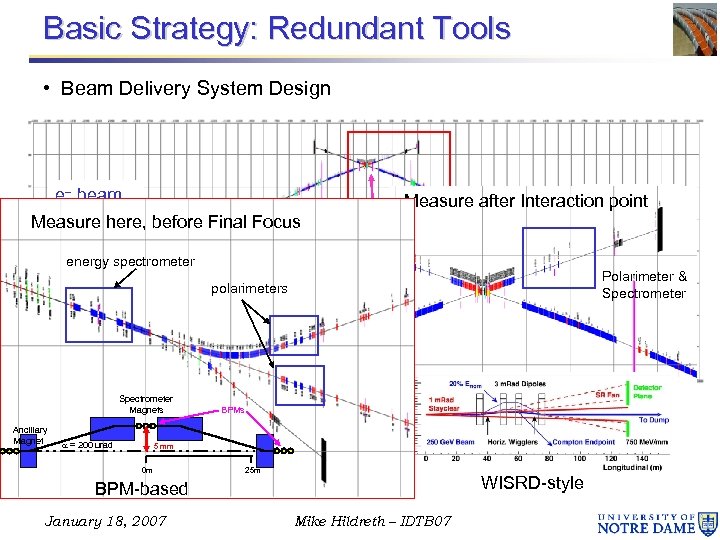 Basic Strategy: Redundant Tools • Beam Delivery System Design e- beam Measure here, before Final Focus e+ beam Measure after Interaction point Interaction Points energy spectrometer Polarimeter & Spectrometer polarimeters Spectrometer Magnets Ancillary Magnet BPMs Also necessary: measurements (e. g. bhabhas) from actual particle detector at the IP 0 m 25 m WISRD-style BPM-based a = 200 urad 5 mm January 18, 2007 Mike Hildreth – IDTB 07
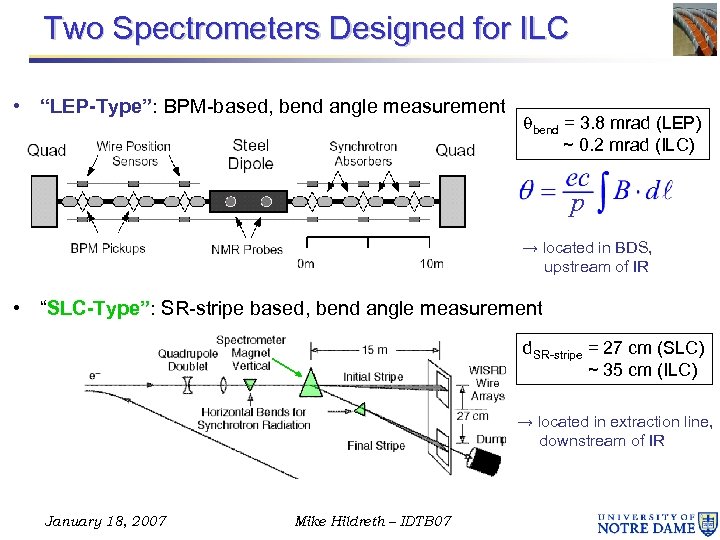 Two Spectrometers Designed for ILC • “LEP-Type”: BPM-based, bend angle measurement qbend = 3. 8 mrad (LEP) ~ 0. 2 mrad (ILC) p → located in BDS, upstream of IR • “SLC-Type”: SR-stripe based, bend angle measurement d. SR-stripe = 27 cm (SLC) ~ 35 cm (ILC) → located in extraction line, downstream of IR January 18, 2007 Mike Hildreth – IDTB 07
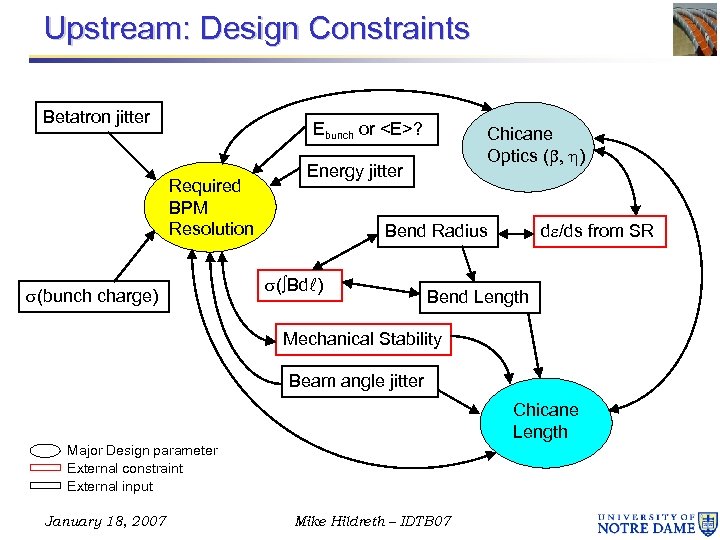
 Considerations • Upstream Spectrometer – Constrained by allowed emittance growth from SR – Constrained by available real estate in BDS, overall size • These constraints determine needed BPM resolution/stability – Other issues drive systematic errors, diagnostics – Must be robust, invisible to luminosity • Downstream Spectrometer – Constrained by available space in extraction line • larger crossing angle desired • background/interference-free region necessary – robust, rad-hard detectors necessary – measurements of d. L/d. E on disrupted beam possible – modelling of extraction line important to eliminate/mitigate surprises • (underway. . . ) January 18, 2007 Mike Hildreth – IDTB 07
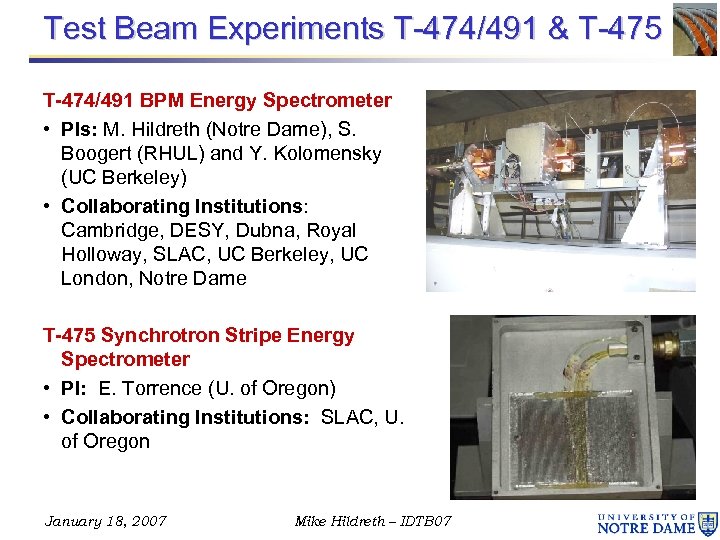 Test Beam Experiments T-474/491 & T-475 T-474/491 BPM Energy Spectrometer • PIs: M. Hildreth (Notre Dame), S. Boogert (RHUL) and Y. Kolomensky (UC Berkeley) • Collaborating Institutions: Cambridge, DESY, Dubna, Royal Holloway, SLAC, UC Berkeley, UC London, Notre Dame T-475 Synchrotron Stripe Energy Spectrometer • PI: E. Torrence (U. of Oregon) • Collaborating Institutions: SLAC, U. of Oregon January 18, 2007 Mike Hildreth – IDTB 07
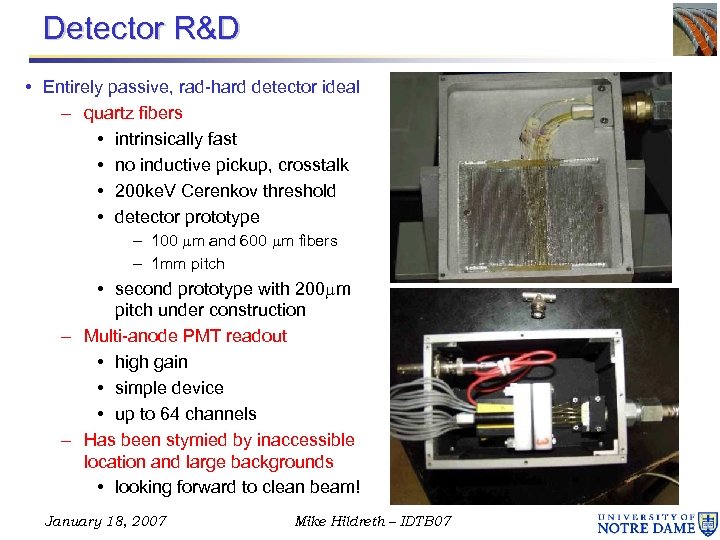 Detector R&D • Entirely passive, rad-hard detector ideal – quartz fibers • intrinsically fast • no inductive pickup, crosstalk • 200 ke. V Cerenkov threshold • detector prototype – 100 mm and 600 mm fibers – 1 mm pitch • second prototype with 200 mm pitch under construction – Multi-anode PMT readout • high gain • simple device • up to 64 channels – Has been stymied by inaccessible location and large backgrounds • looking forward to clean beam! January 18, 2007 Mike Hildreth – IDTB 07
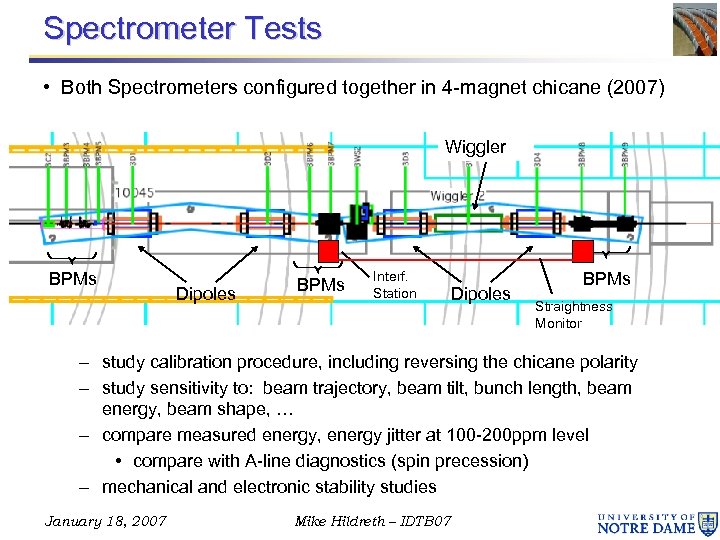 Spectrometer Tests • Both Spectrometers configured together in 4 -magnet chicane (2007) Synchrotron Stripe Detector Wiggler For BPM spectrometer BPMs Dipoles BPMs Interf. Station BPMs • d. E/E=100 ppm → dx= 500 nm, at BPMs 3 -4 • Dipole B-field ~ 1 k. Gauss Ø same as for ILC design Dipoles BPMs Straightness Monitor Dipole – study calibration procedure, including reversing the chicane polarity – study sensitivity to: beam trajectory, beam tilt, bunch length, beam energy, beam shape, … – compare measured energy, energy jitter at 100 -200 ppm level • compare with A-line diagnostics (spin precession) – mechanical and electronic stability studies January 18, 2007 Mike Hildreth – IDTB 07
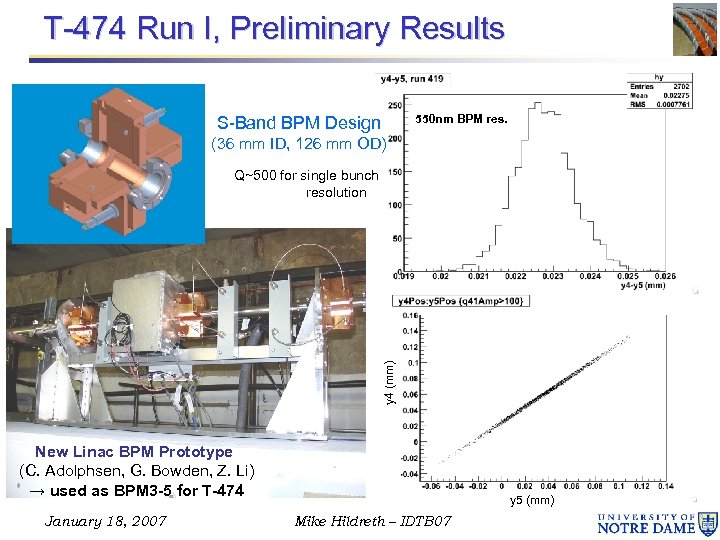 T-474 Run I, Preliminary Results 550 nm BPM res. S-Band BPM Design (36 mm ID, 126 mm OD) y 4 (mm) Q~500 for single bunch resolution New Linac BPM Prototype (C. Adolphsen, G. Bowden, Z. Li) → used as BPM 3 -5 for T-474 January 18, 2007 y 5 (mm) Mike Hildreth – IDTB 07
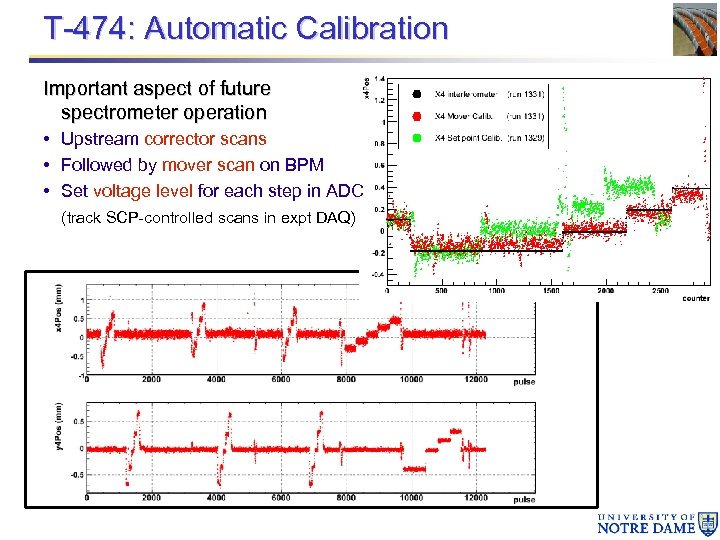 T-474: Automatic Calibration Important aspect of future spectrometer operation • Upstream corrector scans • Followed by mover scan on BPM • Set voltage level for each step in ADC (track SCP-controlled scans in expt DAQ)
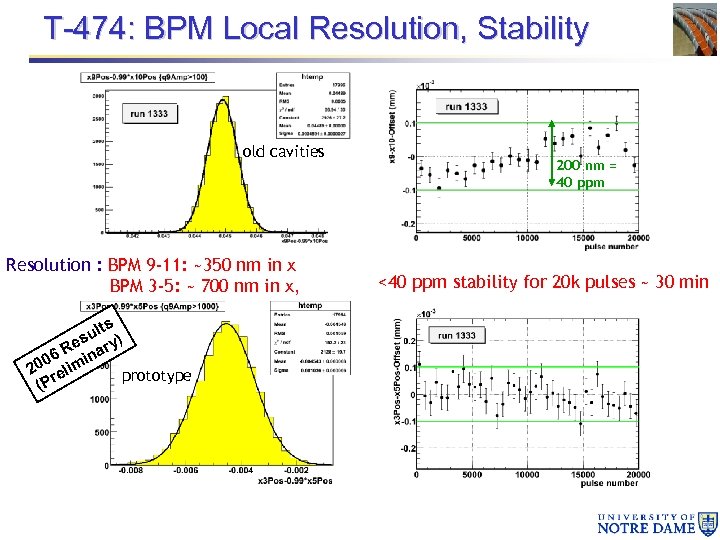 T-474: BPM Local Resolution, Stability old cavities Resolution : BPM 9 -11: ~350 nm in x BPM 3 -5: ~ 700 nm in x, s ult ) s Re nary i 06 20 elim prototype (Pr 200 nm = 40 ppm <40 ppm stability for 20 k pulses ~ 30 min
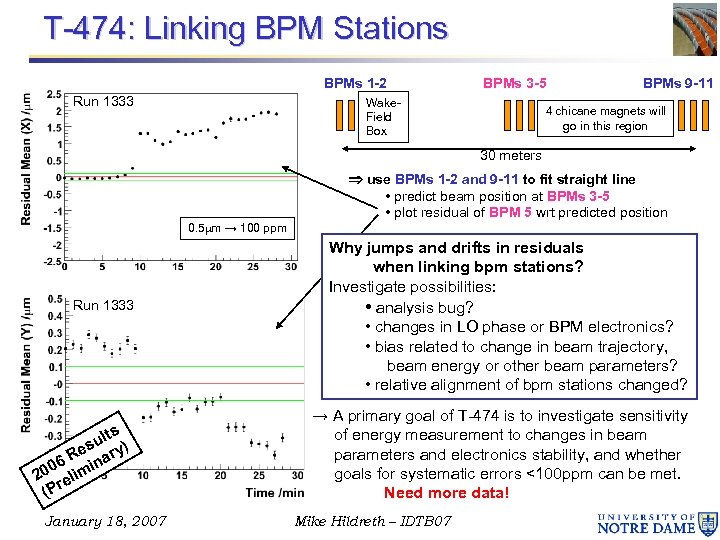 T-474: Linking BPM Stations BPMs 1 -2 Run 1333 BPMs 3 -5 Wake. Field Box BPMs 9 -11 4 chicane magnets will go in this region 30 meters use BPMs 1 -2 and 9 -11 to fit straight line • predict beam position at BPMs 3 -5 • plot residual of BPM 5 wrt predicted position 0. 5 mm → 100 ppm Run 1333 lts su y) e r 6 R ina 0 20 elim (Pr January 18, 2007 Why jumps and drifts in residuals when linking bpm stations? Investigate possibilities: • analysis bug? • changes in LO phase or BPM electronics? • bias related to change in beam trajectory, beam energy or other beam parameters? • relative alignment of bpm stations changed? → A primary goal of T-474 is to investigate sensitivity of energy measurement to changes in beam parameters and electronics stability, and whether goals for systematic errors <100 ppm can be met. Need more data! Mike Hildreth – IDTB 07
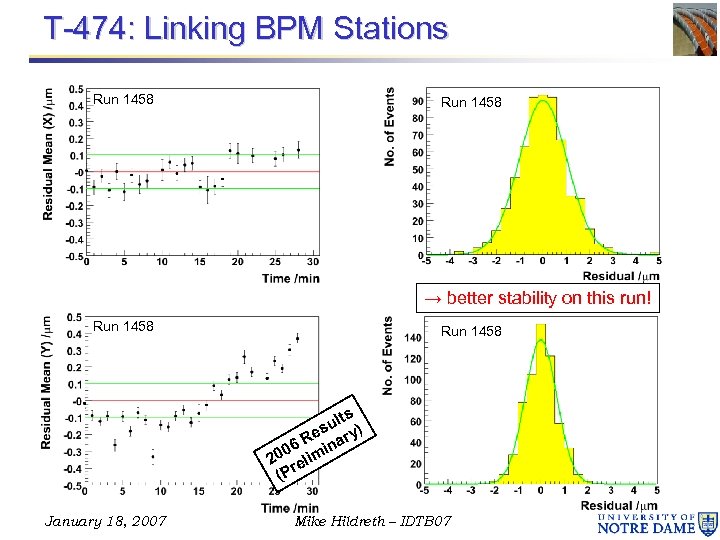 T-474: Linking BPM Stations Run 1458 → better stability on this run! Run 1458 lts su y) e r 6 R ina 0 im 20 el (Pr January 18, 2007 Mike Hildreth – IDTB 07
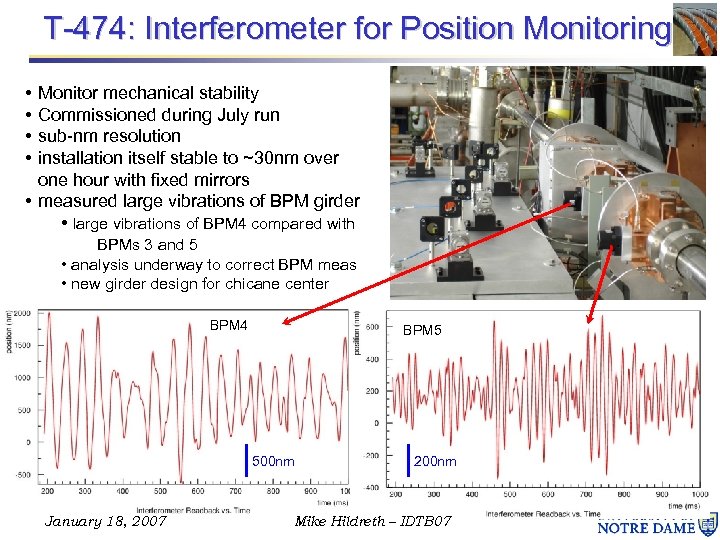 T-474: Interferometer for Position Monitoring • • Monitor mechanical stability Commissioned during July run sub-nm resolution installation itself stable to ~30 nm over one hour with fixed mirrors • measured large vibrations of BPM girder • large vibrations of BPM 4 compared with BPMs 3 and 5 • analysis underway to correct BPM meas • new girder design for chicane center BPM 4 BPM 5 500 nm January 18, 2007 200 nm Mike Hildreth – IDTB 07
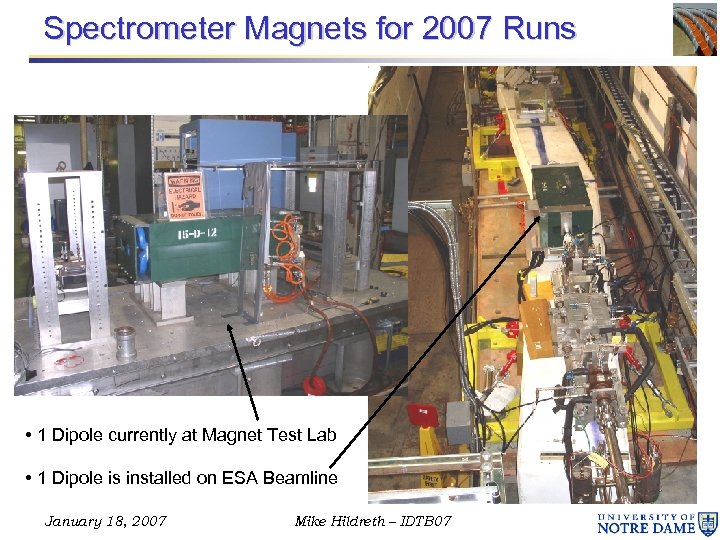 Spectrometer Magnets for 2007 Runs • 1 Dipole currently at Magnet Test Lab • 1 Dipole is installed on ESA Beamline January 18, 2007 Mike Hildreth – IDTB 07
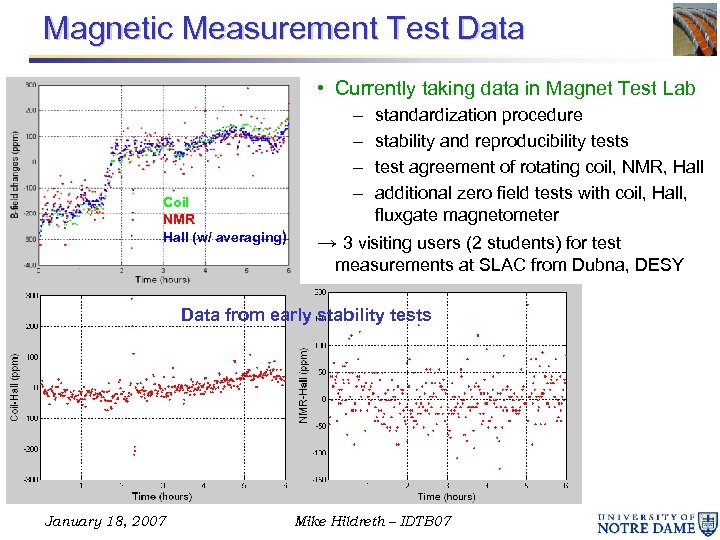 Magnetic Measurement Test Data • Currently taking data in Magnet Test Lab Coil NMR Hall (w/ averaging) – – standardization procedure stability and reproducibility tests test agreement of rotating coil, NMR, Hall additional zero field tests with coil, Hall, fluxgate magnetometer → 3 visiting users (2 students) for test measurements at SLAC from Dubna, DESY Data from early stability tests January 18, 2007 Mike Hildreth – IDTB 07
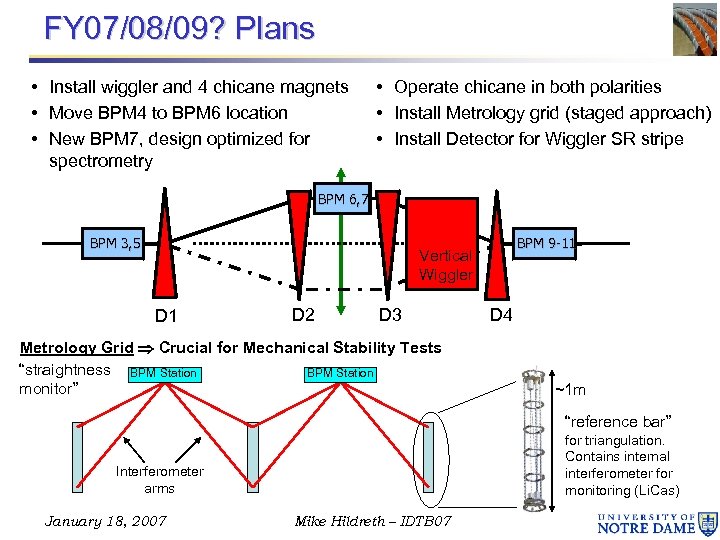 FY 07/08/09? Plans • Install wiggler and 4 chicane magnets • Move BPM 4 to BPM 6 location • New BPM 7, design optimized for spectrometry • Operate chicane in both polarities • Install Metrology grid (staged approach) • Install Detector for Wiggler SR stripe BPM 6, 7 BPM 3, 5 BPM 9 -11 Vertical Wiggler D 1 D 2 D 3 Metrology Grid Crucial for Mechanical Stability Tests “straightness BPM Station monitor” D 4 ~1 m “reference bar” for triangulation. Contains internal interferometer for monitoring (Li. Cas) Interferometer arms January 18, 2007 Mike Hildreth – IDTB 07
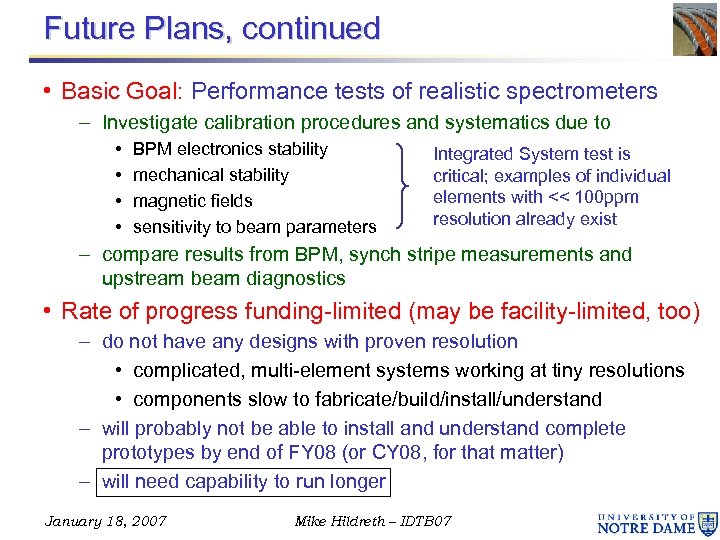 Future Plans, continued • Basic Goal: Performance tests of realistic spectrometers – Investigate calibration procedures and systematics due to • • BPM electronics stability mechanical stability magnetic fields sensitivity to beam parameters Integrated System test is critical; examples of individual elements with << 100 ppm resolution already exist – compare results from BPM, synch stripe measurements and upstream beam diagnostics • Rate of progress funding-limited (may be facility-limited, too) – do not have any designs with proven resolution • complicated, multi-element systems working at tiny resolutions • components slow to fabricate/build/install/understand – will probably not be able to install and understand complete prototypes by end of FY 08 (or CY 08, for that matter) – will need capability to run longer January 18, 2007 Mike Hildreth – IDTB 07
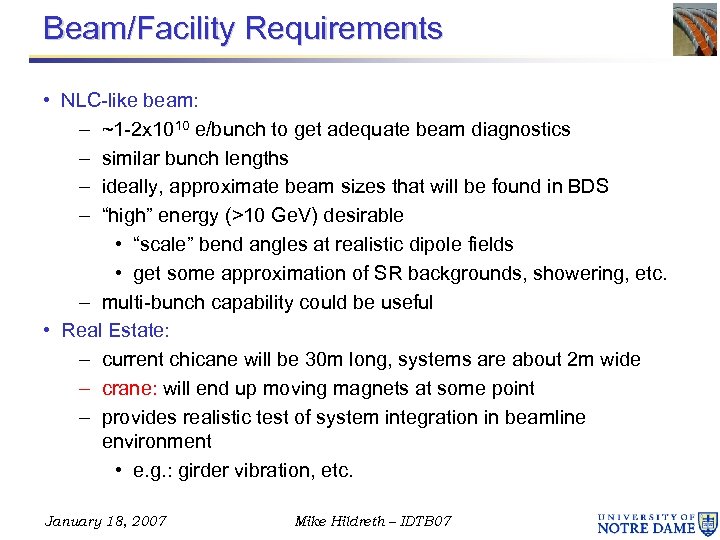 Beam/Facility Requirements • NLC-like beam: – ~1 -2 x 10¹⁰ e/bunch to get adequate beam diagnostics – similar bunch lengths – ideally, approximate beam sizes that will be found in BDS – “high” energy (>10 Ge. V) desirable • “scale” bend angles at realistic dipole fields • get some approximation of SR backgrounds, showering, etc. – multi-bunch capability could be useful • Real Estate: – current chicane will be 30 m long, systems are about 2 m wide – crane: will end up moving magnets at some point – provides realistic test of system integration in beamline environment • e. g. : girder vibration, etc. January 18, 2007 Mike Hildreth – IDTB 07
 Additional Slides January 18, 2007 Mike Hildreth – IDTB 07
 Upstream: Design Constraints Betatron jitter Ebunch or
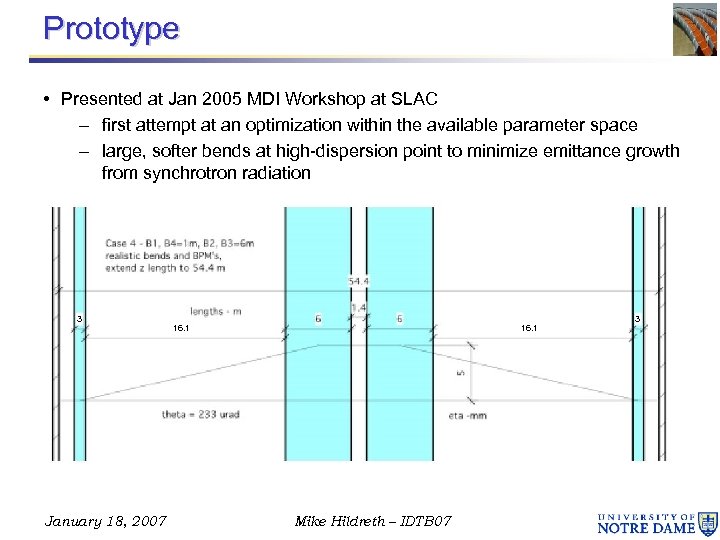 Prototype • Presented at Jan 2005 MDI Workshop at SLAC – first attempt at an optimization within the available parameter space – large, softer bends at high-dispersion point to minimize emittance growth from synchrotron radiation 3 January 18, 2007 16. 1 Mike Hildreth – IDTB 07 3
 Progress: New Optics! new January 18, 2007 Mike Hildreth – IDTB 07
 Optics: details energy collimation energy spectrometer chicane ΔX = 5 mm (on-energy) January 18, 2007 Mike Hildreth – IDTB 07 “tail-folding” octupoles
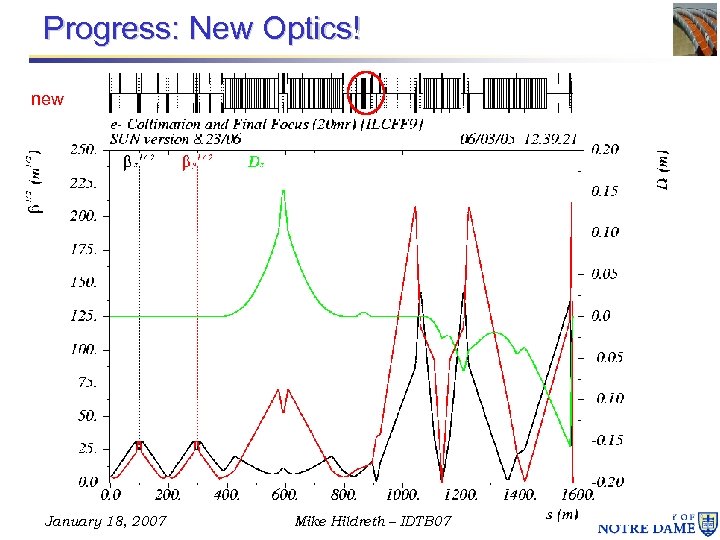
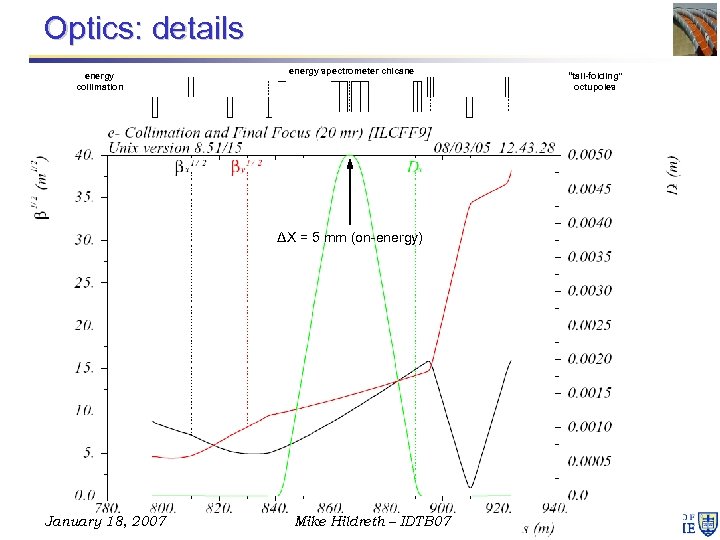
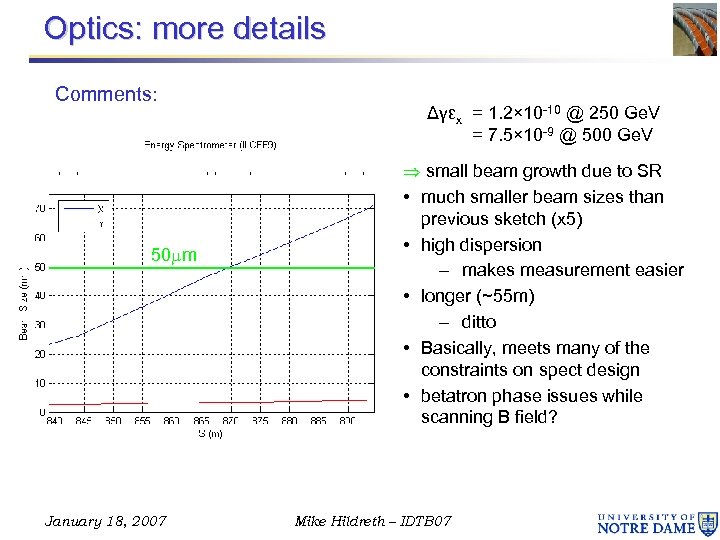 Optics: more details Comments: 50 mm January 18, 2007 Δγεx = 1. 2× 10 -10 @ 250 Ge. V = 7. 5× 10 -9 @ 500 Ge. V small beam growth due to SR • much smaller beam sizes than previous sketch (x 5) • high dispersion – makes measurement easier • longer (~55 m) – ditto • Basically, meets many of the constraints on spect design • betatron phase issues while scanning B field? Mike Hildreth – IDTB 07
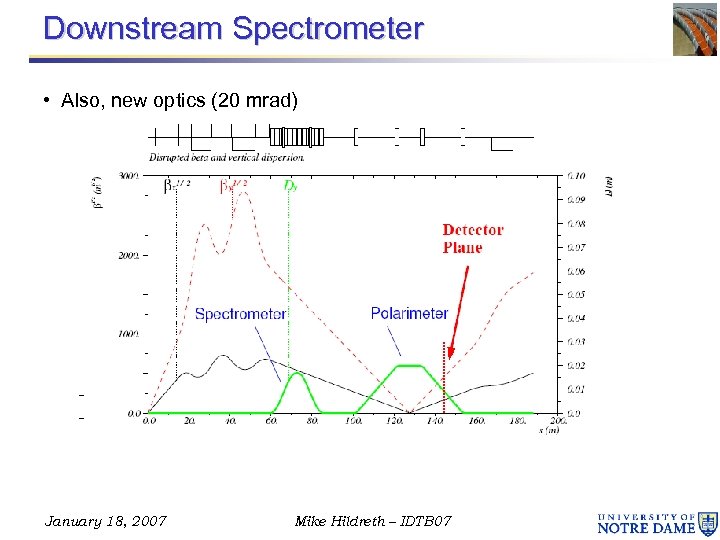 Downstream Spectrometer • Also, new optics (20 mrad) – Advantageous to have Spectrometer detector plane near 2 nd IP – separate chicanes for spectrometer, polarimeter much easier! January 18, 2007 Mike Hildreth – IDTB 07
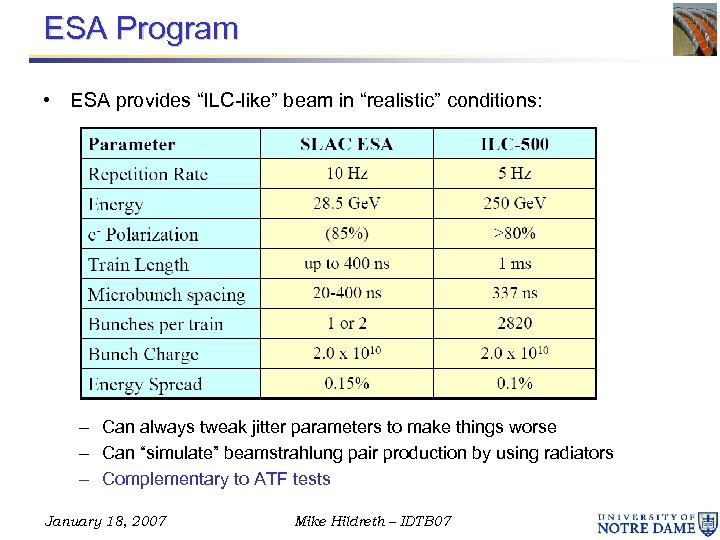 ESA Program • ESA provides “ILC-like” beam in “realistic” conditions: – Can always tweak jitter parameters to make things worse – Can “simulate” beamstrahlung pair production by using radiators – Complementary to ATF tests January 18, 2007 Mike Hildreth – IDTB 07