


 Скачать презентацию Energy Research and Policy Ernest J Moniz Cecil
f404572bb6d796ca4417174c469fce7b.ppt
- Количество слайдов: 25
 Energy Research and Policy Ernest J. Moniz Cecil and Ida Green Professor Of Physics and Engineering Systems Co-Director, Laboratory for Energy and the Environment May 10, 2006
 Perfect Storm of Energy Challenges • Energy supply and demand e. g. projected doubling of energy use and tripling of electricity use by 2050 in business as usual • Energy and security e. g. geological and geopolitical realities of oil supply • Energy and environment e. g. greenhouse gas emissions and climate change
 • Future scenarios highly uncertain on mid-century time scale • 50 -year time scale characteristic of significant change in energy infrastructure, of greenhouse gas concentrations approaching twice pre-industrial, … • Multiple uncertainties • Resource availability? -fossil fuels, land for renewables, … • Science and technology advances? -technology breakthroughs, climate change impacts • Geopolitical considerations? -Middle East, climate protocol participation, …
 US Energy Supply Since 1850 Author: Koonin Source: EIA
 Global Primary Energy Demand BAU, Ref. Gas Price, Limited Nuclear Source: EPPA
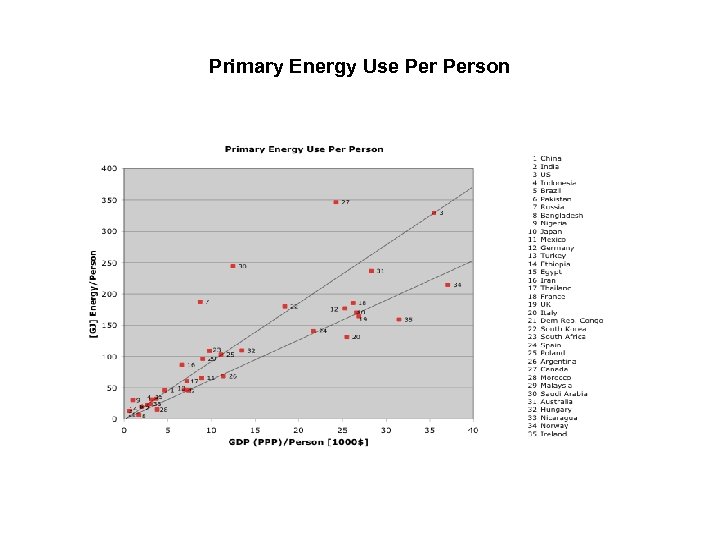 Primary Energy Use Person
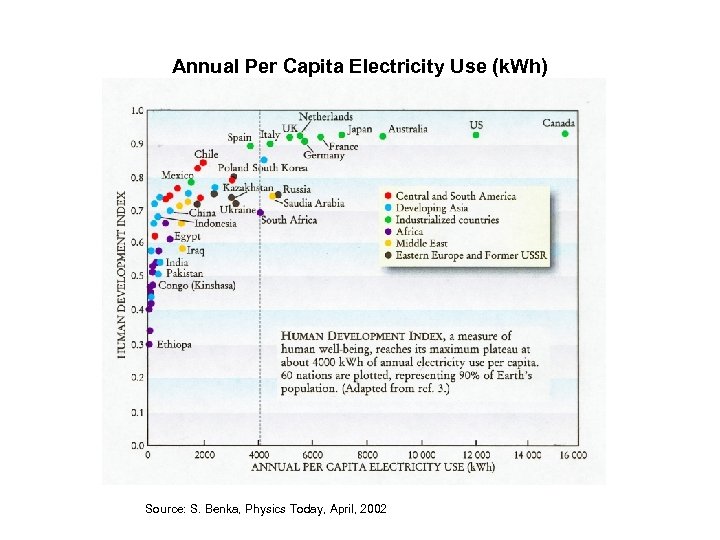 Annual Per Capita Electricity Use (k. Wh) Source: S. Benka, Physics Today, April, 2002
 Energy and Security • Oil (and natural gas) adequate and reliable supply • Vulnerability of extended energy delivery systems • Nuclear weapons proliferation facilitated by worldwide nuclear power expansion • Dislocation from environmental impacts, such as from climate change
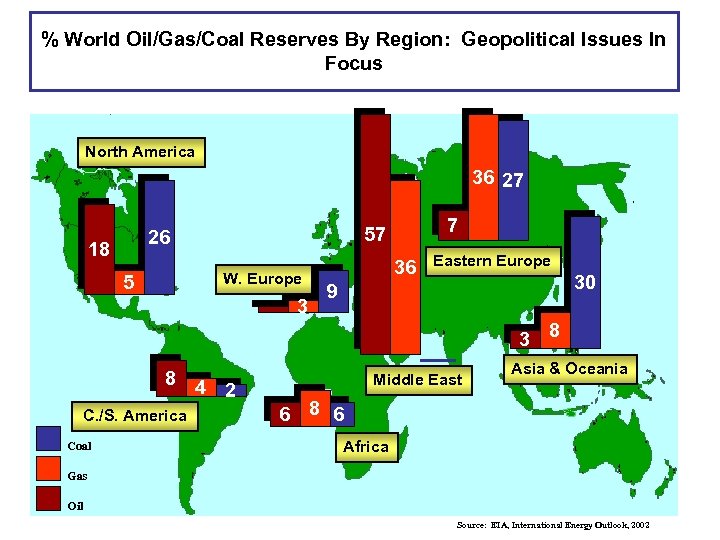 % World Oil/Gas/Coal Reserves By Region: Geopolitical Issues In Focus North America 36 27 18 W. Europe 5 7 57 26 3 36 Eastern Europe 30 9 3 8 8 4 2 C. /S. America Coal Middle East Asia & Oceania 6 8 6 Africa Gas Oil Source: EIA, International Energy Outlook, 2002
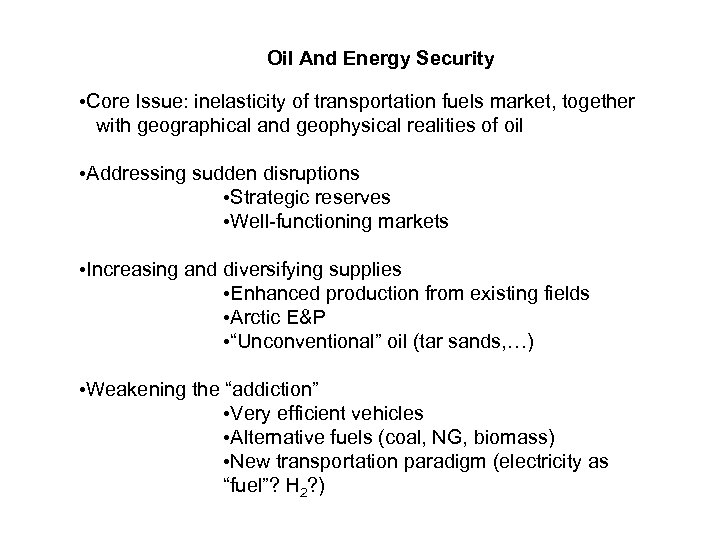 Oil And Energy Security • Core Issue: inelasticity of transportation fuels market, together with geographical and geophysical realities of oil • Addressing sudden disruptions • Strategic reserves • Well-functioning markets • Increasing and diversifying supplies • Enhanced production from existing fields • Arctic E&P • “Unconventional” oil (tar sands, …) • Weakening the “addiction” • Very efficient vehicles • Alternative fuels (coal, NG, biomass) • New transportation paradigm (electricity as “fuel”? H 2? )
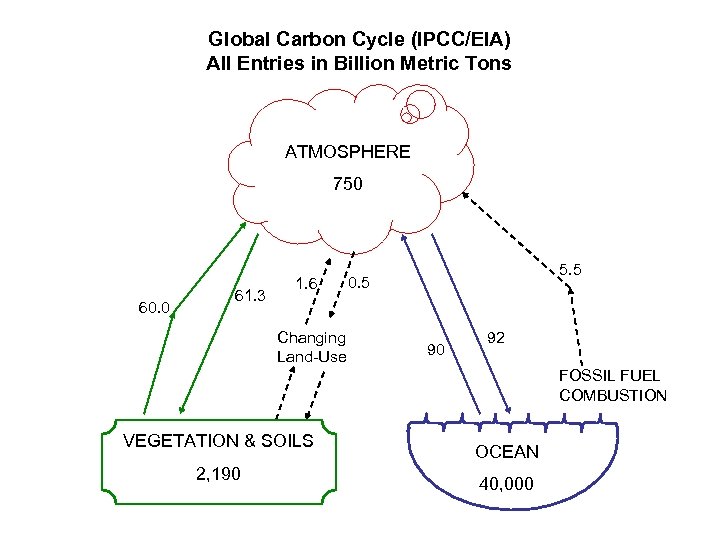 Global Carbon Cycle (IPCC/EIA) All Entries in Billion Metric Tons ATMOSPHERE 750 60. 0 61. 3 1. 6 Changing Land-Use 5. 5 0. 5 90 92 FOSSIL FUEL COMBUSTION VEGETATION & SOILS 2, 190 OCEAN 40, 000
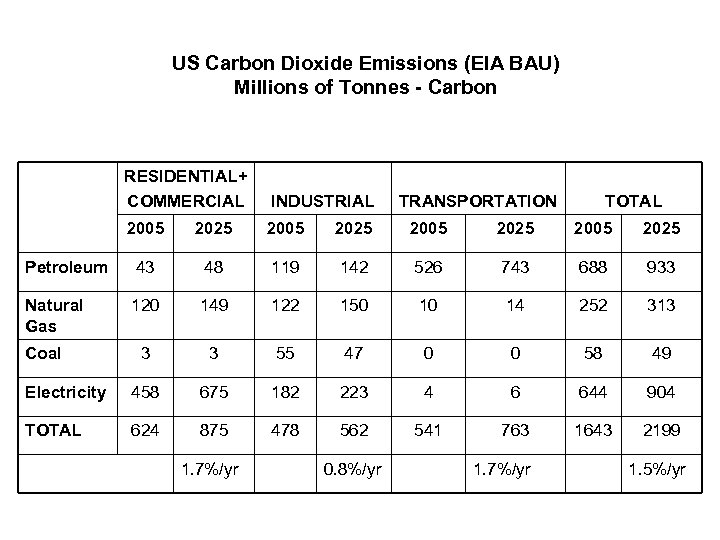 US Carbon Dioxide Emissions (EIA BAU) Millions of Tonnes - Carbon RESIDENTIAL+ COMMERCIAL INDUSTRIAL 2005 2025 Petroleum 43 48 119 142 526 743 688 933 Natural Gas 120 149 122 150 10 14 252 313 3 3 55 47 0 0 58 49 Electricity 458 675 182 223 4 6 644 904 TOTAL 624 875 478 562 541 763 1643 2199 Coal 1. 7%/yr 0. 8%/yr TRANSPORTATION 1. 7%/yr TOTAL 1. 5%/yr
 Climate Change Technology/Policy Pathways • Efficiency • Low carbon or “carbon-less” technologies/fuels • Fuel switching, e. g. , coal to natural gas • Nuclear power (fission, possibly fusion in long term) • Renewables (wind, geothermal, solar, …) Note: scale matters • Carbon dioxide capture and sequestration
 The EPPA model can be used to study how world energy markets would adapt to a carbon policy change. In the EPPA world, a significant (but not exorbitant? ) CO 2 tax leads to emissions stabilization by mid-century. However, the time to stabilization and the scale of emissions are quite dependent on the “tax profile. ”




 • If developing economies do not adopt a carbon charge, emissions cannot be stabilized by mid-century. • If developing economies adopt a carbon charge but lag behind developed economies in doing so, stabilization of emissions is possible, although achieved later and at a higher level. • For example, a 10 year lag increases cumulative emissions to midcentury by less than 10%.



 Science and Technology for a Clean Energy Future • Renewable technologies (wind, solar, geothermal, waves, biofuels) • Electrochemical energy storage and conversion • Core enabling science and technology (superconducting and cryogenic components, nanotechnology and materials, transport phenomena, …) • Nuclear fusion
 Improving Today’s Energy Systems • Advanced nuclear reactors and fuel cycles that address cost, safety, waste, and nonproliferation objectives • Affordable supply of fossil-derived fuels (oil, natural gas, coal) from both conventional and unconventional sources and processes • Key enablers such as carbon sequestration • Thermal conversion and utilization for dramatically enhanced energy efficiency, including in industrial uses • Enhanced reliability, robustness and resiliency of energy delivery networks • System integration in energy supply, delivery, and use • Learning from the past and understanding current public attitudes towards energy systems • Understanding and facilitating the energy technology innovation process • In-depth integrative energy and technology policy studies that draw on faculty across the campus
 Energy Systems For a Rapidly Evolving World • Science and policy of climate change • Advanced efficient building technologies • Advanced transportation systems, from novel technologies and new fuels, to systems design including passenger and freight networks • “Giga-city” design and development, particularly in the developing world