 Скачать презентацию ENERGY Post Carbon Cities Planning for Energy and
3b0a62b849ee269e52e5a7395fc5e7fd.ppt
- Количество слайдов: 29



ENERGY Post Carbon Cities: Planning for Energy and Climate Uncertainty Daniel Lerch Post Carbon Cities Program Manager www. postcarboncities. net 26 June 2008 : : NJTPA, Newark, NJ Post Carbon Cities - 1
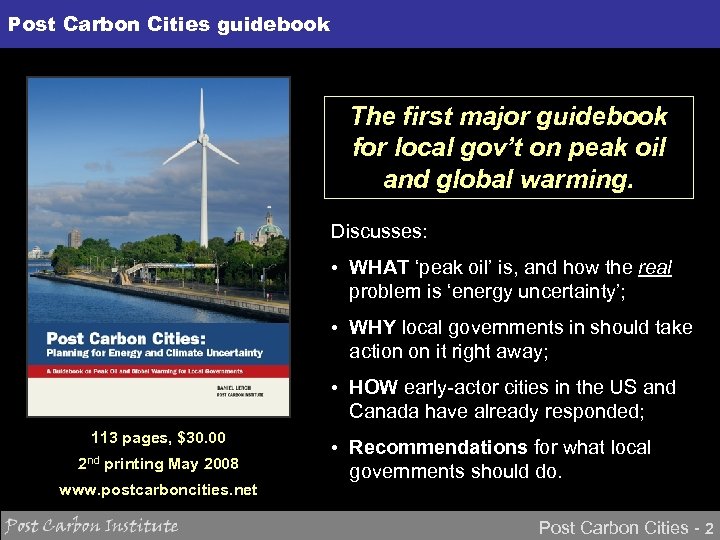
ENERGY Post Carbon Cities guidebook The first major guidebook for local gov’t on peak oil and global warming. Discusses: • WHAT ‘peak oil’ is, and how the real problem is ‘energy uncertainty’; • WHY local governments in should take action on it right away; • HOW early-actor cities in the US and Canada have already responded; 113 pages, $30. 00 2 nd printing May 2008 www. postcarboncities. net • Recommendations for what local governments should do. Post Carbon Cities - 2
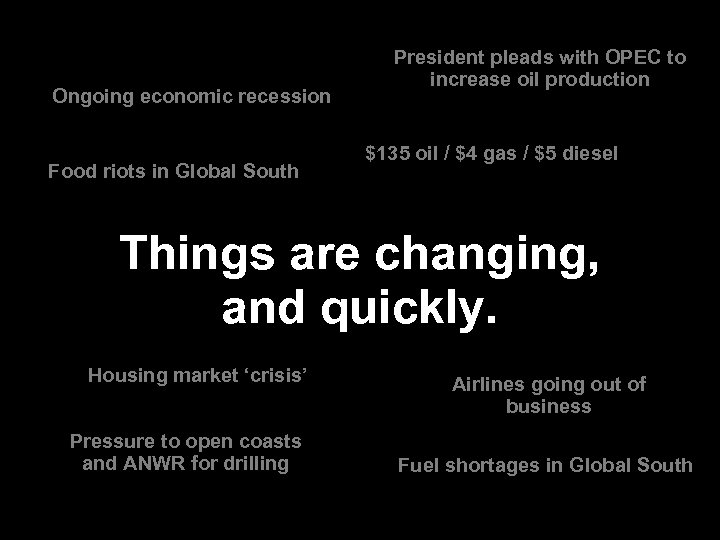
ENERGY Ongoing economic recession Food riots in Global South President pleads with OPEC to increase oil production $135 oil / $4 gas / $5 diesel Things are changing, and quickly. Housing market ‘crisis’ Pressure to open coasts and ANWR for drilling Airlines going out of business Fuel shortages in Global South Post Carbon Cities - 3
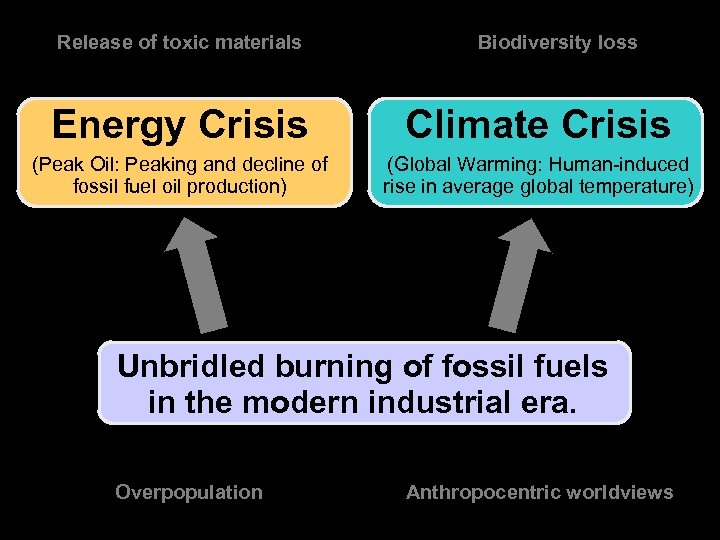
Release of toxic materials ENERGY Biodiversity loss Energy Crisis Climate Crisis (Peak Oil: Peaking and decline of fossil fuel oil production) (Global Warming: Human-induced rise in average global temperature) Unbridled burning of fossil fuels in the modern industrial era. Overpopulation Anthropocentric worldviews Post Carbon Cities - 4
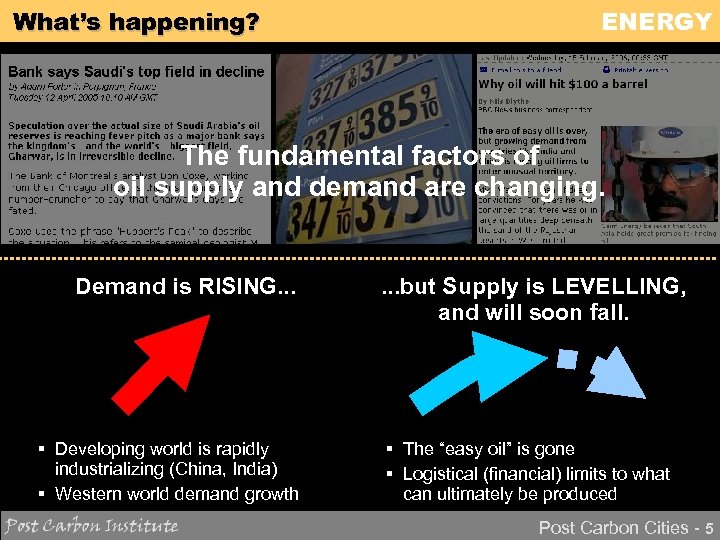
What’s happening? ENERGY The fundamental factors of oil supply and demand are changing. Demand is RISING. . . Developing world is rapidly industrializing (China, India) Western world demand growth . . . but Supply is LEVELLING, and will soon fall. The “easy oil” is gone Logistical (financial) limits to what can ultimately be produced Post Carbon Cities - 5
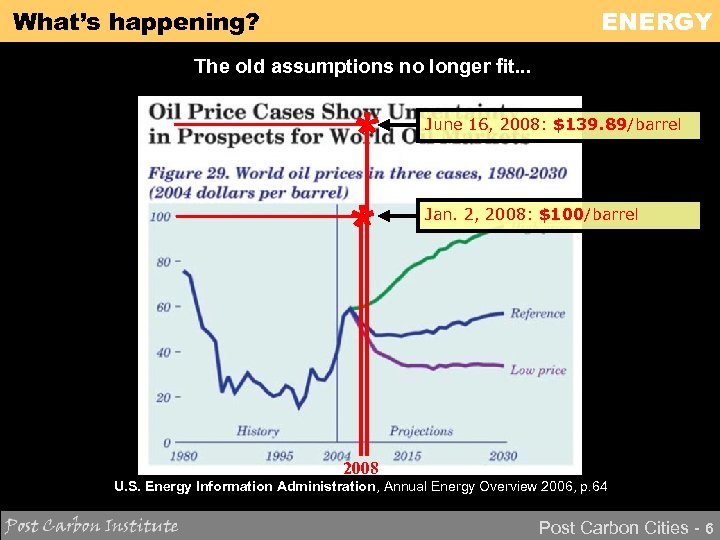
ENERGY What’s happening? The old assumptions no longer fit. . . * * June 16, 2008: $139. 89/barrel Jan. 2, 2008: $100/barrel 2008 U. S. Energy Information Administration, Annual Energy Overview 2006, p. 64 Post Carbon Cities - 6
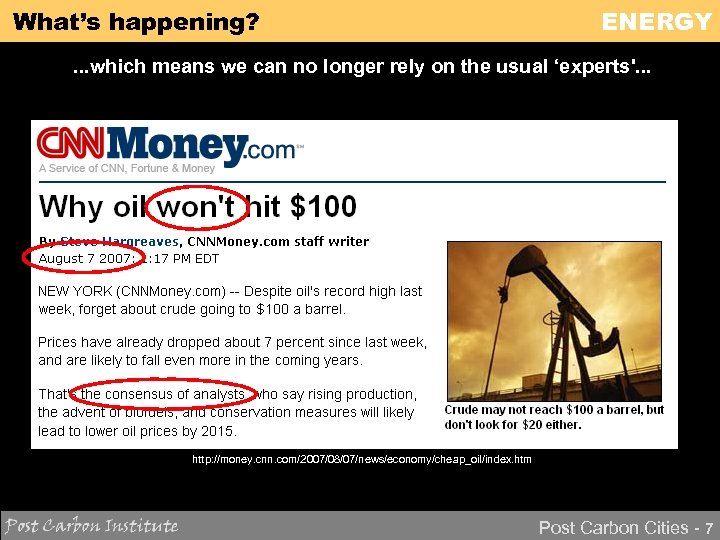
What’s happening? ENERGY . . . which means we can no longer rely on the usual ‘experts'. . . http: //money. cnn. com/2007/08/07/news/economy/cheap_oil/index. htm Post Carbon Cities - 7
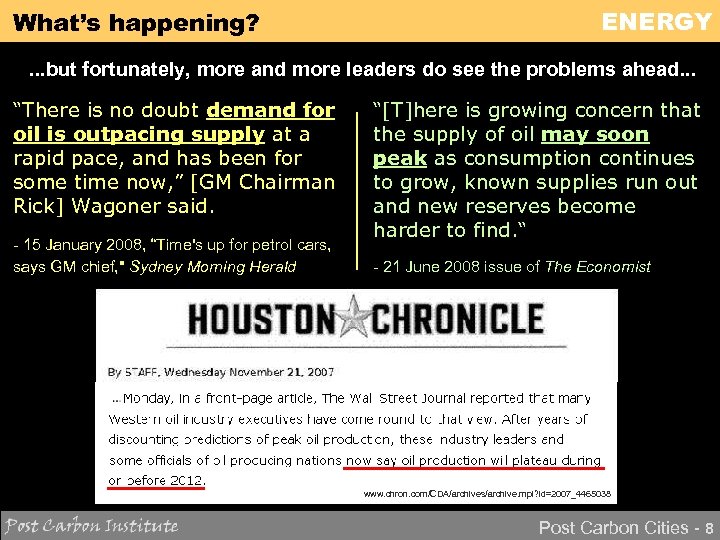
What’s happening? ENERGY . . . but fortunately, more and more leaders do see the problems ahead. . . “There is no doubt demand for oil is outpacing supply at a rapid pace, and has been for some time now, ” [GM Chairman Rick] Wagoner said. - 15 January 2008, “Time's up for petrol cars, says GM chief, " Sydney Morning Herald “[T]here is growing concern that the supply of oil may soon peak as consumption continues to grow, known supplies run out and new reserves become harder to find. “ - 21 June 2008 issue of The Economist www. chron. com/CDA/archives/archive. mpl? id=2007_4465038 Post Carbon Cities - 8
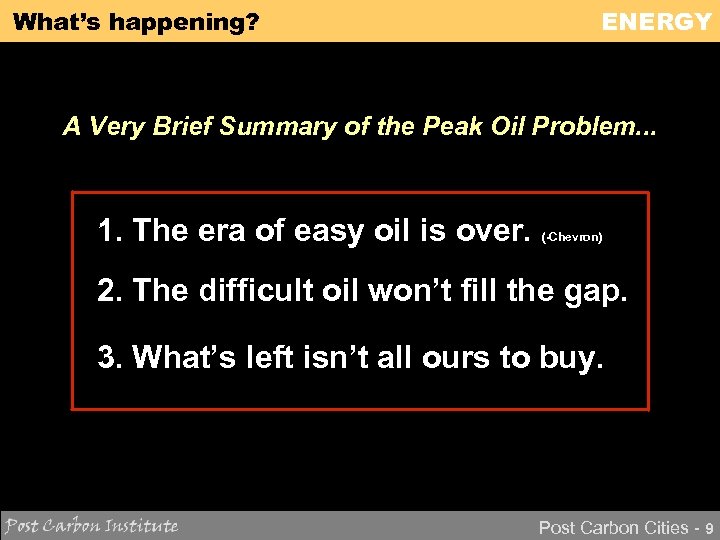
What’s happening? ENERGY A Very Brief Summary of the Peak Oil Problem. . . 1. The era of easy oil is over. (-Chevron) 2. The difficult oil won’t fill the gap. 3. What’s left isn’t all ours to buy. Post Carbon Cities - 9
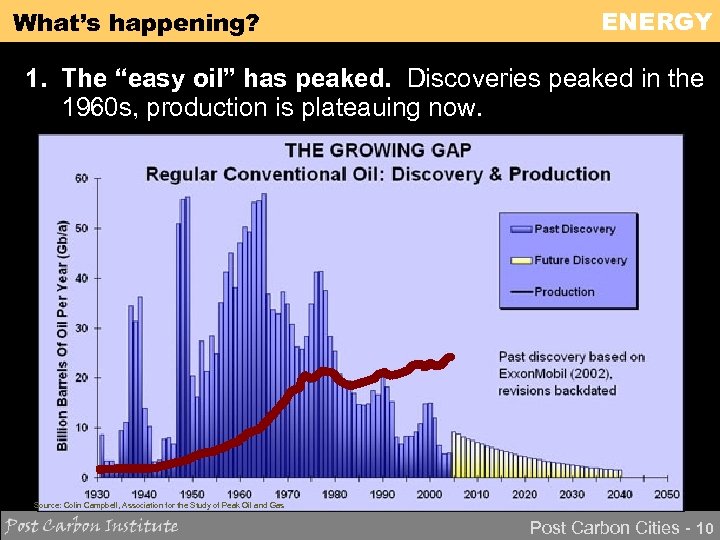
What’s happening? ENERGY 1. The “easy oil” has peaked. Discoveries peaked in the 1960 s, production is plateauing now. Source: Colin Campbell, Association for the Study of Peak Oil and Gas Post Carbon Cities - 10
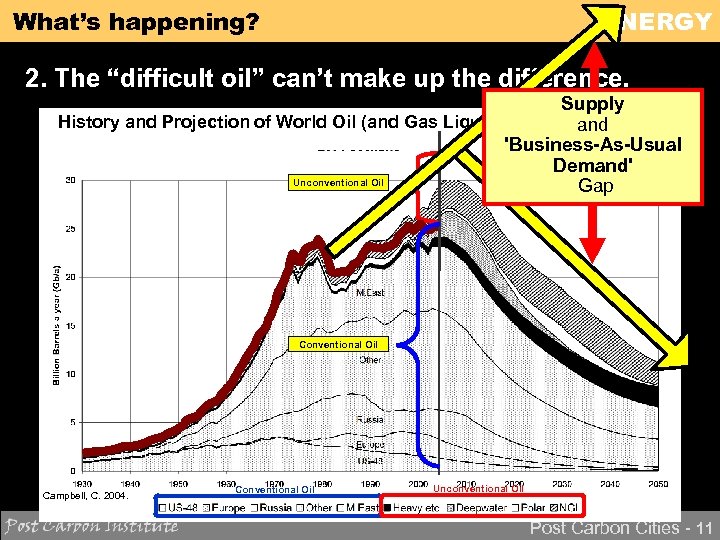
ENERGY What’s happening? 2. The “difficult oil” can’t make up the difference. Supply History and Projection of World Oil (and Gas Liquids) Production, 2004 and 'Business-As-Usual Demand' Unconventional Oil Gap Conventional Oil Campbell, C. 2004. Conventional Oil Unconventional Oil Post Carbon Cities - 11
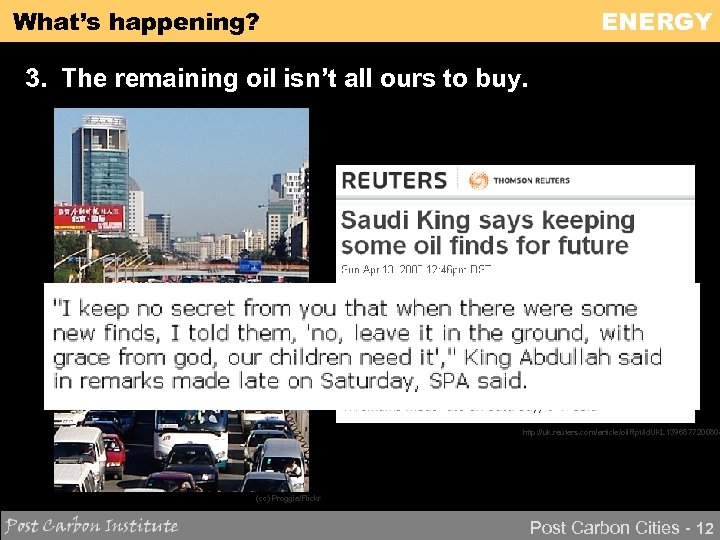
What’s happening? ENERGY 3. The remaining oil isn’t all ours to buy. http: //uk. reuters. com/article/oil. Rpt/id. UKL 1396877200804 (cc) Proggie/Flickr Post Carbon Cities - 12
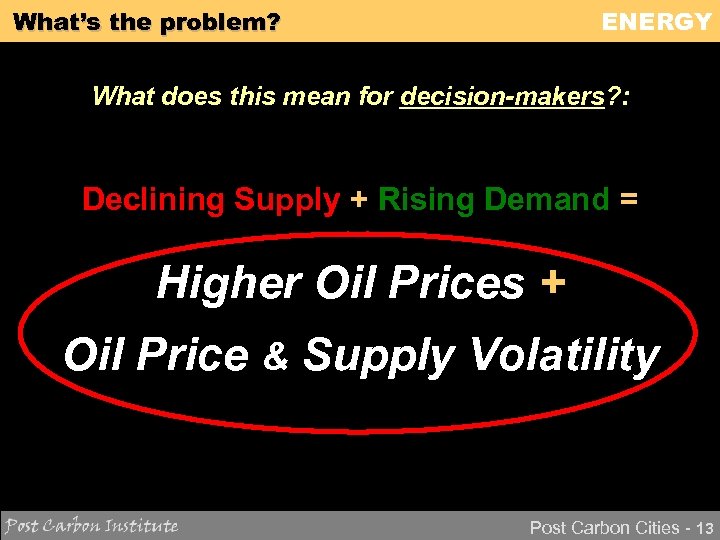
ENERGY What’s the problem? What does this mean for decision-makers? : Declining Supply + Rising Demand = Higher Oil Prices + Oil Price & Supply Volatility Post Carbon Cities - 13
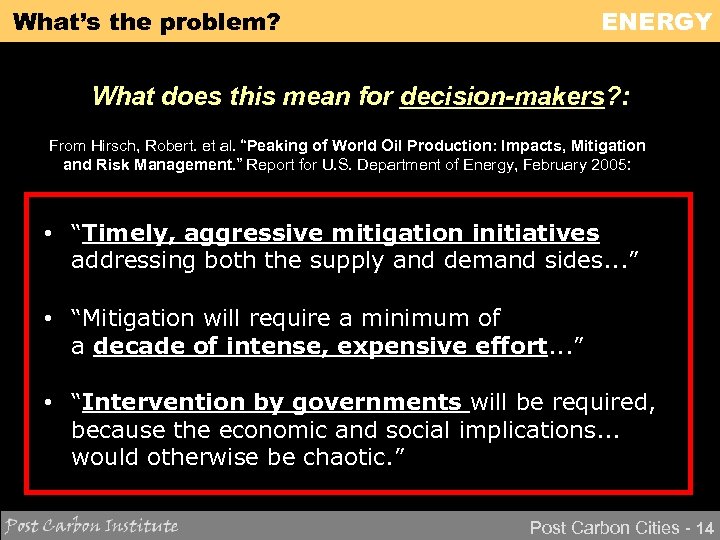
What’s the problem? ENERGY What does this mean for decision-makers? : From Hirsch, Robert. et al. “Peaking of World Oil Production: Impacts, Mitigation and Risk Management. ” Report for U. S. Department of Energy, February 2005: • “Timely, aggressive mitigation initiatives addressing both the supply and demand sides. . . ” • “Mitigation will require a minimum of a decade of intense, expensive effort. . . ” • “Intervention by governments will be required, because the economic and social implications. . . would otherwise be chaotic. ” Post Carbon Cities - 14
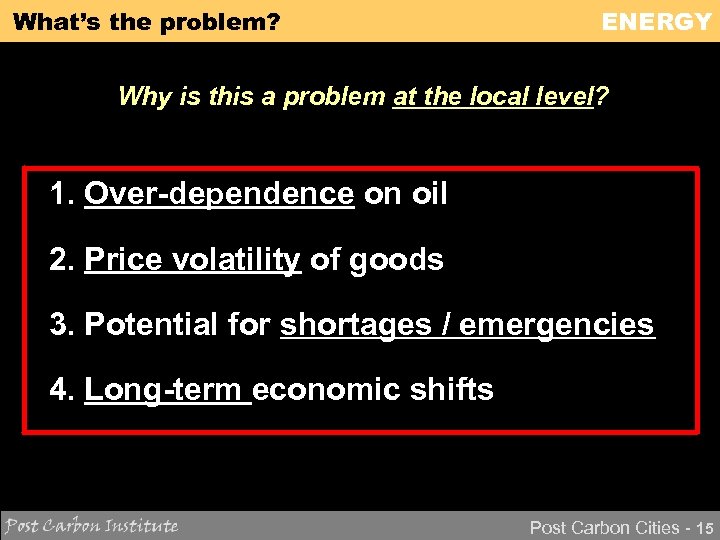
What’s the problem? ENERGY Why is this a problem at the local level? 1. Over-dependence on oil 2. Price volatility of goods 3. Potential for shortages / emergencies 4. Long-term economic shifts Post Carbon Cities - 15
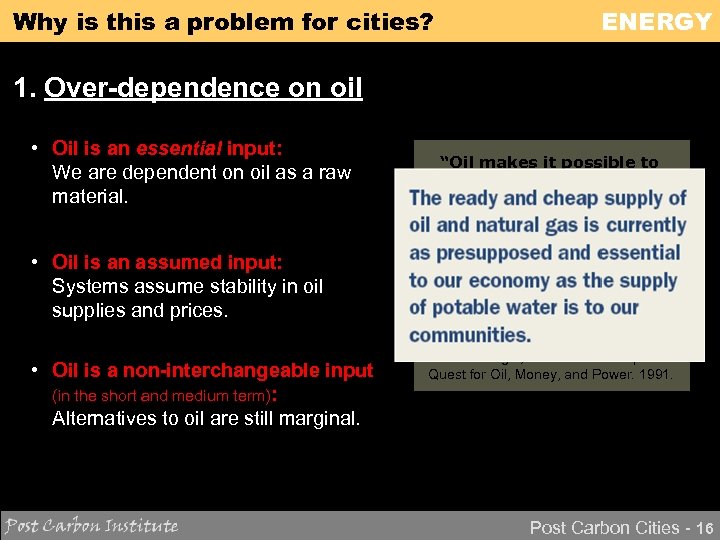
Why is this a problem for cities? ENERGY 1. Over-dependence on oil • Oil is an essential input: We are dependent on oil as a raw material. • Oil is an assumed input: Systems assume stability in oil supplies and prices. • Oil is a non-interchangeable input (in the short and medium term): Alternatives to oil are still marginal. “Oil makes it possible to transport food to the. . . megacities of the world. “Oil also provides the plastics and chemicals that are the bricks and mortar of contemporary civilization. . . ” –Daniel Yergin, The Prize: The Epic Quest for Oil, Money, and Power. 1991. Post Carbon Cities - 16
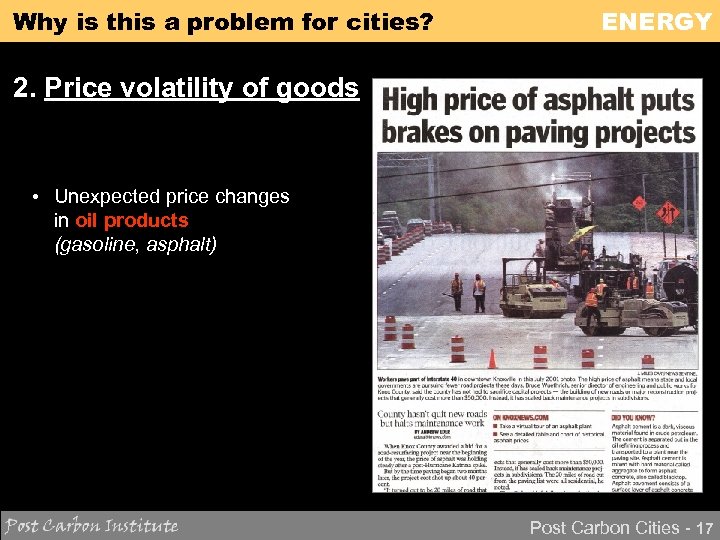
Why is this a problem for cities? ENERGY 2. Price volatility of goods • Unexpected price changes in oil products (gasoline, asphalt) Post Carbon Cities - 17
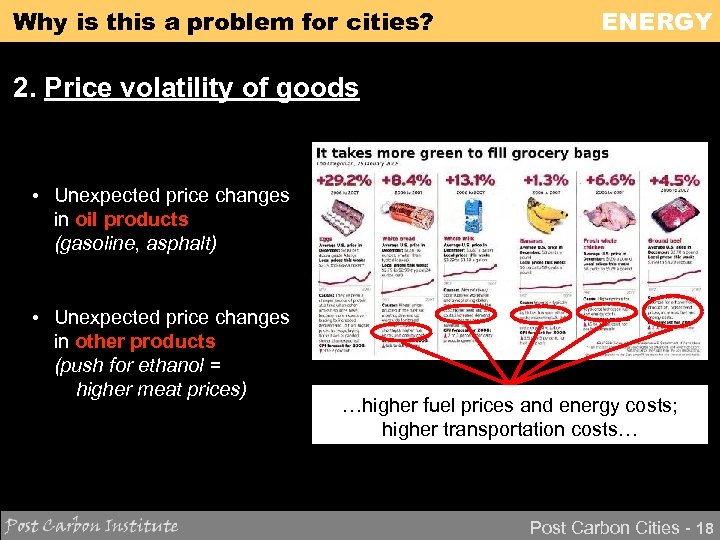
Why is this a problem for cities? ENERGY 2. Price volatility of goods • Unexpected price changes in oil products (gasoline, asphalt) • Unexpected price changes in other products (push for ethanol = higher meat prices) …higher fuel prices and energy costs; higher transportation costs… Post Carbon Cities - 18
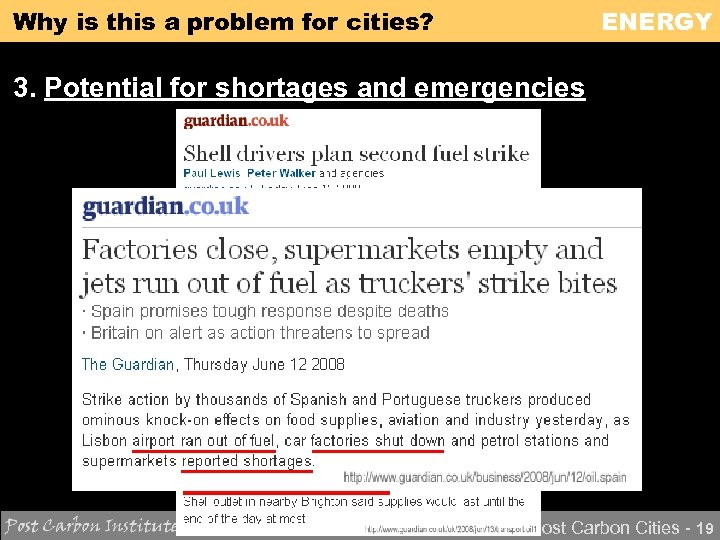
Why is this a problem for cities? ENERGY 3. Potential for shortages and emergencies Post Carbon Cities - 19
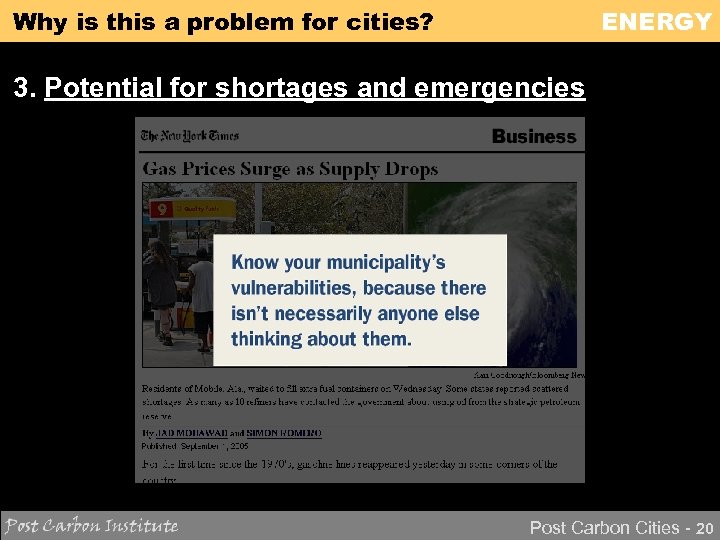
ENERGY Why is this a problem for cities? 3. Potential for shortages and emergencies Post Carbon Cities - 20
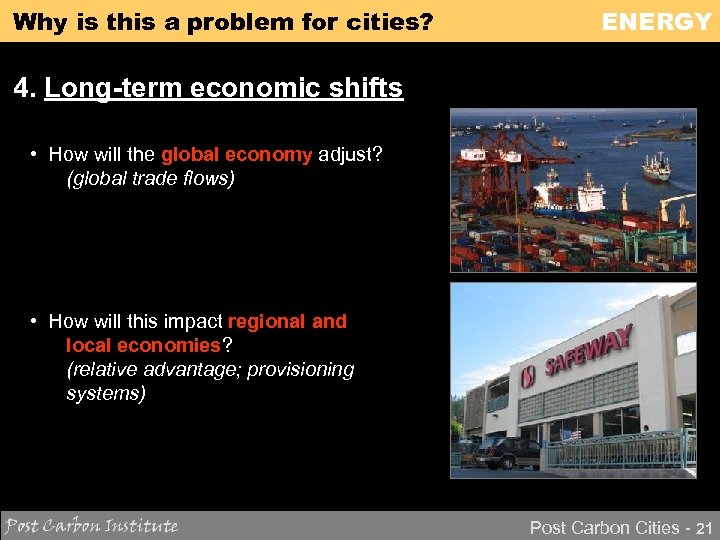
Why is this a problem for cities? ENERGY 4. Long-term economic shifts • How will the global economy adjust? (global trade flows) • How will this impact regional and local economies? (relative advantage; provisioning systems) Post Carbon Cities - 21
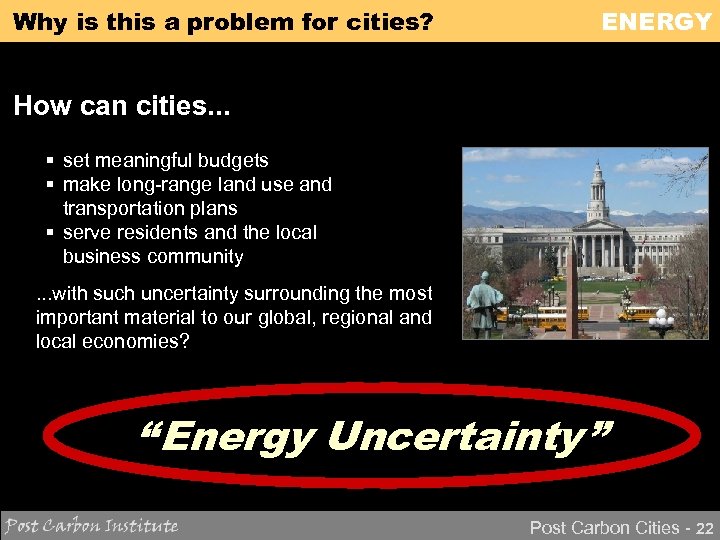
Why is this a problem for cities? ENERGY How can cities. . . set meaningful budgets make long-range land use and transportation plans serve residents and the local business community. . . with such uncertainty surrounding the most important material to our global, regional and local economies? “ Energy Uncertainty ” Post Carbon Cities - 22
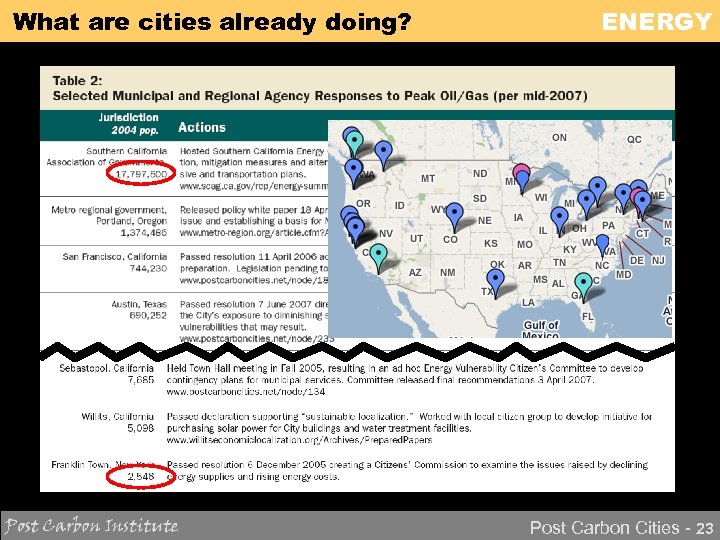
What are cities already doing? ENERGY Post Carbon Cities - 23
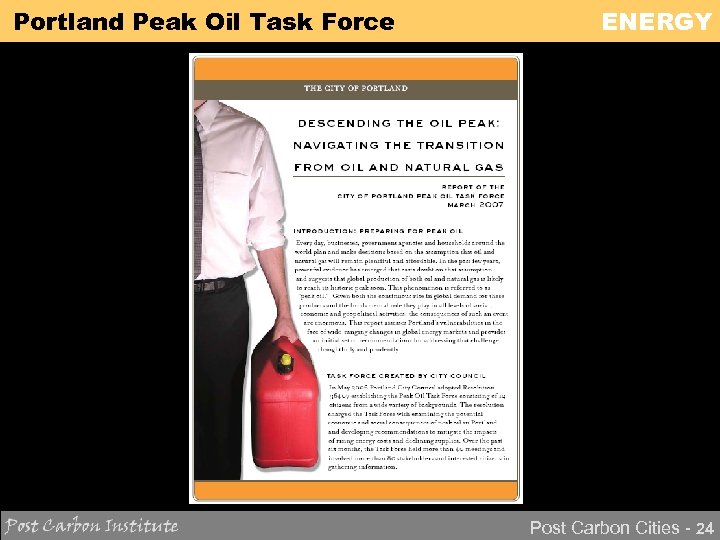
Portland Peak Oil Task Force ENERGY Post Carbon Cities - 24
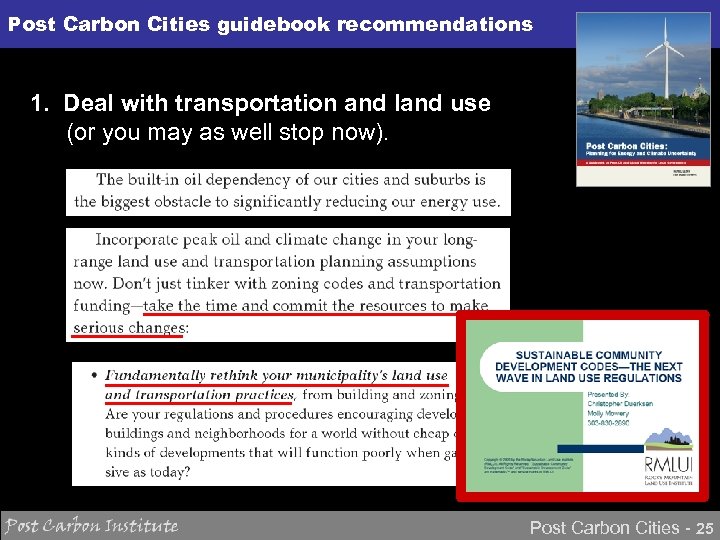
Post Carbon Cities guidebook recommendations ENERGY 1. Deal with transportation and land use (or you may as well stop now). Post Carbon Cities - 25
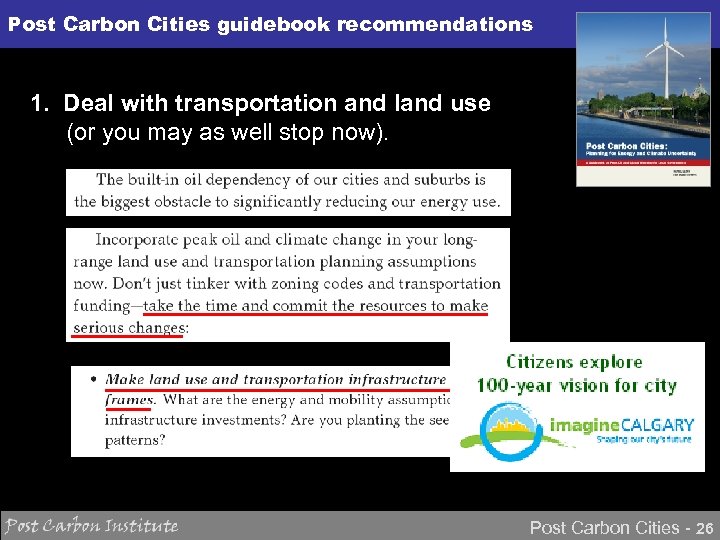
Post Carbon Cities guidebook recommendations ENERGY 1. Deal with transportation and land use (or you may as well stop now). Post Carbon Cities - 26
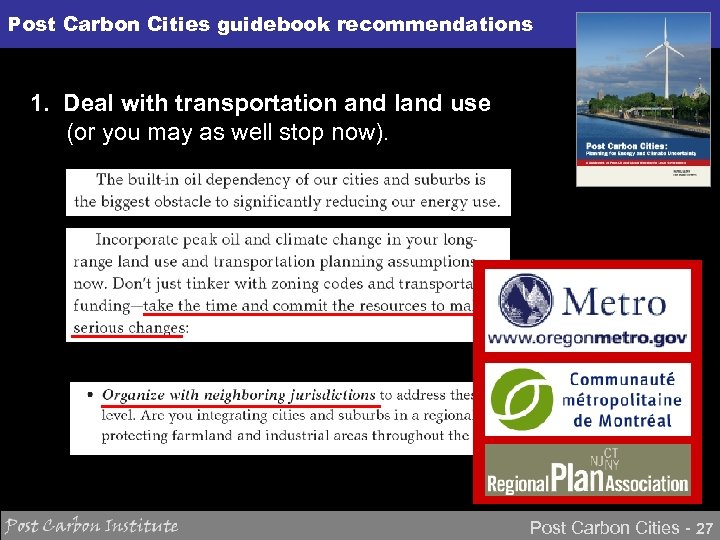
Post Carbon Cities guidebook recommendations ENERGY 1. Deal with transportation and land use (or you may as well stop now). Post Carbon Cities - 27
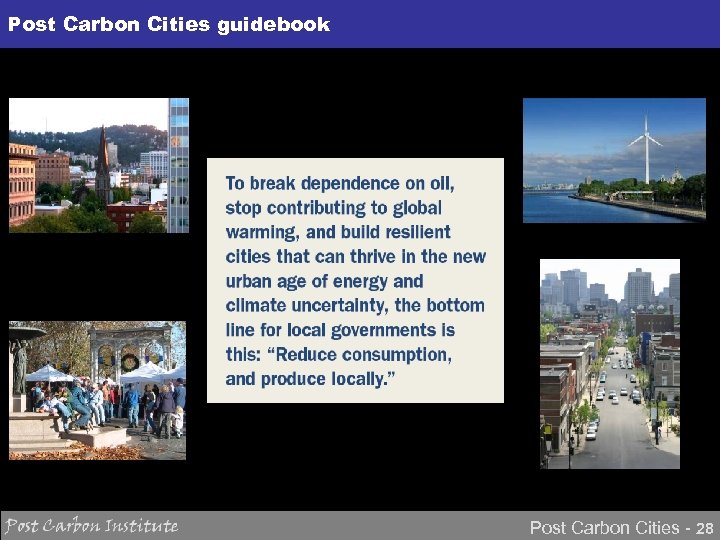
Post Carbon Cities guidebook ENERGY Post Carbon Cities - 28
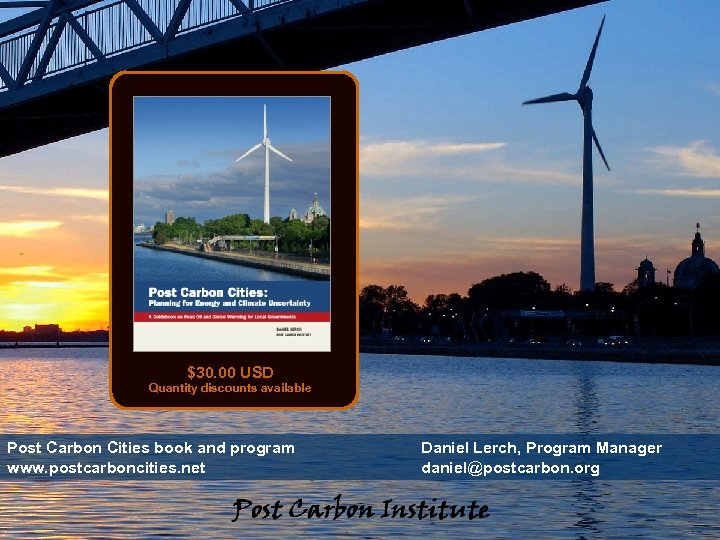
ENERGY $30. 00 USD Quantity discounts available Post Carbon Cities book and program www. postcarboncities. net Daniel Lerch, Program Manager daniel@postcarbon. org Post Carbon Cities - 29
Скачать презентацию ENERGY Post Carbon Cities Planning for Energy and
3b0a62b849ee269e52e5a7395fc5e7fd.ppt