 Скачать презентацию ENERGY INTERDEPENDENCE AND COOPERATION Cross-Border Pipelines and the
48d6b4aceebad9384a2a5654bb188234.ppt
- Количество слайдов: 37



ENERGY INTERDEPENDENCE AND COOPERATION Cross-Border Pipelines and the Energy Charter Treaty Graham Coop General Counsel Graham. Coop@encharter. org Energy Charter Secretariat www. encharter. org Energy in SEE – a must for development Energetika. NET Strategic Conference 010, Portorož, 23 June 2010
Cross-Border Pipelines and the Energy Charter Treaty ØCross-border pipelines in international law • The role of the pipeline: merchant, transporter or hybrid • The role of the border: border delivery, integrated cross-border transit or integrated cross-country transit ØThe Energy Charter Treaty and the transit of oil and gas • Introduction to the Energy Charter Treaty • Transit under the Energy Charter Treaty ØThe Transit Protocol and the Model Agreements • The Transit Protocol to the Energy Charter Treaty • The Model Agreements for the construction of crossborder pipelines 2
Cross-Border Pipelines and the Energy Charter Treaty ØCross-border pipelines in international law • The role of the pipeline: merchant, transporter or hybrid • The role of the border: border delivery, integrated cross-border transit or integrated cross-country transit ØThe Energy Charter Treaty and the transit of oil and gas • Introduction to the Energy Charter Treaty • Transit under the Energy Charter Treaty ØThe Transit Protocol and the Model Agreements • The Transit Protocol to the Energy Charter Treaty • The Model Agreements for the construction of crossborder pipelines 3
Cross-border pipelines in international law ØThe role of the pipeline • • • Merchant pipelines Transportation service pipelines Hybrid pipelines ØThe role of the border • • • Border delivery Integrated cross-border transit Integrated cross-country transit 4
Cross-Border Pipelines and the Energy Charter Treaty ØCross-border pipelines in international law • The role of the pipeline: merchant, transporter or hybrid • The role of the border: border delivery, integrated cross-border transit or integrated cross-country transit ØThe Energy Charter Treaty and the transit of oil and gas • Introduction to the Energy Charter Treaty • Transit under the Energy Charter Treaty ØThe Transit Protocol and the Model Agreements • The Transit Protocol to the Energy Charter Treaty • The Model Agreements for the construction of crossborder pipelines 5
Historical and political background to the ECT Ø Common interest in energy cooperation between CIS and western world in post-Cold War era Ø Inter-governmental framework was needed to provide legal stability for investments and to secure trade and transit of energy Ø Promote energy market reforms (re-structuring and commercialisation, energy price reforms) Ø Promote higher energy efficiency 6
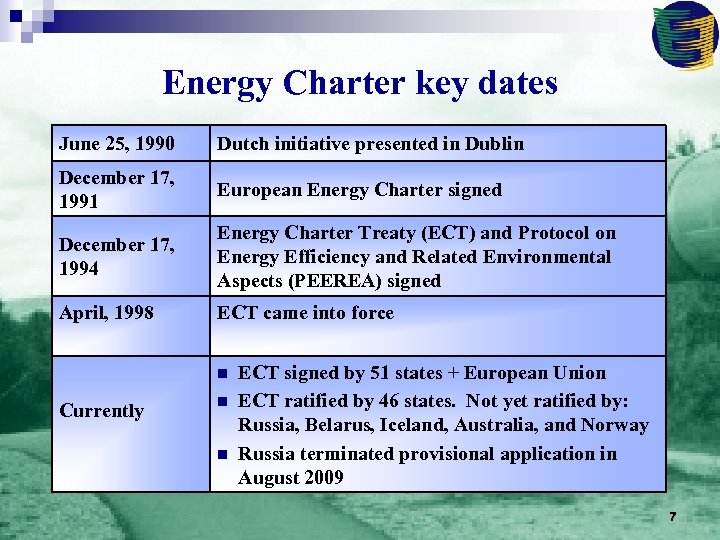
Energy Charter key dates June 25, 1990 Dutch initiative presented in Dublin December 17, 1991 European Energy Charter signed December 17, 1994 Energy Charter Treaty (ECT) and Protocol on Energy Efficiency and Related Environmental Aspects (PEEREA) signed April, 1998 ECT came into force n Currently n n ECT signed by 51 states + European Union ECT ratified by 46 states. Not yet ratified by: Russia, Belarus, Iceland, Australia, and Norway Russia terminated provisional application in August 2009 7
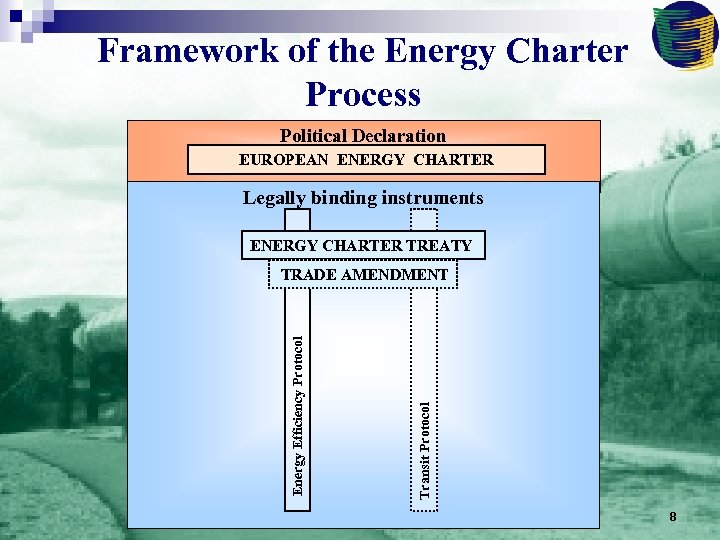
Framework of the Energy Charter Process Political Declaration EUROPEAN ENERGY CHARTER Legally binding instruments ENERGY CHARTER TREATY Transit Protocol Energy Efficiency Protocol TRADE AMENDMENT 8
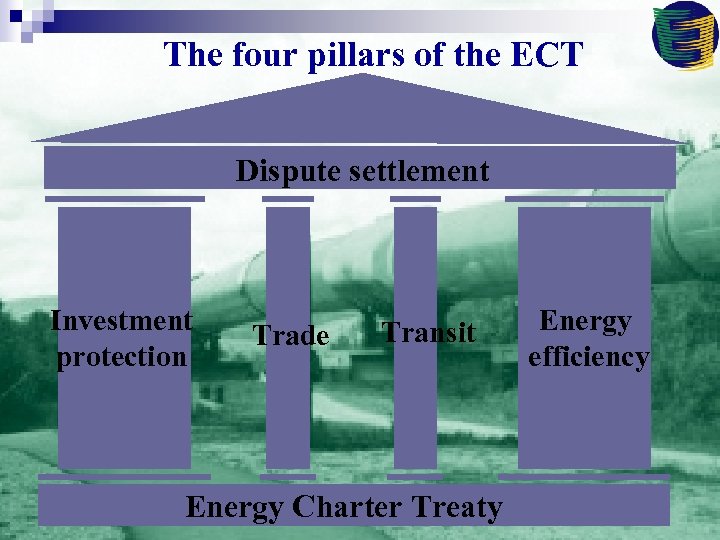
The four pillars of the ECT Dispute settlement Investment protection 3 March 2005 Trade Transit Energy Charter Treaty Energy efficiency
The ECT – a pioneer in its field Ø Unique in covering trade, transit, energy efficiency and investment Ø Offers intermediary step towards WTO membership Ø Establishes inter-governmental forum to discuss energy cooperation issues 10
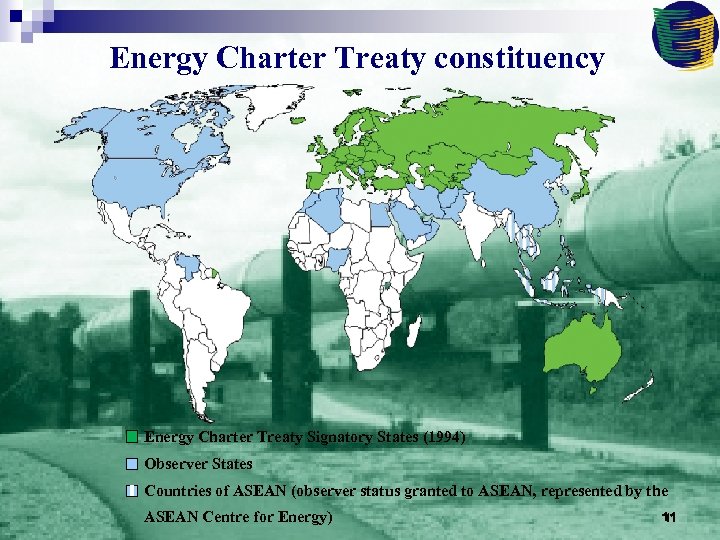
Energy Charter Treaty constituency Energy Charter Treaty Signatory States (1994) Observer States Countries of ASEAN (observer status granted to ASEAN, represented by the ASEAN Centre for Energy) 11 11
Investment protection ECT Part III (Articles 10 -17) Offers protected investors a wide range of guarantees and protections (FET, CPS, non-discrimination, MFN, umbrella clause, key personnel, expropriation, freedom of transfers) 12
Investor-state dispute resolution ECT Article 26 Offers protected investors, in the event of alleged violation by host state of Part III obligations, investor-state arbitration under (at investor’s choice): • Arbitration Institute of Stockholm Chamber of Commerce • ICSID or ICSID Additional Facility (subject to nationality requirements) • UNCITRAL Rules 13
Applicable definitions of “Investment” and “Investor” ECT Articles 1 (6) and 1 (7) Investment: Every kind of asset (e. g. shares, claims to money, intellectual property, licences, concessions) owned or controlled directly or indirectly by an Investor: natural persons of a CP (including permanent residents), and companies/organisations organised in accordance with the laws of a CP 14
Mailbox companies ECT Article 17 Each Contracting Party reserves the right to deny the advantages of this Part to: (1) a legal entity if citizens or nationals of a third state own or control such entity and if that entity has no substantial business activities in the Area of the Contracting Party in which it is organised…. 15
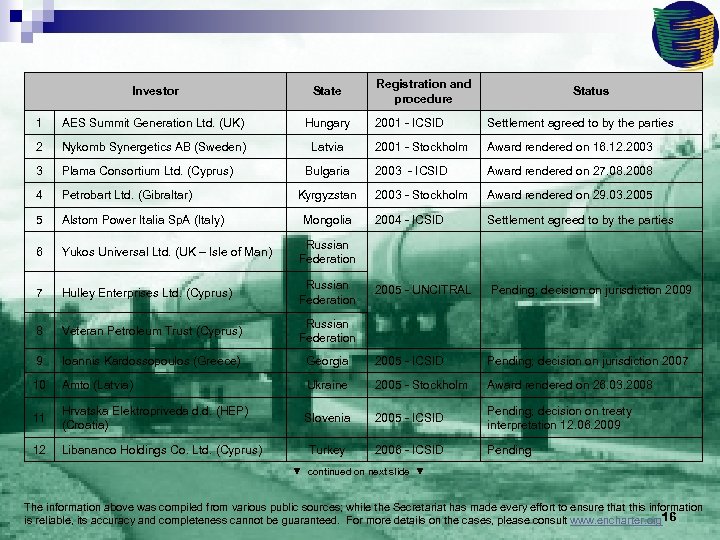
Investor State 1 AES Summit Generation Ltd. (UK) Hungary 2 Nykomb Synergetics AB (Sweden) Latvia 3 Plama Consortium Ltd. (Cyprus) 4 Petrobart Ltd. (Gibraltar) 5 Alstom Power Italia Sp. A (Italy) 6 Yukos Universal Ltd. (UK – Isle of Man) Russian Federation 7 Hulley Enterprises Ltd. (Cyprus) Russian Federation 8 Veteran Petroleum Trust (Cyprus) Russian Federation 9 Ioannis Kardossopoulos (Greece) 10 Registration and procedure Status 2001 - ICSID Settlement agreed to by the parties 2001 - Stockholm Award rendered on 16. 12. 2003 - ICSID Award rendered on 27. 08. 2008 2003 - Stockholm Award rendered on 29. 03. 2005 2004 - ICSID Settlement agreed to by the parties 2005 - UNCITRAL Pending; decision on jurisdiction 2009 Georgia 2005 - ICSID Pending; decision on jurisdiction 2007 Amto (Latvia) Ukraine 2005 - Stockholm Award rendered on 26. 03. 2008 11 Hrvatska Elektropriveda d. d. (HEP) (Croatia) Slovenia 2005 - ICSID Pending; decision on treaty interpretation 12. 06. 2009 12 Libananco Holdings Co. Ltd. (Cyprus) Turkey 2006 - ICSID Pending Bulgaria Kyrgyzstan Mongolia ▼ continued on next slide ▼ The information above was compiled from various public sources; while the Secretariat has made every effort to ensure that this information is reliable, its accuracy and completeness cannot be guaranteed. For more details on the cases, please consult www. encharter. org 16
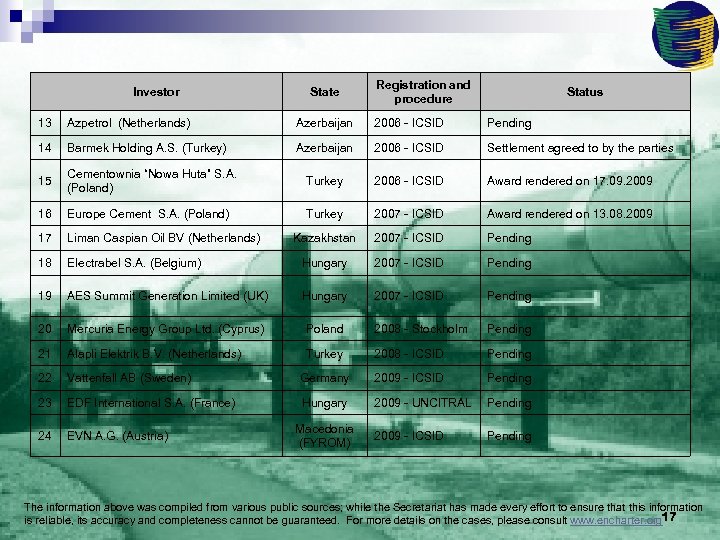
Investor State Registration and procedure Status 13 Azpetrol (Netherlands) Azerbaijan 2006 - ICSID Pending 14 Barmek Holding A. S. (Turkey) Azerbaijan 2006 - ICSID Settlement agreed to by the parties 15 Cementownia “Nowa Huta” S. A. (Poland) Turkey 2006 - ICSID Award rendered on 17. 09. 2009 16 Europe Cement S. A. (Poland) Turkey 2007 - ICSID Award rendered on 13. 08. 2009 17 Liman Caspian Oil BV (Netherlands) Kazakhstan 2007 - ICSID Pending 18 Electrabel S. A. (Belgium) Hungary 2007 - ICSID Pending 19 AES Summit Generation Limited (UK) Hungary 2007 - ICSID Pending 20 Mercuria Energy Group Ltd. (Cyprus) Poland 2008 - Stockholm Pending 21 Alapli Elektrik B. V. (Netherlands) Turkey 2008 - ICSID Pending 22 Vattenfall AB (Sweden) Germany 2009 - ICSID Pending 23 EDF International S. A. (France) Hungary 2009 - UNCITRAL Pending 24 EVN A. G. (Austria) 2009 - ICSID Pending Macedonia (FYROM) The information above was compiled from various public sources; while the Secretariat has made every effort to ensure that this information is reliable, its accuracy and completeness cannot be guaranteed. For more details on the cases, please consult www. encharter. org 17
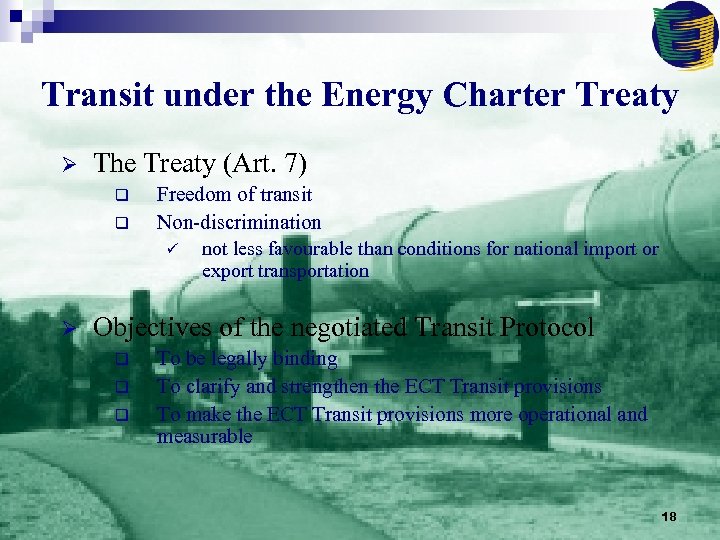
Transit under the Energy Charter Treaty Ø The Treaty (Art. 7) q q Ø Freedom of transit Non-discrimination ü not less favourable than conditions for national import or export transportation Objectives of the negotiated Transit Protocol q q q To be legally binding To clarify and strengthen the ECT Transit provisions To make the ECT Transit provisions more operational and measurable 18
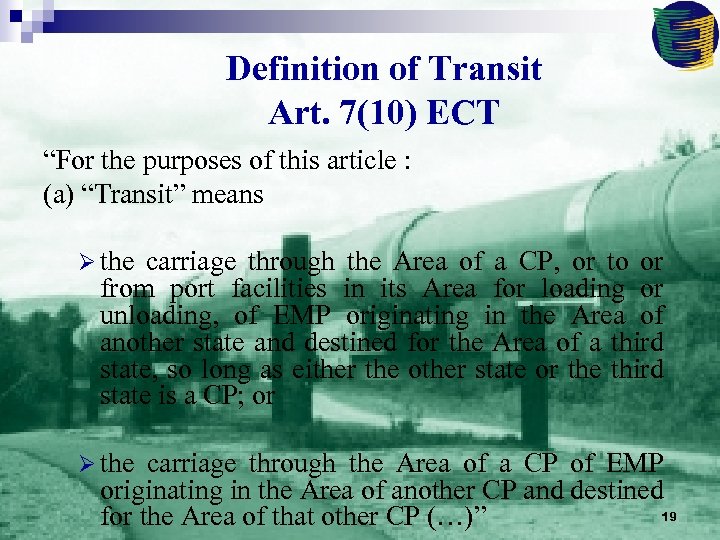
Definition of Transit Art. 7(10) ECT “For the purposes of this article : (a) “Transit” means Ø the carriage through the Area of a CP, or to or from port facilities in its Area for loading or unloading, of EMP originating in the Area of another state and destined for the Area of a third state, so long as either the other state or the third state is a CP; or Ø the carriage through the Area of a CP of EMP originating in the Area of another CP and destined 19 for the Area of that other CP (…)”
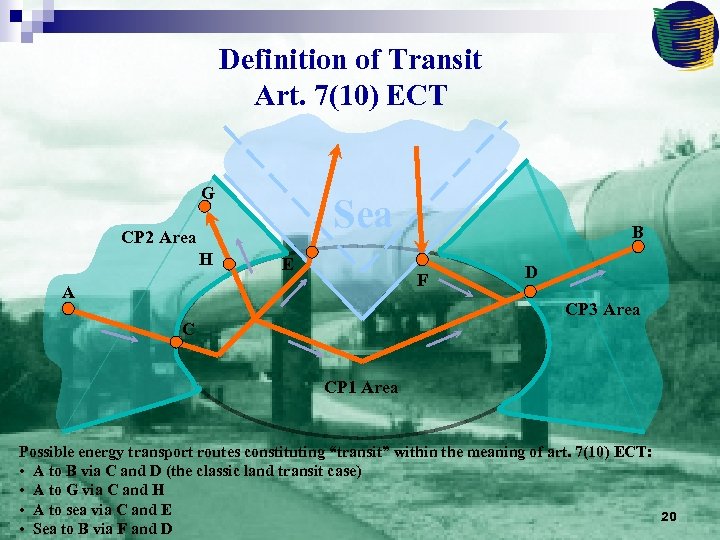
Definition of Transit Art. 7(10) ECT G Sea CP 2 Area H E B F A D CP 3 Area C CP 1 Area Possible energy transport routes constituting “transit” within the meaning of art. 7(10) ECT: • A to B via C and D (the classic land transit case) • A to G via C and H • A to sea via C and E • Sea to B via F and D 20
ECT Article 7: Transit Ø Ø No mandatory third party access Freedom of energy transit q Ø Non-discrimination q q Ø Ø as to origin, destination or ownership as to pricing Non-interruption of flow Obligation not to obstruct the establishment of new capacity, in case of: q q Ø no unreasonable delays, restrictions or charges Lack of infrastructure Insufficient available capacity National treatment q Transit treated no less favourably than energy originating in or destined for transit country itself 21
Cross-Border Pipelines and the Energy Charter Treaty ØCross-border pipelines in international law • The role of the pipeline: merchant, transporter or hybrid • The role of the border: border delivery, integrated cross-border transit or integrated cross-country transit ØThe Energy Charter Treaty and the transit of oil and gas • Introduction to the Energy Charter Treaty • Transit under the Energy Charter Treaty ØThe Transit Protocol and the Model Agreements • The Transit Protocol to the Energy Charter Treaty • The Model Agreements for the construction of crossborder pipelines 22
The Transit Protocol and the Model Agreements ØThe Transit Protocol to the Energy Charter Treaty • A multilateral international legal instrument in the course of negotiation • Potentially legally binding on all Contracting Parties to the ECT which elect to join the TP ØThe Model Agreements for the construction of cross-border pipelines • Available, but not obligatory, for use by States, investors and other parties to cross-border pipeline projects 23
Draft Transit Protocol Objectives Ø To be legally binding Ø To clarify and strengthen the ECT Transit provisions Ø To make the ECT Transit provisions more operational and measurable 24
Draft Transit Protocol Key provisions Ø Definition of “Available Capacity for Transit” Ø Conditions for access to available capacity Ø Criteria for setting transit tariffs 25
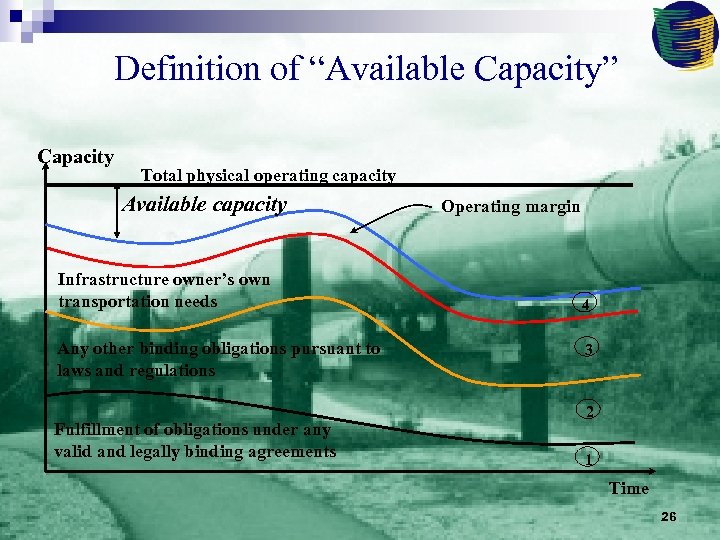
Definition of “Available Capacity” Capacity Total physical operating capacity Available capacity Infrastructure owner’s own transportation needs Any other binding obligations pursuant to laws and regulations Fulfillment of obligations under any valid and legally binding agreements Operating margin 4 3 2 1 Time 26
Access to “Available Capacity” Negotiated access : • • • On the basis of transparent procedures On commercial terms Non-discriminatory as to origin, destination or ownership No mandatory TPA 27
Transit tariffs Ø Cost–based • operational and investment costs, including a reasonable rate of return Ø Transparent Ø Non–discriminatory Ø Objective Ø Reasonable 28
Other provisions Ø Prohibition of unauthorised taking of energy Ø Measures to prevent / mitigate accidental interruption, reduction or stoppage of transit Ø Protection of environment Ø Metering and measuring at borders Ø Standards (technical, environmental, health, safety, social, accounting) 29
Outstanding issues Ø ‘Mismatch’ issue • Long-term supply contracts and shorterterm transit contracts Ø Regional Economic Integration Organization (REIO) clause Ø Transit tariffs 30
Model Agreements for cross-border pipelines Ø Model Agreements (MA) – a guide to best practice Ø Model IGA and HGA – a package approach Ø Basis of the package approach: • • • IGA and HGAs are interdependent and linked IGA is an international treaty HGAs are State contracts Entry into force of HGAs is conditional on that of the IGA All agreements refer to one identified project with identified project investors 31
Structure of MA package Intergovernmental Agreement (“IGA”) Ø Treaty model – agreement among States, either signatories or parties to Energy Charter Treaty Ø Applies not only to transit state, but also to producer and consumer states (at least 2 state parties) Ø Umbrella agreement to Host Government Agreements (“HGAs”) and to project agreements Ø Deals with horizontal issues 32

Structure of MA package Host Government Agreement (“HGA”) Ø Agreement between host state and project investor (= State contract) Ø Covers commercial terms of the project insofar as these concern the relevant host government Ø Deals with vertical issues 33
Structure of MA package Project Agreements Ø Outside scope of the Energy Charter Secretariat’s Model Agreements mandate Ø Defined in IGA and in HGAs 34
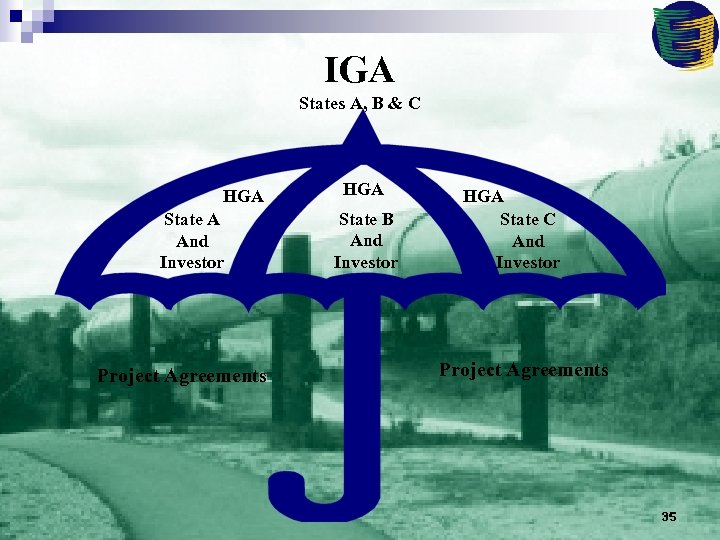
IGA States A, B & C HGA State A And Investor Project Agreements HGA State B And Investor HGA State C And Investor Project Agreements 35
Conclusions Ø Energy interdependence and cooperation require a stable legal regime for cross-border transport of energy Ø ECT investment protection regime, Transit Protocol and Model Agreements offer the best multilateral framework of rules on transit Ø Strategic objective for energy interdependence and cooperation in SEE: the Energy Charter’s Transit rules finalised, entered into force and observed in practice 36
ENERGY INTERDEPENDENCE AND COOPERATION Cross-Border Pipelines and the Energy Charter Treaty Graham Coop General Counsel Graham. Coop@encharter. org Energy Charter Secretariat www. encharter. org Energy in SEE – a must for development Energetika. NET Strategic Conference 010, Portorož, 23 June 2010
Скачать презентацию ENERGY INTERDEPENDENCE AND COOPERATION Cross-Border Pipelines and the
48d6b4aceebad9384a2a5654bb188234.ppt