


 Скачать презентацию Energy Efficiency Innovation Review 2005 Ø Summary report
b68ea1ece66a95e3ff42659f142db1e0.ppt
- Количество слайдов: 20
 Energy Efficiency Innovation Review (2005) Ø Summary report: http: //www. hm-treasury. gov. uk/media/FB 4/AE/ pbr 05_energy_675. pdf Ø Domestic sector: http: //www. est. org. uk/uploads/documents/aboutest/Household%20 energy% 20 efficiency%20 action%20 for%20 a%20 low%20 carbon%20 society. pdf
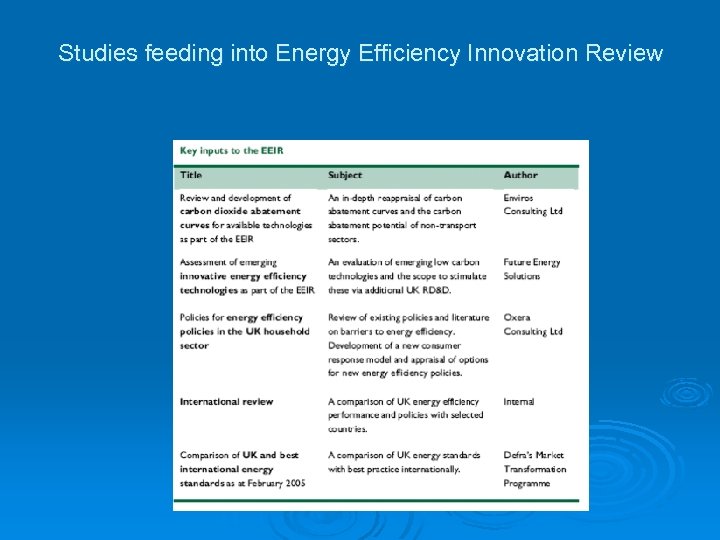
 Energy Efficiency Innovation Review (2005) Launched – pre-budget report (2004) Published Dec 2005 Defra, HM Treasury, Carbon Trust & Energy Saving Trust Ø An input to the wider review of the UK Climate Change Programme Ø Ø Purpose l l Ø Examine how a step-change in energy efficiency (domestic, business & public sector) can be delivered cost effectively How can energy efficiency improvements be embedded into decision making across the economy ‘Innovation’ – technical & policy innovation
 Focus Ø Includes l l l Ø Excludes: l l l Ø How to deliver demand side efficiencies How to increase the uptake of existing energy-efficient goods and services How to accelerate the development of new, energy-efficient technologies Transport Energy services The scope for local and regional delivery Assessments l l Potential energy & carbon savings projected to 2010 and 2020 Role of new technologies – up to 2050
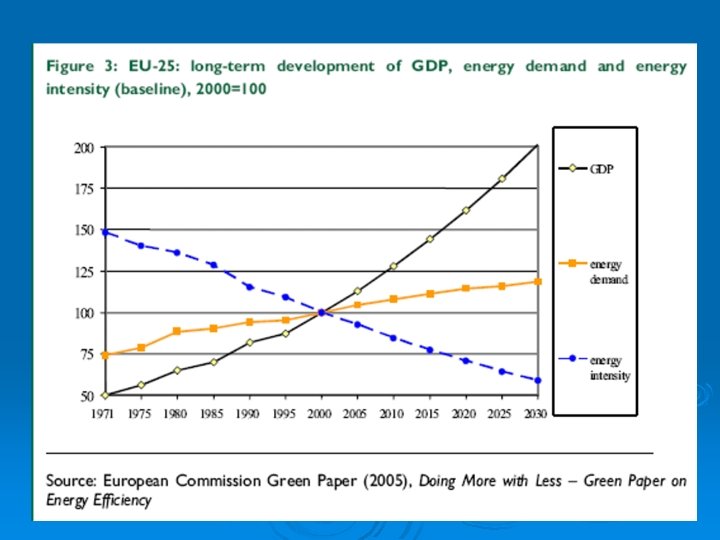
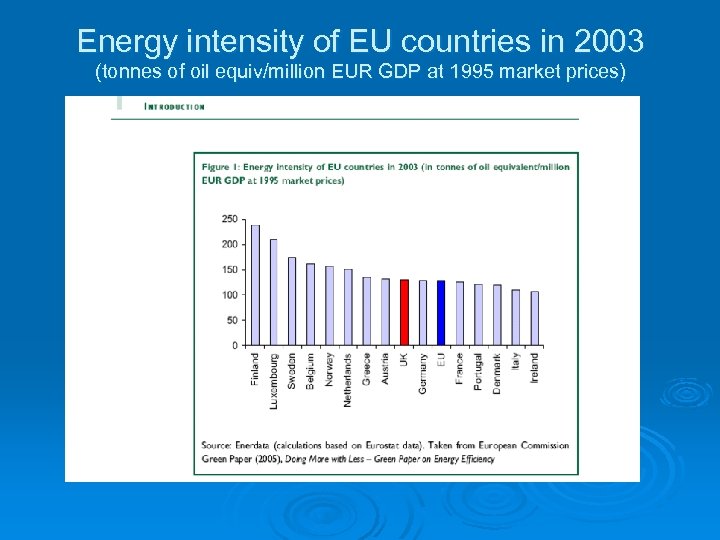 Energy intensity of EU countries in 2003 (tonnes of oil equiv/million EUR GDP at 1995 market prices)
 UK position – consumer products UK/EU leads energy performance standards for washing machines & dishwashers Ø Good energy performance standards & best practice standards for heating demand reduction – not world leader Ø Patchy coverage Ø l Ø other white goods, heating products Limited/no coverage l consumer electronics, domestic lighting, cooking, ICT UK/EU – few performance standards for motors, drives, commercial lighting Ø No UK/EUI minimum standards for commercial air conditioning & lighting Ø UK/EU few endorsement standards, little best practice coverage Ø l Ø except domestic boilers, gas water heaters, domestic heating, demand reduction and ICT Where standards are in place – 40% standards lead world wide.
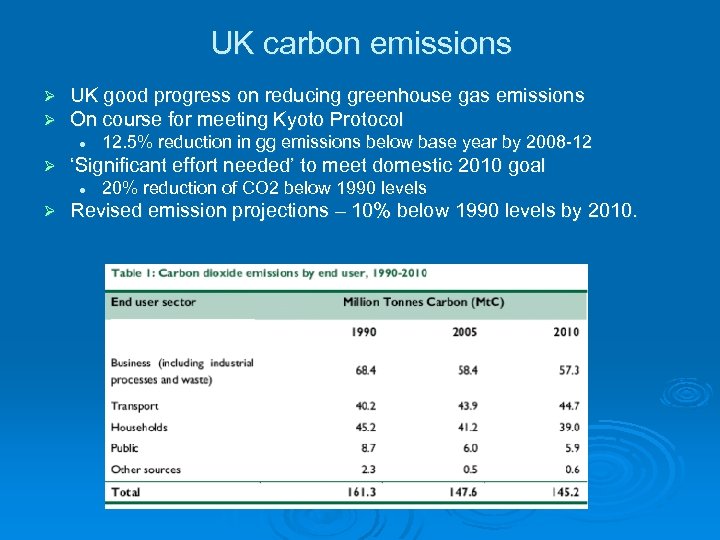 UK carbon emissions Ø Ø UK good progress on reducing greenhouse gas emissions On course for meeting Kyoto Protocol l Ø ‘Significant effort needed’ to meet domestic 2010 goal l Ø 12. 5% reduction in gg emissions below base year by 2008 -12 20% reduction of CO 2 below 1990 levels Revised emission projections – 10% below 1990 levels by 2010.
 Household Sector Ø Responsible for 40 Mt. C/year (30% UK total) l l Ø Scope to deliver 9 Mt. C of cost-effective savings by 2020 l l Ø Space & water heating 75% Lights & appliances 25% 7. 5 Mt. C from measures tackling space and water heating 1. 5 Mt. C from appliances Two types of decisions impact on energy efficiency investment l l (in addition to low or no cost behavioural measures) One-off measures driven by energy saving • Eg retrofit insulation or heating controls l Purchase or replacement of fittings/appliances • Decision to purchase not driven by energy saving • But scope to purchase high efficiency option Ø Potential carbon emission similar but levers to influence decisions are very different
 Energy Efficiency Commitment (EEC) Electricity and gas suppliers are required to achieve targets for the promotion of improvements in domestic energy efficiency. Ø Environmental aim Ø l Ø Social aim l l Ø EEC will also contribute to the alleviation of fuel poverty. 50% of energy savings must be focussed on a priority group of lowincome consumers in receipt of certain benefits and tax credits/pension credit. Eleven suppliers were set a target of 62 TWH in 2002 apportioned according to number of customers l l Ø will contribute to the Climate Change Programme by cutting greenhouse gas emissions 1 M homes loft/cavity wall insulation 750, 000 energy efficient appliances 450, 000 condensing gas boilers 36 M low energy lamps All obligated suppliers met their energy saving targets or went beyond them
 Several key challenges Ø Current programmes deliver their savings through social housing l l Ø Lack of focus on behaviour/ how to incentivise behavioural change l Ø By end of decade the improvement of social housing insulation will be exhausted Need to find ways to deliver to owner-occupiers & private landlords Reduce heating hours, internal temperature, lighting levels and appliance usage Current physical measures will reach saturation point early to mid next decade l Need to draw in new physical measures • Solid wall insulation, low carbon technologies, high insulation products
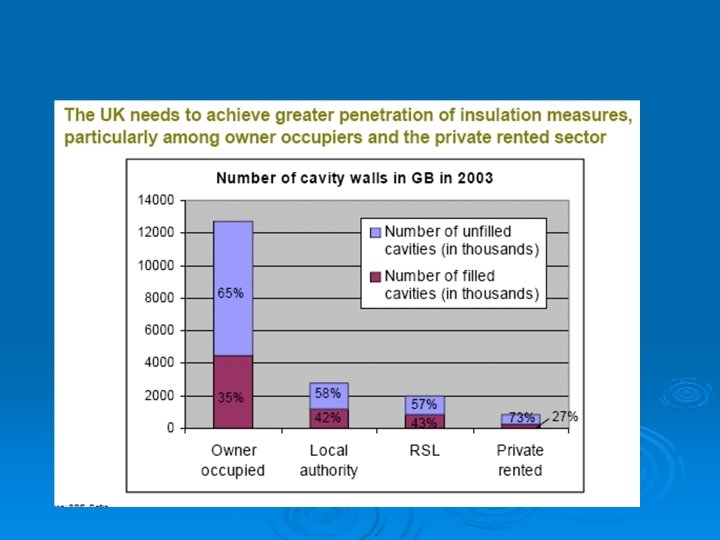
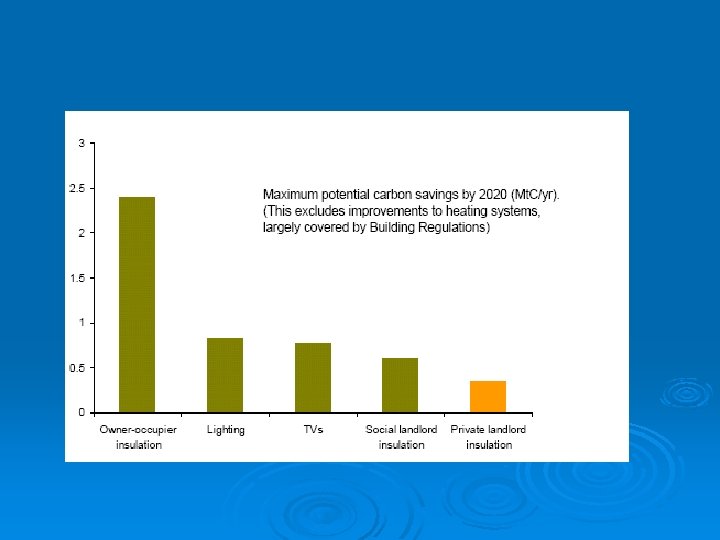
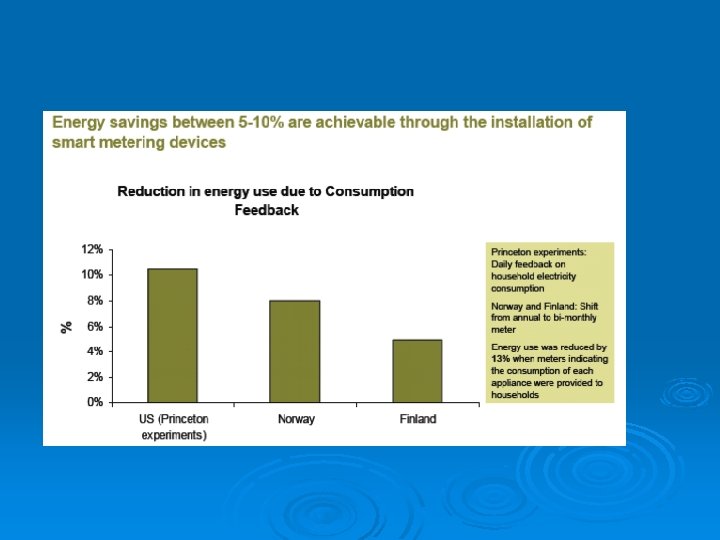
 Options for new or expanded policies on buildings: supplier obligation (EEC) Ø Ø An effective route to drive energy efficiency take-up Access to consumer is a key factor in delivering carbon savings Further increase in target is feasible - 50% increase on the current phase 2 barriers l l Ø How can EEC and other measures facilitate an increase in the uptake of energy efficiency measures l Ø Up-front costs, reliability and reputation of installer, perceived ‘hassle factor’, personal recommendation Supplier cap and trade scheme – after 2011 l Ø Move from a market which provides units of energy to one that addresses the heating, lighting and power needs of the consumer Cost effectiveness not a key driver for installing insulation l Ø Cost perception gap – customers have poor knowledge of costs and benefits of measures Distrust of supply chain Move away from installation of physical measures towards direct delivery of carbon or energy targets Energy Consumption feedback l l Cost effective Accessible real time displays Smart metering (Energy End-use Efficiency and Energy Services Directive)
 Building Regulations Ø Ø Most consistently effective policy Further tightening in 2010 Opportunities will decline after 2010 Further improvements – low carbon technologies l Ø Need to reduce costs l l l Ø Solar water heating, small-scale renewables, micro-CHP, heat pumps Builders Obligation Sustainable Building Code for a small proportion of houses built by volume house-builders Drive down costs of new technologies by increasing market penetration Compliance with Building Regulations l l Study of 99 new houses Third failed to achieve recommended level for air tightness
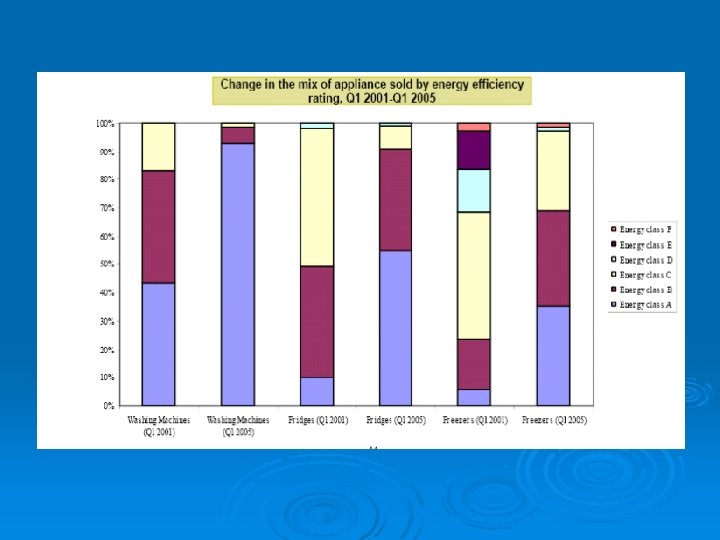
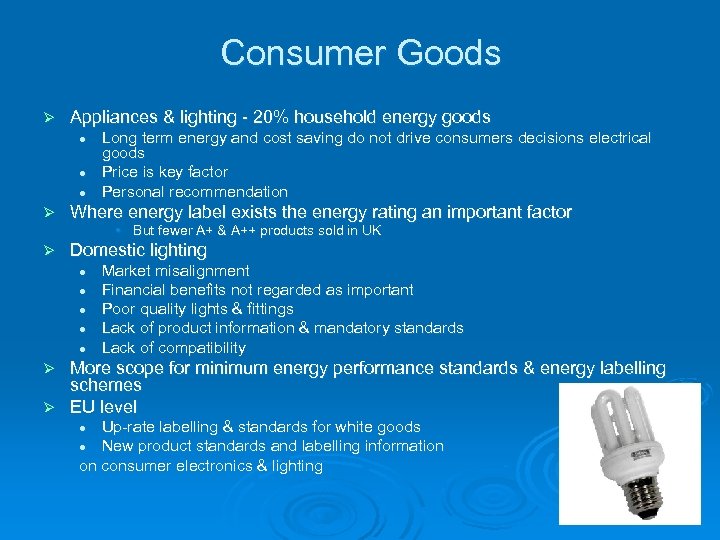 Consumer Goods Ø Appliances & lighting - 20% household energy goods l l l Ø Long term energy and cost saving do not drive consumers decisions electrical goods Price is key factor Personal recommendation Where energy label exists the energy rating an important factor • But fewer A+ & A++ products sold in UK Ø Domestic lighting l l l Market misalignment Financial benefits not regarded as important Poor quality lights & fittings Lack of product information & mandatory standards Lack of compatibility More scope for minimum energy performance standards & energy labelling schemes Ø EU level Ø Up-rate labelling & standards for white goods l New product standards and labelling information on consumer electronics & lighting l
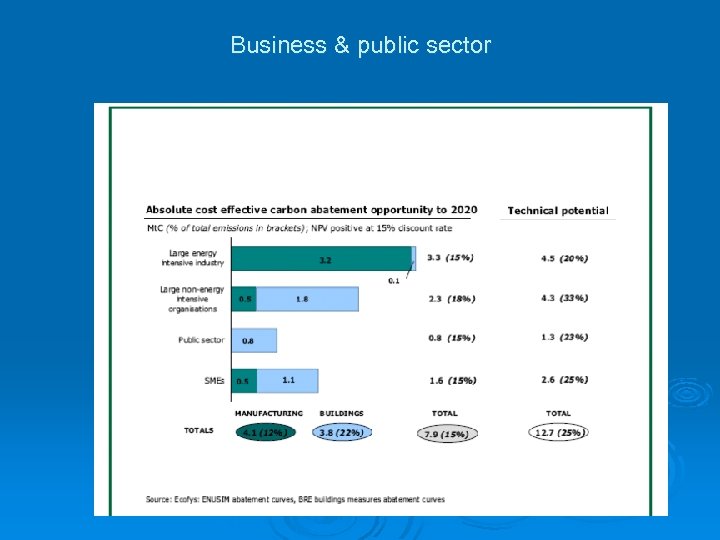 Business & public sector
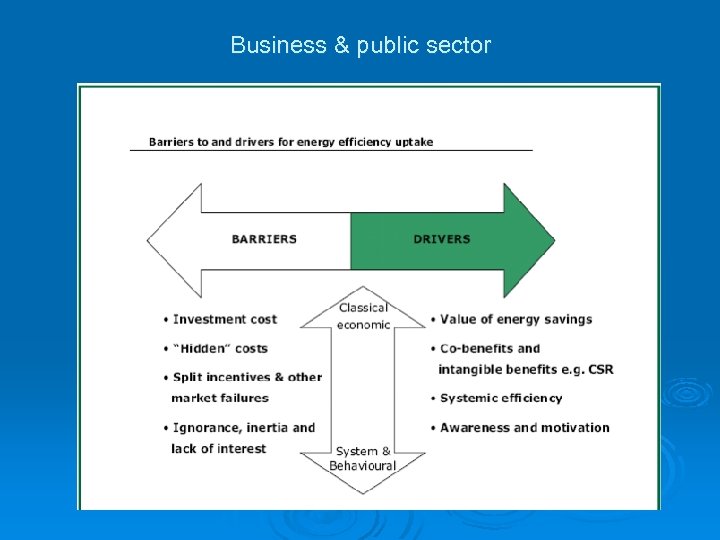 Business & public sector
 Studies feeding into Energy Efficiency Innovation Review