


 Скачать презентацию Energy Efficiency -an architect s perspective Professor J Owen
373fedae3c6852fc544643a47028be8a.ppt
- Количество слайдов: 25
 Energy Efficiency -an architect’s perspective Professor J Owen Lewis UCD Energy Research Group EURIMA Congress, Budapest June 2007
 “The most sustainable energy is saved energy” l Energy itself not of particular interest towards desired ends -but is a means l Clients desire the services which energy can deliver comfort, illumination, power, transportation. . . l The architectural challenge: ensure energy services are delivered in a sustainable manner -with maximum efficiency, and minimal environmental impact l Holistic perspective: integrated, contextual, whole life cycle, socially aware, economic solution
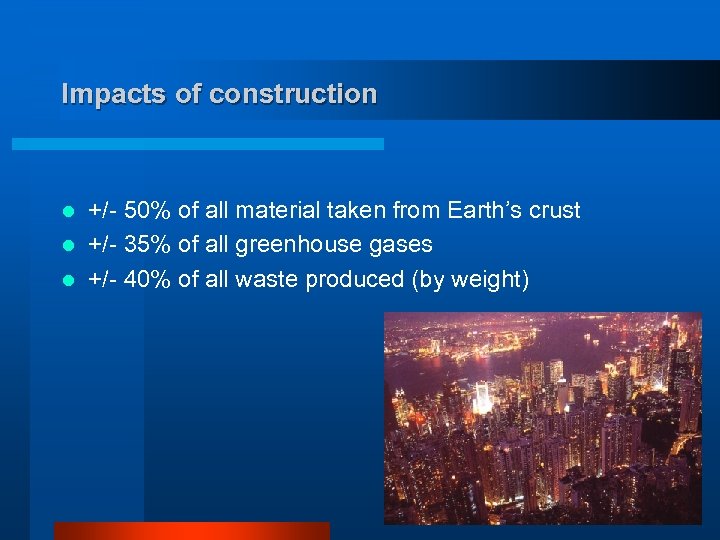 Impacts of construction +/- 50% of all material taken from Earth’s crust l +/- 35% of all greenhouse gases l +/- 40% of all waste produced (by weight) l
 Impacts of construction +/- 50% of all material taken from Earth’s crust l +/- 35% of all greenhouse gases l +/- 40% of all waste produced (by weight) l l effects on health and productivity of all l the well-being of largest industrial workforce
 Sustainable Building Design l “Sustainable design integrates consideration of resource and energy efficiency, healthy buildings and materials, ecologically and socially sensitive land use and an aesthetic that inspires, affirms and enables” • Union Internationale des Architectes’ Declaration of Interdependence for a Sustainable Future, Chicago, 1993 Economic, Social, and Environmental pillars of sustainable development
 Opportunities l Stern Review: “The scientific evidence is now overwhelming: climate change is a serious global threat, and it demands an urgent global response” l RIBA endorsement of Contraction and Convergence policy October 2006
 ACE Political Statement Sustainable Architecture & Environment -Energy Efficiency The ACE commits itself to l An active promotion of the principles of sustainable development l The formulation of proposals for concrete action l Contribute to the implementation of agreed EU proposals, in terms of that which concerns it directly, as well as in conjunction with other interested organisations Specific early measures will include l The inclusion of energy and environmental performance information as an assessment criterion in all architectural competitions and competitive selection processes l The encouragement of similar performance information to accompany all published architectural reviews l A recommendation that such information becomes an additional criterion in selection processes for public architectural awards
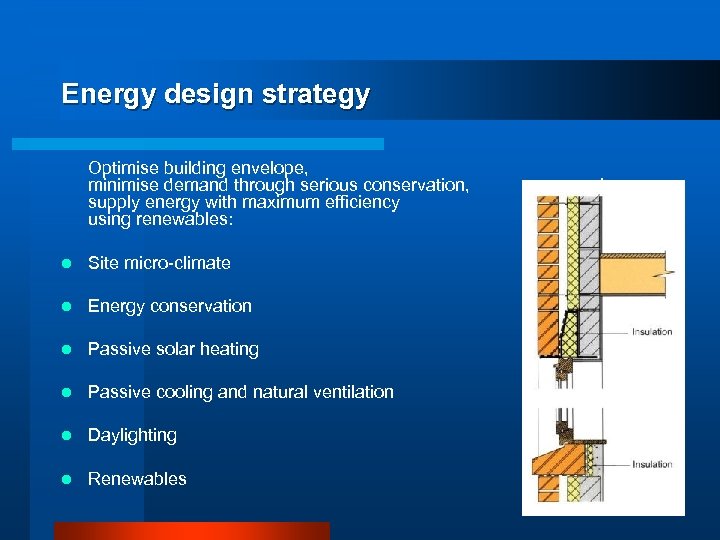 Energy design strategy Optimise building envelope, minimise demand through serious conservation, supply energy with maximum efficiency using renewables: l Site micro-climate l Energy conservation l Passive solar heating l Passive cooling and natural ventilation l Daylighting l Renewables and
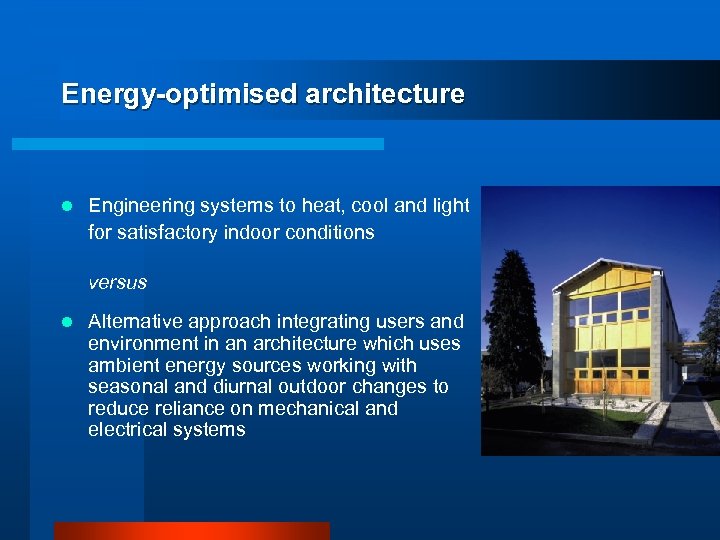 Energy-optimised architecture l Engineering systems to heat, cool and light for satisfactory indoor conditions versus l Alternative approach integrating users and environment in an architecture which uses ambient energy sources working with seasonal and diurnal outdoor changes to reduce reliance on mechanical and electrical systems
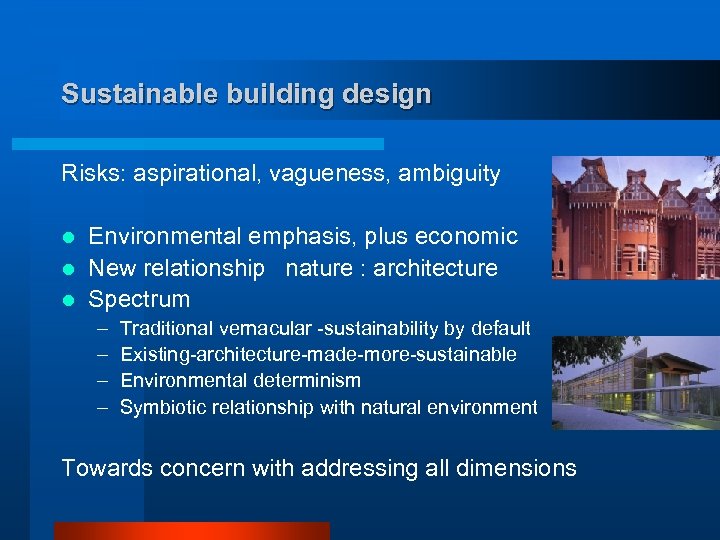 Sustainable building design Risks: aspirational, vagueness, ambiguity Environmental emphasis, plus economic l New relationship nature : architecture l Spectrum l – – Traditional vernacular -sustainability by default Existing-architecture-made-more-sustainable Environmental determinism Symbiotic relationship with natural environment Towards concern with addressing all dimensions
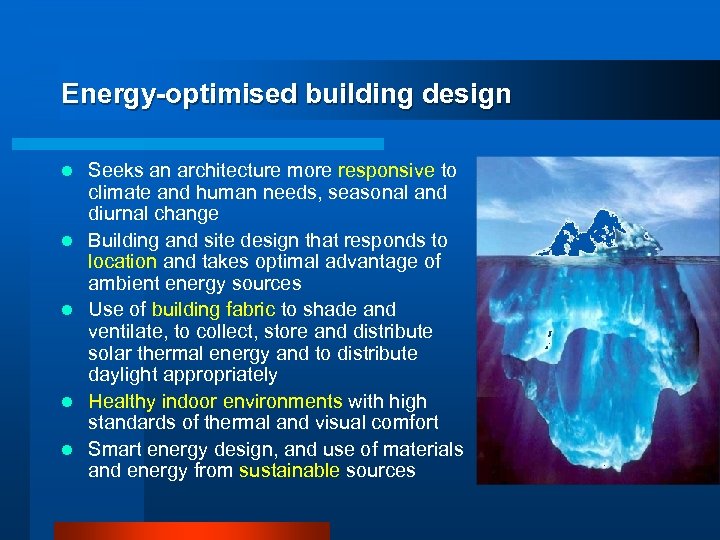 Energy-optimised building design l l l Seeks an architecture more responsive to climate and human needs, seasonal and diurnal change Building and site design that responds to location and takes optimal advantage of ambient energy sources Use of building fabric to shade and ventilate, to collect, store and distribute solar thermal energy and to distribute daylight appropriately Healthy indoor environments with high standards of thermal and visual comfort Smart energy design, and use of materials and energy from sustainable sources
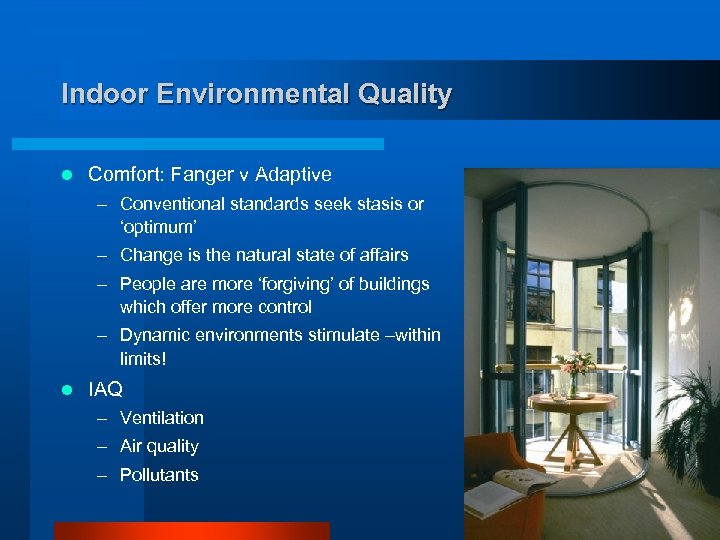 Indoor Environmental Quality l Comfort: Fanger v Adaptive – Conventional standards seek stasis or ‘optimum’ – Change is the natural state of affairs – People are more ‘forgiving’ of buildings which offer more control – Dynamic environments stimulate –within limits! l IAQ – Ventilation – Air quality – Pollutants
 Integrated design for high performance building l Know-how and skills l l l Design team practice Design, specification, procurement, construction, commissioning, testing, operation, maintenance Replacing Energy with Ingenuity New materials, unconventional combinations l Innovative technologies, appropriate systems l Smart monitoring and control l Building Science l Target setting l Design for longevity, flexibility and change l Pervasive quality l
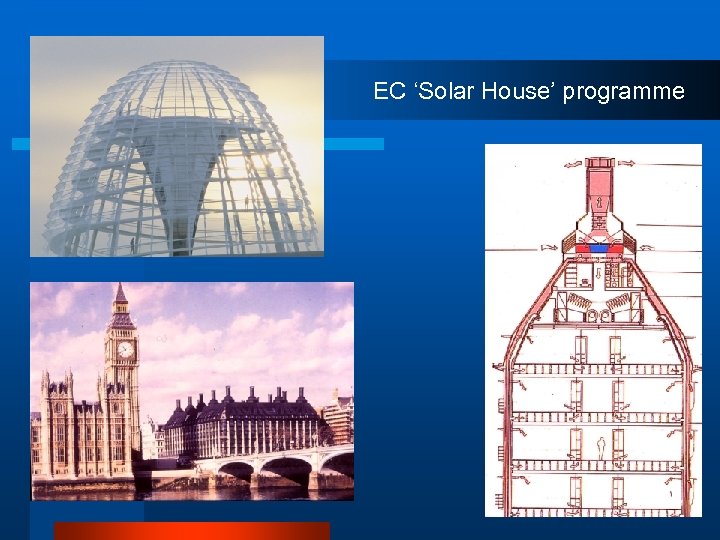 EC ‘Solar House’ programme
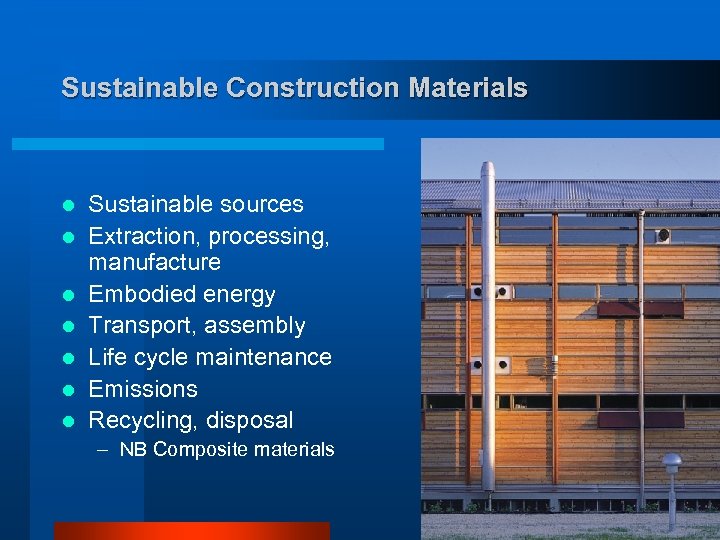 Sustainable Construction Materials l l l l Sustainable sources Extraction, processing, manufacture Embodied energy Transport, assembly Life cycle maintenance Emissions Recycling, disposal – NB Composite materials
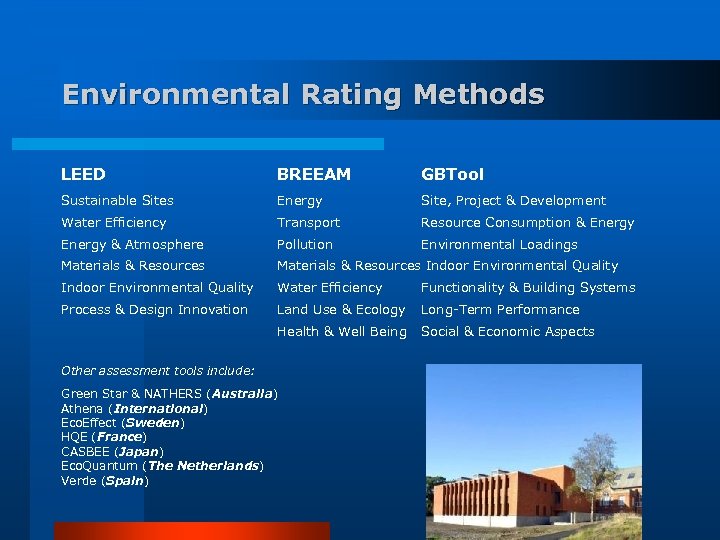 Environmental Rating Methods LEED BREEAM GBTool Sustainable Sites Energy Site, Project & Development Water Efficiency Transport Resource Consumption & Energy & Atmosphere Pollution Environmental Loadings Materials & Resources Indoor Environmental Quality Water Efficiency Functionality & Building Systems Process & Design Innovation Land Use & Ecology Long-Term Performance Health & Well Being Social & Economic Aspects Other assessment tools include: Green Star & NATHERS (Australia) Athena (International) Eco. Effect (Sweden) HQE (France) CASBEE (Japan) Eco. Quantum (The Netherlands) Verde (Spain)
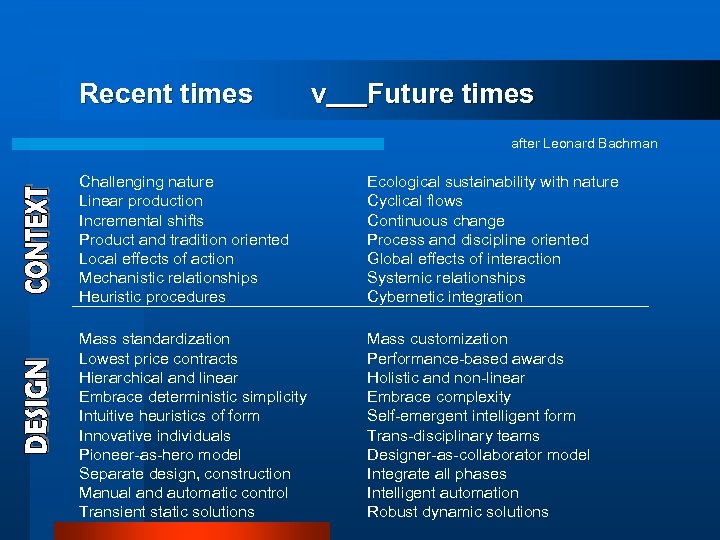 Recent times v Future times after Leonard Bachman Challenging nature Linear production Incremental shifts Product and tradition oriented Local effects of action Mechanistic relationships Heuristic procedures Ecological sustainability with nature Cyclical flows Continuous change Process and discipline oriented Global effects of interaction Systemic relationships Cybernetic integration Mass standardization Lowest price contracts Hierarchical and linear Embrace deterministic simplicity Intuitive heuristics of form Innovative individuals Pioneer-as-hero model Separate design, construction Manual and automatic control Transient static solutions Mass customization Performance-based awards Holistic and non-linear Embrace complexity Self-emergent intelligent form Trans-disciplinary teams Designer-as-collaborator model Integrate all phases Intelligent automation Robust dynamic solutions
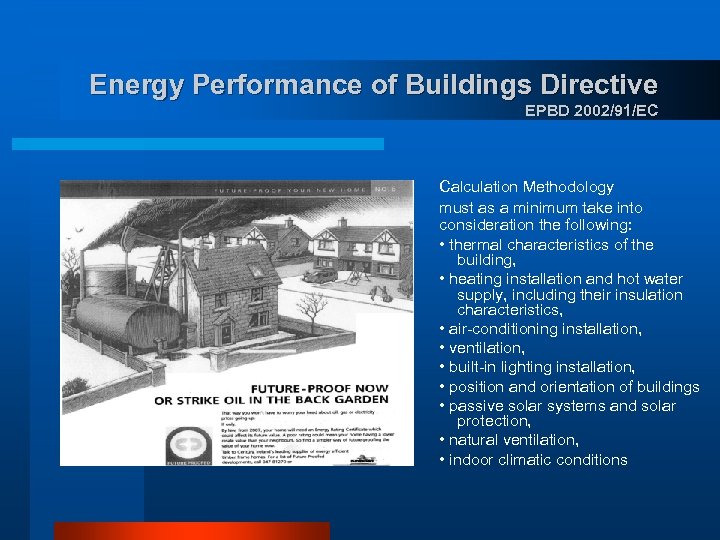 Energy Performance of Buildings Directive EPBD 2002/91/EC Calculation Methodology must as a minimum take into consideration the following: • thermal characteristics of the building, • heating installation and hot water supply, including their insulation characteristics, • air-conditioning installation, • ventilation, • built-in lighting installation, • position and orientation of buildings • passive solar systems and solar protection, • natural ventilation, • indoor climatic conditions
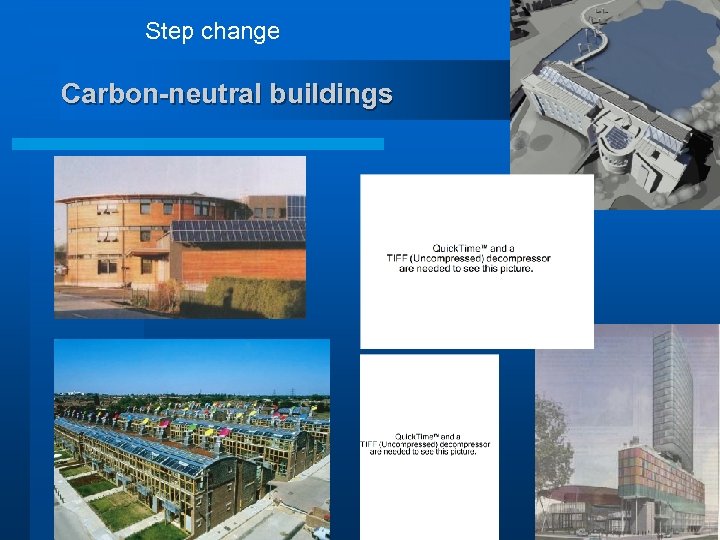 Step change Carbon-neutral buildings
 Passivhaus standard Residential Annual heating requirement <15 k. Wh/m 2. yr Primary energy consumption <120 k. Wh/m 2. yr Envelope air-tightness n 50 <0. 6/h Passive House, Darmstadt 1990
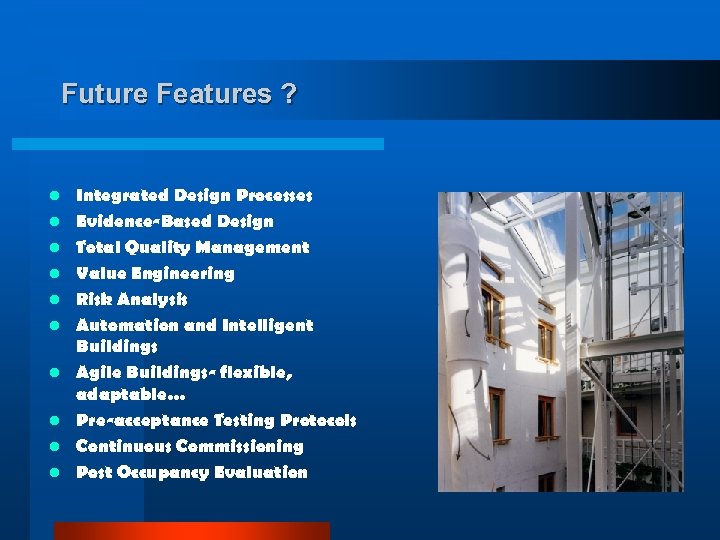 Future Features ? l l l l l Integrated Design Processes Evidence-Based Design Total Quality Management Value Engineering Risk Analysis Automation and Intelligent Buildings Agile Buildings- flexible, adaptable… Pre-acceptance Testing Protocols Continuous Commissioning Post Occupancy Evaluation
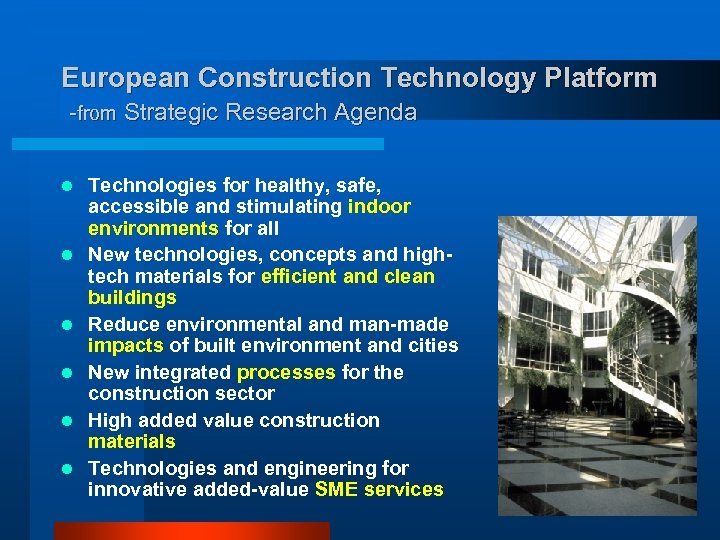 European Construction Technology Platform -from Strategic Research Agenda l l l Technologies for healthy, safe, accessible and stimulating indoor environments for all New technologies, concepts and hightech materials for efficient and clean buildings Reduce environmental and man-made impacts of built environment and cities New integrated processes for the construction sector High added value construction materials Technologies and engineering for innovative added-value SME services
 Industrial Change? l Fragmented -design /manufacture /supply /assembly within profoundly distinct organisations Most buildings are prototypes l Need for building science l Expenditure on R&D is very low l Implementation of research results uneven l – suspicion of innovation and resistance to change exists Thus, challenge of bringing about change in construction industry is not trivial
 Thank you