


 Скачать презентацию Energy Cost Control Show Me the Money A
aa5a074f72d09b68fd32ea2cd2132bfb.ppt
- Количество слайдов: 41
 Energy Cost Control: Show Me the Money! A Financial Calculator Christopher Russell Energy Path. FINDER www. energypathfinder. com (443) 636 -7746 crussell@energypathfinder. com
 About Christopher Russell, C. E. M. , C. R. M. n n Energy Manager, Howard County Maryland Independent consulting since 2006 Principal, Energy Pathfinder Director of Industrial Programs, Alliance to Save Energy, 1999 -2006 MBA, M. A. , University of MD; B. A. , Mc. Gill University Published November 2009 2
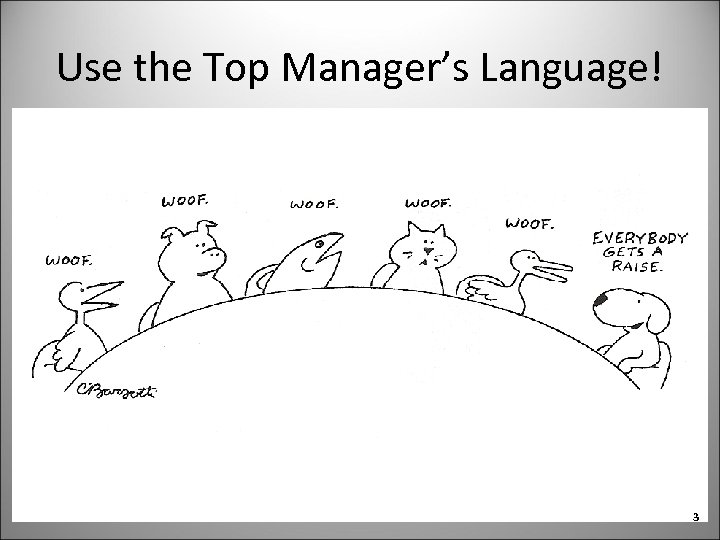 Use the Top Manager’s Language! 3
 OUTLINE FOR TODAY • PART 1: Economic Justification • PART 2: Economic Metrics • PART 3: “Making the Case” to Upper Management 4
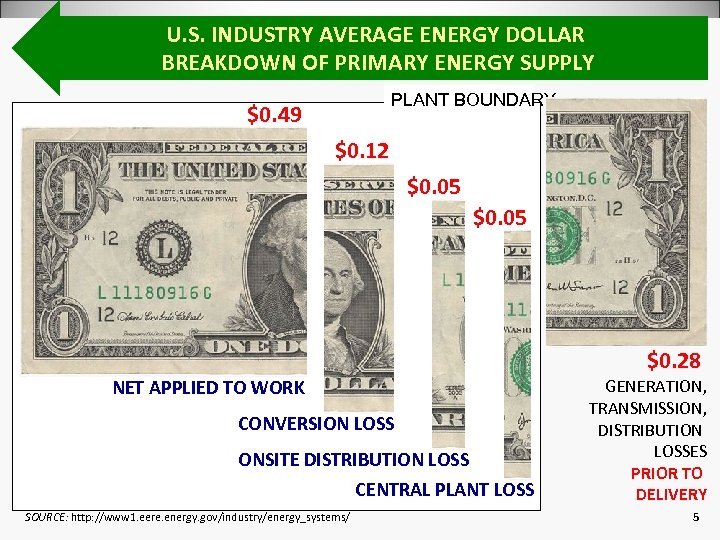 U. S. INDUSTRY AVERAGE ENERGY DOLLAR BREAKDOWN OF PRIMARY ENERGY SUPPLY PLANT BOUNDARY $0. 49 $0. 12 $0. 05 $0. 28 NET APPLIED TO WORK CONVERSION LOSS ONSITE DISTRIBUTION LOSS CENTRAL PLANT LOSS (c)2009 Energy Pathfinder Mangement Consulting, LLC SOURCE: http: //www 1. eere. energy. gov/industry/energy_systems/ www. energypathfinder. com GENERATION, TRANSMISSION, DISTRIBUTION LOSSES PRIOR TO DELIVERY 5 5
 CHALLENGE FOR FACILITY MANAGERS n Facilities at the end of the budget “food chain” n Limited staff, resources, analytical capability n Evaluating 21 st century energy improvements with 1920 s investment analysis techniques! 6
 ABOUT ENERGY IMPROVEMENTS: What do business leaders want to know? • What’s the benefit? – How many dollars? – How quickly do the dollars accrue? – What’s the risk of investing? – What’s the risk of NOT investing? • What’s the most that I should pay for it? …per current investment criteria • How does this compare to other ways to use money? 7
 OUTLINE FOR TODAY • PART 1: Economic Justification • PART 2: Economic Metrics • PART 3: “Making the Case” to Upper Management 8
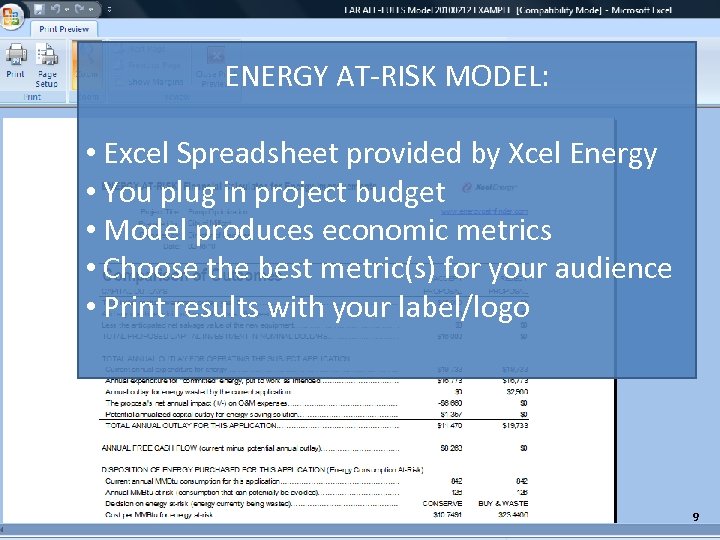 ENERGY AT-RISK MODEL: • Excel Spreadsheet provided by Xcel Energy • You plug in project budget • Model produces economic metrics • Choose the best metric(s) for your audience • Print results with your label/logo 9
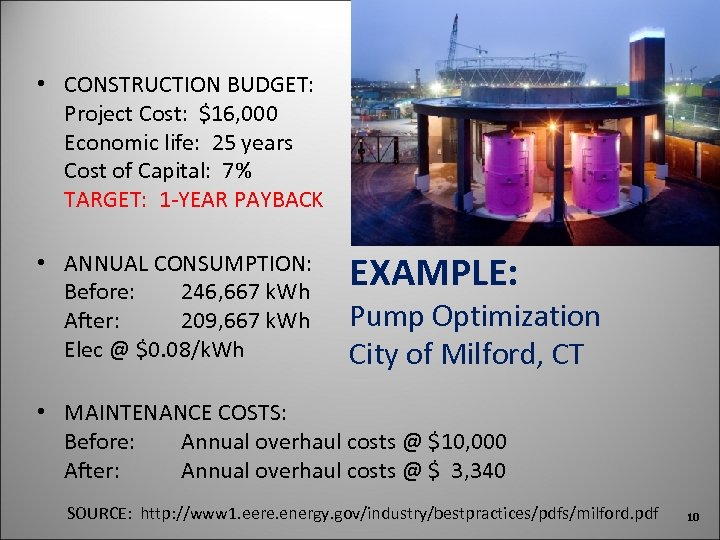 • CONSTRUCTION BUDGET: Project Cost: $16, 000 Economic life: 25 years Cost of Capital: 7% TARGET: 1 -YEAR PAYBACK • ANNUAL CONSUMPTION: Before: 246, 667 k. Wh After: 209, 667 k. Wh Elec @ $0. 08/k. Wh EXAMPLE: Pump Optimization City of Milford, CT • MAINTENANCE COSTS: Before: Annual overhaul costs @ $10, 000 After: Annual overhaul costs @ $ 3, 340 SOURCE: http: //www 1. eere. energy. gov/industry/bestpractices/pdfs/milford. pdf 10
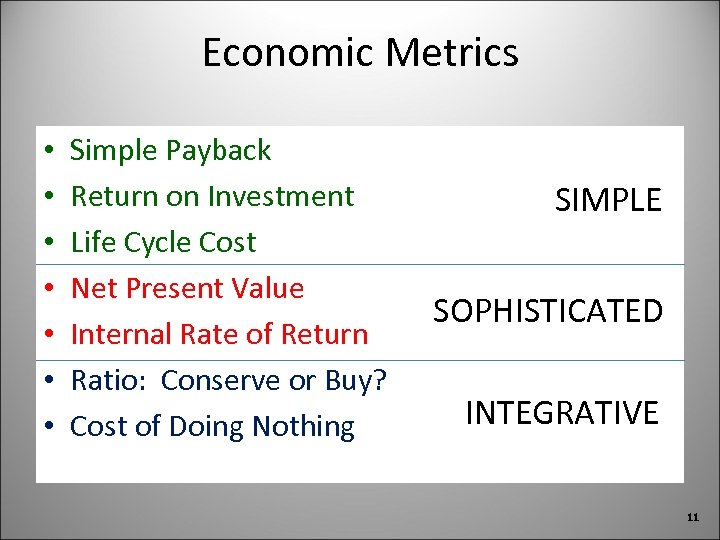 Economic Metrics • • Simple Payback Return on Investment Life Cycle Cost Net Present Value Internal Rate of Return Ratio: Conserve or Buy? Cost of Doing Nothing SIMPLE SOPHISTICATED INTEGRATIVE 11
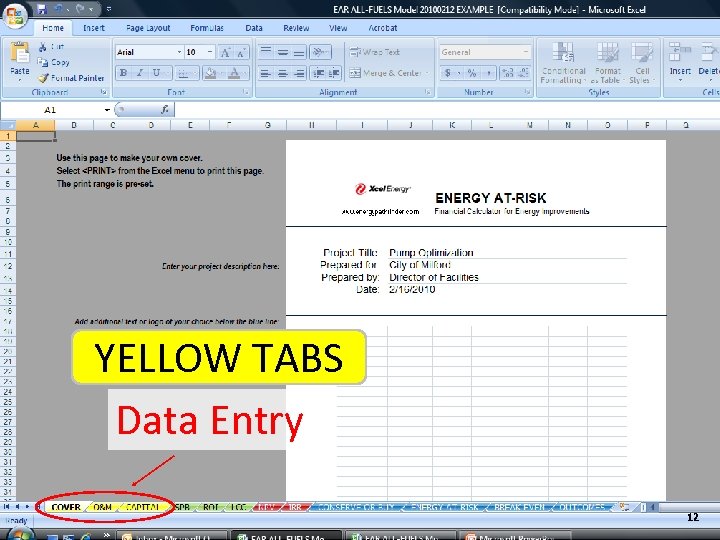 YELLOW TABS Data Entry 12
 YELLOW TAB DEMO 13
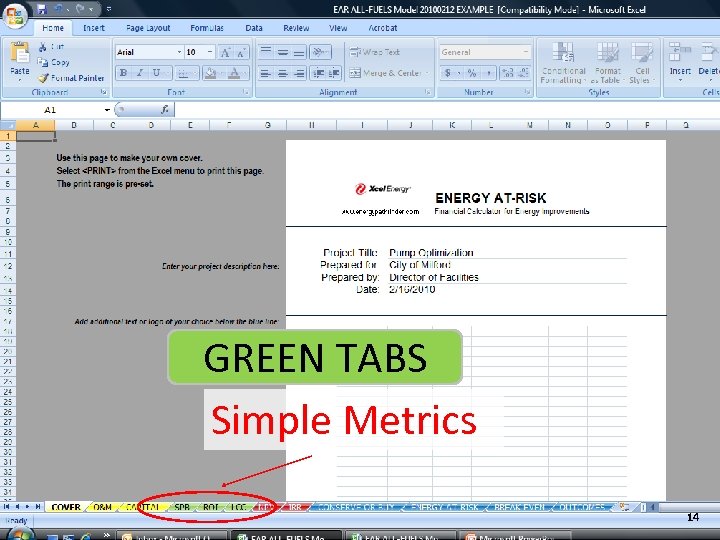 GREEN TABS Simple Metrics 14
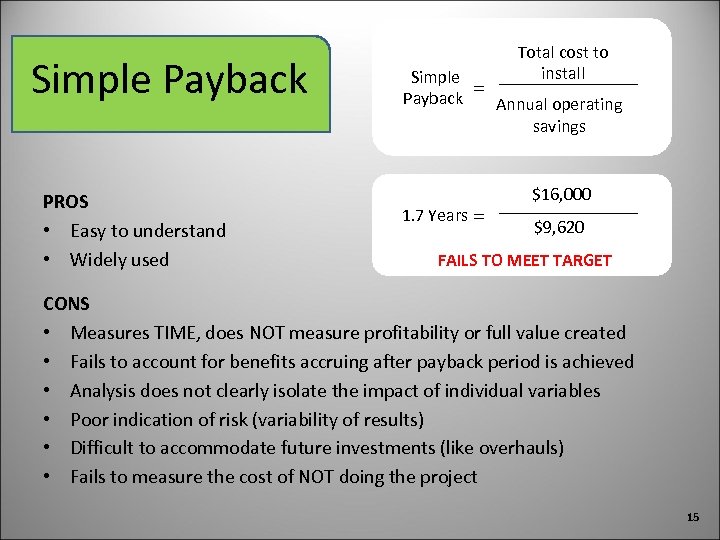 Simple Payback PROS • Easy to understand • Widely used Total cost to install Simple = Payback Annual operating savings 1. 7 Years = $16, 000 $9, 620 FAILS TO MEET TARGET CONS • Measures TIME, does NOT measure profitability or full value created • Fails to account for benefits accruing after payback period is achieved • Analysis does not clearly isolate the impact of individual variables • Poor indication of risk (variability of results) • Difficult to accommodate future investments (like overhauls) • Fails to measure the cost of NOT doing the project 15
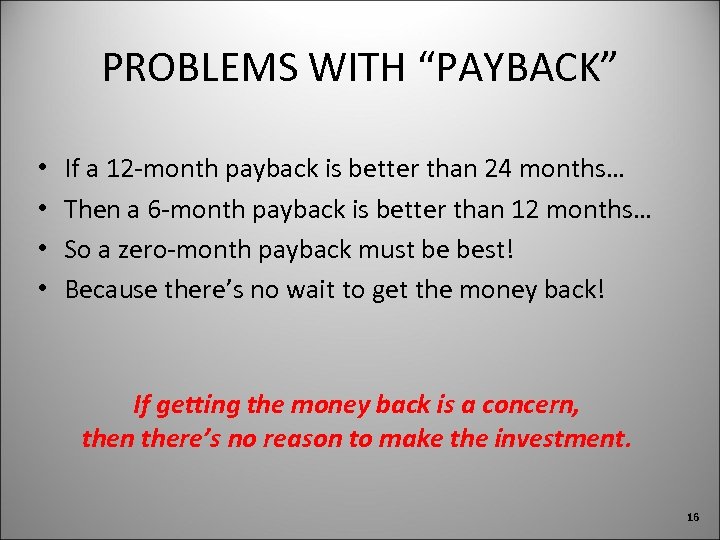 PROBLEMS WITH “PAYBACK” • • If a 12 -month payback is better than 24 months… Then a 6 -month payback is better than 12 months… So a zero-month payback must be best! Because there’s no wait to get the money back! If getting the money back is a concern, then there’s no reason to make the investment. 16
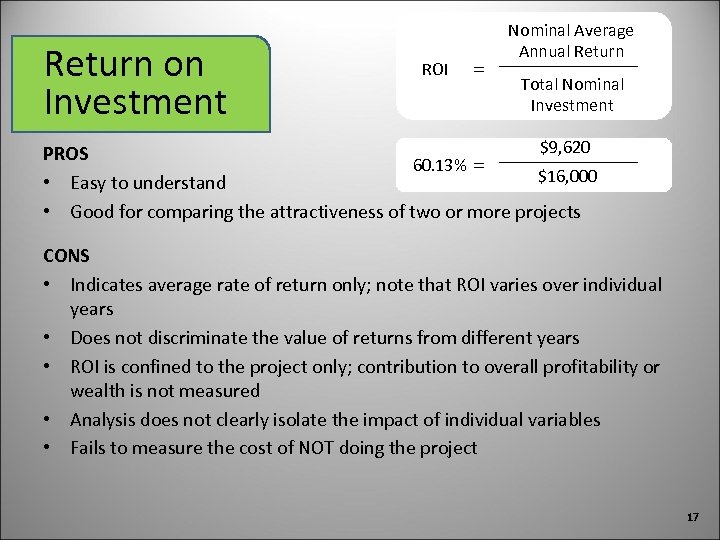 Return on Investment ROI = Nominal Average Annual Return Total Nominal Investment $9, 620 PROS 60. 13% = $16, 000 • Easy to understand • Good for comparing the attractiveness of two or more projects CONS • Indicates average rate of return only; note that ROI varies over individual years • Does not discriminate the value of returns from different years • ROI is confined to the project only; contribution to overall profitability or wealth is not measured • Analysis does not clearly isolate the impact of individual variables • Fails to measure the cost of NOT doing the project 17
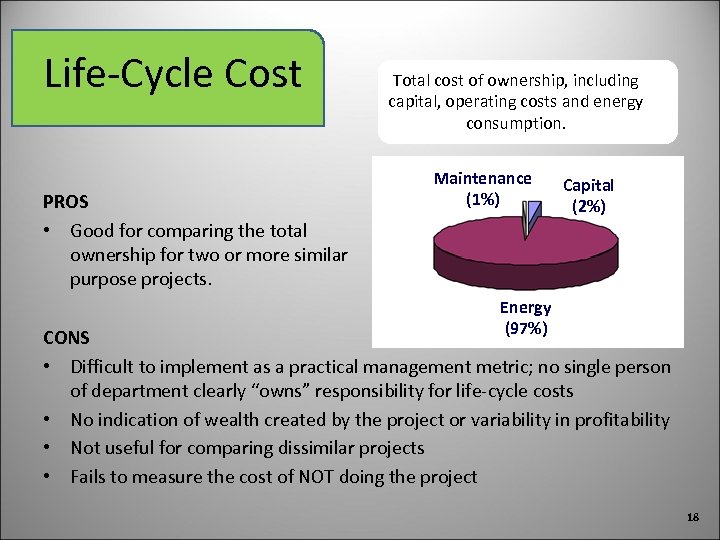 Life-Cycle Cost PROS • Good for comparing the total ownership for two or more similar purpose projects. Total cost of ownership, including capital, operating costs and energy consumption. Maintenance (1%) Capital (2%) Energy (97%) CONS • Difficult to implement as a practical management metric; no single person of department clearly “owns” responsibility for life-cycle costs • No indication of wealth created by the project or variability in profitability • Not useful for comparing dissimilar projects • Fails to measure the cost of NOT doing the project 18
 GREEN TAB DEMO 19
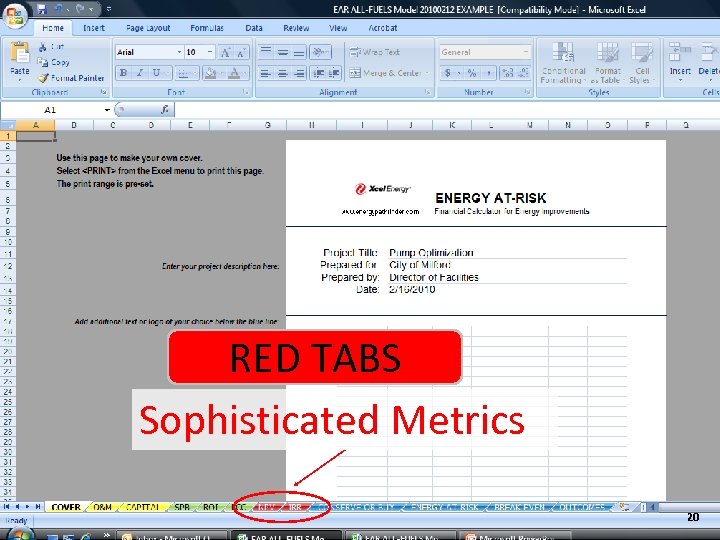 RED TABS Sophisticated Metrics 20
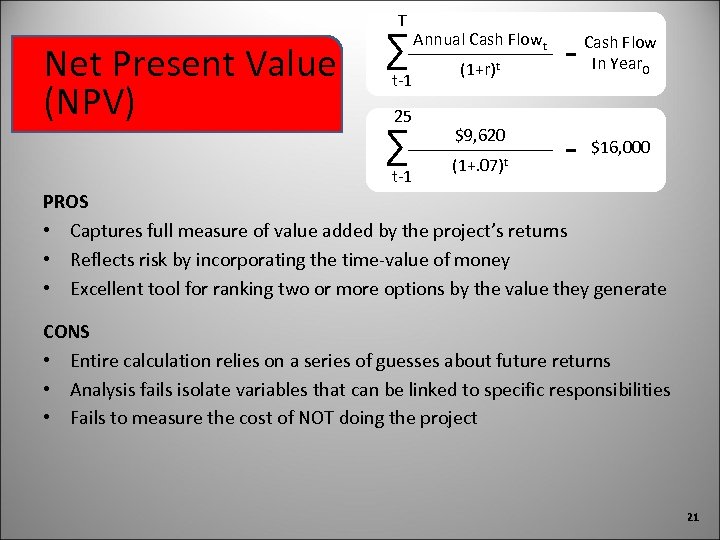 T Net Present Value (NPV) ∑ t-1 25 ∑ t-1 Annual Cash Flowt (1+r)t $9, 620 (1+. 07)t - Cash Flow In Year 0 - $16, 000 PROS • Captures full measure of value added by the project’s returns • Reflects risk by incorporating the time-value of money • Excellent tool for ranking two or more options by the value they generate CONS • Entire calculation relies on a series of guesses about future returns • Analysis fails isolate variables that can be linked to specific responsibilities • Fails to measure the cost of NOT doing the project 21
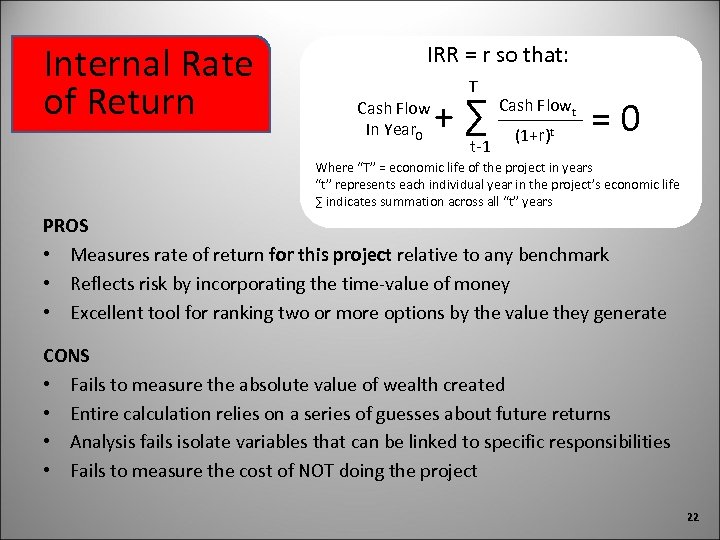 Internal Rate of Return IRR = r so that: Cash Flow In Year 0 T +∑ t-1 Cash Flowt (1+r)t =0 Where “T” = economic life of the project in years “t” represents each individual year in the project’s economic life ∑ indicates summation across all “t” years PROS • Measures rate of return for this project relative to any benchmark • Reflects risk by incorporating the time-value of money • Excellent tool for ranking two or more options by the value they generate CONS • Fails to measure the absolute value of wealth created • Entire calculation relies on a series of guesses about future returns • Analysis fails isolate variables that can be linked to specific responsibilities • Fails to measure the cost of NOT doing the project 22
 RED TAB DEMO 23
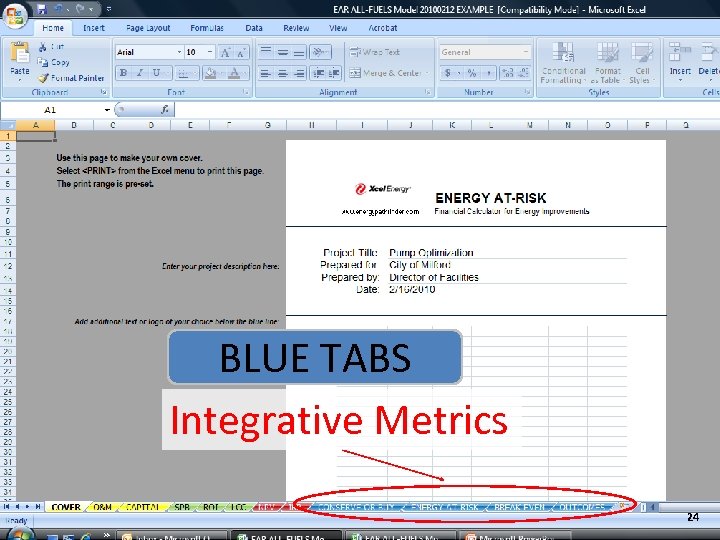 BLUE TABS Integrative Metrics 24
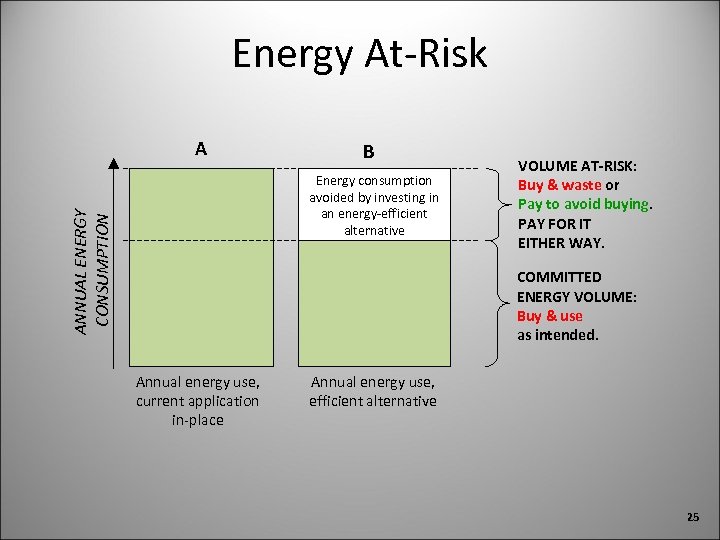 Energy At-Risk A B ANNUAL ENERGY CONSUMPTION Energy consumption avoided by investing in an energy-efficient alternative VOLUME AT-RISK: Buy & waste or Pay to avoid buying. PAY FOR IT EITHER WAY. COMMITTED ENERGY VOLUME: Buy & use as intended. Annual energy use, current application in-place Annual energy use, efficient alternative 25
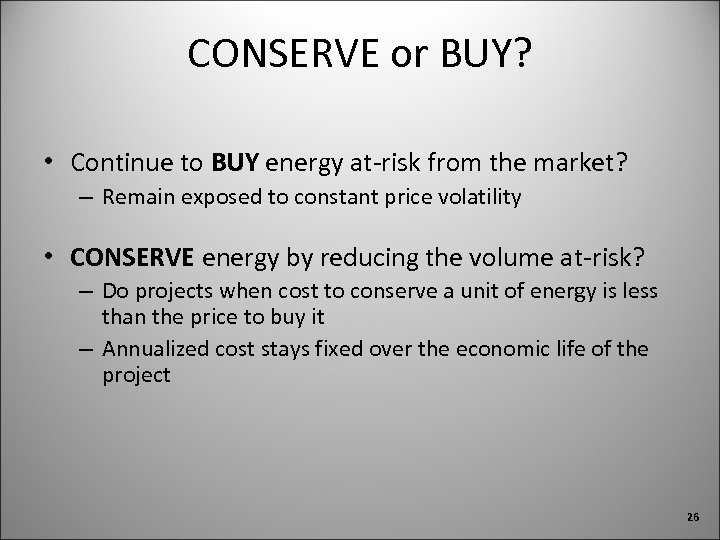 CONSERVE or BUY? • Continue to BUY energy at-risk from the market? – Remain exposed to constant price volatility • CONSERVE energy by reducing the volume at-risk? – Do projects when cost to conserve a unit of energy is less than the price to buy it – Annualized cost stays fixed over the economic life of the project 26
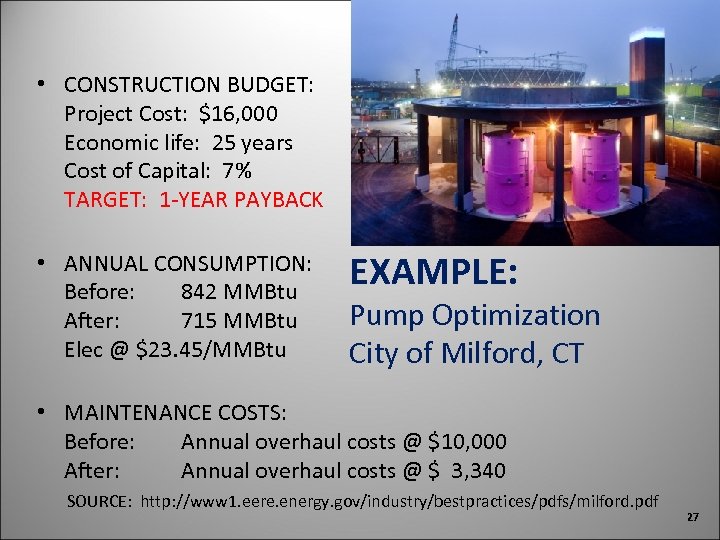 • CONSTRUCTION BUDGET: Project Cost: $16, 000 Economic life: 25 years Cost of Capital: 7% TARGET: 1 -YEAR PAYBACK • ANNUAL CONSUMPTION: Before: 842 MMBtu After: 715 MMBtu Elec @ $23. 45/MMBtu EXAMPLE: Pump Optimization City of Milford, CT • MAINTENANCE COSTS: Before: Annual overhaul costs @ $10, 000 After: Annual overhaul costs @ $ 3, 340 SOURCE: http: //www 1. eere. energy. gov/industry/bestpractices/pdfs/milford. pdf 27
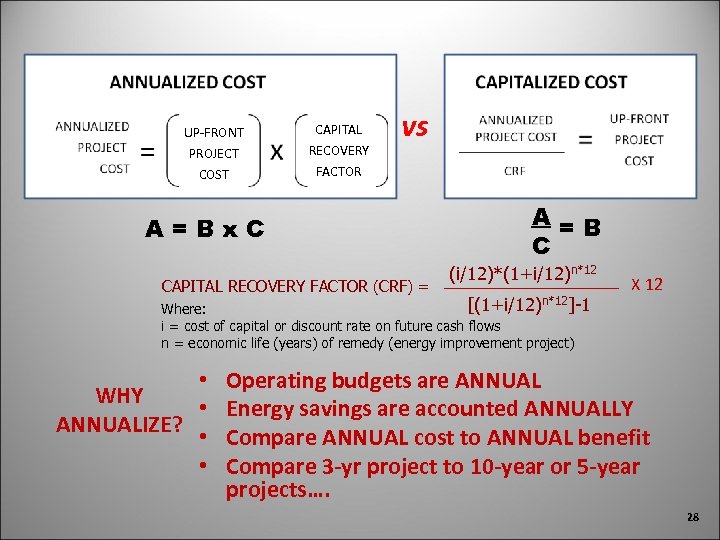 UP-FRONT CAPITAL PROJECT COST RECOVERY FACTOR vs A=Bx. C CAPITAL RECOVERY FACTOR (CRF) = A=B C (i/12)*(1+i/12)n*12 [(1+i/12) ]-1 Where: i = cost of capital or discount rate on future cash flows n = economic life (years) of remedy (energy improvement project) • WHY • ANNUALIZE? • • n*12 X 12 Operating budgets are ANNUAL Energy savings are accounted ANNUALLY Compare ANNUAL cost to ANNUAL benefit Compare 3 -yr project to 10 -year or 5 -year projects…. 28
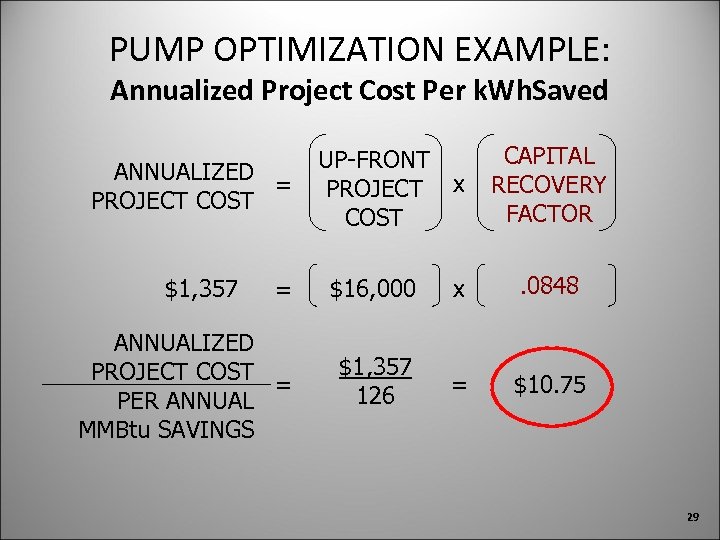 PUMP OPTIMIZATION EXAMPLE: Annualized Project Cost Per k. Wh. Saved ANNUALIZED = PROJECT COST UP-FRONT PROJECT x COST CAPITAL RECOVERY FACTOR = $16, 000 x . 0848 ANNUALIZED PROJECT COST = PER ANNUAL MMBtu SAVINGS $1, 357 126 = $10. 75 $1, 357 29
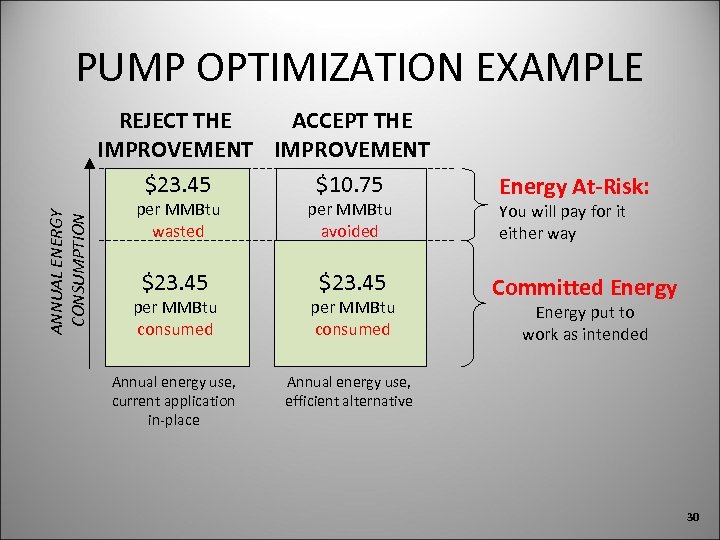 PUMP OPTIMIZATION EXAMPLE ANNUAL ENERGY CONSUMPTION REJECT THE ACCEPT THE IMPROVEMENT $23. 45 $10. 75 per MMBtu wasted per MMBtu avoided $23. 45 per MMBtu consumed Annual energy use, current application in-place Energy At-Risk: You will pay for it either way Committed Energy Annual energy use, efficient alternative Energy put to work as intended 30
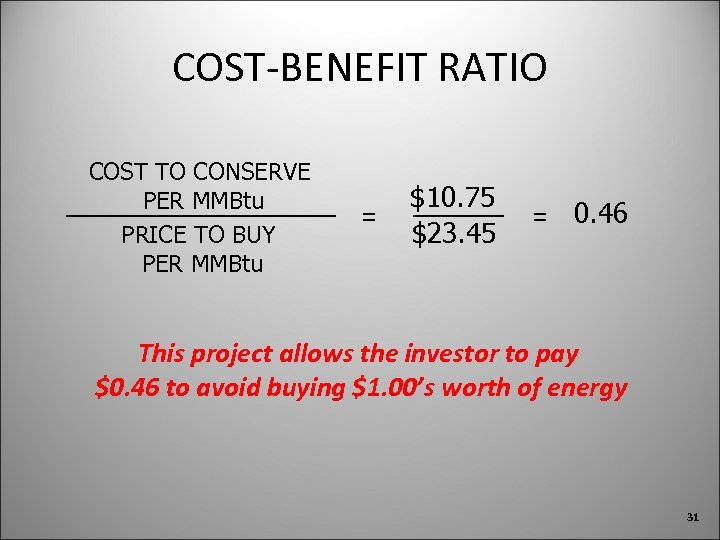 COST-BENEFIT RATIO COST TO CONSERVE PER MMBtu PRICE TO BUY PER MMBtu = $10. 75 $23. 45 = 0. 46 This project allows the investor to pay $0. 46 to avoid buying $1. 00’s worth of energy 31
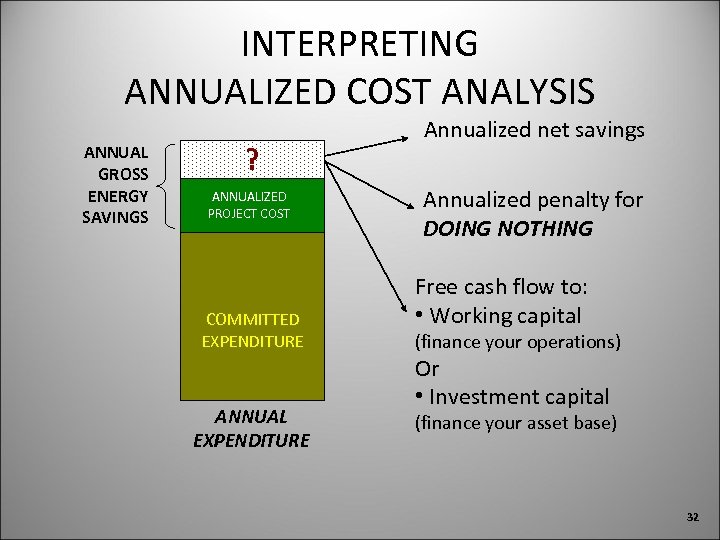 INTERPRETING ANNUALIZED COST ANALYSIS ANNUAL GROSS ENERGY SAVINGS ? ANNUALIZED PROJECT COST COMMITTED EXPENDITURE ANNUAL EXPENDITURE Annualized net savings Annualized penalty for DOING NOTHING Free cash flow to: • Working capital (finance your operations) Or • Investment capital (finance your asset base) 32
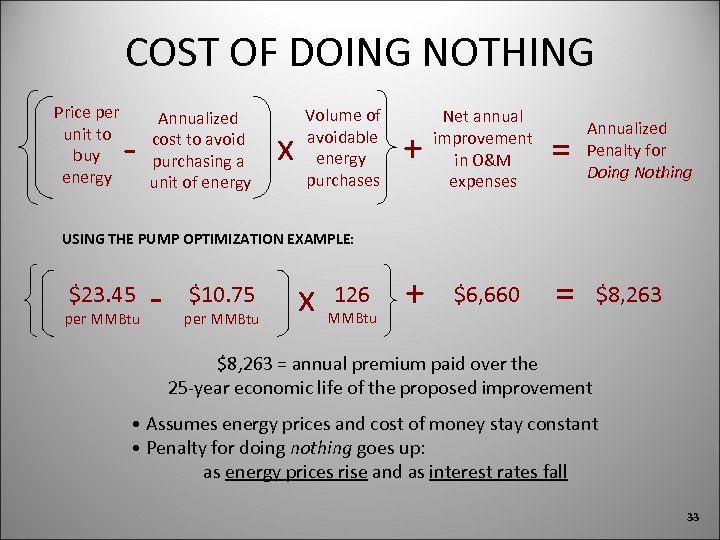 COST OF DOING NOTHING Price per unit to buy energy - Annualized cost to avoid purchasing a unit of energy x Volume of avoidable energy purchases + Net annual improvement in O&M expenses = + $6, 660 = Annualized Penalty for Doing Nothing USING THE PUMP OPTIMIZATION EXAMPLE: $23. 45 per MMBtu - $10. 75 per MMBtu x 126 MMBtu $8, 263 = annual premium paid over the 25 -year economic life of the proposed improvement • Assumes energy prices and cost of money stay constant • Penalty for doing nothing goes up: as energy prices rise and as interest rates fall 33
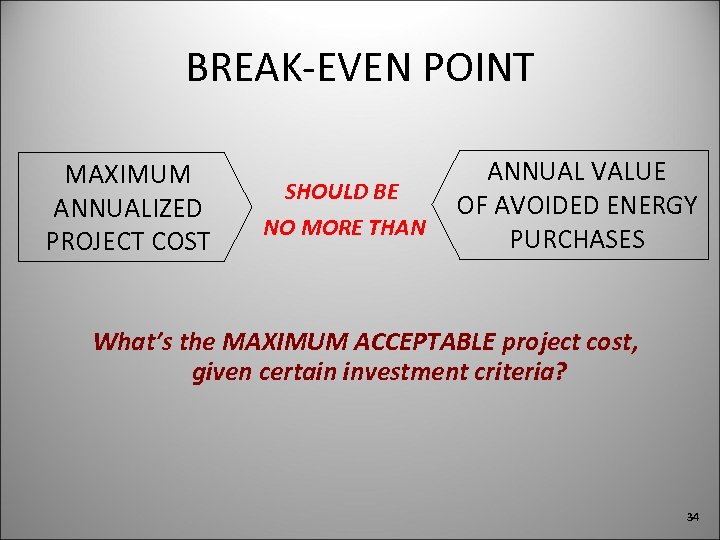 BREAK-EVEN POINT MAXIMUM ANNUALIZED PROJECT COST SHOULD BE NO MORE THAN ANNUAL VALUE OF AVOIDED ENERGY PURCHASES What’s the MAXIMUM ACCEPTABLE project cost, given certain investment criteria? 34
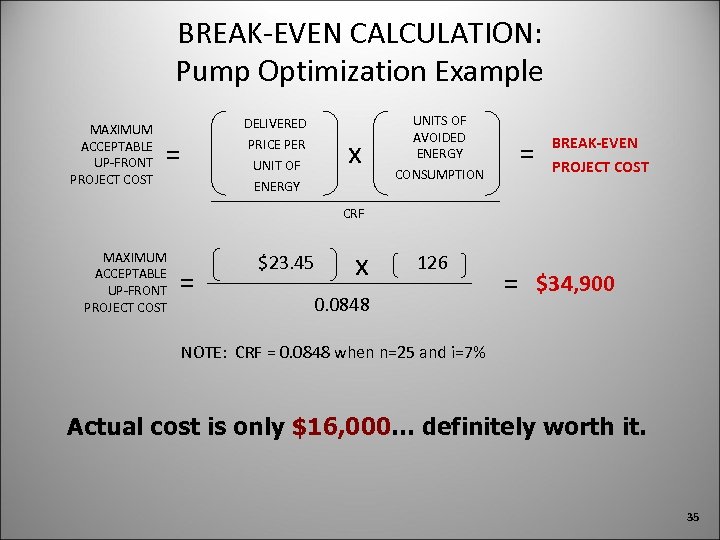 BREAK-EVEN CALCULATION: Pump Optimization Example MAXIMUM ACCEPTABLE UP-FRONT PROJECT COST DELIVERED = x PRICE PER UNIT OF ENERGY UNITS OF AVOIDED ENERGY CONSUMPTION = BREAK-EVEN PROJECT COST CRF MAXIMUM ACCEPTABLE UP-FRONT PROJECT COST = $23. 45 x 126 0. 0848 = $34, 900 NOTE: CRF = 0. 0848 when n=25 and i=7% Actual cost is only $16, 000… definitely worth it. 35
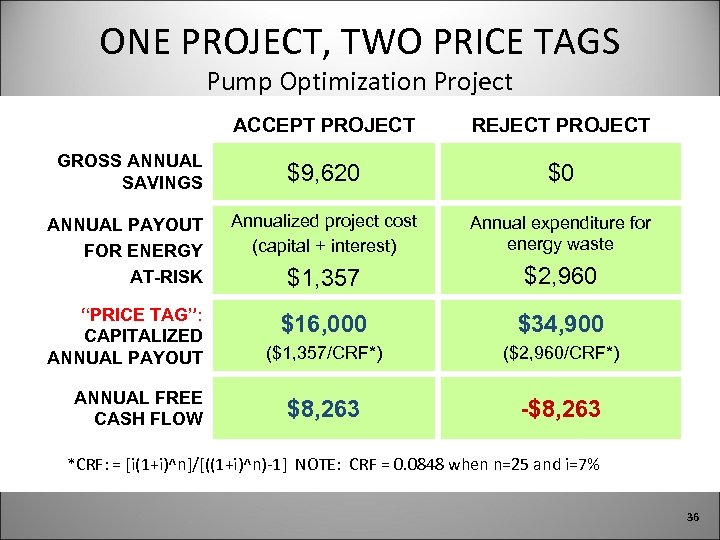 ONE PROJECT, TWO PRICE TAGS Pump Optimization Project ACCEPT PROJECT REJECT PROJECT GROSS ANNUAL SAVINGS $9, 620 $0 ANNUAL PAYOUT FOR ENERGY AT-RISK Annualized project cost (capital + interest) Annual expenditure for energy waste $1, 357 $2, 960 “PRICE TAG”: CAPITALIZED ANNUAL PAYOUT $16, 000 $34, 900 ($1, 357/CRF*) ($2, 960/CRF*) $8, 263 -$8, 263 ANNUAL FREE CASH FLOW *CRF: = [i(1+i)^n]/[((1+i)^n)-1] NOTE: CRF = 0. 0848 when n=25 and i=7% 36
 BLUE TAB DEMO 37
 OUTLINE FOR TODAY • PART 1: Economic Justification • PART 2: Economic Metrics • PART 3: “Making the Case” to Upper Management 38
 Still Need to Use Simple Payback? • Pass up a good energy saving project? • Add the capitalized value of energy waste to the new core-business project • A “good” core-business project is one that pays for itself plus the energy waste 39
 IMPROVE YOUR CAPITAL BUDGET REQUESTS • “Package” your energy project with a core-business initiative • Facilities provides a free cash flow subsidy to the core-business project • At capital budget time, the core-business project manager becomes your ally, not your competitor • Same energy project, different title. You choose: – “Pump Optimization Project” – “$8, 000 Free Cash Flow for 25 Years” • Show TWO PRICE TAGS: – Cost to accept, cost to reject • Show the cash flow lost to rejecting or delaying your proposal 40
 THANK YOU! The discussion never ends. BLOG: http: //energypathfinder. blogspot. com BOOK: “Managing Energy from the Top Down” WEB: www. energypathfinder. com From Shop Floor to Top Floor Best Practices in Corporate Energy Management Chicago, April 6 -7 http: //www. pewclimate. org/energy-efficiency/conference Energy Path. FINDER Christopher Russell crussell@energypathfinder. com (443) 636 -7746 41