


 Скачать презентацию Energy Conservation in Wireless Sensor Networks Giuseppe Anastasi
584cbe28b432e9cabb7408447d85cb5e.ppt
- Количество слайдов: 90
 Energy Conservation in Wireless Sensor Networks Giuseppe Anastasi Pervasive Computing & Networking Lab (Per. Lab) Dept. of Information Engineering, University of Pisa E-mail: giuseppe. anastasi@iet. unipi. it Website: www. iet. unipi. it/~anastasi/ Per. Lab COST Action IC 0804 Training School – Palma de Mallorca, Spain, April 24 -27, 2012
 Per. Lab http: //www. perlab. it 2
 My Research Activity Per. Lab § Green Internet § Energy-Efficient P 2 P File Sharing § WSANs for Energy-Efficiency § Monitoring of electricity consumptions in buildings § Control of electrical devices in buildings/campuses § Wireless Sensor Networks for critical applications § IEEE 802. 15. 4/Zig. Bee Standards § WSNs with Mobile Elements (MEs) § Adaptive Discovery Strategies § Energy-Efficient and Reliable Data Transfer to MEs 3
 Energy Conservation in Wireless Sensor Networks Giuseppe Anastasi Pervasive Computing & Networking Lab (Perlab) Dept. of Information Engineering, University of Pisa E-mail: giuseppe. anastasi@iet. unipi. it Website: www. iet. unipi. it/~anastasi/
 Overview Per. Lab § Introduction § The Energy Problem in WSNs § Energy Conservation in static WSNs § Data-driven approaches § Topology Management § Power Management § Energy Conservation in WSNs with Mobile Nodes § Power Management & MN Discovery § WSNs for Energy Efficiency § Energy Efficiency in Buildings § Adaptive Lighting in Tunnels 5
 References Per. Lab § G. Anastasi, M. Conti, M. Di Francesco, A. Passarella, Energy Conservation in Wireless Sensor Networks: a Survey, Ad Hoc Networks, Vol. 7, N. 3, pp. 537 -568, May 2009. Elsevier. § C. Alippi, G. Anastasi, M. Di Francesco, M. Roveri, Energy Management in Sensor Networks with Energy-hungry Sensors, IEEE Instrumentation and Measurement Magazine, Vol. 12, N. 2, pp. 16 -23, April 2009. § M. Di Francesco, S. Das, G. Anastasi, Data Collection in Wireless Sensor Networks with Mobile Elements: A Survey, ACM Transactions on Sensor Networks, Vol. 8, N. 1, August 2011. Available at http: //www. iet. unipi. it/~anastasi/ 6
 Introduction
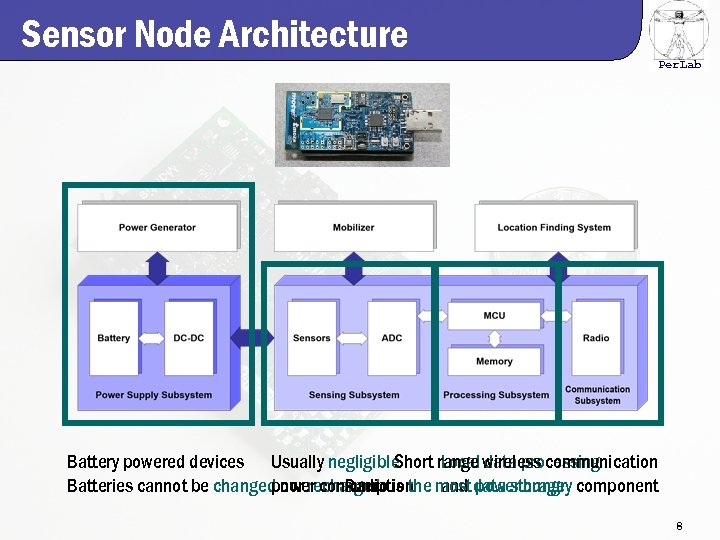 Sensor Node Architecture Per. Lab Short range wireless communication Local data processing Battery powered devices Usually negligible Radio power consumption and power hungry Batteries cannot be changed nor recharged is the most data storage component 8
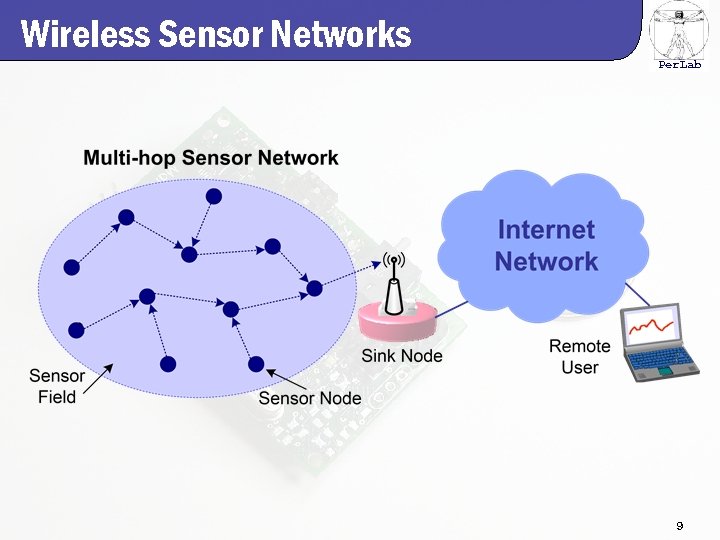 Wireless Sensor Networks Per. Lab 9
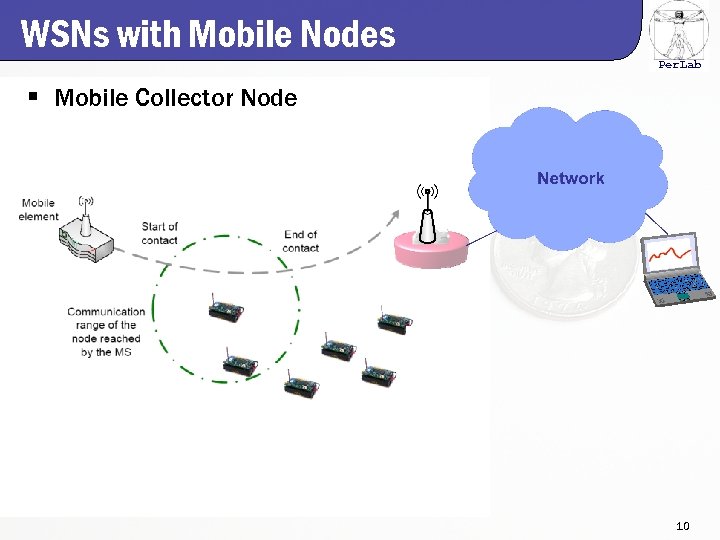 WSNs with Mobile Nodes Per. Lab § Mobile Collector Node 10
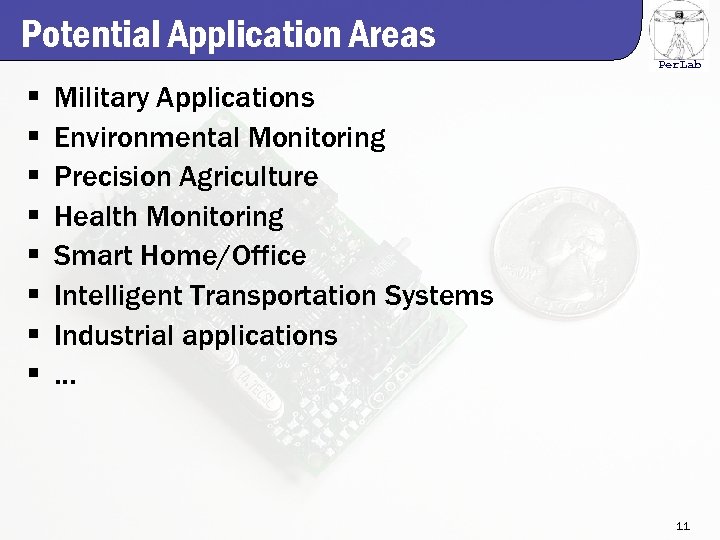 Potential Application Areas Per. Lab § § § § Military Applications Environmental Monitoring Precision Agriculture Health Monitoring Smart Home/Office Intelligent Transportation Systems Industrial applications … 11
 The Energy Problem
 The energy problem Per. Lab § Energy is the key issue in the WSN design § Applications may require a network lifetime in the order of several months or even years § If always active, sensor nodes deplete their energy in less than a week § Possible approaches § § § Low-power sensor nodes Energy harvesting Energy conservation Energy efficient protocols/applications Cross-layering … 13
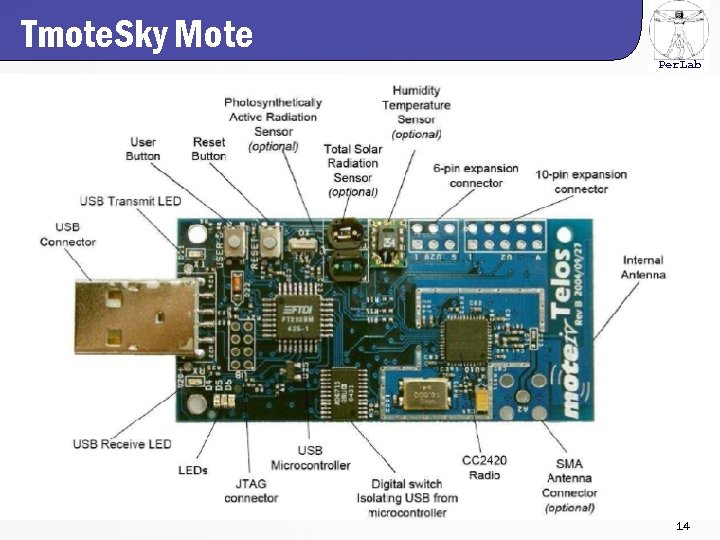 Tmote. Sky Mote Per. Lab 14
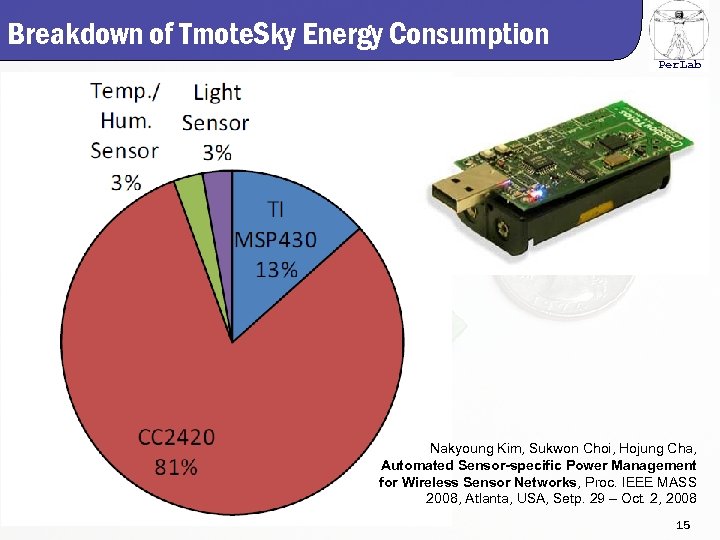 Breakdown of Tmote. Sky Energy Consumption Per. Lab Nakyoung Kim, Sukwon Choi, Hojung Cha, Automated Sensor-specific Power Management for Wireless Sensor Networks, Proc. IEEE MASS 2008, Atlanta, USA, Setp. 29 – Oct. 2, 2008 15
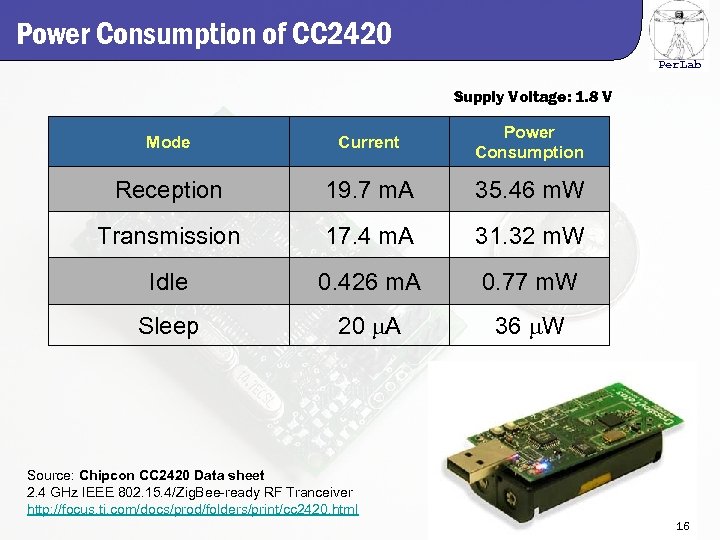 Power Consumption of CC 2420 Per. Lab Supply Voltage: 1. 8 V Mode Current Power Consumption Reception 19. 7 m. A 35. 46 m. W Transmission 17. 4 m. A 31. 32 m. W Idle 0. 426 m. A 0. 77 m. W Sleep 20 m. A 36 m. W Source: Chipcon CC 2420 Data sheet 2. 4 GHz IEEE 802. 15. 4/Zig. Bee-ready RF Tranceiver http: //focus. ti. com/docs/prod/folders/print/cc 2420. html 16
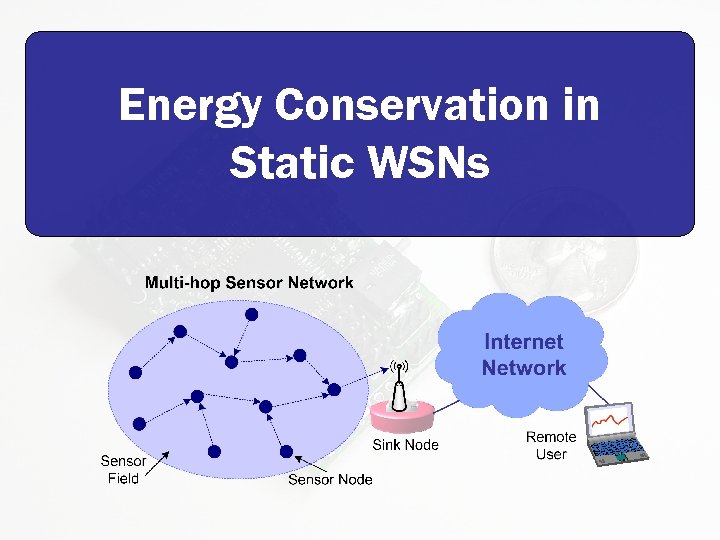 Energy Conservation in Static WSNs
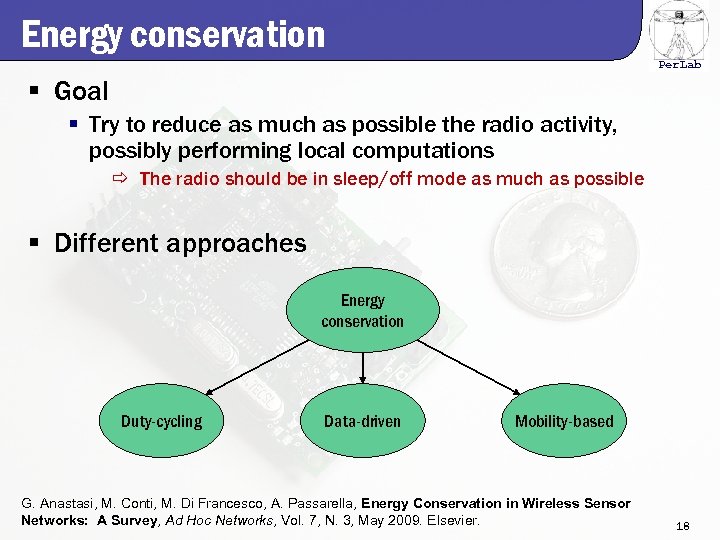 Energy conservation Per. Lab § Goal § Try to reduce as much as possible the radio activity, possibly performing local computations ð The radio should be in sleep/off mode as much as possible § Different approaches Energy conservation Duty-cycling Data-driven Mobility-based G. Anastasi, M. Conti, M. Di Francesco, A. Passarella, Energy Conservation in Wireless Sensor Networks: A Survey, Ad Hoc Networks, Vol. 7, N. 3, May 2009. Elsevier. 18
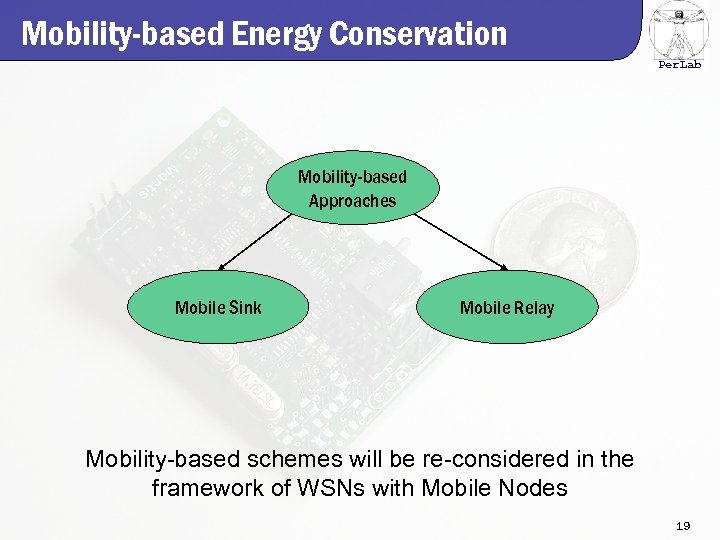 Mobility-based Energy Conservation Per. Lab Mobility-based Approaches Mobile Sink Mobile Relay Mobility-based schemes will be re-considered in the framework of WSNs with Mobile Nodes 19
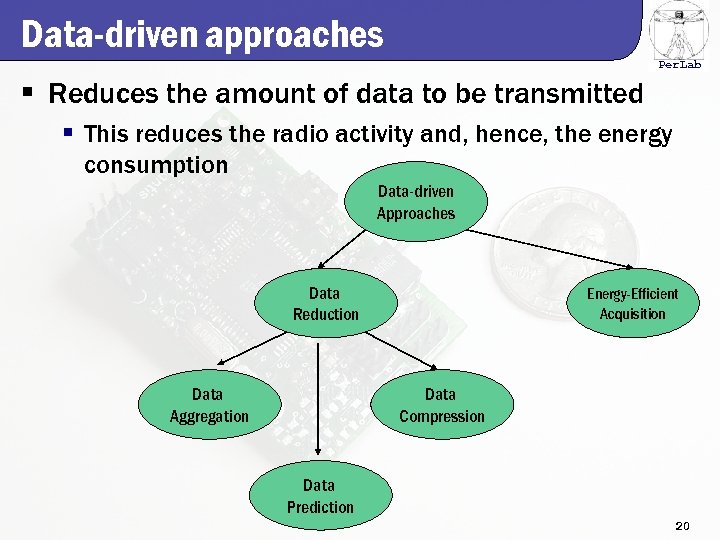 Data-driven approaches Per. Lab § Reduces the amount of data to be transmitted § This reduces the radio activity and, hence, the energy consumption Data-driven Approaches Data Reduction Data Aggregation Energy-Efficient Acquisition Data Compression Data Prediction 20
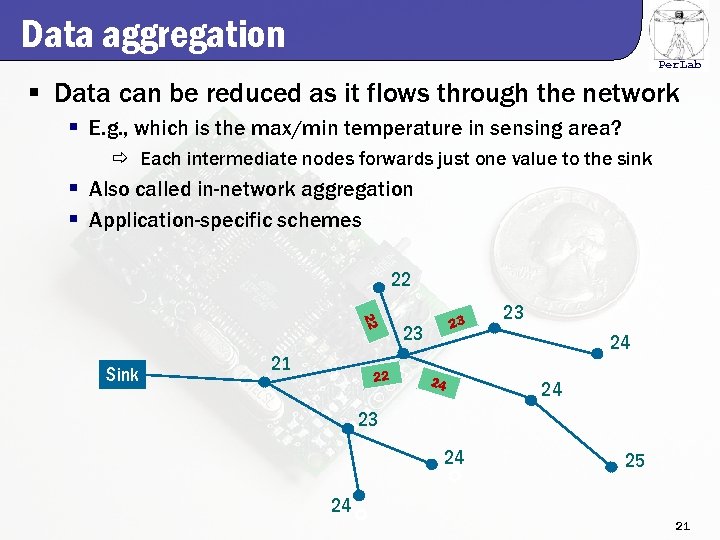 Data aggregation Per. Lab § Data can be reduced as it flows through the network § E. g. , which is the max/min temperature in sensing area? ð Each intermediate nodes forwards just one value to the sink § Also called in-network aggregation § Application-specific schemes 22 22 Sink 21 22 23 23 24 24 23 24 25 24 21
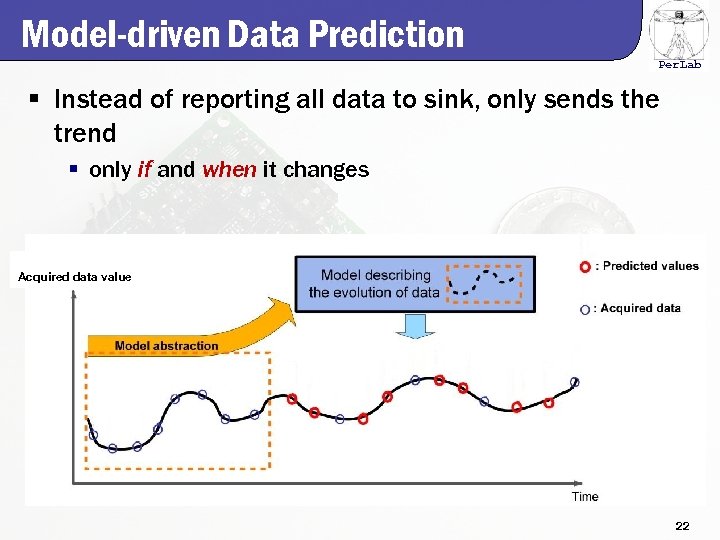 Model-driven Data Prediction Per. Lab § Instead of reporting all data to sink, only sends the trend § only if and when it changes Acquired data value 22
 Limitations of Data-driven approaches Per. Lab § Just reducing the amount of data does not necessarily result in energy consumption reduction § Transmitting a message requires approximately the same energy, irrespective of the message size § Energy costs for maintaining the sensor network cannot be avoided § Data reductions eliminates data redundancy 100% communication reliability is required How much energy-consumption reduction in practice? 23
 Limitations of data-driven approaches Per. Lab Usman Raza, Alessandro Camerra, Amy L Murphy, Themis Palpanas, Gian Pietro Picco, What Does Model-Driven Data Acquisition Really Achieve in Wireless Sensor Networks? , Proc. IEEE Per. Com 2012, Lugano, Switzerland, March 19 -23, 2012. § WSN for adaptive lighting in road tunnels § Model-driven data acquisition approach § Derivative-Based Prediction (DBP) § The proposed technique suppresses 99. 1% of reports § However, lifetime “only” triples § Idle listening § Overhead introduced by the routing protocol ð Routing tree management § Need for reliable communication protocols 24
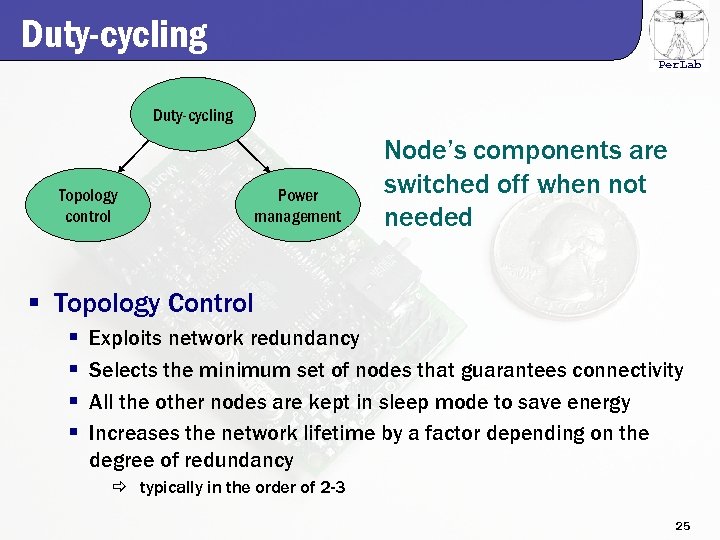 Duty-cycling Per. Lab Duty-cycling Topology control Power management Node’s components are switched off when not needed § Topology Control § § Exploits network redundancy Selects the minimum set of nodes that guarantees connectivity All the other nodes are kept in sleep mode to save energy Increases the network lifetime by a factor depending on the degree of redundancy ð typically in the order of 2 -3 25
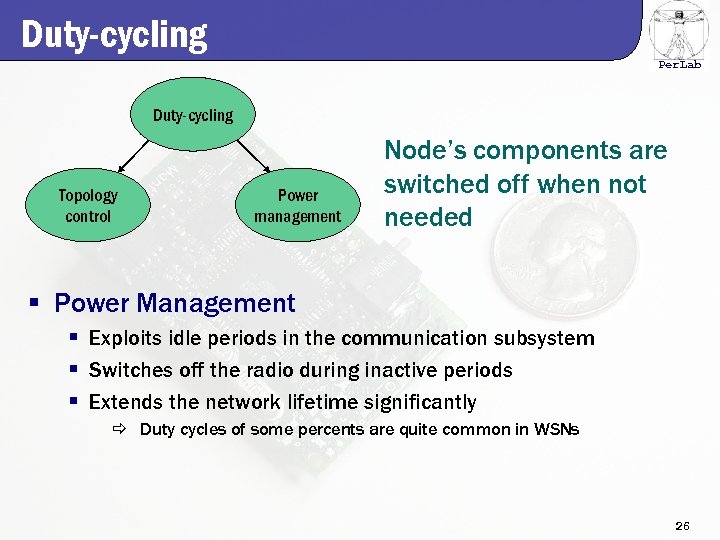 Duty-cycling Per. Lab Duty-cycling Topology control Power management Node’s components are switched off when not needed § Power Management § Exploits idle periods in the communication subsystem § Switches off the radio during inactive periods § Extends the network lifetime significantly ð Duty cycles of some percents are quite common in WSNs 26
 Topology Control
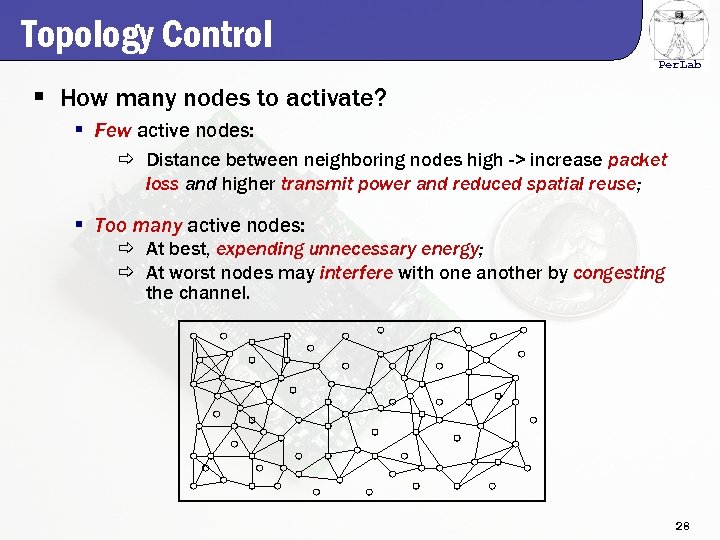 Topology Control Per. Lab § How many nodes to activate? § Few active nodes: ð Distance between neighboring nodes high -> increase packet loss and higher transmit power and reduced spatial reuse; § Too many active nodes: ð At best, expending unnecessary energy; ð At worst nodes may interfere with one another by congesting the channel. 28
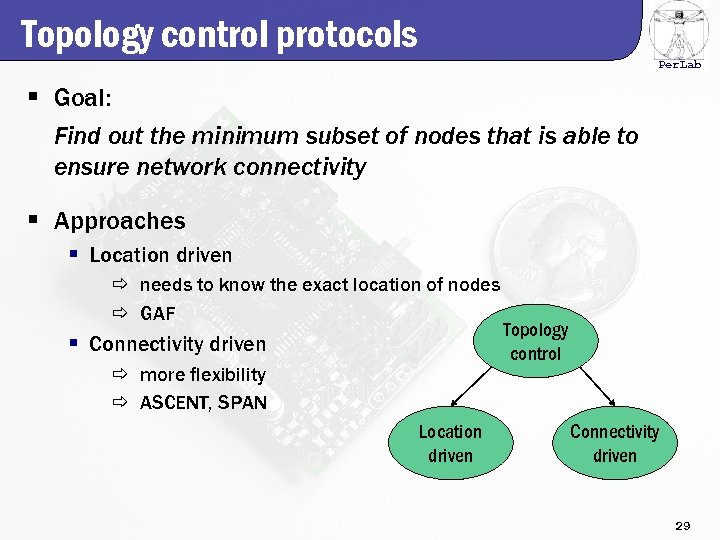 Topology control protocols Per. Lab § Goal: Find out the minimum subset of nodes that is able to ensure network connectivity § Approaches § Location driven ð needs to know the exact location of nodes ð GAF § Connectivity driven ð more flexibility ð ASCENT, SPAN Location driven Topology control Connectivity driven 29
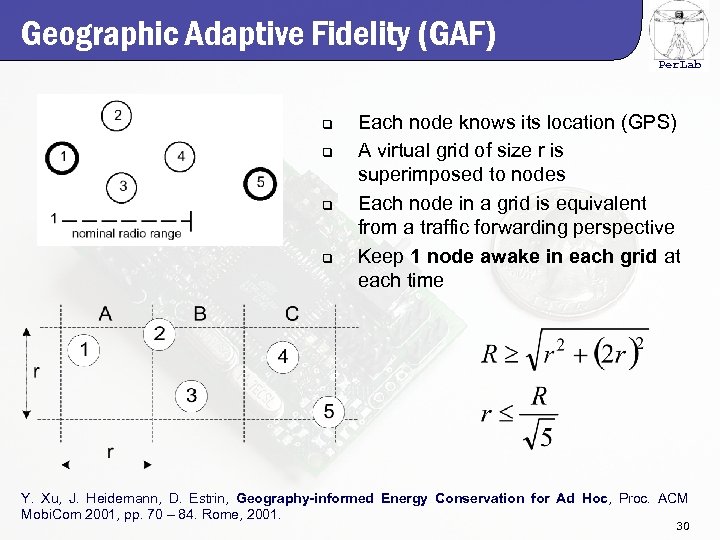 Geographic Adaptive Fidelity (GAF) Per. Lab q q Each node knows its location (GPS) A virtual grid of size r is superimposed to nodes Each node in a grid is equivalent from a traffic forwarding perspective Keep 1 node awake in each grid at each time Y. Xu, J. Heidemann, D. Estrin, Geography-informed Energy Conservation for Ad Hoc, Proc. ACM Mobi. Com 2001, pp. 70 – 84. Rome, 2001. 30
 Geographic Adaptive Fidelity (GAF) Per. Lab § Topology Management + Routing § Cluster-head election § Cluster-head rotation for uniform energy consumption § All nodes inside a cluster, but the cluster-head, are sleeping § Routing § As soon as the cluster-head detects an event, it wakes up all the other nodes in the cluster § The cluster-head receives packets from cluster nodes, and forwards them to the sink node (no data aggregation) 31
 ASCENT Per. Lab § Adaptive Self-Configuring s. Ensor Networks Topologies § Does not depend on the routing protocol § Decision about joining the network based on local measurements § Each node measures the number of neighbors and packet loss locally. § Each node then makes an informed decision to join the network topology or to sleep by turning its radio off. A. Cerpa, D. Estrin, Ascent: Adaptive Self-Configuring Sensor Network Topologies, Proc. IEEE INFOCOM 2002. 32
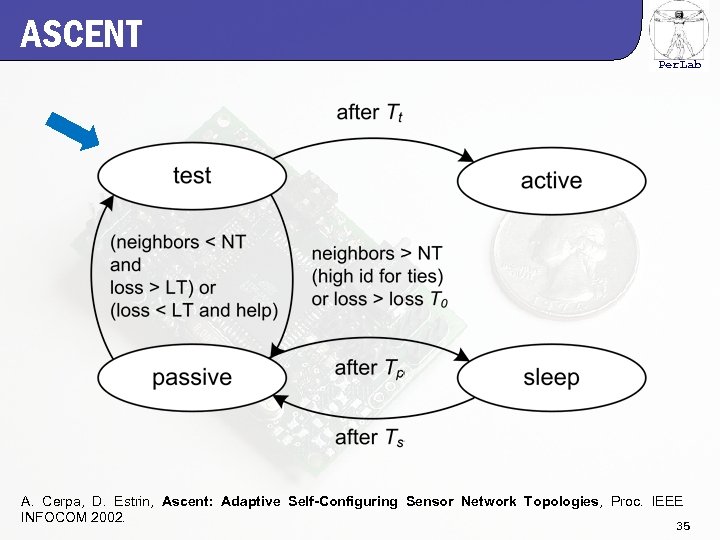
 ASCENT Per. Lab • Nodes can be in active or passive state – Active nodes are part of the topology (or stay awake) and forward data packets – Nodes in passive state can be sleeping or collecting network measurements. They do not forward any packets. – An active node may send help messages to solicit passive neighbors to become active if it is experiencing a low message loss – A node that joins the network (test state) sends an announcement message. – This process continues until the number of active nodes is such that the experienced message loss is below a pre-defined applicationdependent threshold. – The process will re-start when some future network event (e. g. a node failure) or a change in the environmental conditions causes an increase in the message loss. A. Cerpa, D. Estrin, Ascent: Adaptive Self-Configuring Sensor Network Topologies, Proc. IEEE INFOCOM 2002. 33
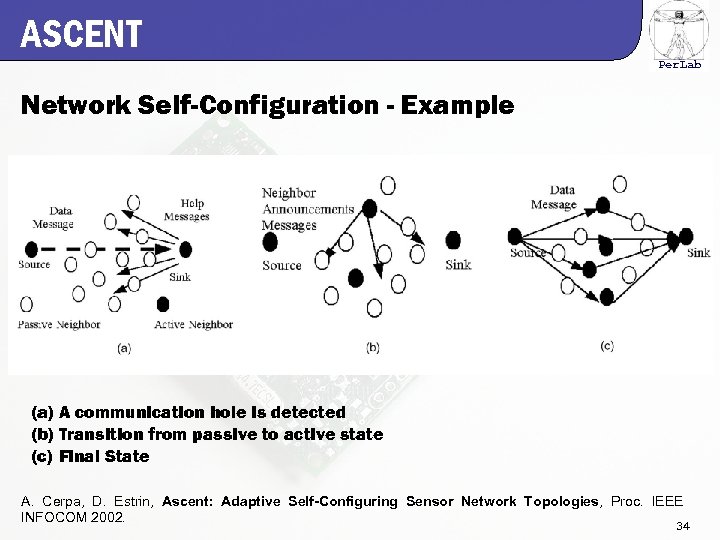 ASCENT Per. Lab Network Self-Configuration - Example (a) A communication hole is detected (b) Transition from passive to active state (c) Final State A. Cerpa, D. Estrin, Ascent: Adaptive Self-Configuring Sensor Network Topologies, Proc. IEEE INFOCOM 2002. 34
 ASCENT Per. Lab A. Cerpa, D. Estrin, Ascent: Adaptive Self-Configuring Sensor Network Topologies, Proc. IEEE INFOCOM 2002. 35
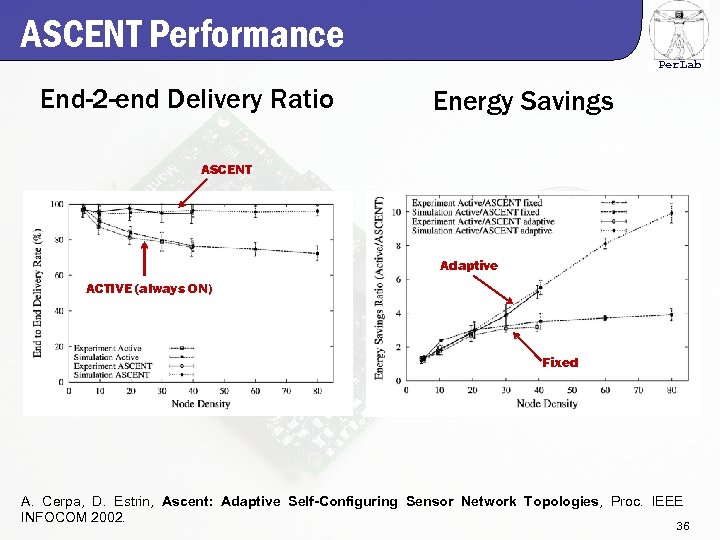 ASCENT Performance Per. Lab End-2 -end Delivery Ratio Energy Savings ASCENT Adaptive ACTIVE (always ON) Fixed A. Cerpa, D. Estrin, Ascent: Adaptive Self-Configuring Sensor Network Topologies, Proc. IEEE INFOCOM 2002. 36
 Power Management
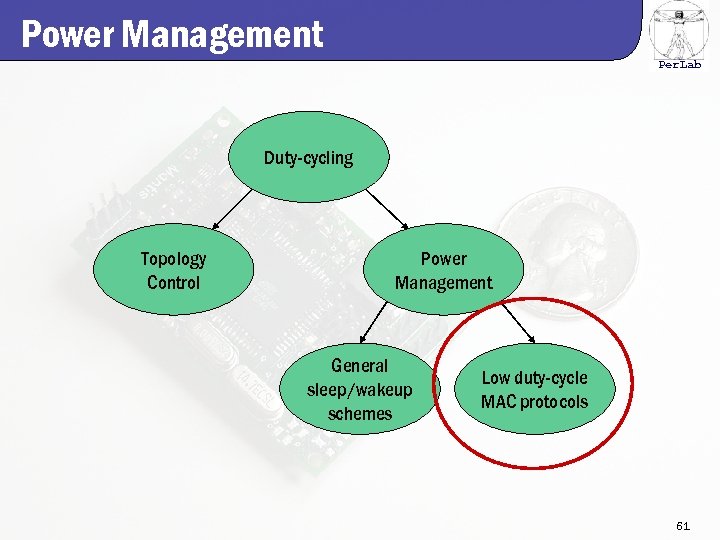
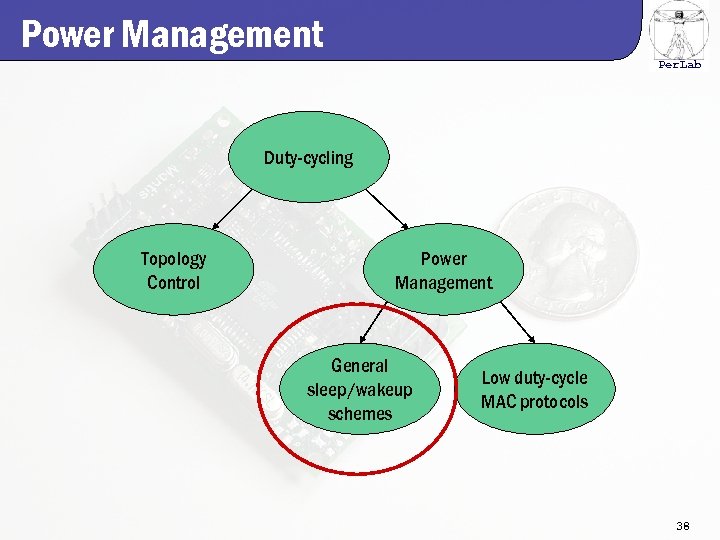 Power Management Per. Lab Duty-cycling Topology Control Power Management General sleep/wakeup schemes Low duty-cycle MAC protocols 38
 General sleep/wakeup schemes Per. Lab § When should a node wake up for communicating with its neighbors? 39
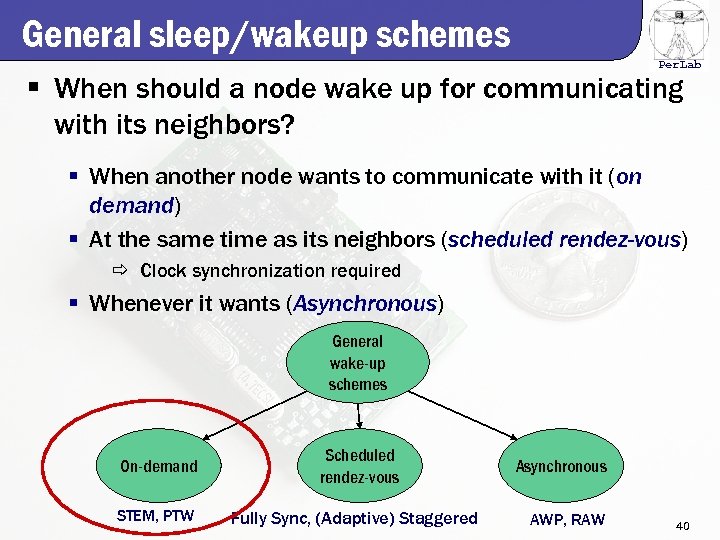 General sleep/wakeup schemes Per. Lab § When should a node wake up for communicating with its neighbors? § When another node wants to communicate with it (on demand) § At the same time as its neighbors (scheduled rendez-vous) ð Clock synchronization required § Whenever it wants (Asynchronous) General wake-up schemes On-demand STEM, PTW Scheduled rendez-vous Fully Sync, (Adaptive) Staggered Asynchronous AWP, RAW 40
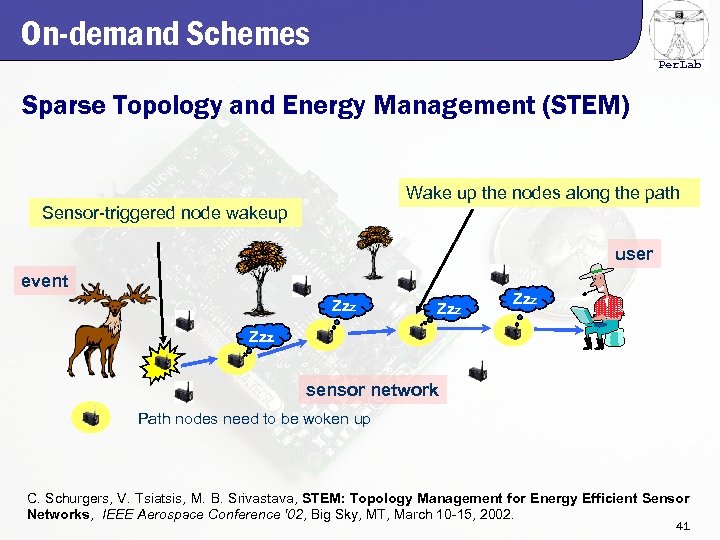 On-demand Schemes Per. Lab Sparse Topology and Energy Management (STEM) Wake up the nodes along the path Sensor-triggered node wakeup user event Zzz Zzz sensor network Path nodes need to be woken up C. Schurgers, V. Tsiatsis, M. B. Srivastava, STEM: Topology Management for Energy Efficient Sensor Networks, IEEE Aerospace Conference '02, Big Sky, MT, March 10 -15, 2002. 41
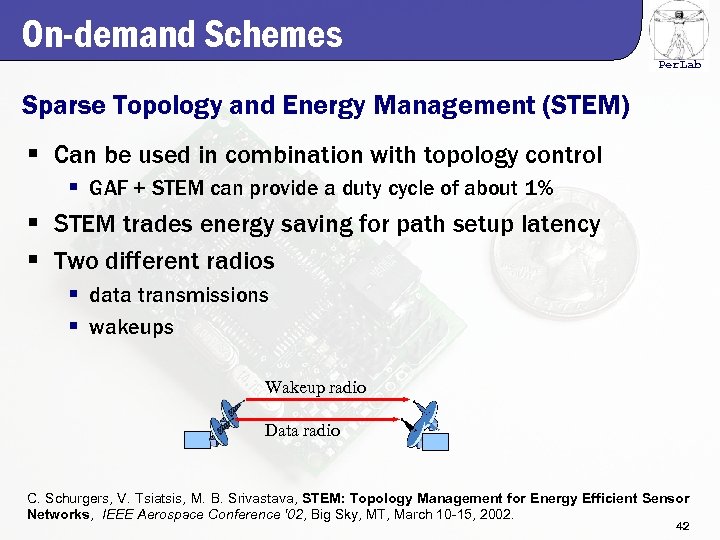 On-demand Schemes Per. Lab Sparse Topology and Energy Management (STEM) § Can be used in combination with topology control § GAF + STEM can provide a duty cycle of about 1% § STEM trades energy saving for path setup latency § Two different radios § data transmissions § wakeups Wakeup radio Data radio C. Schurgers, V. Tsiatsis, M. B. Srivastava, STEM: Topology Management for Energy Efficient Sensor Networks, IEEE Aerospace Conference '02, Big Sky, MT, March 10 -15, 2002. 42
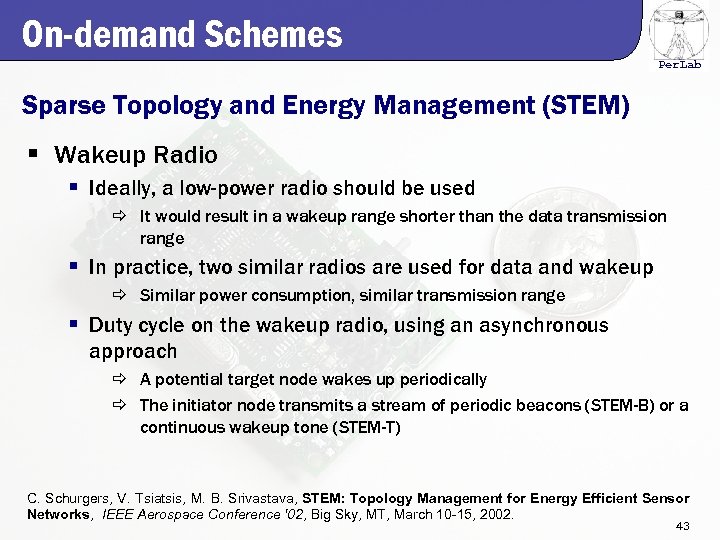 On-demand Schemes Per. Lab Sparse Topology and Energy Management (STEM) § Wakeup Radio § Ideally, a low-power radio should be used ð It would result in a wakeup range shorter than the data transmission range § In practice, two similar radios are used for data and wakeup ð Similar power consumption, similar transmission range § Duty cycle on the wakeup radio, using an asynchronous approach ð A potential target node wakes up periodically ð The initiator node transmits a stream of periodic beacons (STEM-B) or a continuous wakeup tone (STEM-T) C. Schurgers, V. Tsiatsis, M. B. Srivastava, STEM: Topology Management for Energy Efficient Sensor Networks, IEEE Aerospace Conference '02, Big Sky, MT, March 10 -15, 2002. 43
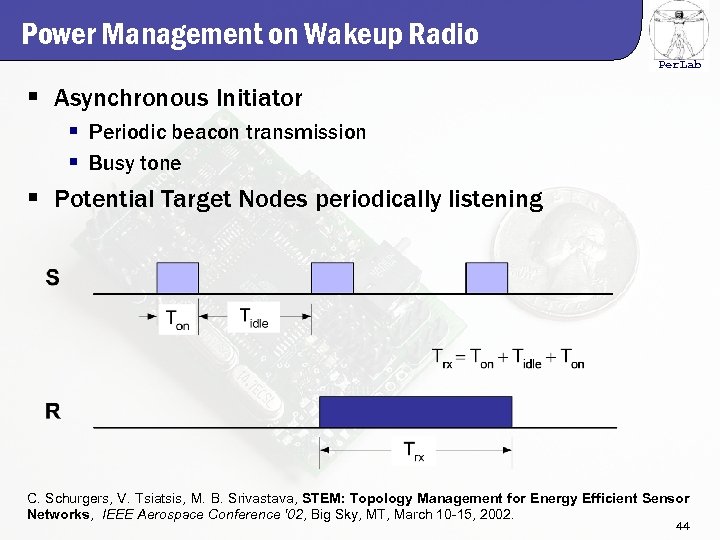 Power Management on Wakeup Radio Per. Lab § Asynchronous Initiator § Periodic beacon transmission § Busy tone § Potential Target Nodes periodically listening C. Schurgers, V. Tsiatsis, M. B. Srivastava, STEM: Topology Management for Energy Efficient Sensor Networks, IEEE Aerospace Conference '02, Big Sky, MT, March 10 -15, 2002. 44
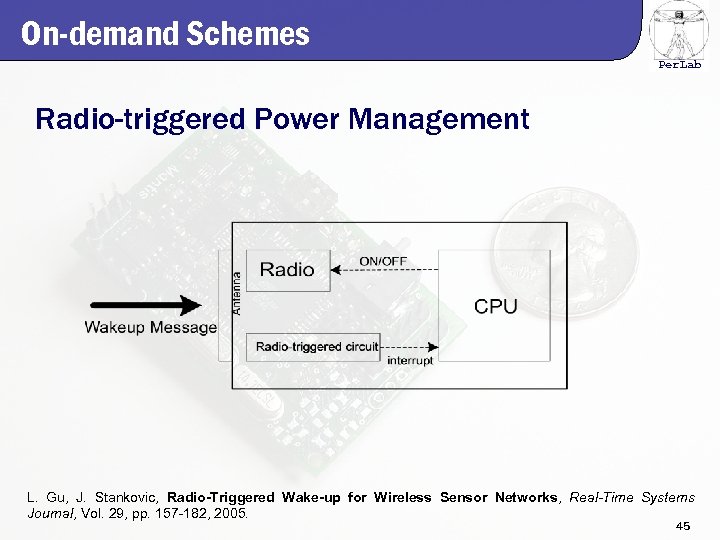 On-demand Schemes Per. Lab Radio-triggered Power Management L. Gu, J. Stankovic, Radio-Triggered Wake-up for Wireless Sensor Networks, Real-Time Systems Journal, Vol. 29, pp. 157 -182, 2005. 45
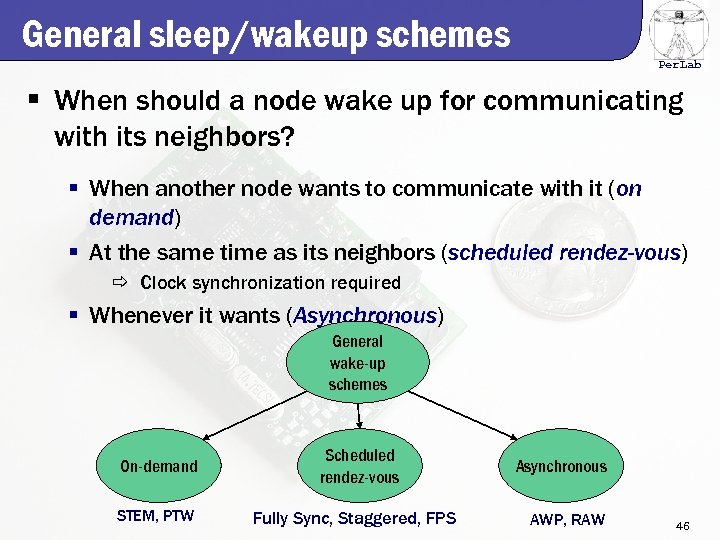 General sleep/wakeup schemes Per. Lab § When should a node wake up for communicating with its neighbors? § When another node wants to communicate with it (on demand) § At the same time as its neighbors (scheduled rendez-vous) ð Clock synchronization required § Whenever it wants (Asynchronous) General wake-up schemes On-demand STEM, PTW Scheduled rendez-vous Fully Sync, Staggered, FPS Asynchronous AWP, RAW 46
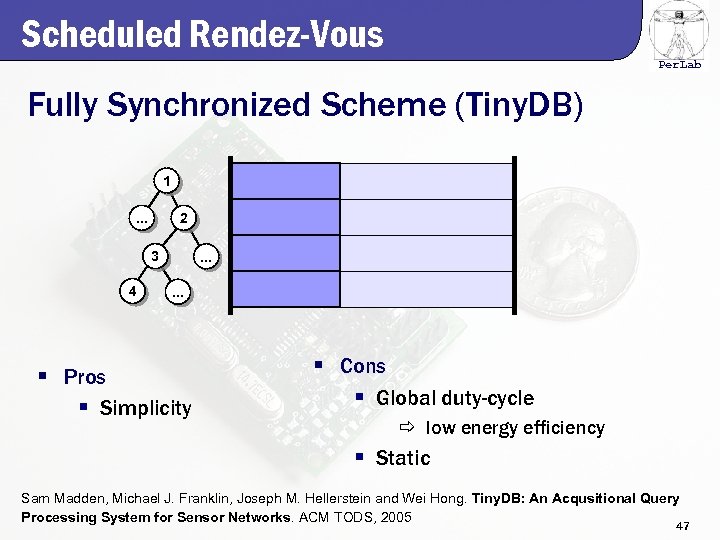 Scheduled Rendez-Vous Per. Lab Fully Synchronized Scheme (Tiny. DB) 1. . . 2 3 4 . . . § Pros § Simplicity § Cons § Global duty-cycle ð low energy efficiency § Static Sam Madden, Michael J. Franklin, Joseph M. Hellerstein and Wei Hong. Tiny. DB: An Acqusitional Query Processing System for Sensor Networks. ACM TODS, 2005 47
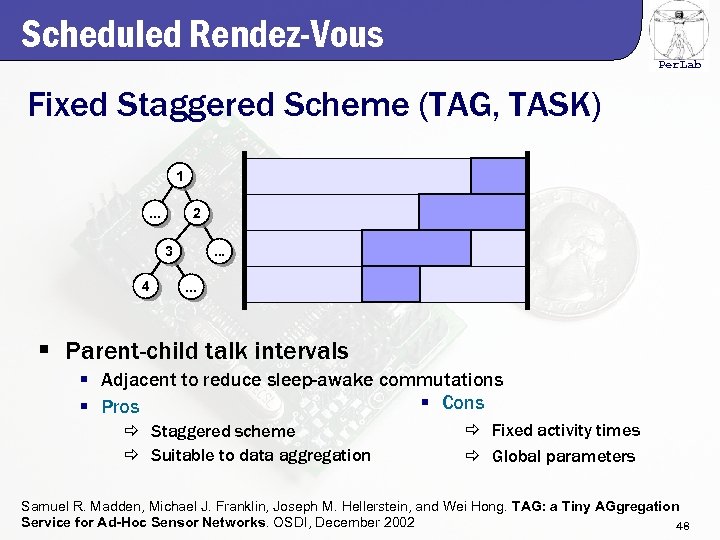 Scheduled Rendez-Vous Per. Lab Fixed Staggered Scheme (TAG, TASK) 1. . . 2 3 4 . . . § Parent-child talk intervals § Adjacent to reduce sleep-awake commutations § Cons § Pros ð Staggered scheme ð Suitable to data aggregation ð Fixed activity times ð Global parameters Samuel R. Madden, Michael J. Franklin, Joseph M. Hellerstein, and Wei Hong. TAG: a Tiny AGgregation Service for Ad-Hoc Sensor Networks. OSDI, December 2002 48
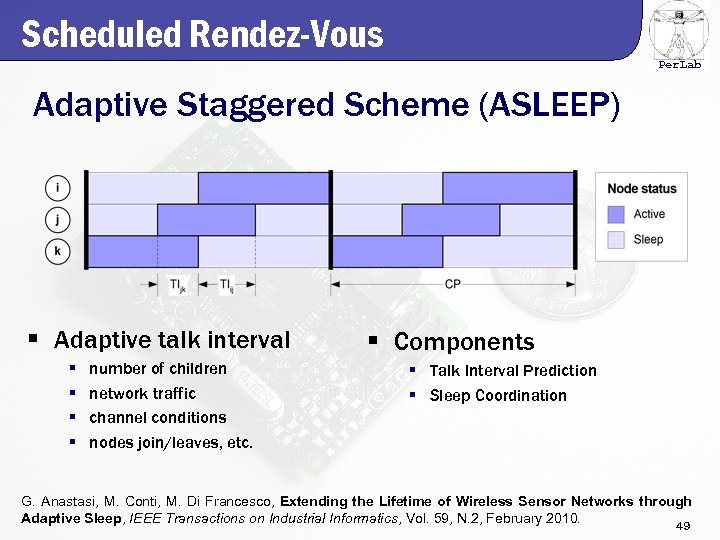 Scheduled Rendez-Vous Per. Lab Adaptive Staggered Scheme (ASLEEP) § Adaptive talk interval § § number of children network traffic channel conditions nodes join/leaves, etc. § Components § Talk Interval Prediction § Sleep Coordination G. Anastasi, M. Conti, M. Di Francesco, Extending the Lifetime of Wireless Sensor Networks through Adaptive Sleep, IEEE Transactions on Industrial Informatics, Vol. 59, N. 2, February 2010. 49
 ASLEEP Components Per. Lab § Talk Interval Prediction Algorithm § Sleep Coordination Algorithm § Direct Beacons § Reverse Beacons § Beacon Protection § Beacon Loss Compensation 50
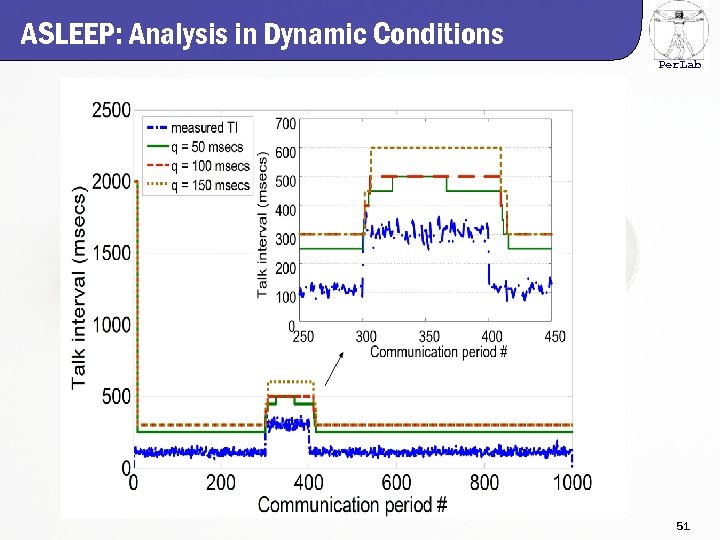 ASLEEP: Analysis in Dynamic Conditions Per. Lab 51
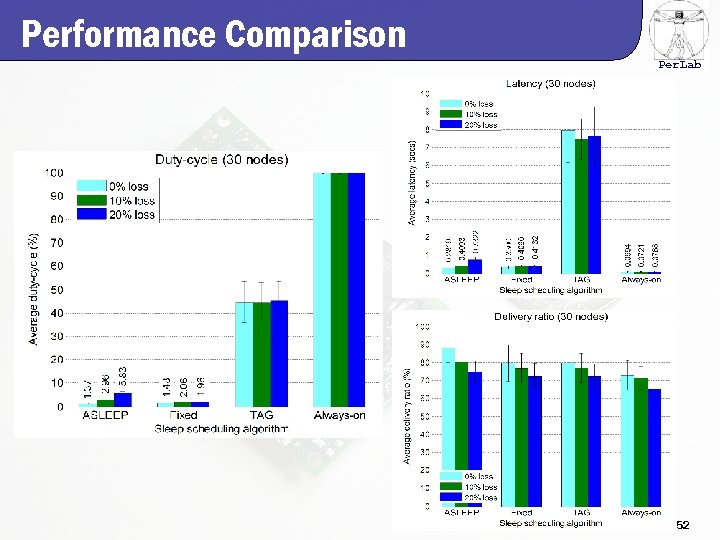 Performance Comparison Per. Lab 52
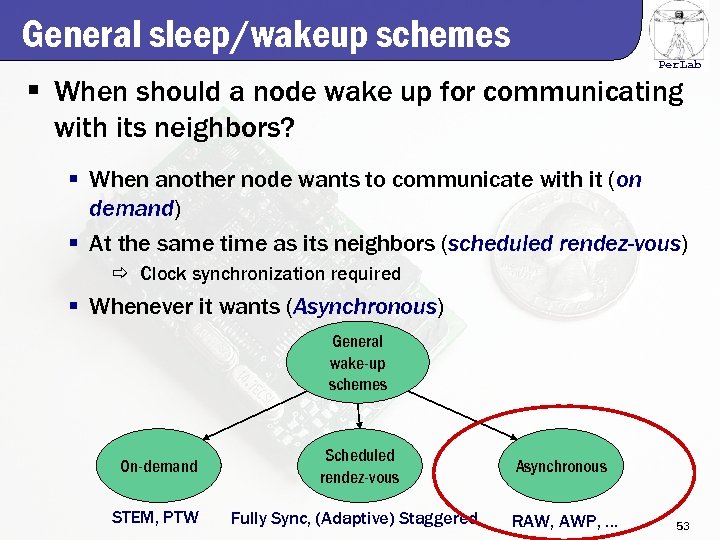 General sleep/wakeup schemes Per. Lab § When should a node wake up for communicating with its neighbors? § When another node wants to communicate with it (on demand) § At the same time as its neighbors (scheduled rendez-vous) ð Clock synchronization required § Whenever it wants (Asynchronous) General wake-up schemes On-demand STEM, PTW Scheduled rendez-vous Fully Sync, (Adaptive) Staggered Asynchronous RAW, AWP, … 53
 Random Asynchronous Wakeup (RAW) Per. Lab Routing Protocol + Random Wakeup Scheme § Several Paths towards the destination § Especially if the network is dense § Forwarding Candidate Set (FCS) set of active neighbors that are closest to the destination § In terms of number of hops (h-FCS) § In terms of distance (d-FCS) V. Paruchuri, S. Basavaraju, R. Kannan, S. Iyengar, Random Asynchronous Wakeup Protocol for Sensor Networks, Proc. IEEE Int’l Conf. On Broadband Networks (BROADNETS 2004), 2004. 54
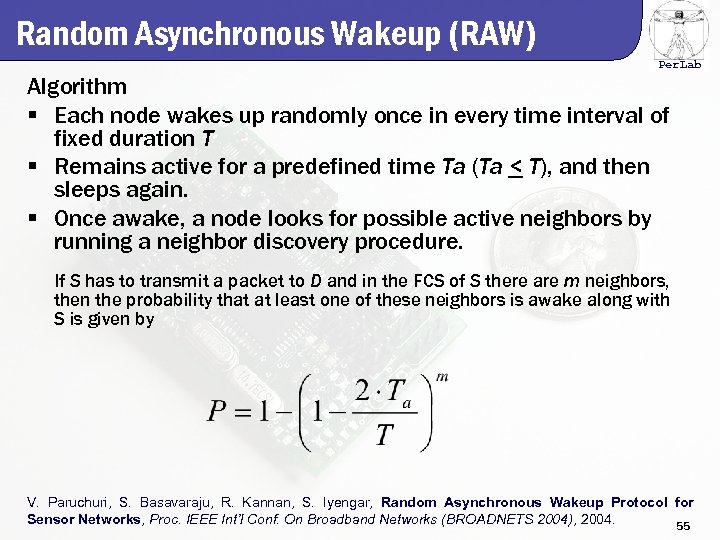 Random Asynchronous Wakeup (RAW) Per. Lab Algorithm § Each node wakes up randomly once in every time interval of fixed duration T § Remains active for a predefined time Ta (Ta < T), and then sleeps again. § Once awake, a node looks for possible active neighbors by running a neighbor discovery procedure. If S has to transmit a packet to D and in the FCS of S there are m neighbors, then the probability that at least one of these neighbors is awake along with S is given by V. Paruchuri, S. Basavaraju, R. Kannan, S. Iyengar, Random Asynchronous Wakeup Protocol for Sensor Networks, Proc. IEEE Int’l Conf. On Broadband Networks (BROADNETS 2004), 2004. 55
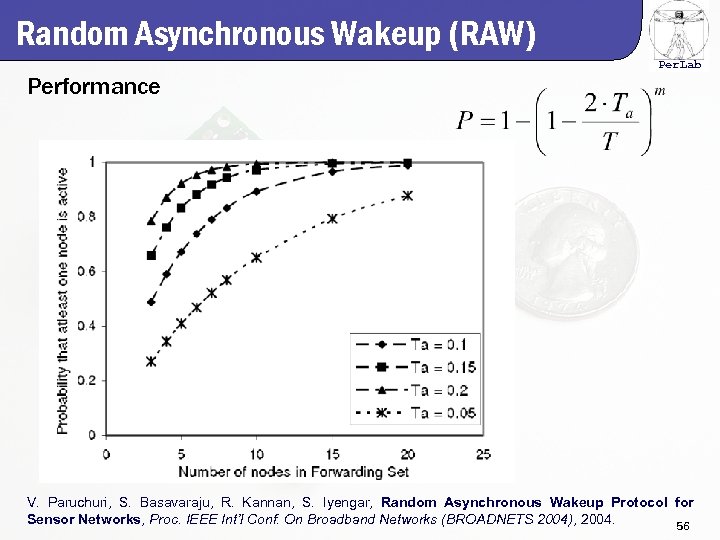 Random Asynchronous Wakeup (RAW) Performance Per. Lab V. Paruchuri, S. Basavaraju, R. Kannan, S. Iyengar, Random Asynchronous Wakeup Protocol for Sensor Networks, Proc. IEEE Int’l Conf. On Broadband Networks (BROADNETS 2004), 2004. 56
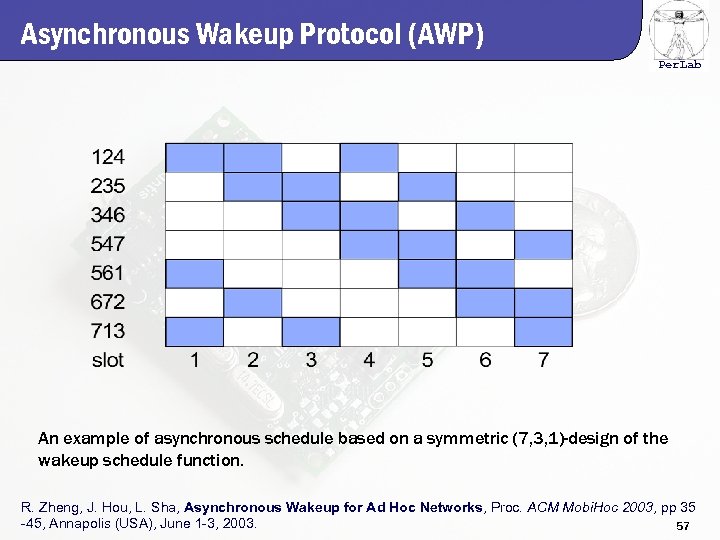 Asynchronous Wakeup Protocol (AWP) Per. Lab An example of asynchronous schedule based on a symmetric (7, 3, 1)-design of the wakeup schedule function. R. Zheng, J. Hou, L. Sha, Asynchronous Wakeup for Ad Hoc Networks, Proc. ACM Mobi. Hoc 2003, pp 35 -45, Annapolis (USA), June 1 -3, 2003. 57
 Asynchronous Sender and Periodic Listening Per. Lab 58
 Asynchronous Sender and Periodic Listening Per. Lab 59
 Power Management Low-duty Cycle MAC Protocols
 Power Management Per. Lab Duty-cycling Topology Control Power Management General sleep/wakeup schemes Low duty-cycle MAC protocols 61
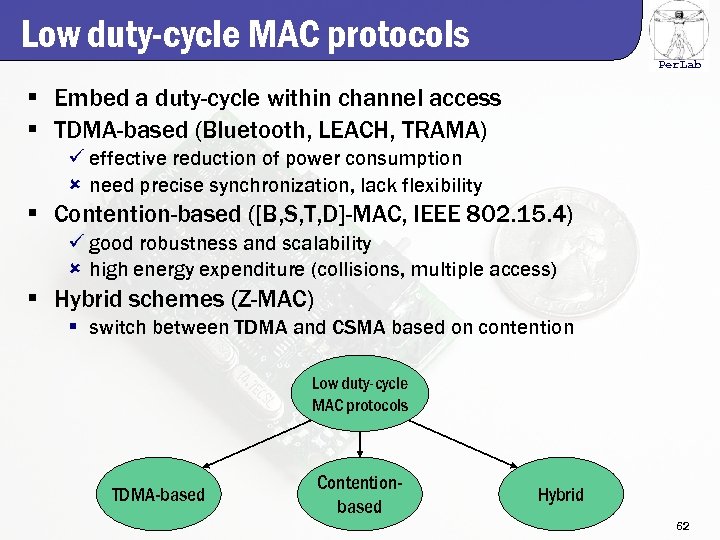 Low duty-cycle MAC protocols Per. Lab § Embed a duty-cycle within channel access § TDMA-based (Bluetooth, LEACH, TRAMA) ü effective reduction of power consumption û need precise synchronization, lack flexibility § Contention-based ([B, S, T, D]-MAC, IEEE 802. 15. 4) ü good robustness and scalability û high energy expenditure (collisions, multiple access) § Hybrid schemes (Z-MAC) § switch between TDMA and CSMA based on contention Low duty-cycle MAC protocols TDMA-based Contentionbased Hybrid 62
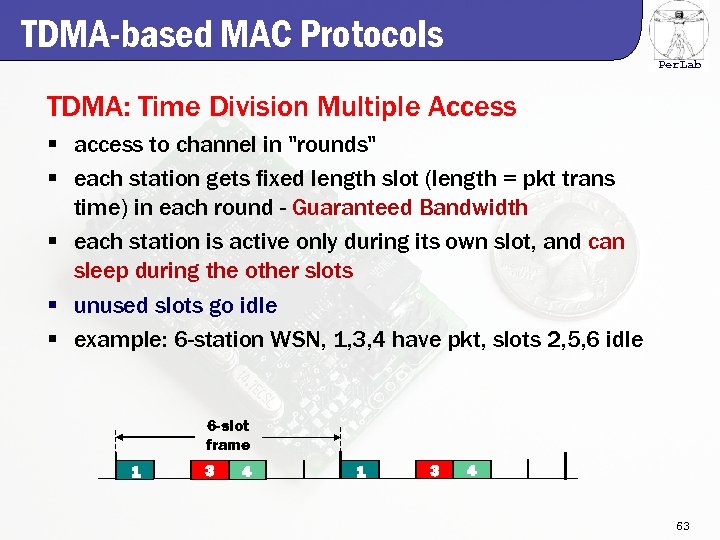 TDMA-based MAC Protocols Per. Lab TDMA: Time Division Multiple Access § access to channel in "rounds" § each station gets fixed length slot (length = pkt trans time) in each round - Guaranteed Bandwidth § each station is active only during its own slot, and can sleep during the other slots § unused slots go idle § example: 6 -station WSN, 1, 3, 4 have pkt, slots 2, 5, 6 idle 6 -slot frame 1 3 4 63
 LEACH Per. Lab Low Energy Adaptive Clustering Hierarchy § Nodes are organized in clusters § A Cluster-Head (CH) for each cluster § Coordinates all the activities within the cluster § Nodes report data to their CH through TDMA § Each nodes has a predefined slot § Nodes wakeup only during their sleep § The CH has the highest energy consumption W. R. Heinzelman, A. Chandrakasan, and H. Balakrishnan, Energy-Efficient Communication Protocol for Wireless Microsensor Networks, Proc. Hawaii International Conference on System Sciences, January, 2000. 64
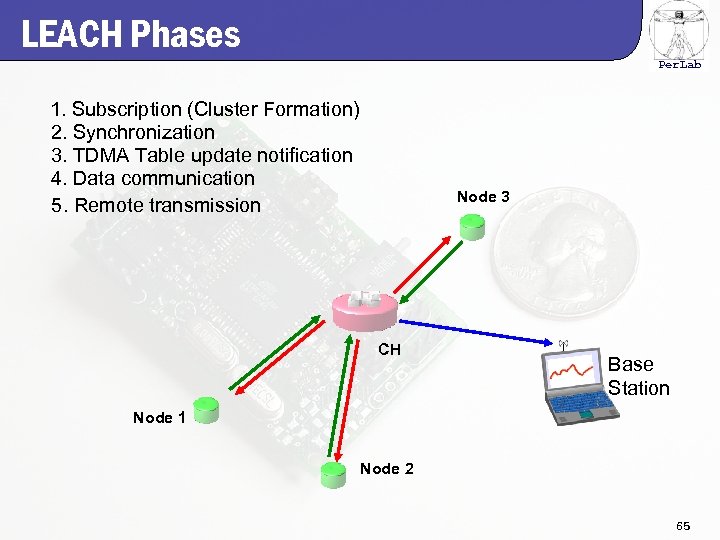 LEACH Phases Per. Lab 1. Subscription (Cluster Formation) 2. Synchronization 3. TDMA Table update notification 4. Data communication 5. Remote transmission Node 3 CH Base Station Node 1 Node 2 65
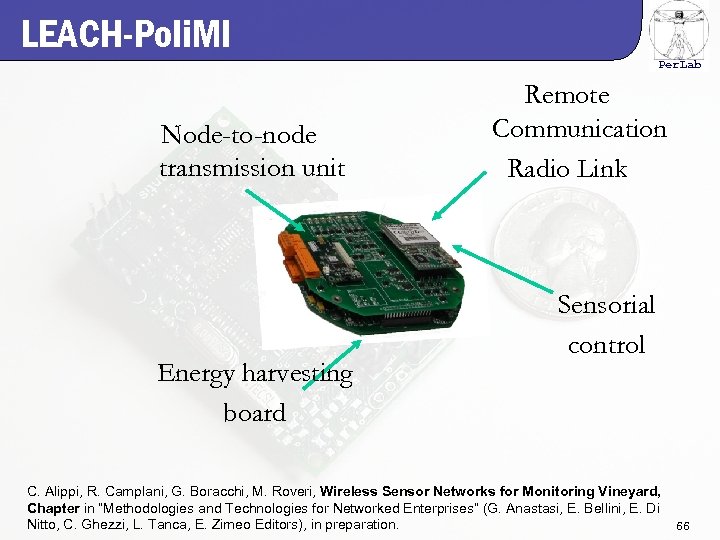 LEACH-Poli. MI Per. Lab Node-to-node transmission unit Energy harvesting board Remote Communication Radio Link Sensorial control C. Alippi, R. Camplani, G. Boracchi, M. Roveri, Wireless Sensor Networks for Monitoring Vineyard, Chapter in “Methodologies and Technologies for Networked Enterprises” (G. Anastasi, E. Bellini, E. Di Nitto, C. Ghezzi, L. Tanca, E. Zimeo Editors), in preparation. 66
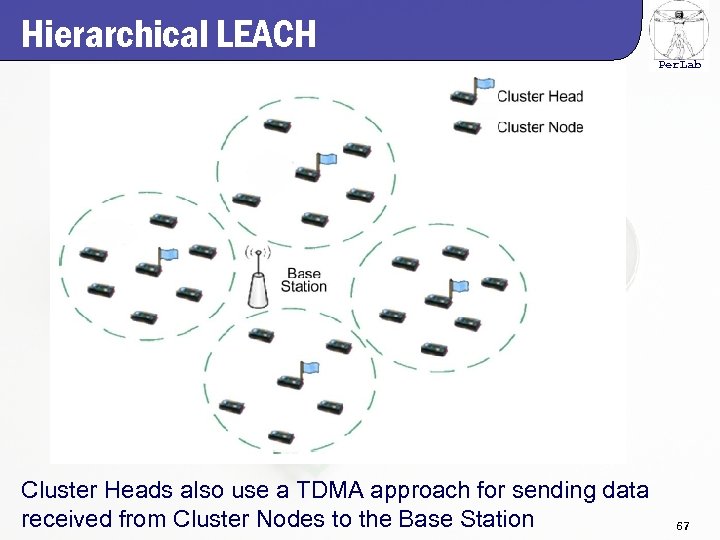 Hierarchical LEACH Per. Lab Cluster Heads also use a TDMA approach for sending data received from Cluster Nodes to the Base Station 67
 TDMA-based MAC Protocols: Summary Per. Lab § High energy efficiency § Nodes are active only during their slots § Minimum energy consumption without extra overhead § Limited Flexibility § A topology change may require a different slot allocation pattern § Limited Scalability § Finding a scalable slot allocation function is not trivial, especially in multi-hop (i. e. , hierarchical) networks § Interference prone § Finding an interference-free schedule may be hard § The interference range is larger than the transmission range § Tight Synchronization Required § Clock synch introduces overhead 68
 CSMA-based MAC Protocols Per. Lab § No synchronization required § Robustness § Synch may be needed for power management § Large Flexibility § A topology change do not require any re-configuration or schedule update notification § Limited Scalability § A large number of nodes can cause a large number of collisions and retransmissions § Low Energy Efficiency § Nodes may conflict § Energy consumed for overhearing 69
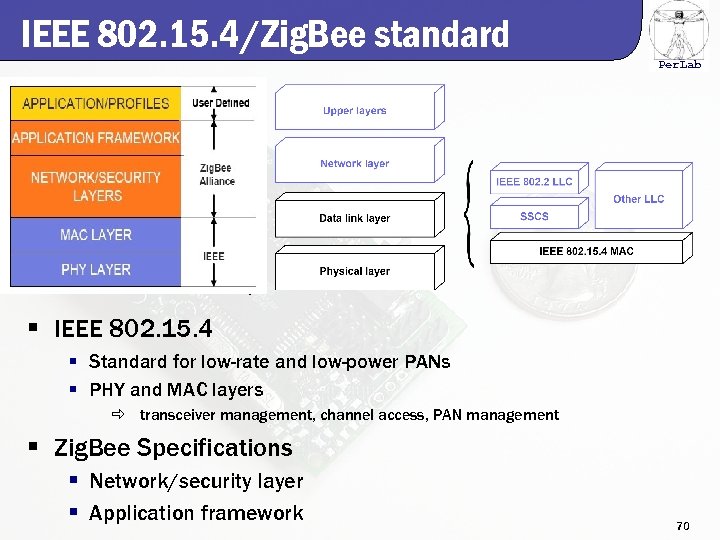 IEEE 802. 15. 4/Zig. Bee standard Per. Lab § IEEE 802. 15. 4 § Standard for low-rate and low-power PANs § PHY and MAC layers ð transceiver management, channel access, PAN management § Zig. Bee Specifications § Network/security layer § Application framework 70
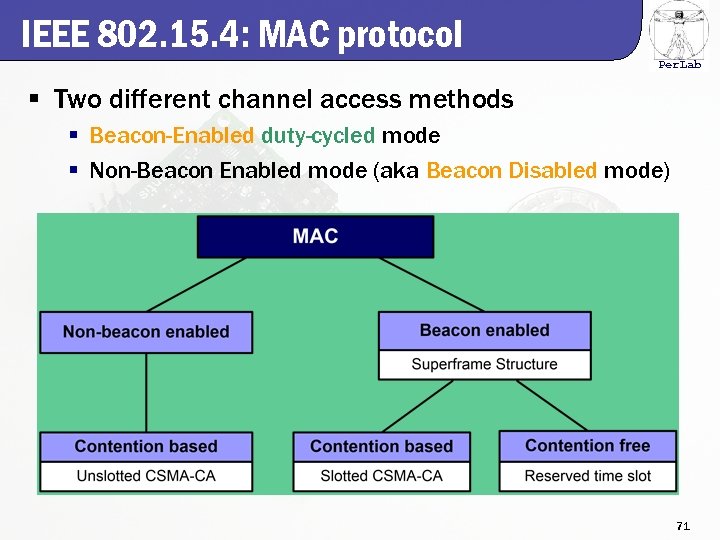 IEEE 802. 15. 4: MAC protocol Per. Lab § Two different channel access methods § Beacon-Enabled duty-cycled mode § Non-Beacon Enabled mode (aka Beacon Disabled mode) 71
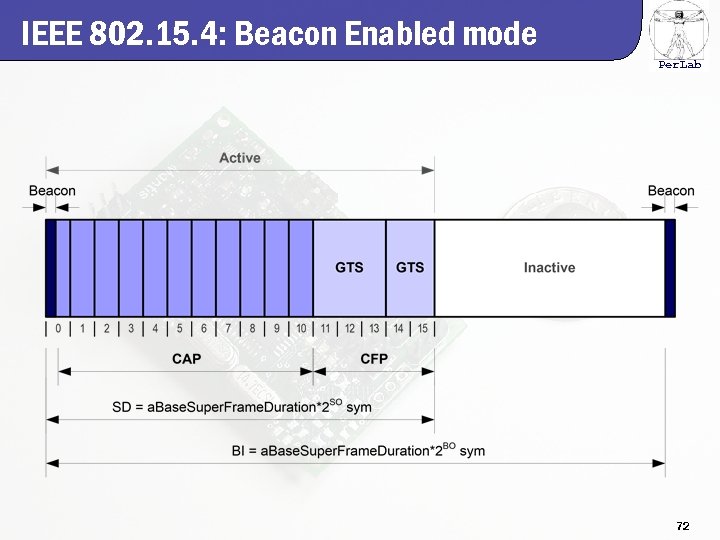 IEEE 802. 15. 4: Beacon Enabled mode Per. Lab 72
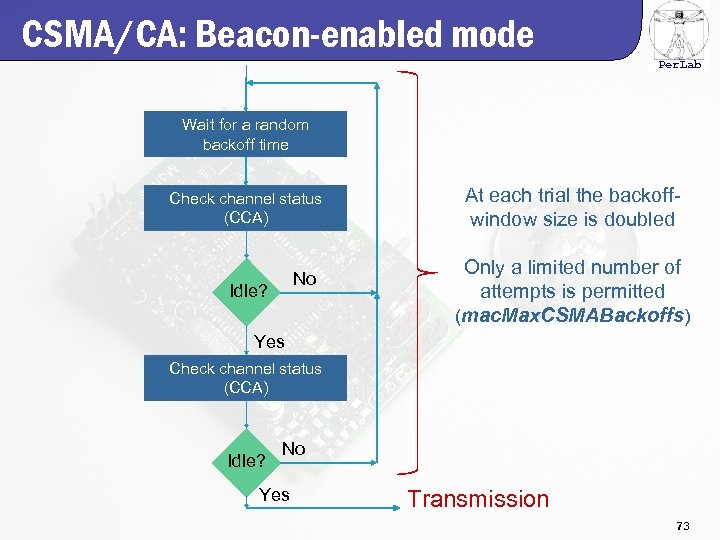 CSMA/CA: Beacon-enabled mode Per. Lab Wait for a random backoff time Check channel status (CCA) No Idle? At each trial the backoffwindow size is doubled Only a limited number of attempts is permitted (mac. Max. CSMABackoffs) Yes Check channel status (CCA) Idle? No Yes Transmission 73
 Acknowledgement Mechanism Per. Lab § Optional mechanism § Destination Side § ACK sent upon successful reception of a data frame § Sender side § Retransmission if ACK not (correctly) received within the timeout § At each retransmission attempt the backoff window size is re-initialized § Only a maximum number of retransmissions allowed (mac. Max. Frame. Retries) 74
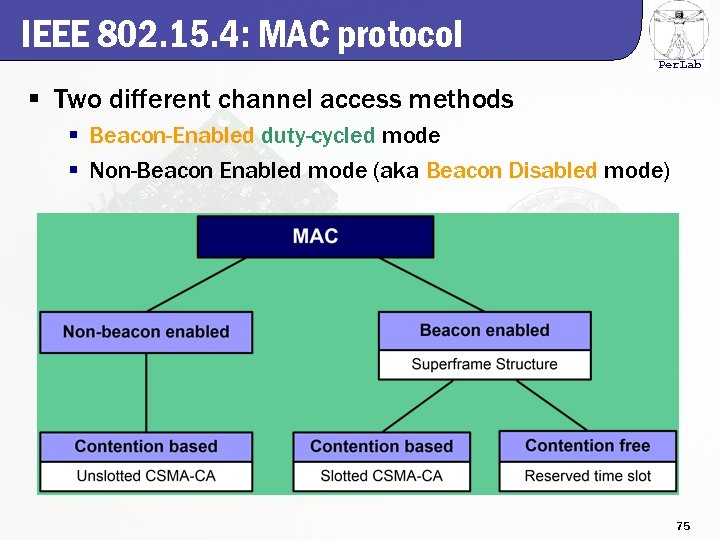 IEEE 802. 15. 4: MAC protocol Per. Lab § Two different channel access methods § Beacon-Enabled duty-cycled mode § Non-Beacon Enabled mode (aka Beacon Disabled mode) 75
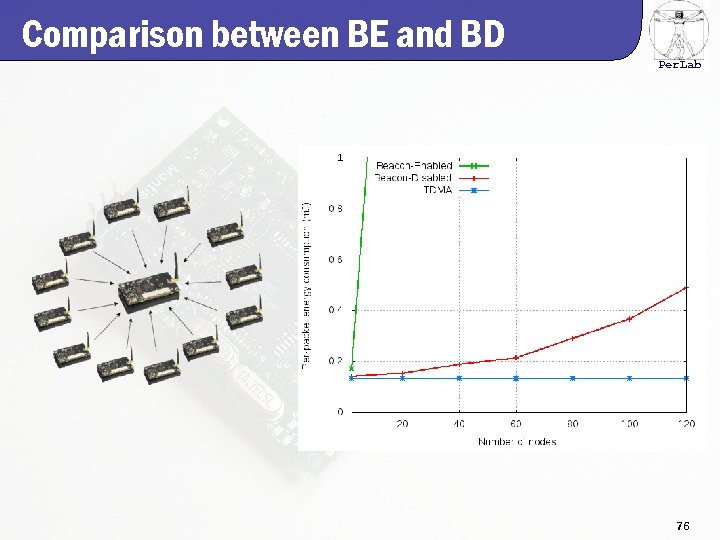 Comparison between BE and BD Per. Lab 76
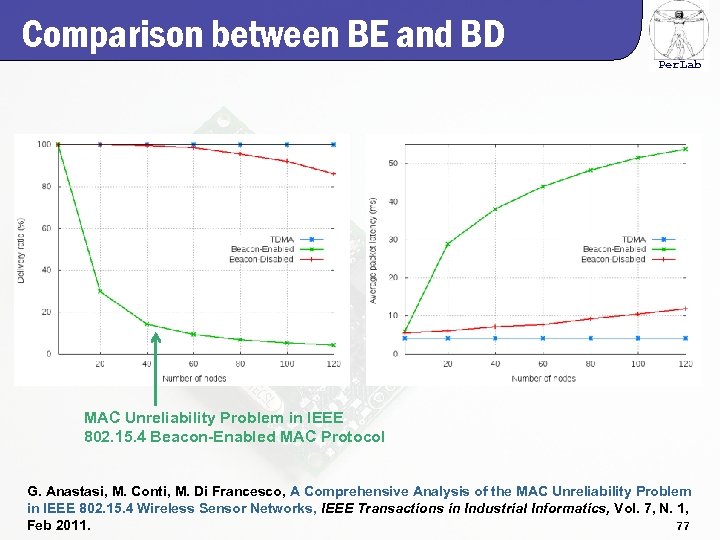 Comparison between BE and BD Per. Lab MAC Unreliability Problem in IEEE 802. 15. 4 Beacon-Enabled MAC Protocol G. Anastasi, M. Conti, M. Di Francesco, A Comprehensive Analysis of the MAC Unreliability Problem in IEEE 802. 15. 4 Wireless Sensor Networks, IEEE Transactions in Industrial Informatics, Vol. 7, N. 1, 77 Feb 2011.
 MAC with asynchronous PM Per. Lab § 802. 15. 4 Non-Beacon Enabled § Asynchronous: nodes can wake up and transmit at any time ð Possible conflicts are regulated by CSMA/CA § It assumes that the destination is always ON ð The destination may be either the sink or a Zig. Bee router § This is a strong limitation 78
 B-MAC with Low-power Listening Per. Lab § Availability § Designed before IEEE 802. 15 MAC (at UCB) § Shipped with the Tiny. OS operating system § B-MAC design considerations § simplicity § configurable options § minimize idle listening (to save energy) § B-MAC components § CSMA (without RTS/CTS) § optional low-power listening (LPL) § optional acknowledgements 79
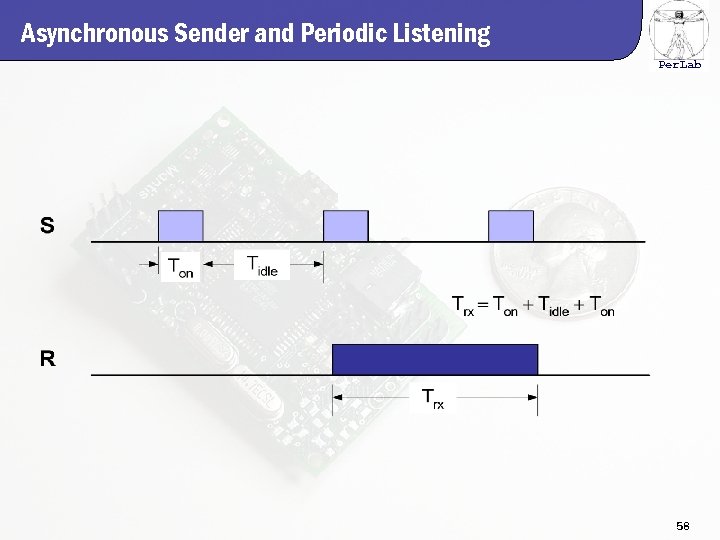
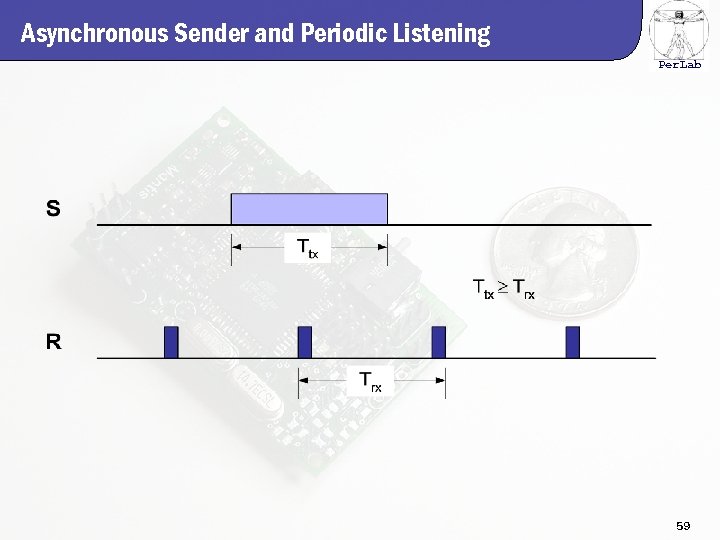
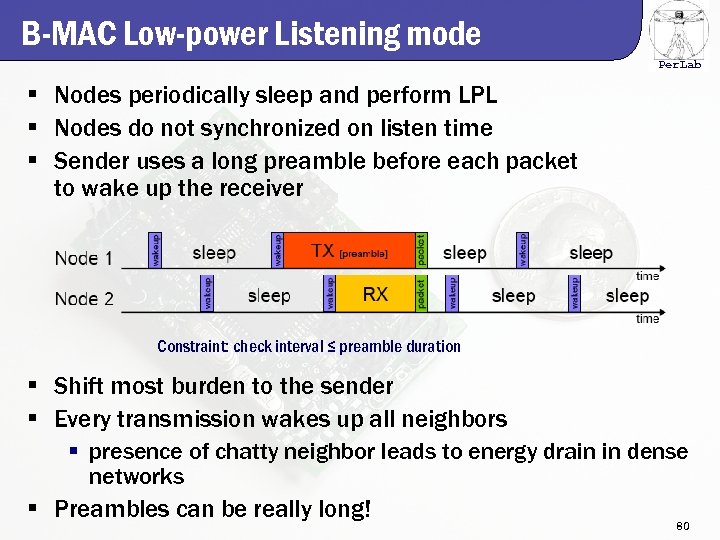 B-MAC Low-power Listening mode Per. Lab § Nodes periodically sleep and perform LPL § Nodes do not synchronized on listen time § Sender uses a long preamble before each packet to wake up the receiver Constraint: check interval ≤ preamble duration § Shift most burden to the sender § Every transmission wakes up all neighbors § presence of chatty neighbor leads to energy drain in dense networks § Preambles can be really long! 80
 Conclusions & Research Key Questions
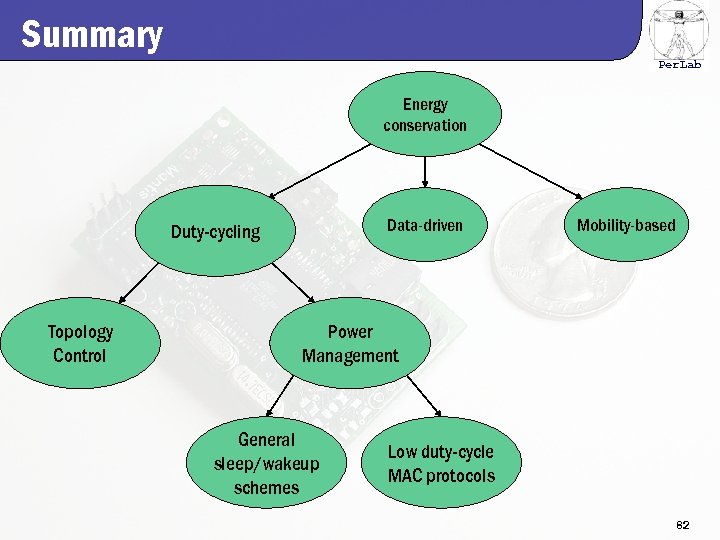 Summary Per. Lab Energy conservation Duty-cycling Topology Control Data-driven Mobility-based Power Management General sleep/wakeup schemes Low duty-cycle MAC protocols 82
 Key Research Questions Per. Lab § Data-driven approaches can significantly reduce the amount of data to be transmitted § Up to 99% and beyond § However, this does not necessarily result in energy consumption reduction, due to § Energy costs introduced by transmission overhead, network management § Additional costs due to communication reliability Are they really useful in practice? 83
 Key Research Questions Per. Lab § Topology Management exploits node redundancy § The increase in the network lifetime depends on the actual redundancy, and is limited in practice (some %) § It allows a longer lifetime at the cost of increased redundancy (i. e. , larger economic costs) 84
 Key Research Questions Per. Lab § Power Management eliminates idle times § May provide very large energy reductions, with limited costs (in terms of additional complexity) § Energy Efficiency vs. Robustness ð Simple approaches high robustness/limited energy efficiency ð Complex approaches higher energy efficiency but less robustness ð Very complex solutions cannot work in practice 85
 Key Research Questions Per. Lab § General (i. e. , application-layer) sleep/wakeup schemes or MAC-layer schemes? § And which MAC protocol? § TDMA or contention-based (802. 15. 4, B-MAC)? § IEEE 802. 15. 4: BE or BD? §… 86
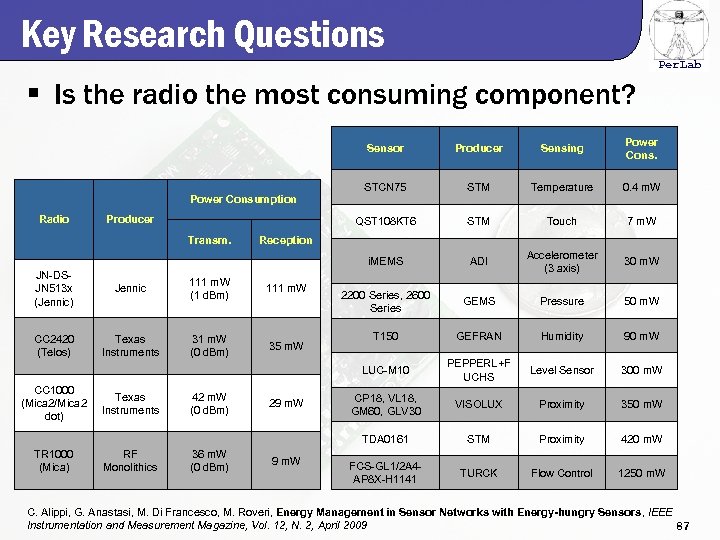 Key Research Questions Per. Lab § Is the radio the most consuming component? Sensor Producer Sensing Power Cons. STCN 75 STM Temperature 0. 4 m. W QST 108 KT 6 STM Touch 7 m. W i. MEMS ADI Accelerometer (3 axis) 30 m. W 2200 Series, 2600 Series GEMS Pressure 50 m. W T 150 GEFRAN Humidity 90 m. W LUC-M 10 PEPPERL+F UCHS Level Sensor 300 m. W CP 18, VL 18, GM 60, GLV 30 VISOLUX Proximity 350 m. W TDA 0161 STM Proximity 420 m. W FCS-GL 1/2 A 4 AP 8 X-H 1141 TURCK Flow Control 1250 m. W Power Consumption Radio Producer Transm. JN-DS- JN 513 x (Jennic) Jennic CC 2420 (Telos) Texas Instruments CC 1000 (Mica 2/Mica 2 dot) TR 1000 (Mica) Texas Instruments RF Monolithics Reception 111 m. W (1 d. Bm) 111 m. W 31 m. W (0 d. Bm) 35 m. W 42 m. W (0 d. Bm) 36 m. W (0 d. Bm) 29 m. W C. Alippi, G. Anastasi, M. Di Francesco, M. Roveri, Energy Management in Sensor Networks with Energy-hungry Sensors, IEEE Instrumentation and Measurement Magazine, Vol. 12, N. 2, April 2009 87
 Key Research Questions Per. Lab § Power Management or Energy Harvesting? § Power management reduces energy consumption, while energy harvesting captures energy § Energy harvesting becomes unavoidable when § Perpetual operations are required § Power Management is not able to meet the application requirements § Are they really alternative approaches? 88
 Key Research Questions Per. Lab § When using Energy harvesting the WSN protocols and applications can take advantage of the available energy How to maximize the WSN performance while guaranteeing perpetual operations (i. e. , infinite lifetime)? 89
 Comments or Questions? Per. Lab