


 Скачать презентацию Energy Challenges Their Imminence Scale Impact and Mitigation
8c47de0e4f3fb32e1a0ff1f731720470.ppt
- Количество слайдов: 70
 Energy Challenges: Their Imminence, Scale, Impact and Mitigation Sanjay. V. Khare Department of Physics and Astronomy, The University of Toledo, OH-43606 http: //astro 1. panet. utoledo. edu/~khare/ Acknowledgements Funding: NSF, DARPA, DOE, WPAFB, PVIC from Sate of Ohio, Data and Slides: Gratitude and thanks to many fellow scientists Presentation: My student Shandeep Voggu Themes of this Discussion 1. Peak Oil Curve, EROEI 2. Wealth and Energy 3. Good life re-definition
 Sequence of Emotional Reactions Steps • Surprise and Shock • Denial of Problem • Anger • Depression • Acceptance or Surrender • Adaptation and Creative Action
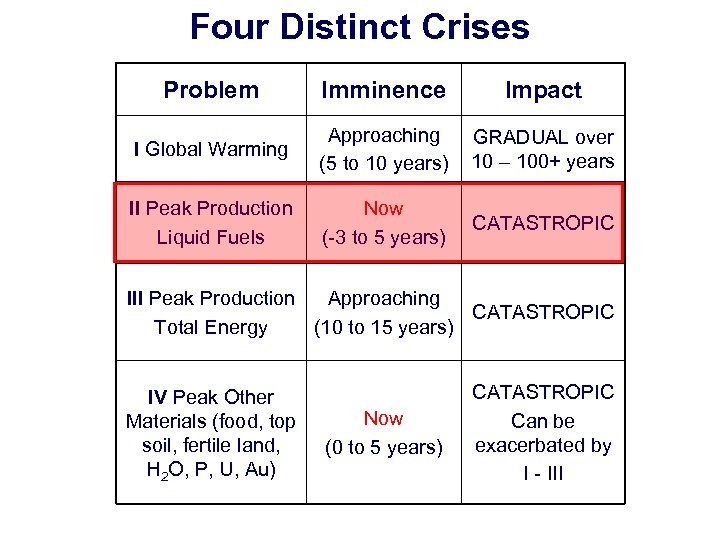 Four Distinct Crises Problem Imminence Impact I Global Warming Approaching (5 to 10 years) GRADUAL over 10 – 100+ years II Peak Production Liquid Fuels Now (-3 to 5 years) CATASTROPIC III Peak Production Approaching CATASTROPIC Total Energy (10 to 15 years) IV Peak Other Materials (food, top soil, fertile land, H 2 O, P, U, Au) Now (0 to 5 years) CATASTROPIC Can be exacerbated by I - III
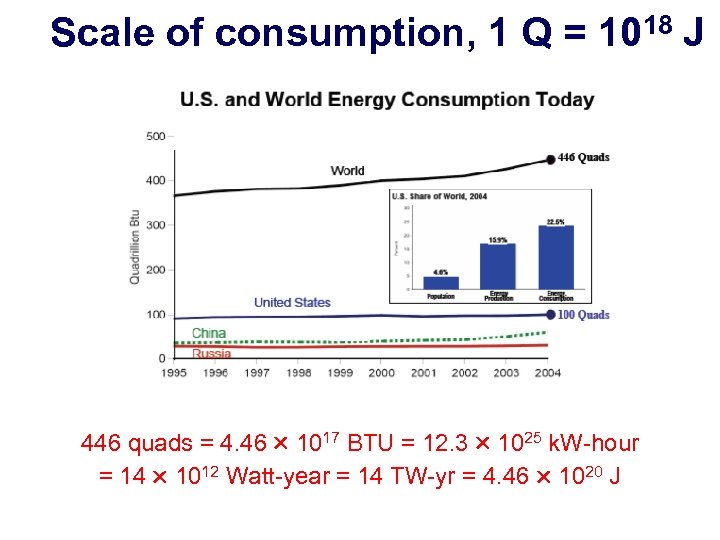 Scale of consumption, 1 Q = 1018 J 446 quads = 4. 46 1017 BTU = 12. 3 1025 k. W-hour = 14 1012 Watt-year = 14 TW-yr = 4. 46 1020 J
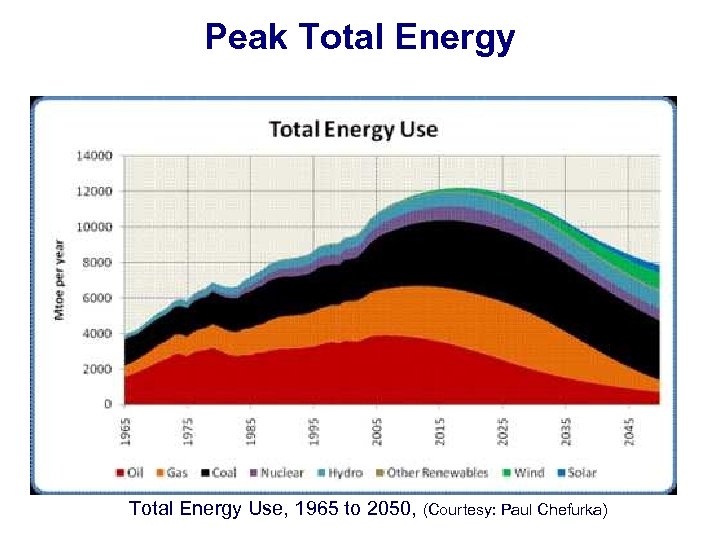
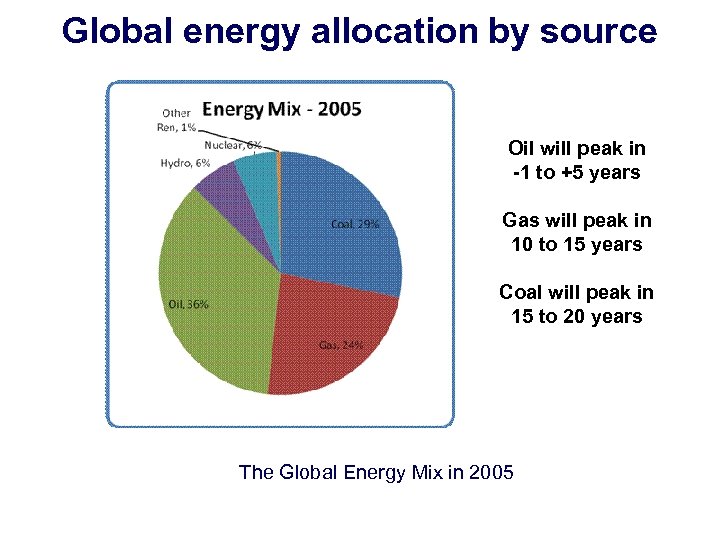 Global energy allocation by source Oil will peak in -1 to +5 years Gas will peak in 10 to 15 years Coal will peak in 15 to 20 years The Global Energy Mix in 2005
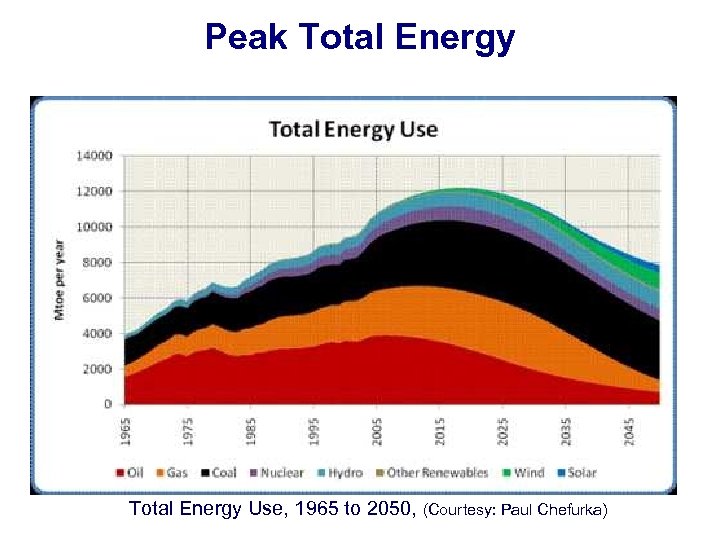 Peak Total Energy Use, 1965 to 2050, (Courtesy: Paul Chefurka)
 PEAK OIL (and the unfolding energy crisis) -What is Peak Oil? -What are the consequences? -What can we do about it?
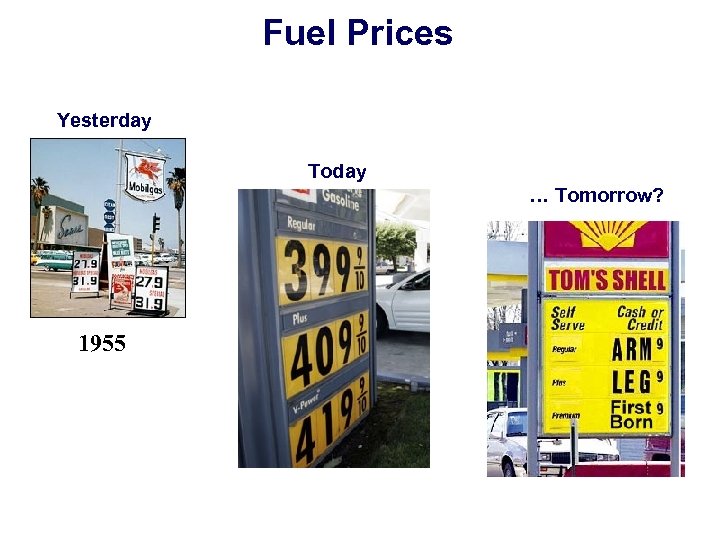 Fuel Prices Yesterday Today … Tomorrow? 1955 2005
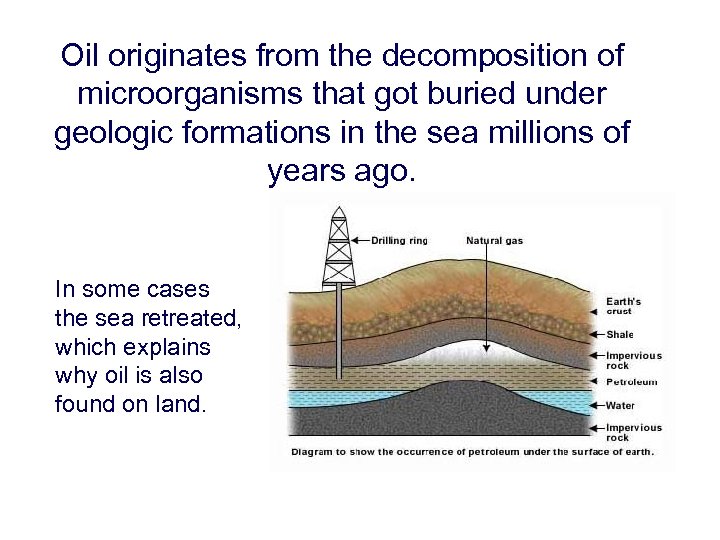 Oil originates from the decomposition of microorganisms that got buried under geologic formations in the sea millions of years ago. In some cases the sea retreated, which explains why oil is also found on land.
 -Oil was a gift from nature. -It took millions of years to produce -When it’s gone, it’s gone forever
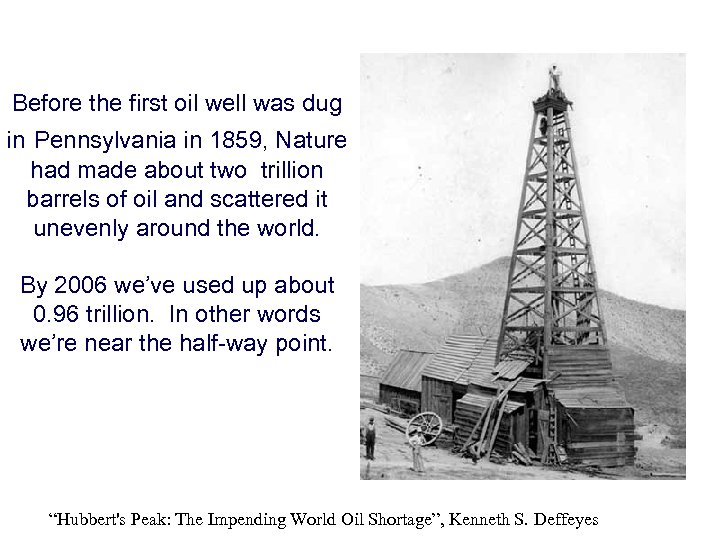 Before the first oil well was dug in Pennsylvania in 1859, Nature had made about two trillion barrels of oil and scattered it unevenly around the world. By 2006 we’ve used up about 0. 96 trillion. In other words we’re near the half-way point. “Hubbert's Peak: The Impending World Oil Shortage”, Kenneth S. Deffeyes
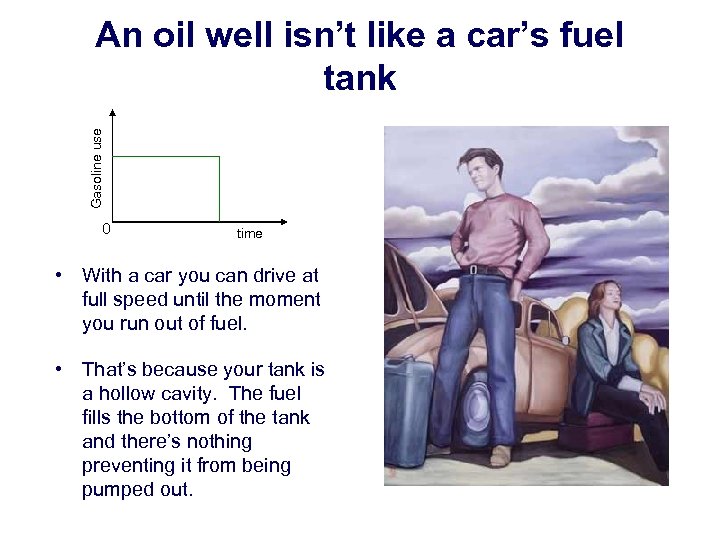 Gasoline use An oil well isn’t like a car’s fuel tank 0 time • With a car you can drive at full speed until the moment you run out of fuel. • That’s because your tank is a hollow cavity. The fuel fills the bottom of the tank and there’s nothing preventing it from being pumped out.
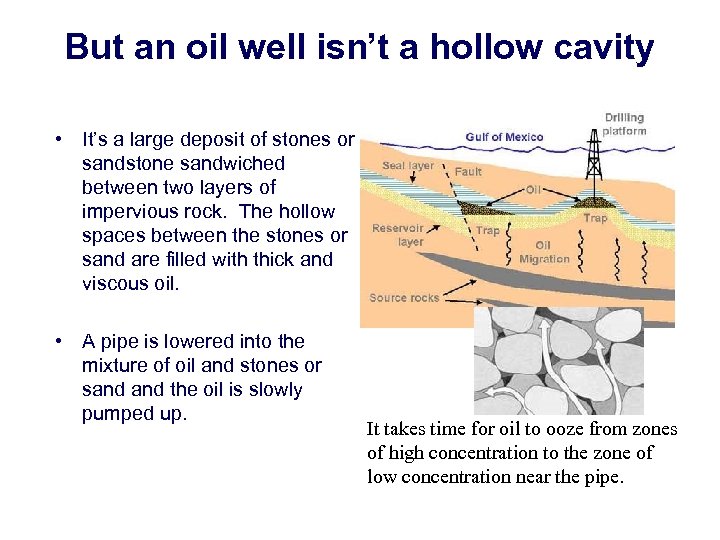 But an oil well isn’t a hollow cavity • It’s a large deposit of stones or sandstone sandwiched between two layers of impervious rock. The hollow spaces between the stones or sand are filled with thick and viscous oil. • A pipe is lowered into the mixture of oil and stones or sand the oil is slowly pumped up. Click It takes time for oil to ooze from zones of high concentration to the zone of low concentration near the pipe.
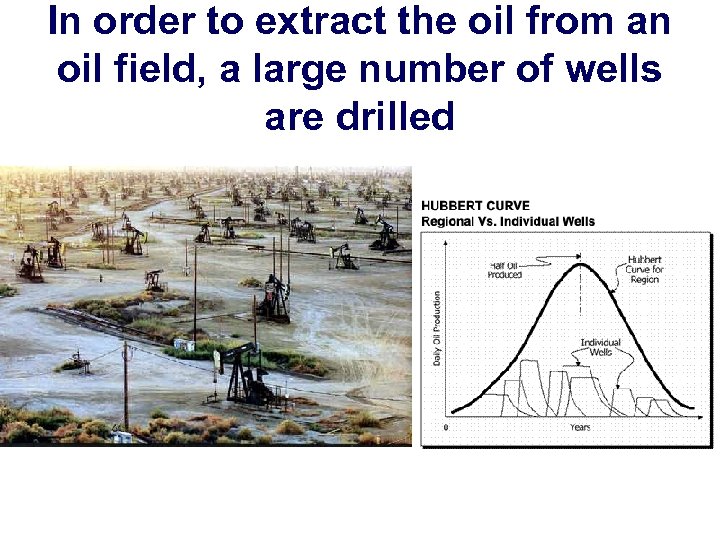 In order to extract the oil from an oil field, a large number of wells are drilled
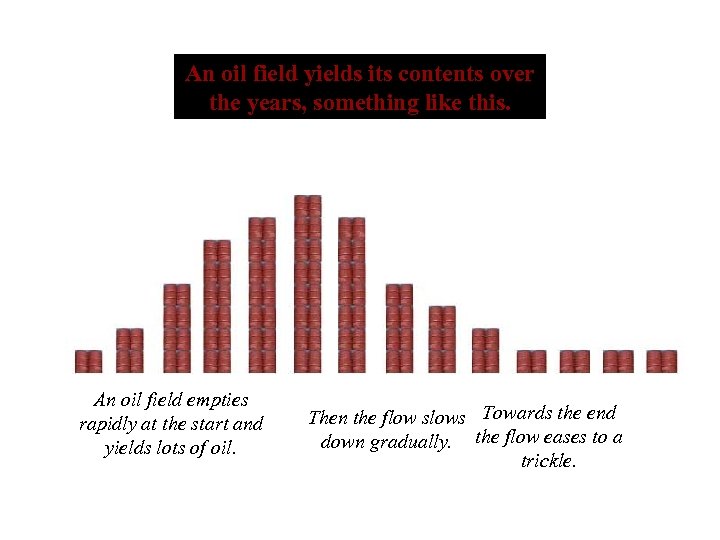 An oil field yields its contents over the years, something like this. An oil field empties rapidly at the start and yields lots of oil. Then the flow slows Towards the end down gradually. the flow eases to a trickle.
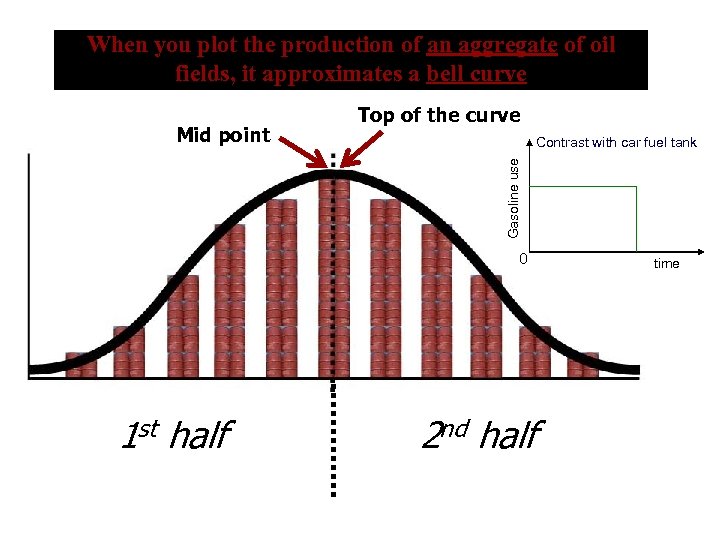 When you plot the production of an aggregate of oil fields, it approximates a bell curve Contrast with car fuel tank Gasoline use Mid point Top of the curve 0 1 st half 2 nd half time
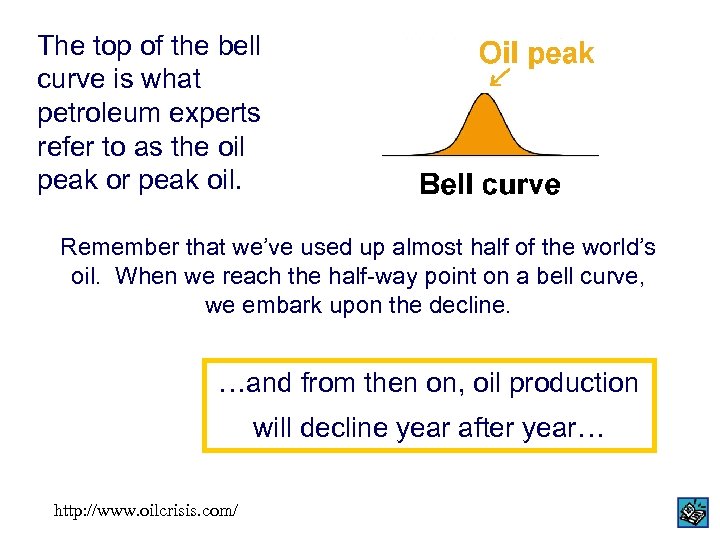 The top of the bell curve is what petroleum experts refer to as the oil peak or peak oil. Remember that we’ve used up almost half of the world’s oil. When we reach the half-way point on a bell curve, we embark upon the decline. …and from then on, oil production will decline year after year… http: //www. oilcrisis. com/
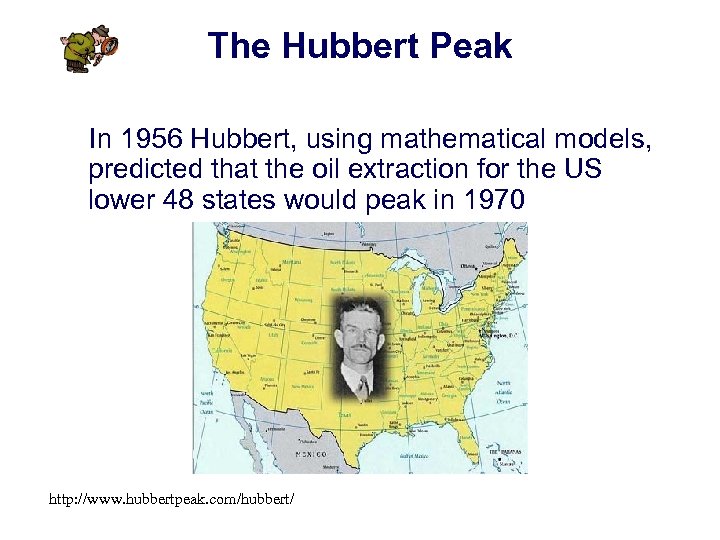 The Hubbert Peak In 1956 Hubbert, using mathematical models, predicted that the oil extraction for the US lower 48 states would peak in 1970 http: //www. hubbertpeak. com/hubbert/
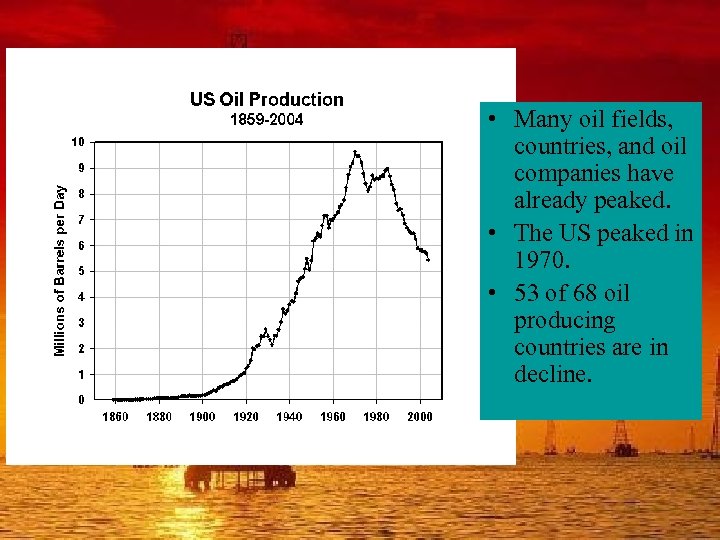 • Many oil fields, countries, and oil companies have already peaked. • The US peaked in 1970. • 53 of 68 oil producing countries are in decline.
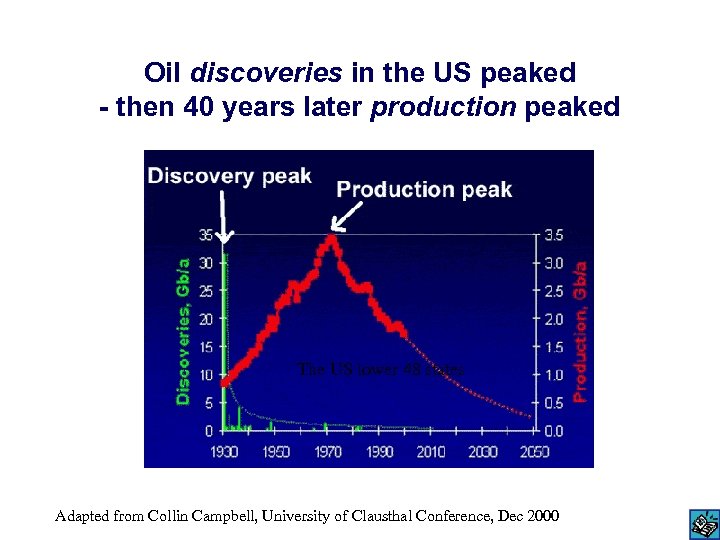 Oil discoveries in the US peaked - then 40 years later production peaked The US lower 48 states Adapted from Collin Campbell, University of Clausthal Conference, Dec 2000
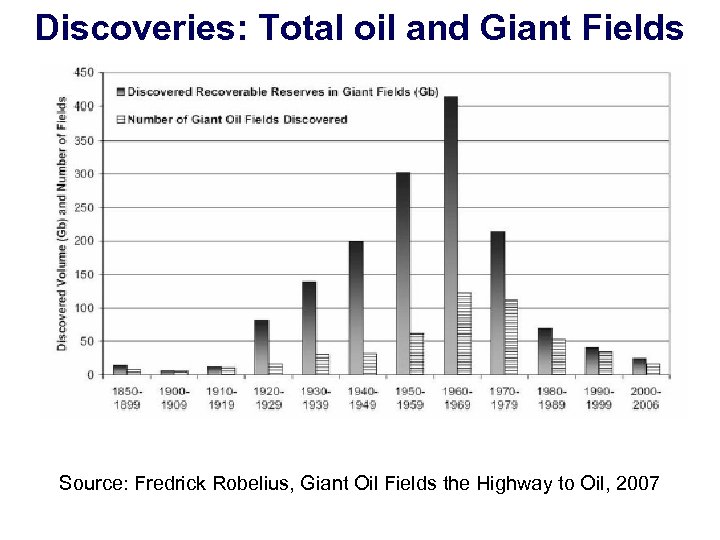 Discoveries: Total oil and Giant Fields Source: Fredrick Robelius, Giant Oil Fields the Highway to Oil, 2007
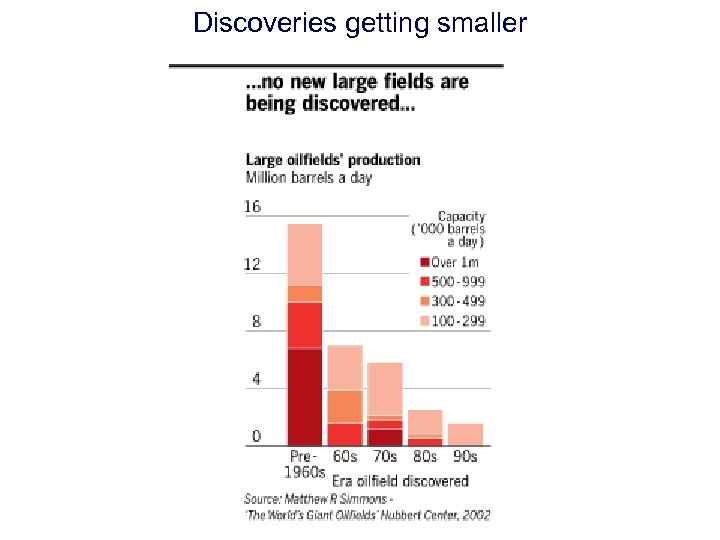 Discoveries getting smaller
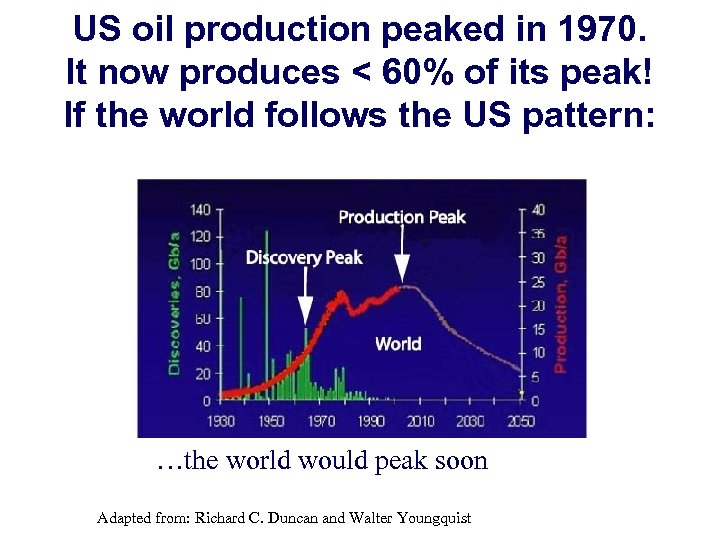 US oil production peaked in 1970. It now produces < 60% of its peak! If the world follows the US pattern: …the world would peak soon Adapted from: Richard C. Duncan and Walter Youngquist
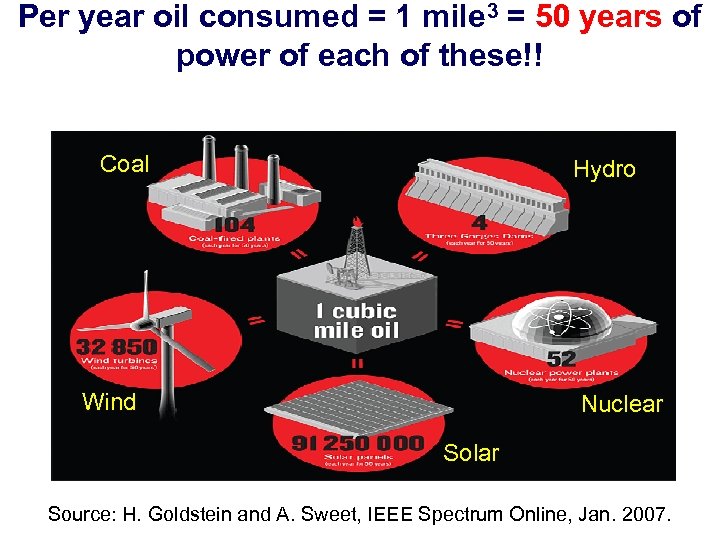 Per year oil consumed = 1 mile 3 = 50 years of power of each of these!! Coal Hydro Wind Nuclear Solar Source: H. Goldstein and A. Sweet, IEEE Spectrum Online, Jan. 2007.
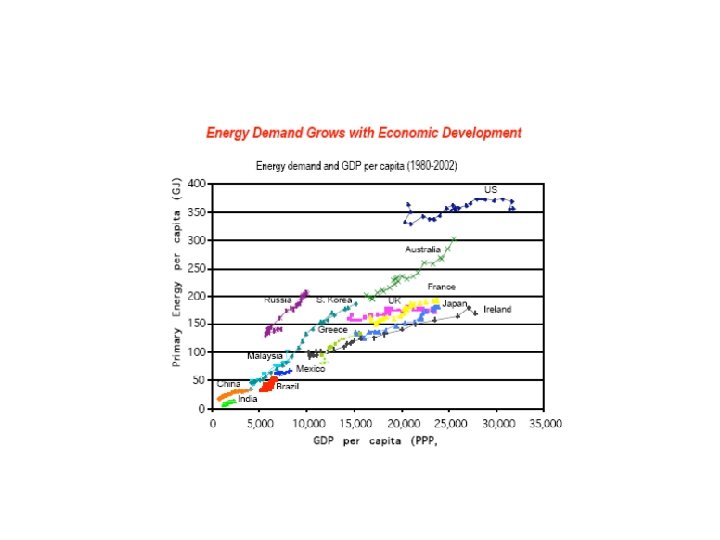
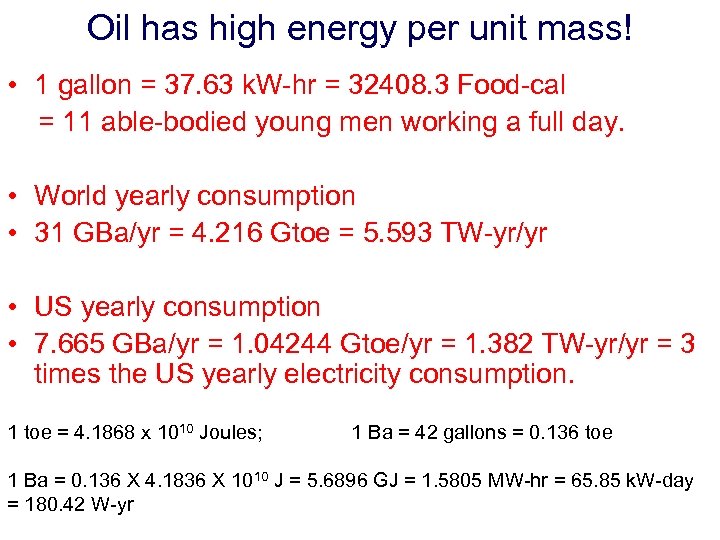 Oil has high energy per unit mass! • 1 gallon = 37. 63 k. W-hr = 32408. 3 Food-cal = 11 able-bodied young men working a full day. • World yearly consumption • 31 GBa/yr = 4. 216 Gtoe = 5. 593 TW-yr/yr • US yearly consumption • 7. 665 GBa/yr = 1. 04244 Gtoe/yr = 1. 382 TW-yr/yr = 3 times the US yearly electricity consumption. 1 toe = 4. 1868 x 1010 Joules; 1 Ba = 42 gallons = 0. 136 toe 1 Ba = 0. 136 X 4. 1836 X 1010 J = 5. 6896 GJ = 1. 5805 MW-hr = 65. 85 k. W-day = 180. 42 W-yr
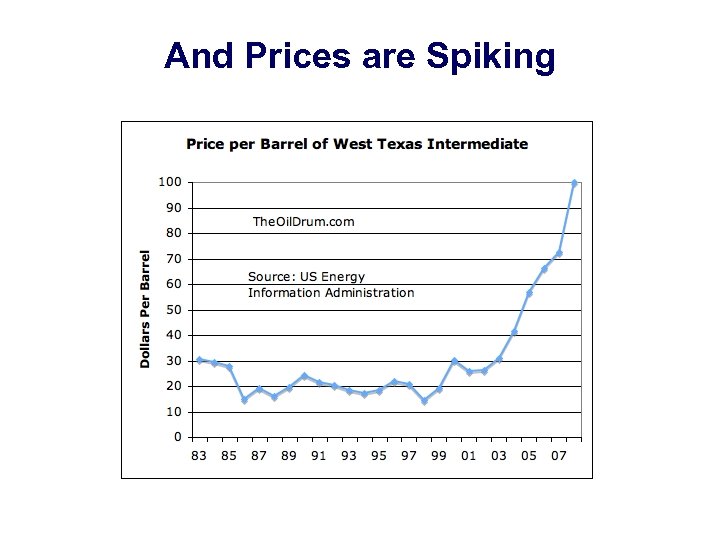 And Prices are Spiking
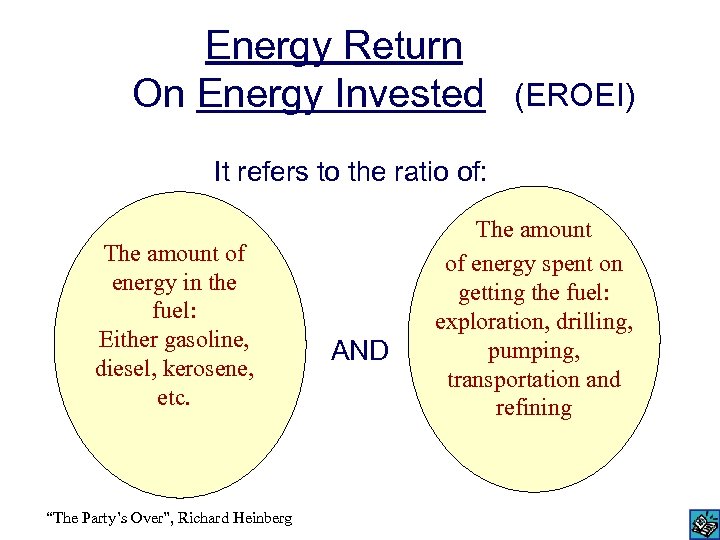 Energy Return On Energy Invested (EROEI) It refers to the ratio of: The amount of energy in the fuel: Either gasoline, diesel, kerosene, etc. “The Party’s Over”, Richard Heinberg AND The amount of energy spent on getting the fuel: exploration, drilling, pumping, transportation and refining
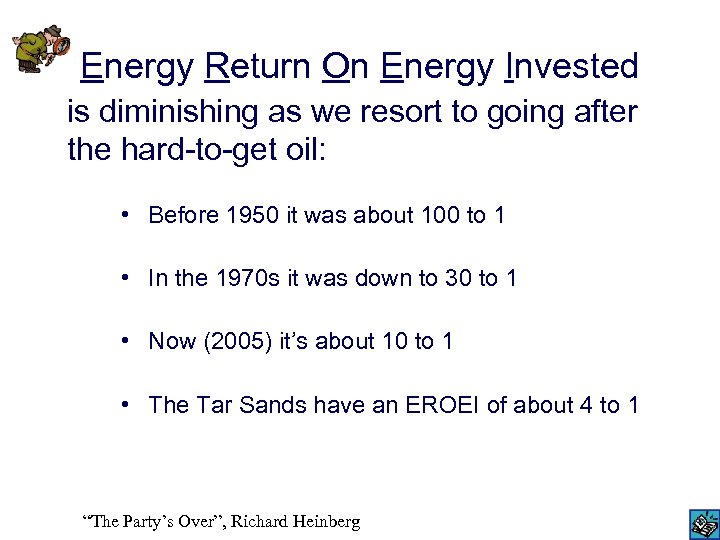 Energy Return On Energy Invested is diminishing as we resort to going after the hard-to-get oil: • Before 1950 it was about 100 to 1 • In the 1970 s it was down to 30 to 1 • Now (2005) it’s about 10 to 1 • The Tar Sands have an EROEI of about 4 to 1 “The Party’s Over”, Richard Heinberg
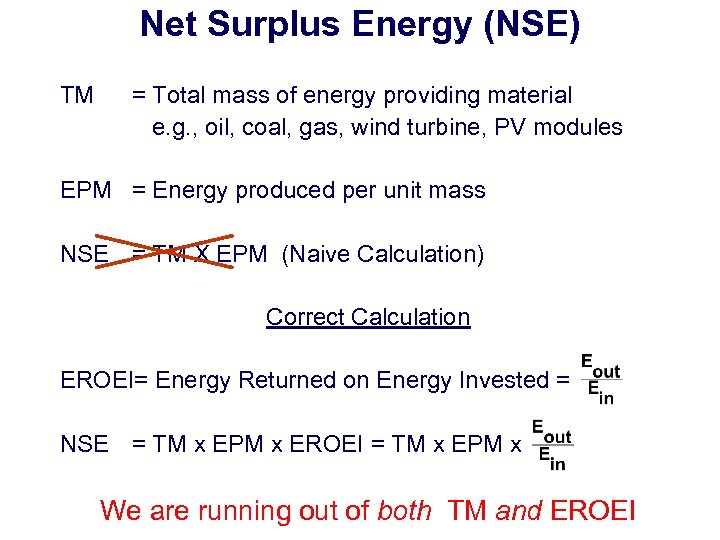 Net Surplus Energy (NSE) TM = Total mass of energy providing material e. g. , oil, coal, gas, wind turbine, PV modules EPM = Energy produced per unit mass NSE = TM X EPM (Naive Calculation) Correct Calculation EROEI= Energy Returned on Energy Invested = NSE = TM x EPM x EROEI = TM x EPM x We are running out of both TM and EROEI
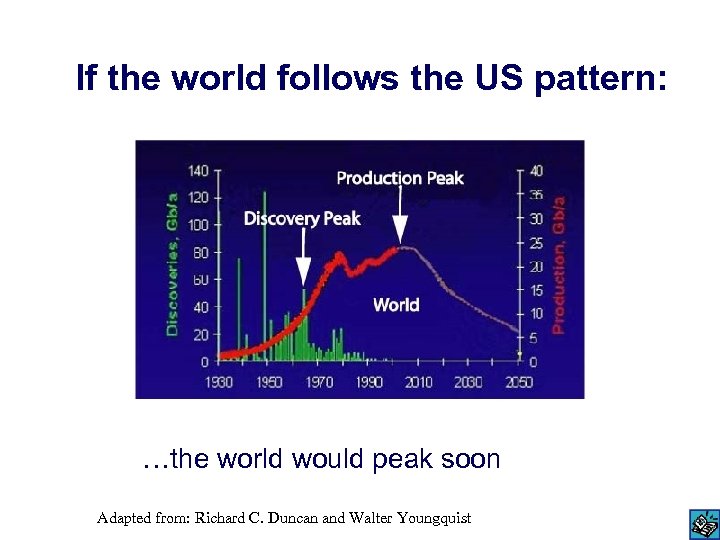 If the world follows the US pattern: …the world would peak soon Adapted from: Richard C. Duncan and Walter Youngquist
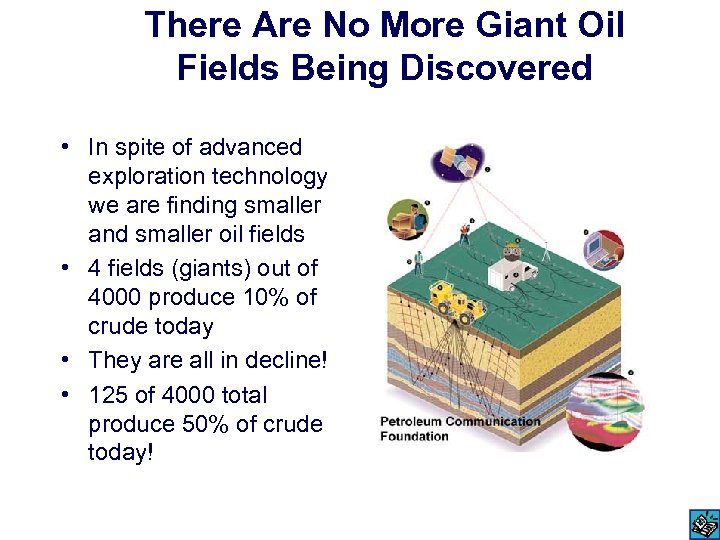 There Are No More Giant Oil Fields Being Discovered • In spite of advanced exploration technology we are finding smaller and smaller oil fields • 4 fields (giants) out of 4000 produce 10% of crude today • They are all in decline! • 125 of 4000 total produce 50% of crude today!
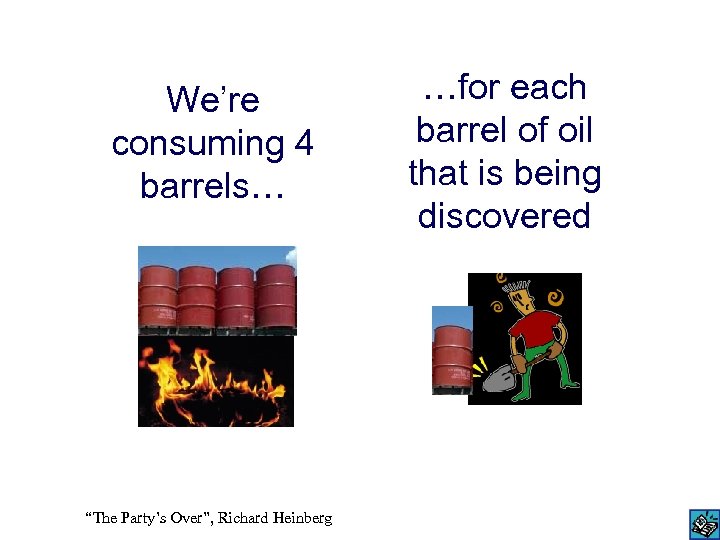 We’re consuming 4 barrels… “The Party’s Over”, Richard Heinberg …for each barrel of oil that is being discovered
 Exploration doesn’t pay anymore In 2003 oil companies spent $8 billion on exploration and discovered $4 billion in new reserves. * Since 2000, the cost of finding and developing new sources of oil has risen about 15% annually. * Thomas Homer Dixon and Julio Friedmann, N. Y. Times, 25 Mar 2005 ** John S. Herold consulting firm
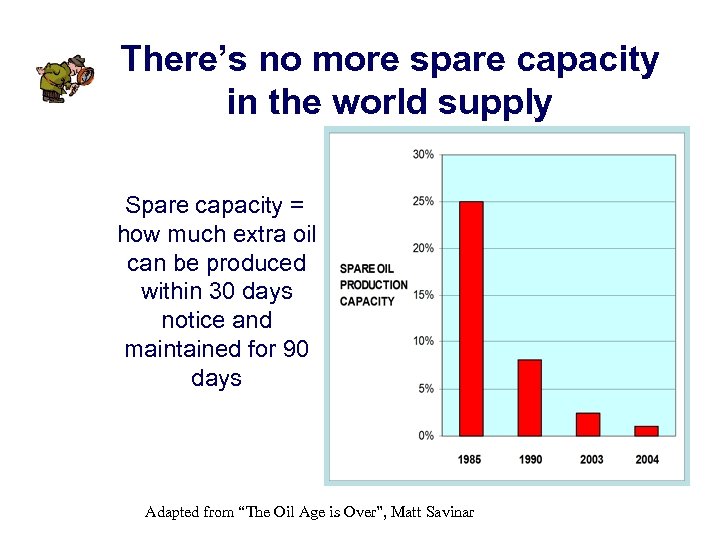 There’s no more spare capacity in the world supply Spare capacity = how much extra oil can be produced within 30 days notice and maintained for 90 days Adapted from “The Oil Age is Over”, Matt Savinar
 Spurious OPEC Reserve Revisions
 Peak Total Energy Use, 1965 to 2050, (Courtesy: Paul Chefurka)
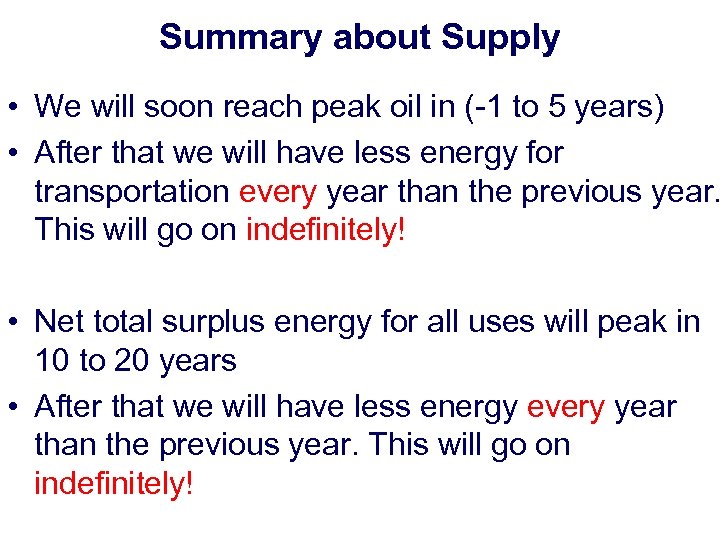 Summary about Supply • We will soon reach peak oil in (-1 to 5 years) • After that we will have less energy for transportation every year than the previous year. This will go on indefinitely! • Net total surplus energy for all uses will peak in 10 to 20 years • After that we will have less energy every year than the previous year. This will go on indefinitely!
 PEAK OIL Part 2 -What are the consequences? -Extremely Serious!
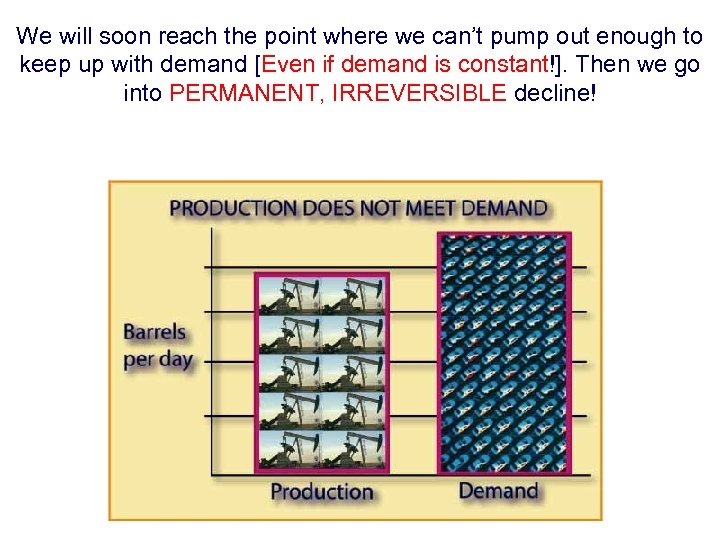 We will soon reach the point where we can’t pump out enough to keep up with demand [Even if demand is constant!]. Then we go into PERMANENT, IRREVERSIBLE decline!
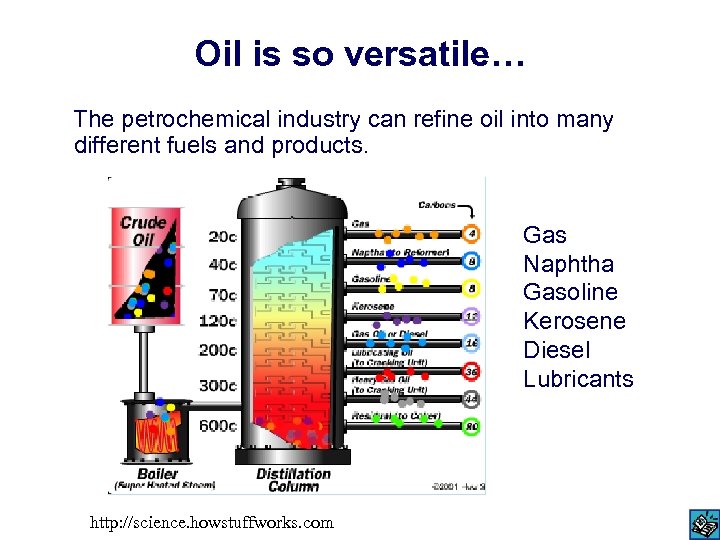 Oil is so versatile… The petrochemical industry can refine oil into many different fuels and products. Gas Naphtha Gasoline Kerosene Diesel Lubricants http: //science. howstuffworks. com
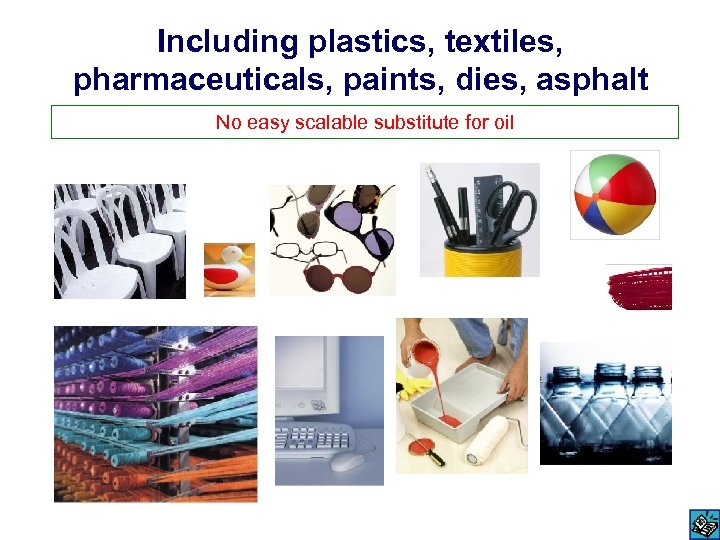 Including plastics, textiles, pharmaceuticals, paints, dies, asphalt No easy scalable substitute for oil
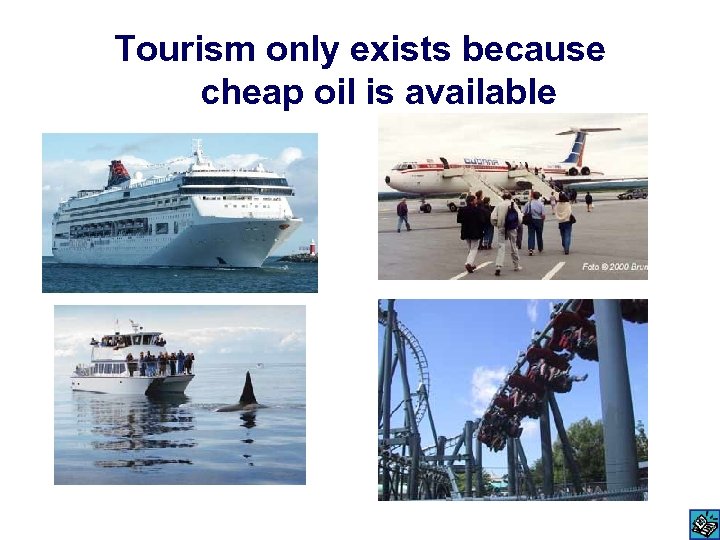 Tourism only exists because cheap oil is available
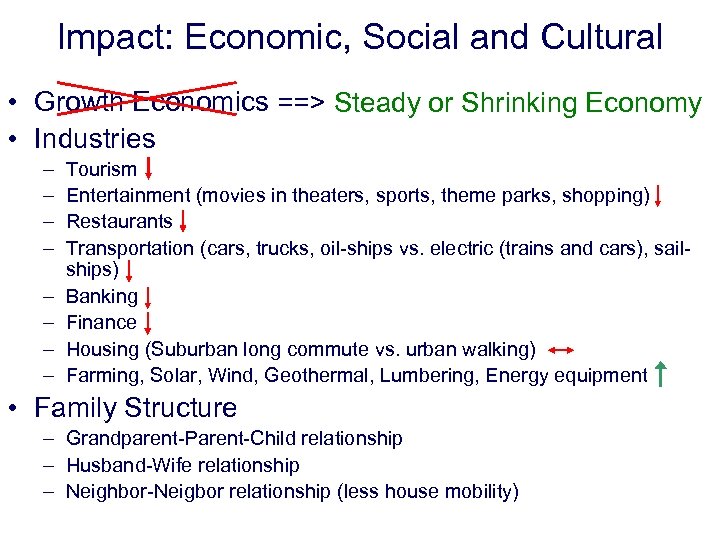 Impact: Economic, Social and Cultural • Growth Economics ==> Steady or Shrinking Economy • Industries – – – – Tourism Entertainment (movies in theaters, sports, theme parks, shopping) Restaurants Transportation (cars, trucks, oil-ships vs. electric (trains and cars), sailships) Banking Finance Housing (Suburban long commute vs. urban walking) Farming, Solar, Wind, Geothermal, Lumbering, Energy equipment • Family Structure – Grandparent-Parent-Child relationship – Husband-Wife relationship – Neighbor-Neigbor relationship (less house mobility)
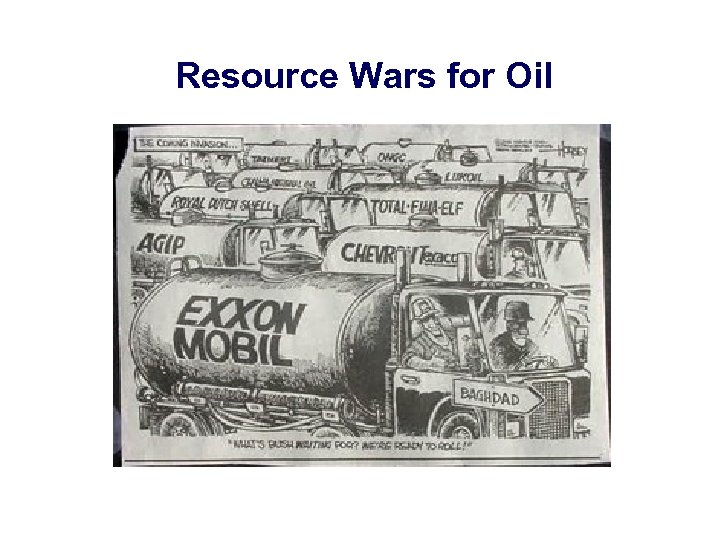 Resource Wars for Oil
 Fossil Fuel and Agriculture • Farming “is an annual artificial catastrophe, and it requires the equivalent of three or four tons of TNT per acre for a modern American farm. Iowa's fields require the energy of 4, 000 Nagasaki bombs every year. ” 1 1 Richard Manning; “The Oil We Eat”, Harpers, 2005. Mr. Manning was referring to the growing of the world’s major grain crops - corn, rice and wheat.
 Fossil Fuel and Agriculture • On average, the food industry uses 10 calories of fossil fuel energy to produce 1 calorie of food. • For pork, it’s 68 calories for 1 calorie on your plate. • For beef, it’s 35 calories for 1 calorie on your plate. 1 1 Richard Manning; “The Oil We Eat”, Harpers, 2005.
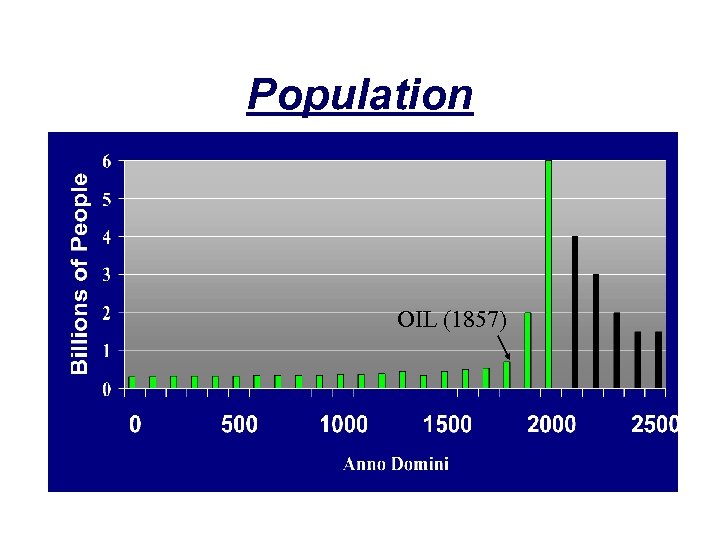 Population First Oil Well OIL (1857) ?
 PEAK OIL Part 3 -What can we do about it?
 Is there an easy solution? • No, not in reality [Meaning: New sources are not scalable and have low EROEI]. • Conservation is a partial solution. • Alternative fuels (solar, wind, geothermal) are likely to provide help but not for transport. • New technology like battery-operated cars are likely to help a little only in the long run (> 20 years). • Demand Reduction: We may need to unwind good portion of globalization; go back to simpler life styles, technologies that worked before.
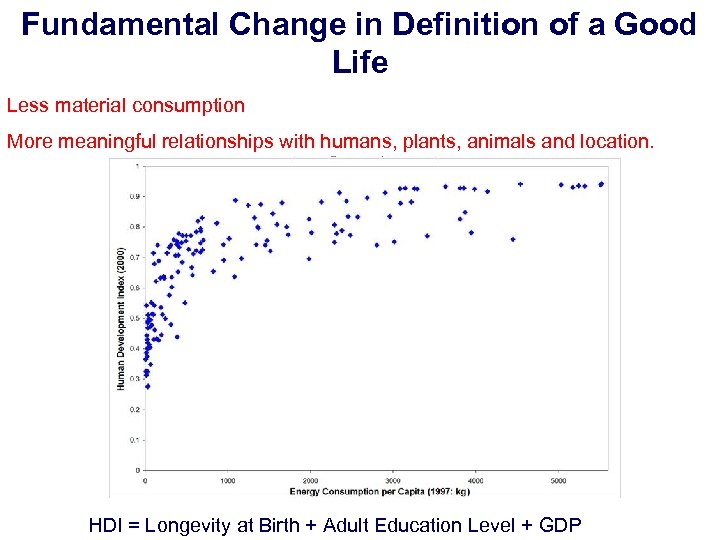 Fundamental Change in Definition of a Good Life Less material consumption More meaningful relationships with humans, plants, animals and location. HDI = Longevity at Birth + Adult Education Level + GDP
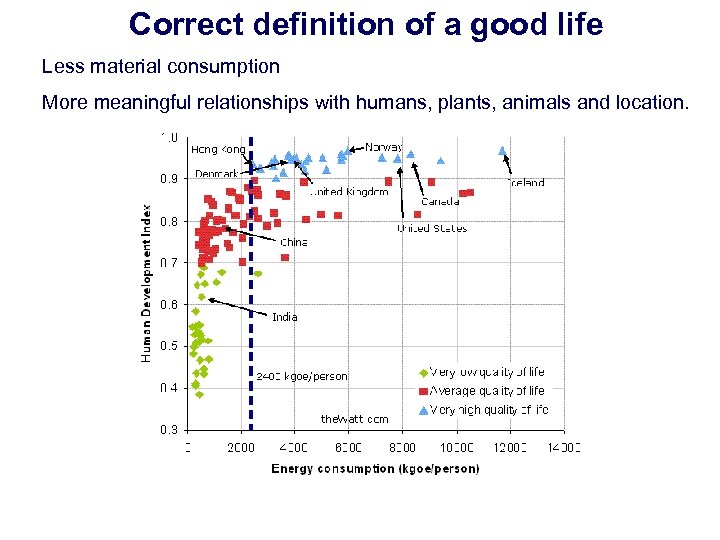 Correct definition of a good life Less material consumption More meaningful relationships with humans, plants, animals and location.
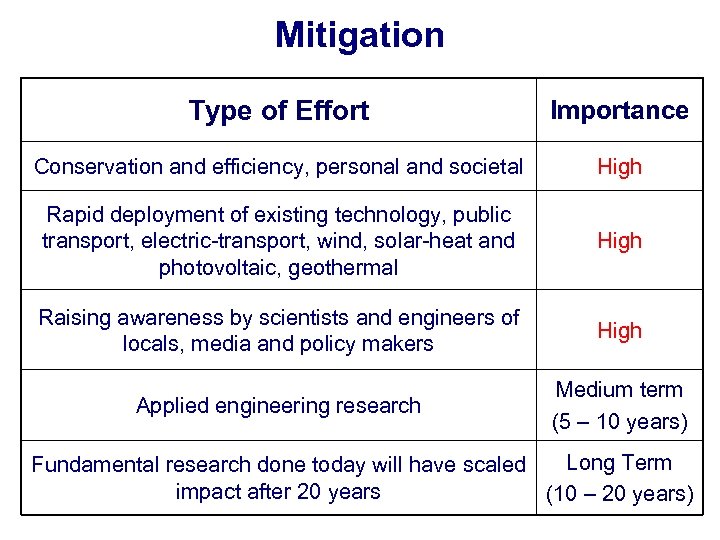 Mitigation Type of Effort Importance Conservation and efficiency, personal and societal High Rapid deployment of existing technology, public transport, electric-transport, wind, solar-heat and photovoltaic, geothermal High Raising awareness by scientists and engineers of locals, media and policy makers High Applied engineering research Medium term (5 – 10 years) Long Term Fundamental research done today will have scaled impact after 20 years (10 – 20 years)
 Most important step • A Depletion Protocol to cut imports to match depletion rate • Will avoid wars
 Priorities (USA) -Tackle population growth -Massive public education for reduction in demand (targets of 50 to 80% per capita in 10 years) - Stop corn ethanol immediately -Reactivate electric trains, trams, trolleys, buses -World War II type effort for energy conservation in homes and buildings, solid state lighting, CAFE standards -World War II type effort for car and truck batteries, wind, geothermal, and wave energy -Buying locally produced goods where possible -Greater use of arable land for growing crops such as oilseeds, willow for wood pellets, forest generation solar,
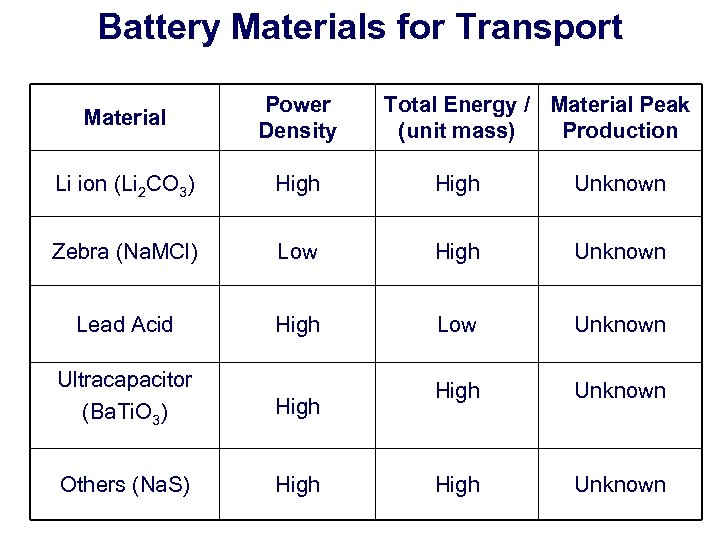 Battery Materials for Transport Material Power Density Li ion (Li 2 CO 3) High Unknown Zebra (Na. MCl) Low High Unknown Lead Acid High Low Unknown High Unknown Ultracapacitor (Ba. Ti. O 3) High Others (Na. S) High Total Energy / Material Peak (unit mass) Production
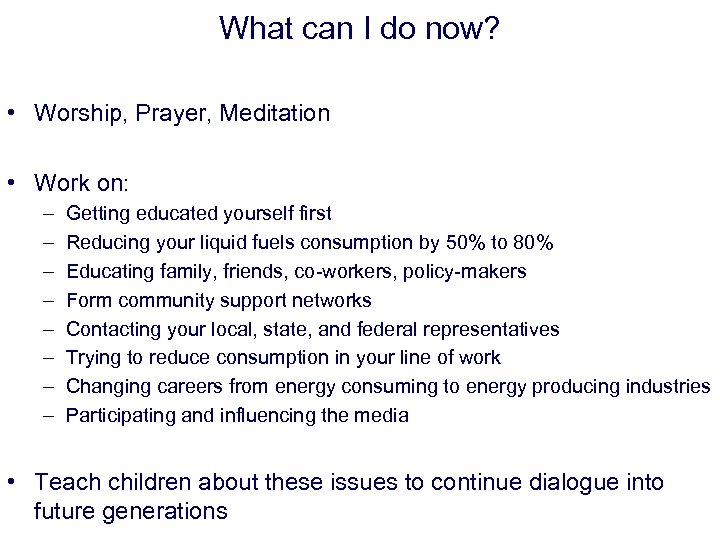 What can I do now? • Worship, Prayer, Meditation • Work on: – – – – Getting educated yourself first Reducing your liquid fuels consumption by 50% to 80% Educating family, friends, co-workers, policy-makers Form community support networks Contacting your local, state, and federal representatives Trying to reduce consumption in your line of work Changing careers from energy consuming to energy producing industries Participating and influencing the media • Teach children about these issues to continue dialogue into future generations
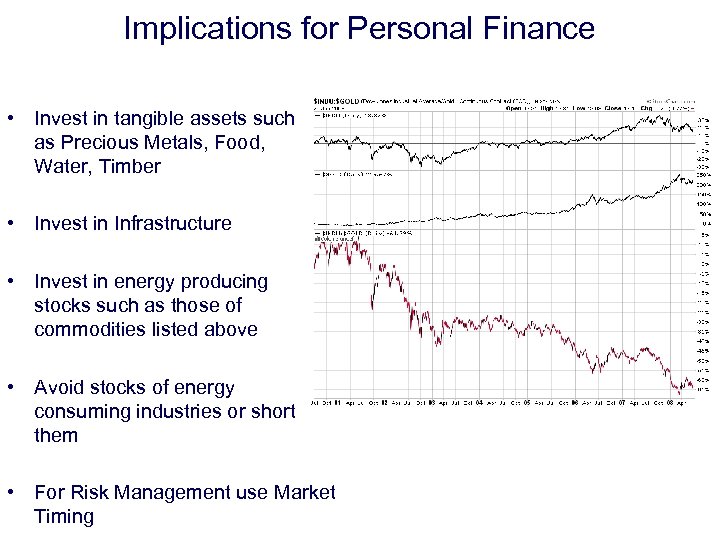 Implications for Personal Finance • Invest in tangible assets such as Precious Metals, Food, Water, Timber • Invest in Infrastructure • Invest in energy producing stocks such as those of commodities listed above • Avoid stocks of energy consuming industries or short them • For Risk Management use Market Timing
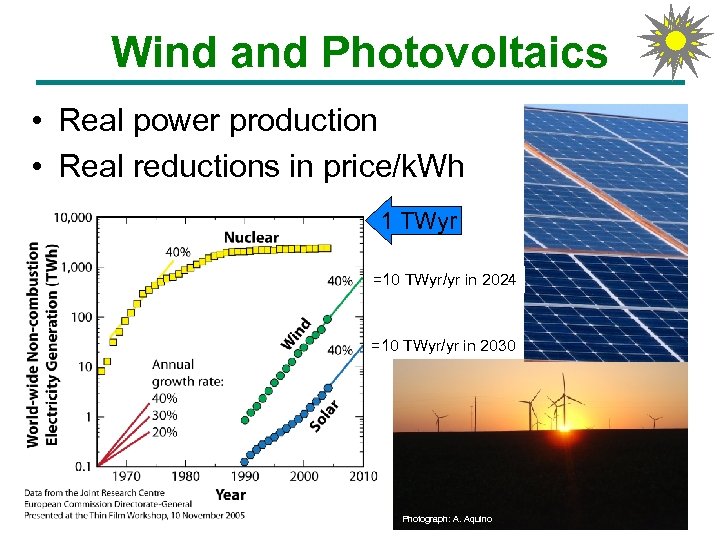 Wind and Photovoltaics • Real power production • Real reductions in price/k. Wh 1 TWyr =10 TWyr/yr in 2024 =10 TWyr/yr in 2030 Photograph: A. Aquino
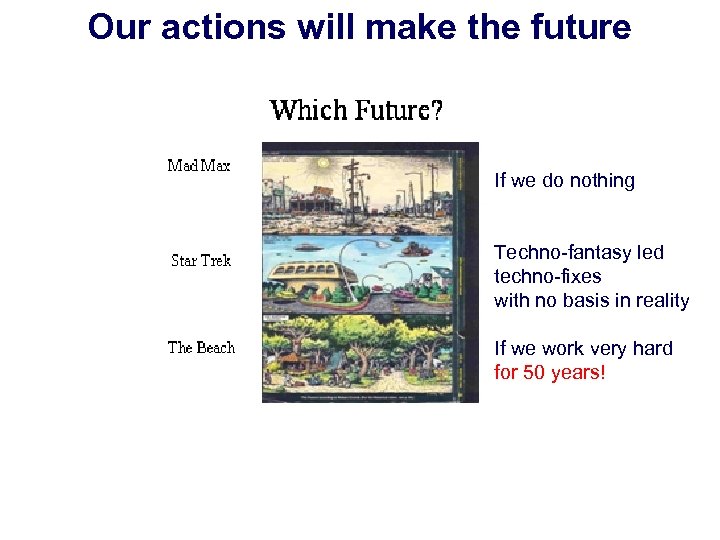 Our actions will make the future If we do nothing Techno-fantasy led techno-fixes with no basis in reality If we work very hard for 50 years!
 Thank You References: • www. theoildrum. com • www. energybulletin. net • www. aspo-usa. org • Beyond Oil: The View from Hubbert's Peak; By Kenneth S. Deffeyes • Out of Gas: The End of the Age of Oil; By David Goodstein • Twilight in the Dessert; by Matthew R. Simmons
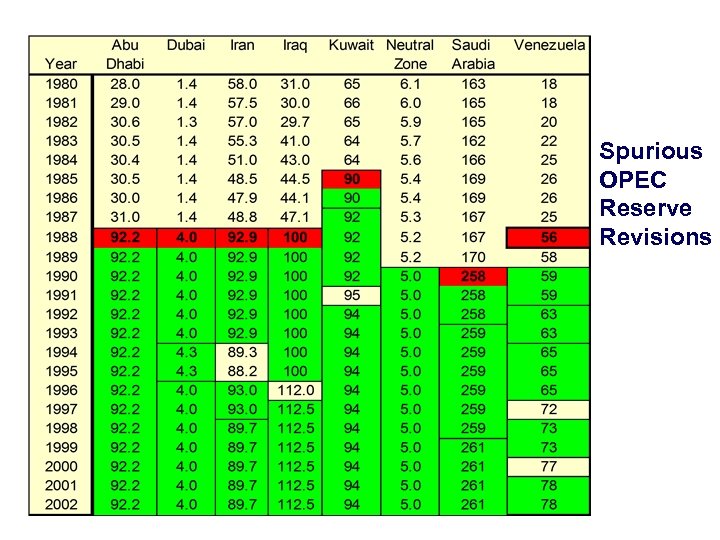
 Myth #1: OPEC could produce more if it used current techniques • International oil companies use same service companies US companies do • Most are using up-to-date techniques • Expenditures often are high • Problem is very old fields • Overstated reserves raise expectations
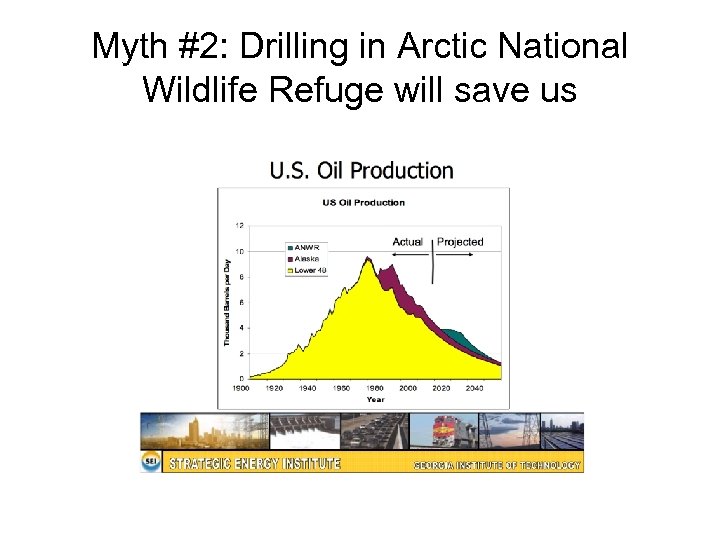 Myth #2: Drilling in Arctic National Wildlife Refuge will save us
 Myth #3: A small downturn can easily be made up with energy efficiency • The quickest impacts are financial – Recession or depression – Serious recession in 1973 - 75 • Use of biofuels raises food prices – Further increases recession risk • Don’t need peak for recession – Only need supply/demand shortfall – Likely what we are experiencing now
 Myth #4: Canadian oil sands will save us • Hard to see this with current technology – Technology known since 1920 s – Production slow and expensive • Requires huge amount of natural gas – In limited supply • Most optimistic forecasts equal 5% of current world oil by 2030 – Even this exceeds available natural gas
 Myth #5: Biofuels will save us • Corn-based ethanol has many problems – Raises food prices, not scalable, CO 2 issues, depletes water supply • Cellulosic ethanol theoretically better – Still does not scale to more than 20% of need – Competes with biomass for electric, home heat • Biofuel from algae might work – Not perfected yet
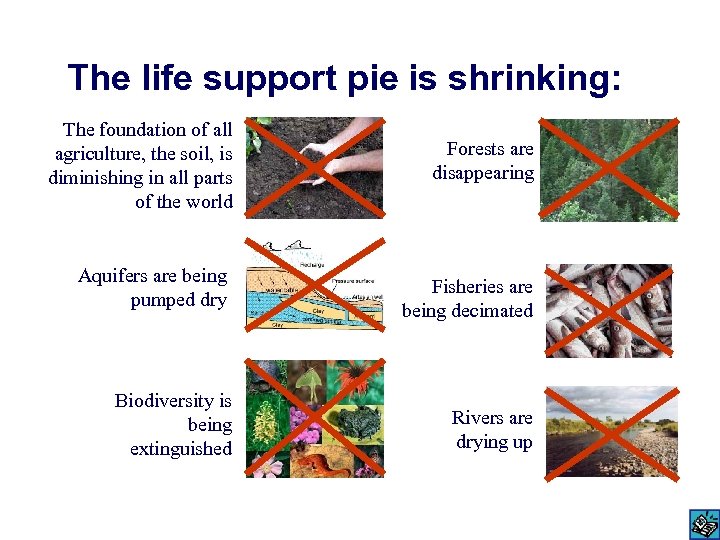 The life support pie is shrinking: The foundation of all agriculture, the soil, is diminishing in all parts of the world Aquifers are being pumped dry Biodiversity is being extinguished Forests are disappearing Fisheries are being decimated Rivers are drying up
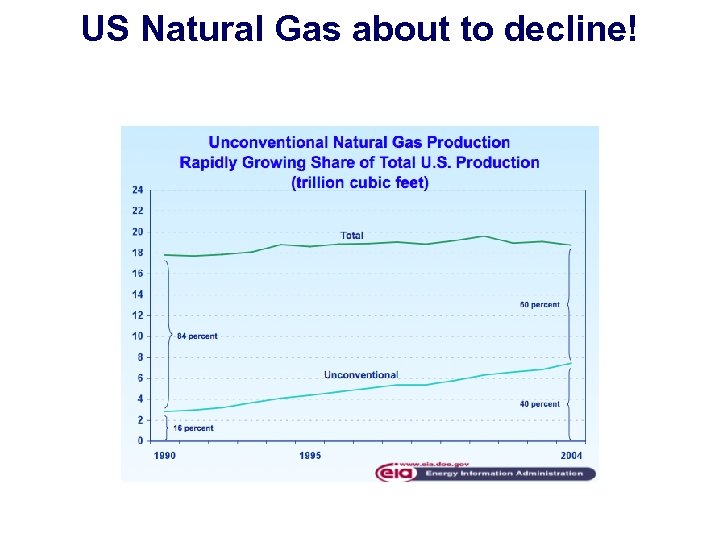 US Natural Gas about to decline!
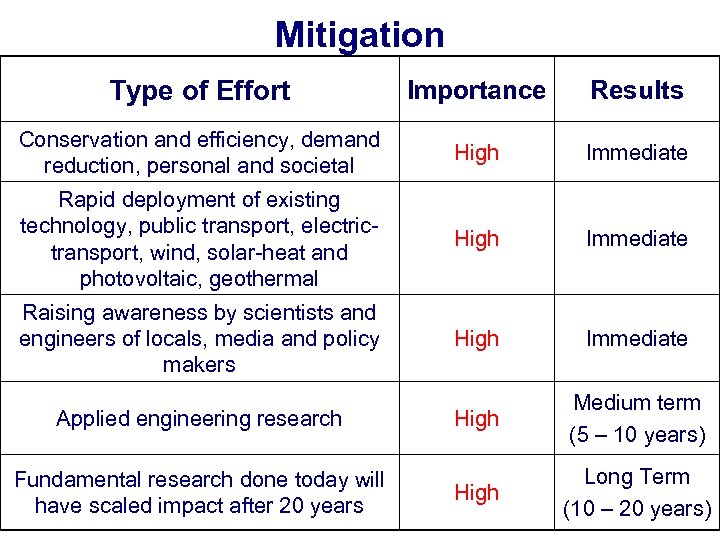 Mitigation Type of Effort Importance Results Conservation and efficiency, demand reduction, personal and societal High Immediate Rapid deployment of existing technology, public transport, electrictransport, wind, solar-heat and photovoltaic, geothermal High Immediate Raising awareness by scientists and engineers of locals, media and policy makers High Immediate High Medium term (5 – 10 years) High Long Term (10 – 20 years) Applied engineering research Fundamental research done today will have scaled impact after 20 years