 Скачать презентацию Energy-aware Self-stabilizing Multicasting for MANETs Tridib Mukherjee IMPACT
7b4dd0d8a866f41b52d084f0499a46c5.ppt
- Количество слайдов: 23




Energy-aware Self-stabilizing Multicasting for MANETs Tridib Mukherjee IMPACT Lab Arizona State University impact. asu. edu 03/28/07
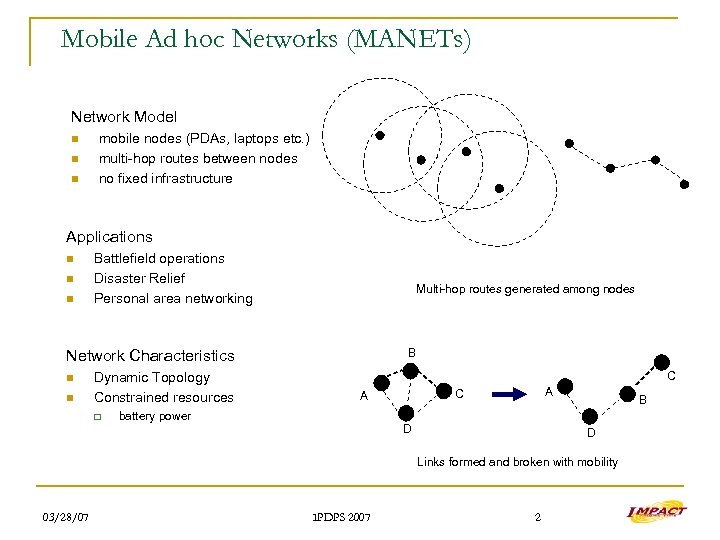
Mobile Ad hoc Networks (MANETs) Network Model n n n mobile nodes (PDAs, laptops etc. ) multi-hop routes between nodes no fixed infrastructure Applications n n n Battlefield operations Disaster Relief Personal area networking Multi-hop routes generated among nodes B Network Characteristics n n Dynamic Topology Constrained resources q C A B battery power D D Links formed and broken with mobility 03/28/07 IPDPS 2007 2
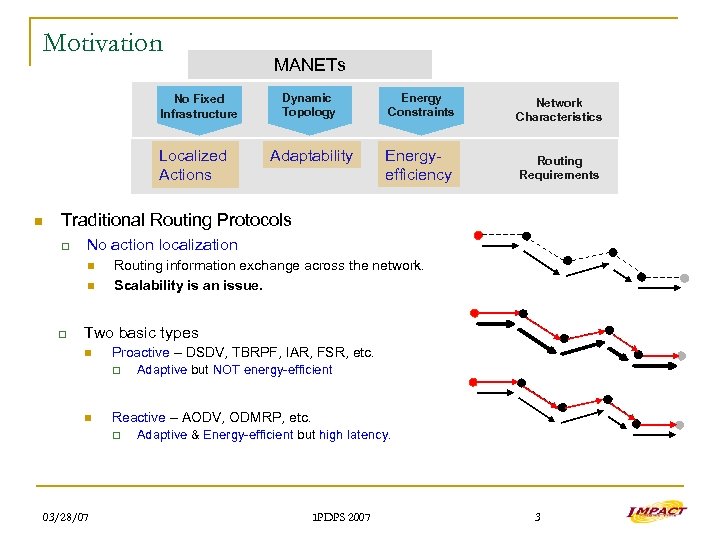
Motivation No Fixed Infrastructure Localized Actions n MANETs Dynamic Topology Energy Constraints Network Characteristics Adaptability Energyefficiency Routing Requirements Traditional Routing Protocols q No action localization n n q Routing information exchange across the network. Scalability is an issue. Two basic types n Proactive – DSDV, TBRPF, IAR, FSR, etc. q n Reactive – AODV, ODMRP, etc. q 03/28/07 Adaptive but NOT energy-efficient Adaptive & Energy-efficient but high latency. IPDPS 2007 3
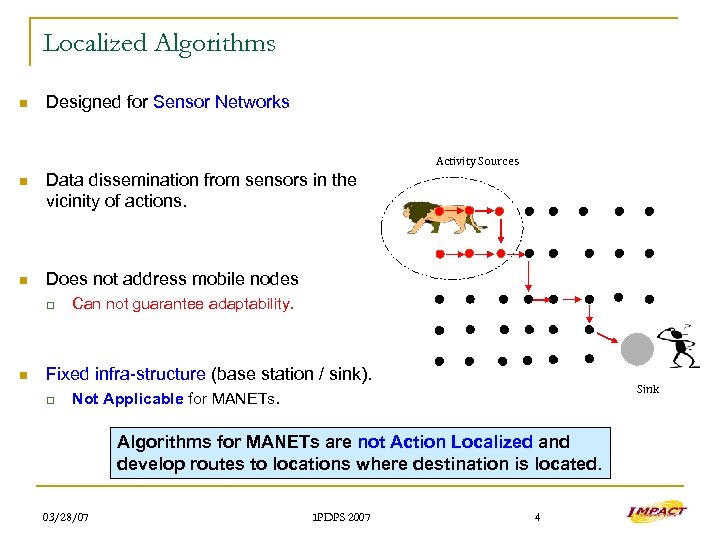
Localized Algorithms n Designed for Sensor Networks Activity Sources n Data dissemination from sensors in the vicinity of actions. n Does not address mobile nodes q n Can not guarantee adaptability. Fixed infra-structure (base station / sink). q Sink Not Applicable for MANETs. Algorithms for MANETs are not Action Localized and develop routes to locations where destination is located. 03/28/07 IPDPS 2007 4
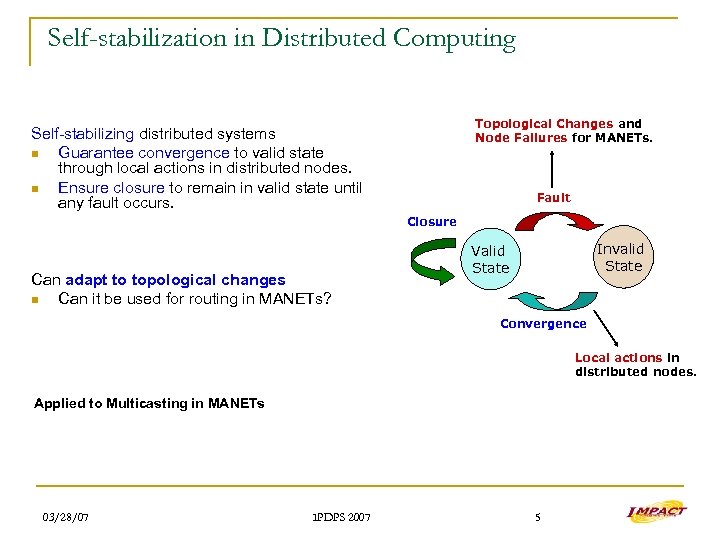
Self-stabilization in Distributed Computing Topological Changes and Node Failures for MANETs. Self-stabilizing distributed systems n Guarantee convergence to valid state through local actions in distributed nodes. n Ensure closure to remain in valid state until any fault occurs. Fault Closure Can adapt to topological changes n Can it be used for routing in MANETs? Invalid State Valid State Convergence Local actions in distributed nodes. Applied to Multicasting in MANETs 03/28/07 IPDPS 2007 5
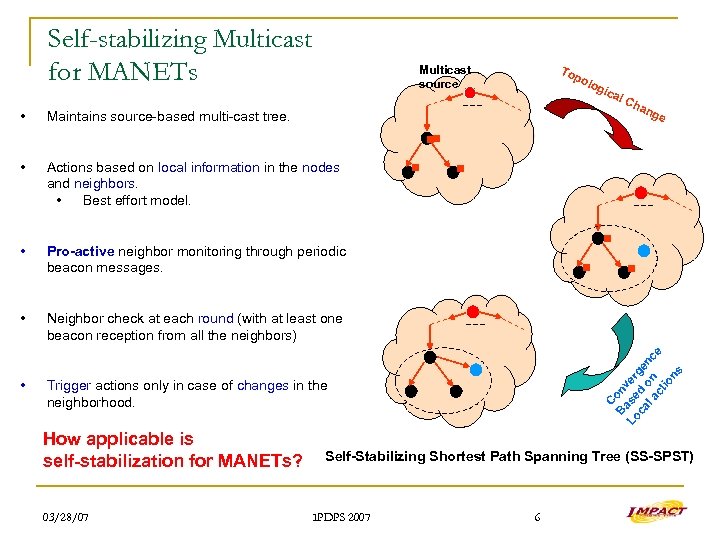
Self-stabilizing Multicast for MANETs Multicast source Neighbor check at each round (with at least one beacon reception from all the neighbors) • Trigger actions only in case of changes in the neighborhood. ge Pro-active neighbor monitoring through periodic beacon messages. • han Actions based on local information in the nodes and neighbors. • Best effort model. • l. C Maintains source-based multi-cast tree. • log ica How applicable is self-stabilization for MANETs? 03/28/07 C Ba onv Lo se er ca d ge l a on nc e ct io ns • To po Self-Stabilizing Shortest Path Spanning Tree (SS-SPST) IPDPS 2007 6
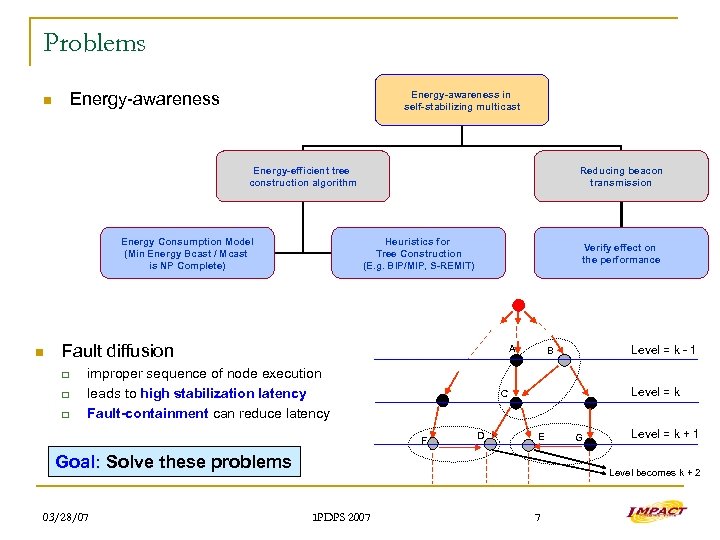
Problems Energy-awareness in self-stabilizing multicast Energy-awareness n Energy-efficient tree construction algorithm Heuristics for Tree Construction (E. g. BIP/MIP, S-REMIT) Energy Consumption Model (Min Energy Bcast / Mcast is NP Complete) n Reducing beacon transmission Verify effect on the performance Fault diffusion q q q A improper sequence of node execution leads to high stabilization latency Fault-containment can reduce latency Level = k C F D E Goal: Solve these problems 03/28/07 Level = k - 1 B G Level = k + 1 Level becomes k + 2 IPDPS 2007 7
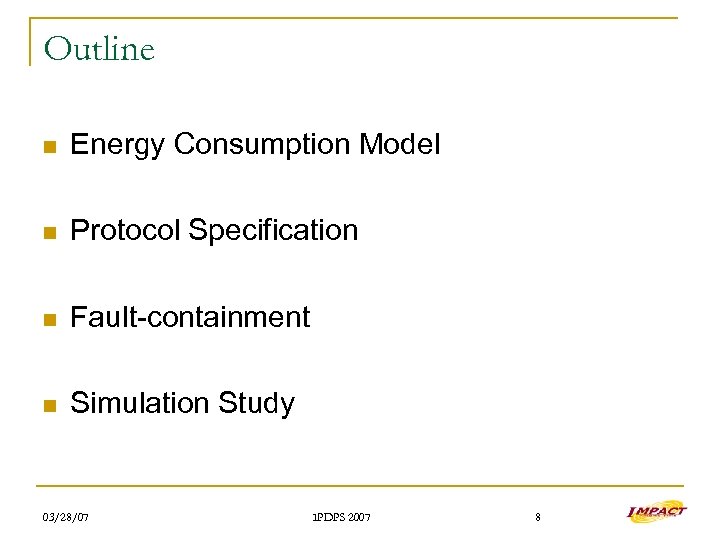
Outline n Energy Consumption Model n Protocol Specification n Fault-containment n Simulation Study 03/28/07 IPDPS 2007 8
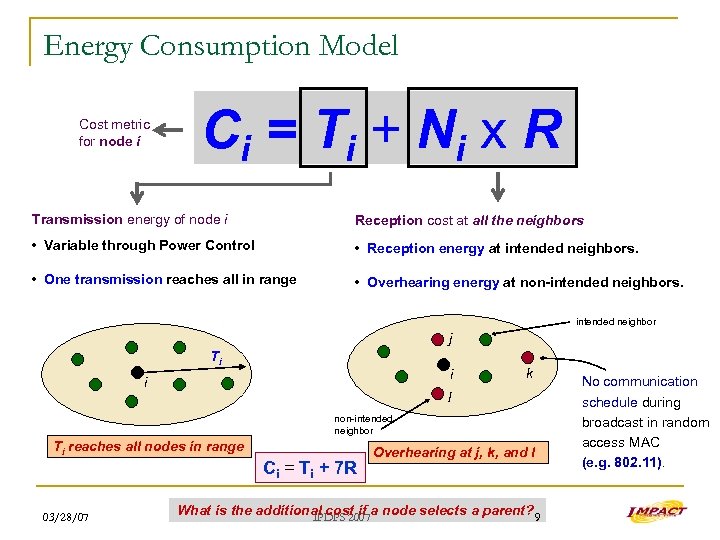
Energy Consumption Model Cost metric for node i Ci = T i + Ni x R Transmission energy of node i Reception cost at all the neighbors • Variable through Power Control • Reception energy at intended neighbors. • One transmission reaches all in range • Overhearing energy at non-intended neighbors. intended neighbor j Ti i i k l non-intended neighbor Ti reaches all nodes in range Ci = Ti + 7 R 03/28/07 Overhearing at j, k, and l What is the additional cost if a node selects a parent? 9 IPDPS 2007 No communication schedule during broadcast in random access MAC (e. g. 802. 11).
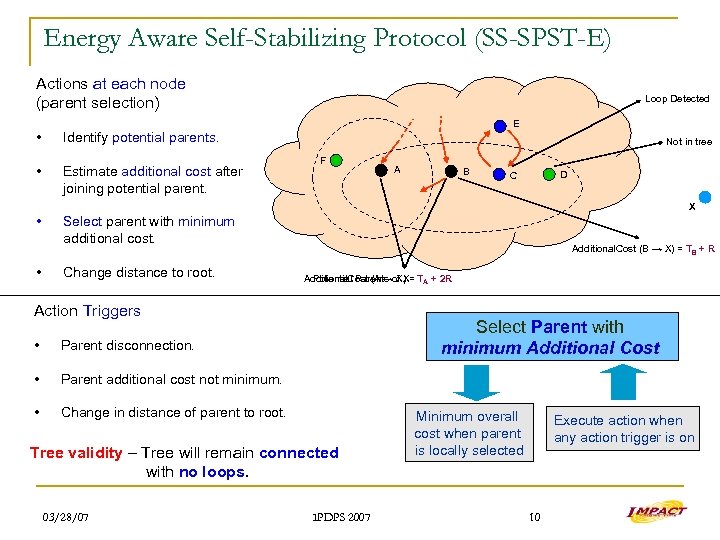
Energy Aware Self-Stabilizing Protocol (SS-SPST-E) Actions at each node (parent selection) Loop Detected E • Identify potential parents. • Estimate additional cost after joining potential parent. Not in tree F A B D C X • • Select parent with minimum additional cost. Change distance to root. Additional. Cost (B → X) = TB + R Additional. Cost (A →of X= TA + 2 R Potential Parents X) Action Triggers • Parent disconnection. • Parent additional cost not minimum. • Select Parent with minimum Additional Cost Change in distance of parent to root. Tree validity – Tree will remain connected with no loops. 03/28/07 IPDPS 2007 Minimum overall cost when parent is locally selected Execute action when any action trigger is on 10
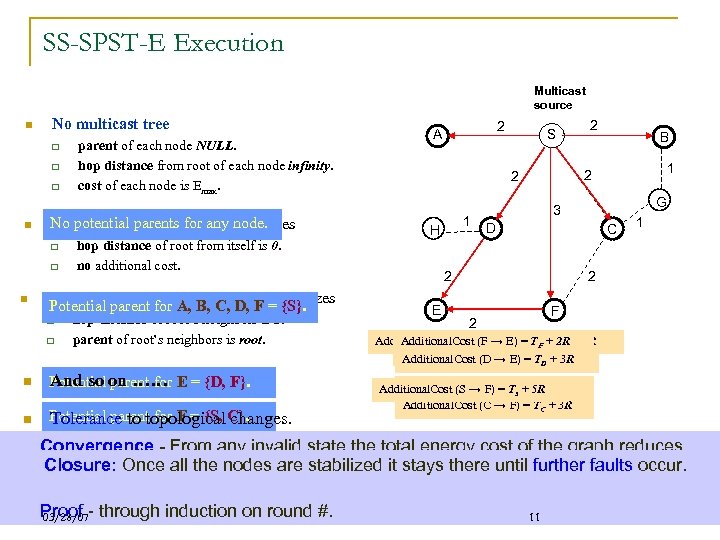
SS-SPST-E Execution Multicast source n No multicast tree q q q n No potential parents for any node. First Round – source (root) stabilizes q q n parent of each node NULL. hop distance from root of each node infinity. cost of each node is Emax. hop distance of root from itself is 0. no additional cost. Second Round – neighbors of root stabilizes Potential parent for A, B, C, D, F = {S}. q q hop distance of root’s neighbors is 1. parent of root’s neighbors is root. n And so parent for Potential on …… E = {D, F}. n Potential parent for F = {S, C}. Tolerance to topological changes. 2 A S 1 1 G 3 D C 2 E B 2 2 H 2 1 2 F 2 Additional. Cost {A, B, C, TF = Ts Additional. Cost (S →(F → E) = D})+ 2 R + 4 R Additional. Cost (D → E) = TD + 3 R Additional. Cost (D → E) = Additional. Cost F) = TS Additional. Cost (S → Ts + 5 R + R Additional. Cost (C → F) = TC + 3 R Convergence - From any invalid state the total energy cost of the graph reduces Closure: round till all the nodes in the system are stabilized. after every. Once all the nodes are stabilized it stays there until further faults occur. Proof - through induction on round. IPDPS 2007 #. 03/28/07 11
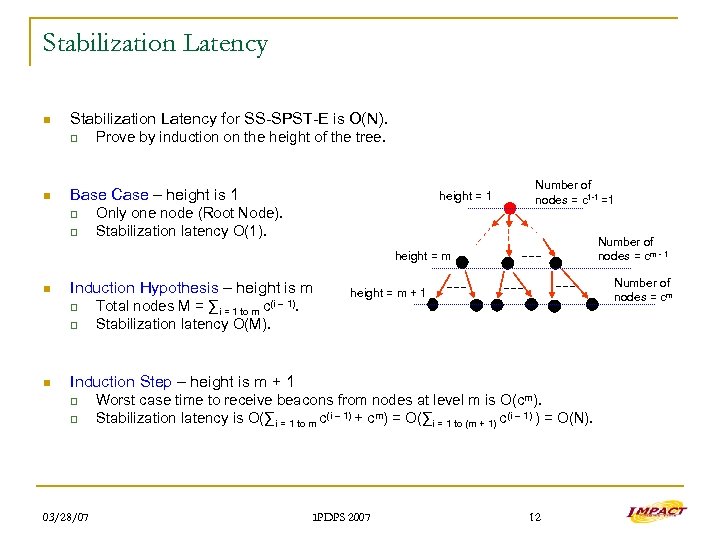
Stabilization Latency n Stabilization Latency for SS-SPST-E is O(N). q n Prove by induction on the height of the tree. Base Case – height is 1 q q height = 1 Only one node (Root Node). Stabilization latency O(1). Number of nodes = c 1 -1 =1 Number of nodes = cm - 1 height = m n Induction Hypothesis – height is m q q n Total nodes M = ∑i = 1 to m c(i – 1). Stabilization latency O(M). Number of nodes = cm height = m + 1 Induction Step – height is m + 1 q q 03/28/07 Worst case time to receive beacons from nodes at level m is O(cm). Stabilization latency is O(∑i = 1 to m c(i – 1) + cm) = O(∑i = 1 to (m + 1) c(i – 1) ) = O(N). IPDPS 2007 12
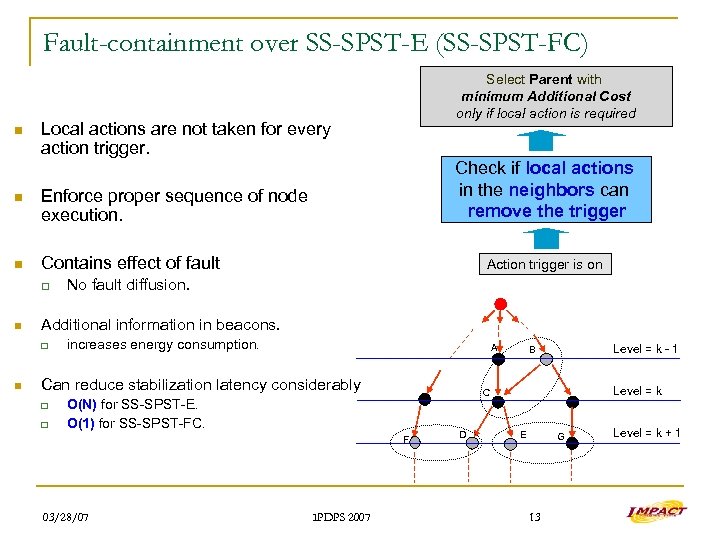
Fault-containment over SS-SPST-E (SS-SPST-FC) n Select Parent with minimum Additional Cost only if local action is required Local actions are not taken for every action trigger. n Enforce proper sequence of node execution. n Check if local actions in the neighbors can remove the trigger Contains effect of fault q n No fault diffusion. Additional information in beacons. q n Action trigger is on increases energy consumption. A Can reduce stabilization latency considerably q q F IPDPS 2007 Level = k C O(N) for SS-SPST-E. O(1) for SS-SPST-FC. 03/28/07 Level = k - 1 B D E G 13 Level = k + 1
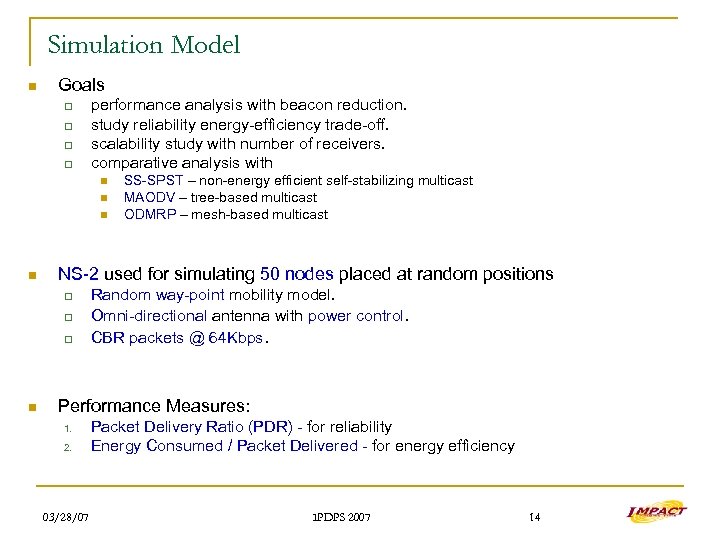
Simulation Model n Goals q q performance analysis with beacon reduction. study reliability energy-efficiency trade-off. scalability study with number of receivers. comparative analysis with n n NS-2 used for simulating 50 nodes placed at random positions q q q n SS-SPST – non-energy efficient self-stabilizing multicast MAODV – tree-based multicast ODMRP – mesh-based multicast Random way-point mobility model. Omni-directional antenna with power control. CBR packets @ 64 Kbps. Performance Measures: 1. 2. 03/28/07 Packet Delivery Ratio (PDR) - for reliability Energy Consumed / Packet Delivered - for energy efficiency IPDPS 2007 14
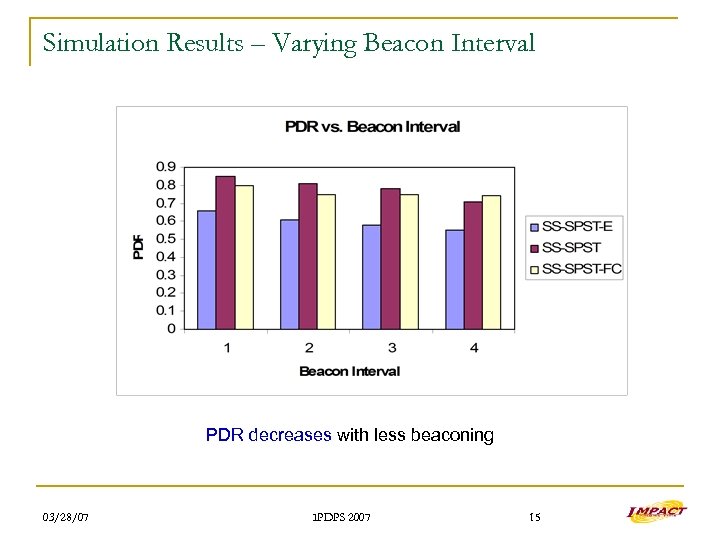
Simulation Results – Varying Beacon Interval PDR decreases with less beaconing 03/28/07 IPDPS 2007 15
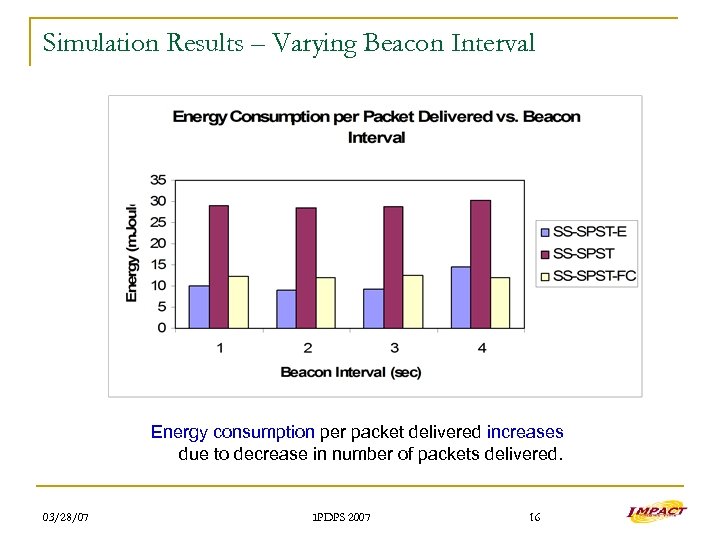
Simulation Results – Varying Beacon Interval Energy consumption per packet delivered increases due to decrease in number of packets delivered. 03/28/07 IPDPS 2007 16
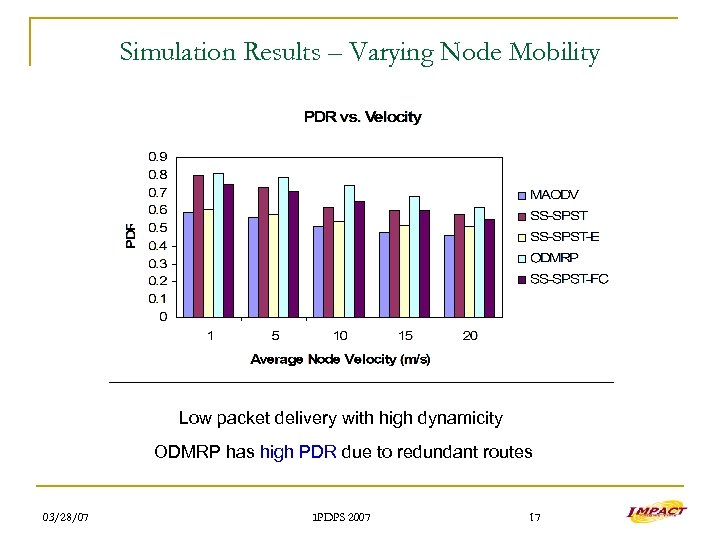
Simulation Results – Varying Node Mobility Low packet delivery with high dynamicity ODMRP has high PDR due to redundant routes 03/28/07 IPDPS 2007 17
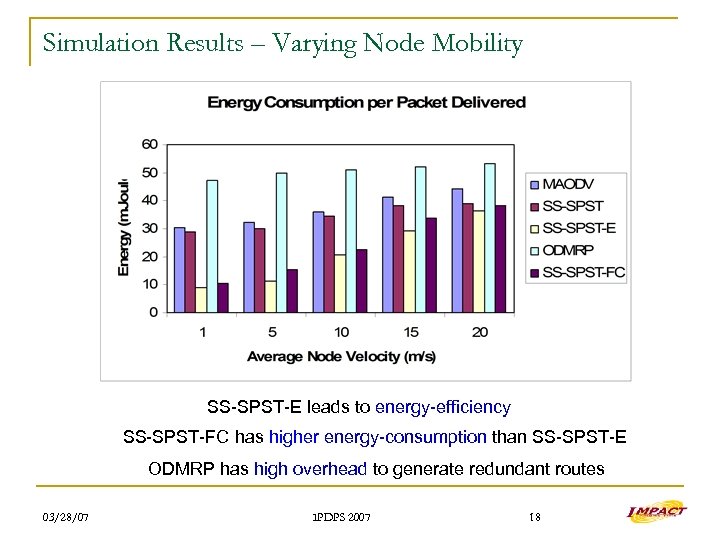
Simulation Results – Varying Node Mobility SS-SPST-E leads to energy-efficiency SS-SPST-FC has higher energy-consumption than SS-SPST-E ODMRP has high overhead to generate redundant routes 03/28/07 IPDPS 2007 18
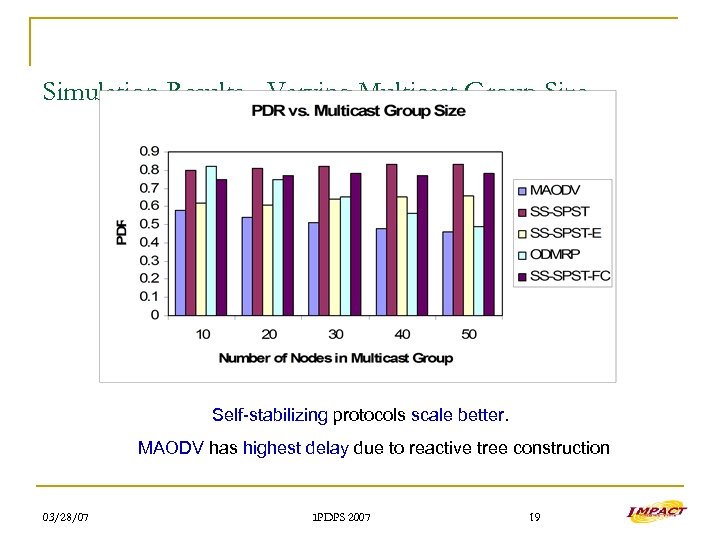
Simulation Results - Varying Multicast Group Size Self-stabilizing protocols scale better. MAODV has highest delay due to reactive tree construction 03/28/07 IPDPS 2007 19
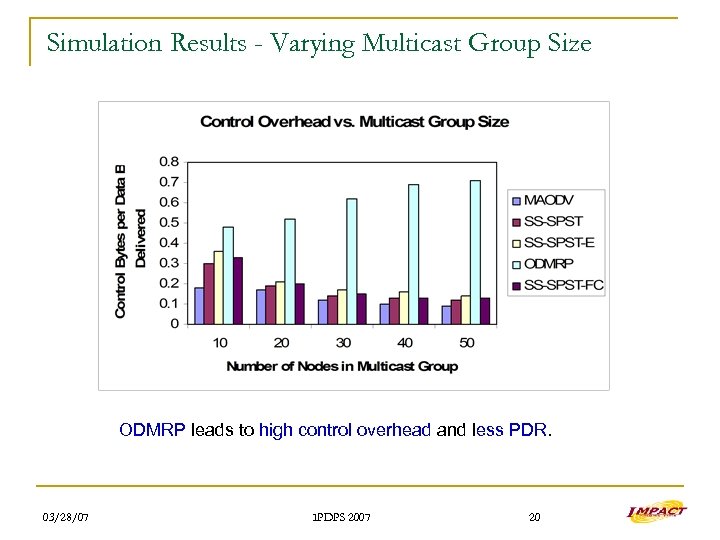
Simulation Results - Varying Multicast Group Size ODMRP leads to high control overhead and less PDR. 03/28/07 IPDPS 2007 20
Conclusions & Future Work n SS-SPST-E provides energy-efficiency and action localization. q High adaptability to topological changes. n SS-SPST-FC further increases packet delivery. q Decreases stabilization latency. n SS-SPST-E and SS-SPST-FC lead to group-scalability. n Energy wastage in beaconing if less or no multicast traffic. n Future Work q Optimizing periodic beacon transmission. q Applying adaptive localization to other energy-efficient multicast (BIP/MIP etc. ). 03/28/07 IPDPS 2007 21
References n Internet Engineering Task Force (IETF) Mobile Ad Hoc Networks (MANET) Working Group Charter. http: //www. ietf. org/html. charters/manet-charter. html. n Q. Zhao, L. Tong. Energy Efficiency of Large-Scale Wireless Networks: Proactive Versus Reactive Networking. IEEE Journal on Selected Areas in Communications, Vol. 23, No. 5, May, 2005. n E. W. Dijkstra, “Self Stabilizing systems in spite of distributed control”, In Proc. Communications of the ACM, November 1974. n S. K. S. Gupta and P. K. Srimani. “Self-Stabilizing Multicast Protocols for Ad Hoc Networks”. Journal of Parallel and Distributed Computing, 2003. n E. Royer and C. E. Perkins. ”Multicast operation of the ad-hoc on-demand distance vector routing protocol”. In Proc. Of the 5 th ACM/IEEE Annual Conf. On Mobile Computing and Networking, August 1999. n S. Meguerdichian, S. Slijepcevic, V. Karayan, M. Potkonjak. “Localized Algorithms In Wireless Ad-Hoc Networks: Location Discovery And Sensor Exposure”. In 2 nd ACM International Symposium on Mobile Ad Hoc Networking & Computing. 2001 n M. Gerla, S. J. Lee and C. C. Chang. ”On-Demand multicast routing protocol (ODMRP) for ad hoc networks”. In Proc. Of IEEE Wireless Communications and Networking Conference 1999, LA, September 1999. n S. Vaudevan, C. Zhang, D. Goeckel, D. Towsley. “Optimal Power Allocation in Wireless Networks with Transmitter -Receiver Power Tradeoff Proc. INFOCOM’ 06, 2006. 03/28/07 IPDPS 2007 22

Questions ? ? ? 03/28/07 IPDPS 2007 23
Скачать презентацию Energy-aware Self-stabilizing Multicasting for MANETs Tridib Mukherjee IMPACT
7b4dd0d8a866f41b52d084f0499a46c5.ppt