 Скачать презентацию Energy and Metabolism Reflection 1 27 Describe
5036dea1fc145aea409158821d1a2ab2.ppt
- Количество слайдов: 67



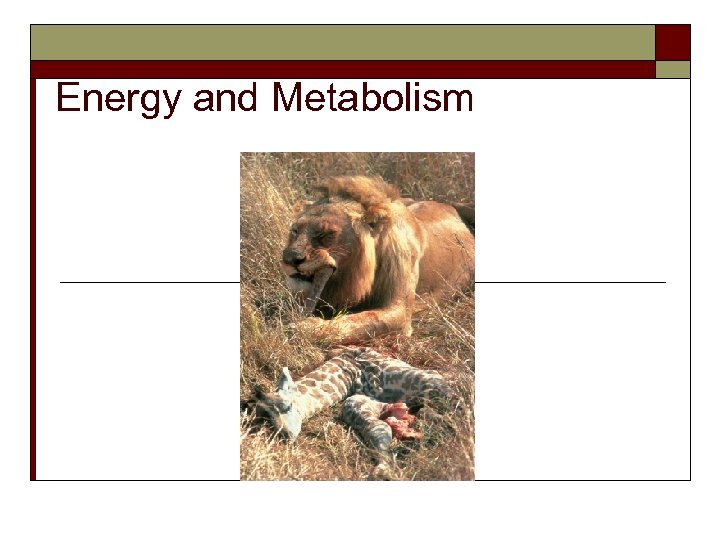
Energy and Metabolism
Reflection 1/27 – Describe what is meant by metabolism. 1/28 – Describe the role enzymes play and name the type of macromolecules they represent. 1/29 – Name 3 enzymes and their substrates. 2/1 – Explain how to denature an enzyme and name 2 ways to denature an enzyme.
Why would someone metabolism be better? How do you digest alcohol? Where does it go? What causes alcoholic bingeing to be dangerous?
Alcohol Metabolism o Since alcohol is not stored or used, it is metabolized before any nutrition. Long term drinking leads to malnutrition. If on diet, causes you to retain your weight, because your body does not digest fat. Alcohol first.
A Toast to Alcohol Dehydrogenase o o Metabolic processes break down organic molecules such as ethanol and other toxins – binge drinking is currently the most serious drug problem on college campuses. Different people – sex and race produce different amounts of dehydrogenase.
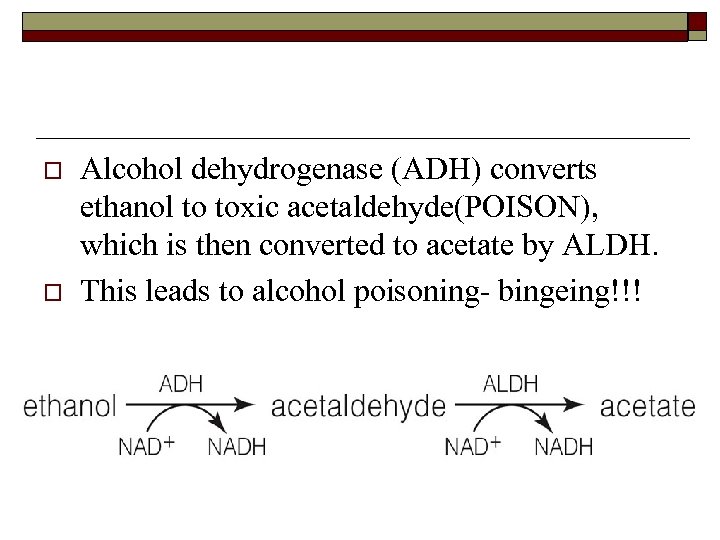
o o Alcohol dehydrogenase (ADH) converts ethanol to toxic acetaldehyde(POISON), which is then converted to acetate by ALDH. This leads to alcohol poisoning- bingeing!!!
What do you think of when you think of a chemical reaction? Name some chemical reactions. Do you think photosynthesis and cellular respiration are chemical reactions?
Chemical Reactions – Speed up Change substances into different substances by breaking and forming chemical bonds. DOES THIS OCCUR WITH DIGESTION?
Parts of an Equation All chemical reactions… have two parts: 1. 2. o o Reactants = the substances you start with Products = the substances you end up with The reactants will turn into the products. Reactants ® Products
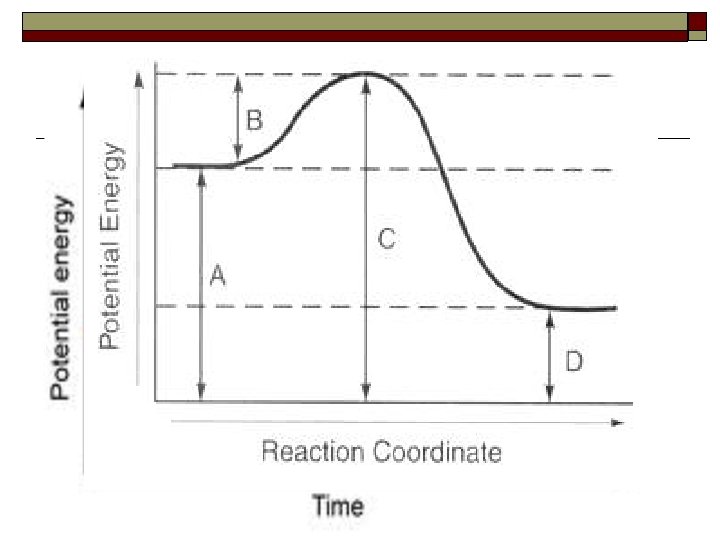
Bond Energy o o o BOND ENERGY : Amount of energy needed to break the bonds between molecules. Energy is needed to break bonds. The stronger the bond the more energy needed. The amount of energy is different for all bonds. Energy is released when bonds are formed like with H and O to make water.
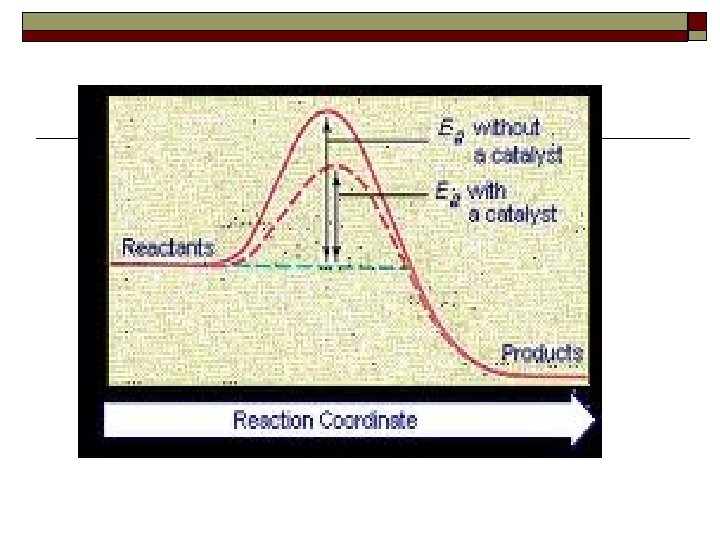
Activation Energy o Energy needed to get the reaction started. Some reaction takes more energy than others. Usually this is increasing the temperature but organisms cannot change the temperature so something else has to help decrease the amount of energy needed. We cannot use all our energy for reactions like photosynthesis and respiration.
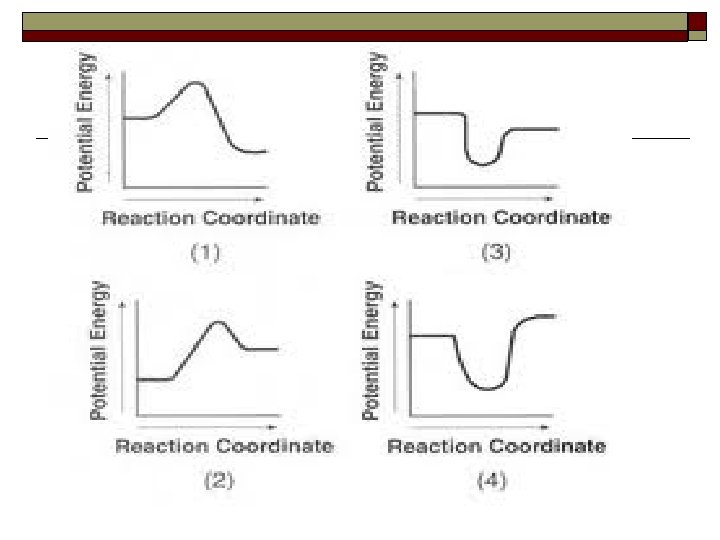
Exothermic and Endothermic Reactions o A reaction in which heat or more energy is produced is given out is exothermic. o A reaction in which heat is taken in or more energy is used is endothermic.
Exothermic reactions o o Chemical reaction where more energy is released than it absorbs Difference in energy between reactant and products. Usually heat or light. EX: Cellular respiration
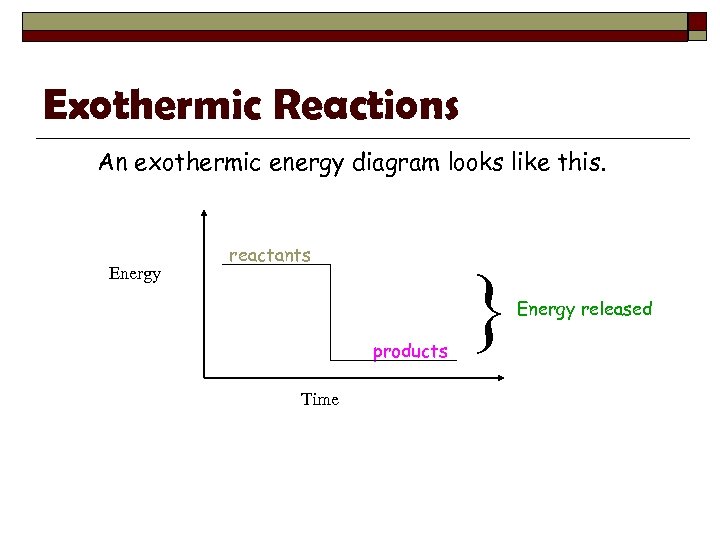
Exothermic Reactions An exothermic energy diagram looks like this. Energy reactants products Time } Energy released
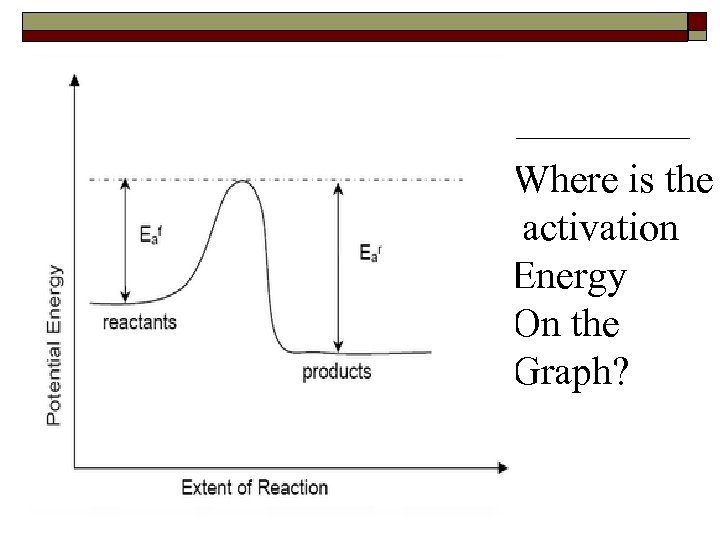
Where is the activation Energy On the Graph?
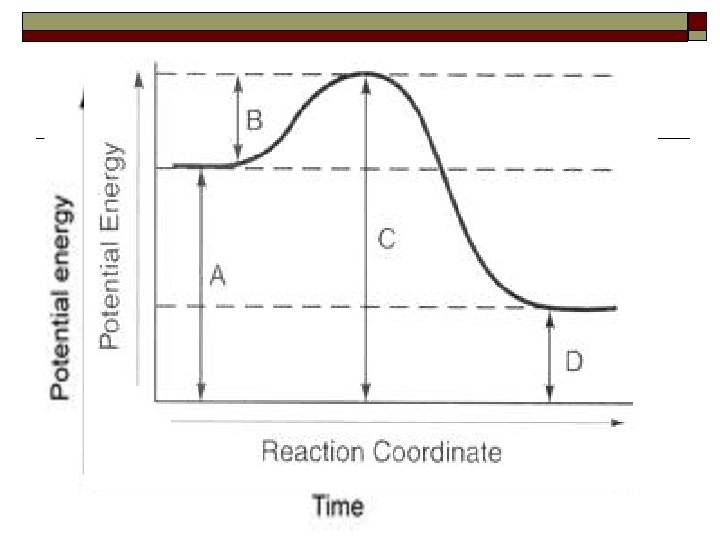
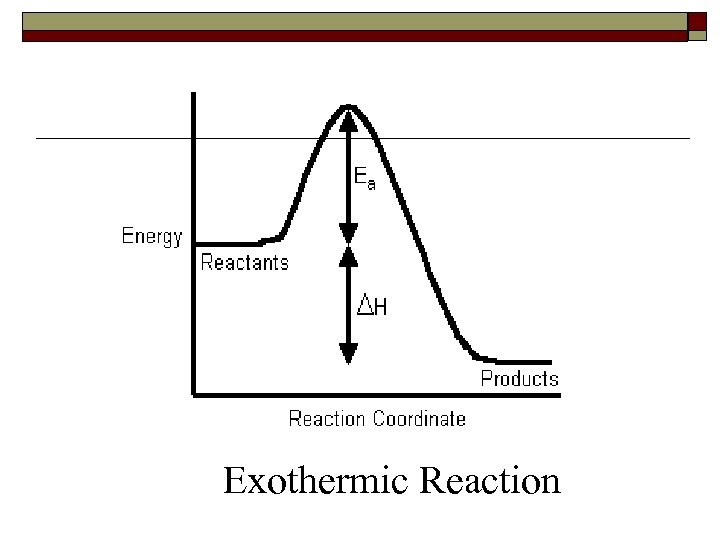
Exothermic Reaction
ENERGY AND CHEMICAL REACTIONS Endothermic reactions o These reactions take in heat energy from their surroundings. o These cause temperatures to fall. They get cold!!!
Endothermic reactions o o o Chemical reaction where more energy is absorbed than released. IT IS A NET THING!!! Energy must be absorbed to make up difference between reactants and products EX: photosynthesis Traps energy in bonds of glucose
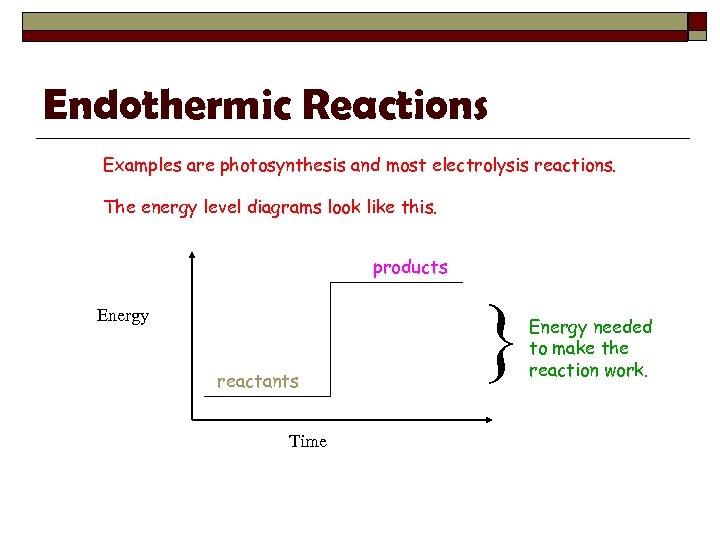
Endothermic Reactions Examples are photosynthesis and most electrolysis reactions. The energy level diagrams look like this. products Energy reactants Time } Energy needed to make the reaction work.
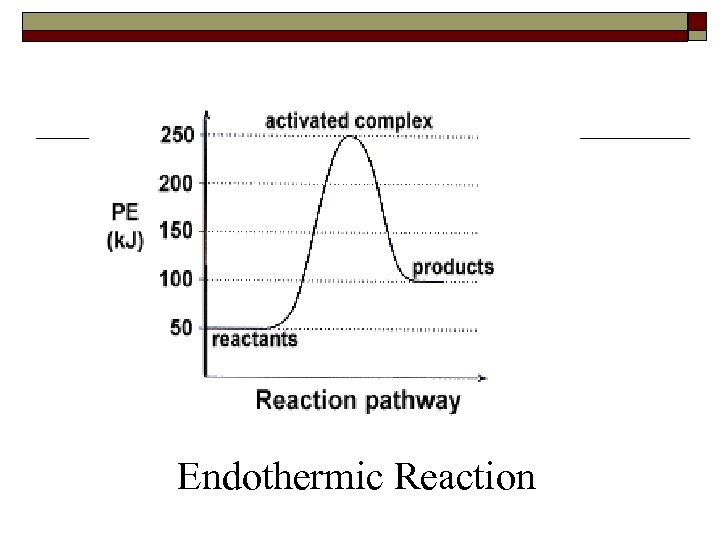
Endothermic Reaction
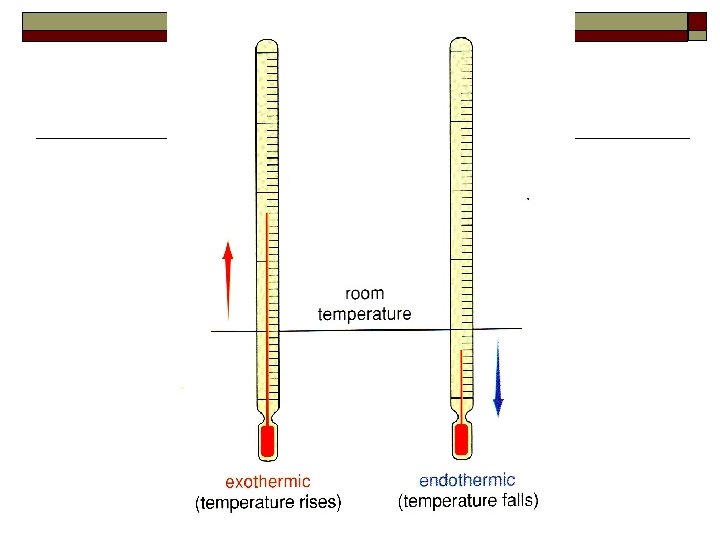
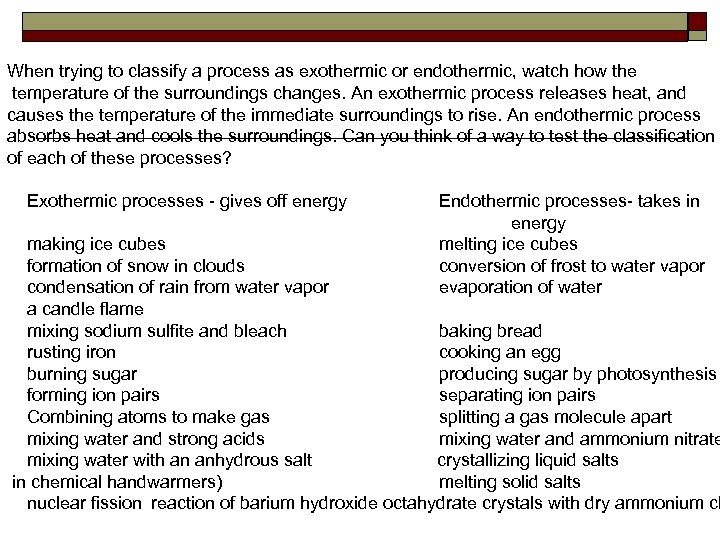
When trying to classify a process as exothermic or endothermic, watch how the temperature of the surroundings changes. An exothermic process releases heat, and causes the temperature of the immediate surroundings to rise. An endothermic process absorbs heat and cools the surroundings. Can you think of a way to test the classification of each of these processes? Exothermic processes - gives off energy Endothermic processes- takes in energy melting ice cubes conversion of frost to water vapor evaporation of water making ice cubes formation of snow in clouds condensation of rain from water vapor a candle flame mixing sodium sulfite and bleach baking bread rusting iron cooking an egg burning sugar producing sugar by photosynthesis forming ion pairs separating ion pairs Combining atoms to make gas splitting a gas molecule apart mixing water and strong acids mixing water and ammonium nitrate mixing water with an anhydrous salt crystallizing liquid salts in chemical handwarmers) melting solid salts nuclear fission reaction of barium hydroxide octahydrate crystals with dry ammonium ch
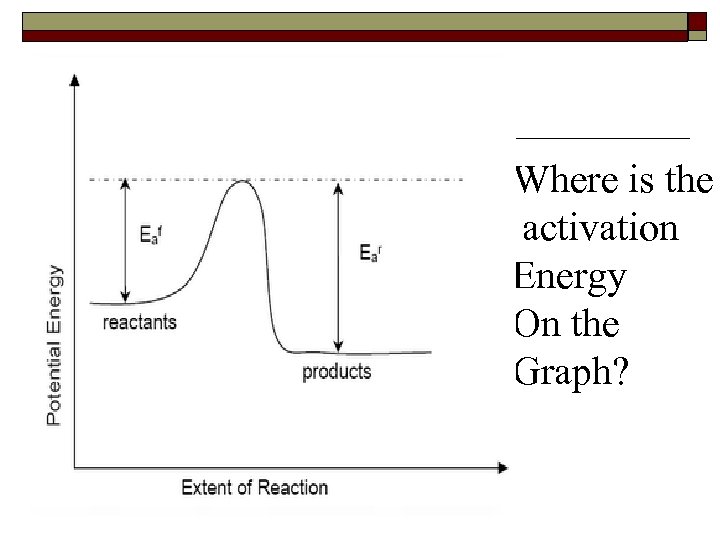
Where is the activation Energy On the Graph?
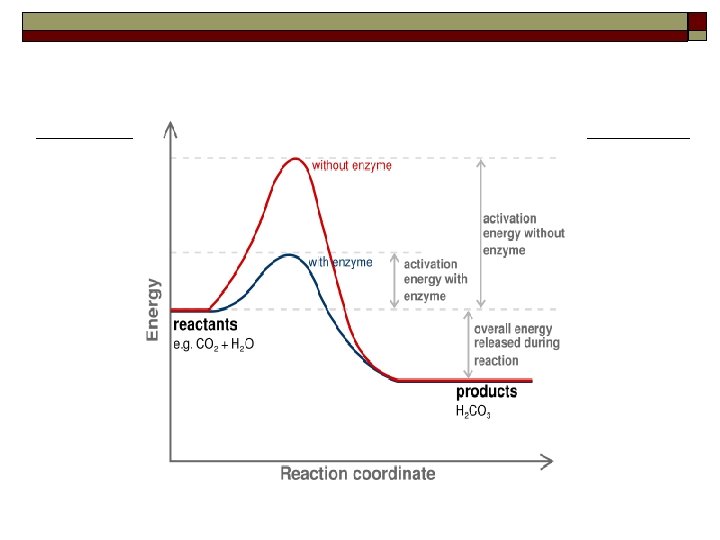
Enzymes 27
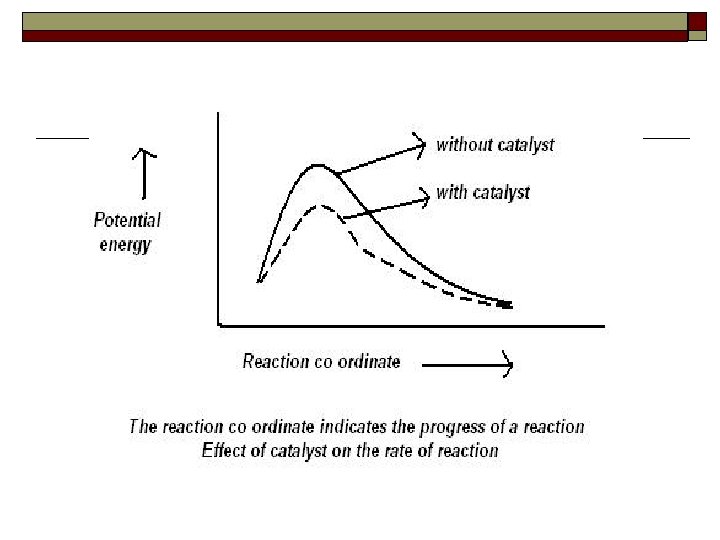
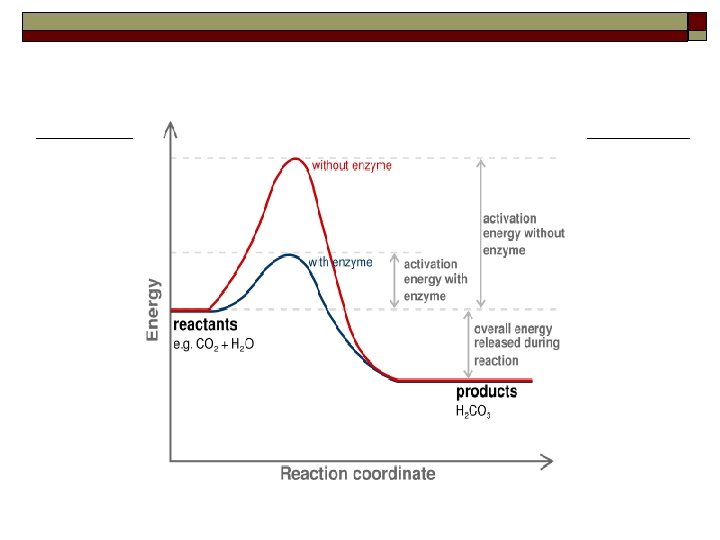
ENZYMES *A type of protein that acts as a catalyst which lowers activation energy needed to start a reaction. *They speed up reactions by weaken bonds. *Always in in -ase © 2007 Paul Billiet ODWS
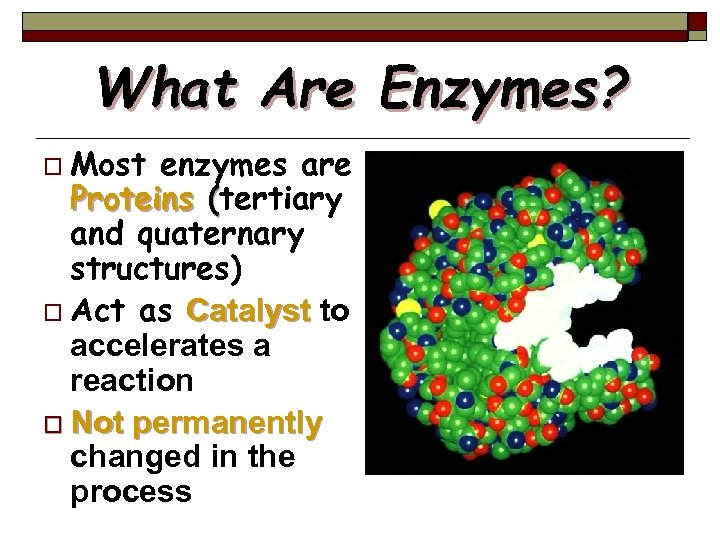
What Are Enzymes? o Most enzymes are Proteins (tertiary and quaternary structures) o Act as Catalyst to accelerates a reaction o Not permanently changed in the process 29
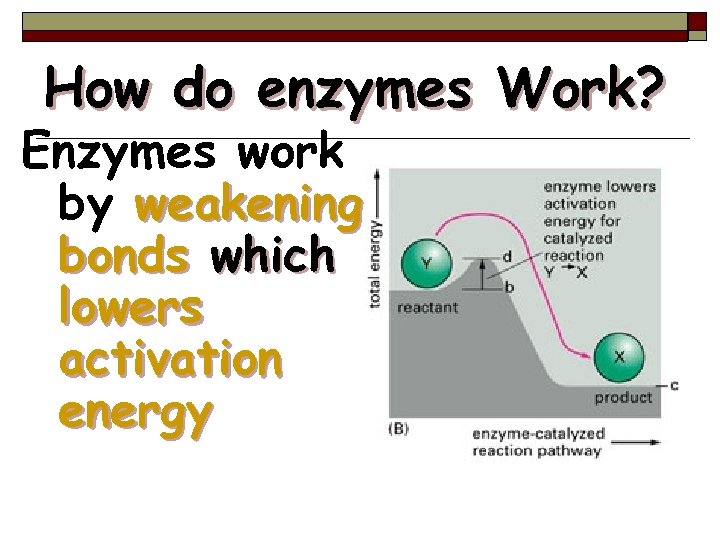
How do enzymes Work? Enzymes work by weakening bonds which lowers activation energy 30
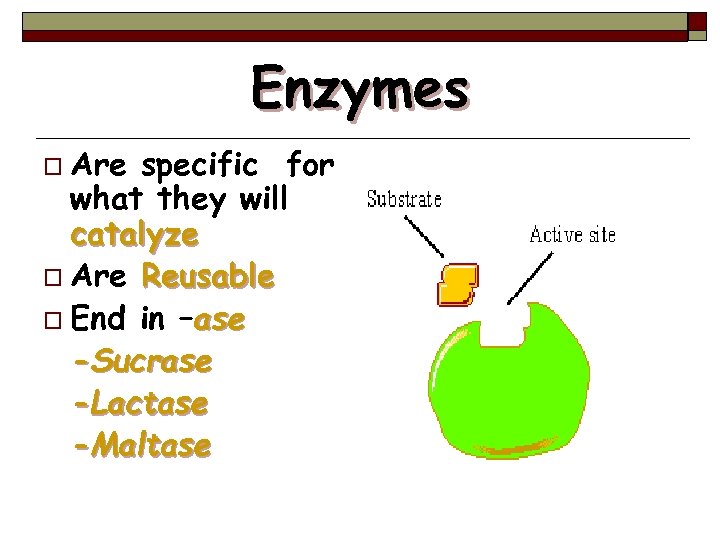
Enzymes o Are specific for what they will catalyze o Are Reusable o End in –ase -Sucrase -Lactase -Maltase 31
The substrate o o The substrate of an enzyme are the reactants that are acted on by the enzyme. Enzymes are specific to their substrates The specificity is determined by the active site ENZYMES ARE SHAPED TO FIT ONLY THEIR SUBTRATE BECAUSE THEIR ACTIVE SITE IS SHAPED TO FIT ONLY ONE SUBSTRATE!!!! © 2007 Paul Billiet ODWS
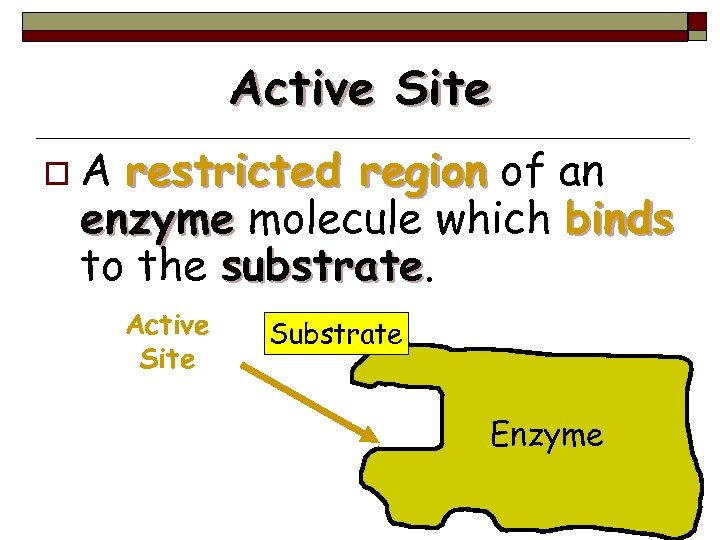
Active Site o. A restricted region of an enzyme molecule which binds to the substrate Active Site Substrate Enzyme 33
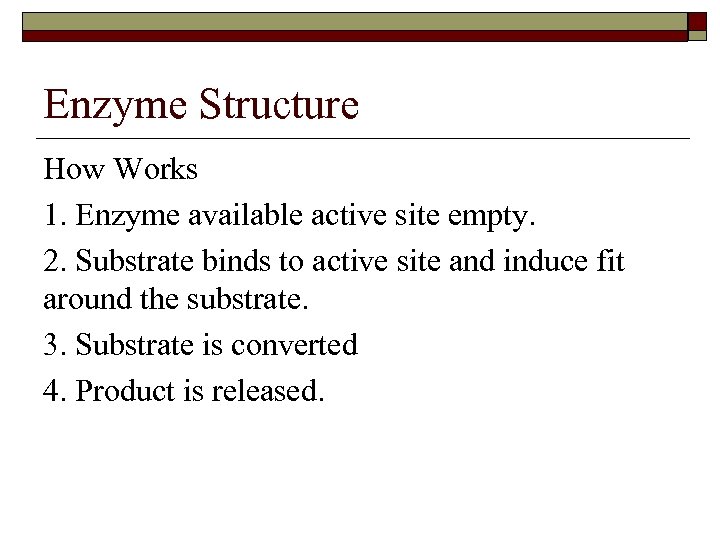
Enzyme Structure How Works 1. Enzyme available active site empty. 2. Substrate binds to active site and induce fit around the substrate. 3. Substrate is converted 4. Product is released.
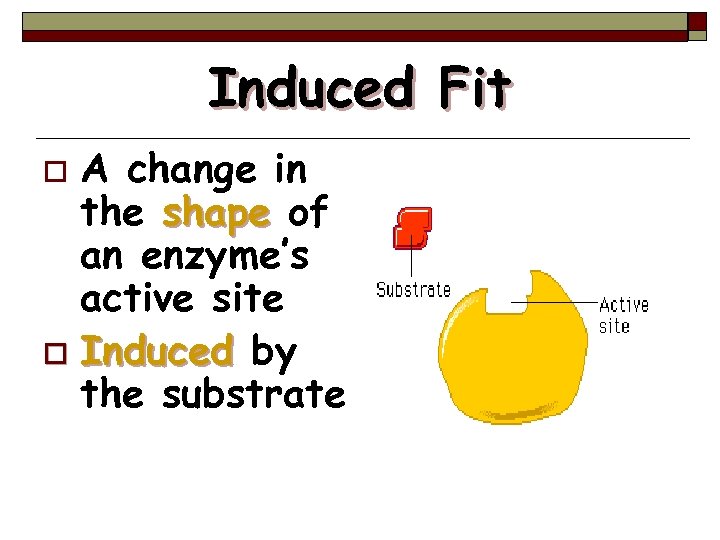
Induced Fit A change in the shape of an enzyme’s active site o Induced by the substrate o 35
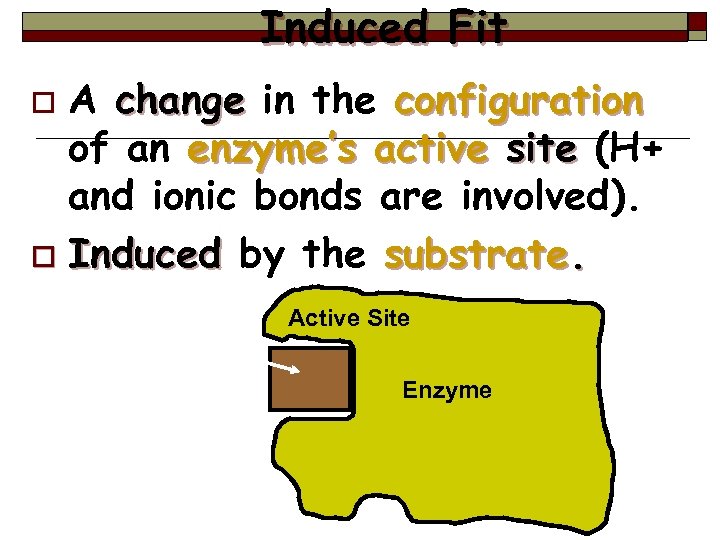
Induced Fit A change in the configuration of an enzyme’s active site (H+ and ionic bonds are involved). o Induced by the substrate. o substrate Active Site Enzyme induced fit 36
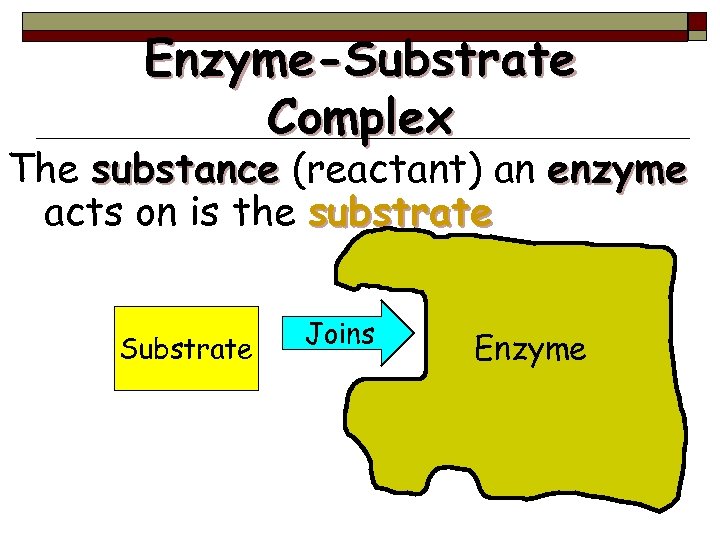
Enzyme-Substrate Complex The substance (reactant) an enzyme acts on is the substrate Substrate Joins Enzyme 37
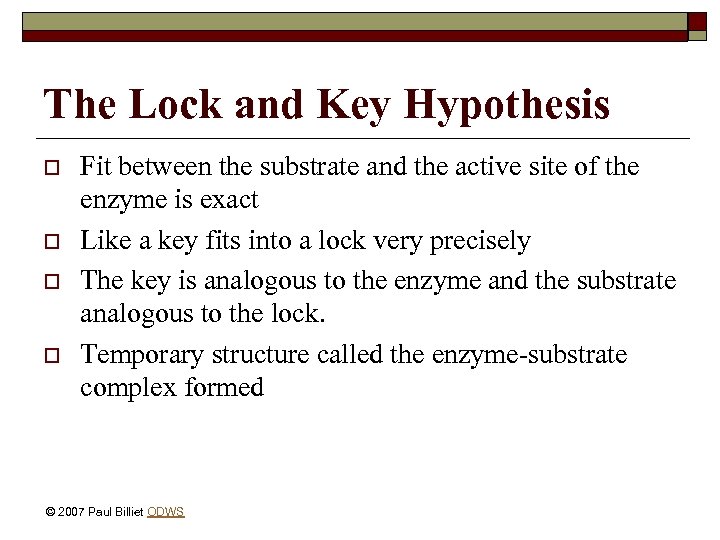
The Lock and Key Hypothesis o o Fit between the substrate and the active site of the enzyme is exact Like a key fits into a lock very precisely The key is analogous to the enzyme and the substrate analogous to the lock. Temporary structure called the enzyme-substrate complex formed © 2007 Paul Billiet ODWS
Different Types of Enzymes o o Metabolic or digestive enzymes to digst food Detergent enzymes There are over 500 enzymes in just one cell!! Needed to speed up reactions or wold be too slow!!!
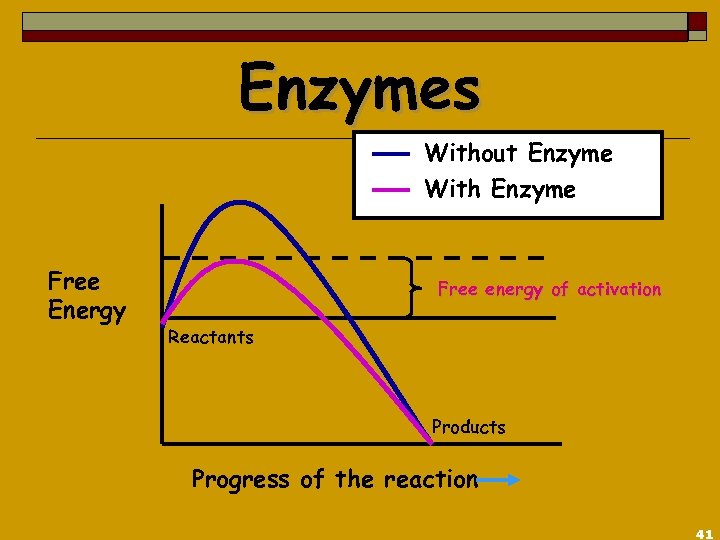
Enzymes Without Enzyme With Enzyme Free Energy Free energy of activation Reactants Products Progress of the reaction 41
Digestive enzymes are secreted by the body to digest the food eaten. There are three categories of digestive enzymes: • Amylases (found in saliva, the pancreas, and intestinal juices) break down carbohydrates; • Proteases (found in the stomach, pancreatic, and intestinal juices) help digest protein; • Lipases (pancreatic juices, and in food fats) aid in fat digestion. •
• Amylase enzymes are found in the saliva and in the juices of the pancreas and intestinal tract and help the digestive process by breaking down carbohydrates. There are different kinds of amylase. For example, the enzyme sucrase breaks down the sugar sucrose found in cane and beet sugar. The enzyme lactase breaks down the lactose sugar in milk. The enzyme maltase breaks down the malt sugar maltose. • Protease enzymes are found in the juices of the pancreas, the stomach and the intestinal tract and help with the breakdown and the digestion of proteins. • Lipase enzymes are found in the juices of the stomach and pancreas and help to break down fats.
Denaturing of Enzymes Denaturing: enzyme structure is destroyed.
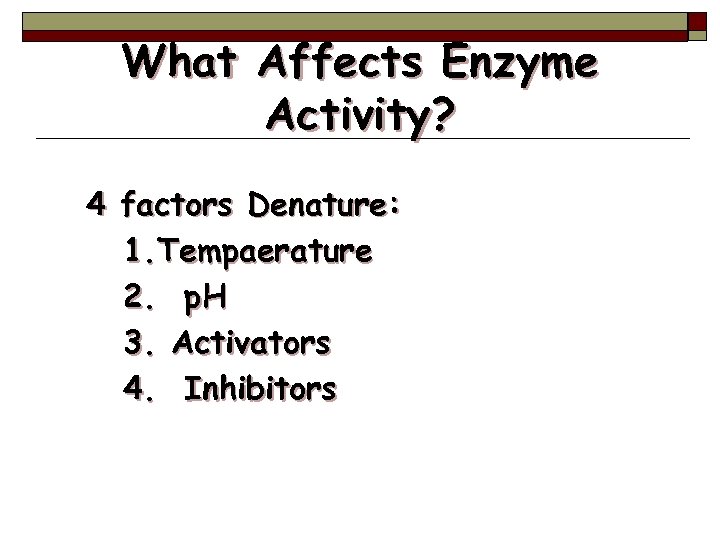
What Affects Enzyme Activity? 4 factors Denature: 1. Tempaerature 2. p. H 3. Activators 4. Inhibitors 46
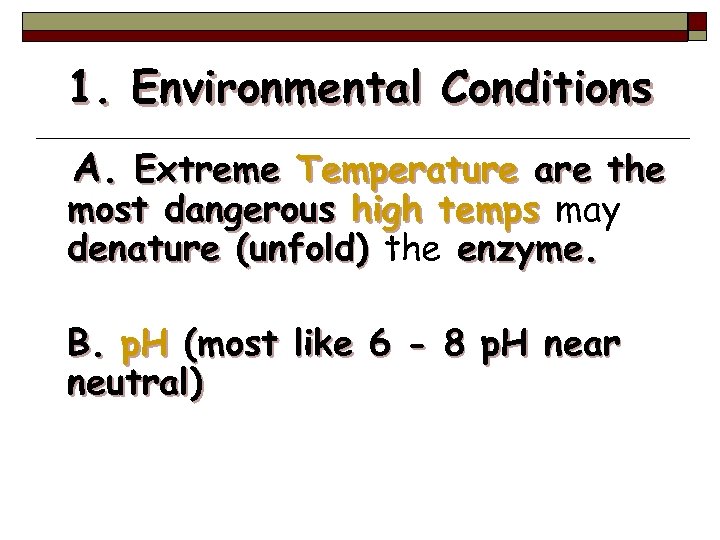
1. Environmental Conditions A. Extreme Temperature are the most dangerous high temps may denature (unfold) the enzyme. B. p. H (most like 6 - 8 p. H near neutral) 47
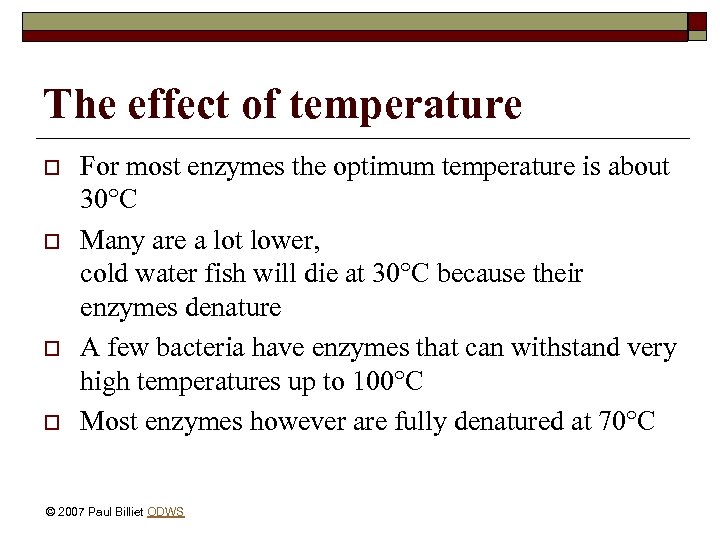
The effect of temperature o o For most enzymes the optimum temperature is about 30°C Many are a lot lower, cold water fish will die at 30°C because their enzymes denature A few bacteria have enzymes that can withstand very high temperatures up to 100°C Most enzymes however are fully denatured at 70°C © 2007 Paul Billiet ODWS
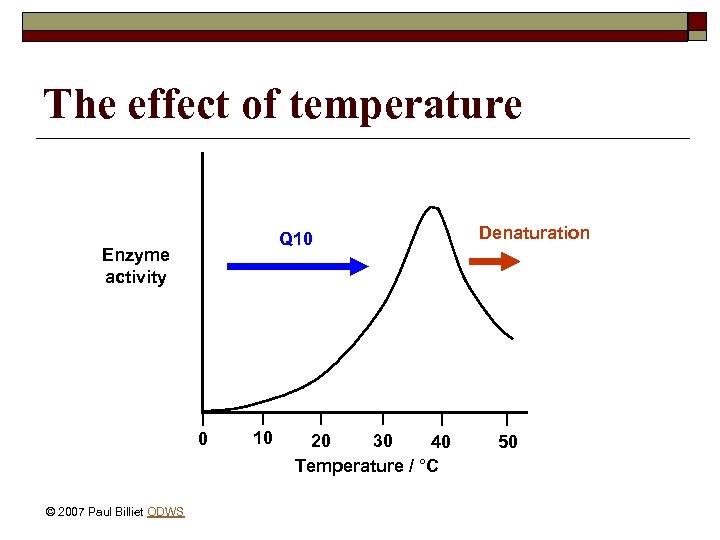
The effect of temperature Q 10 Enzyme activity 0 © 2007 Paul Billiet ODWS 10 20 30 40 Temperature / °C Denaturation 50
Increase of Temperature o o o Can organisms have a great increase in temperature? Need other ways to get increase or to decrease the amount of activation energy needed This is where catalysts come into play.
The effect of p. H o o o Extreme p. H levels will produce denaturation The structure of the enzyme is changed The active site is distorted and the substrate molecules will no longer fit in it At p. H values slightly different from the enzyme’s optimum value, small changes in the charges of the enzyme and it’s substrate molecules will occur This change in ionisation will affect the binding of the substrate with the active site. © 2007 Paul Billiet ODWS
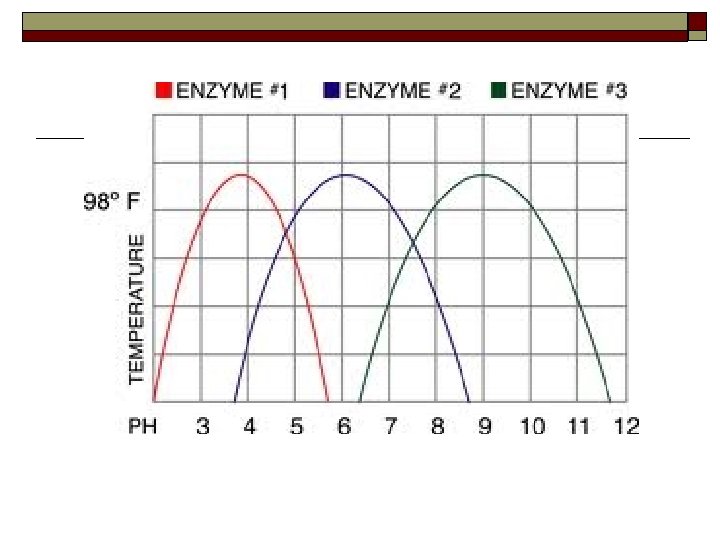
Enzymes work in different p. H o All enzymes can work in different conditions Intestines would have a lower p. H than mouth. o Look at website for examples!!!!!! o
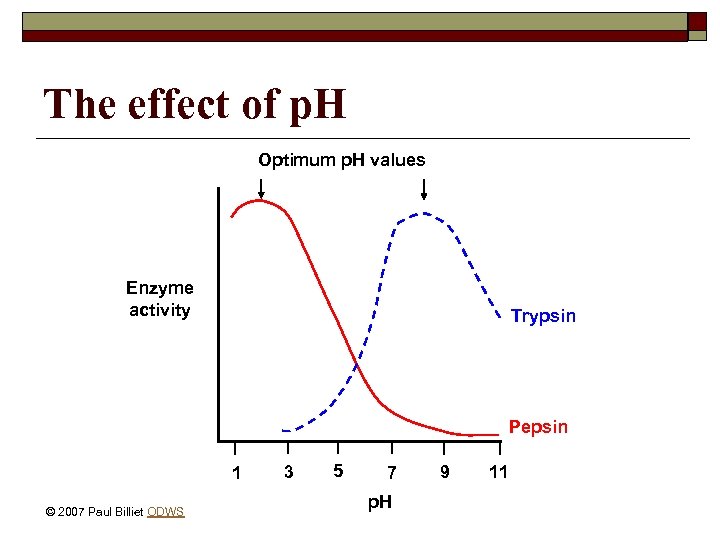
The effect of p. H Optimum p. H values Enzyme activity Trypsin Pepsin 1 © 2007 Paul Billiet ODWS 3 5 7 p. H 9 11
Inhibitors o o Inhibitors are chemicals that reduce the rate of enzymic reactions. The are usually specific and they work at low concentrations. They block the enzyme but they do not usually destroy it. Many drugs and poisons are inhibitors of enzymes in the nervous system. © 2007 Paul Billiet ODWS
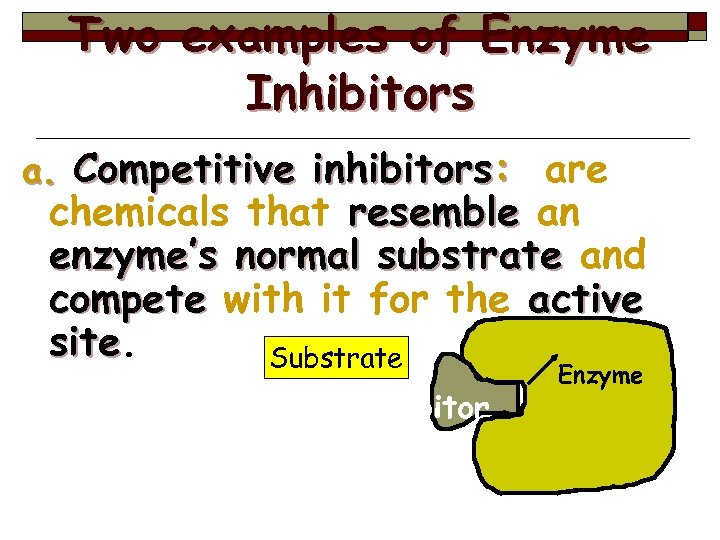
Two examples of Enzyme Inhibitors a. Competitive inhibitors: are chemicals that resemble an enzyme’s normal substrate and compete with it for the active site Substrate Competitive inhibitor Enzyme 57
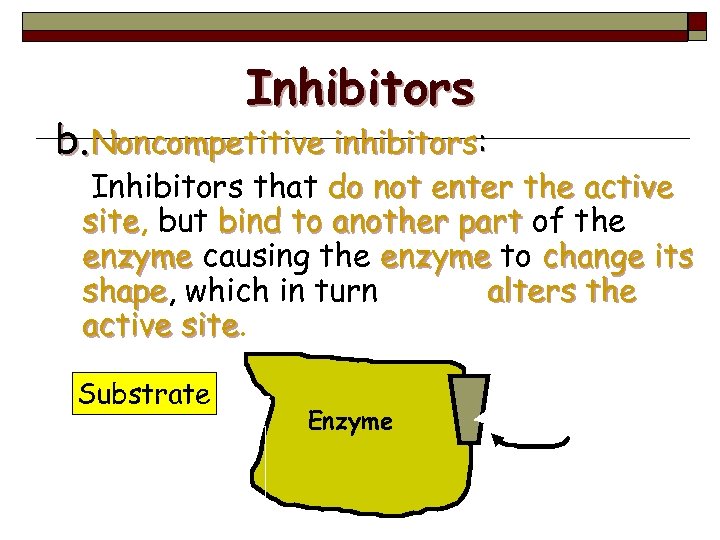
Inhibitors b. Noncompetitive inhibitors: Inhibitors that do not enter the active site, but bind to another part of the site enzyme causing the enzyme to change its shape, which in turn alters the shape active site Substrate active site altered Enzyme Noncompetitive Inhibitor 58
Enzymes o o Substrate, active site, factors that affect enzymes!! Uses for enzymes Purpose – How do they speed up reactions Examples
Metabolic Enzymes Metabolic enzymes run all the body organs and systems by performing various chemical reactions within the body cells. Catalase, which breaks down hydrogen peroxide, a metabolic waste product, liberating the oxygen for use in the body. .
o Place cracker in mouth!! What happens!! WHY? ? ? Would this happen with a piece of meat? o Why or why not? o
http: //highered. mcgraw-hill. com/sites/0072495855/student_ view 0/chapter 2/animation__how_enzymes_work. html
o 1. Enzymes have five important properties that you should know: They are always proteins. 2. They are specific in their action. Each enzyme controls one particular reaction, or type of reaction. Thus sucrase degrades sucrose and only sucrose (table sugar). 3. They are not altered by the reaction. This means that an enzyme can be used repeatedly. It also means that enzymes appear neither in the reactants nor in the products of a chemical equation. 4. They are destroyed by heat. This is because enzymes are proteins, and all proteins are destroyed by heat. Destruction of protein by heat (or under any extreme conditions of p. H or salt concentration) is called denaturation. 5. They are sensitive to p. H. The term p. H refers to the degree of acidity and alkalinity of a solution. Most intracellular enzymes work best in neutral conditions, i. e. conditions that are neither acidic nor alkaline.
o Hydrogen peroxide (H 2 O 2) is a poisonous byproduct of metabolism that can damage cells if it is not removed. Catalase is an enzyme that speeds up the breakdown of hydrogen peroxide into water (H 2 O) and oxygen gas (O 2). o 2 H 2 O 2 ----catalase-------> 2 H 2 O + O 2 o REMEMBER: A CATALYST is a substance that lowers the activation energy required for a chemical reaction, and therefore increases the rate of the reaction without being used up in the process. CATALASE is an enzyme, a biological (organic) catalyst. Hydrogen peroxide is the substrate for catalase.
CATALASE!!! o o o Hydrogen peroxide (H 2 O 2) is something you can buy at the drug store. What you are buying is a 3 -percent solution, meaning the bottle contains 97 -percent water and 3 -percent hydrogen peroxide. Most people use it as an antiseptic. It turns out that it is not very good as an antiseptic, but it is not bad for washing cuts and scrapes and the foaming looks cool. The reason why it foams is because blood and cells contain an enzyme called catalase. Since a cut or scrape contains both blood and damaged cells, there is lots of catalase floating around. When the catalase comes in contact with hydrogen peroxide, it turns the hydrogen peroxide (H 2 O 2) into water (H 2 O) and oxygen gas (O 2). Catalase does this extremely efficiently -- up to 200, 000 reactions per second. The bubbles you see in the foam are pure oxygen bubbles being created by the catalase. Try putting a little hydrogen peroxide on a cut potato and it will do the same thing for the same reason -- catalase in the damaged potato cells reacts with the hydrogen peroxide. Hydrogen peroxide does not foam in the bottle or on your skin because there is no catalase to help the reaction to occur. Hydrogen peroxide is stable at room temperature.
Hydrogen peroxide is not only found at the drug store… it is also produced in the human body by cells of the immune system, for example. These cells make H 2 O 2 to combat infection during the inflammatory process. BUT too much Hydrogen peroxide kills cells by destroying their cell membranes. In other words, H 2 O 2 can, and does cause harm to the human body. The biochemistry of hydrogen peroxide is complex and widely researched. It is an essential molecule for our survival. However, our bodies are pretty smart; they use enzymes to keep levels under control.
Скачать презентацию Energy and Metabolism Reflection 1 27 Describe
5036dea1fc145aea409158821d1a2ab2.ppt