 Скачать презентацию Energy and Carbon Performance of Housing Upgrade Analysis
9bec03b8313e6e383b62f70e58b13958.ppt
- Количество слайдов: 28



Energy and Carbon Performance of Housing: Upgrade Analysis, Energy Labelling and National Policy Development Joe Clarke, Cameron Johnstone, Jae-min Kim, Paul Tuohy Energy Systems Research Unit, University of Strathclyde
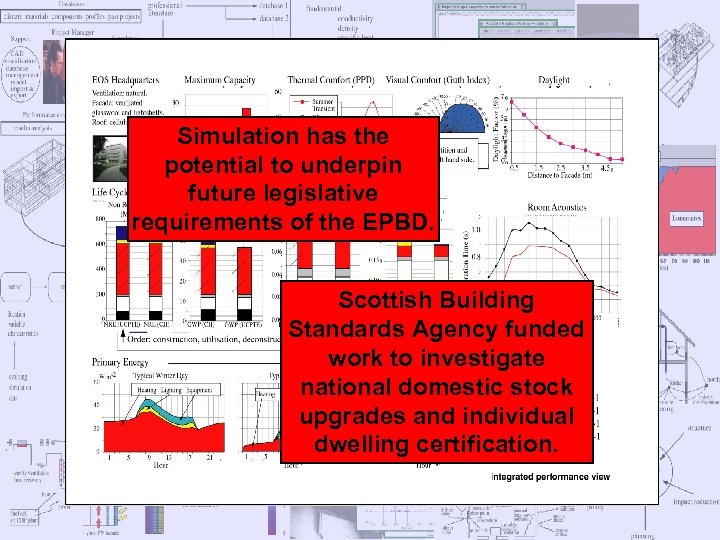
Simulation has the potential to underpin future legislative requirements of the EPBD. Scottish Building Standards Agency funded work to investigate national domestic stock upgrades and individual dwelling certification.
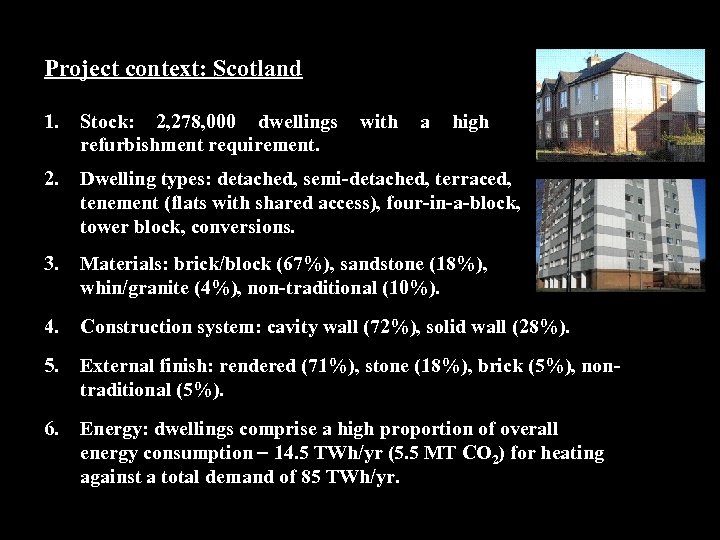
Project context: Scotland 1. Stock: 2, 278, 000 dwellings refurbishment requirement. 2. Dwelling types: detached, semi-detached, terraced, tenement (flats with shared access), four-in-a-block, tower block, conversions. 3. Materials: brick/block (67%), sandstone (18%), whin/granite (4%), non-traditional (10%). 4. Construction system: cavity wall (72%), solid wall (28%). 5. External finish: rendered (71%), stone (18%), brick (5%), nontraditional (5%). 6. Energy: dwellings comprise a high proportion of overall energy consumption 14. 5 TWh/yr (5. 5 MT CO 2) for heating against a total demand of 85 TWh/yr. with a high
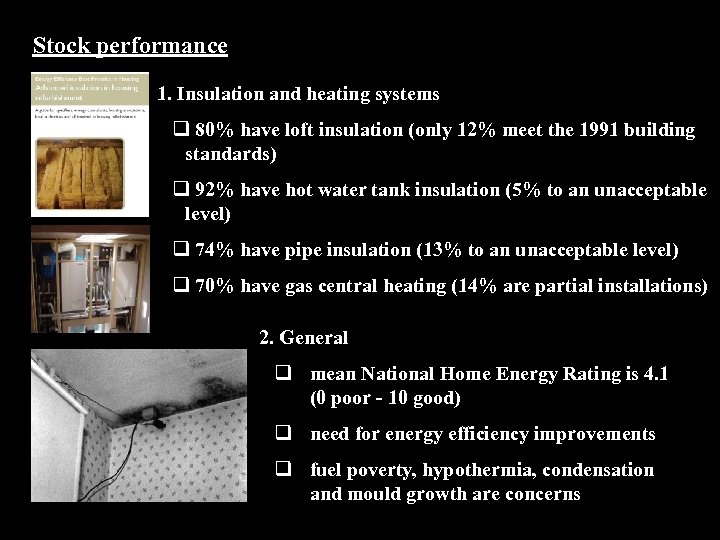
Stock performance 1. Insulation and heating systems q 80% have loft insulation (only 12% meet the 1991 building standards) q 92% have hot water tank insulation (5% to an unacceptable level) q 74% have pipe insulation (13% to an unacceptable level) q 70% have gas central heating (14% are partial installations) 2. General q mean National Home Energy Rating is 4. 1 (0 poor - 10 good) q need for energy efficiency improvements q fuel poverty, hypothermia, condensation and mould growth are concerns
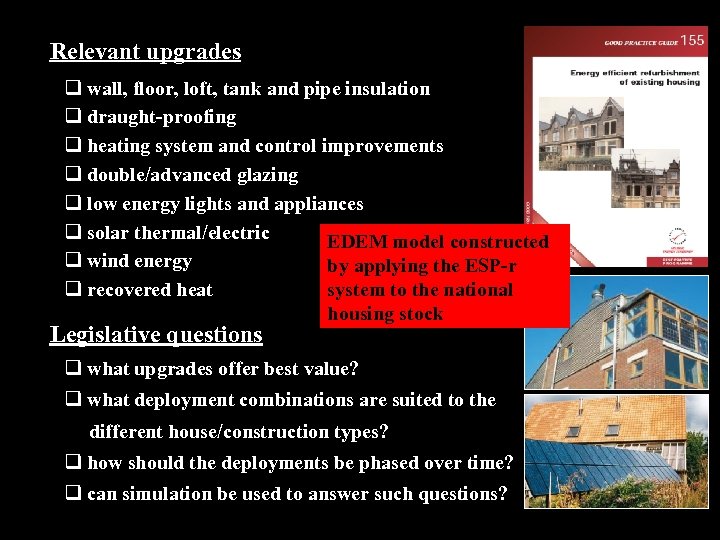
Relevant upgrades q wall, floor, loft, tank and pipe insulation q draught-proofing q heating system and control improvements q double/advanced glazing q low energy lights and appliances q solar thermal/electric EDEM model constructed q wind energy by applying the ESP-r system to the national q recovered heat housing stock Legislative questions q what upgrades offer best value? q what deployment combinations are suited to the different house/construction types? q how should the deployments be phased over time? q can simulation be used to answer such questions?
EDEM: stock modelling q Problematic because of the many permutations of house types, constructional systems and upgrade measures. q Easy to identify dwelling types from an architecture and construction (A/C) viewpoint, but …. • dwellings belonging to the same A/C group may have different energy consumption (/m 2) due to dissimilar energy efficiency measures having been applied; • dwellings corresponding to different A/C groups may have the same consumption because the governing design parameters are essentially the same. q => operate in terms of TCs not A/C types.
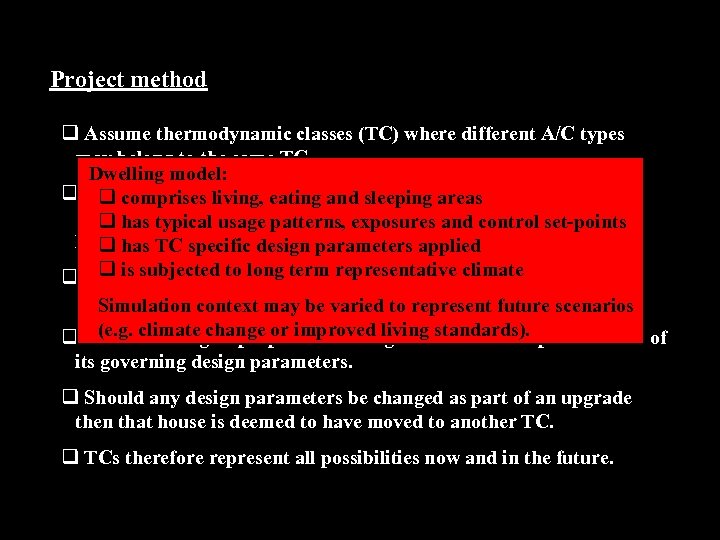
Project method q Assume thermodynamic classes (TC) where different A/C types may belong to the same TC. Dwelling model: q There are 6, 480 TCs each representing unique combination of 7 q comprises living, eating and sleeping areas fabric and 6 system design parameters thatand control set-points q has typical usage patterns, exposures may exist at several levels. TC specific design parameters applied q has q is subjected to long term representative climate q Determine the normalised energy performance of each TCs by simulation. context may be varied to represent future scenarios Simulation (e. g. existing or proposed dwellings to standards). q Relateclimate change or improved livinga TC via the present level of its governing design parameters. q Should any design parameters be changed as part of an upgrade then that house is deemed to have moved to another TC. q TCs therefore represent all possibilities now and in the future.
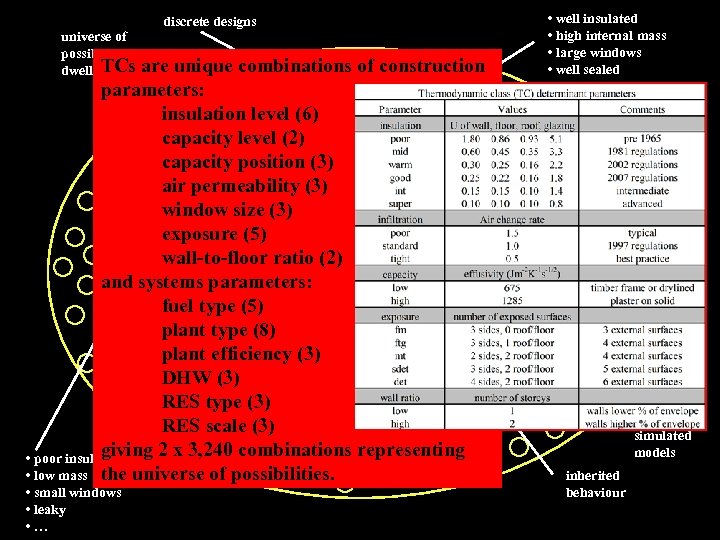
universe of possible TCs dwellings discrete designs are unique combinations of construction parameters: insulation level (6) capacity level (2) capacity position (3) air permeability (3) window size (3) exposure (5) wall-to-floor ratio (2) and systems parameters: fuel type (5) plant type (8) plant efficiency (3) DHW (3) RES type (3) RES scale (3) giving 2 x 3, 240 combinations representing • poor insulation • low mass the universe of possibilities. • small windows • leaky • … • well insulated • high internal mass • large windows • well sealed • … 6, 480 simulated models inherited behaviour
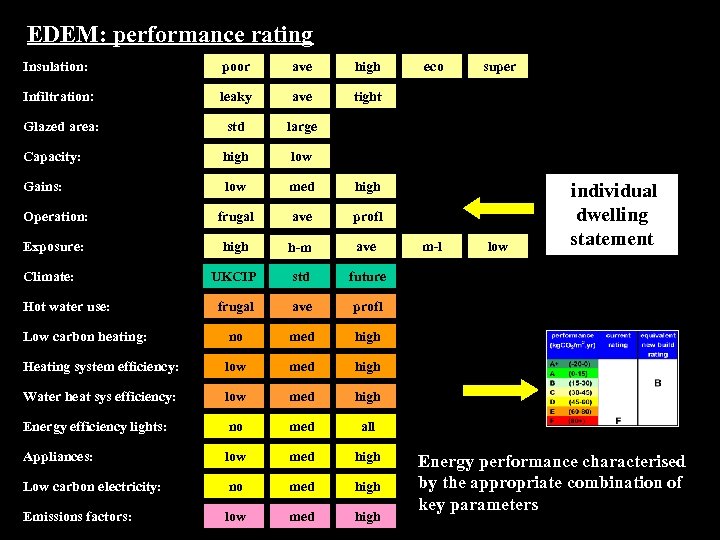
EDEM: performance rating Insulation: poor ave high Infiltration: leaky ave tight Glazed area: std large Capacity: high low Gains: low med high Operation: frugal ave profl Exposure: high h-m ave UKCIP std future frugal ave profl Low carbon heating: no med high Heating system efficiency: low med high Water heat sys efficiency: low med high Energy efficiency lights: no med all Appliances: low med high Low carbon electricity: no med high Emissions factors: low med high Climate: Hot water use: eco m-l super low individual dwelling statement Energy performance characterised by the appropriate combination of key parameters
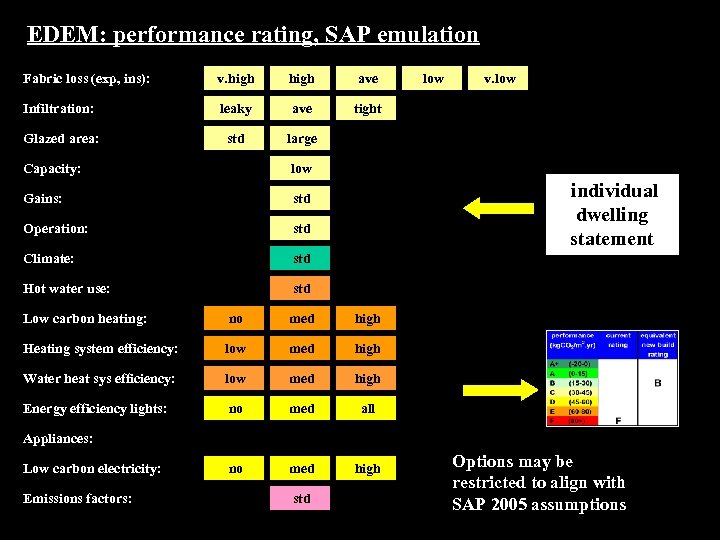
EDEM: performance rating, SAP emulation Fabric loss (exp, ins): v. high ave Infiltration: leaky ave tight Glazed area: std large Capacity: std Operation: std Climate: std Hot water use: v. low Gains: low std individual dwelling statement Low carbon heating: no med high Heating system efficiency: low med high Water heat sys efficiency: low med high Energy efficiency lights: no med all no med high Appliances: Low carbon electricity: Emissions factors: std Options may be restricted to align with SAP 2005 assumptions
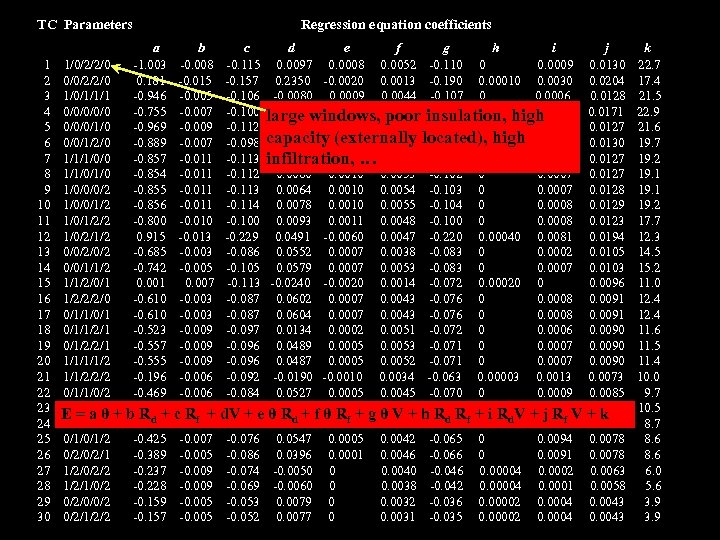
TC Parameters Regression equation coefficients a b c d e f g h i j k 1 1/0/2/2/0 -1. 003 -0. 008 -0. 115 0. 0097 0. 0008 0. 0052 -0. 110 0 0. 0009 0. 0130 22. 7 2 0/0/2/2/0 0. 181 -0. 015 -0. 157 0. 2350 -0. 0020 0. 0013 -0. 190 0. 00010 0. 0030 0. 0204 17. 4 3 1/0/1/1/1 -0. 946 -0. 005 -0. 106 -0. 0080 0. 0009 0. 0044 -0. 107 0 0. 0006 0. 0128 21. 5 4 0/0/0 -0. 755 -0. 007 -0. 100 -0. 0940 0. 0028 0. 0012 -0. 121 0 -0. 0020 0. 0171 22. 9 large windows, poor insulation, high 5 0/0/0/1/0 -0. 969 -0. 009 -0. 112 0. 0387 0. 0009 0. 0052 -0. 105 0 0. 0010 0. 0127 21. 6 capacity (externally located), high 6 0/0/1/2/0 -0. 889 -0. 007 -0. 098 0. 0155 0. 0007 0. 0046 -0. 096 0 0. 0009 0. 0130 19. 7 7 1/1/1/0/0 -0. 857 -0. 011 -0. 113 0. 0048 0. 0010 0. 0054 -0. 102 0 0. 0007 0. 0127 19. 2 infiltration, … 8 1/1/0 -0. 854 -0. 011 -0. 112 0. 0060 0. 0010 0. 0053 -0. 102 0 0. 0007 0. 0127 19. 1 9 1/0/0/0/2 -0. 855 -0. 011 -0. 113 0. 0064 0. 0010 0. 0054 -0. 103 0 0. 0007 0. 0128 19. 1 10 1/0/0/1/2 -0. 856 -0. 011 -0. 114 0. 0078 0. 0010 0. 0055 -0. 104 0 0. 0008 0. 0129 19. 2 11 1/0/1/2/2 -0. 800 -0. 010 -0. 100 0. 0093 0. 0011 0. 0048 -0. 100 0 0. 0008 0. 0123 17. 7 12 1/0/2/1/2 0. 915 -0. 013 -0. 229 0. 0491 -0. 0060 0. 0047 -0. 220 0. 00040 0. 0081 0. 0194 12. 3 13 0/0/2 -0. 685 -0. 003 -0. 086 0. 0552 0. 0007 0. 0038 -0. 083 0 0. 0002 0. 0105 14. 5 14 0/0/1/1/2 -0. 742 -0. 005 -0. 105 0. 0579 0. 0007 0. 0053 -0. 083 0 0. 0007 0. 0103 15. 2 15 1/1/2/0/1 0. 001 0. 007 -0. 113 -0. 0240 -0. 0020 0. 0014 -0. 072 0. 00020 0 0. 0096 11. 0 16 1/2/2/2/0 -0. 610 -0. 003 -0. 087 0. 0602 0. 0007 0. 0043 -0. 076 0 0. 0008 0. 0091 12. 4 17 0/1/1/0/1 -0. 610 -0. 003 -0. 087 0. 0604 0. 0007 0. 0043 -0. 076 0 0. 0008 0. 0091 12. 4 18 0/1/1/2/1 -0. 523 -0. 009 -0. 097 0. 0134 0. 0002 0. 0051 -0. 072 0 0. 0006 0. 0090 11. 6 19 0/1/2/2/1 -0. 557 -0. 009 -0. 096 0. 0489 0. 0005 0. 0053 -0. 071 0 0. 0007 0. 0090 11. 5 20 1/1/2 -0. 555 -0. 009 -0. 096 0. 0487 0. 0005 0. 0052 -0. 071 0 0. 0007 0. 0090 11. 4 21 1/1/2/2/2 -0. 196 -0. 006 -0. 092 -0. 0190 -0. 0010 0. 0034 -0. 063 0. 00003 0. 0013 0. 0073 10. 0 22 0/1/1/0/2 -0. 469 -0. 006 -0. 084 0. 0527 0. 0005 0. 0045 -0. 070 0 0. 0009 0. 0085 9. 7 23 1/2/0 -0. 465 -0. 009 -0. 102 0. 0130 0. 0002 0. 0053 -0. 071 0 0. 0006 0. 0091 10. 5 E = a θ + b Rd + c Rf + d. V + e θ Rd + f θ Rf + g θ V + h Rd Rf + i Rd. V + j Rf V + k 24 0/2/1/0/1 -0. 396 -0. 005 -0. 088 0. 0425 0. 0001 0. 0047 -0. 068 0 0. 0010 0. 0080 8. 7 25 0/1/2 -0. 425 -0. 007 -0. 076 0. 0547 0. 0005 0. 0042 -0. 065 0 0. 0094 0. 0078 8. 6 26 0/2/1 -0. 389 -0. 005 -0. 086 0. 0396 0. 0001 0. 0046 -0. 066 0 0. 0091 0. 0078 8. 6 27 1/2/0/2/2 -0. 237 -0. 009 -0. 074 -0. 0050 0 0. 0040 -0. 046 0. 00004 0. 0002 0. 0063 6. 0 28 1/2/1/0/2 -0. 228 -0. 009 -0. 069 -0. 0060 0 0. 0038 -0. 042 0. 00004 0. 0001 0. 0058 5. 6 29 0/2/0/0/2 -0. 159 -0. 005 -0. 053 0. 0079 0 0. 0032 -0. 036 0. 00002 0. 0004 0. 0043 3. 9 30 0/2/1/2/2 -0. 157 -0. 005 -0. 052 0. 0077 0 0. 0031 -0. 035 0. 00002 0. 0004 0. 0043 3. 9
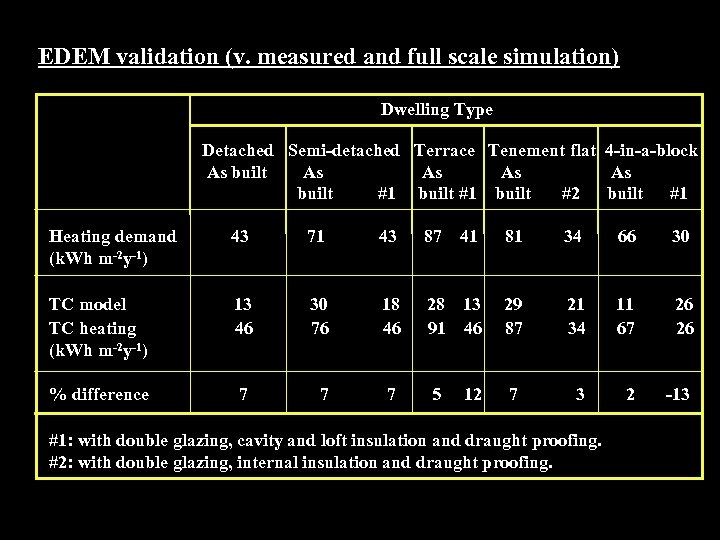
EDEM validation (v. measured and full scale simulation) Dwelling Type Detached Semi-detached Terrace Tenement flat 4 -in-a-block As built As As built #1 built #2 built #1 Heating demand (k. Wh m-2 y-1) 43 71 43 87 41 81 34 66 30 TC model TC heating (k. Wh m-2 y-1) 13 46 30 76 18 46 28 13 91 46 29 87 21 34 11 67 26 26 % difference 7 7 7 5 7 3 2 -13 12 #1: with double glazing, cavity and loft insulation and draught proofing. #2: with double glazing, internal insulation and draught proofing.
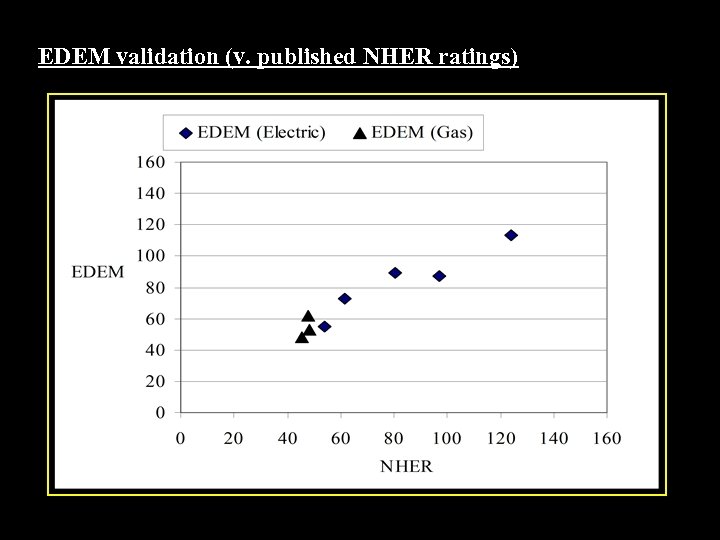
EDEM validation (v. published NHER ratings)
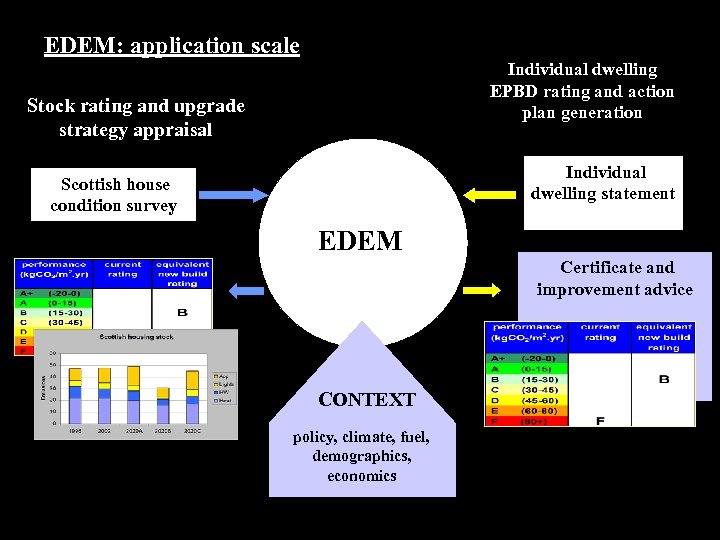
EDEM: application scale Individual dwelling EPBD rating and action plan generation Stock rating and upgrade strategy appraisal Individual dwelling statement Scottish house condition survey EDEM Certificate and improvement advice CONTEXT policy, climate, fuel, demographics, economics
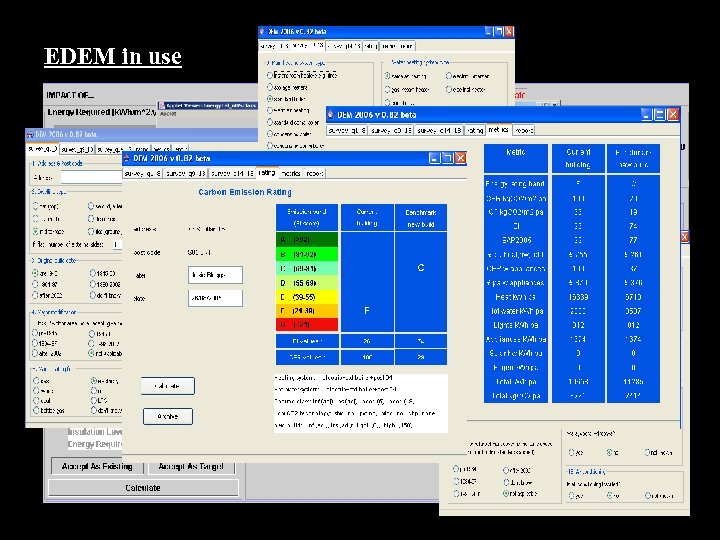
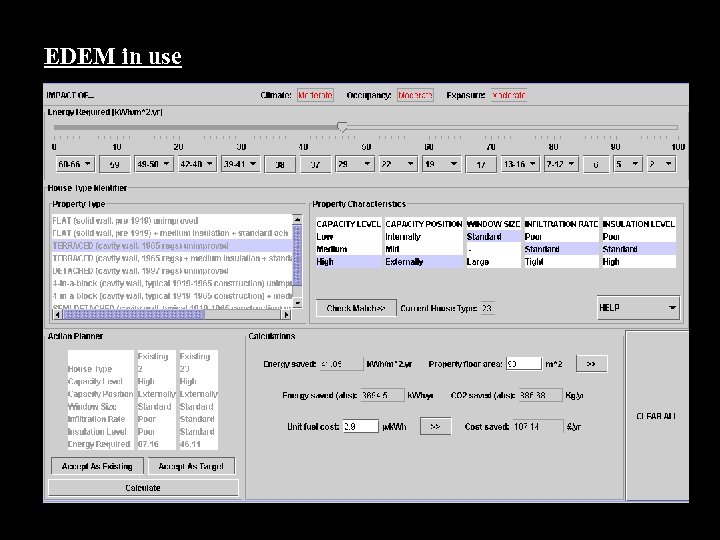
EDEM in use
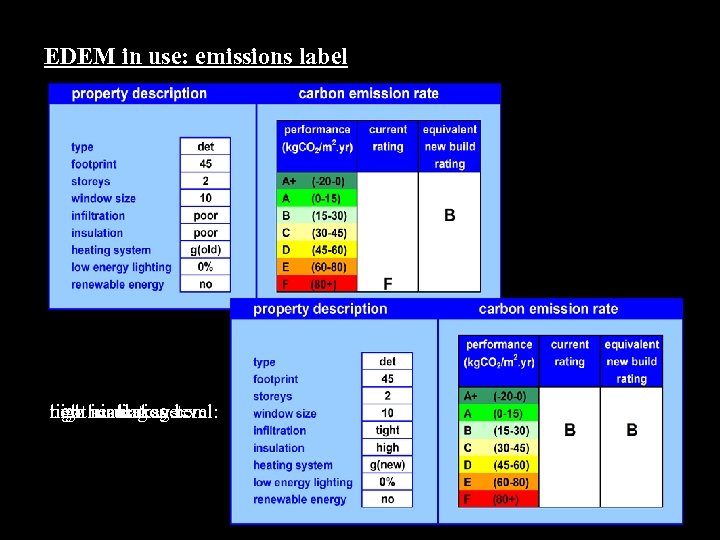
EDEM in use: emissions label new heating system: tight air leakage: high insulation level:
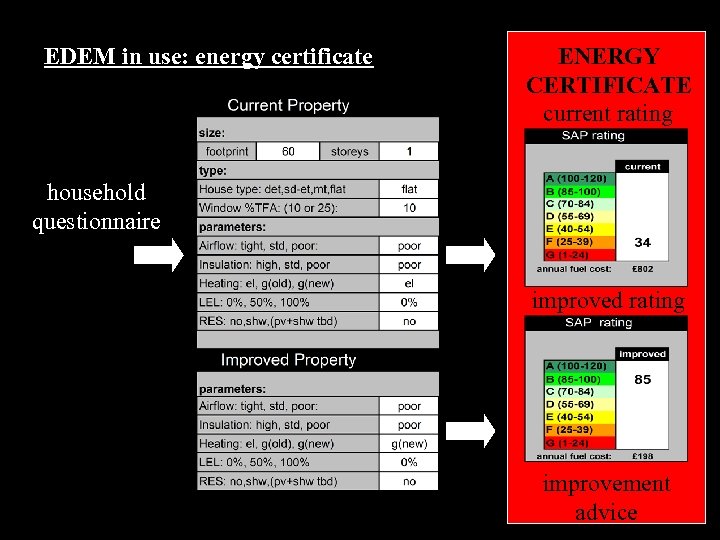
EDEM in use: energy certificate ENERGY CERTIFICATE current rating household questionnaire improved rating improvement advice
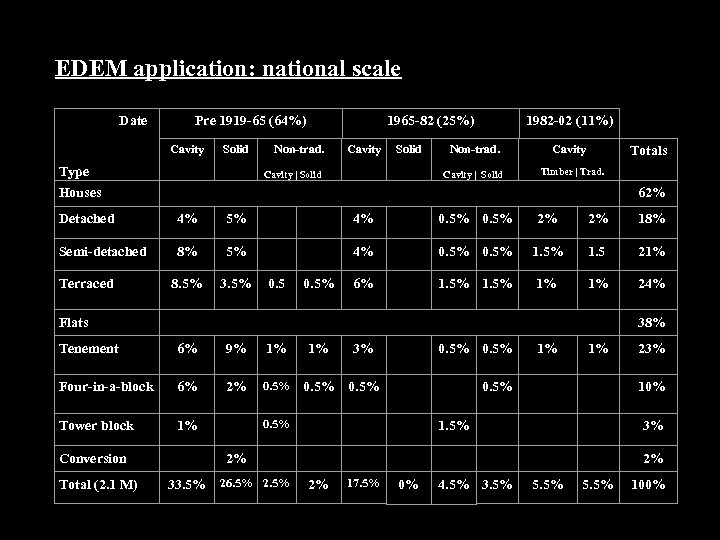
EDEM application: national scale Date Pre 1919 -65 (64%) Cavity Solid Type 1965 -82 (25%) Non-trad. Cavity Solid Cavity | Solid 1982 -02 (11%) Non-trad. Cavity | Solid Cavity Totals Timber | Trad. 62% Houses Detached 4% 5% 4% 0. 5% Semi-detached 8% 5% 4% 8. 5% 3. 5% 0. 5% 6% Terraced 2% 1. 5 18% 0. 5% 2% 1. 5% 1% 24% 38% Flats Tenement 6% 9% 1% Four-in-a-block 6% 2% 0. 5% Tower block 1% 0. 5% Conversion 2% 17. 5% Total (2. 1 M) 21% 33. 5% 26. 5% 2. 5% 1% 3% 0. 5% 1% 1% 23% 0. 5% 10% 1. 5% 3% 2% 5. 5% 100% 0% 4. 5% 3. 5%
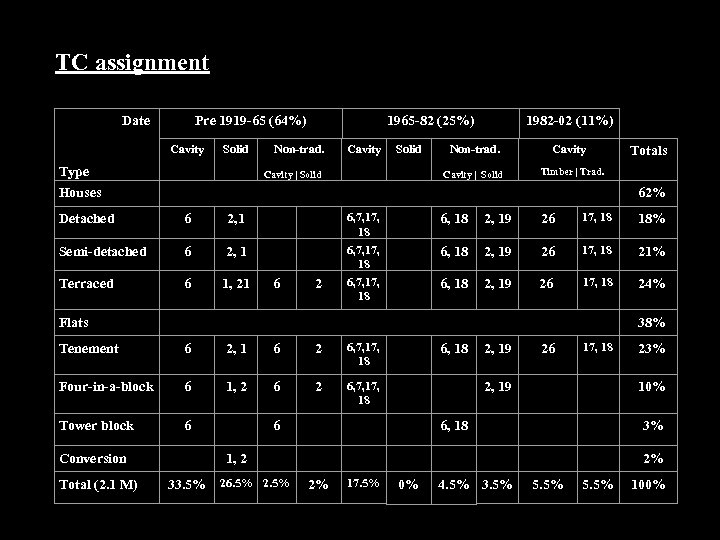
TC assignment Date Pre 1919 -65 (64%) Cavity Solid Type 1965 -82 (25%) Non-trad. Cavity Solid Cavity | Solid 1982 -02 (11%) Non-trad. Cavity | Solid Cavity Totals Timber | Trad. 62% Houses Detached 6 2, 1 Semi-detached 6 2, 1 Terraced 6 1, 21 6 2 6, 7, 17, 18 6, 7, 18 17, 18 18% 2, 19 26 17, 18 21% 2, 19 26 17, 18 24% 6, 18 2, 19 6, 18 38% Flats Tenement 6 2, 1 6 2 6, 7, 18 6, 18 2, 19 26 17, 18 23% Four-in-a-block 6 1, 2 6, 7, 18 2, 19 10% Tower block 6 6 6, 18 3% Conversion 1, 2 2% 2% 17. 5% 5. 5% 100% Total (2. 1 M) 33. 5% 26. 5% 2. 5% 0% 4. 5% 3. 5%
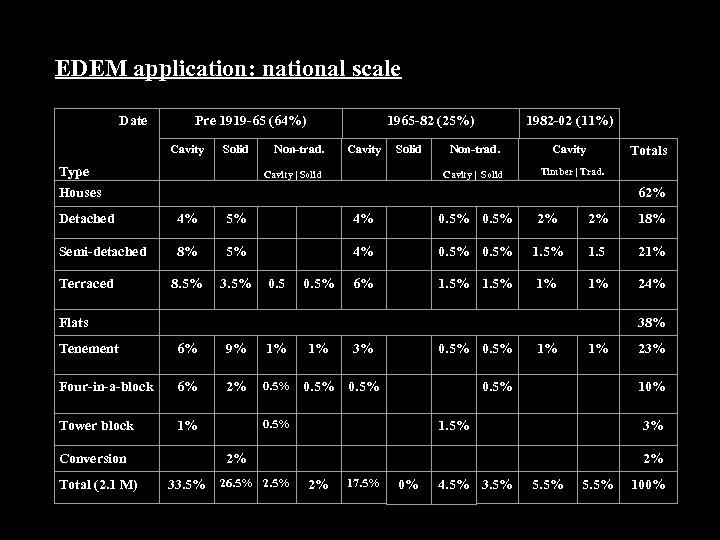
EDEM application: national scale Date Pre 1919 -65 (64%) Cavity Solid Type 1965 -82 (25%) Non-trad. Cavity Solid Cavity | Solid 1982 -02 (11%) Non-trad. Cavity | Solid Cavity Totals Timber | Trad. 62% Houses Detached 4% 5% 4% 0. 5% Semi-detached 8% 5% 4% 8. 5% 3. 5% 0. 5% 6% Terraced 2% 1. 5 18% 0. 5% 2% 1. 5% 1% 24% 38% Flats Tenement 6% 9% 1% Four-in-a-block 6% 2% 0. 5% Tower block 1% 0. 5% Conversion 2% 17. 5% Total (2. 1 M) 21% 33. 5% 26. 5% 2. 5% 1% 3% 0. 5% 1% 1% 23% 0. 5% 10% 1. 5% 3% 2% 5. 5% 100% 0% 4. 5% 3. 5%
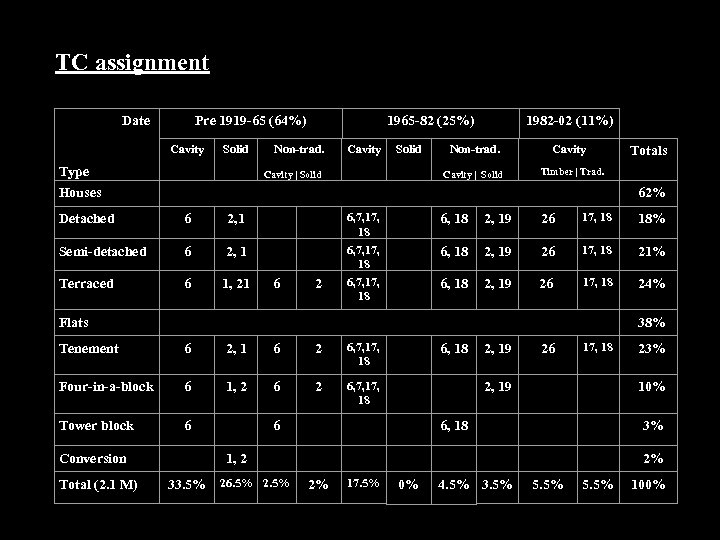
TC assignment Date Pre 1919 -65 (64%) Cavity Solid Type 1965 -82 (25%) Non-trad. Cavity Solid Cavity | Solid 1982 -02 (11%) Non-trad. Cavity | Solid Cavity Totals Timber | Trad. 62% Houses Detached 6 2, 1 Semi-detached 6 2, 1 Terraced 6 1, 21 6 2 6, 7, 17, 18 6, 7, 18 17, 18 18% 2, 19 26 17, 18 21% 2, 19 26 17, 18 24% 6, 18 2, 19 6, 18 38% Flats Tenement 6 2, 1 6 2 6, 7, 18 6, 18 2, 19 26 17, 18 23% Four-in-a-block 6 1, 2 6, 7, 18 2, 19 10% Tower block 6 6 6, 18 3% Conversion 1, 2 2% 2% 17. 5% 5. 5% 100% Total (2. 1 M) 33. 5% 26. 5% 2. 5% 0% 4. 5% 3. 5%
EDEM in use
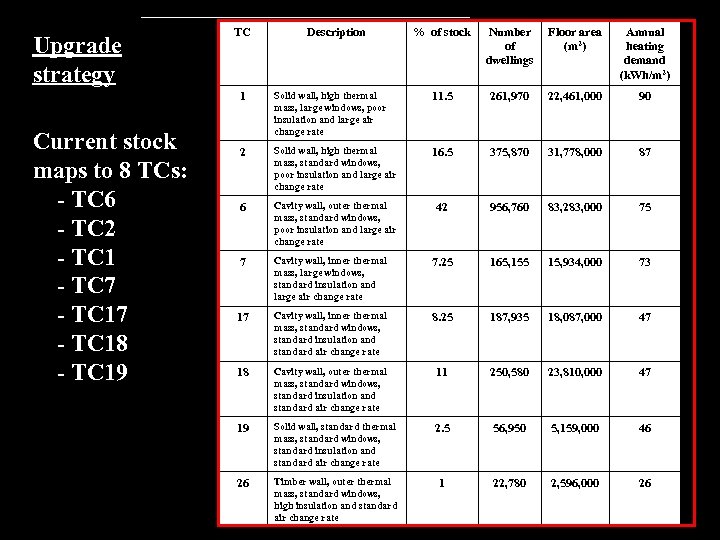
Upgrade strategy TC Description % of stock Number of dwellings Floor area (m 2) Annual heating demand (k. Wh/m 2) 1 Current stock maps to 8 TCs: - TC 6 - TC 2 - TC 1 - TC 7 - TC 18 - TC 19 Solid wall, high thermal mass, large windows, poor insulation and large air change rate 11. 5 261, 970 22, 461, 000 90 2 Solid wall, high thermal mass, standard windows, poor insulation and large air change rate 16. 5 375, 870 31, 778, 000 87 6 Cavity wall, outer thermal mass, standard windows, poor insulation and large air change rate 42 956, 760 83, 283, 000 75 7 Cavity wall, inner thermal mass, large windows, standard insulation and large air change rate 7. 25 165, 155 15, 934, 000 73 17 Cavity wall, inner thermal mass, standard windows, standard insulation and standard air change rate 8. 25 187, 935 18, 087, 000 47 18 Cavity wall, outer thermal mass, standard windows, standard insulation and standard air change rate 11 250, 580 23, 810, 000 47 19 Solid wall, standard thermal mass, standard windows, standard insulation and standard air change rate 2. 5 56, 950 5, 159, 000 46 26 Timber wall, outer thermal mass, standard windows, high insulation and standard air change rate 1 22, 780 2, 596, 000 26
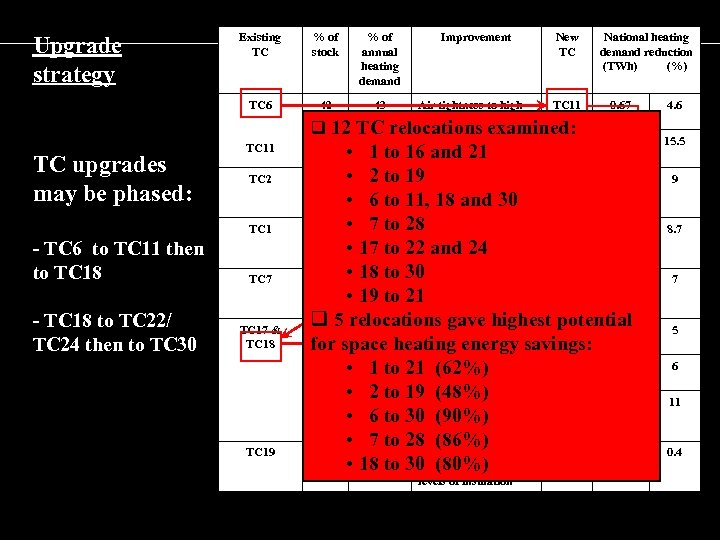
Existing TC % of stock % of annual heating demand TC 6 Upgrade strategy 42 43 Improvement New TC Air tightness to high standards TC 11 Insulation to standard TC 18 q 12 TC relocations examined: TC upgrades may be phased: TC 11 TC 2 TC 1 - TC 6 to TC 11 then to TC 18 TC 7 - TC 18 to TC 22/ TC 24 then to TC 30 TC 17 & TC 18 TC 19 National heating demand reduction (TWh) (%) 0. 67 4. 6 2. 2 15. 5 • 1 to 16 and 21 levels 16. 5 • 2 to 19 19 Standard levels of TC 19 1. 3 draught proofing and • 6 to 11, 18 and 30 insulation 11. 5 • 7 to 28 14 High levels of draught TC 21 1. 2 proofing; standard • 17 to 22 andinsulation 24 levels of 7. 25 • 188 to 30 High levels of draught TC 28 1 proofing and • 19 to 21 insulation q 5 relocations levels of draught TC 22 gave highest potential 19. 25 13. 5 High 0. 7 proofing for space heating energy savings: High levels of TC 24 0. 9 • 1 to 21 (62%) insulation • 2 to 19 (48%) draught TC 30 High levels of 1. 6 proofing and • 6 to 30 (90%) insulation • 7 to 28 (86%) draught TC 21 0. 06 2. 5 1. 5 High levels of • 18 to 30 (80%) proofing; standard levels of insulation 9 8. 7 7 5 6 11 0. 4
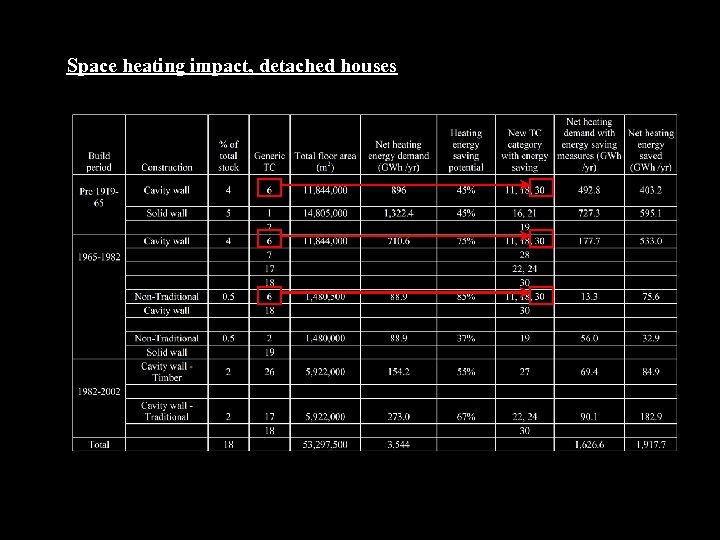
Space heating impact, detached houses
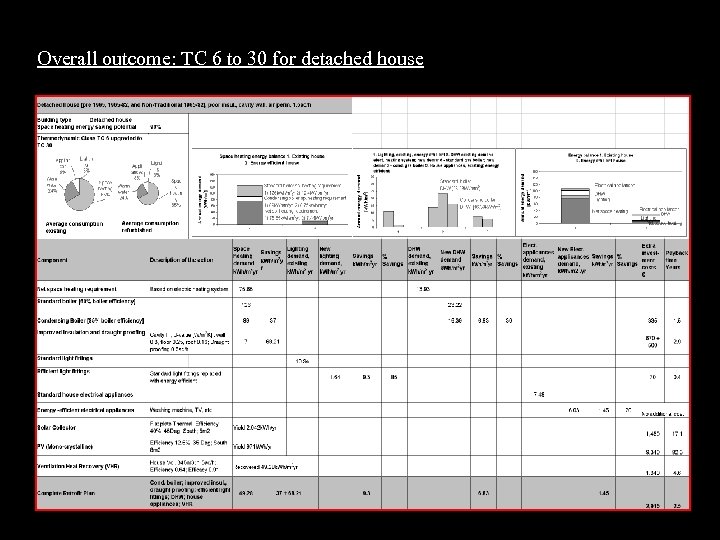
Overall outcome: TC 6 to 30 for detached house
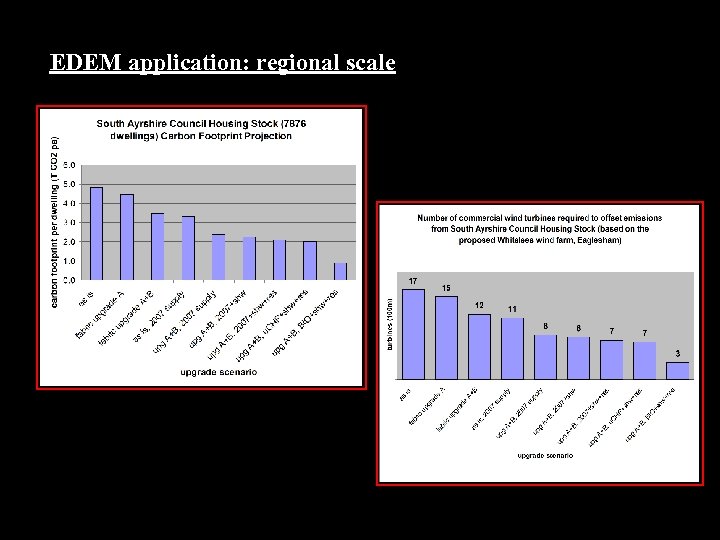
EDEM application: regional scale improvement advice
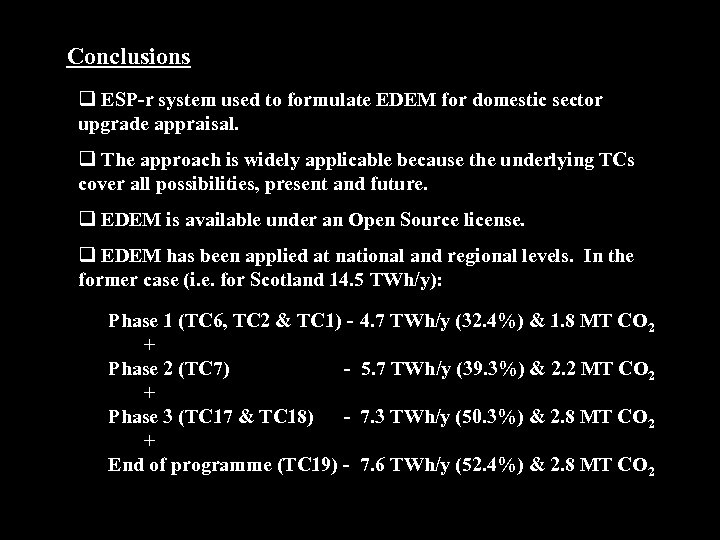
Conclusions q ESP-r system used to formulate EDEM for domestic sector upgrade appraisal. q The approach is widely applicable because the underlying TCs cover all possibilities, present and future. q EDEM is available under an Open Source license. q EDEM has been applied at national and regional levels. In the former case (i. e. for Scotland 14. 5 TWh/y): Phase 1 (TC 6, TC 2 & TC 1) + Phase 2 (TC 7) + Phase 3 (TC 17 & TC 18) + End of programme (TC 19) - 4. 7 TWh/y (32. 4%) & 1. 8 MT CO 2 5. 7 TWh/y (39. 3%) & 2. 2 MT CO 2 7. 3 TWh/y (50. 3%) & 2. 8 MT CO 2 7. 6 TWh/y (52. 4%) & 2. 8 MT CO 2
Скачать презентацию Energy and Carbon Performance of Housing Upgrade Analysis
9bec03b8313e6e383b62f70e58b13958.ppt