 Скачать презентацию Enduring Homeland Security Solutions Public Safety Integration Center
10016614c9d35868dcc8d957724a417a.ppt
- Количество слайдов: 17



Enduring Homeland Security Solutions Public Safety Integration Center Capabilities Briefing Focus on Mandatory Wireless Interoperability for Public Safety Communications Public Safety Integration Center SAIC Enterprise Building, Mc. Lean, Virginia December 2002 1
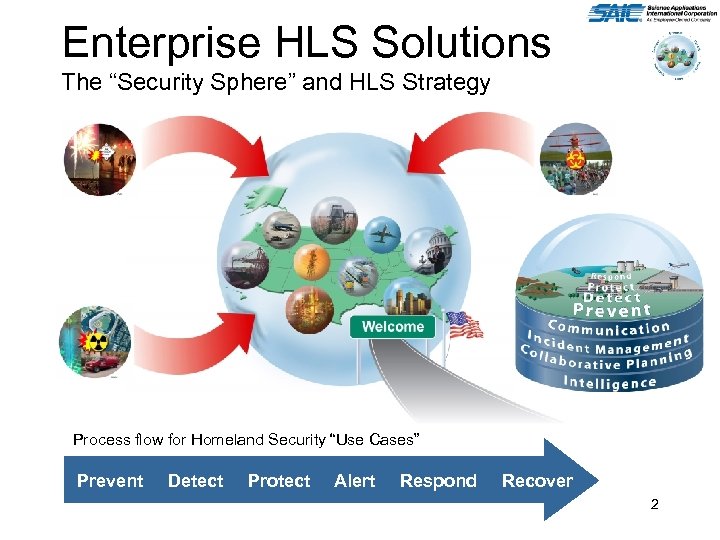
Enterprise HLS Solutions The “Security Sphere” and HLS Strategy Process flow for Homeland Security “Use Cases” Prevent Detect Protect Alert Respond Recover 2
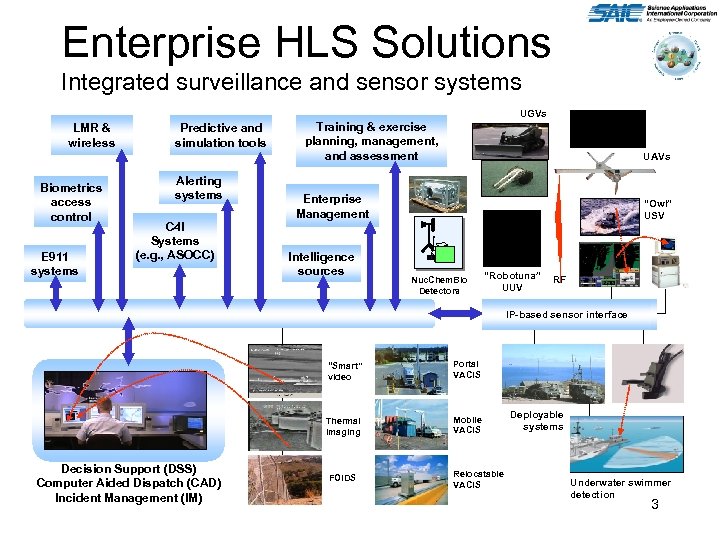
Enterprise HLS Solutions Integrated surveillance and sensor systems UGVs LMR & wireless Biometrics access control E 911 systems Predictive and simulation tools Alerting systems C 4 I Systems (e. g. , ASOCC) Training & exercise planning, management, and assessment UAVs Enterprise Management Intelligence sources “Owl” USV Nuc. Chem. Bio Detectors “Robotuna” UUV RF IP-based sensor interface Computer Aided Dispatch “Smart” video Thermal imaging Decision Support (DSS) Computer Aided Dispatch (CAD) Incident Management (IM) Portal VACIS Mobile VACIS FOIDS Relocatable VACIS Deployable systems Underwater swimmer detection 3
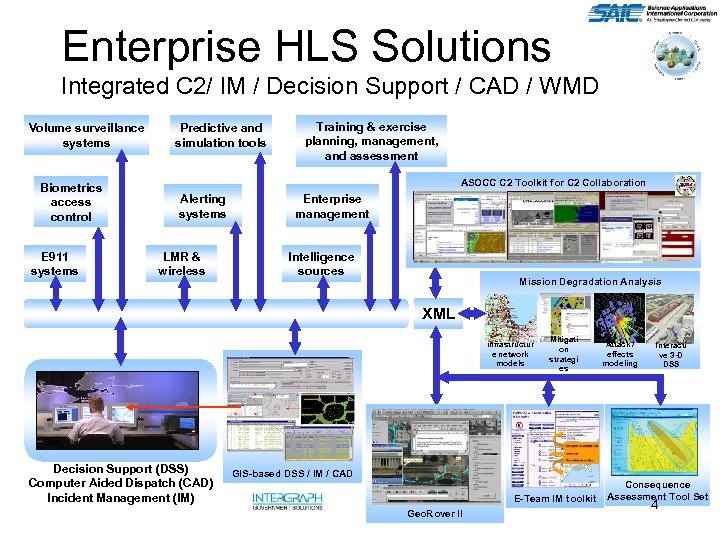
Enterprise HLS Solutions Integrated C 2/ IM / Decision Support / CAD / WMD Volume surveillance systems Biometrics access control E 911 systems Predictive and simulation tools Training & exercise planning, management, and assessment ASOCC C 2 Toolkit for C 2 Collaboration Alerting systems LMR & wireless Enterprise management Intelligence sources Mission Degradation Analysis XML Infrastructur e network models Decision Support (DSS) Computer Aided Dispatch (CAD) Incident Management (IM) Mitigati on strategi es GIS-based DSS / IM / CAD E-Team IM toolkit Geo. Rover II Attack / effects modeling Interacti ve 3 -D DSS Consequence Assessment Tool Set 4
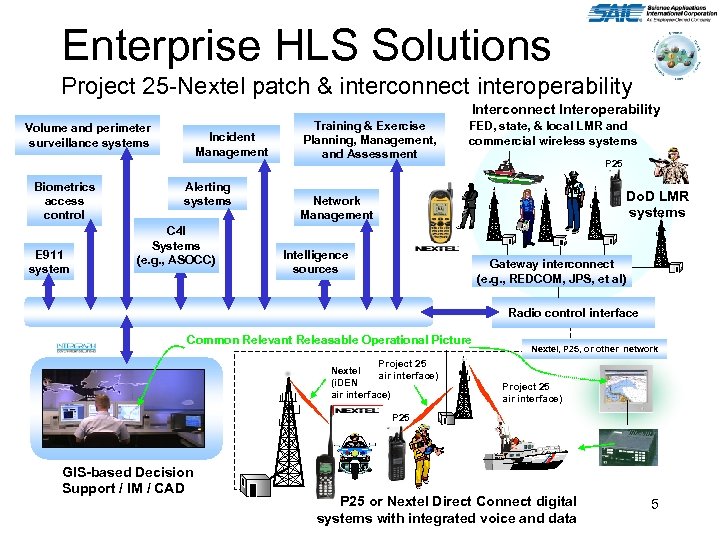
Enterprise HLS Solutions Project 25 -Nextel patch & interconnect interoperability Interconnect Interoperability Volume and perimeter surveillance systems Biometrics access control E 911 system Incident Management Alerting systems C 4 I Systems (e. g. , ASOCC) Training & Exercise Planning, Management, and Assessment FED, state, & local LMR and commercial wireless systems P 25 Do. D LMR systems Network Management Intelligence sources Gateway interconnect (e. g. , REDCOM, JPS, et al) Radio control interface Common Relevant Releasable Operational Picture Project 25 air interface) Nextel (i. DEN air interface) Nextel, P 25, or other network Project 25 air interface) P 25 GIS-based Decision Support / IM / CAD P 25 or Nextel Direct Connect digital systems with integrated voice and data 5
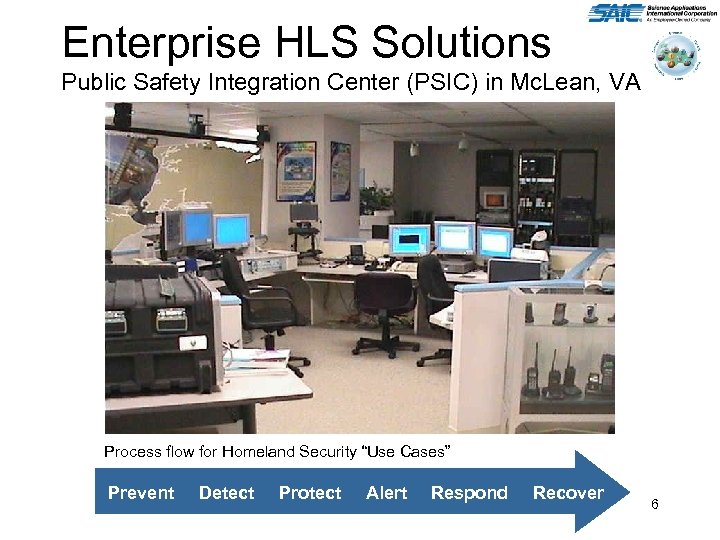
Enterprise HLS Solutions Public Safety Integration Center (PSIC) in Mc. Lean, VA Process flow for Homeland Security “Use Cases” Prevent Detect Protect Alert Respond Recover 6
Legacy Words of wisdom from radio history • “…all those who have been working with me, entertain a true feeling of gratitude that wireless … has again helped to save human lives. ” • “…two† operators, so that one may be on duty at all time. … With two operators, one could be working the news, the other – …[if] properly equipped – could be listening for distress signals. ” • “I am proud, but I see many things that will have to be done if wireless is to be be of the fullest utility” • “Wireless … should not be regulated to death, as it easily could be” – “… it simply must be governed in some manner, and the one body fit to do the regulating would be an international board. ” – “All must be considered and must join in the proceedings. ” † Emphasis added 7
Legacy Results of coastal state PS survey - 1999 1972 • “It is a common experience for one police agency to not have information concerning the on-going activities of another agency with concurrent jurisdiction. This can prove to be dangerous for all members of the law enforcement community. ” from a Police Chief in a 1, 000 person jurisdiction • Major urban PD cannot communicate by radio with the State Police, nearby towns can’t communicate with the State Police or urban PD • No broadcast capability into adjacent towns, as well as the inability to call for mutual aid, have put lives and property at risk • One coastal PD must communicate with Army Corps of Engineers, Drug Enforcement Agency, US Coast Guard, US Navy, US Army campus security, and US Air Force campus security, besides adjacent towns and the State Police - but can’t. 8
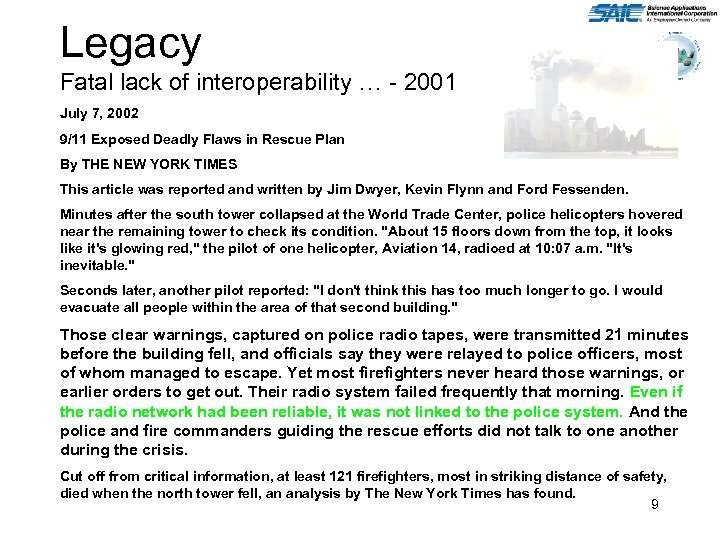
Legacy Fatal lack of interoperability … - 2001 July 7, 2002 9/11 Exposed Deadly Flaws in Rescue Plan By THE NEW YORK TIMES This article was reported and written by Jim Dwyer, Kevin Flynn and Ford Fessenden. Minutes after the south tower collapsed at the World Trade Center, police helicopters hovered near the remaining tower to check its condition. "About 15 floors down from the top, it looks like it's glowing red, " the pilot of one helicopter, Aviation 14, radioed at 10: 07 a. m. "It's inevitable. " Seconds later, another pilot reported: "I don't think this has too much longer to go. I would evacuate all people within the area of that second building. " Those clear warnings, captured on police radio tapes, were transmitted 21 minutes before the building fell, and officials say they were relayed to police officers, most of whom managed to escape. Yet most firefighters never heard those warnings, or earlier orders to get out. Their radio system failed frequently that morning. Even if the radio network had been reliable, it was not linked to the police system. And the police and fire commanders guiding the rescue efforts did not talk to one another during the crisis. Cut off from critical information, at least 121 firefighters, most in striking distance of safety, died when the north tower fell, an analysis by The New York Times has found. 9
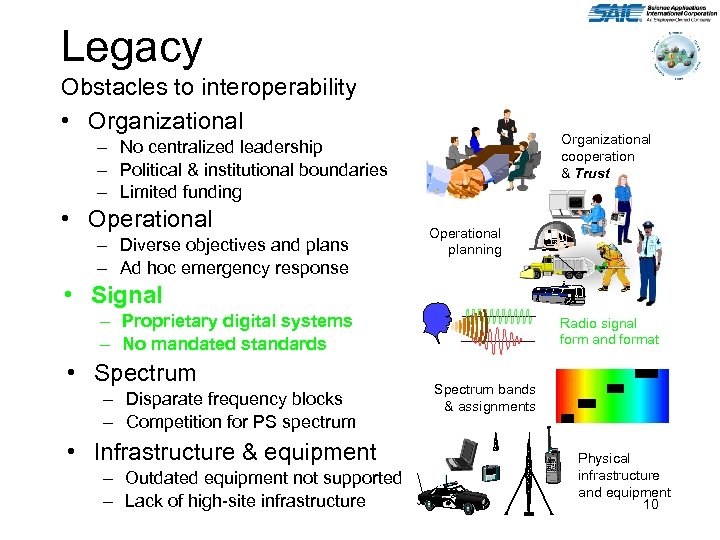
Legacy Obstacles to interoperability • Organizational cooperation & Trust – No centralized leadership – Political & institutional boundaries – Limited funding • Operational – Diverse objectives and plans – Ad hoc emergency response Operational planning • Signal – Proprietary digital systems – No mandated standards • Spectrum – Disparate frequency blocks – Competition for PS spectrum • Infrastructure & equipment – Outdated equipment not supported – Lack of high-site infrastructure Radio signal form and format Spectrum bands & assignments Physical infrastructure and equipment 10
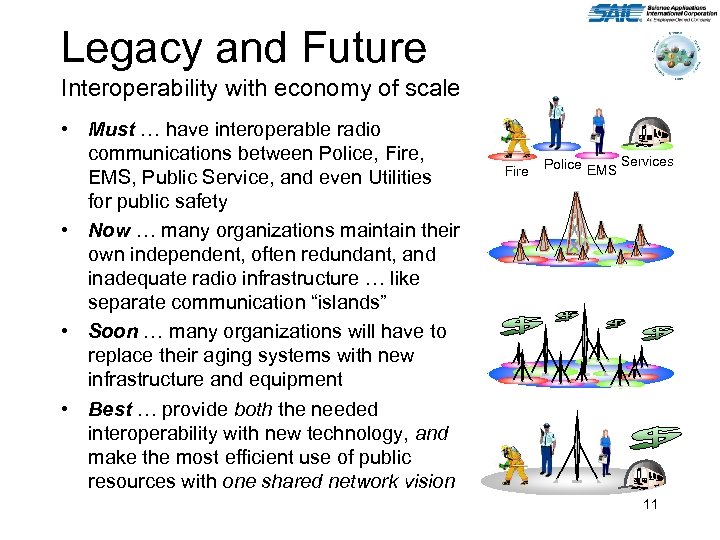
Legacy and Future Interoperability with economy of scale • Must … have interoperable radio communications between Police, Fire, EMS, Public Service, and even Utilities for public safety • Now … many organizations maintain their own independent, often redundant, and inadequate radio infrastructure … like separate communication “islands” • Soon … many organizations will have to replace their aging systems with new infrastructure and equipment • Best … provide both the needed interoperability with new technology, and make the most efficient use of public resources with one shared network vision Fire Police EMS Services 11
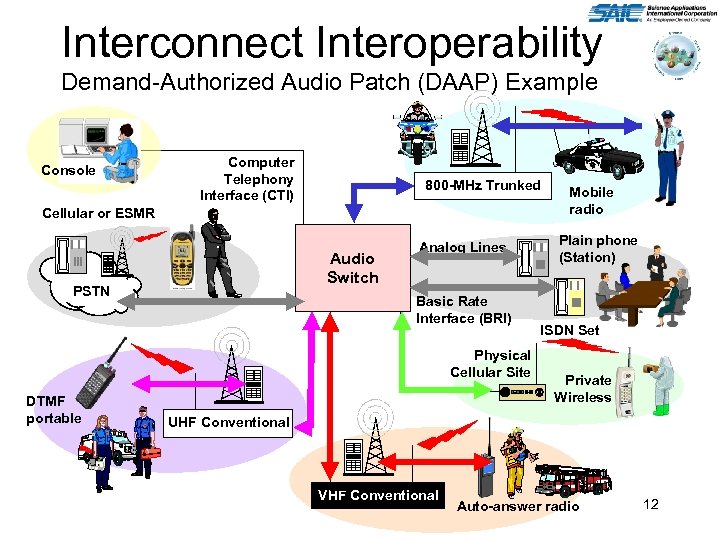
Interconnect Interoperability Demand-Authorized Audio Patch (DAAP) Example Console Computer Telephony Interface (CTI) 800 -MHz Trunked Cellular or ESMR Audio Switch PSTN Analog Lines Basic Rate Interface (BRI) Physical Cellular Site DTMF portable Mobile radio Plain phone (Station) ISDN Set Private Wireless UHF Conventional VHF Conventional Auto-answer radio 12
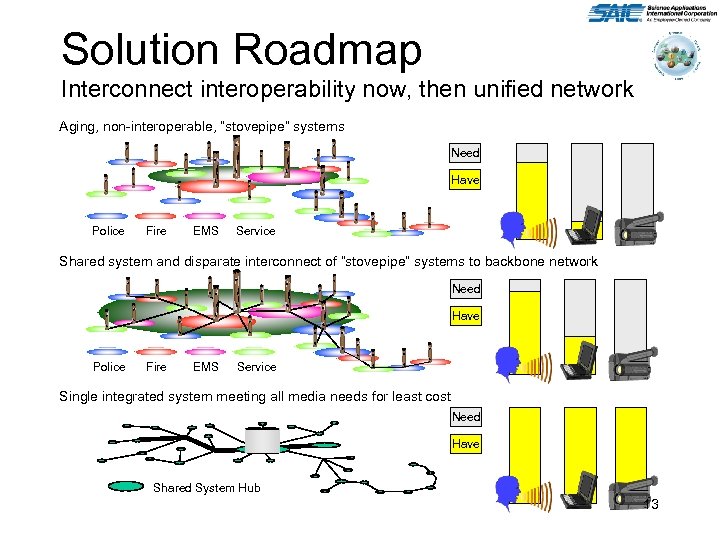
Solution Roadmap Interconnect interoperability now, then unified network Aging, non-interoperable, “stovepipe” systems Need Have Police Fire EMS Service Shared system and disparate interconnect of “stovepipe” systems to backbone network Need Have Police Fire EMS Service Single integrated system meeting all media needs for least cost Need Have Shared System Hub 13
Enduring Interoperability Digital Network Management System (DNMS) l Talk-group interoperability across disparate systems – Open (IPR-free) DNMS architecture – Land mobile radio & commercial services – Hardware & software reuse l DNMS Consortium SAIC standards oversight with LMR vendors & telecom providers l Progress – – Preliminary MOU ‘ 98 NIJ Feasibility Study ‘ 00 PACMERS requirement Preliminary requirements analysis Figure 7. 7. The DNMS concept, from Robert I. Desourdis, Jr. , David R. Smith, William D. Speights, Richard J. Dewey, John R. Di. Salvo, Emerging Public Safety Wireless Systems, Artech House, Boston, forthcoming. 14
Enduring Interoperability A standards-based “interoperability” model for success • Automated HF Radio MIL-STD-188 -141 … – Government-funded standard technical contributions from users, industry, academia – Drew best technology from proprietary systems – Result is non-proprietary level playing field, no royalties • Restored interoperability among agencies lost in analog-to-digital technology transition • Adopted worldwide as de facto interoperability standard 15
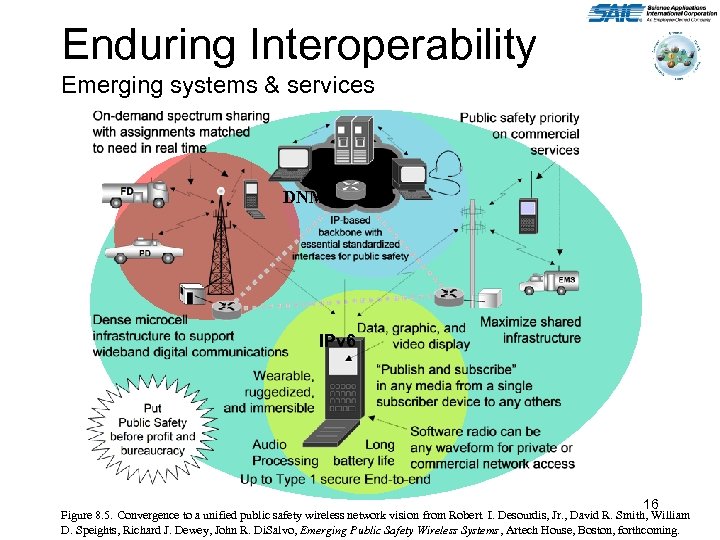
Enduring Interoperability Emerging systems & services DNMS IPv 6 16 Figure 8. 5. Convergence to a unified public safety wireless network vision from Robert I. Desourdis, Jr. , David R. Smith, William D. Speights, Richard J. Dewey, John R. Di. Salvo, Emerging Public Safety Wireless Systems, Artech House, Boston, forthcoming.
Enduring HLS Solutions Bob Desourdis 1710 SAIC Drive, Mc. Lean, VA (703) 676 -4890 desourdisr@saic. com (best) 17
Скачать презентацию Enduring Homeland Security Solutions Public Safety Integration Center
10016614c9d35868dcc8d957724a417a.ppt