 Скачать презентацию End-to-End Issues Route Diversity Load balancing
8fd448d84a26a910a4b039934fb32470.ppt
- Количество слайдов: 24




End-to-End Issues
Route Diversity § Load balancing o Per packet splitting o Per flow splitting § Spill over § Route change o Failure o policy § Route flapping 2
Diversity Effects § Packet reorder o TCP performance o Larger playback buffer § Jitter However, jitter can occur due cross traffic. What contribute more to jitter? 3
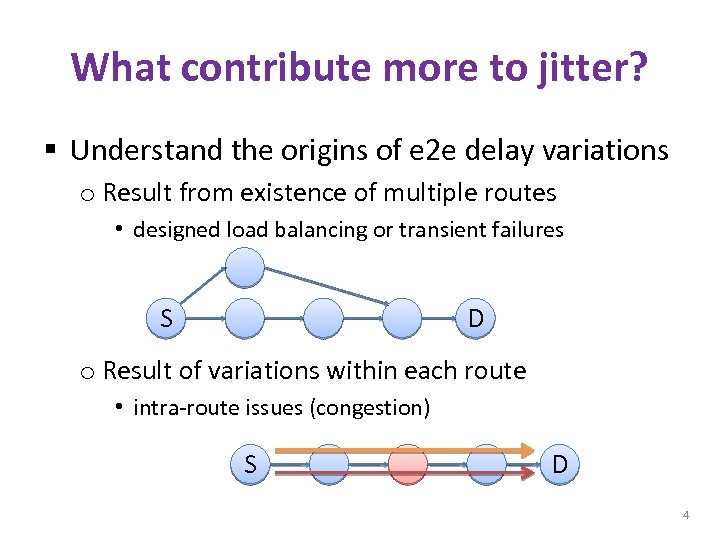
What contribute more to jitter? § Understand the origins of e 2 e delay variations o Result from existence of multiple routes • designed load balancing or transient failures S D o Result of variations within each route • intra-route issues (congestion) S D 4
![Related Work § [Wang et al. , Pucha et al. ] studied the impact](https://present5.com/presentation/8fd448d84a26a910a4b039934fb32470/image-5.jpg "Related Work § [Wang et al. , Pucha et al. ] studied the impact")
Related Work § [Wang et al. , Pucha et al. ] studied the impact that specific routing events have on the overall delay o Routing changes result in significant RTT delay increase o However, variability is small § [Augustin et al. ] examined the delay between different parallel routes in short time epoch o Only 12% have a delay difference which is larger than 1 ms § [Pathak et al. ] studied the delay asymmetry o There is a strong correlation between one-way delay changes and route changes 5
Key Differences § We study the RTT delay alonger time periods § Examine the difference of the delay distribution between parallel routes § Focus on the origin of delay variability o Within each route (e. g. congestion) o Due to multiple routes (e. g. load-balance) 6
How do we measure? • Use DIMES for conducting two experiments – 2006 and 2009 – Over 100 agents measures to each other – Broad set of ASes and geo locations – Active traceroute (ICMP and UDP) – Each agent probes all target IPs every 1 -2 hours – 4 days of probing – Collect the route IPs and e 2 e delay 7
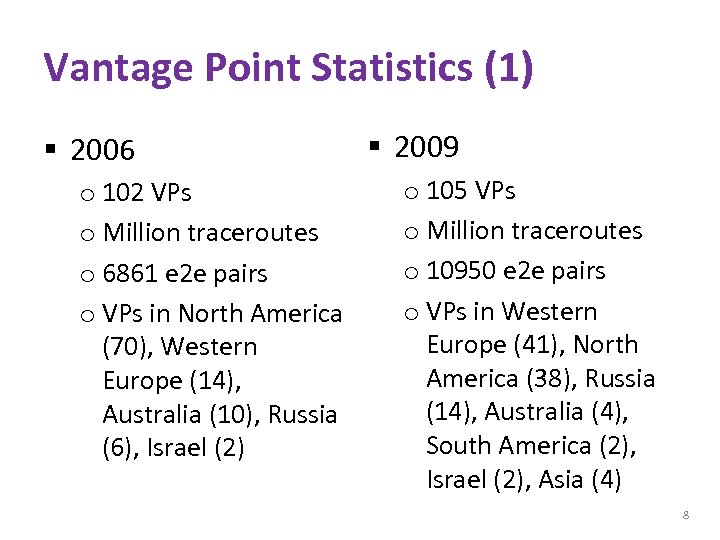
Vantage Point Statistics (1) § 2006 o 102 VPs o Million traceroutes o 6861 e 2 e pairs o VPs in North America (70), Western Europe (14), Australia (10), Russia (6), Israel (2) § 2009 o 105 VPs o Million traceroutes o 10950 e 2 e pairs o VPs in Western Europe (41), North America (38), Russia (14), Australia (4), South America (2), Israel (2), Asia (4) 8
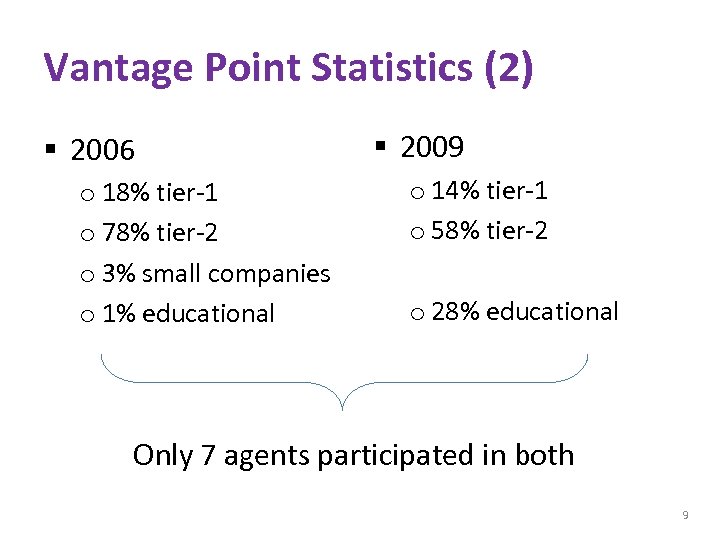
Vantage Point Statistics (2) § 2006 o 18% tier-1 o 78% tier-2 o 3% small companies o 1% educational § 2009 o 14% tier-1 o 58% tier-2 o 28% educational Only 7 agents participated in both 9
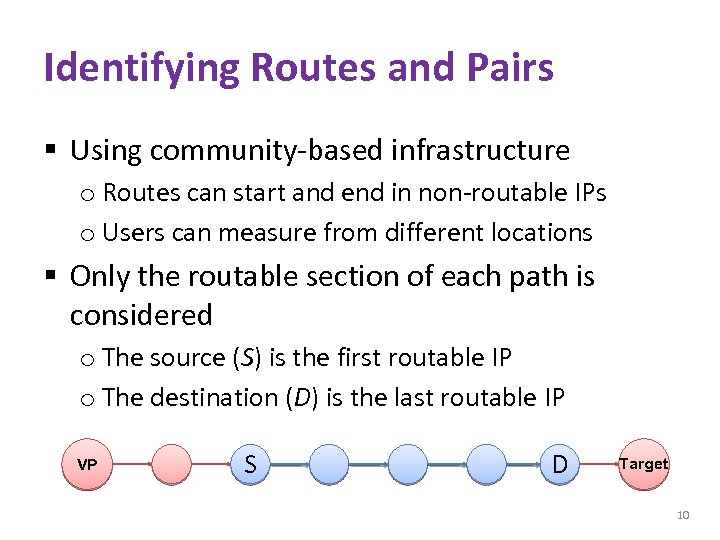
Identifying Routes and Pairs § Using community-based infrastructure o Routes can start and end in non-routable IPs o Users can measure from different locations § Only the routable section of each path is considered o The source (S) is the first routable IP o The destination (D) is the last routable IP VP S D Target 10
Some Accounting • The e 2 e pair Pi=(S, D) contains all the measured paths between S and D • For a pair Pi , the set Eij contains the measured paths that follow route j • For a pair Pi , the dominant route Eir is the route that was seen the most times – There can be several dominant routes with equal prevalence – For brevity we assume there is one at index r 11
Delay Stability (1) § Each route Eij has a set of RTT delays, corresponding to each measured path § Each delay is a sample, we consider the segment length resulting from the 95% confidence interval surrounding the mean value – CI(Eij) § High variance samples result in long CI 12
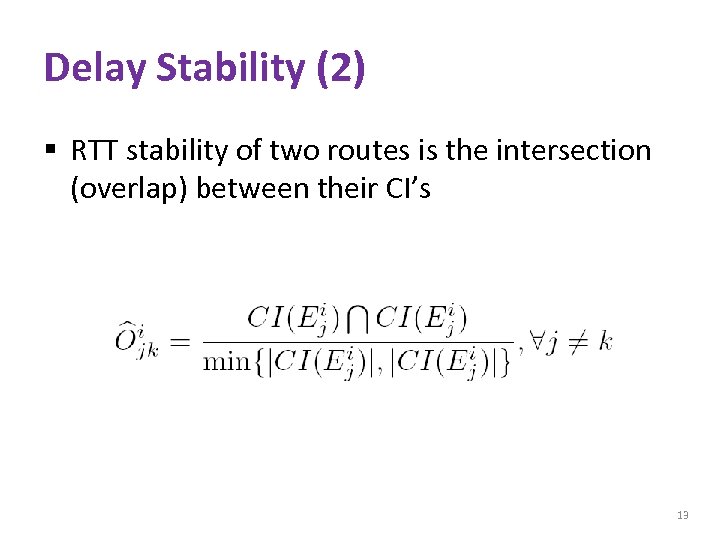
Delay Stability (2) § RTT stability of two routes is the intersection (overlap) between their CI’s 13
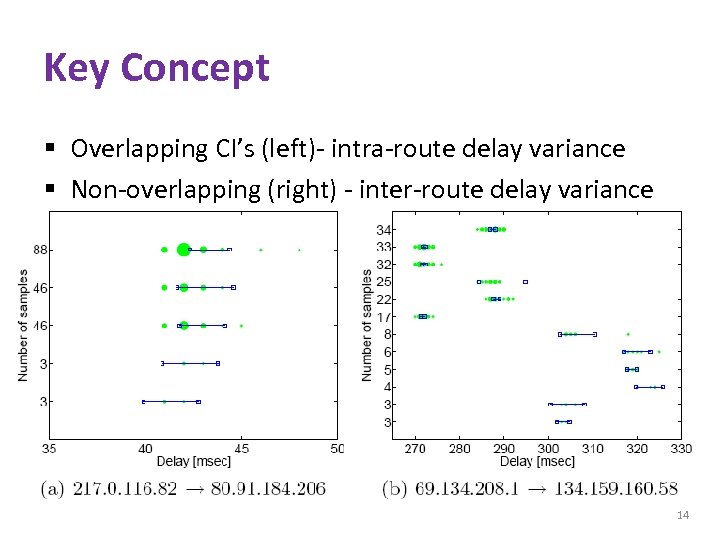
Key Concept § Overlapping CI’s (left)- intra-route delay variance § Non-overlapping (right) - inter-route delay variance 14
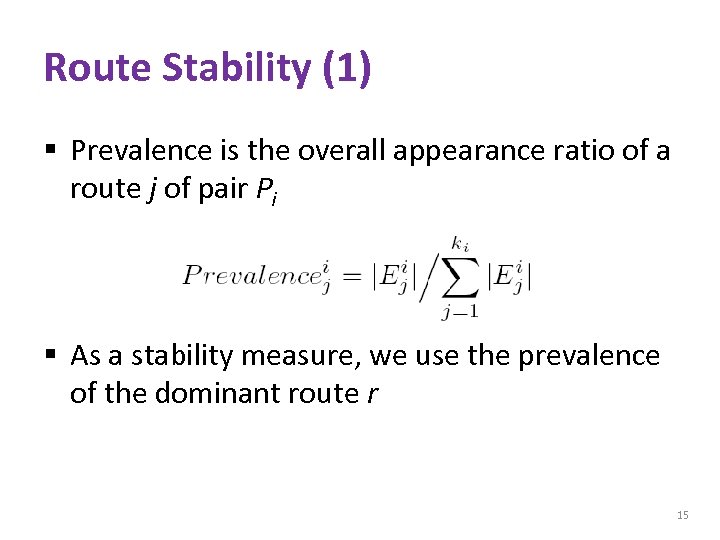
Route Stability (1) § Prevalence is the overall appearance ratio of a route j of pair Pi § As a stability measure, we use the prevalence of the dominant route r 15
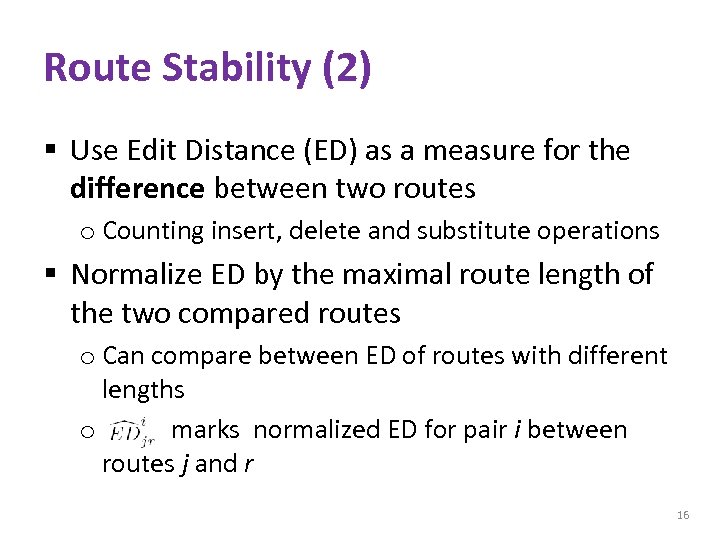
Route Stability (2) § Use Edit Distance (ED) as a measure for the difference between two routes o Counting insert, delete and substitute operations § Normalize ED by the maximal route length of the two compared routes o Can compare between ED of routes with different lengths o marks normalized ED for pair i between routes j and r 16
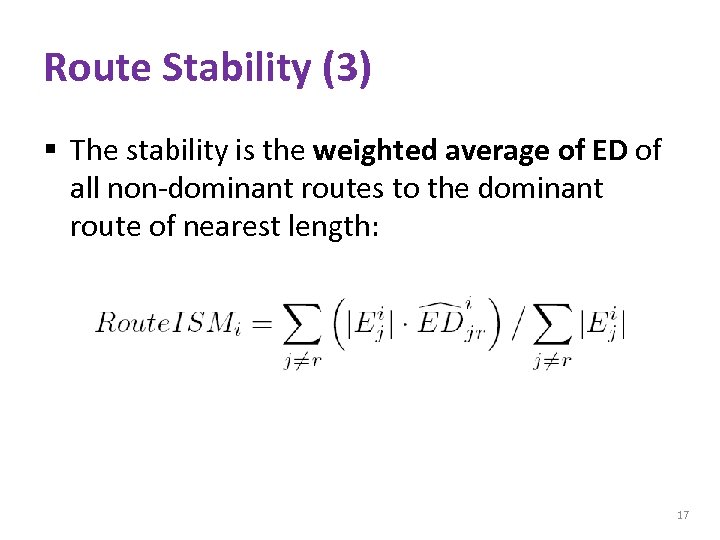
Route Stability (3) § The stability is the weighted average of ED of all non-dominant routes to the dominant route of nearest length: 17
Things to Note § We measure RTT values o Capture forward and reverse path delay o Route stability is measured on the forward path • However, 90% of our routes have very similar forward and reverse paths • Indicating that stability of one-way is a good estimation § Using UDP and ICMP o Capture all possible routes, not flows o Upper bound for instability 18
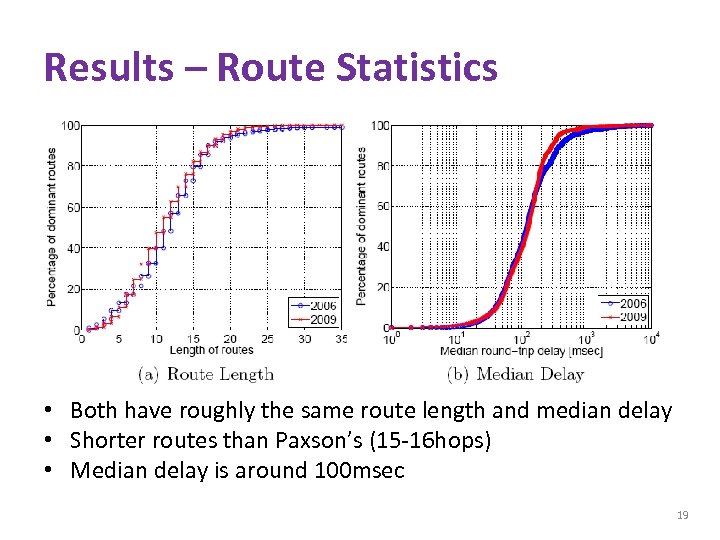
Results – Route Statistics • Both have roughly the same route length and median delay • Shorter routes than Paxson’s (15 -16 hops) • Median delay is around 100 msec 19
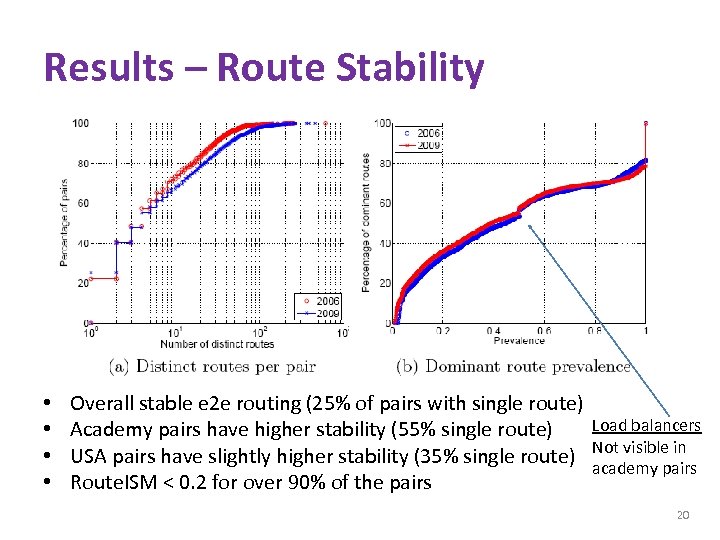
Results – Route Stability • • Overall stable e 2 e routing (25% of pairs with single route) Load balancers Academy pairs have higher stability (55% single route) USA pairs have slightly higher stability (35% single route) Not visible in academy pairs Route. ISM < 0. 2 for over 90% of the pairs 20
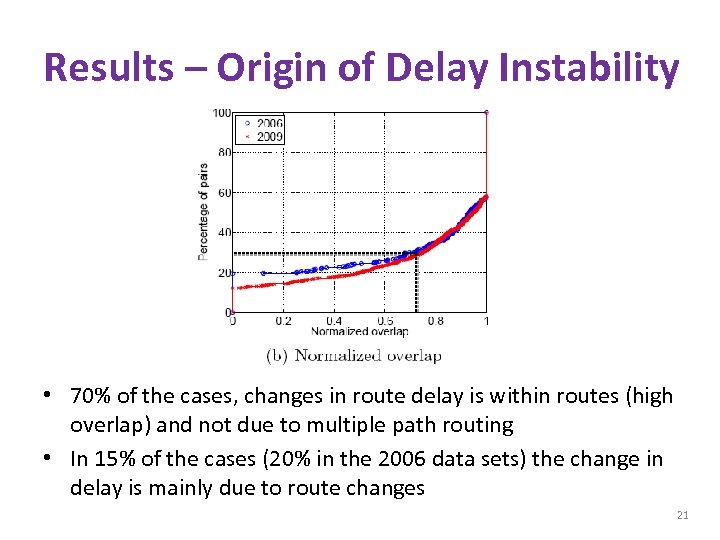
Results – Origin of Delay Instability • 70% of the cases, changes in route delay is within routes (high overlap) and not due to multiple path routing • In 15% of the cases (20% in the 2006 data sets) the change in delay is mainly due to route changes 21
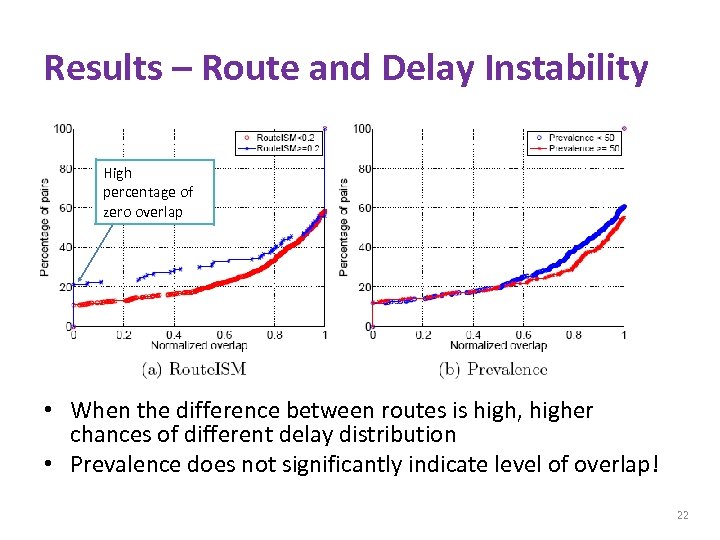
Results – Route and Delay Instability High percentage of zero overlap • When the difference between routes is high, higher chances of different delay distribution • Prevalence does not significantly indicate level of overlap! 22
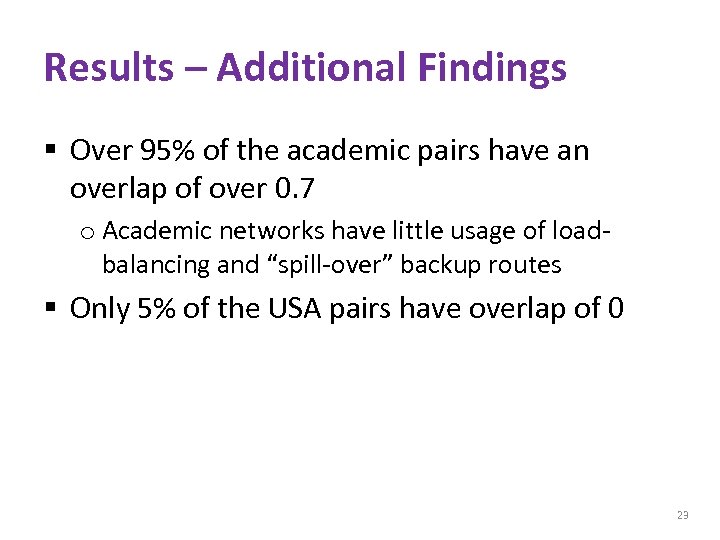
Results – Additional Findings § Over 95% of the academic pairs have an overlap of over 0. 7 o Academic networks have little usage of loadbalancing and “spill-over” backup routes § Only 5% of the USA pairs have overlap of 0 23
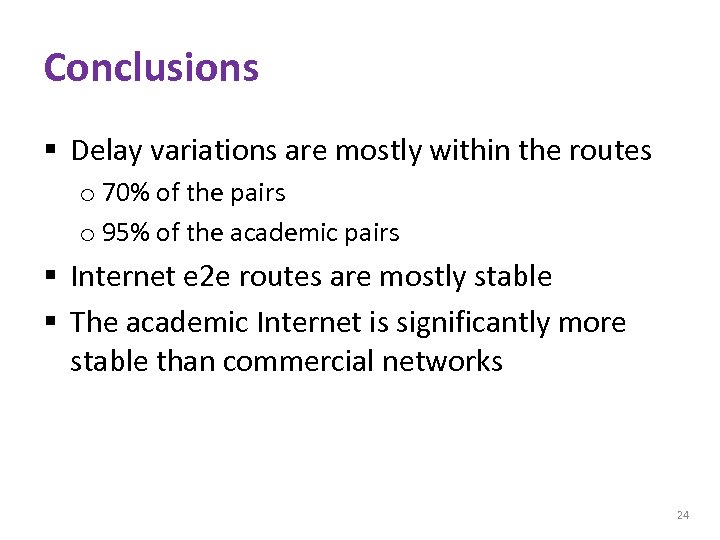
Conclusions § Delay variations are mostly within the routes o 70% of the pairs o 95% of the academic pairs § Internet e 2 e routes are mostly stable § The academic Internet is significantly more stable than commercial networks 24
Скачать презентацию End-to-End Issues Route Diversity Load balancing
8fd448d84a26a910a4b039934fb32470.ppt