


 Скачать презентацию End of Consumer Theory Lecture 15 Dr Jennifer
fd1e89754527d3cbab32dfe030975685.ppt
- Количество слайдов: 11
 End of Consumer Theory Lecture 15 Dr. Jennifer P. Wissink © 2017 John M. Abowd and Jennifer P. Wissink, all rights reserved. Extra snow day lecture
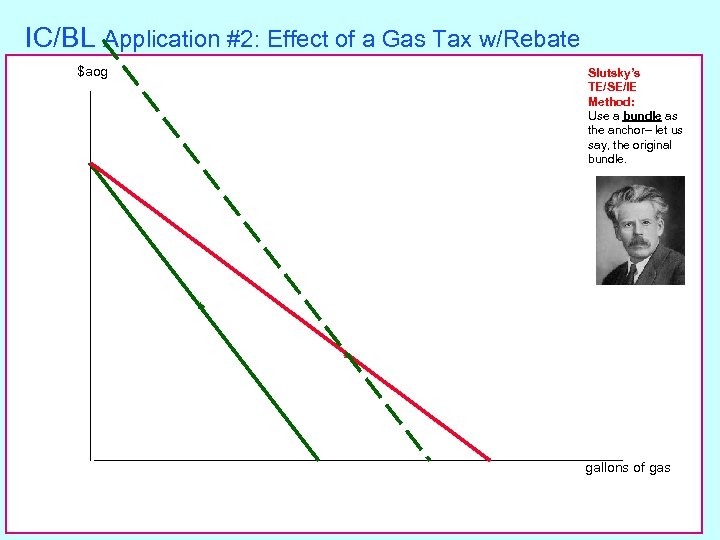 IC/BL Application #2: Effect of a Gas Tax w/Rebate $aog Slutsky’s TE/SE/IE Method: Use a bundle as the anchor– let us say, the original bundle. gallons of gas
 i>clicker question Tony is a successful utility maximizer with very nicely behaved preferences for ham and crackers. He has fixed income I=$1, 000 to spend every month. For Tony, ham is a normal good and crackers are an inferior good. Suppose that going from March to April, Tony hears that the price of ham will increase. Income and the price of crackers will remain unchanged. Comparing April to March you predict Tony A. B. C. D. E. must buy more ham and must buy less crackers. must buy more ham and don’t know about crackers. must buy less ham and must buy more crackers. must buy less ham and don’t know about crackers. don’t know about ham and must buy more crackers.
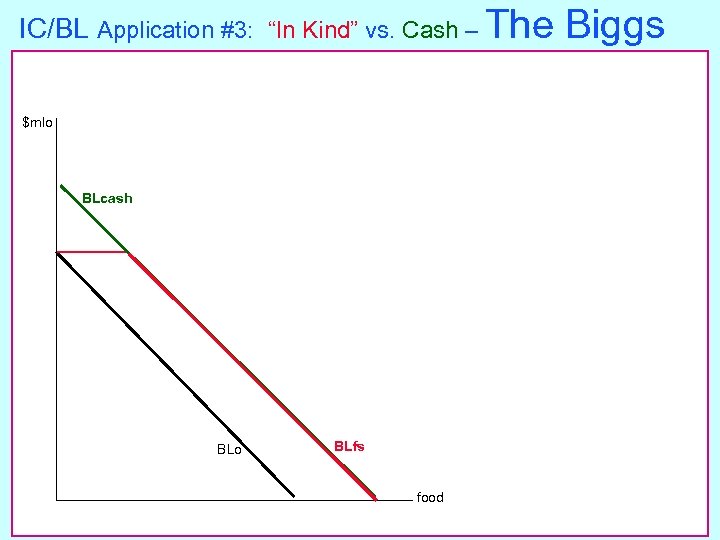 IC/BL Application #3: “In Kind” vs. Cash – The $mlo BLcash BLo BLfs food Biggs
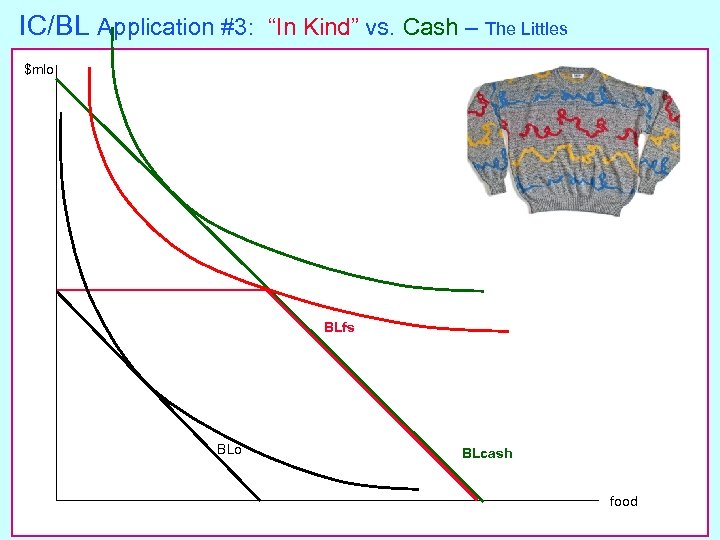 IC/BL Application #3: “In Kind” vs. Cash – The Littles $mlo BLfs BLo BLcash food
 IC/BL Application #4: Two-Part Tariffs (Sam’s Club Example) u Consider Sam (who owns Sam’s Club and sells only X) and Abe (a shopper) and suppose: – IAbe = $2, 000 – PX = $10 and PY = $10 – Initially for Abe: Xo* =100 and Yo* =100 – Perfectly competitive firms sell Y – Sam’s Club has a monopoly (only seller) on X – Average total cost to make X for Sam’s Club is constant and equal to $5 u Sam’s idea: Offer Abe the following deal – Abe pays $200 to join Sam’s Club and then. . . – Sam lowers price of X to PX = $8 u u Note: PY is still $10 and IAbe is still $2, 000 Question: Is this a good idea? If so, for whom?
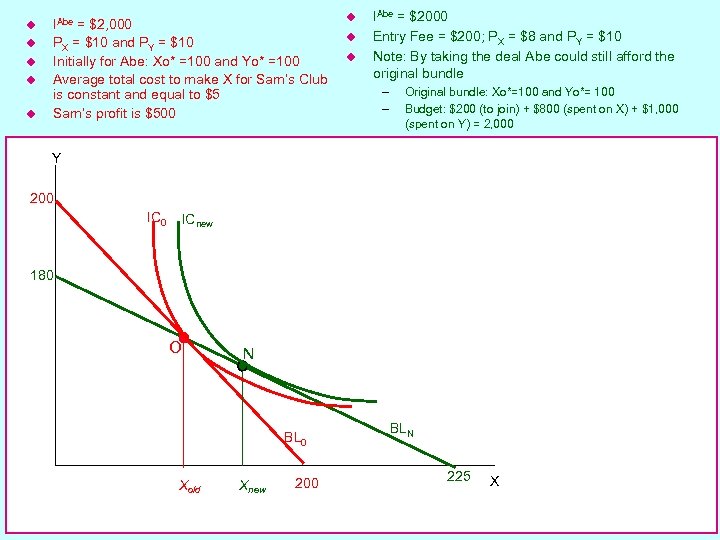 u u u IAbe = $2, 000 PX = $10 and PY = $10 Initially for Abe: Xo* =100 and Yo* =100 Average total cost to make X for Sam’s Club is constant and equal to $5 Sam’s profit is $500 u u u IAbe = $2000 Entry Fee = $200; PX = $8 and PY = $10 Note: By taking the deal Abe could still afford the original bundle – – Original bundle: Xo*=100 and Yo*= 100 Budget: $200 (to join) + $800 (spent on X) + $1, 000 (spent on Y) = 2, 000 Y 200 ICnew 180 O N BL 0 Xold Xnew 200 BLN 225 X
 IC/BL Application #5: Reacting to a Wage Change: The Odd Case of Labor/Leisure! BEWARE! u Consider a day in the life of Fred. u Fred is endowed with 24 hours of time. – He can consume his time as Leisure (Z) or… – He can sell his time at $w/hour as Labor (L). – His time constraint is: Z + L = 24 u Suppose Fred gets utility from Z and $aog. u Suppose Fred’s only source of income is his labor income = $w. L, which he spends on all other goods.
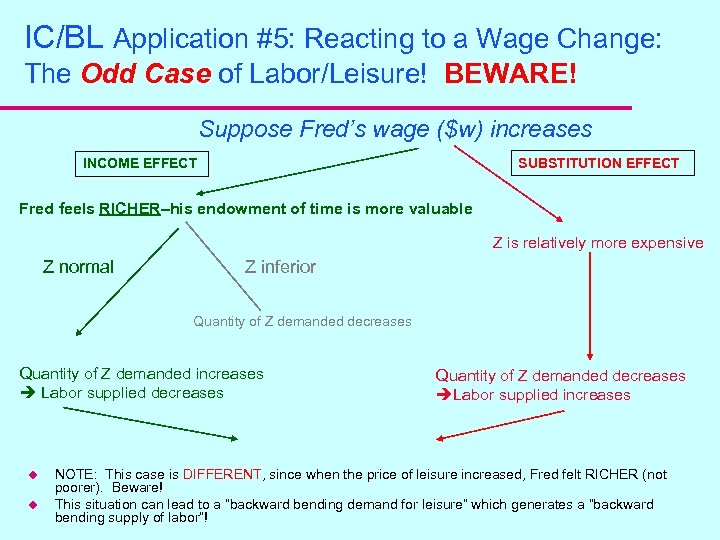 IC/BL Application #5: Reacting to a Wage Change: The Odd Case of Labor/Leisure! BEWARE! Suppose Fred’s wage ($w) increases SUBSTITUTION EFFECT INCOME EFFECT Fred feels RICHER–his endowment of time is more valuable Z is relatively more expensive Z normal Z inferior Quantity of Z demanded decreases Quantity of Z demanded increases Labor supplied decreases u u Quantity of Z demanded decreases Labor supplied increases NOTE: This case is DIFFERENT, since when the price of leisure increased, Fred felt RICHER (not poorer). Beware! This situation can lead to a “backward bending demand for leisure” which generates a “backward bending supply of labor”!
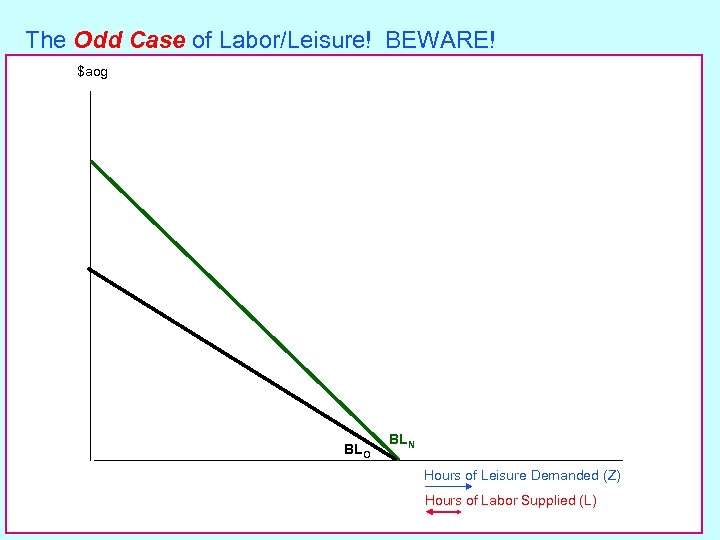 The Odd Case of Labor/Leisure! BEWARE! $aog BLO BLN Hours of Leisure Demanded (Z) Hours of Labor Supplied (L)
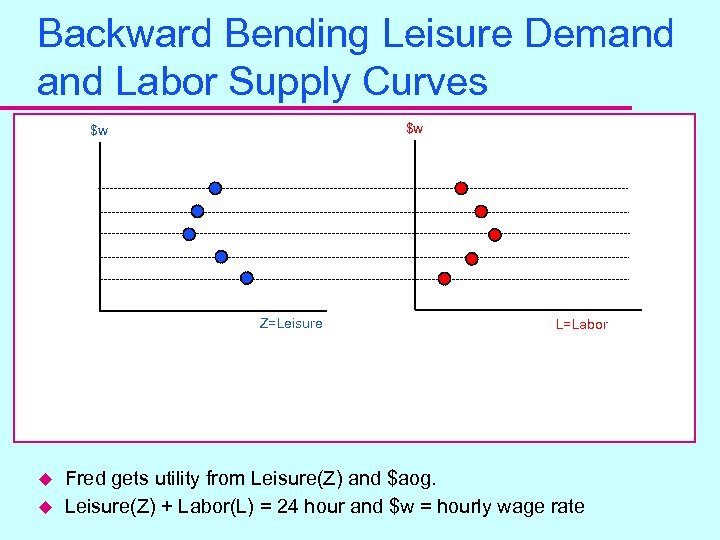 Backward Bending Leisure Demand Labor Supply Curves $w $w Z=Leisure u u L=Labor Fred gets utility from Leisure(Z) and $aog. Leisure(Z) + Labor(L) = 24 hour and $w = hourly wage rate