


 Скачать презентацию Encouraging Quality in Early Childhood Education and Care
b4dbf295dda99ebe31cc4a8353916ad3.ppt
- Количество слайдов: 23
 Encouraging Quality in Early Childhood Education and Care Deborah Roseveare Head, Education and Training Policy Division Israel Accession Seminar 22 -23 November, 2011
 Why invest in high quality ECEC? 1. ECEC has significant economic and social payoffs 2. ECEC supports parents and boosts female employment 3. ECEC is part of society’s responsibility to: – educate children – combat child poverty – help children overcome educational disadvantage
 Benefits of high quality ECEC ü better child well-being and learning outcomes as a foundation for lifelong learning ü more equitable child outcomes and reduction of poverty ü increased intergenerational social mobility ü more female labour market participation ü increased fertility rates ü better social and economic development for society at large
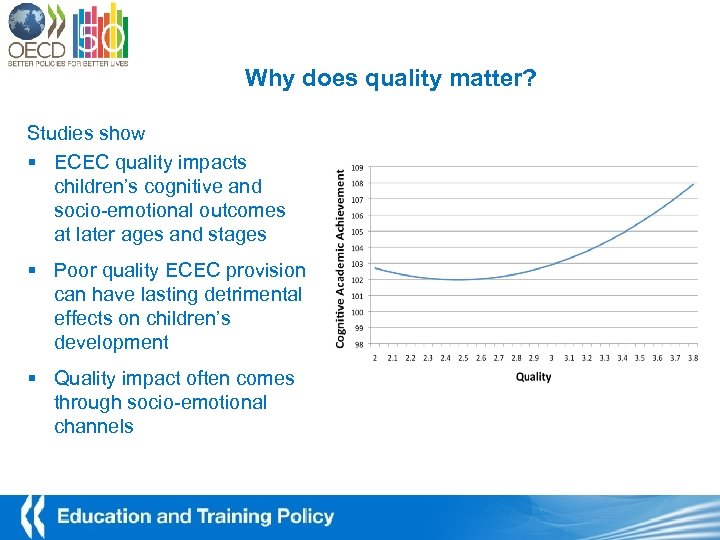 Why does quality matter? Studies show § ECEC quality impacts children’s cognitive and socio-emotional outcomes at later ages and stages § Poor quality ECEC provision can have lasting detrimental effects on children’s development § Quality impact often comes through socio-emotional channels
 What is quality? • Quality means different things to different people • Can be defined in terms of child development outcomes or quality of services • General agreement that high quality involves social, cultural, educational and economic outcomes for children
 What is OECD doing? Developing an Online Policy Toolbox for identifying how to improve quality in ECEC Policy levers: 1. Setting out quality goals and regulations 2. Designing and implementing curriculum and standards 3. Improving workforce conditions, qualifications and training 4. Engaging families and communities 5. Advancing data collection, research and monitoring
 Policy Lever 1: Setting out quality goals and regulations ü align resources with prioritised areas ü promote more coordinated child-centred services ü level the playing field for providers ü help parents make informed choices Policy Lever 2: Designing and implementing curriculum and learning standards ü ensure consistent quality for ECEC provision across different settings ü help staff to enhance instruction strategies ü help parents to better understand child development
 Policy Lever 3: Improving qualifications, training and working conditions ü ECEC staff play the key role in ensuring healthy child development and learning ü Areas for reform include: – qualifications – initial education – professional development – working conditions
 Policy Lever 4: Engaging families and communities ü Parents and communities should be regarded as “partners” working towards the same goal ü Home learning environments and neighbourhood matter for healthy child development and learning Policy Lever 5: Advancing data collection, research and monitoring ü Data, research and monitoring are powerful tools for ü improving children’s outcomes ü driving continuous improvement in service delivery
 What children should learn in ECEC and how? Curriculum and standards can reinforce positive impacts on children’s learning and development ü Ensure even quality across different settings ü Guide staff on how to enhance children’s learning and well-being ü Inform parents of their children’s learning and development Countries take different approaches to designing curriculum q Academic approach makes use of staff-initiated curriculum with cognitive aims to prepare children for school q Comprehensive approach is child-centred and focuses on holistic development and well-being
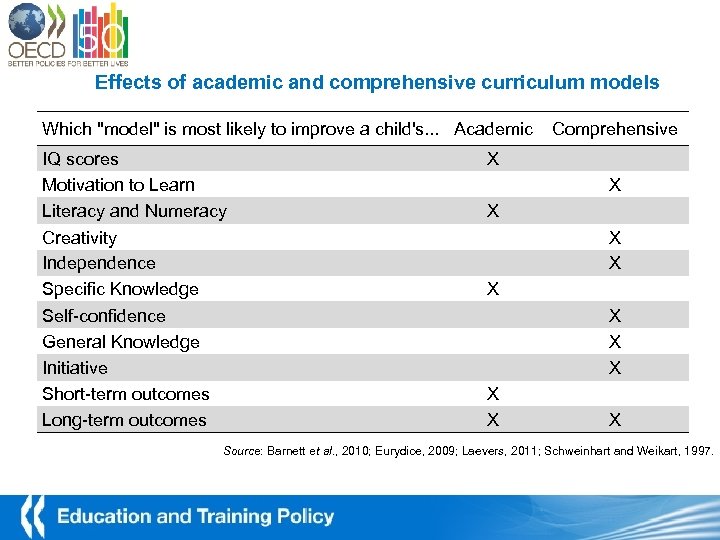 Effects of academic and comprehensive curriculum models Which "model" is most likely to improve a child's. . . Academic IQ scores Motivation to Learn Literacy and Numeracy Creativity Independence Specific Knowledge Self-confidence General Knowledge Initiative Short-term outcomes Long-term outcomes Comprehensive X X X Source: Barnett et al. , 2010; Eurydice, 2009; Laevers, 2011; Schweinhart and Weikart, 1997.
 Blending both cognitive and socio-emotional development in an integrated curriculum may be best But consensus not yet reached: • American researchers more likely to support academic approach • European researchers more likely to emphasise non-cognitive learning Cultural aspects and value systems also play a role • Asian value systems emphasise group interests which may not mesh well with an individual child-centred approach Evidence from neuroscience also suggests that both cognitive and socioemotional development are important
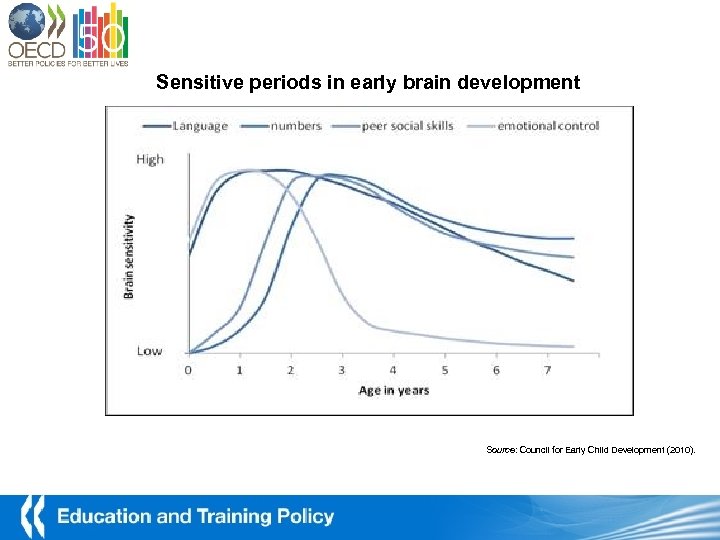 Sensitive periods in early brain development Source: Council for Early Child Development (2010).
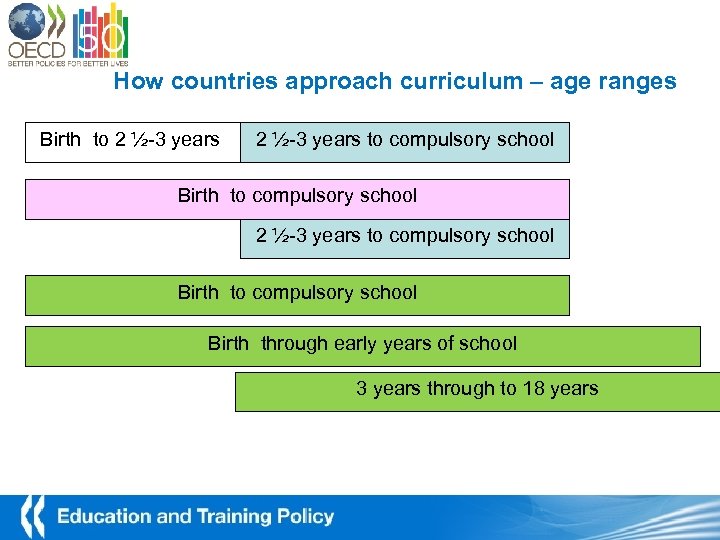 How countries approach curriculum – age ranges Birth to 2 ½-3 years to compulsory school Birth to compulsory school 2 ½-3 years to compulsory school Birth through early years of school 3 years through to 18 years
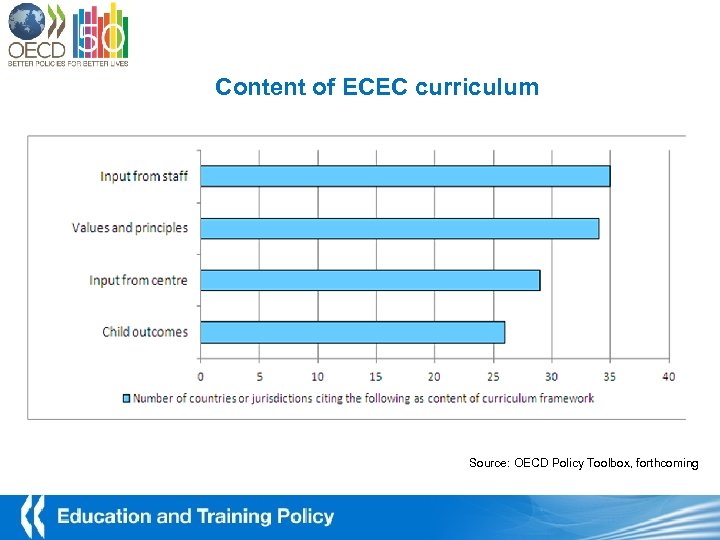 Content of ECEC curriculum Source: OECD Policy Toolbox, forthcoming
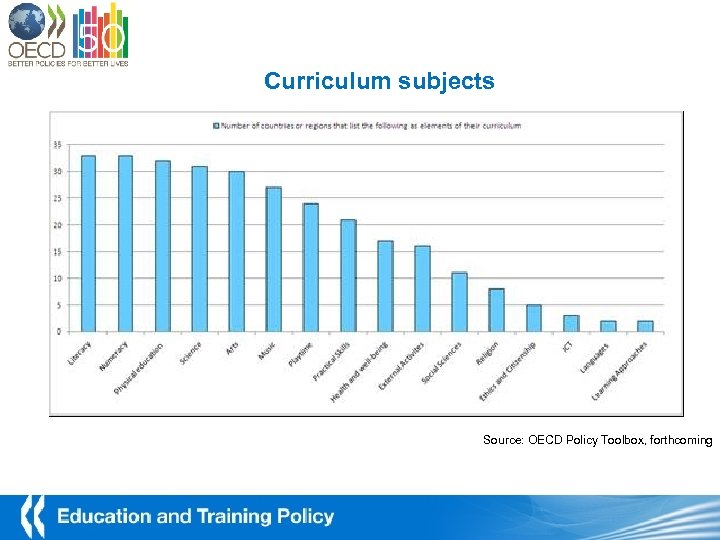 Curriculum subjects Source: OECD Policy Toolbox, forthcoming
 Strategy options for developing and implementing curriculum Challenge 1: Defining goals and content • Setting out clear curriculum goals and guiding principles • Developing standards or attainment targets • Reviewing or analysing curriculum to improve relevance • Supporting local initiatives in setting up their own curriculum • Involving stakeholders in the design process
 Strategy options for developing and implementing curriculum Challenge 2: Curriculum alignment for continuous child development • Aligning curriculum with broader quality goals and assessment practices • Adopting a unified curriculum for care and early education • Aligning ECEC curriculum with other levels of education
 Strategy options for developing and implementing curriculum Challenge 3: Dissemination and communication about the framework • Informing stakeholders about curriculum change through seminars and meetings • Communication with staff through written forms of dissemination • Communicating with parents
 Strategy options for developing and implementing curriculum Challenge 4: Effective Implementation • Ensuring stakeholder buy-in by involving them in the design process • Piloting before implementing nation-wide/state-wide • Providing practical support materials • Setting out guidelines for materials or prescribing materials • Revising initial education, designing and providing demand-driven training • Providing expert assistance to ECEC providers • Improving working conditions to stimulate effective implementation
 Strategy options for developing and implementing curriculum Challenge 5: Systematic evaluation and assessment • Integrating curriculum as part of monitoring process • Link evaluating/reviewing the curriculum framework with quality improvement
 Lessons learnt in developing and implementing curriculum and standards 1. Orient the curriculum reform to focus on “child” and “holistic development” 2. Engage key stakeholders and relevant experts in the process 3. Ensure coherence in learning and broader social environment for continuous child development 4. Adopt a planning timetable that allows sufficient time for consultation, awareness raising and implementation 5. Ensure that ECEC centre leaders can effectively manage financial and human resources as well as pedagogic practices and, in addition, train staff for effective implementation 6. Use simple and common language to draft the curriculum that can be easily understood by staff and parents
 Thank you! www. oecd. org/edu/earlychildhood