 Скачать презентацию Enabling Grids for E-scienc E The EGEE project
f8ccb64636c35aeb452891e19b7c2bfd.ppt
- Количество слайдов: 43




Enabling Grids for E-scienc. E The EGEE project: building an international production grid infrastructure EGEE is a project co-funded by the European Commission under contract INFSO-RI-508833 www. eu-egee. org INFSO-RI-508833
Enabling Grids for E-scienc. E • • • EGEE - what is it and why is it needed? Middleware – current and future Operations – providing a stable service Networking – enabling collaboration Summary The material for this talk has been contributed by many colleagues in the EGEE & LCG projects. It is heavily based on Bob Jones’ talk at UK AHM 2004. INFSO-RI-508833
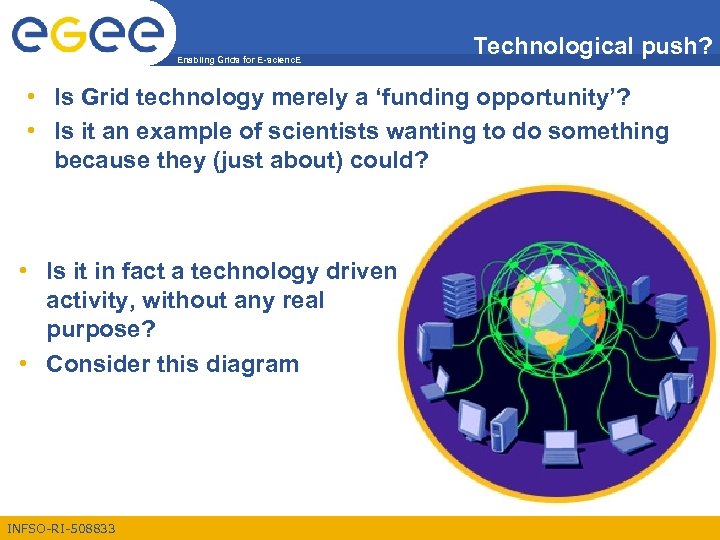
Enabling Grids for E-scienc. E Technological push? • Is Grid technology merely a ‘funding opportunity’? • Is it an example of scientists wanting to do something because they (just about) could? • Is it in fact a technology driven activity, without any real purpose? • Consider this diagram INFSO-RI-508833
Grids vs. Distributed Computing Enabling Grids for E-scienc. E • Existing distributed applications: – tend to be specialised systems – intended for a single purpose or user group • Grids go further and take into account: – Different kinds of resources § Not always the same hardware, data and applications – Different kinds of interactions § User groups or applications want to interact with Grids in different ways – Dynamic nature § Resources and users added/removed/changed frequently INFSO-RI-508833
What is Grid Computing? Enabling Grids for E-scienc. E • A Virtual Organisation is: – People from different institutions working to solve a common goal – Sharing distributed processing and data resources • Grid infrastructure enables virtual organisations “Grid computing is coordinated resource sharing and problem solving in dynamic, multi-institutional virtual organizations” (I. Foster) INFSO-RI-508833
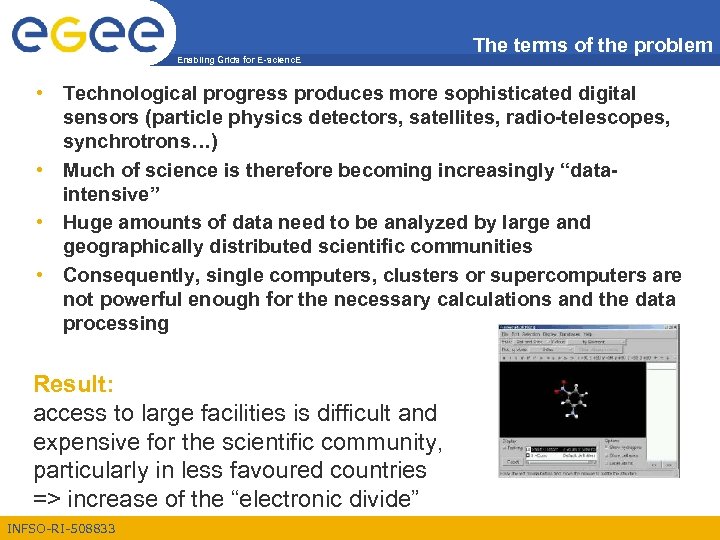
Enabling Grids for E-scienc. E The terms of the problem • Technological progress produces more sophisticated digital sensors (particle physics detectors, satellites, radio-telescopes, synchrotrons…) • Much of science is therefore becoming increasingly “dataintensive” • Huge amounts of data need to be analyzed by large and geographically distributed scientific communities • Consequently, single computers, clusters or supercomputers are not powerful enough for the necessary calculations and the data processing Result: access to large facilities is difficult and expensive for the scientific community, particularly in less favoured countries => increase of the “electronic divide” INFSO-RI-508833
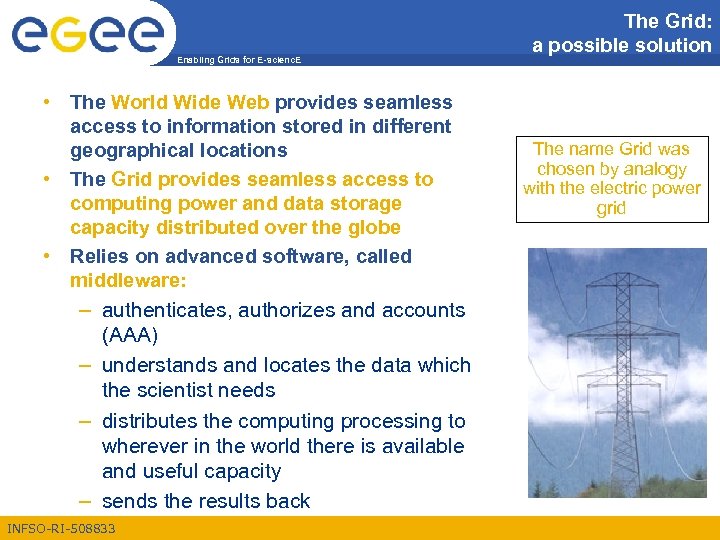
Enabling Grids for E-scienc. E • The World Wide Web provides seamless access to information stored in different geographical locations • The Grid provides seamless access to computing power and data storage capacity distributed over the globe • Relies on advanced software, called middleware: – authenticates, authorizes and accounts (AAA) – understands and locates the data which the scientist needs – distributes the computing processing to wherever in the world there is available and useful capacity – sends the results back INFSO-RI-508833 The Grid: a possible solution The name Grid was chosen by analogy with the electric power grid
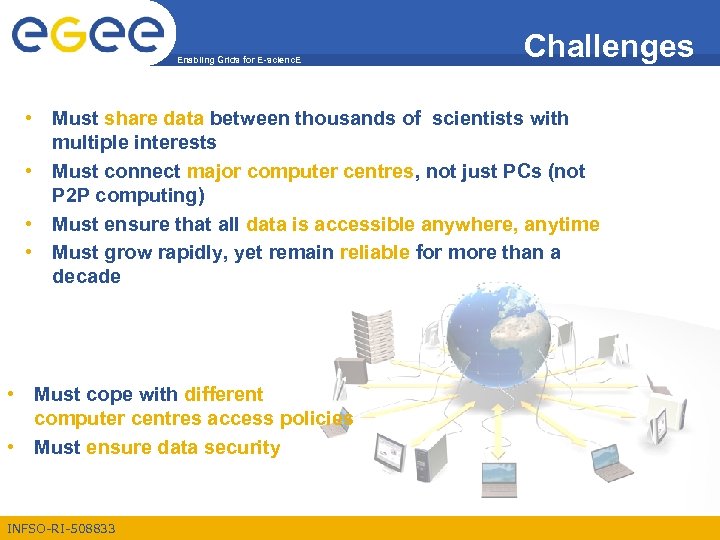
Enabling Grids for E-scienc. E Challenges • Must share data between thousands of scientists with multiple interests • Must connect major computer centres, not just PCs (not P 2 P computing) • Must ensure that all data is accessible anywhere, anytime • Must grow rapidly, yet remain reliable for more than a decade • Must cope with different computer centres access policies • Must ensure data security INFSO-RI-508833
Enabling Grids for E-scienc. E Benefits • Effective and seamless collaboration of dispersed communities, scientific first and then industrial • Ability to run large-scale applications aggregating thousands of computers, for very wide range of applications • Transparent access to distributed resources from your desktop • The term “e-Science” has been coined to express these benefits • In the vision of the “Knowledge Grid”, the Grid can act as unifying agent between applications and non homogeneous data INFSO-RI-508833
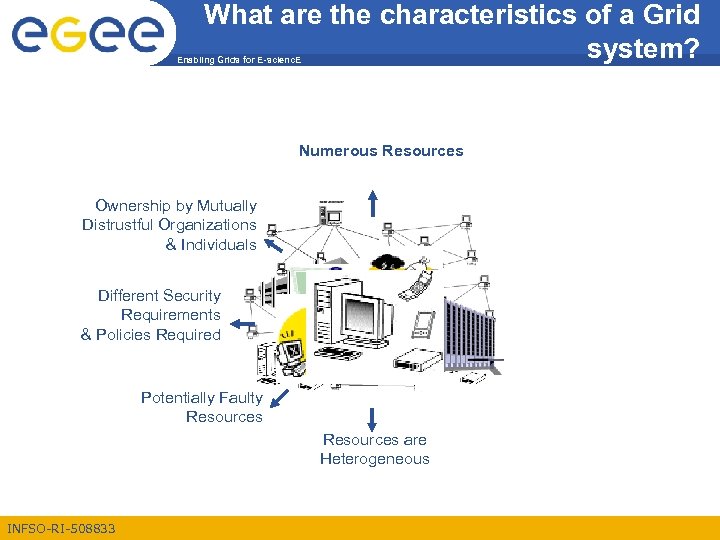
What are the characteristics of a Grid system? Enabling Grids for E-scienc. E Numerous Resources Ownership by Mutually Distrustful Organizations & Individuals Different Security Requirements & Policies Required Potentially Faulty Resources are Heterogeneous INFSO-RI-508833
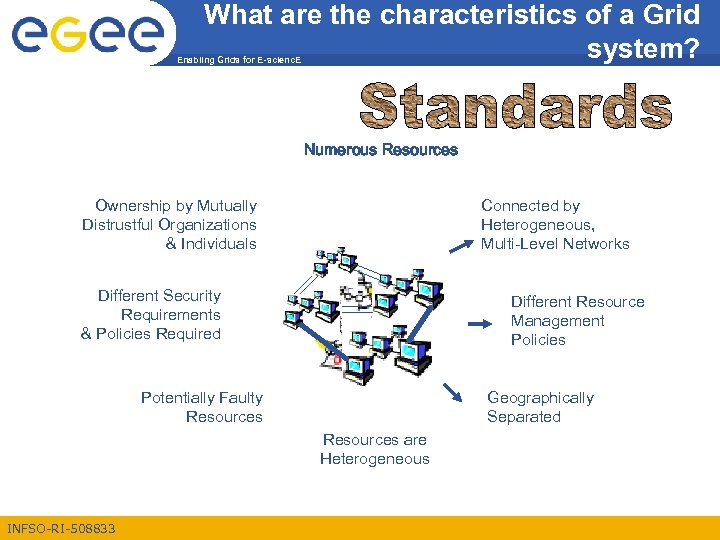
What are the characteristics of a Grid system? Enabling Grids for E-scienc. E Numerous Resources Connected by Heterogeneous, Multi-Level Networks Ownership by Mutually Distrustful Organizations & Individuals Different Security Requirements & Policies Required Different Resource Management Policies Potentially Faulty Resources Geographically Separated Resources are Heterogeneous INFSO-RI-508833
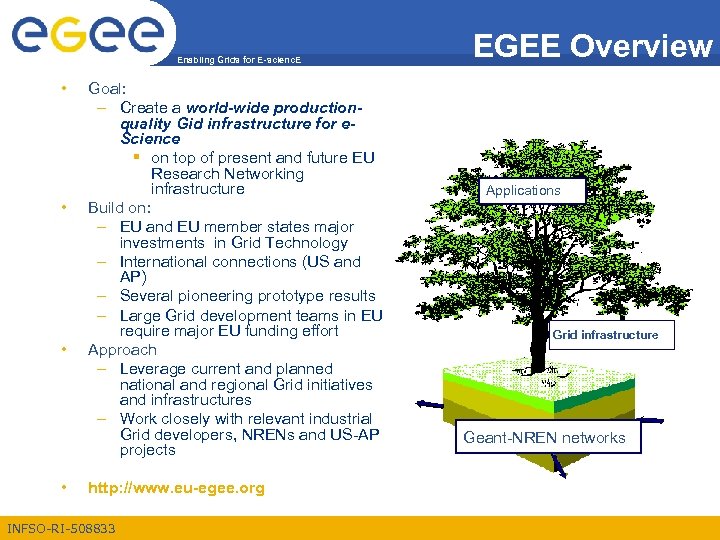
Enabling Grids for E-scienc. E • • Goal: – Create a world-wide productionquality Gid infrastructure for e. Science § on top of present and future EU Research Networking infrastructure Build on: – EU and EU member states major investments in Grid Technology – International connections (US and AP) – Several pioneering prototype results – Large Grid development teams in EU require major EU funding effort Approach – Leverage current and planned national and regional Grid initiatives and infrastructures – Work closely with relevant industrial Grid developers, NRENs and US-AP projects http: //www. eu-egee. org INFSO-RI-508833 EGEE Overview Applications Grid infrastructure Geant-NREN networks
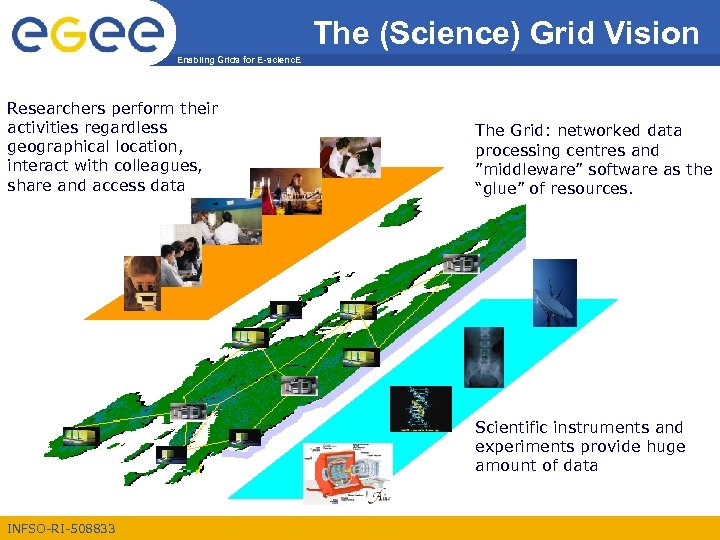
The (Science) Grid Vision Enabling Grids for E-scienc. E Researchers perform their activities regardless geographical location, interact with colleagues, share and access data The Grid: networked data processing centres and ”middleware” software as the “glue” of resources. Scientific instruments and experiments provide huge amount of data INFSO-RI-508833
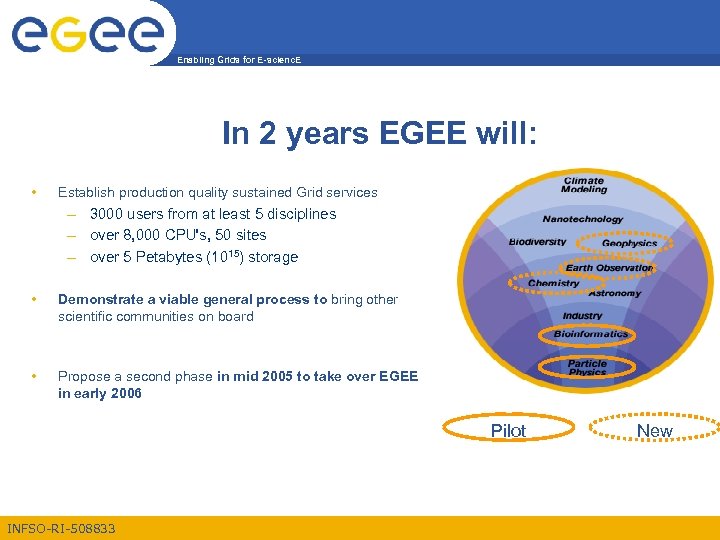
Enabling Grids for E-scienc. E In 2 years EGEE will: • Establish production quality sustained Grid services – 3000 users from at least 5 disciplines – over 8, 000 CPU's, 50 sites – over 5 Petabytes (1015) storage • Demonstrate a viable general process to bring other scientific communities on board • Propose a second phase in mid 2005 to take over EGEE in early 2006 Pilot INFSO-RI-508833 New
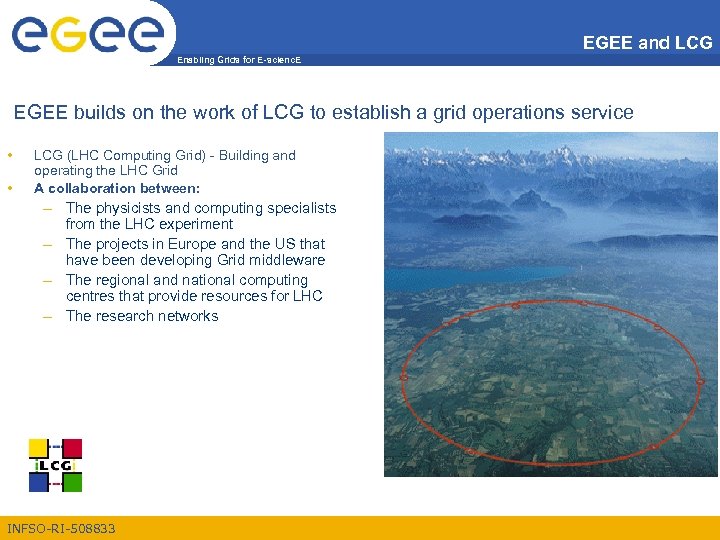
EGEE and LCG Enabling Grids for E-scienc. E EGEE builds on the work of LCG to establish a grid operations service • • LCG (LHC Computing Grid) - Building and operating the LHC Grid A collaboration between: – The physicists and computing specialists from the LHC experiment – The projects in Europe and the US that have been developing Grid middleware – The regional and national computing centres that provide resources for LHC – The research networks INFSO-RI-508833
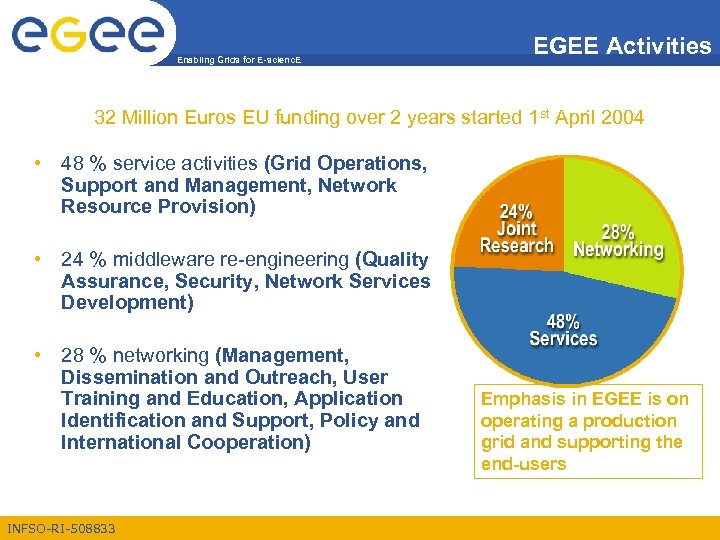
Enabling Grids for E-scienc. E EGEE Activities 32 Million Euros EU funding over 2 years started 1 st April 2004 • 48 % service activities (Grid Operations, Support and Management, Network Resource Provision) • 24 % middleware re-engineering (Quality Assurance, Security, Network Services Development) • 28 % networking (Management, Dissemination and Outreach, User Training and Education, Application Identification and Support, Policy and International Cooperation) INFSO-RI-508833 Emphasis in EGEE is on operating a production grid and supporting the end-users
Enabling Grids for E-scienc. E • • • EGEE - what is it and why is it needed? Middleware – current and future Operations – providing a stable service Networking – enabling collaboration Summary INFSO-RI-508833
Enabling Grids for E-scienc. E • “g. Lite” - the new EGEE middleware • Service oriented - components that are : – Loosely coupled (by messages) – Accessible across network; modular and self-contained; clean modes of failure – So can change implementation without changing interfaces – Can be developed in anticipation of new uses • … and are based on standards. Opens EGEE to: – New middleware (plethora of tools now available) – Heterogeneous resources (storage, computation…) – Interact with other Grids (international, regional and national) INFSO-RI-508833 g. Lite
Enabling Grids for E-scienc. E • • • Architecture Guiding Principles Lightweight (existing) services – Easily and quickly deployable – Use existing services where possible as basis for re-engineering Interoperability – Allow for multiple implementations Resilience and Fault Tolerance • Co-existence with deployed infrastructure – Reduce requirements on site components – Co-existence (and convergence) with LCG-2 and Grid 3 are essential for the EGEE Grid service • Service oriented approach – Follow WSRF standardization – No mature WSRF implementations exist to date so start with plain WS (WS-I) – Provide framework to others so higher-level services can be developed quickly Architecture: https: //edms. cern. ch/document/476451 INFSO-RI-508833
Enabling Grids for E-scienc. E • EGEE - what is it and why is it needed? • Middleware – current and future • Operations – providing a stable service – Needs more than middleware – Organisational, operational infrastructure • Networking – enabling collaboration • Summary INFSO-RI-508833
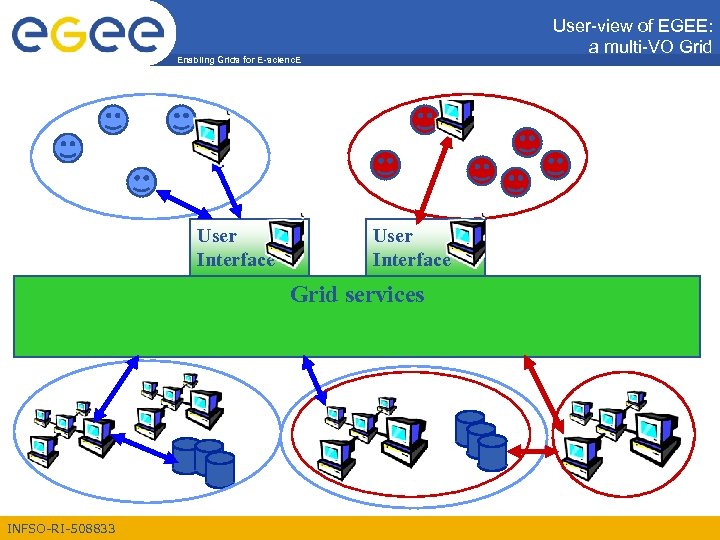
User-view of EGEE: a multi-VO Grid Enabling Grids for E-scienc. E User Interface Grid services INFSO-RI-508833
Enabling Grids for E-scienc. E • • EGEE: adding a VO EGEE has a formal procedure for adding selected new user communities (Virtual Organisations): Negotiation with one of the Regional Operations Centres Seek balance between the resources contributed by a VO and those that they consume. Resource allocation will be made at the VO level. Many resources need to be available to multiple VOs : shared use of resources is fundamental to a Grid INFSO-RI-508833
Enabling Grids for E-scienc. E SA 1 - Operations • Scale of the production service – April 2004: ~2000 CPUs over ~ 30 sites (LCG-1 → LCG-2) – December 2004: ~8000 CPUs over ~ 80 sites (Migrated to Scientific Linux) § This is far beyond the project milestones! – Continuous improvements to LCG-2 middleware • Set-up of CIC/ROCs – Roles/responsibilities defined in execution plans § documented and implemented • On-going: – Complete set-up of pre-production service – Deployment planning for g. Lite (EGEE 1 M/W version) – Deploy accounting infrastructure INFSO-RI-508833
Enabling Grids for E-scienc. E Running the Production Service Grid deployment has entered a new phase • Basic middleware is working – responsible now for a small fraction of the problems • Outstanding performance/functionality issues – RLS, RB / little modularity & lack of consistent interfaces … – some solutions are being developed but many cannot be addressed in current software/architecture - set priorities for new middleware (g. Lite) • Many operational issues – mis-configuration, out of date mware, single points of failure, failover, mgmt interfaces … – resources unsuitable for applications needs (e. g. insufficient disk space) – slow response by sites to problems (holiday periods, security concerns) – new middleware will not help for many of these issues - grid partners must think Service The grid still does not appear as a single coherent facility applications must adapt to the current service to gain maximum profit but result has been very effective for LHCb - ~3000 concurrent jobs INFSO-RI-508833
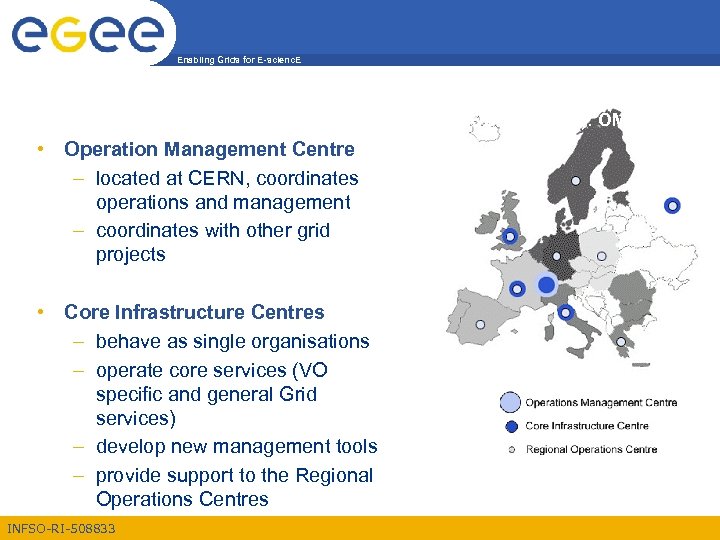
Enabling Grids for E-scienc. E EGEE Operations (I): OMC and CIC • Operation Management Centre – located at CERN, coordinates operations and management – coordinates with other grid projects • Core Infrastructure Centres – behave as single organisations – operate core services (VO specific and general Grid services) – develop new management tools – provide support to the Regional Operations Centres INFSO-RI-508833
Enabling Grids for E-scienc. E EGEE Operations: ROC • Regional Operations Centre responsibilities and roles: – Testing (certification) of new middleware on a variety of platforms before deployment – Deployment of middleware releases + coordination + distribution inside the region – integration of ‘Local’ VO – Development of procedures and capabilities to operate the resources – First-line user support – Bring new resources into the infrastructure and support their operation – Coordination of integration of national grid infrastructures Provide resources for pre-production service INFSO-RI-508833
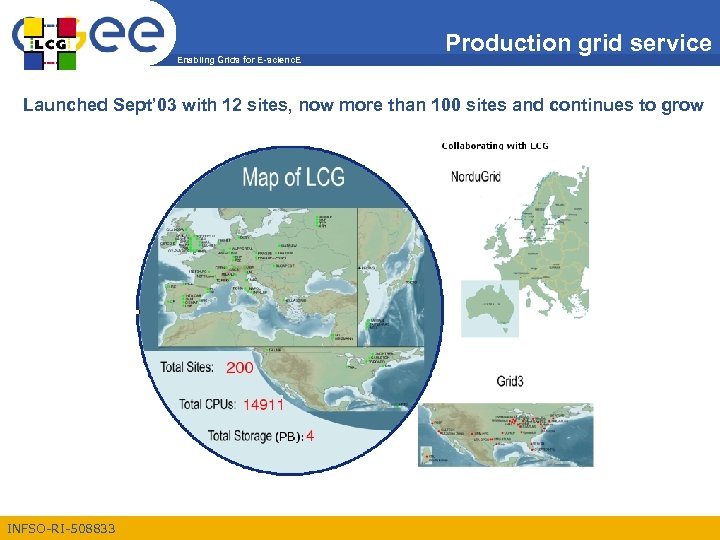
Enabling Grids for E-scienc. E Production grid service Launched Sept’ 03 with 12 sites, now more than 100 sites and continues to grow INFSO-RI-508833
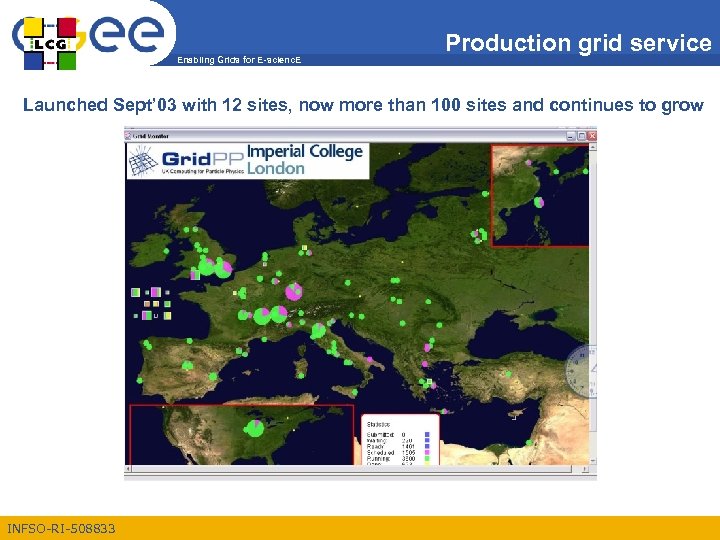
Enabling Grids for E-scienc. E Production grid service Launched Sept’ 03 with 12 sites, now more than 100 sites and continues to grow INFSO-RI-508833
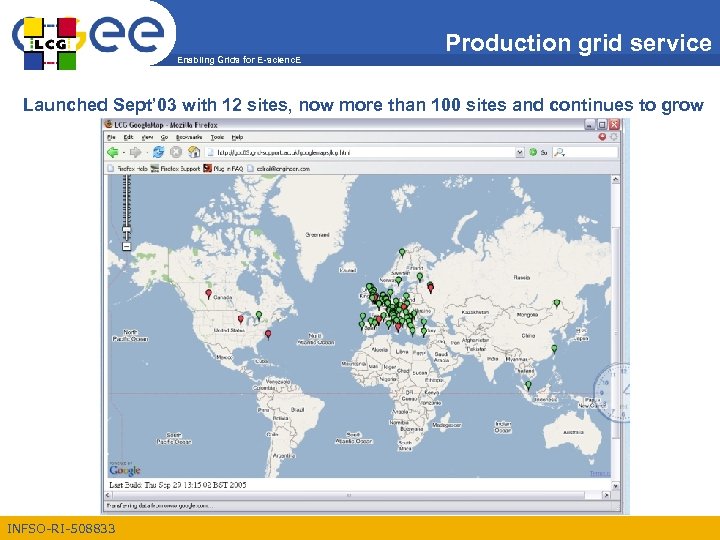
Enabling Grids for E-scienc. E Production grid service Launched Sept’ 03 with 12 sites, now more than 100 sites and continues to grow INFSO-RI-508833
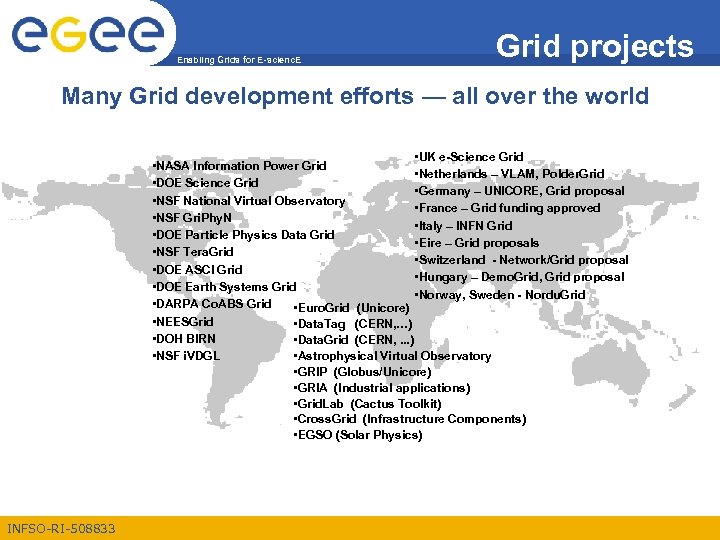
Enabling Grids for E-scienc. E Grid projects Many Grid development efforts — all over the world • UK e-Science Grid • NASA Information Power Grid • Netherlands – VLAM, Polder. Grid • DOE Science Grid • Germany – UNICORE, Grid proposal • NSF National Virtual Observatory • France – Grid funding approved • NSF Gri. Phy. N • Italy – INFN Grid • DOE Particle Physics Data Grid • Eire – Grid proposals • NSF Tera. Grid • Switzerland - Network/Grid proposal • DOE ASCI Grid • Hungary – Demo. Grid, Grid proposal • DOE Earth Systems Grid • Norway, Sweden - Nordu. Grid • DARPA Co. ABS Grid • Euro. Grid (Unicore) • NEESGrid • Data. Tag (CERN, …) • DOH BIRN • Data. Grid (CERN, . . . ) • Astrophysical Virtual Observatory • NSF i. VDGL • GRIP (Globus/Unicore) • GRIA (Industrial applications) • Grid. Lab (Cactus Toolkit) • Cross. Grid (Infrastructure Components) • EGSO (Solar Physics) INFSO-RI-508833
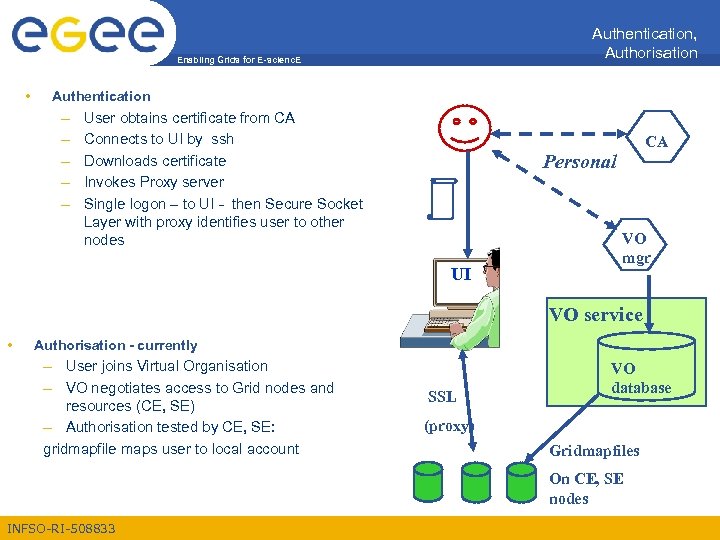
Authentication, Authorisation Enabling Grids for E-scienc. E • Authentication – – – User obtains certificate from CA Connects to UI by ssh Downloads certificate Invokes Proxy server Single logon – to UI - then Secure Socket Layer with proxy identifies user to other nodes CA Personal UI VO mgr VO service • Authorisation - currently – User joins Virtual Organisation – VO negotiates access to Grid nodes and resources (CE, SE) – Authorisation tested by CE, SE: gridmapfile maps user to local account SSL VO database (proxy) Gridmapfiles On CE, SE nodes INFSO-RI-508833
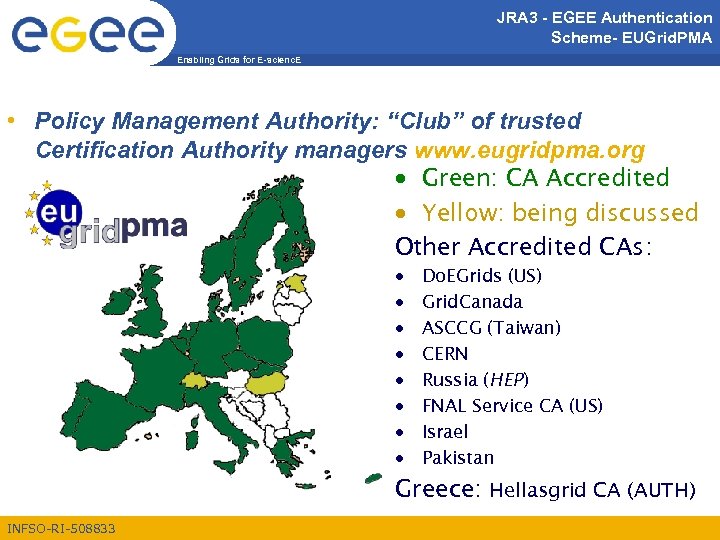
JRA 3 - EGEE Authentication Scheme- EUGrid. PMA Enabling Grids for E-scienc. E • Policy Management Authority: “Club” of trusted Certification Authority managers www. eugridpma. org · Green: CA Accredited · Yellow: being discussed Other Accredited CAs: · · · · Do. EGrids (US) Grid. Canada ASCCG (Taiwan) CERN Russia (HEP) FNAL Service CA (US) Israel Pakistan Greece: Hellasgrid CA (AUTH) INFSO-RI-508833
Enabling Grids for E-scienc. E • • EGEE - what is it and why is it needed? Middleware – current and future Operations – providing a stable service Networking – enabling collaboration – Current application communities • Summary INFSO-RI-508833
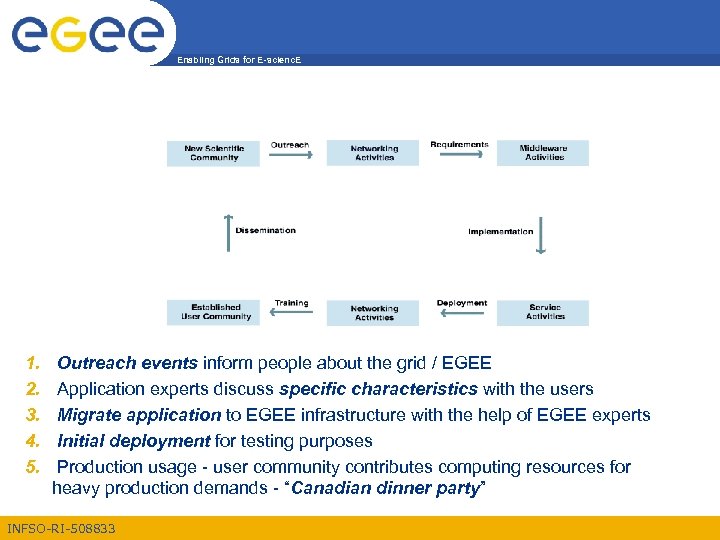
Enabling Grids for E-scienc. E Bringing new applications to the grid 1. 2. 3. 4. 5. Outreach events inform people about the grid / EGEE Application experts discuss specific characteristics with the users Migrate application to EGEE infrastructure with the help of EGEE experts Initial deployment for testing purposes Production usage - user community contributes computing resources for heavy production demands - “Canadian dinner party” INFSO-RI-508833
NA 3 – User training and induction Enabling Grids for E-scienc. E • • • NA 3 has been involved in more than 130 training events across the world – (including the GGF and other grid schools) – ~2000 people trained § induction; application developer; advanced; activity retreats – Material archive online with ~1000 presentations Strong links made with GILDA testbed and use of GENIUS portal – Regularly used as part of tutorials Essential element of the virtuous cycle for new communities – Training is one of the first things new communities need Process for handling feedback defined – Helping to improve material and organisation Roadmap for future event planned – Open to new suggestions – Produced status report and update training plan taking into account lessons learned On-going – Plan for next EGEE M/W (g. Lite) training INFSO-RI-508833
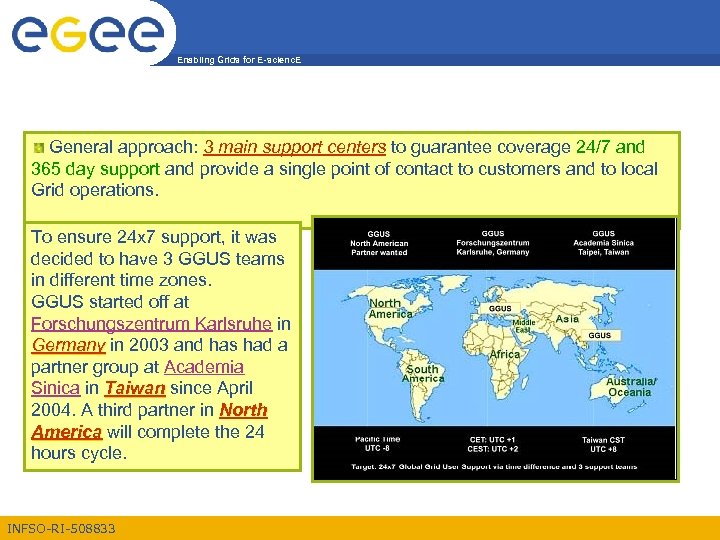
Enabling Grids for E-scienc. E EGEE User Support: infrastructure General approach: 3 main support centers to guarantee coverage 24/7 and 365 day support and provide a single point of contact to customers and to local Grid operations. To ensure 24 x 7 support, it was decided to have 3 GGUS teams in different time zones. GGUS started off at Forschungszentrum Karlsruhe in Germany in 2003 and has had a partner group at Academia Sinica in Taiwan since April 2004. A third partner in North America will complete the 24 hours cycle. INFSO-RI-508833
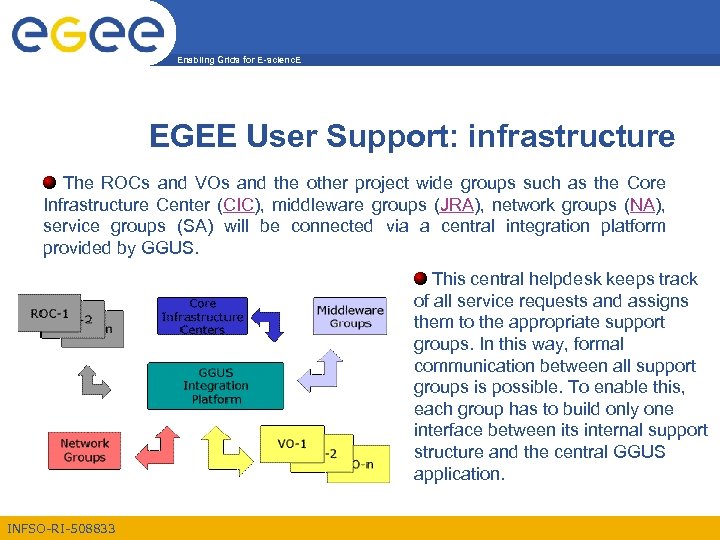
Enabling Grids for E-scienc. E EGEE User Support: infrastructure The ROCs and VOs and the other project wide groups such as the Core Infrastructure Center (CIC), middleware groups (JRA), network groups (NA), service groups (SA) will be connected via a central integration platform provided by GGUS. This central helpdesk keeps track of all service requests and assigns them to the appropriate support groups. In this way, formal communication between all support groups is possible. To enable this, each group has to build only one interface between its internal support structure and the central GGUS application. INFSO-RI-508833
Enabling Grids for E-scienc. E • More about applications and communities in the next talk INFSO-RI-508833
Enabling Grids for E-scienc. E • • EGEE - what is it and why is it needed? Middleware – current and future Operations – providing a stable service Networking – enabling collaboration – Current application communities – Enabling new and effective use of EGEE • Summary INFSO-RI-508833
Enabling Grids for E-scienc. E Who else can benefit from EGEE? • EGEE Generic Applications Advisory Panel: – For new applications • EU projects: Mammo. Grid, Diligent, SEE-GRID … • Expression of interest: Planck/Gaia (astroparticle), Sim. Dat (drug discovery) INFSO-RI-508833
Enabling Grids for E-scienc. E Intellectual Property • The existing EGEE grid middleware (LCG-2) is distributed under an Open Source License developed by EU Data. Grid – Derived from modified BSD - no restriction on usage (academic or commercial) beyond acknowledgement – Same approach for new middleware (g. Lite) • Application software maintains its own licensing scheme – Sites must obtain appropriate licenses before installation INFSO-RI-508833
Summary Enabling Grids for E-scienc. E • EGEE is the first attempt to build a worldwide Grid infrastructure for data intensive applications from many scientific domains • A large-scale production grid service is already deployed and being used for HEP and Bio. Med applications with new applications being ported • Resources & user groups will rapidly expand during the project • A process is in place for migrating new applications to the EGEE infrastructure • A training programme has started with events already held • Prototype “next generation” middleware is being tested (g. Lite) • Plans for a follow-on project are being discussed INFSO-RI-508833
When will the grid disappear? Enabling Grids for E-scienc. E • Two possibilities: • 1. Grids will not fulfill their promise and fade into being a niche distributed computing domain • 2 Grids will become ubiquitous and easily usable – transparent to the user and so ‘disappear’ – Following the trajectory of other networked services INFSO-RI-508833
Скачать презентацию Enabling Grids for E-scienc E The EGEE project
f8ccb64636c35aeb452891e19b7c2bfd.ppt