 Скачать презентацию Enabling Activities to Review and Update the National
0767f184f063fa1e3ca6f15a5550a6cf.ppt
- Количество слайдов: 33



Enabling Activities to Review and Update the National Implementation Plan for the Stockholm Convention on Persistent Organic Pollutants 4 -5 March 2013, Antalya, Turkey Understanding the listed PBDEs Roland Weber POPs Environmental Consulting, Ulmenstrasse 3, 73035 Göppingen, Germany 1
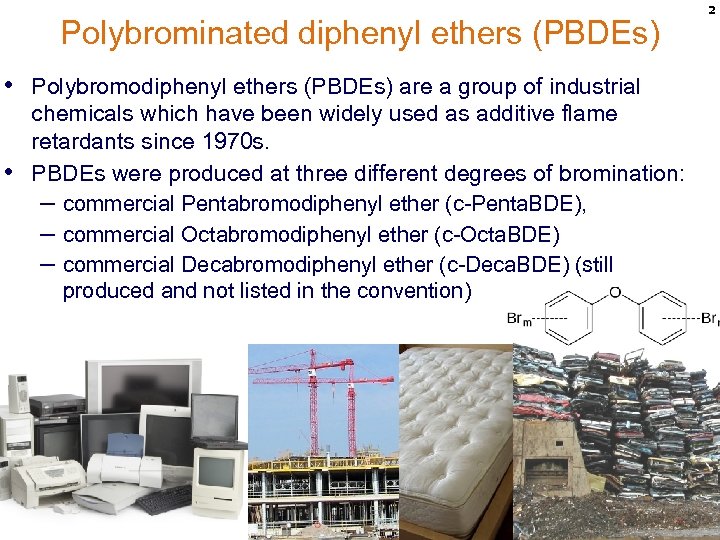
Polybrominated diphenyl ethers (PBDEs) • Polybromodiphenyl ethers (PBDEs) are a group of industrial • chemicals which have been widely used as additive flame retardants since 1970 s. PBDEs were produced at three different degrees of bromination: – commercial Pentabromodiphenyl ether (c-Penta. BDE), – commercial Octabromodiphenyl ether (c-Octa. BDE) – commercial Decabromodiphenyl ether (c-Deca. BDE) (still produced and not listed in the convention) 2
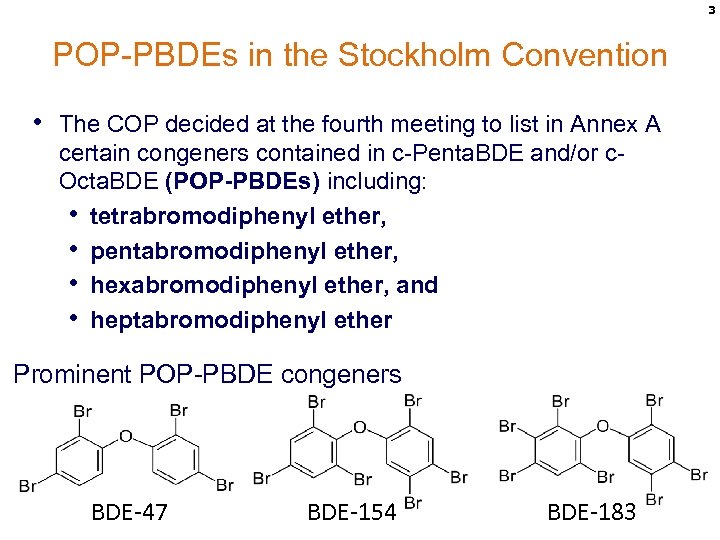
3 POP-PBDEs in the Stockholm Convention • The COP decided at the fourth meeting to list in Annex A certain congeners contained in c-Penta. BDE and/or c. Octa. BDE (POP-PBDEs) including: • tetrabromodiphenyl ether, • pentabromodiphenyl ether, • hexabromodiphenyl ether, and • heptabromodiphenyl ether Prominent POP-PBDE congeners BDE-47 BDE-154 BDE-183
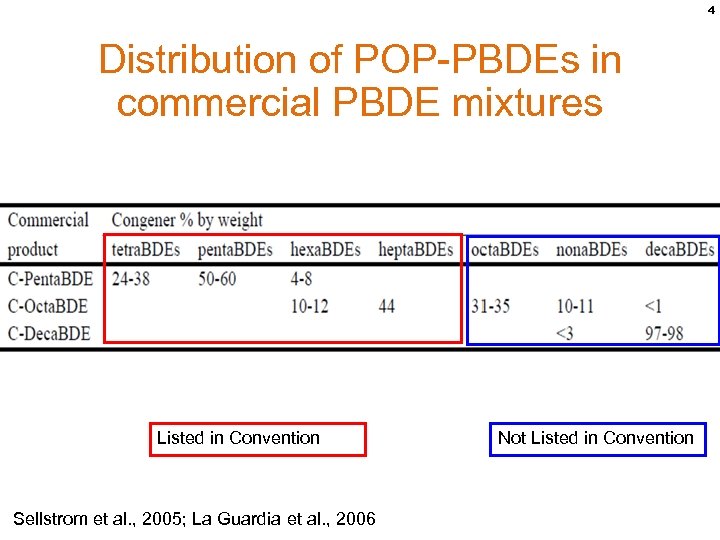
4 Distribution of POP-PBDEs in commercial PBDE mixtures Listed in Convention Sellstrom et al. , 2005; La Guardia et al. , 2006 Not Listed in Convention
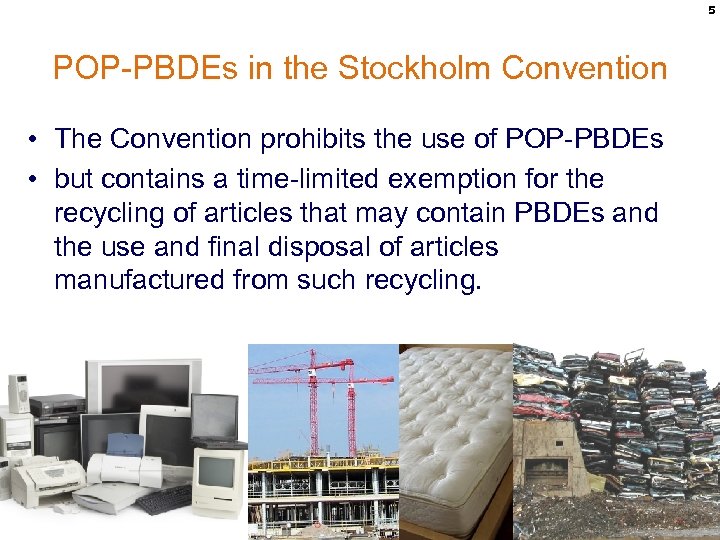
5 POP-PBDEs in the Stockholm Convention • The Convention prohibits the use of POP-PBDEs • but contains a time-limited exemption for the recycling of articles that may contain PBDEs and the use and final disposal of articles manufactured from such recycling.
6 Obligation under the Convention • Production and use of POP-PBDE is not allowed. • Recycling of articles containing POP-PBDEs and the use and final disposal of articles produced from these recycled materials are allowed where the Party has notified the Secretariat to make use of the exemptions and the provisions in Part IV and V of Annex A. • Trade of articles in use containing POP-PBDEs is allowed if the Secretariat has been notified by the exporting Party and importing Party for exemptions of recycling.
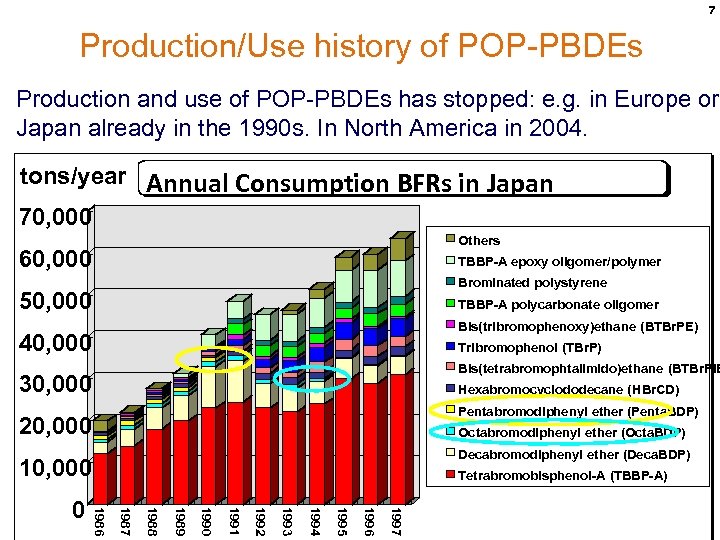
7 Production/Use history of POP-PBDEs Production and use of POP-PBDEs has stopped: e. g. in Europe or Japan already in the 1990 s. In North America in 2004. tons/year Annual Consumption BFRs in Japan 70, 000 Others 60, 000 TBBP-A epoxy oligomer/polymer Brominated polystyrene 50, 000 TBBP-A polycarbonate oligomer Bis(tribromophenoxy)ethane (BTBr. PE) 40, 000 Tribromophenol (TBr. P) Bis(tetrabromophtalimido)ethane (BTBr. PIE 30, 000 Hexabromocyclododecane (HBr. CD) Pentabromodiphenyl ether (Penta. BDP) 20, 000 Octabromodiphenyl ether (Octa. BDP) Decabromodiphenyl ether (Deca. BDP) 10, 000 1997 1996 1995 1994 1993 1992 1991 1990 1989 1988 1987 1986 0 Tetrabromobisphenol-A (TBBP-A)
8 POP-PBDE and Deca. BDE • The total production of all PBDEs from 1970 to 2005 is estimated between 1, 300, 000 and 1, 500, 000 tonnes Commercial Mixture Tonnes c-Penta. BDE 91, 000 to 105, 000 c-Octa. BDE 102, 700 to 118, 500 c-Deca. BDE 1, 100, 000 to 1, 250, 000 • While the production of c-Penta. BDE and c-Octa. BDE have been discontinued, the production of not-listed Deca. BDE continues. • The debromination of Deca. BDE to lower PBDE is assessed by the POP Reviewing Committee. • EU: Deca. BDE is restricted for electrical & electronic equipment (Directive 2002/95/EC + 2005/717/EC) but not for other uses.
9 Hexabromobiphenyl (HBB) • Only approximately 6000 tonnes of commercial HBB were produced in the United States from 1970 to 1976. • Due to the early and relatively small production and use of HBB, the chemical is of minor relevance since most of HBB containing materials have been disposed off already decades ago. • This minor relevance is also reflected in the low HBB/PBB levels in food and the related low exposure: E. g. in European countries (having used PBB to some extent in the past) HBB/PBBs were mostly below detection levels in food (EFSA 2010).
10 PBDE material flows and major use areas to be addressed by inventory & BAT/BEP • Polymers containing c-Octa. BDE – Largest amount used in plastic electrical and electronic equipment (EEE) and now in related wastes (WEEE) – Minor amount in e. g. polymers in transport sector • Polyurethane (PUR) foam containing c-Penta. BDE – Large amount in transport (car. bus, truck, train etc. ) – In countries with flame retardant standards also used in furniture and construction and minor use in mattresses • Minor use c-Penta. BDE: e. g. in textiles and rubber
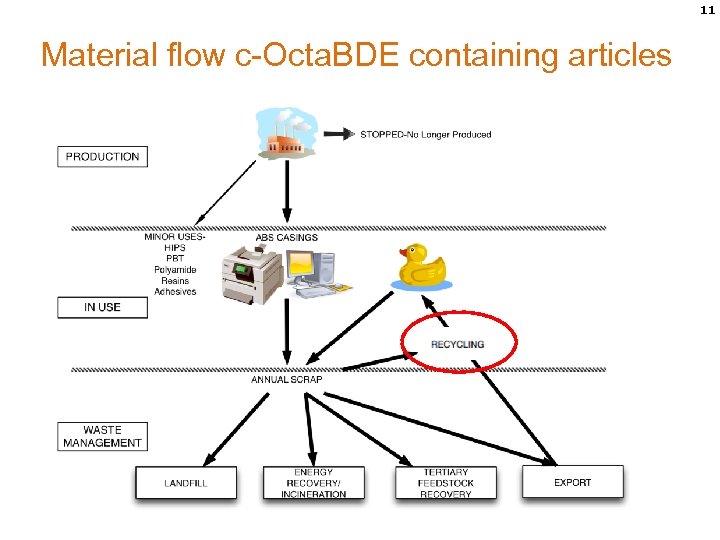
11 Material flow c-Octa. BDE containing articles
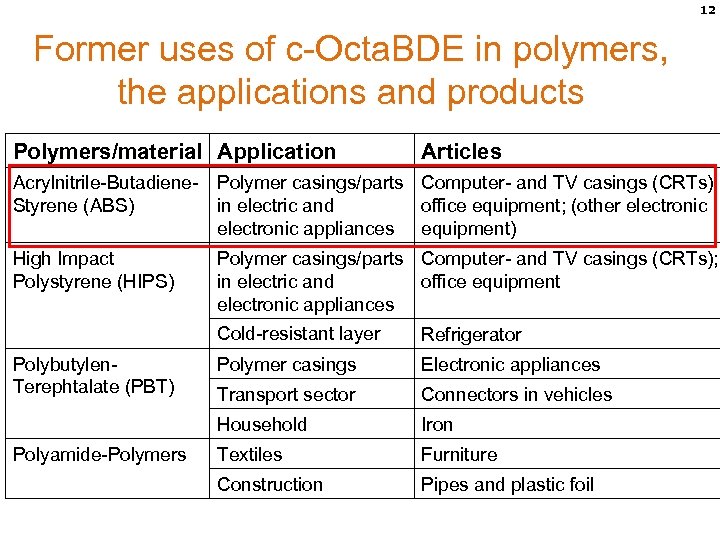
12 Former uses of c-Octa. BDE in polymers, the applications and products Polymers/material Application Articles Acrylnitrile-Butadiene- Polymer casings/parts Computer- and TV casings (CRTs); Styrene (ABS) in electric and office equipment; (other electronic appliances equipment) High Impact Polystyrene (HIPS) Polymer casings/parts Computer- and TV casings (CRTs); in electric and office equipment electronic appliances Cold-resistant layer Polyamide-Polymers Polymer casings Electronic appliances Transport sector Connectors in vehicles Household Polybutylen. Terephtalate (PBT) Refrigerator Iron Textiles Furniture Construction Pipes and plastic foil
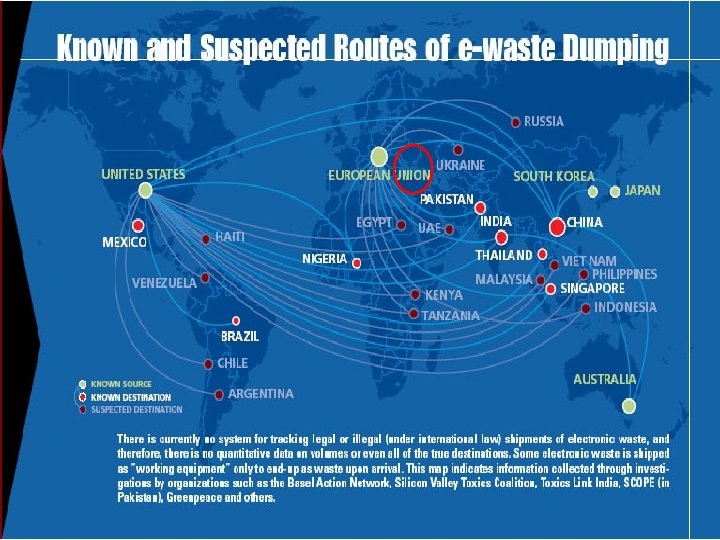
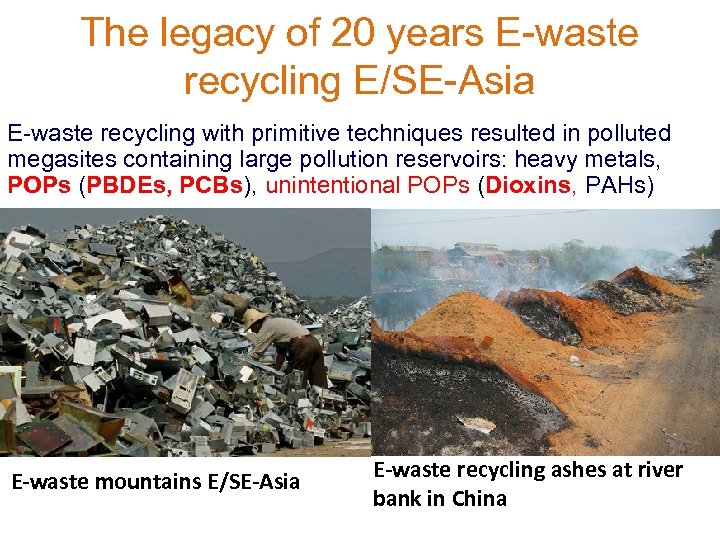
The legacy of 20 years E-waste recycling E/SE-Asia E-waste recycling with primitive techniques resulted in polluted megasites containing large pollution reservoirs: heavy metals, POPs (PBDEs, PCBs), unintentional POPs (Dioxins, PAHs) E-waste mountains E/SE-Asia E-waste recycling ashes at river bank in China
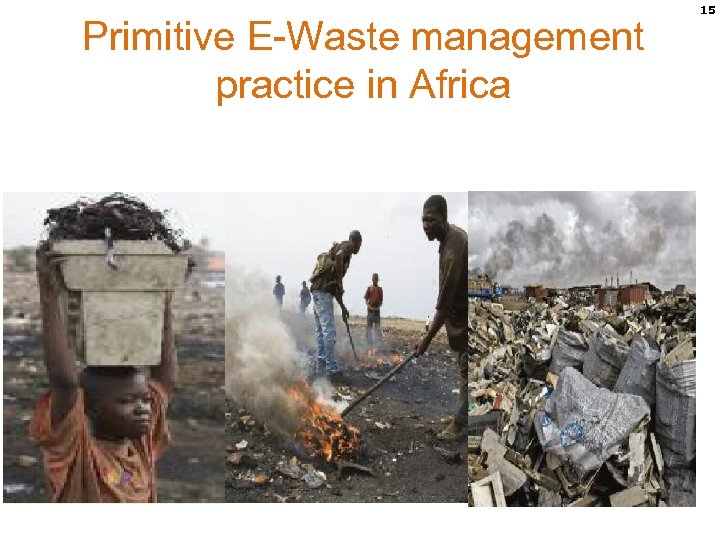
Primitive E-Waste management practice in Africa 15
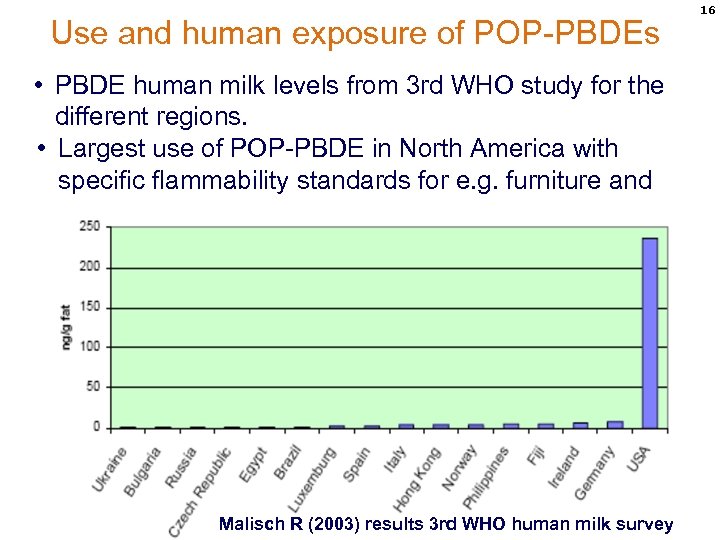
Use and human exposure of POP-PBDEs • PBDE human milk levels from 3 rd WHO study for the different regions. • Largest use of POP-PBDE in North America with specific flammability standards for e. g. furniture and transport. Malisch R (2003) results 3 rd WHO human milk survey 16
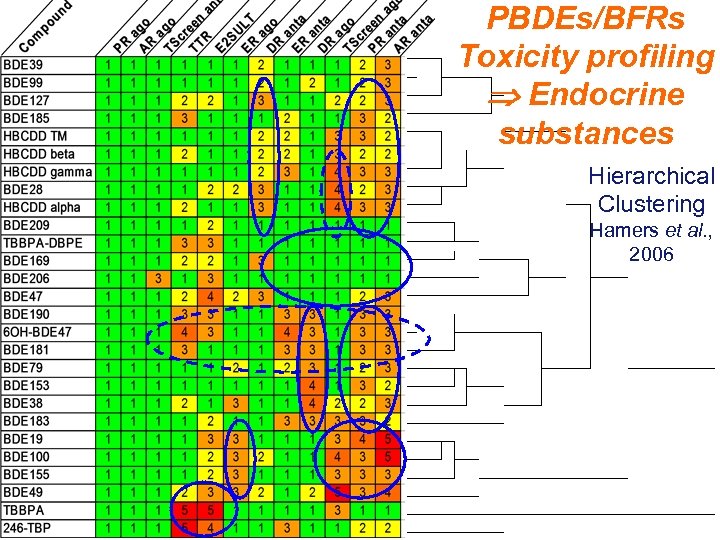
PBDEs/BFRs Toxicity profiling Endocrine substances Hierarchical Clustering Hamers et al. , 2006
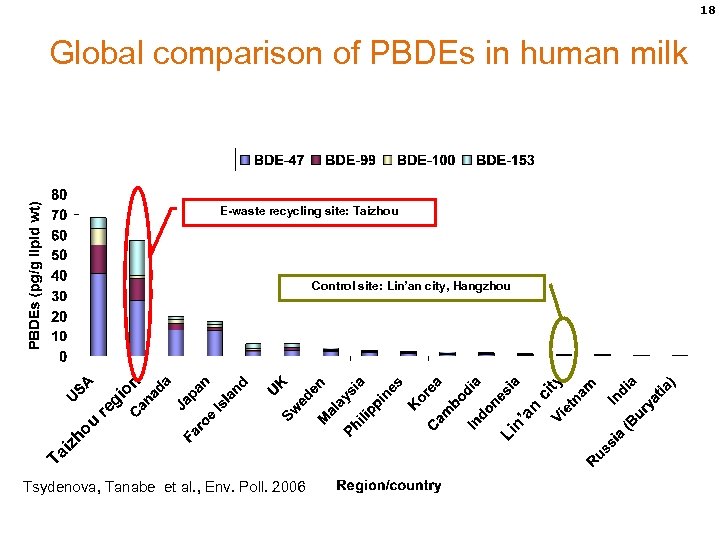
18 Global comparison of PBDEs in human milk E-waste recycling site: Taizhou u ho z ai T Tsydenova, Tanabe et al. , Env. Poll. 2006 Li n o gi re n’ Lia nn ’ac nit y ci ty Control site: Lin’an city, Hangzhou
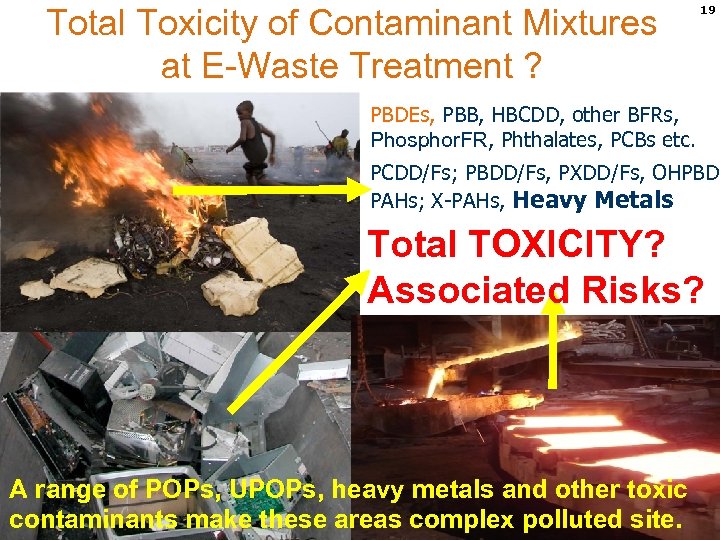
Total Toxicity of Contaminant Mixtures at E-Waste Treatment ? 19 PBDEs, PBB, HBCDD, other BFRs, Phosphor. FR, Phthalates, PCBs etc. PCDD/Fs; PBDD/Fs, PXDD/Fs, OHPBDE PAHs; X-PAHs, Heavy Metals Total TOXICITY? Associated Risks? A range of POPs, UPOPs, heavy metals and other toxic contaminants make these areas complex polluted site.
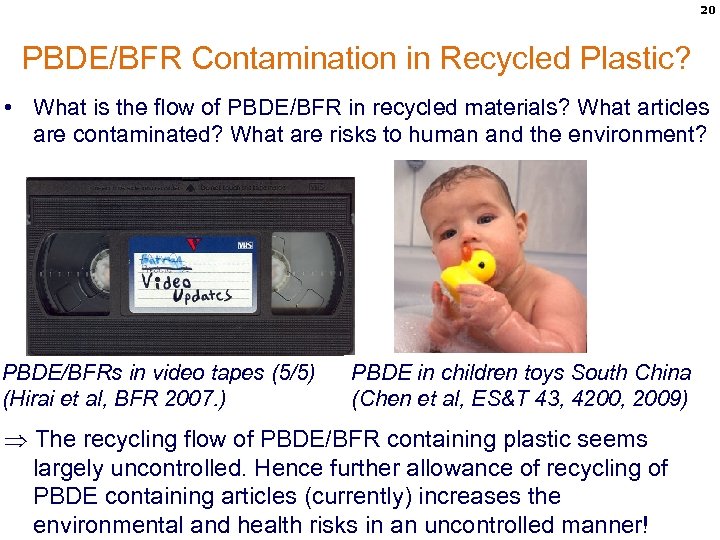
20 PBDE/BFR Contamination in Recycled Plastic? • What is the flow of PBDE/BFR in recycled materials? What articles are contaminated? What are risks to human and the environment? PBDE/BFRs in video tapes (5/5) (Hirai et al, BFR 2007. ) PBDE in children toys South China (Chen et al, ES&T 43, 4200, 2009) The recycling flow of PBDE/BFR containing plastic seems largely uncontrolled. Hence further allowance of recycling of PBDE containing articles (currently) increases the environmental and health risks in an uncontrolled manner!
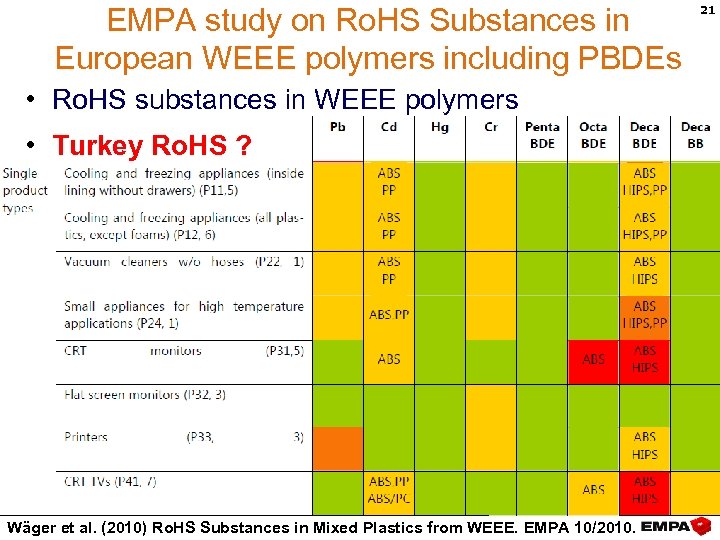
EMPA study on Ro. HS Substances in European WEEE polymers including PBDEs • Ro. HS substances in WEEE polymers • Turkey Ro. HS ? Wäger et al. (2010) Ro. HS Substances in Mixed Plastics from WEEE. EMPA 10/2010. 21
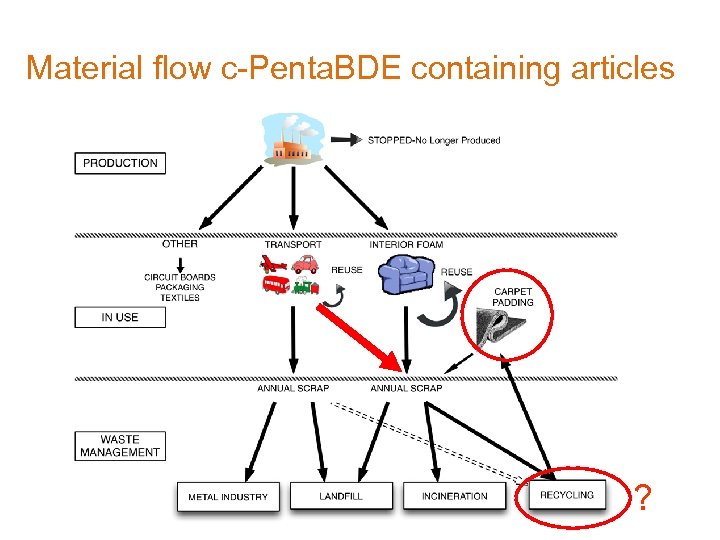
Material flow c-Penta. BDE containing articles ?
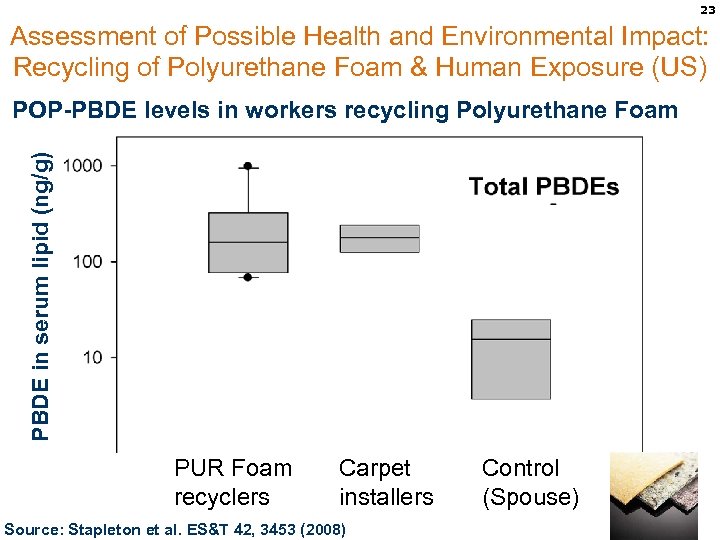
23 Assessment of Possible Health and Environmental Impact: Recycling of Polyurethane Foam & Human Exposure (US) PBDE in serum lipid (ng/g) POP-PBDE levels in workers recycling Polyurethane Foam PUR Foam recyclers Carpet installers Source: Stapleton et al. ES&T 42, 3453 (2008) Control (Spouse)
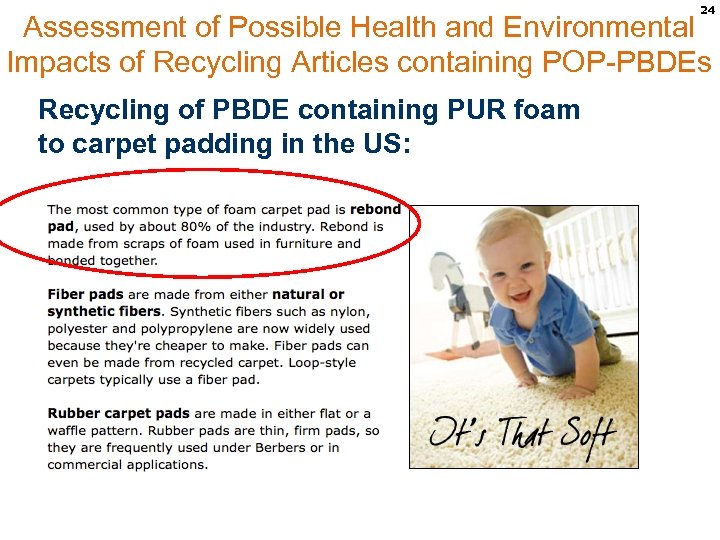
24 Assessment of Possible Health and Environmental Impacts of Recycling Articles containing POP-PBDEs Recycling of PBDE containing PUR foam to carpet padding in the US:
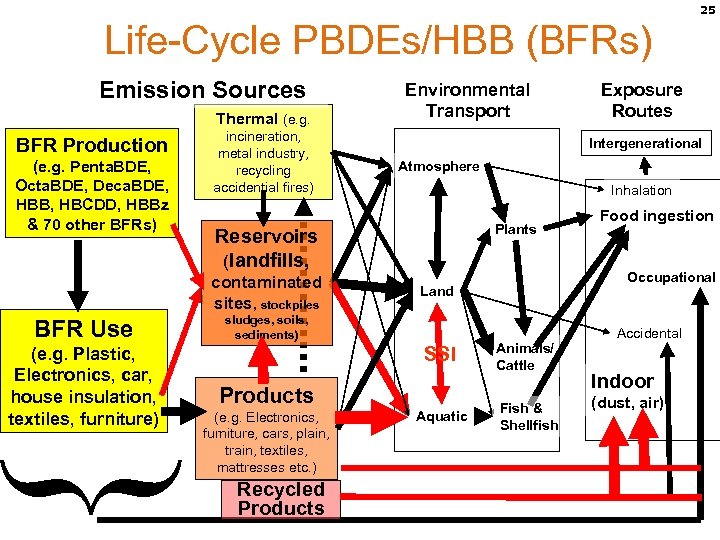
25 Life-Cycle PBDEs/HBB (BFRs) Emission Sources Thermal (e. g. BFR Production (e. g. Penta. BDE, Octa. BDE, Deca. BDE, HBB, HBCDD, HBBz & 70 other BFRs) incineration, metal industry, recycling accidential fires) (e. g. Plastic, Electronics, car, house insulation, textiles, furniture) Atmosphere Inhalation Plants SSl Products Recycled Products Aquatic Food ingestion Occupational Land sludges, soils, sediments) (e. g. Electronics, furniture, cars, plain, train, textiles, mattresses etc. ) Exposure Routes Intergenerational Reservoirs (landfills, contaminated sites, stockpiles BFR Use Environmental Transport Animals/ Cattle Fish & Shellfish Accidental Indoor (dust, air)
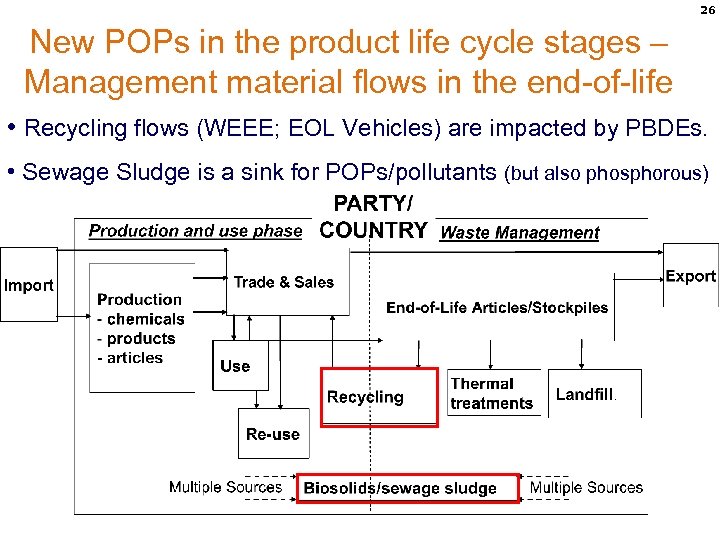
26 New POPs in the product life cycle stages – Management material flows in the end-of-life • Recycling flows (WEEE; EOL Vehicles) are impacted by PBDEs. • Sewage Sludge is a sink for POPs/pollutants (but also phosphorous)
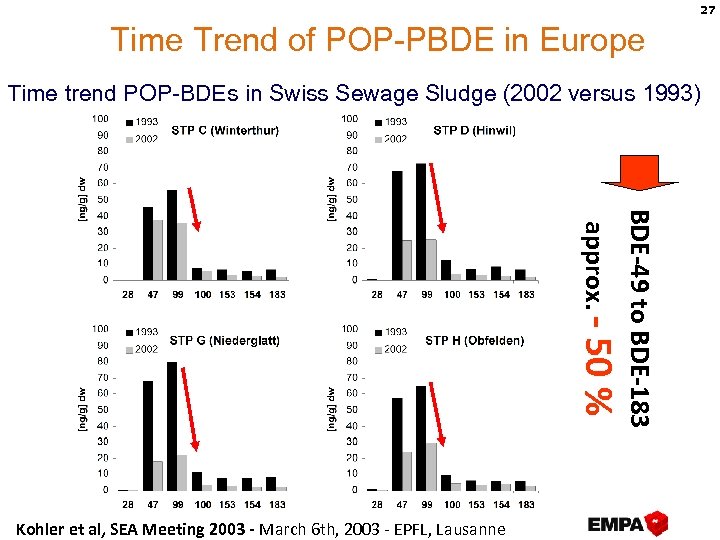
27 Time Trend of POP-PBDE in Europe Time trend POP-BDEs in Swiss Sewage Sludge (2002 versus 1993) BDE-49 to BDE-183 approx. - 50 % Kohler et al, SEA Meeting 2003 - March 6 th, 2003 - EPFL, Lausanne
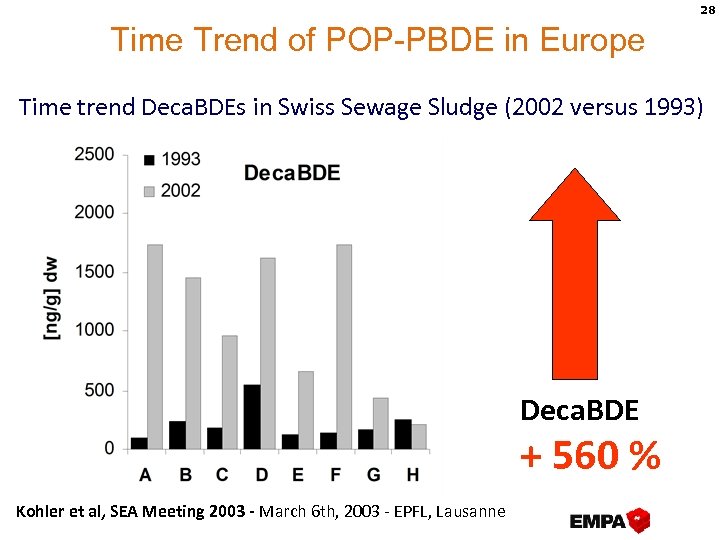
28 Time Trend of POP-PBDE in Europe Time trend Deca. BDEs in Swiss Sewage Sludge (2002 versus 1993) Deca. BDE + 560 % Kohler et al, SEA Meeting 2003 - March 6 th, 2003 - EPFL, Lausanne
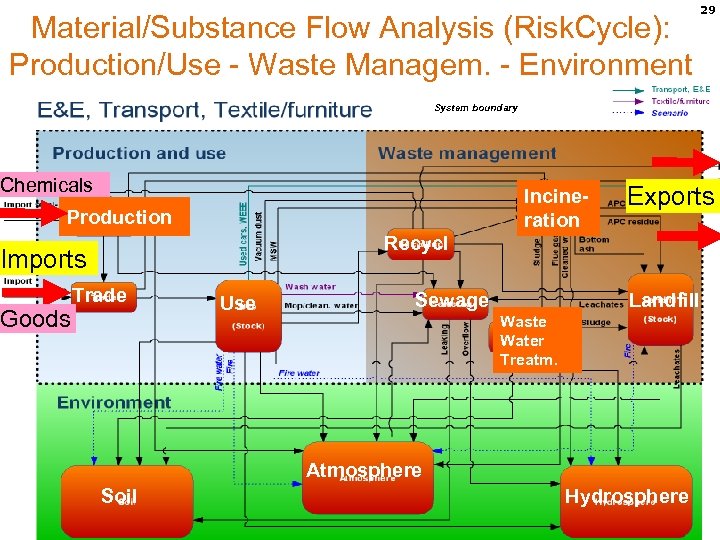
Material/Substance Flow Analysis (Risk. Cycle): Production/Use - Waste Managem. - Environment 29 System boundary Chemicals Incineration Production Recycl Imports Goods Exports Trade Use Sewage Landfill Waste Water Treatm. Atmosphere Soil Hydrosphere
30 Time Trend of POP-PBDE in Europe Time trend of some POPs in Human milk Sweden. Source: Natural Research Defense Council
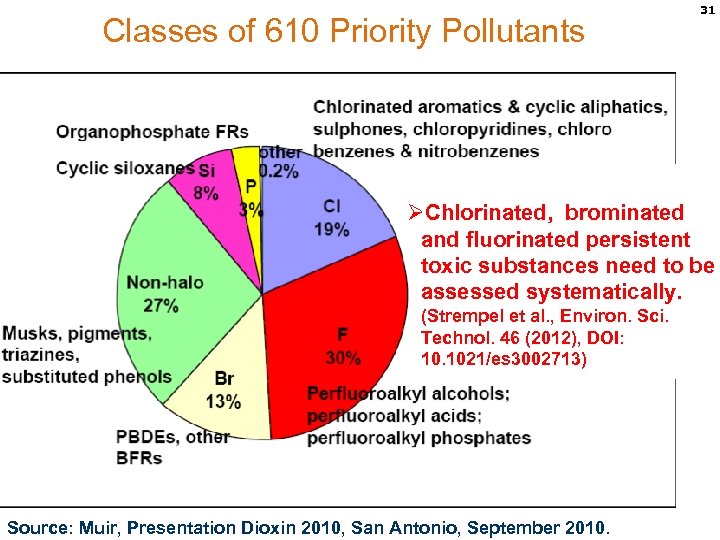
Classes of 610 Priority Pollutants 31 ØChlorinated, brominated and fluorinated persistent toxic substances need to be assessed systematically. (Strempel et al. , Environ. Sci. Technol. 46 (2012), DOI: 10. 1021/es 3002713) Source: Muir, Presentation Dioxin 2010, San Antonio, September 2010.
Tesekkür Ederim Questions ? http: //www. pops. int ssc@pops. int
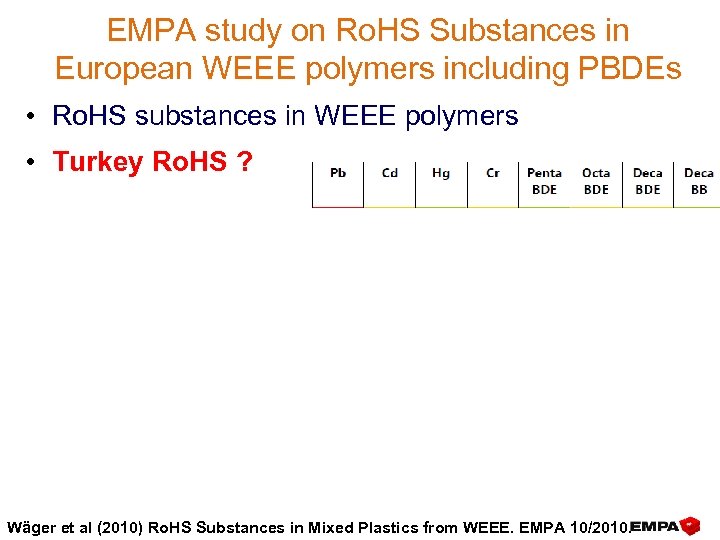
EMPA study on Ro. HS Substances in European WEEE polymers including PBDEs • Ro. HS substances in WEEE polymers • Turkey Ro. HS ? Wäger et al (2010) Ro. HS Substances in Mixed Plastics from WEEE. EMPA 10/2010.
Скачать презентацию Enabling Activities to Review and Update the National
0767f184f063fa1e3ca6f15a5550a6cf.ppt