


 Скачать презентацию EN 554 Photonic Networks Lecture 2 — Devices
9821da13ddcb783911dd2248a31add0f.ppt
- Количество слайдов: 51
 EN 554 Photonic Networks Lecture 2 - Devices & Components Professor Z Ghassemlooy Northumbria Communications Laboratory School of Informatics, Engineering and Technology The University of Northumbria U. K. http: //soe. unn. ac. uk/ocr Prof. Z Ghassemlooy 1
 Contents § § § § § Connectors + Optical Splice Attenuators Coupler Splitter Filters Fibre Brag Grating Optical Isolator Circulators Optical Add/Drop Multiplexer & Demultiplexer Prof. Z Ghassemlooy 2
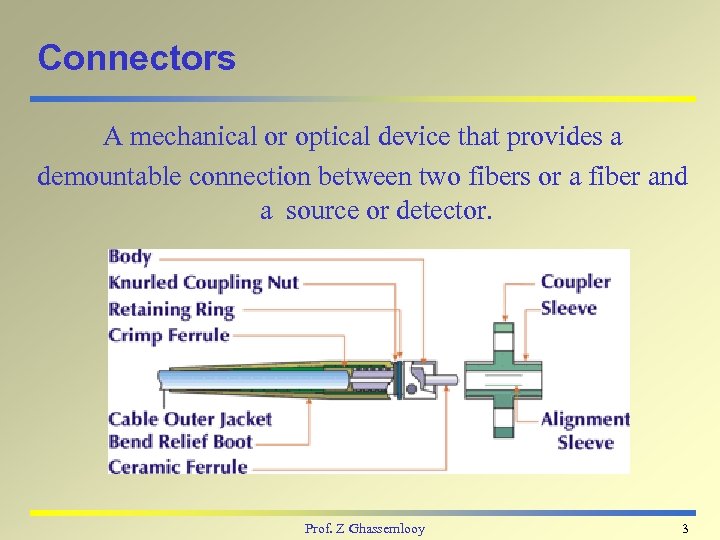 Connectors A mechanical or optical device that provides a demountable connection between two fibers or a fiber and a source or detector. Prof. Z Ghassemlooy 3
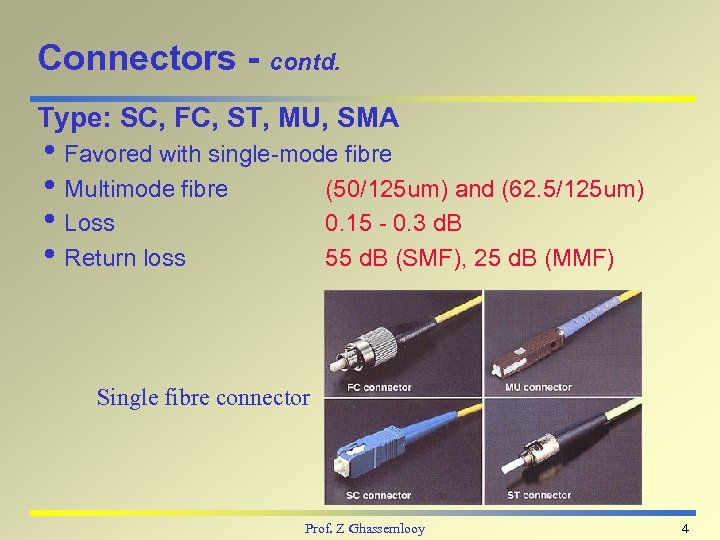 Connectors - contd. Type: SC, FC, ST, MU, SMA i Favored with single-mode fibre i Multimode fibre (50/125 um) and (62. 5/125 um) i Loss 0. 15 - 0. 3 d. B i Return loss 55 d. B (SMF), 25 d. B (MMF) Single fibre connector Prof. Z Ghassemlooy 4
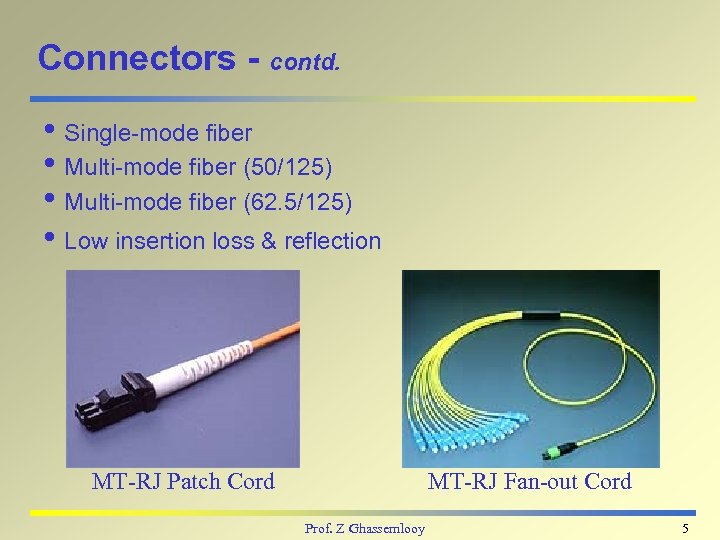 Connectors - contd. i Single-mode fiber i Multi-mode fiber (50/125) i Multi-mode fiber (62. 5/125) i Low insertion loss & reflection MT-RJ Patch Cord MT-RJ Fan-out Cord Prof. Z Ghassemlooy 5
 Optical Splices i. Mechanical – Ends of two pieces of fiber are cleaned and stripped, then carefully butted together and aligned using a mechanical assembly. A gel is used at the point of contact to reduce light reflection and keep the splice loss at a minimum. The ends of the fiber are held together by friction or compression, and the splice assembly features a locking mechanism so that the fibers remained aligned. i. Fusion – Involves actually melting (fusing) together the ends of two pieces of fiber. The result is a continuous fiber without a break. Both are capable of splice losses in the range of 0. 15 d. B (3%) to 0. 1 d. B (2%). Prof. Z Ghassemlooy 6
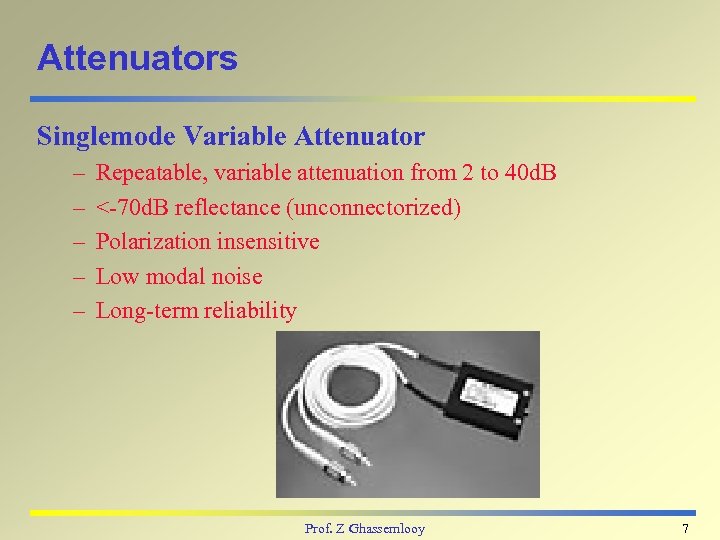 Attenuators Singlemode Variable Attenuator – – – Repeatable, variable attenuation from 2 to 40 d. B <-70 d. B reflectance (unconnectorized) Polarization insensitive Low modal noise Long-term reliability Prof. Z Ghassemlooy 7
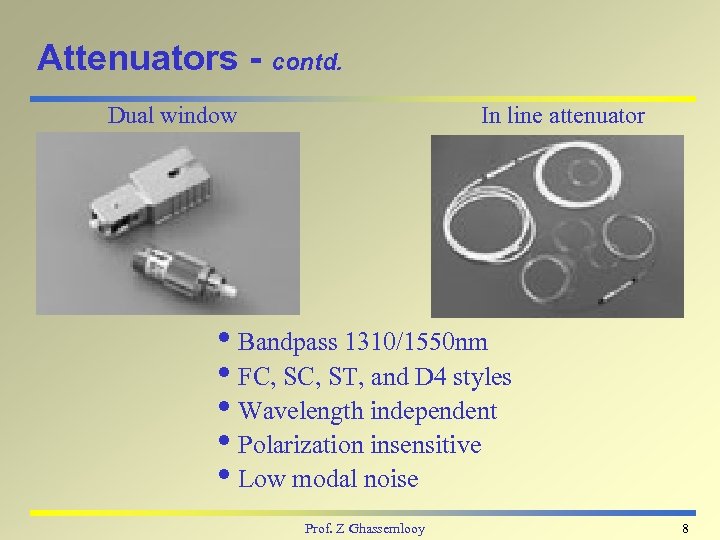 Attenuators - contd. Dual window In line attenuator i. Bandpass 1310/1550 nm i. FC, ST, and D 4 styles i. Wavelength independent i. Polarization insensitive i. Low modal noise Prof. Z Ghassemlooy 8
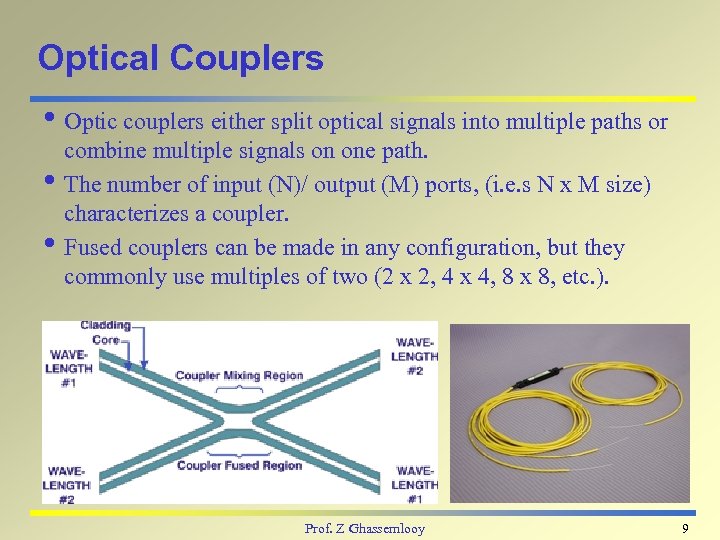 Optical Couplers i Optic couplers either split optical signals into multiple paths or combine multiple signals on one path. i The number of input (N)/ output (M) ports, (i. e. s N x M size) characterizes a coupler. i Fused couplers can be made in any configuration, but they commonly use multiples of two (2 x 2, 4 x 4, 8 x 8, etc. ). Prof. Z Ghassemlooy 9
 Coupler i. Uses – Splitter: (50: 50) – Taps: (90: 10) or (95: 05) – Combiners i An important issue: – two output differ p/2 in phase i Applications: – – Optical Switches, Mach Zehnder Interferometers, Optical amplifiers, passive star couplers, . . . Prof. Z Ghassemlooy 10
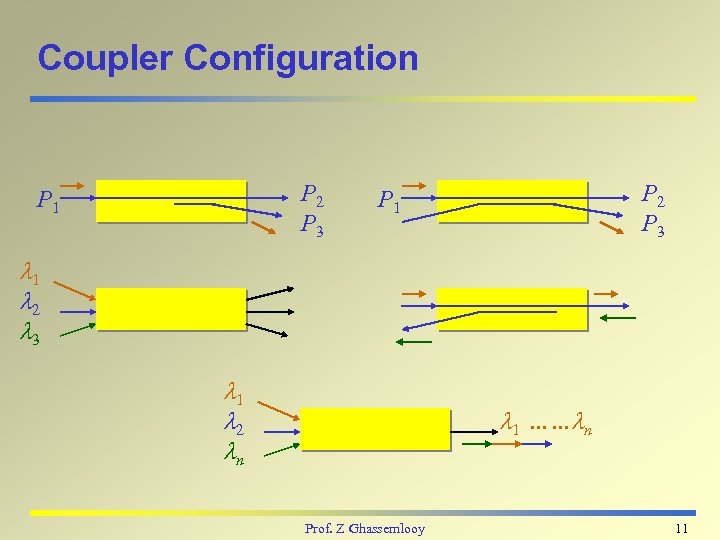 Coupler Configuration P 2 P 3 P 1 1 2 3 1 2 n 1 …… n Prof. Z Ghassemlooy 11
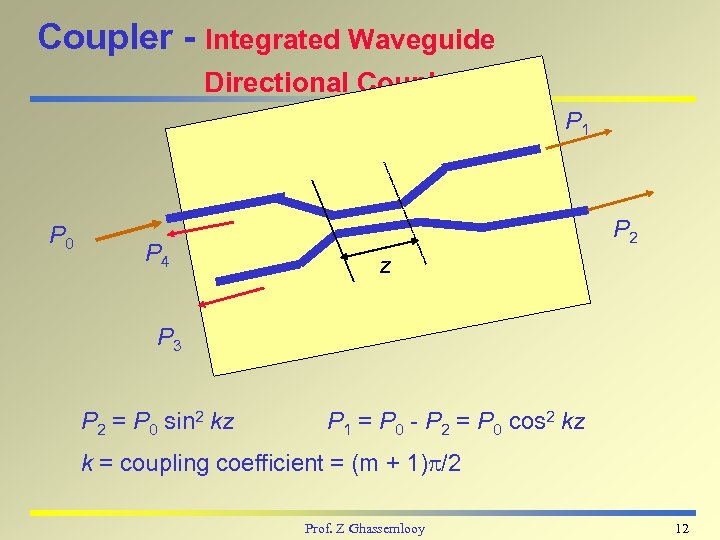 Coupler - Integrated Waveguide Directional Coupler P 1 P 0 P 4 P 2 z P 3 P 2 = P 0 sin 2 kz P 1 = P 0 - P 2 = P 0 cos 2 kz k = coupling coefficient = (m + 1) /2 Prof. Z Ghassemlooy 12
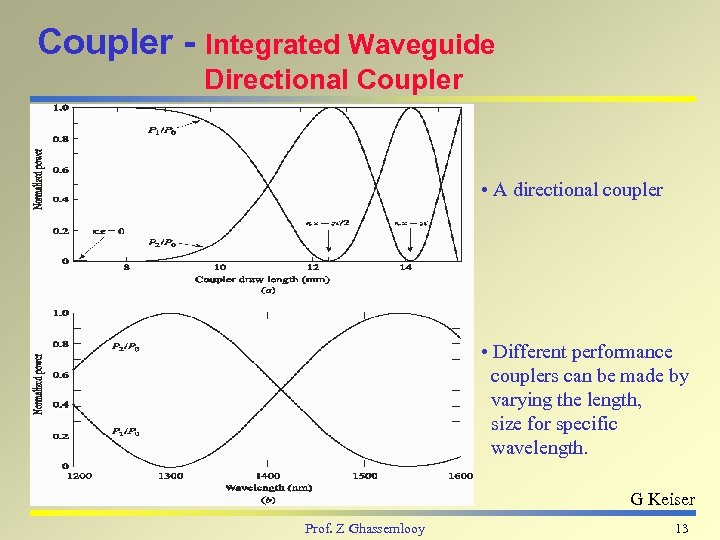 Coupler - Integrated Waveguide Directional Coupler • A directional coupler • Different performance couplers can be made by varying the length, size for specific wavelength. G Keiser Prof. Z Ghassemlooy 13
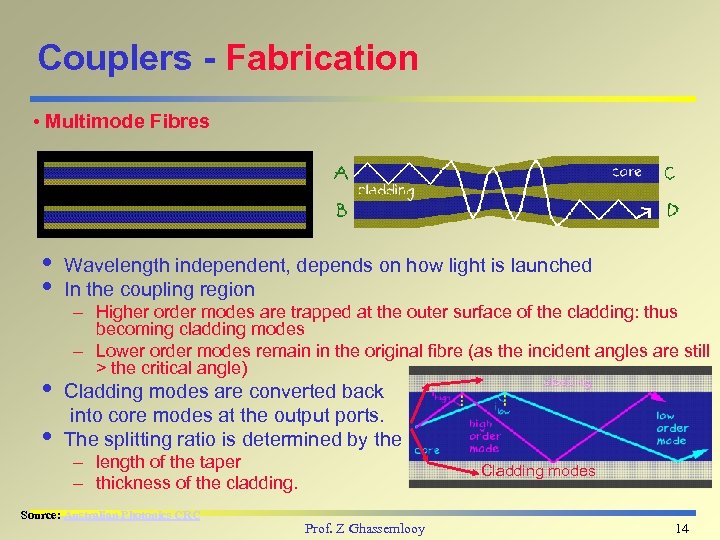 Couplers - Fabrication • Multimode Fibres i Wavelength independent, depends on how light is launched i In the coupling region – Higher order modes are trapped at the outer surface of the cladding: thus becoming cladding modes – Lower order modes remain in the original fibre (as the incident angles are still > the critical angle) i Cladding modes are converted back into core modes at the output ports. i The splitting ratio is determined by the – length of the taper – thickness of the cladding. Source: Australian Photonics CRC Cladding modes Prof. Z Ghassemlooy 14
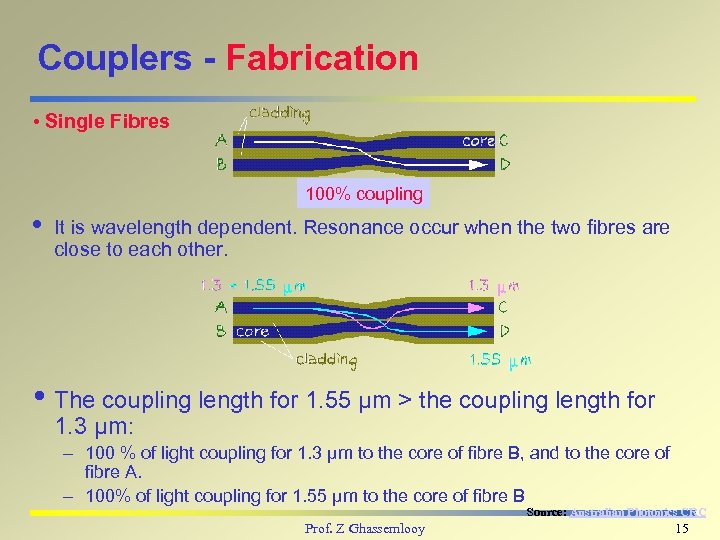 Couplers - Fabrication • Single Fibres 100% coupling i It is wavelength dependent. Resonance occur when the two fibres are close to each other. i The coupling length for 1. 55 µm > the coupling length for 1. 3 µm: – 100 % of light coupling for 1. 3 µm to the core of fibre B, and to the core of fibre A. – 100% of light coupling for 1. 55 µm to the core of fibre B Source: Australian Photonics CRC Prof. Z Ghassemlooy 15
 Couplers - Fabrication i The amount of power transmitted into fibres depend on the coupling length i The coupling length changes with the wavelength. i The splitting ratio can be tuned choosing the coupling length. i By choosing carefully the coupler length, it is possible to combine or separate Two different wavelengths Prof. Z Ghassemlooy 16
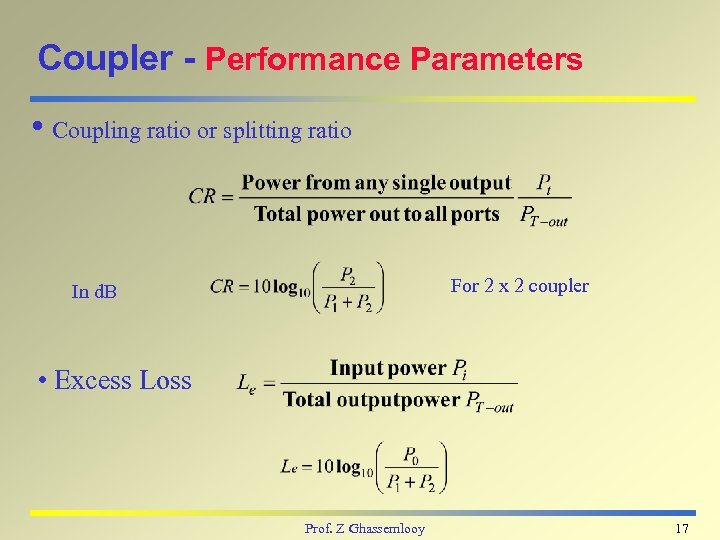 Coupler - Performance Parameters i Coupling ratio or splitting ratio For 2 x 2 coupler In d. B • Excess Loss Prof. Z Ghassemlooy 17
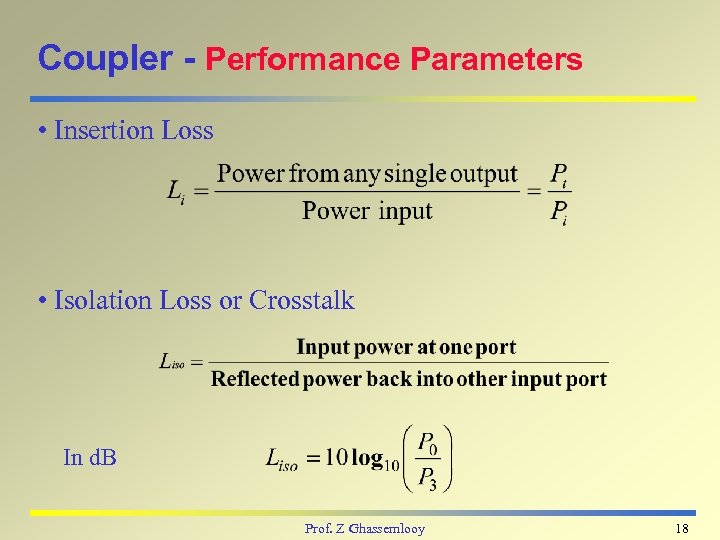 Coupler - Performance Parameters • Insertion Loss • Isolation Loss or Crosstalk In d. B Prof. Z Ghassemlooy 18
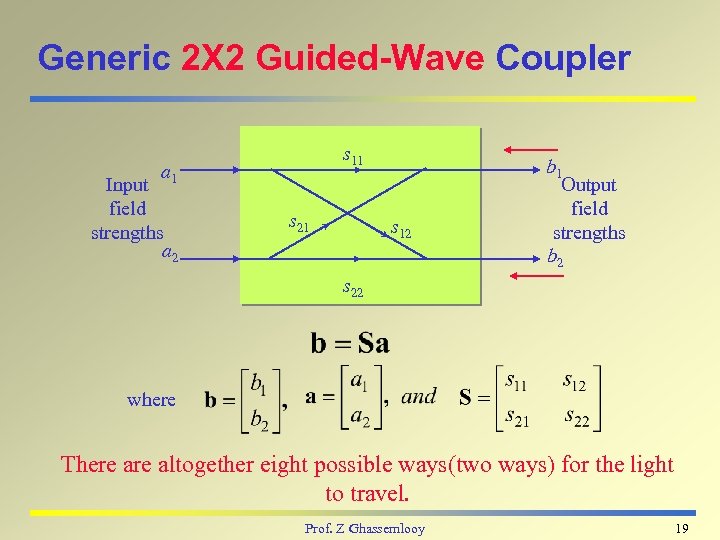 Generic 2 X 2 Guided-Wave Coupler s 11 a 1 Input field strengths a 2 s 21 s 12 b 1 Output field strengths b 2 s 22 where There altogether eight possible ways(two ways) for the light to travel. Prof. Z Ghassemlooy 19
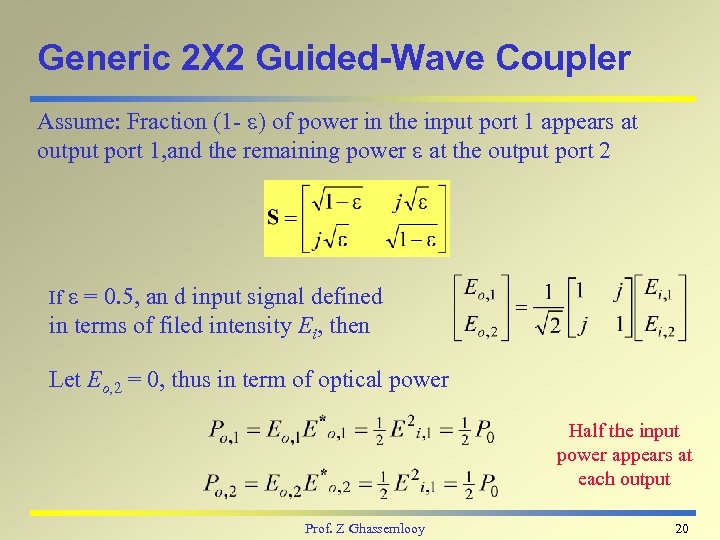 Generic 2 X 2 Guided-Wave Coupler Assume: Fraction (1 - ) of power in the input port 1 appears at output port 1, and the remaining power at the output port 2 If = 0. 5, an d input signal defined in terms of filed intensity Ei, then Let Eo, 2 = 0, thus in term of optical power Half the input power appears at each output Prof. Z Ghassemlooy 20
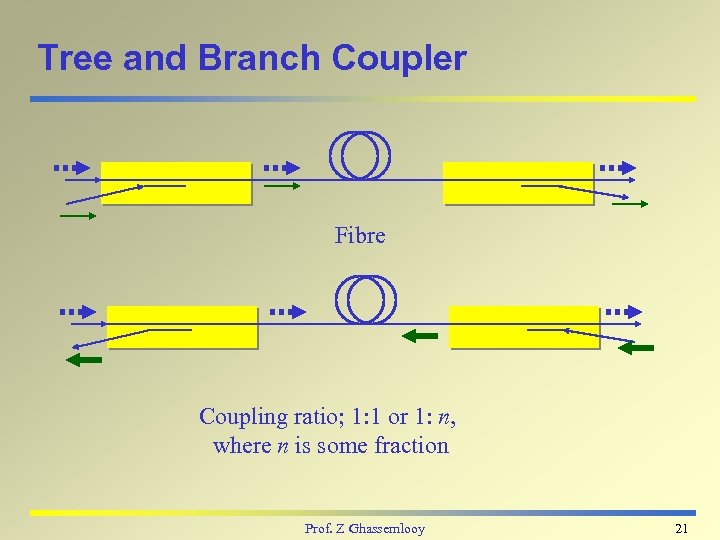 Tree and Branch Coupler Fibre Coupling ratio; 1: 1 or 1: n, where n is some fraction Prof. Z Ghassemlooy 21
 Star Couplers i. Optical couplers with more than four ports. i. Types of star couplers: – transmission star coupler the light at any of the input port is split equally through all output ports. – reflection star coupler Prof. Z Ghassemlooy 22
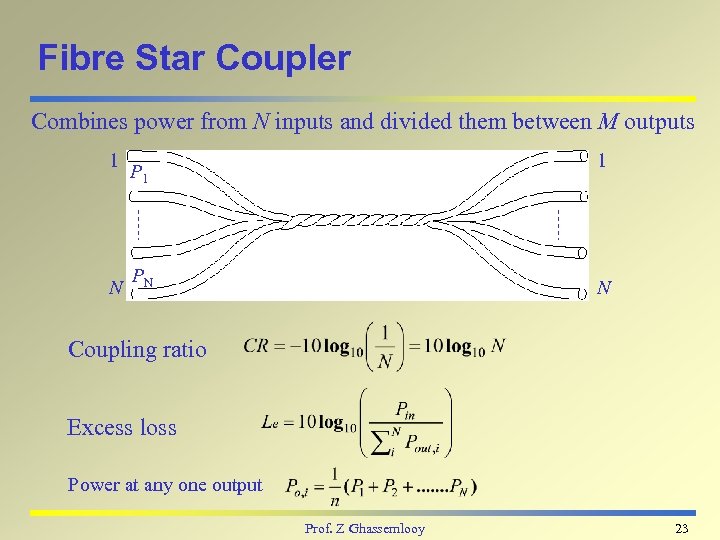 Fibre Star Coupler Combines power from N inputs and divided them between M outputs 1 N 1 PN N Coupling ratio Excess loss Power at any one output Prof. Z Ghassemlooy 23
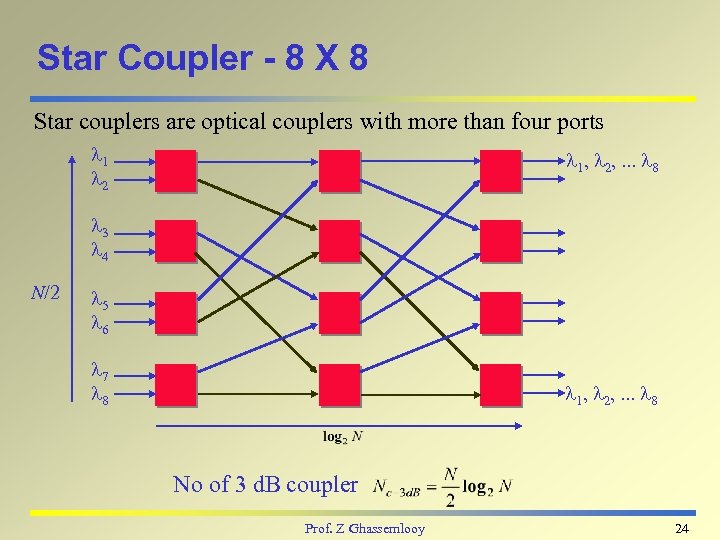 Star Coupler - 8 X 8 Star couplers are optical couplers with more than four ports 1 2 1, 2, . . . 8 3 4 N/2 5 6 7 8 1, 2, . . . 8 No of 3 d. B coupler Prof. Z Ghassemlooy 24
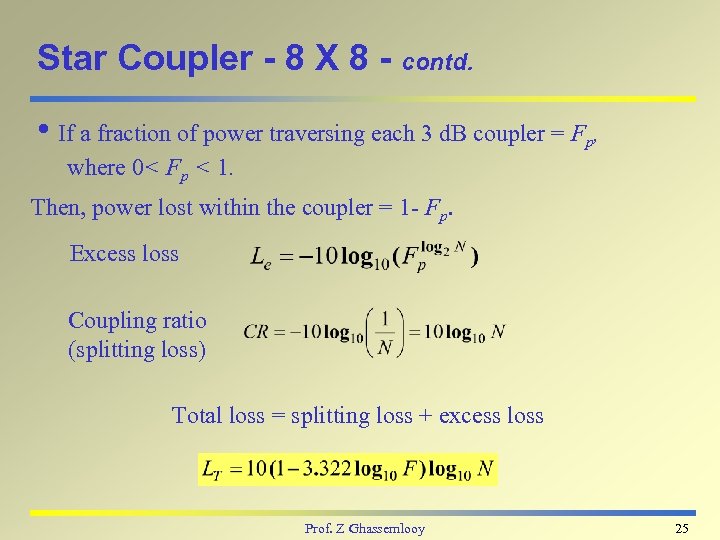 Star Coupler - 8 X 8 - contd. i If a fraction of power traversing each 3 d. B coupler = Fp, where 0< Fp < 1. Then, power lost within the coupler = 1 - Fp. Excess loss Coupling ratio (splitting loss) Total loss = splitting loss + excess loss Prof. Z Ghassemlooy 25
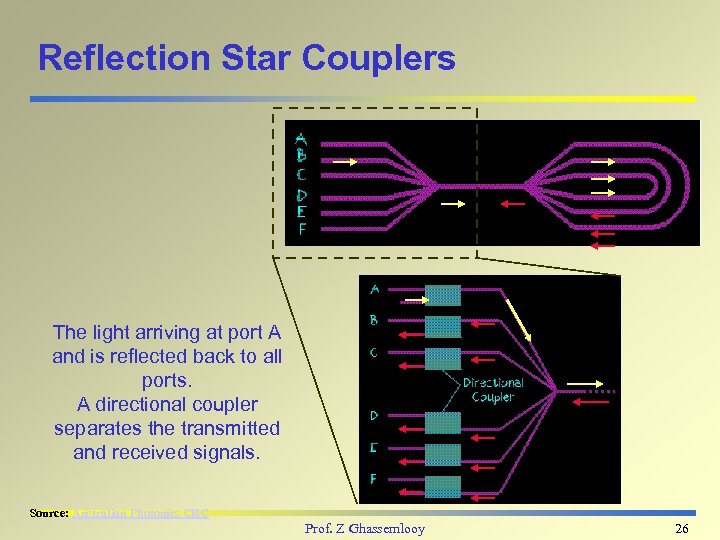 Reflection Star Couplers The light arriving at port A and is reflected back to all ports. A directional coupler separates the transmitted and received signals. Source: Australian Photonics CRC Prof. Z Ghassemlooy 26
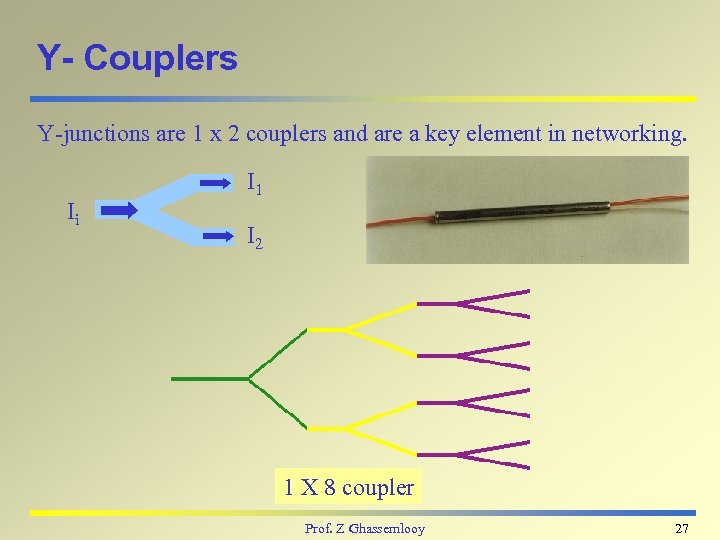 Y- Couplers Y-junctions are 1 x 2 couplers and are a key element in networking. Ii I 1 I 2 1 X 8 coupler Prof. Z Ghassemlooy 27
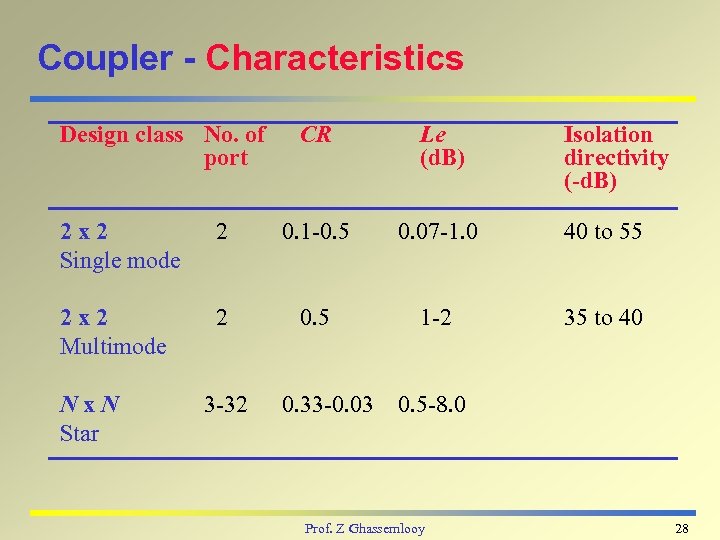 Coupler - Characteristics Design class No. of port CR Le (d. B) Isolation directivity (-d. B) 2 x 2 Single mode 2 0. 1 -0. 5 0. 07 -1. 0 40 to 55 2 x 2 Multimode 2 0. 5 1 -2 35 to 40 Nx. N Star 3 -32 0. 33 -0. 03 0. 5 -8. 0 Prof. Z Ghassemlooy 28
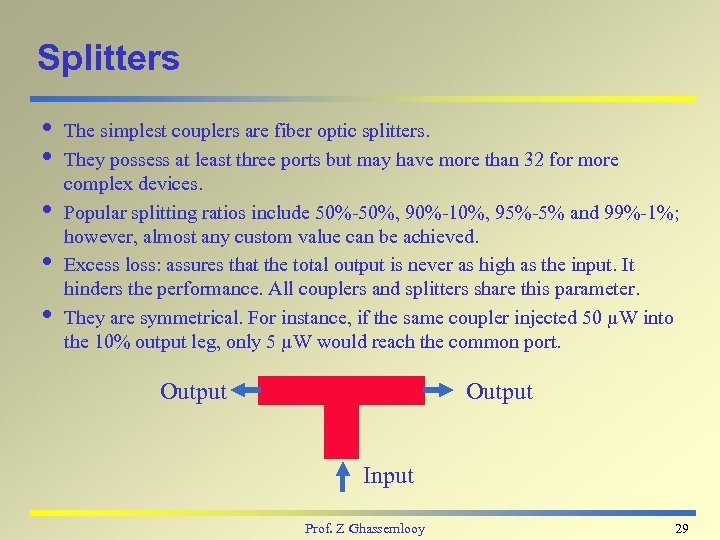 Splitters i The simplest couplers are fiber optic splitters. i They possess at least three ports but may have more than 32 for more complex devices. i Popular splitting ratios include 50%-50%, 90%-10%, 95%-5% and 99%-1%; however, almost any custom value can be achieved. i Excess loss: assures that the total output is never as high as the input. It hinders the performance. All couplers and splitters share this parameter. i They are symmetrical. For instance, if the same coupler injected 50 µW into the 10% output leg, only 5 µW would reach the common port. Output Input Prof. Z Ghassemlooy 29
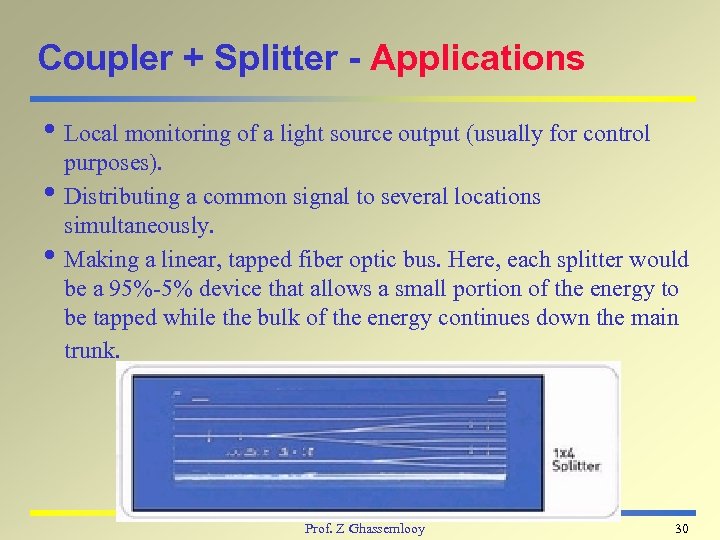 Coupler + Splitter - Applications i Local monitoring of a light source output (usually for control purposes). i Distributing a common signal to several locations simultaneously. i Making a linear, tapped fiber optic bus. Here, each splitter would be a 95%-5% device that allows a small portion of the energy to be tapped while the bulk of the energy continues down the main trunk. Prof. Z Ghassemlooy 30
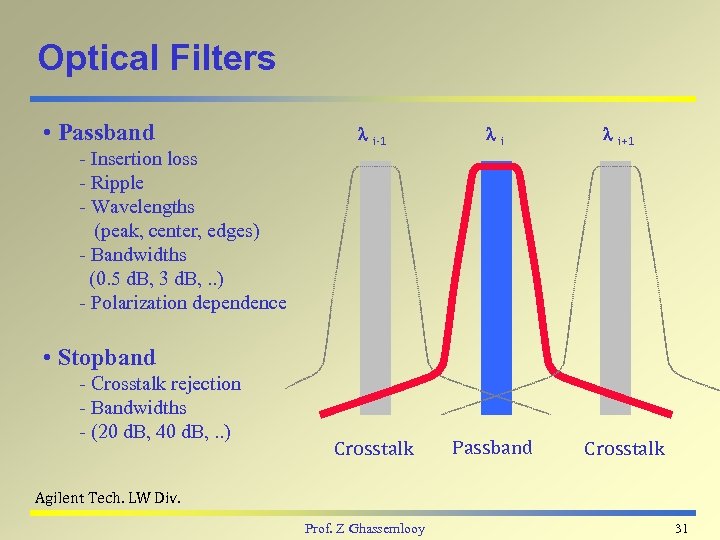 Optical Filters • Passband - Insertion loss - Ripple - Wavelengths (peak, center, edges) - Bandwidths (0. 5 d. B, 3 d. B, . . ) - Polarization dependence l i-1 li Crosstalk Passband l i+1 • Stopband - Crosstalk rejection - Bandwidths - (20 d. B, 40 d. B, . . ) Crosstalk Agilent Tech. LW Div. Prof. Z Ghassemlooy 31
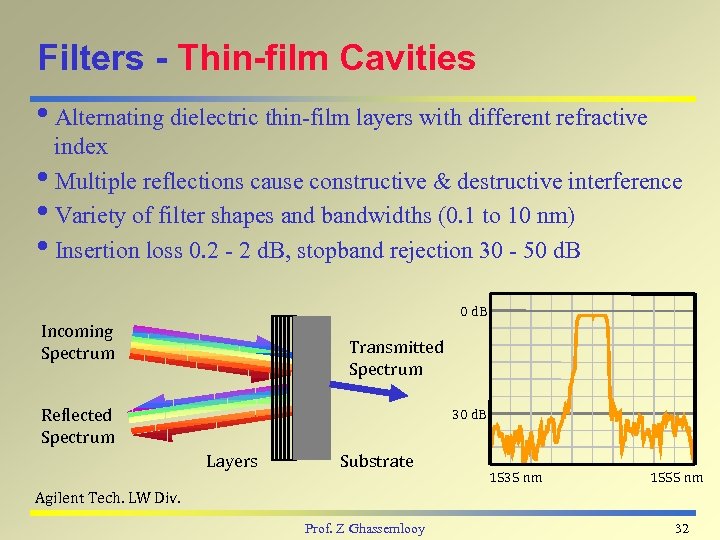 Filters - Thin-film Cavities i. Alternating dielectric thin-film layers with different refractive index i. Multiple reflections cause constructive & destructive interference i. Variety of filter shapes and bandwidths (0. 1 to 10 nm) i. Insertion loss 0. 2 - 2 d. B, stopband rejection 30 - 50 d. B Incoming Spectrum Transmitted Spectrum Reflected Spectrum 30 d. B Layers Substrate 1535 nm 1555 nm Agilent Tech. LW Div. Prof. Z Ghassemlooy 32
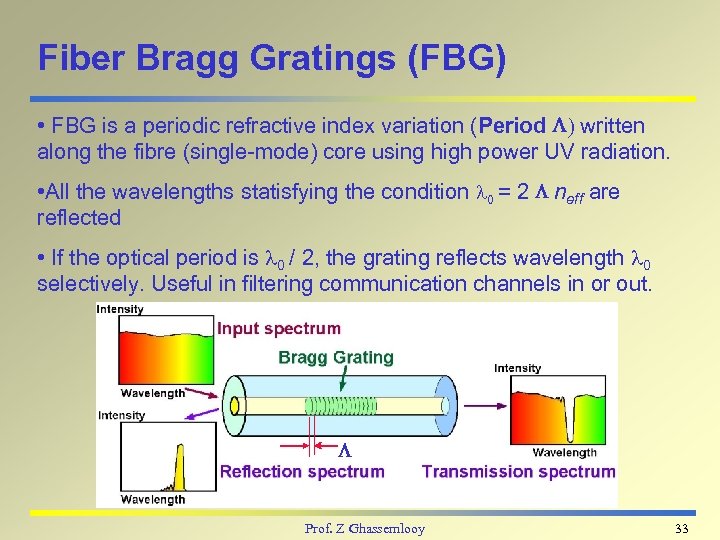 Fiber Bragg Gratings (FBG) • FBG is a periodic refractive index variation (Period ) written along the fibre (single-mode) core using high power UV radiation. • All the wavelengths statisfying the condition 0 = 2 neff are reflected • If the optical period is 0 / 2, the grating reflects wavelength 0 selectively. Useful in filtering communication channels in or out. Prof. Z Ghassemlooy 33
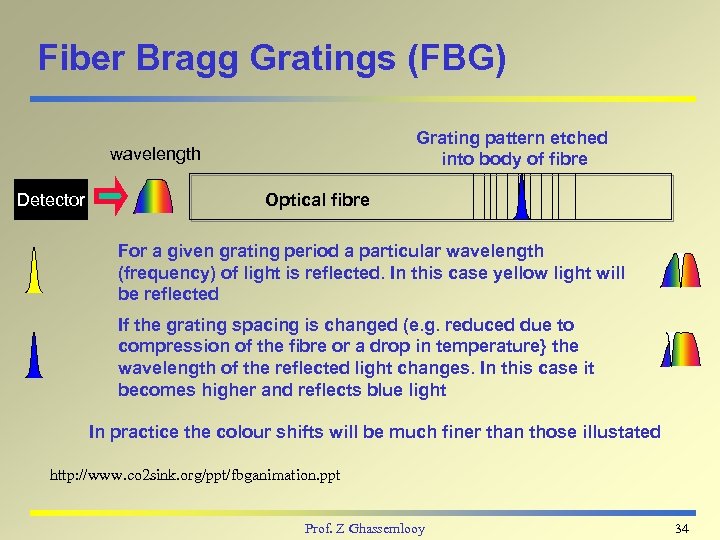 Fiber Bragg Gratings (FBG) Grating pattern etched into body of fibre wavelength Detector Optical fibre For a given grating period a particular wavelength (frequency) of light is reflected. In this case yellow light will be reflected If the grating spacing is changed (e. g. reduced due to compression of the fibre or a drop in temperature} the wavelength of the reflected light changes. In this case it becomes higher and reflects blue light In practice the colour shifts will be much finer than those illustated http: //www. co 2 sink. org/ppt/fbganimation. ppt Prof. Z Ghassemlooy 34
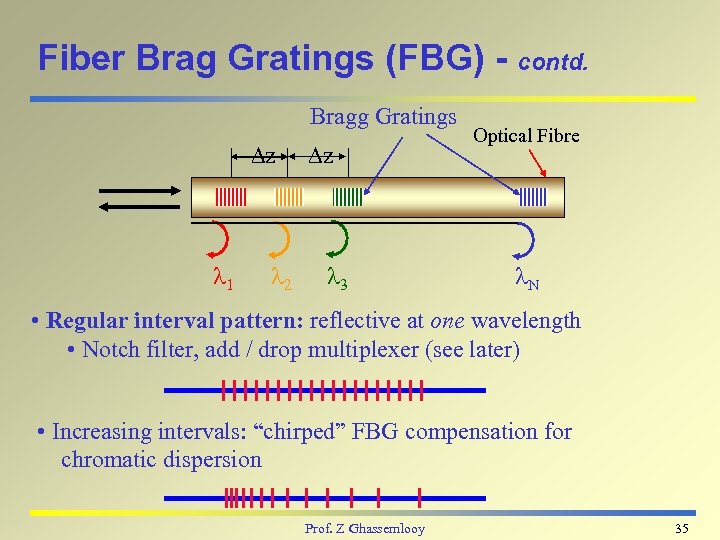 Fiber Brag Gratings (FBG) - contd. Bragg Gratings Dz 1 2 Dz 3 Optical Fibre N • Regular interval pattern: reflective at one wavelength • Notch filter, add / drop multiplexer (see later) • Increasing intervals: “chirped” FBG compensation for chromatic dispersion Prof. Z Ghassemlooy 35
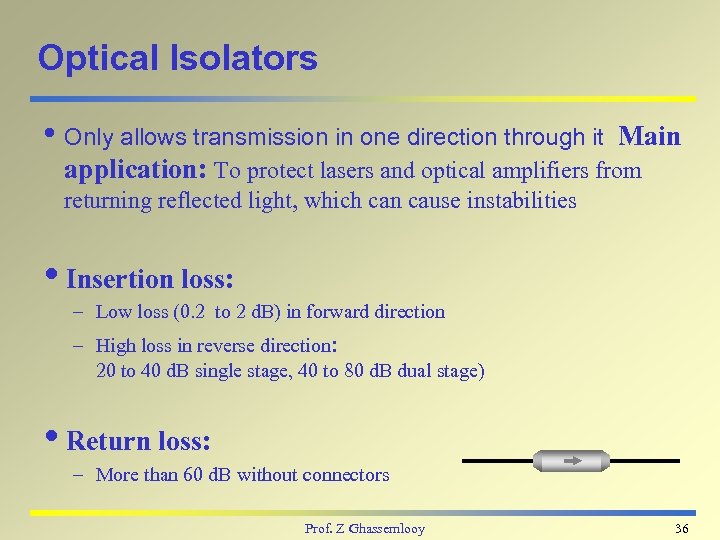 Optical Isolators i Only allows transmission in one direction through it Main application: To protect lasers and optical amplifiers from returning reflected light, which can cause instabilities i. Insertion loss: – Low loss (0. 2 to 2 d. B) in forward direction – High loss in reverse direction: 20 to 40 d. B single stage, 40 to 80 d. B dual stage) i. Return loss: – More than 60 d. B without connectors Prof. Z Ghassemlooy 36
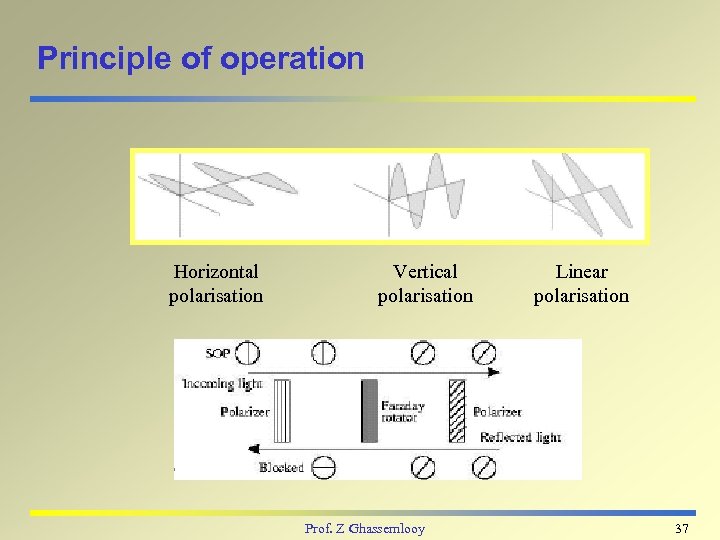 Principle of operation Horizontal polarisation Vertical polarisation Prof. Z Ghassemlooy Linear polarisation 37
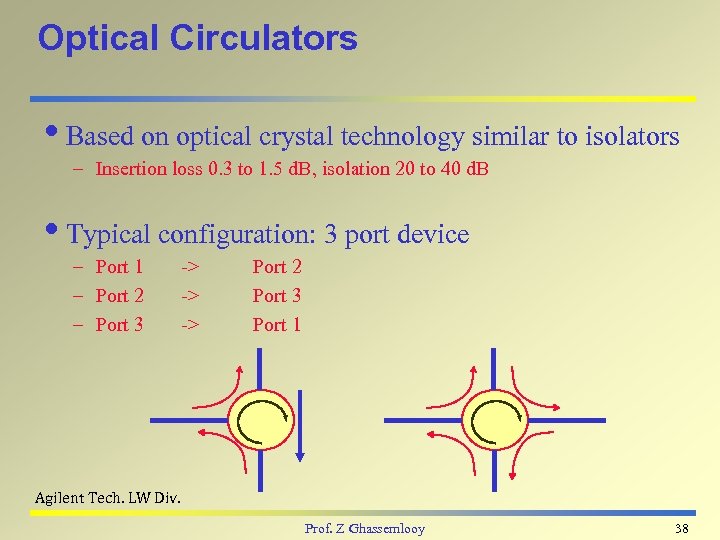 Optical Circulators i. Based on optical crystal technology similar to isolators – Insertion loss 0. 3 to 1. 5 d. B, isolation 20 to 40 d. B i. Typical configuration: 3 port device – Port 1 – Port 2 – Port 3 -> -> -> Port 2 Port 3 Port 1 Agilent Tech. LW Div. Prof. Z Ghassemlooy 38
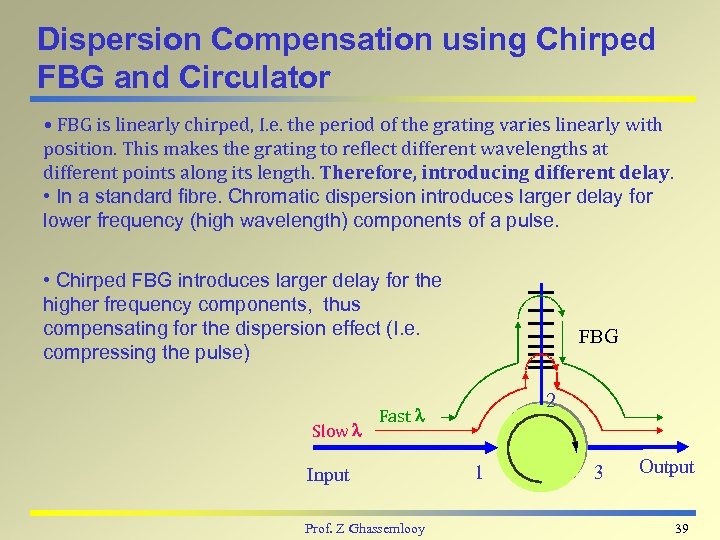 Dispersion Compensation using Chirped FBG and Circulator • FBG is linearly chirped, I. e. the period of the grating varies linearly with position. This makes the grating to reflect different wavelengths at different points along its length. Therefore, introducing different delay. • In a standard fibre. Chromatic dispersion introduces larger delay for lower frequency (high wavelength) components of a pulse. • Chirped FBG introduces larger delay for the higher frequency components, thus compensating for the dispersion effect (I. e. compressing the pulse) Slow l FBG 2 Fast l Input Prof. Z Ghassemlooy 1 3 Output 39
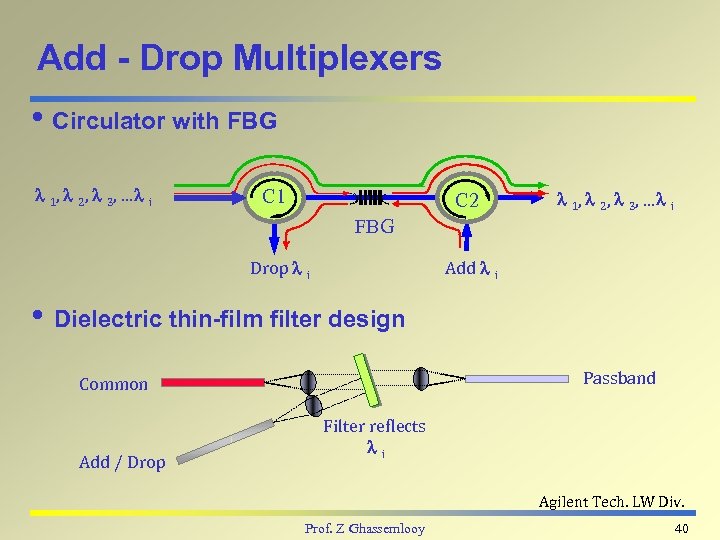 Add - Drop Multiplexers i Circulator with FBG l 1, l 2, l 3, . . . l i C 1 C 2 l 1, l 2, l 3, . . . l i FBG Drop l i Add l i • Dielectric thin-film filter design Passband Common Add / Drop Filter reflects li Agilent Tech. LW Div. Prof. Z Ghassemlooy 40
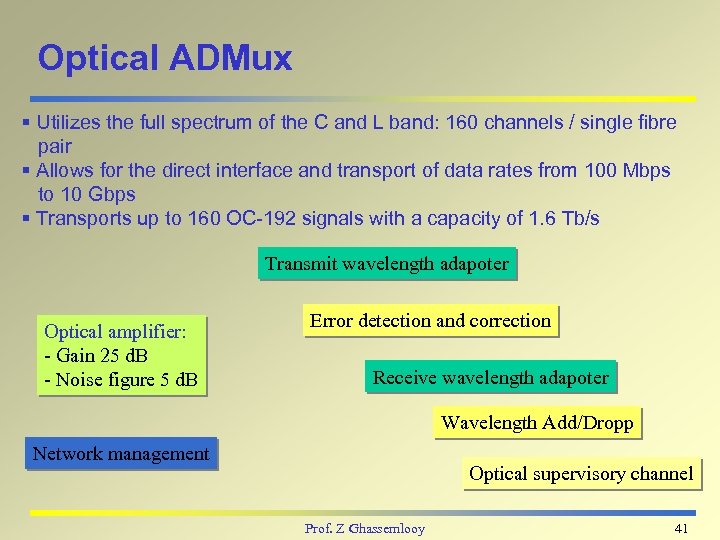 Optical ADMux § Utilizes the full spectrum of the C and L band: 160 channels / single fibre pair § Allows for the direct interface and transport of data rates from 100 Mbps to 10 Gbps § Transports up to 160 OC-192 signals with a capacity of 1. 6 Tb/s Transmit wavelength adapoter Optical amplifier: - Gain 25 d. B - Noise figure 5 d. B Error detection and correction Receive wavelength adapoter Wavelength Add/Dropp Network management Optical supervisory channel Prof. Z Ghassemlooy 41
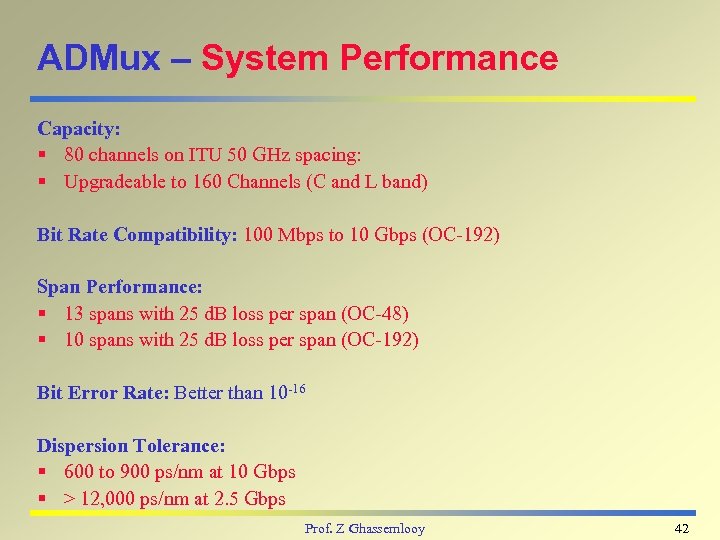 ADMux – System Performance Capacity: § 80 channels on ITU 50 GHz spacing: § Upgradeable to 160 Channels (C and L band) Bit Rate Compatibility: 100 Mbps to 10 Gbps (OC-192) Span Performance: § 13 spans with 25 d. B loss per span (OC-48) § 10 spans with 25 d. B loss per span (OC-192) Bit Error Rate: Better than 10 -16 Dispersion Tolerance: § 600 to 900 ps/nm at 10 Gbps § > 12, 000 ps/nm at 2. 5 Gbps Prof. Z Ghassemlooy 42
 Multiplexers (MUX) / Demultiplexers (DEMUX) i. Key component of wavelength-division multiplexing (WDM) technology i. Types of technologies – Cascaded dielectric filters – Cascaded FBGs – Phased arrays (see later) i. Low crosstalk is essential for demultiplexing Prof. Z Ghassemlooy 43
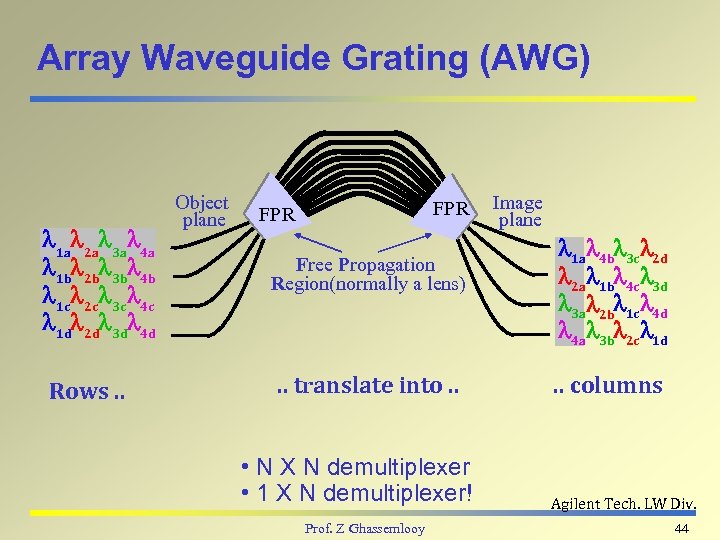 Array Waveguide Grating (AWG) l 1 al 2 al 3 al 4 a l 1 bl 2 bl 3 bl 4 b l 1 c l 2 c l 3 c l 4 c l 1 dl 2 dl 3 dl 4 d Rows. . Object plane FPR Free Propagation Region(normally a lens) . . translate into. . • N X N demultiplexer • 1 X N demultiplexer! Prof. Z Ghassemlooy Image plane l 1 a l 4 bl 3 cl 2 d l 2 a l 1 bl 4 cl 3 d l 3 a l 2 bl 1 cl 4 d l 4 a l 3 bl 2 cl 1 d. . columns Agilent Tech. LW Div. 44
 AWG - contd. • Each experience a different phase shift because of different lengths of waveguide. • Phase shifts wavelength are dependent. • Thus, different channels focus to different output WG, on exit. • N-input and N-output fibres • Single input: wavelength demultiplexer! i 1990 s - First developed i 1999 - Commercially available i No. of channels: 250 to 1000 @ spacing of 10 GHz. Prof. Z Ghassemlooy 45
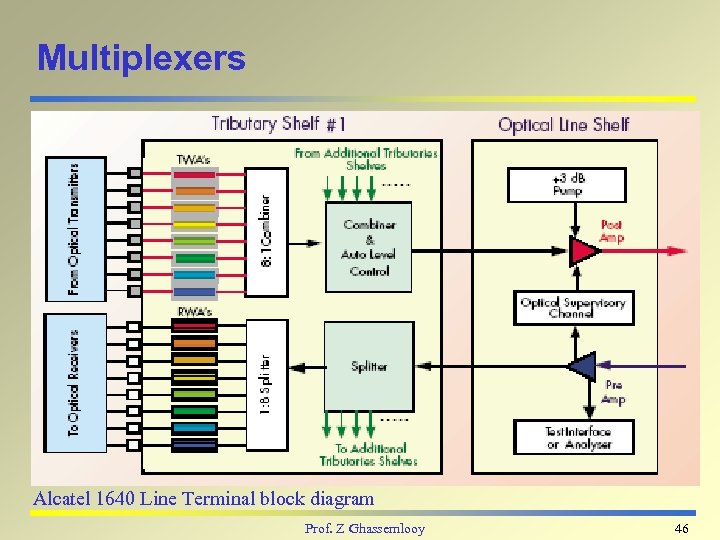 Multiplexers Alcatel 1640 Line Terminal block diagram Prof. Z Ghassemlooy 46
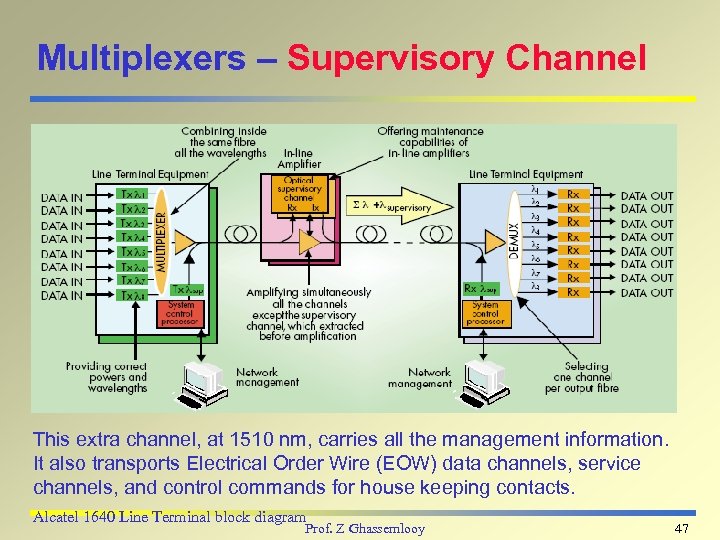 Multiplexers – Supervisory Channel This extra channel, at 1510 nm, carries all the management information. It also transports Electrical Order Wire (EOW) data channels, service channels, and control commands for house keeping contacts. Alcatel 1640 Line Terminal block diagram Prof. Z Ghassemlooy 47
 Multiplexers § Transmission lengths of more than 900 km can be achieved on a 0. 25 d. B/km fibre. § The 240 channels using 3 optical bands: – C (1530– 1570 nm) – L (1570– 1610 nm) – S (1450– 1490 nm) § § Error detection and correction Different synchronous bit rate Multi bit rae: 2. 5 Gbps, 10 Gbps and 40 Gbps Judged by the insertion loss/channel Prof. Z Ghassemlooy 48
 MUX - De. MUX - Performance MUX i. Judged by the insertion loss/channel De. MUX i. Sensitivity to polarisation i. Crosstalk (< -20 d. B) Prof. Z Ghassemlooy 49
 References i http: //oldsite. vislab. usyd. edu. au/photonics/index. html Prof. Z Ghassemlooy 50
 Next Lectures i. Optical amplifier i. Optical Switches Prof. Z Ghassemlooy 51