


 Скачать презентацию EMS Equipment Review MARCH 2015 CE CONDELL MEDICAL
495027187c087dd9c42a4b3339a4611c.ppt
- Количество слайдов: 98
 EMS Equipment Review MARCH 2015 CE CONDELL MEDICAL CENTER EMS SYSTEM CE IDPH SITE CODE #107200 E-1215 PREPARED BY: SHARON HOPKINS, RN, BSN, EMT-P 1
 Objectives 2 Upon successful completion of this module, the EMS provider will be able to: List indications for use of a variety of EMS equipment used in the field. Manage a group of peers in setting up and applying a variety of equipment used in the field. Evaluate the effectiveness of application of a variety of EMS equipment in a practical setting.
 Objectives cont’d 3 Actively participate in review of selected Region X SOP’s as related to the topics presented. Actively participate in review of the process of transmission of 12 lead EKG’s using department specific equipment. Actively participate in reviewing the operation of your department monitor/defibrillator, pacing capacity, synchronized cardioversion and defibrillation at the paramedic level.
 Objectives cont’d Actively participate in HARE/Saeger traction application. Successfully complete the post quiz with a score of 80% or better. 4
 Equipment and Patient Interventions 5 There comes responsibility when using equipment in the delivery of patient care. You need to: ü recognize what the problem is to know what to do ü be able to distinguish what the appropriate intervention(s) is/are ü understand how to properly apply and use the equipment chosen ü recognize when the intervention is working as well as not accomplishing the goal ü know what documentation must be done with each piece of equipment used in patient care ü be knowledgeable regarding the cleaning and returning to service for each piece of equipment
 Capnography Background A continuous, non-invasive monitoring tool Measures level of CO 2 at end of exhalation Quantitative results provides a number Assesses respiratory status thru-out respiratory cycle Provides current, at the moment, breath-to-breath information on patient status Results measured as mm. Hg of CO 2 Normal 35 – 45 mm. Hg 6
 Capnography Information Numeric value provides end tidal (end of breath) CO 2 level Waveform is a picture representation of the CO 2 value exhaled with each breath Airway status reflected in: ü ETCO 2 value (mm. Hg) ü Waveform picture ü Respiratory rate 7
 Definitions Ventilation Ø Process of breathing; eliminating CO 2 from body Respiration Ø Exchange Oxygenation Ø Getting of gasses at alveoli level O 2 to tissues; measured by pulse oximetry Diffusion Ø Process by which gas moves between alveoli and pulmonary capillaries (gases move from area of high concentration to areas of low concentrations) 8
 Capnography Usefulness Provides information on how effectively the body is: ü Producing CO 2 (metabolism) ü Transporting ü Exhaling CO 2 (perfusion) CO 2 (ventilations) Goal – attain/maintain CO 2 levels 35 – 45 mm. Hg 9
 Capnography Usefulness cont’d 10 Confirms and monitors advanced airway placement Indicates effectiveness of chest compressions Ø Blood must circulate through lungs to off-load CO 2 for it to be exhaled Ø Levels expected to minimally be >10 mm. Hg during CPR Indicates return of spontaneous circulation (ROSC) Ø Sudden, sustained rise in levels toward 35 -45 mm. Hg Allows early interventions to be started
 Capnography Usefulness cont’d 11 Monitor asthma & COPD conditions and response to bronchodilator therapy Detect increased respiratory depression and hypoventilation Tiring accessory muscles Neuromuscular disease effect on respiratory center Change in level of consciousness – alcohol/drug overdose, head trauma, sedation/analgesia Seizure activity &/or post ictal period
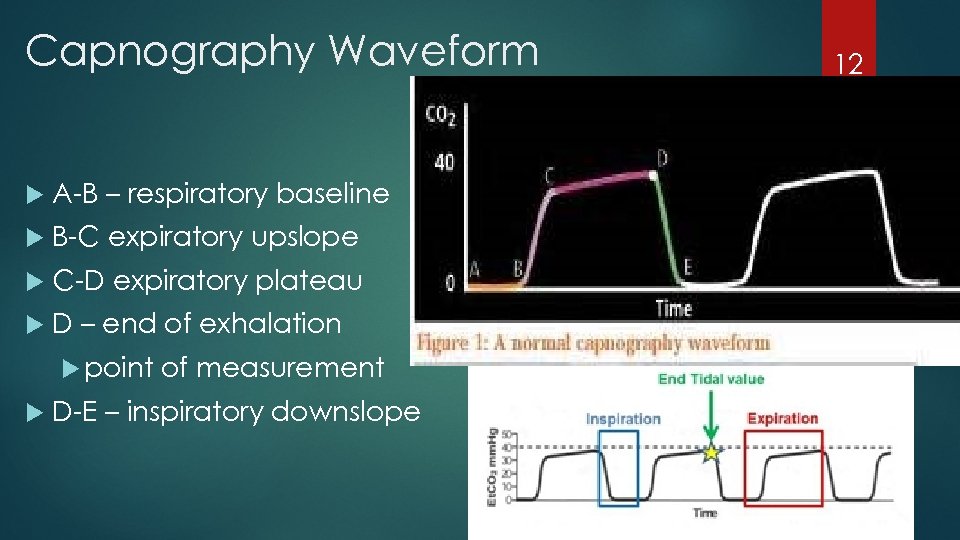 Capnography Waveform A-B – respiratory baseline B-C expiratory upslope C-D expiratory plateau D – end of exhalation point of measurement D-E – inspiratory downslope 12
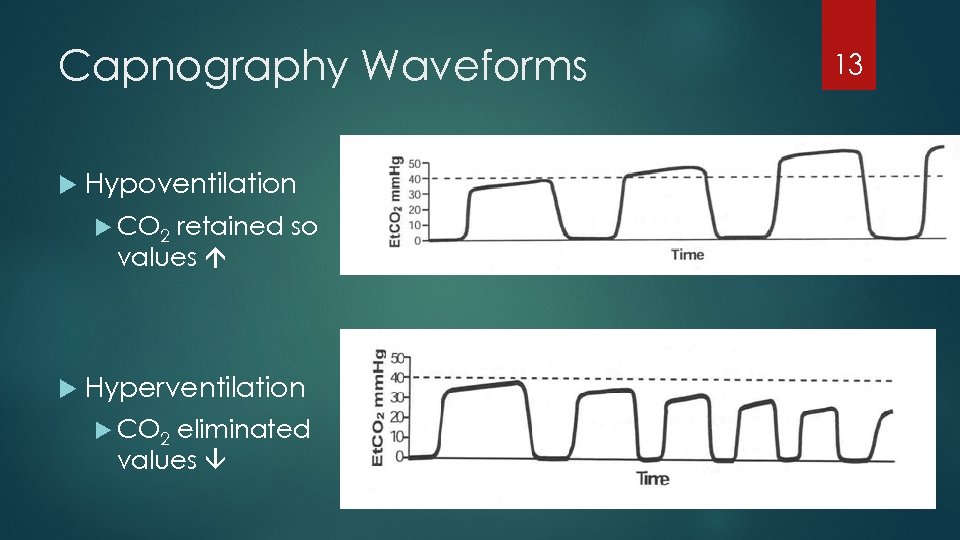 Capnography Waveforms 13 Hypoventilation CO 2 retained so values Hyperventilation CO 2 eliminated values so
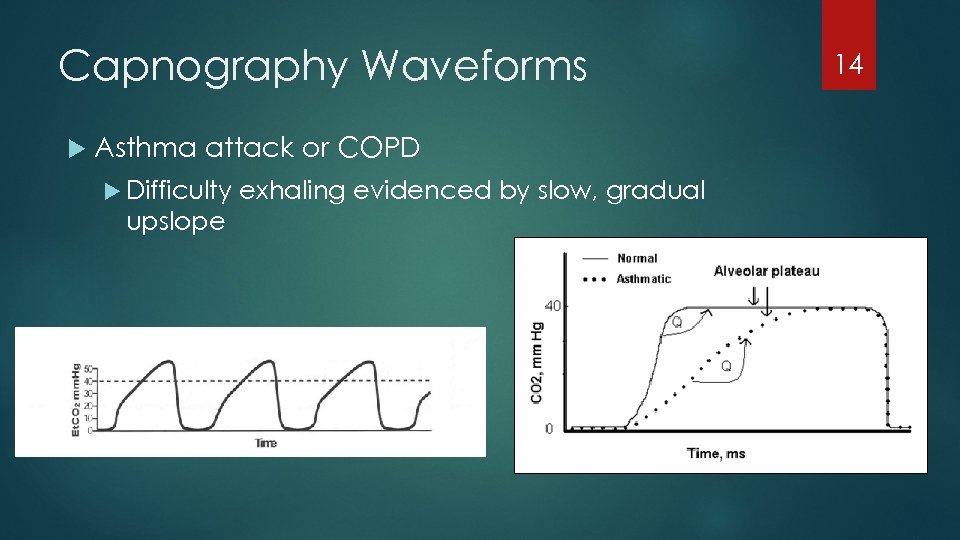 Capnography Waveforms Asthma attack or COPD Difficulty upslope exhaling evidenced by slow, gradual 14
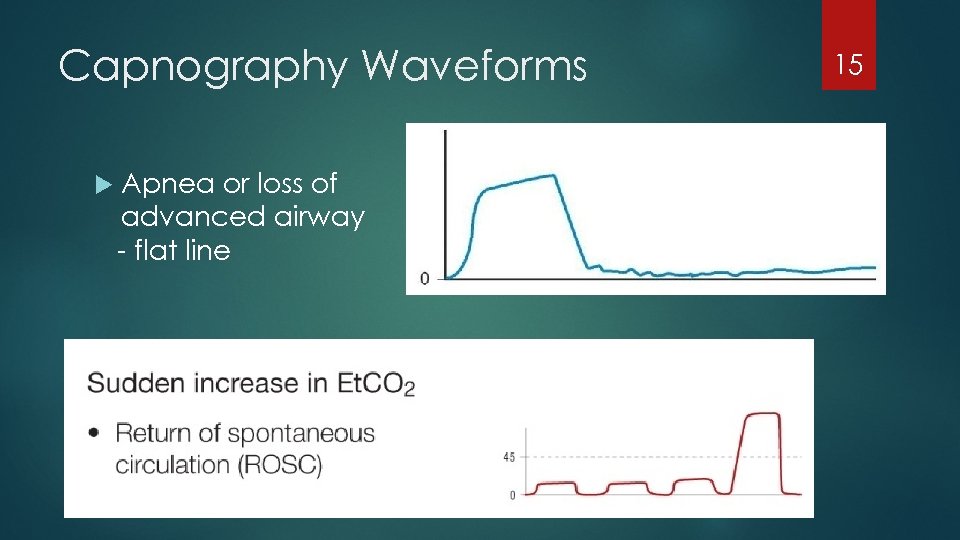 Capnography Waveforms Apnea or loss of advanced airway - flat line 15
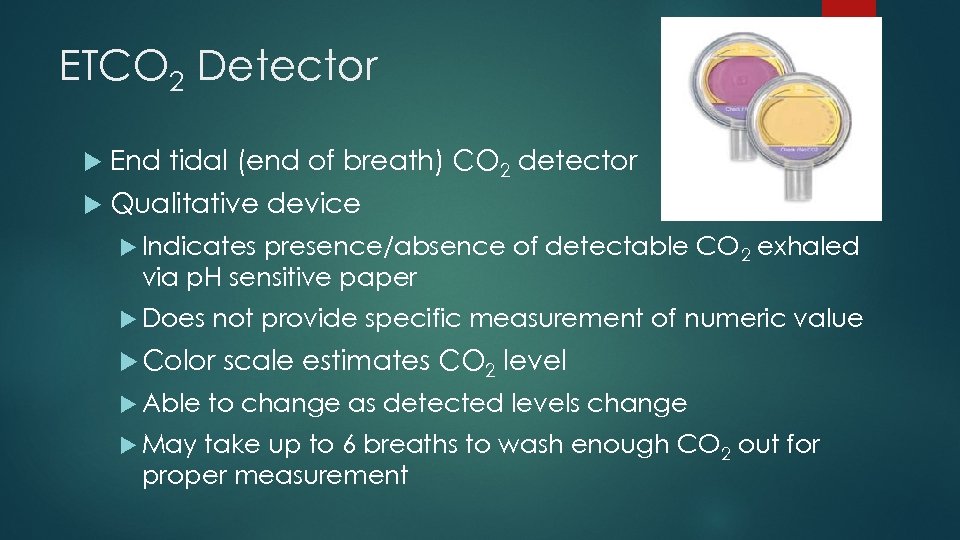 ETCO 2 Detector End tidal (end of breath) CO 2 detector 16 Qualitative device Indicates presence/absence of detectable CO 2 exhaled via p. H sensitive paper Does not provide specific measurement of numeric value Color Able May scale estimates CO 2 level to change as detected levels change take up to 6 breaths to wash enough CO 2 out for proper measurement
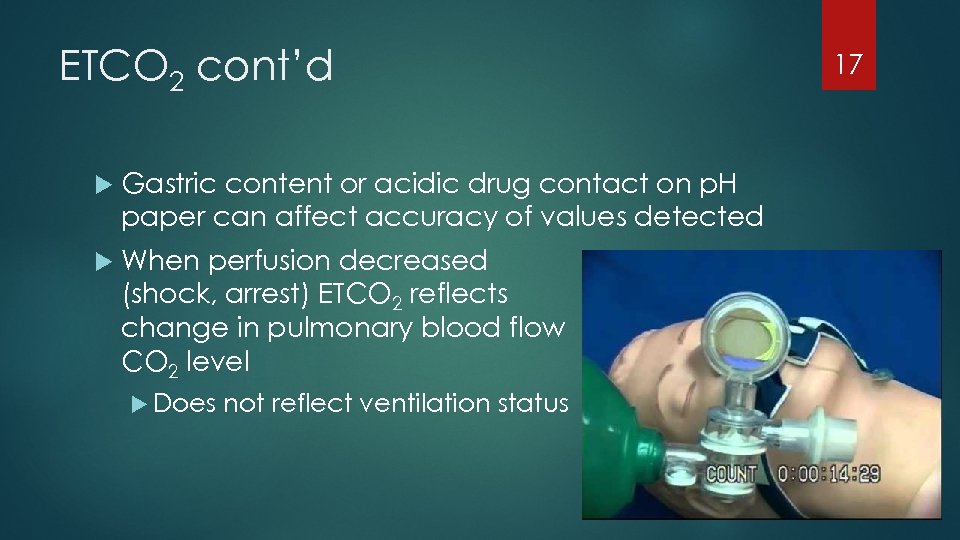 ETCO 2 cont’d 17 Gastric content or acidic drug contact on p. H paper can affect accuracy of values detected When perfusion decreased (shock, arrest) ETCO 2 reflects change in pulmonary blood flow CO 2 level Does not reflect ventilation status and
 Altered CO 2 Levels CO 2 level Shock, cardiac arrest, pulmonary embolism, bronchospasm, complete airway obstruction CO 2 level Hypoventilation, hyperthermia respiratory depression, 18
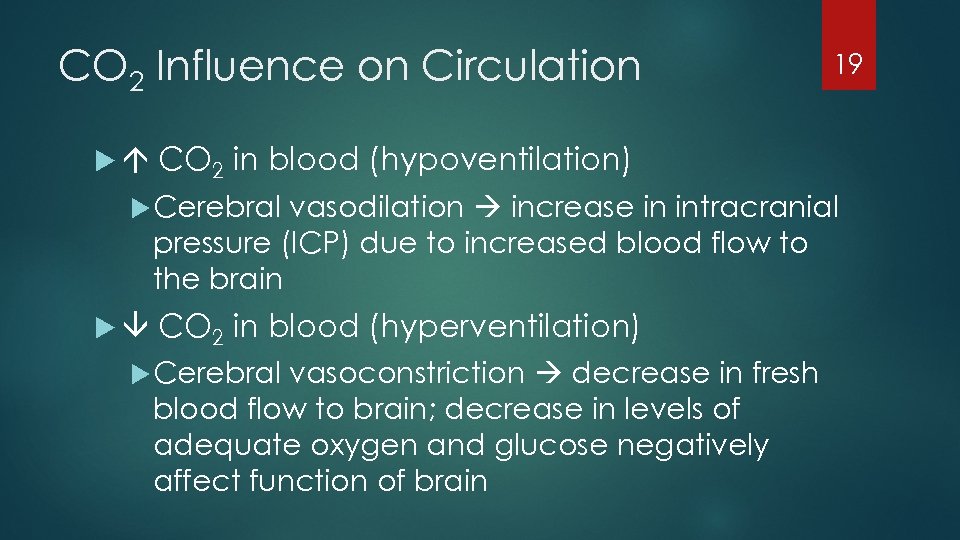 CO 2 Influence on Circulation 19 CO 2 in blood (hypoventilation) Cerebral vasodilation increase in intracranial pressure (ICP) due to increased blood flow to the brain CO 2 in blood (hyperventilation) Cerebral vasoconstriction decrease in fresh blood flow to brain; decrease in levels of adequate oxygen and glucose negatively affect function of brain
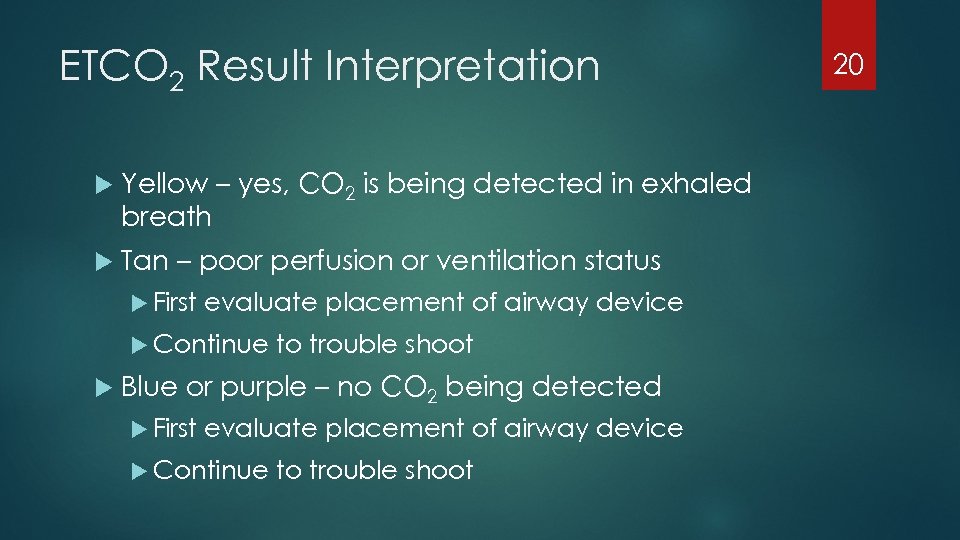 ETCO 2 Result Interpretation Yellow – yes, CO 2 is being detected in exhaled breath Tan – poor perfusion or ventilation status First evaluate placement of airway device Continue to trouble shoot Blue or purple – no CO 2 being detected First evaluate placement of airway device Continue to trouble shoot 20
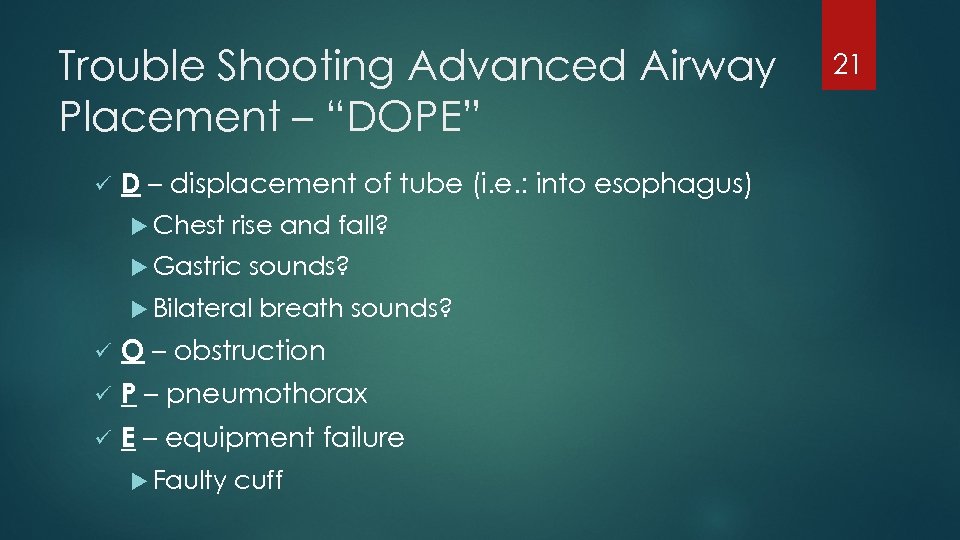 Trouble Shooting Advanced Airway Placement – “DOPE” ü D – displacement of tube (i. e. : into esophagus) Chest rise and fall? Gastric sounds? Bilateral breath sounds? ü O – obstruction ü P – pneumothorax ü E – equipment failure Faulty cuff 21
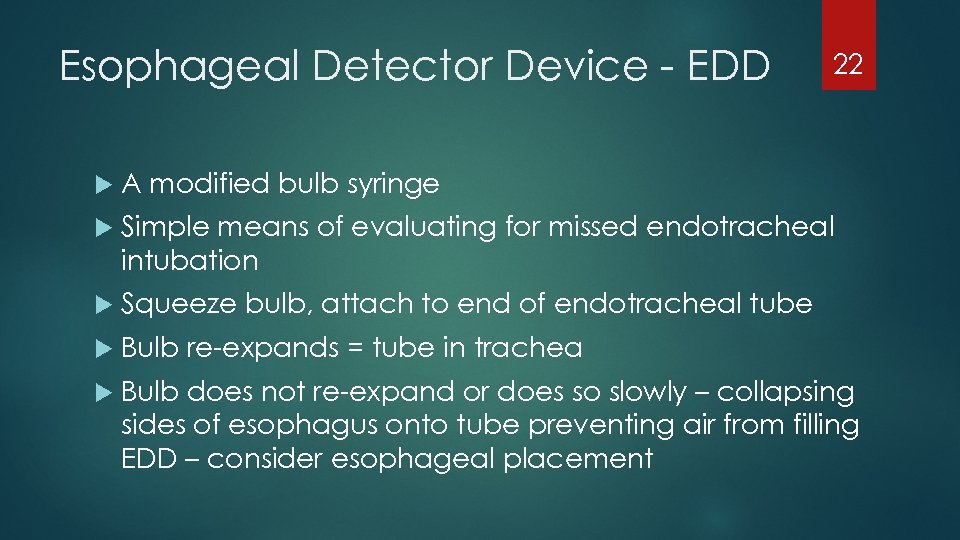 Esophageal Detector Device - EDD 22 A modified bulb syringe Simple means of evaluating for missed endotracheal intubation Squeeze bulb, attach to end of endotracheal tube Bulb re-expands = tube in trachea Bulb does not re-expand or does so slowly – collapsing sides of esophagus onto tube preventing air from filling EDD – consider esophageal placement
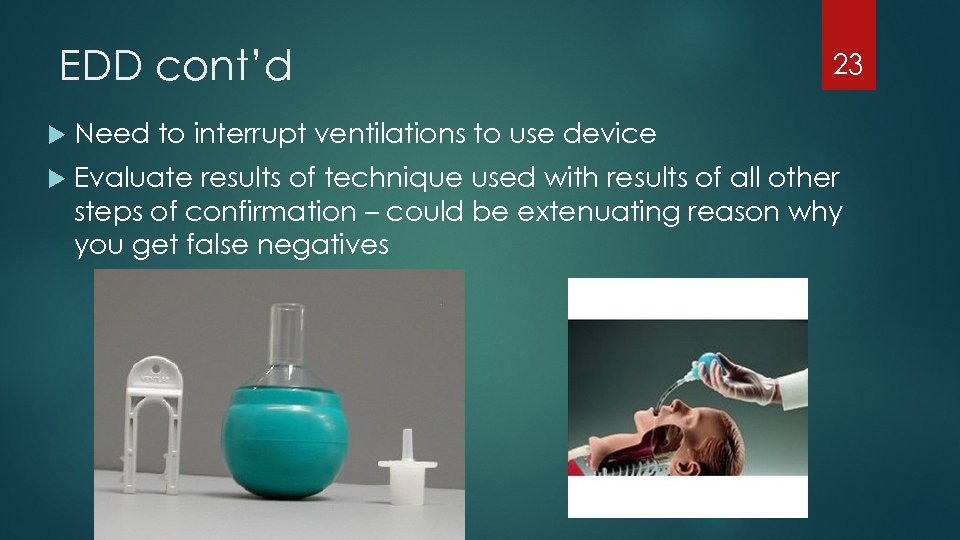 EDD cont’d 23 Need to interrupt ventilations to use device Evaluate results of technique used with results of all other steps of confirmation – could be extenuating reason why you get false negatives
 Defibrillators Electrical capacitor that stores energy Biphasic defibrillators provide waveforms that use less DC energy than monophasic machines Energy flows in one direction and then reverses Therefore, possible decrease in tissue damage Survival rates increase if early CPR provided with prompt defibrillation attempt as soon as possible after collapse 24
 Defibrillation Early defibrillation critical to survival from sudden cardiac arrest Most frequent initial rhythm in arrest is VF Treatment for VF is defib (defibrillation) Probability of successful defibrillation diminishes over time VF deteriorates to asystole over time Check with your vendor to know your biphasic device’s recommended energy settings 25
 Ventricular Fibrillation as Presenting Rhythm Best chance of survival in public ü Early ü CPR activation of EMS initiated very soon after collapse ü Early application of AED or other defibrillation attempt Current passes though fibrillating heart to depolarize heart cells to allow them to uniformly repolarize Allows dominant pacemaker (SA node) to take over electrical control Goal – resume organized electrical activity 26
 Influences on Success of Defibrillation Time from onset of VF – shorter time survival Condition of myocardium Less success in presence of hypoxia, acidosis, hypothermia, electrolyte imbalance, drug toxicity Pad size Larger pads felt to be more effective and cause less myocardial damage; should not overlap Ideal size for adults 10 -13 cm (4 -5 inches) Ideal size for peds 4. 5 cm (roughly 3 inches) 27
 Influences cont’d Pad / skin interface Need to the resistance Greater the resistance the less energy delivered to the heart and the greater the heat production at the skin surface Pad contact Max contact with skin; no air bubbles breaking contact; no pads touching or overlapping Avoiding placement of pads over bone Bone is poor conductor of electricity 28
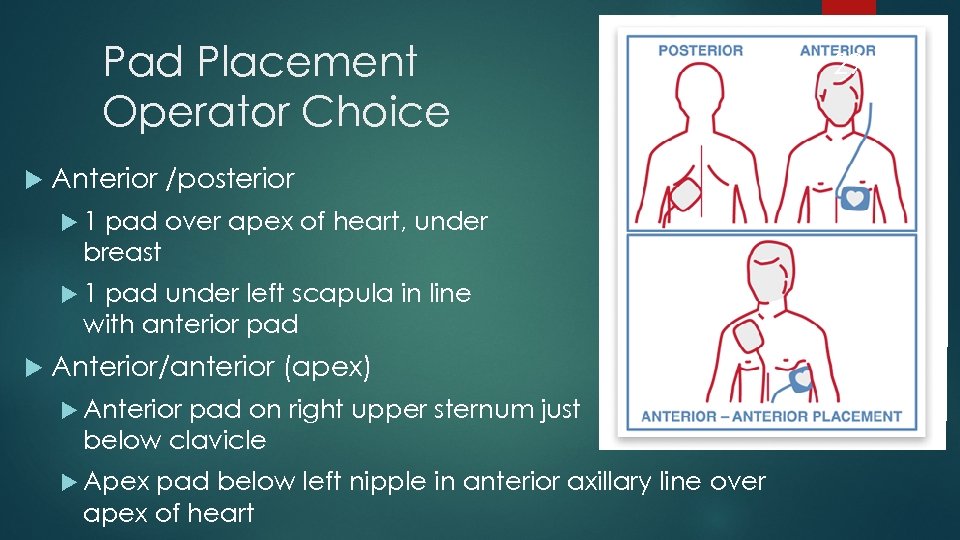 Pad Placement Operator Choice 29 Anterior /posterior 1 pad over apex of heart, under breast left 1 pad under left scapula in line with anterior pad Anterior/anterior (apex) Anterior pad on right upper sternum just below clavicle Apex pad below left nipple in anterior axillary line over apex of heart
 Pad Placement cont’d DO NOT place pads Over sternum – bone poor conductor of electricity Over pacemaker or AICD – deflects energy; could damage the implanted device Place Over at least one inch away from device topical medication patches – deflects energy 30
 Defibrillation Indications VF, pulseless VT Contraindications Failure to demonstrate one of the above rhythms Asystole – defibrillation places a patient into asystole for the dominant pacemaker to take over PEA – electrical activity not a problem; needs mechanical response fixed 31
 Defibrillation Equipment Monitor/defibrillator Defibrillating Example: pads Pad. Pro Defibrillation/pacing/cardioversion/monitoring electrodes Most come with conductive gel already applied in center of pad 32
 Defibrillation Safety CPR is performed just until the defibrillator is ready Confirm O 2 not blowing across patient’s chest wall – hold away from the patient when not using the BVM Physically look all around (“nose to toes”) Clearly yell out “all clear” Deliver energy Immediately resume CPR 33
 Return of Spontaneous Circulation ROSC After 2 minutes of resumed CPR, evaluate the rhythm If an organized rhythm is viewed on the monitor, THEN check for a pulse If no pulse, rhythm is PEA Resume CPR Adult 1 and 2 man CPR 30: 2 Infant and child 1 man CPR 30: 2 Infant and child 2 man CPR 15: 2 34
 Indications to Activate Cooling Protocol Post ROSC Presumed cardiac arrest NOT indicated for respiratory or traumatic arrest Remains unconscious and unresponsive ROSC present at least 5 minutes Systolic B/P >90 with or without pressor agent use (i. e. : Dopamine) Airway has been secured 35
 ROSC Contraindications Major head trauma or traumatic arrest Recent major surgery within past 14 days Systemic infection (i. e. : septic shock) Coma from other causes Active bleeding Isolated respiratory arrest Hypothermia (34 o C/93. 2 o F) already present 36
 Induction of ROSC Place ice paks in the axilla, neck and groin Areas where blood vessels tend to be superficial Place ice pak over IV site If patient begins to shiver, contact Medical Control Anticipate Shivering order for Valium to stop the shivering will generate heat and therefore increase body temperature 37
 Vasopressor - Dopamine Stimulates alpha, beta, and dopaminergic receptors based on dose provided Starting dose 5 mcg/kg/min IVPB up to 20 mcg/kg/min Take patient’s weight and drop last number Minus Left Ex: 2 from number left with rate to run IVPB in drops per minute 150 pounds; drop “ 0” 15 – 2 = 13 drops per minute 38
 Dopamine cont’d Dopaminergic effects at 2 mcg/kg/min Renal Keep vasodilation to improve blood flow to kidneys working, the body keeps working Beta effects 5 – 10 mcg/kg/min Increases strength of myocardial contraction – squeeze more blood out of ventricles Alpha effects at >20 mcg/kg/min Severe vasoconstriction that diminishes blood flow to all tissues 39
 AED (Automated External Defibrillator) 40 Function AED’s will ü Analyze ü Deliver rhythms a shock if indicated Ventricular fibrillation (VF) Monomorphic and polymorphic VT if rate and R wave morphology exceed preset values Will not deliver a synchronized shock Can indicate loose electrodes / poor electrode contact
 AED Use in Pediatrics 41 Pediatric attenuator used to deliver lower energy doses to children (built into cables with peds pads) 1 -8 year old ü Use ü No pediatric pads if available attenuator (peds pads)available, use standard AED pads < 1 year old ü Manual ü If defibrillator preferred no manual defibrillator, use peds pads with attenuator ü No peds pads, use AED pads available
 AED Use With CPR Do NOT interrupt CPR to apply pads Apply pads while CPR in progress Do not touch patient during analysis phase Can provide compressions during charging phase No O 2 flow across patient body during defibrillation attempt Call and look “ALL CLEAR” prior to each defibrillation attempt Immediately resume CPR 42
 Transition From AED To Defibrillator 43 Upon arrival at scene, if AED ready to discharge, utilize AED Do not interrupt operation of device During 2 minutes of CPR, can switch from AED use to monitor/defibrillator Immediately resume CPR after delivery of each defibrillation attempt regardless of equipment used
 Synchronized Cardioversion 44 A controlled form of defibrillation using a lower energy level that interrupts underlying reentrant pathway Used with organized rhythms and in presence of a pulse Monitor interprets QRS cycle and energy delivered during R wave Less vulnerable area of QRS Downslope Minimal of T wave is relative refractory area stimulant could generate rhythm into VF
 Indications Synchronized Cardioversion Unstable tachyarrhythmias SVT Rapid atrial fibrillation or flutter Hazard of breaking loose a blood clot in the atria and resulting in a stroke Ventricular tachycardia Note: polymorphic VT NOT likely to respond to synchronized cardioversion – no defined R wave 45
 Synchronized Cardioversion Procedure Apply pads Anterior/anterior or anterior/posterior position Sedate if possible This is a painful procedure! Versed 2 mg IVP/IO; repeated every 2 minutes; max 10 mg (desired effect – sedation!) Consider pain management Fentanyl 1 mcg/kg IVP/IN/IO; may repeat in 5 minutes to max of 200 mcg total dose 46
 Sync Procedure cont’d Activate “sync” button Verify 47 R wave is being flagged/identified Choose energy setting starting at the lowest watt setting 100 j, 200 j, 360 j Verify O 2 not blowing across chest wall Look (nose to toes) and call “ALL CLEAR” Press and hold sync buttons until energy discharged Momentary delay waiting to identify the R wave
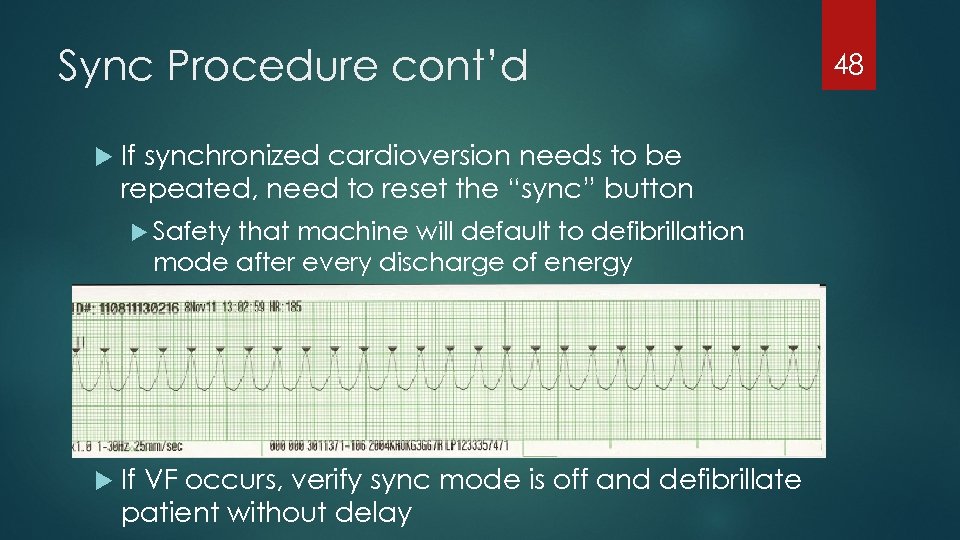 Sync Procedure cont’d If synchronized cardioversion needs to be repeated, need to reset the “sync” button Safety that machine will default to defibrillation mode after every discharge of energy If VF occurs, verify sync mode is off and defibrillate patient without delay 48
 Transcutaneous Pacemaker - TCP Electrical cardiac pacing across the skin TCP is a painful non-invasive procedure so sedation will most likely be necessary Indications Symptomatic bradycardia Hypotensive Hypoperfusing Evaluate level of consciousness and B/P for most reliable indicators of patient condition/stability 49
 TCP Procedure Apply pads (-) (+) over apex of heart, anterior chest wall mid upper back below left scapula Set desired heart rate (80) Confirm sensitivity at auto/demand Begin m. A current at 0 Turn pacer on 50
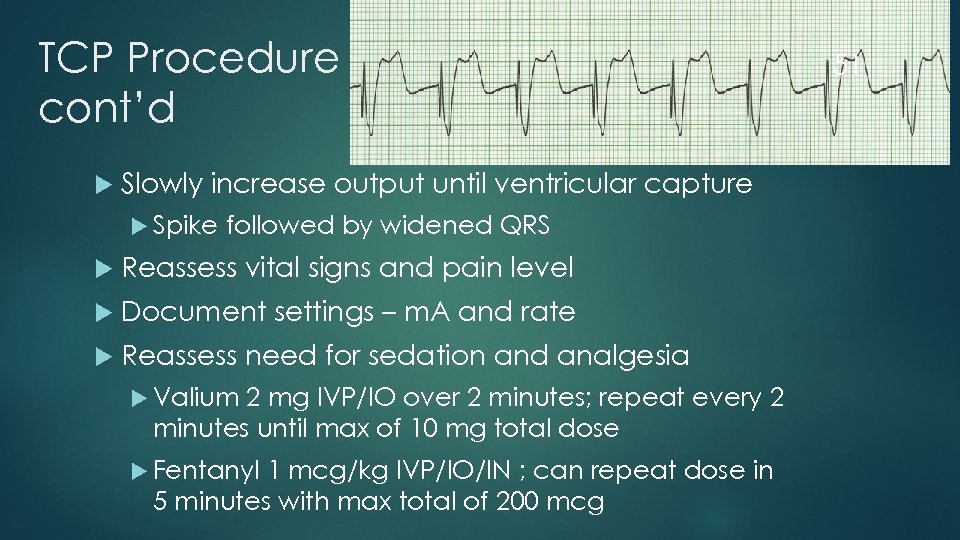 TCP Procedure cont’d Slowly increase output until ventricular capture Spike followed by widened QRS Reassess vital signs and pain level Document settings – m. A and rate Reassess need for sedation and analgesia Valium 2 mg IVP/IO over 2 minutes; repeat every 2 minutes until max of 10 mg total dose Fentanyl 1 mcg/kg IVP/IO/IN ; can repeat dose in 5 minutes with max total of 200 mcg 51
 Critical Thinking Skill and TCP In setting of acute MI, consider contacting Medical Control May want to decrease heart rate of TCP just enough to maintain perfusion Want to avoid increasing the work load on the heart by automatically selecting 80 as the heart rate Increasing work load on heart may increase the size of the infarction 52
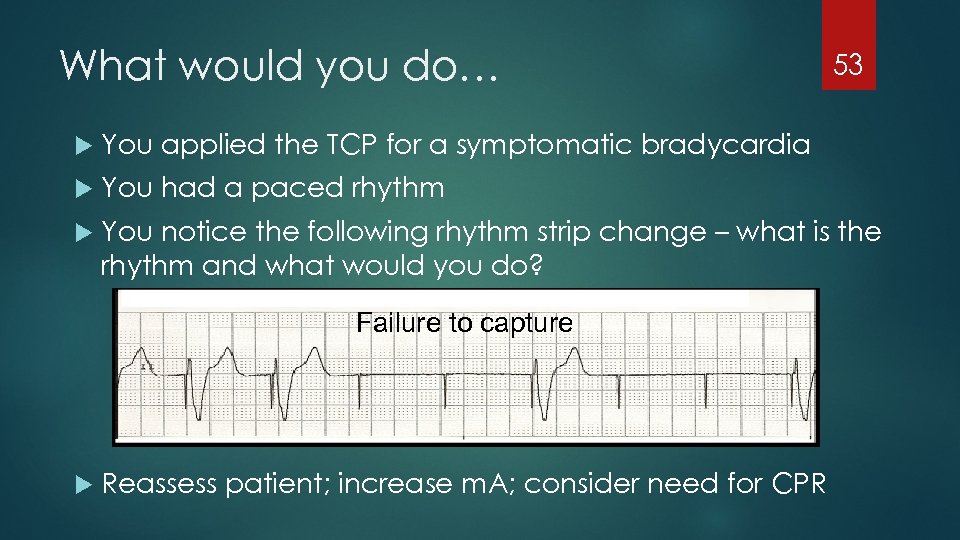 What would you do… 53 You applied the TCP for a symptomatic bradycardia You had a paced rhythm You notice the following rhythm strip change – what is the rhythm and what would you do? Failure to capture Reassess patient; increase m. A; consider need for CPR
 Defibrillation During Pacing Mode Check your device for specifics When in the pacing mode and the need to defibrillate occurs, for some models, you may have to turn off the pacing mode If pacing must be resumed, reset all levels 54
 12 Lead EKG’s A graphic recording of electrical activity in the heart Must evaluate the pulse to determine mechanical response Single lead (i. e. : lead II) evaluates cardiac rhythms 12 lead views can diagnose an acute MI Early interpretation of 12 lead EKG early diagnosing early reperfusion & restoring blood flow to ischemic tissues 55
 Acute MI Death of portion of heart muscle from prolonged deprivation of oxygenated blood Heart’s demand exceeds supply of oxygen over extended period of time Often associated with atherosclerosis process Location and size of infarct depends on vessel involved and site of obstruction Left ventricle most common site 56
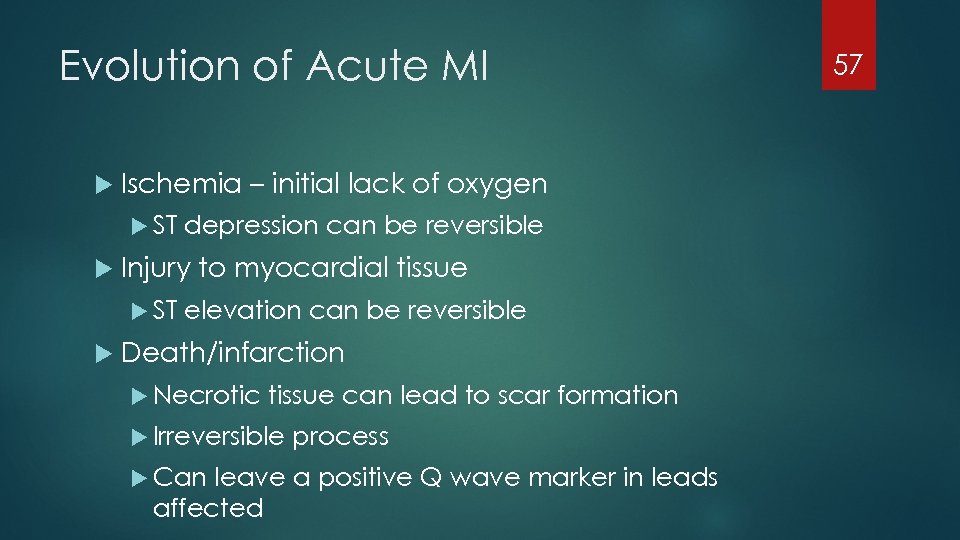 Evolution of Acute MI Ischemia – initial lack of oxygen ST Injury to myocardial tissue ST depression can be reversible elevation can be reversible Death/infarction Necrotic tissue can lead to scar formation Irreversible Can process leave a positive Q wave marker in leads affected 57
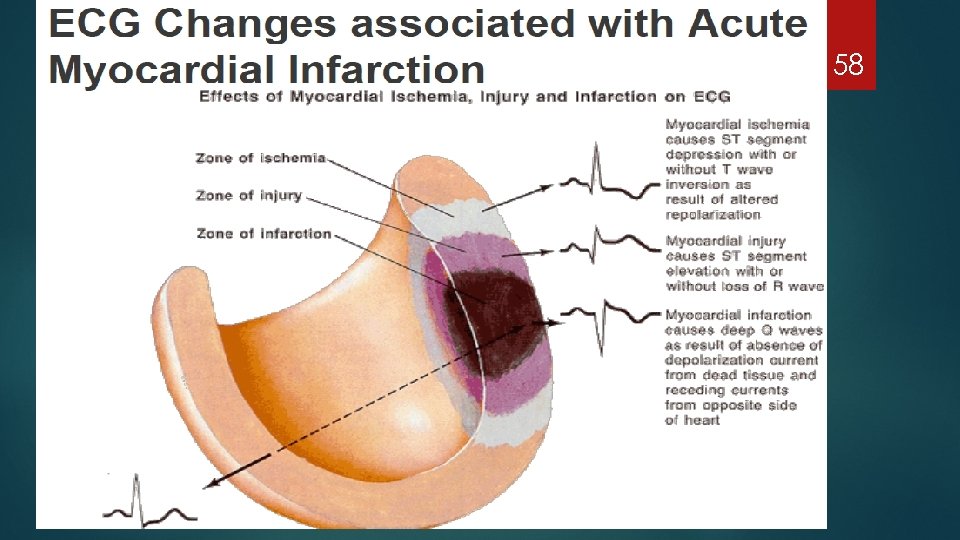 58
58
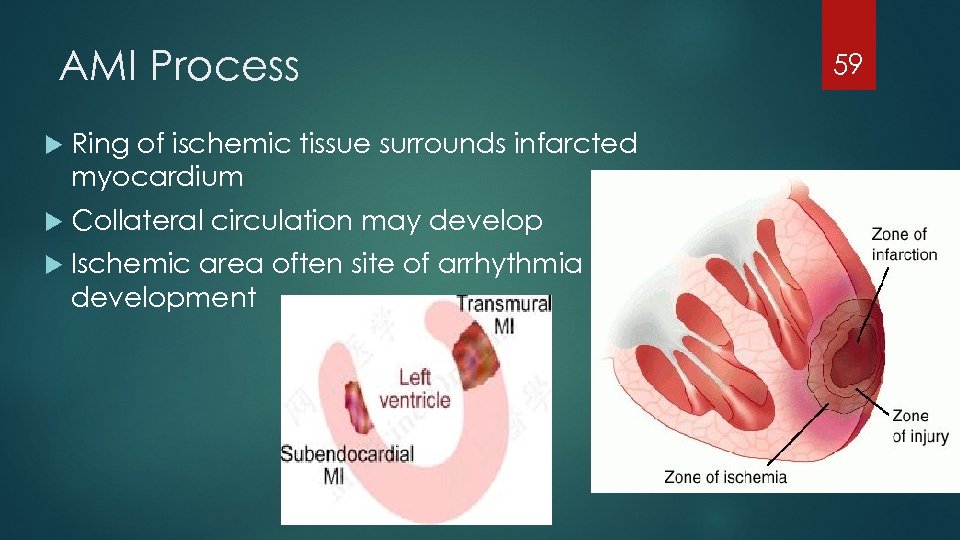 AMI Process Ring of ischemic tissue surrounds infarcted myocardium Collateral circulation may develop Ischemic area often site of arrhythmia development 59
 Complications of AMI 60 Arrhythmia most common VF most lethal Most common cause of sudden death within one hour of onset of signs and symptoms Destruction of myocardial muscle mass can lead to CHF due to impairment of pumping capability Cardiogenic shock may develop if heart function is inefficient and inadequate Ventricular aneurysm can develop due to damaged wall of heart – can rupture causing instant death
 Patient Assessment Pain most common chief complaint Lasts Not more than 30 minutes relieved by rest or NTG Tired and weak most often complaint in elderly, long standing diabetic and women Determine responses to OPQRST assessment at onset, provocation/palliation (worsens/improves), quality in their words, radiation, severity on 0 -10 scale, time of onset Activity 61
 EMS Action Apply monitor Examine underlying rhythm – document rhythm Obtain 12 lead EKG Evaluate for ST segment elevation If elevation, in what group of leads? depressed, look for reciprocal elevation Watch for development of arrhythmias 62
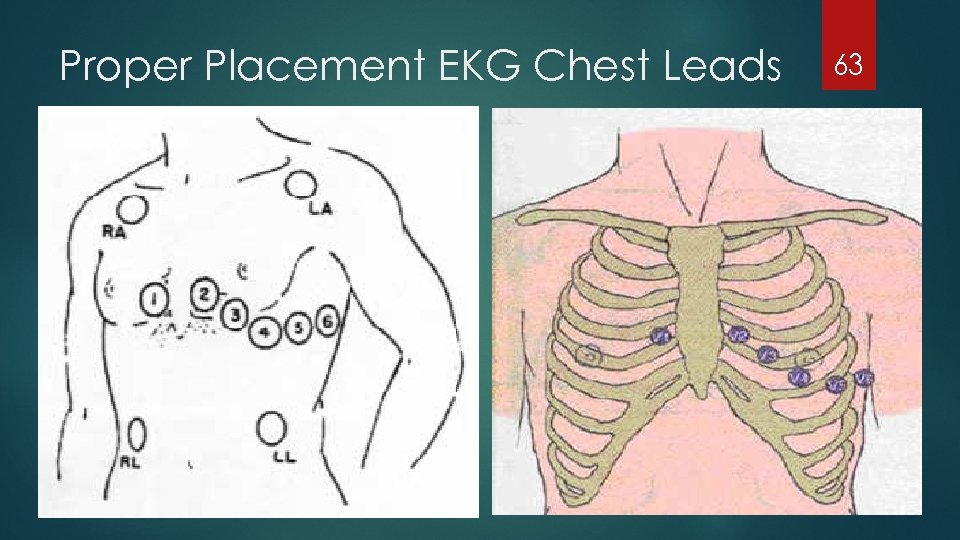 Proper Placement EKG Chest Leads 63
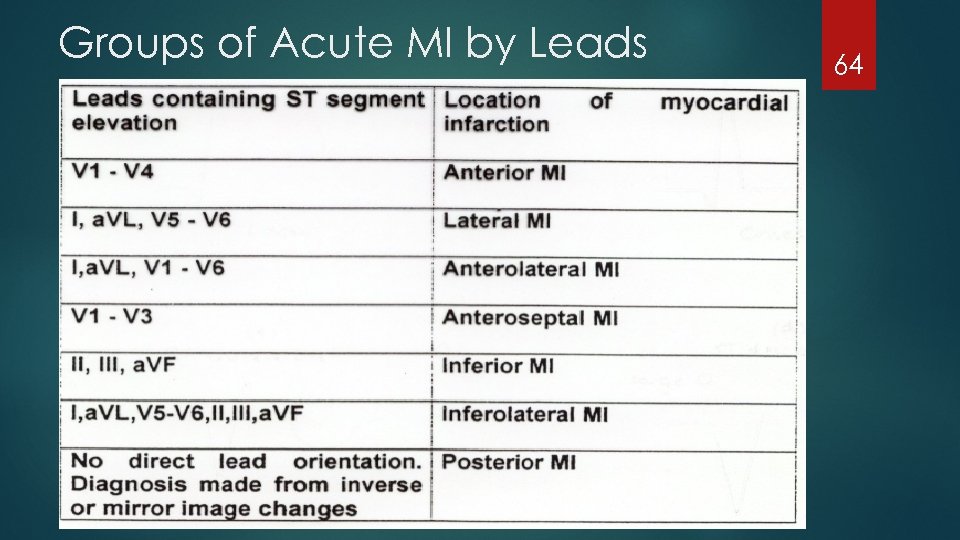 Groups of Acute MI by Leads 64
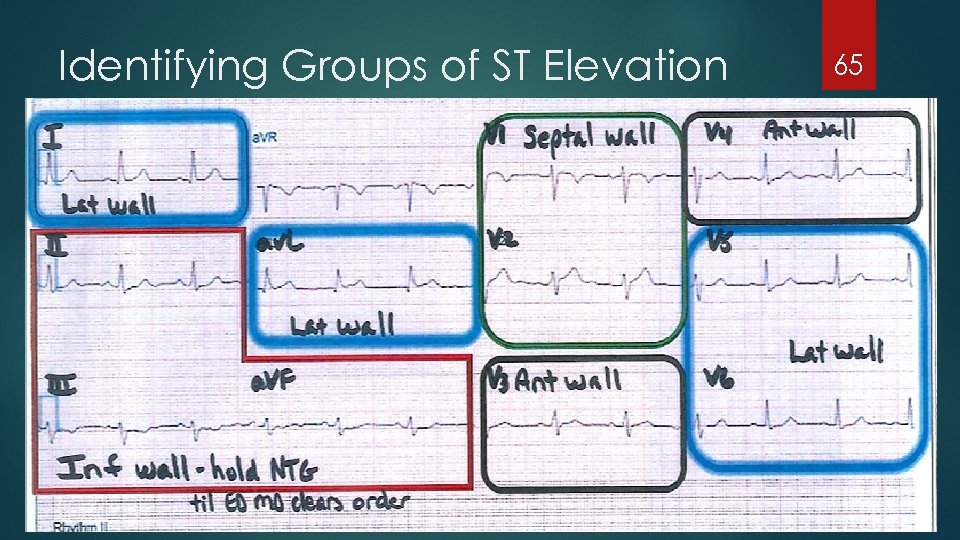 Identifying Groups of ST Elevation 65
 Why Aspirin? ? ? 66 Inhibits platelets from aggregating/collecting at site of plaque rupture inside vessel wall Decreases morbidity and mortality rate Chewed to increase breakdown and absorption time of medication Patients on daily aspirin already have elevated and acceptable blood levels of aspirin – don’t have to supplement a dose if absolutely sure they took one today Always better to give full dose than to risk skipping any dose (just in case of skipped dose)
 12 Lead EKG Procedure Obtain rhythm strip Interpret, report and document rhythm Obtain 12 lead EKG Identified with patient age, sex, department name in preparation for transmission Review for ST elevation pattern Report to Medical Control what you see, then read word for word interpretation on 12 lead EKG printout 67
 12 Lead EKG Documentation Interpret the rhythm strip and document on patient care run report Document presence or absence of ST elevation If elevation, report and document in which leads Provide copy of rhythm strip and 12 lead EKG to ED secretary for placement on patient’s medical record 68
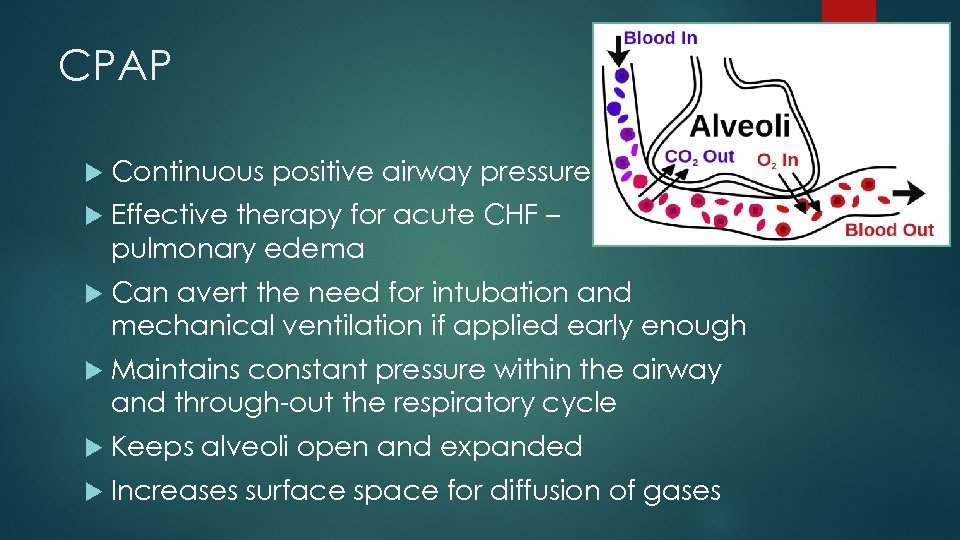 CPAP Continuous positive airway pressure Effective therapy for acute CHF – pulmonary edema Can avert the need for intubation and mechanical ventilation if applied early enough Maintains constant pressure within the airway and through-out the respiratory cycle Keeps alveoli open and expanded Increases surface space for diffusion of gases 69
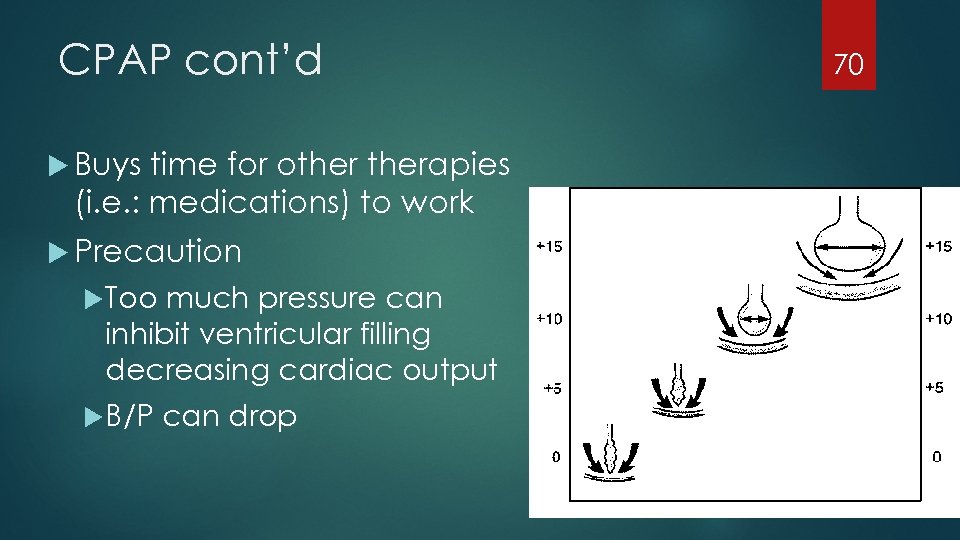 CPAP cont’d Buys time for otherapies (i. e. : medications) to work Precaution Too much pressure can inhibit ventricular filling decreasing cardiac output B/P can drop 70
 CPAP Indications Stable pulmonary edema Alert; systolic B/P >90 mm. Hg COPD with wheezing First contact Medical Control for orders For unstable pulmonary edema (altered mental status, systolic B/P <90 mm. Hg), contact Medical Control to discuss use of CPAP Reminder: all therapies used in pulmonary edema have potential to drop the B/P 71
 CPAP Contraindications Respiratory arrest or apnea Pneumothorax or trauma to chest wall Tracheostomy present Can’t get tight fit over trach stoma Actively vomiting 72
 CPAP Procedure Sit patient upright Assess and obtain baseline vital signs Begin O 2 via non-rebreather mask while setting up equipment Administer first dose NTG Used as venodilator to decrease blood return to heart (decreases pre-load) 73
 CPAP Flow Safe II Procedure Assemble CPAP Flow Safe II Attach proximal end of O 2 tubing with manometer to port in mask Attach distal end of tubing to O 2 source Secure face mask snugly to patient’s face using head harness Adjust O 2 flow – 13 -14 lpm for 10 cm H 2 O Continue administration of medications 74
 CPAP Procedure cont’d 75 Lasix 40 mg IVP (80 mg if on med at home) as a diuretic If systolic B/P remains >90 mm. Hg Morphine 2 mg IVP slowly over 2 minutes May repeat 2 mg every 2 minutes as needed to max of 10 mg Used to decrease anxiety and for benefit of vasodilation If patient shows deterioration during CPAP treatment, remove CPAP, consider intubation, inform Medical Control
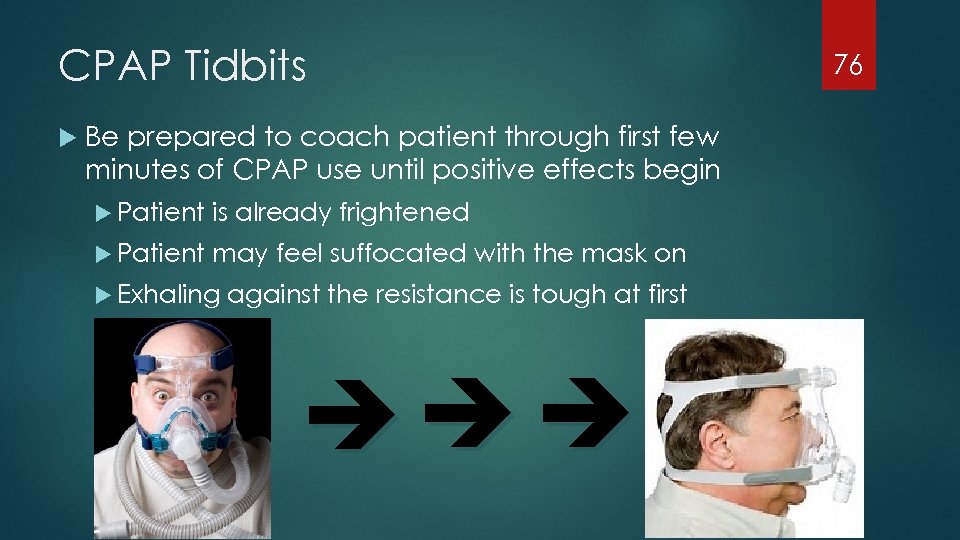 CPAP Tidbits Be prepared to coach patient through first few minutes of CPAP use until positive effects begin Patient is already frightened Patient may feel suffocated with the mask on Exhaling against the resistance is tough at first 76
 HARE and Saeger Traction Indicated for isolated mid-femur fractures Reduces muscle spasm and therefore pain level risk of bones overriding Contraindications Open Do Hip, fracture not want to draw contamination into the wound knee, or pelvic fractures Increased risk of nervous or vascular complications 77
 Preparing for Traction Application Assess motor/sensory/circulation before and after splinting Can you move this/can you feel that? Mark pulses once found – easier to find the site on reassessment Compare to uninjured side Apply manual traction until mechanical traction in place 78
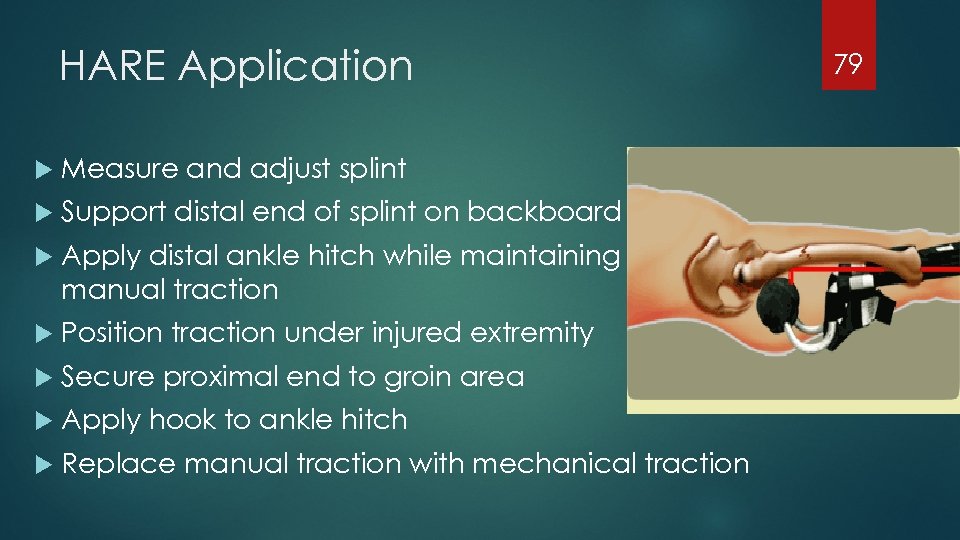 HARE Application Measure and adjust splint Support distal end of splint on backboard Apply distal ankle hitch while maintaining manual traction Position traction under injured extremity Secure proximal end to groin area Apply hook to ankle hitch Replace manual traction with mechanical traction 79
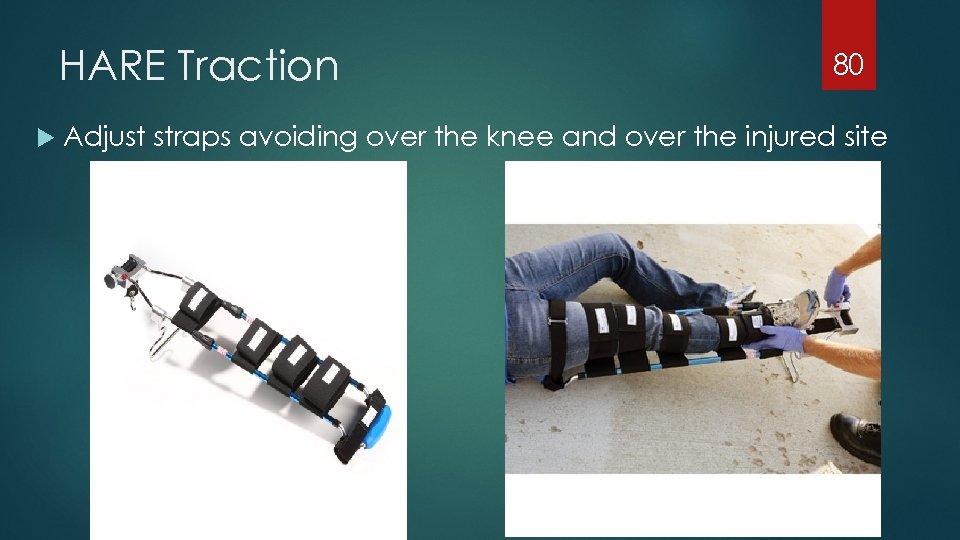 HARE Traction 80 Adjust straps avoiding over the knee and over the injured site
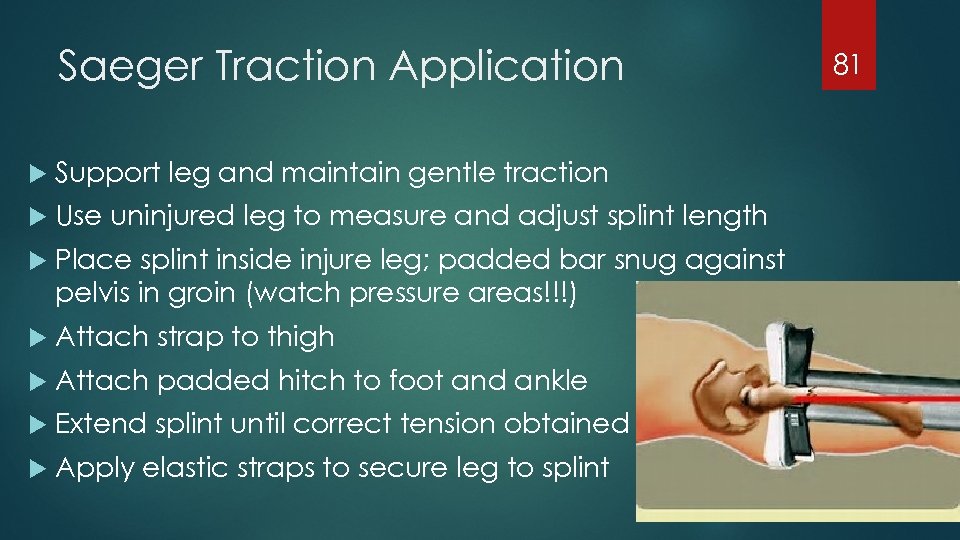 Saeger Traction Application Support leg and maintain gentle traction Use uninjured leg to measure and adjust splint length Place splint inside injure leg; padded bar snug against pelvis in groin (watch pressure areas!!!) Attach strap to thigh Attach padded hitch to foot and ankle Extend splint until correct tension obtained Apply elastic straps to secure leg to splint 81
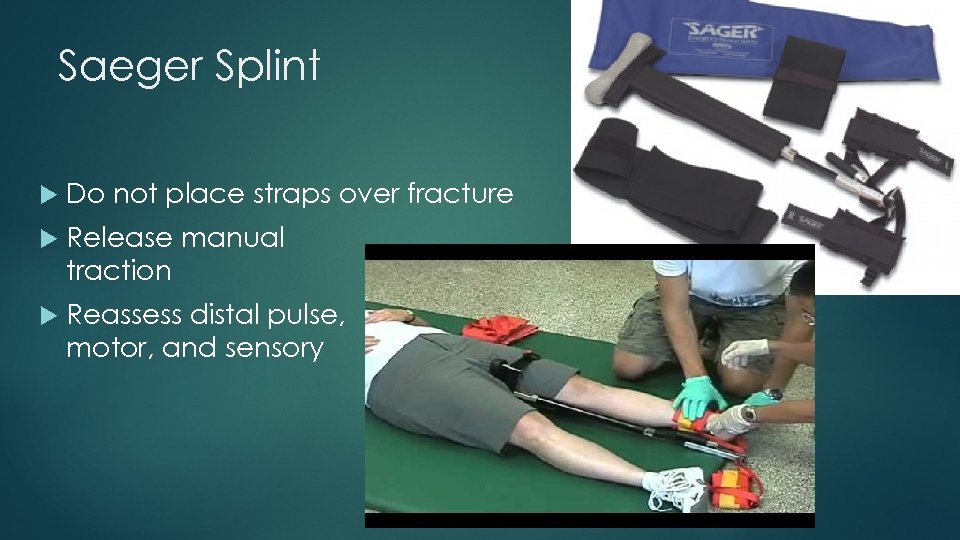 Saeger Splint Do not place straps over fracture Release manual traction Reassess distal pulse, motor, and sensory 82 site
 Pain Control With Use of Traction Fentanyl 1 mcg/kg IVP/IN/IO May repeat same dose in 5 minutes Max total dose of 200 mcg As a CNS depressant, watch the respiratory status If respiratory depression occurs, begin to support ventilations via BVM 1 Breath every 5 – 6 seconds Document 10 -12 breaths per minute assisted Narcan 2 mg IVP/IN/IO can be used to reverse respiratory depression due to opioid use 83
 Cleaning of Traction Splints Rinse off gross contaminant Wet down all surfaces with Cavicide wipes Let device air dry Confirm all straps are accounted for and repackage device in preparation for next patient 84
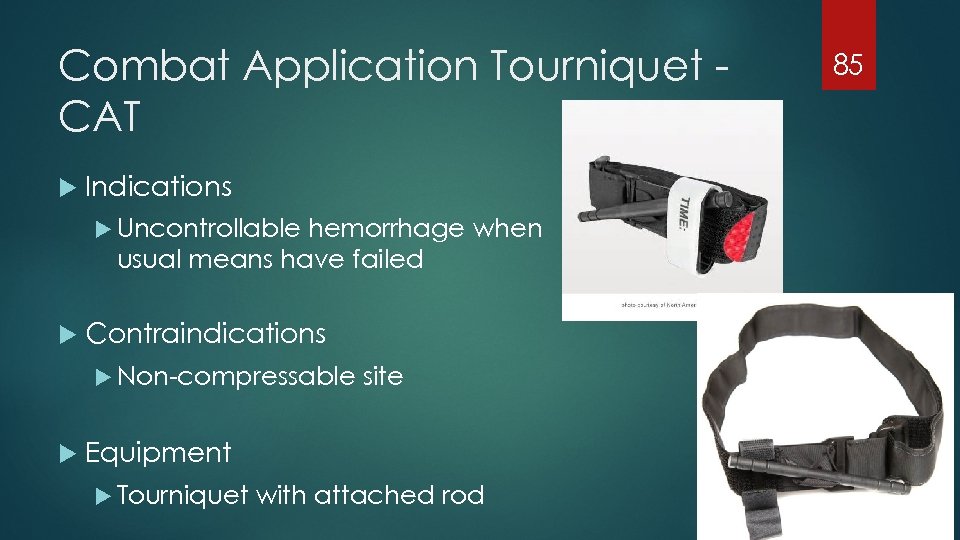 Combat Application Tourniquet CAT Indications Uncontrollable hemorrhage when usual means have failed Contraindications Non-compressable site Equipment Tourniquet with attached rod 85
 CAT - Procedure Apply tourniquet proximal to bleeding site as distal as possible; preferably over bare skin Pull band very tight and securely fasten band back on itself Twist rod until bright red bleeding has stopped Or until distal pulses are eliminated Place rod inside clip; locking into place Secure straps over clip holding rod 86
 CAT – Potential Problems Inability to control bleeding Continue Prepare Apply with direct pressure to apply a second CAT Quik. Clot dressing if available Must be applied directly over wound site for impregnated material to be effective 87
 CAT – Documentation Pearls Reason CAT was applied Time and site of CAT application Results post intervention Consideration of administration of pain medication Fentanyl 1 mcg/kg IVP/IN/IO May repeat in 5 minutes, same dose Max 200 mcg total dosing 88
 Midazolam Versed Potent, rapid onset, short acting benzodiazepine Onset 3 -5 minutes Duration 20 -30 minutes Used as sedative and hypnotic Has amnesic properties and reduces anxiety Amnesia of recent past (antegrade) useful to inhibit unpleasant reminders of procedures Low toxicity and high rate of effectiveness 89
 Indications for Per Versed Region X SOP’s Sedation prior to synchronized cardioversion Useful to maintain sedation post drug assisted intubation procedure Suppresses seizure activity IN 90 route allows safer delivery method Decreases severe anxiety and apprehension
 Precautions With Versed Crosses placental barrier – could cause respiratory depression in newly born infant Elderly more sensitive to effects; metabolize med more slowly Toxicity increases when mixed with CNS depressants (alcohol, opioids like Fentanyl, tricyclic antidepressants) Toxicity may be higher in patients with COPD 91
 Side Effects of Versed ü Respiratory depression ü Drowsiness ü Hypotension When administering, have a BVM readily available Be prepared to assist respirations 1 breath every 5 – 6 seconds Document 10 – 12 breaths per minute assisted 92
 Fentanyl Synthetic opiate analgesic for pain control Shorter acting than morphine Onset immediate when administered IVP Peak effect 3 5 minutes Lasts 30 – 60 minutes Does not affect blood pressure like Morphine does 93
 Dosing For Fentanyl per Region X SOP’s Adult 1 mcg/kg IN/IVP/IO May Max repeat same dose in 5 minutes total dose 200 mcg Pediatrics 0. 5 mcg/kg IVP/IN/IO May repeat same dose in 5 minutes Max total dose 200 mcg 94
 Precautions With Fentanyl Crosses the placental barrier – could cause respiratory depression in newly born infant Monitor respiratory rate, Sp. O 2 levels, and level of consciousness Have BVM available to counteract potential respiratory depression 1 breath every 5 – 6 seconds Document 10 – 12 respirations per minute 95
 Cleaning of Equipment – After Every Patient Use 96 In general, each piece of equipment in contact with a patient MUST be cleaned between each patient use Gross contaminant must be removed Surfaces need to remain wet and allowed to air dry All cables need to be wiped down (i. e. : EKG, B/P, pulse ox) Cables drag across contaminated surfaces A LOT!!! B/P cuffs need to be wiped down Pulse ox sensors need to be cleaned following manufacturer recommendations
 Department Review of Equipment Review set up of capnography monitoring Review operation of monitor/defibrillator for defibrillation, synchronized cardioversion, and TCP Review procedures for transmission of 12 lead EKG to receiving hospital In teams, apply the HARE or Saeger traction device to a peer 97
 Bibliography 98 Bledsoe, B. , Porter, R. , Cherry, R. Paramedic Care Principles & Practices, 4 th edition. Brady. 2013. Campbell, J. , International Trauma Life Support for Emergency Care Providers. 7 th Edition. Pearson. 2012. Mc. Donald, J. ALS Skills Review. AAOS. Jones and Bartlett. 2009. Mistovich, J. , Karren, K. Prehospital Emergency Care 9 th Edition. Brady. 2010. Pediatric Education for Prehospital Professionals 3 rd Edition. American Academy of Pediatrics. 2014. Region X SOP’s; IDPH Approved January 6, 2012. www. MARescue. com