 Скачать презентацию Empowering Navigator Innovation An Emerging Model for Building
3f87f95047cf09bf42a3cf5cdc18354b.ppt
- Количество слайдов: 22



Empowering Navigator Innovation An Emerging Model for Building Employment Capacity for People With Disability Johnette T. Hartnett, Ed. D.
This training has been designed and developed by the Law, Health Policy & Disability Center (LHPDC) of the University of Iowa College of Law disability. law. uiowa. edu
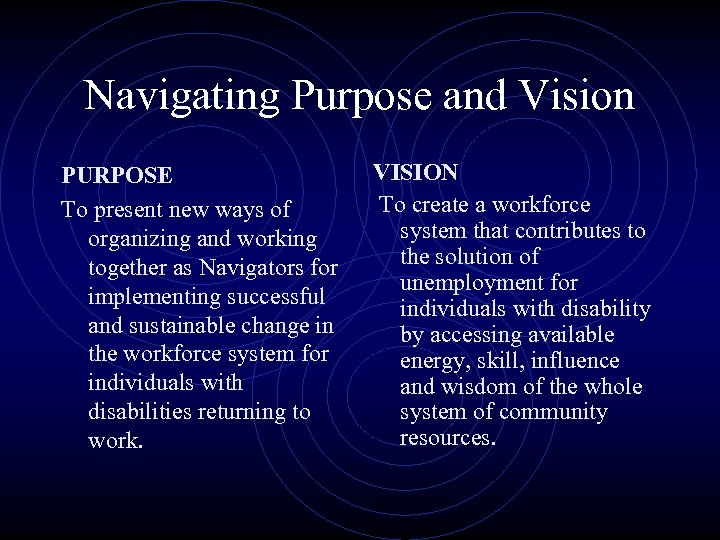
Navigating Purpose and Vision PURPOSE To present new ways of organizing and working together as Navigators for implementing successful and sustainable change in the workforce system for individuals with disabilities returning to work. VISION To create a workforce system that contributes to the solution of unemployment for individuals with disability by accessing available energy, skill, influence and wisdom of the whole system of community resources.
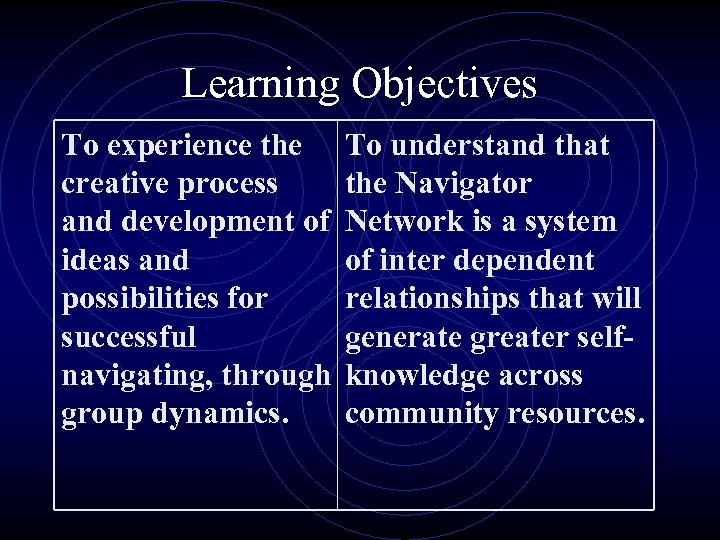
Learning Objectives To experience the creative process and development of ideas and possibilities for successful navigating, through group dynamics. To understand that the Navigator Network is a system of inter dependent relationships that will generate greater selfknowledge across community resources.
Navigating Change for Persons with Disabilities The New Freedom Initiative v Education v Employment v Technology v Community Living Creating conditions for new relationships and partnerships to emerge
NAVIGATORS AS CHANGE AGENTS 80% of the results come from 20% of the action in most endeavors
The Navigators Are Coming! Paul Revere and Personalities that are pollinators the Word-of. Mouth Epidemic of new ideas and trends Malcolm Gladwell (2000) The Tipping Point
A VICTORY MODEL FOR NAVIGATING What factors will help you succeed in influencing others to adopt your services? Help in achieving Navigator objectives!
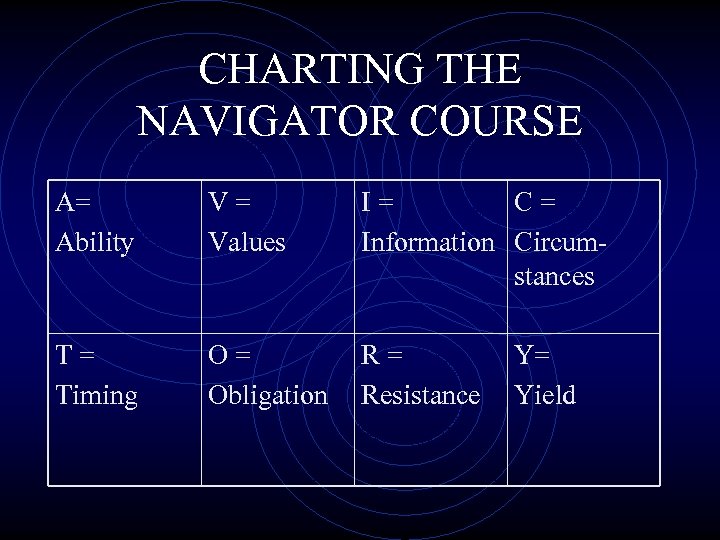
CHARTING THE NAVIGATOR COURSE A= Ability V = Values I = C = Information Circumstances T = Timing O = Obligation R = Resistance Y= Yield
ABILITY I N D I V U D A L v. W
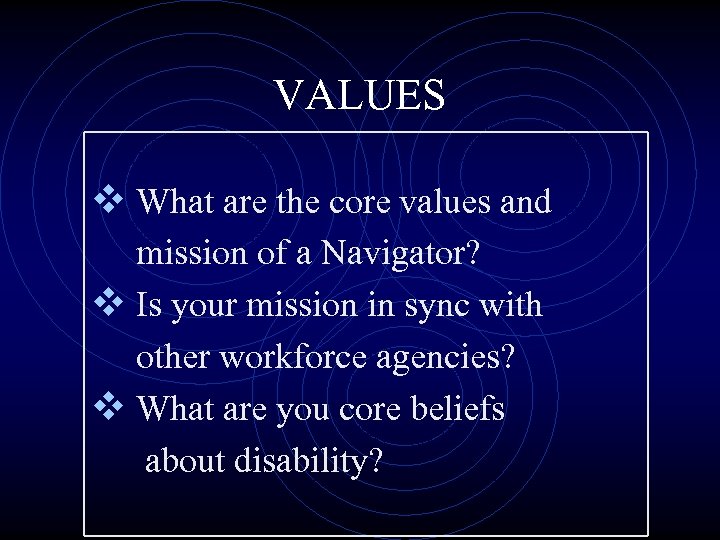
VALUES v What are the core values and mission of a Navigator? v Is your mission in sync with other workforce agencies? v What are you core beliefs about disability?
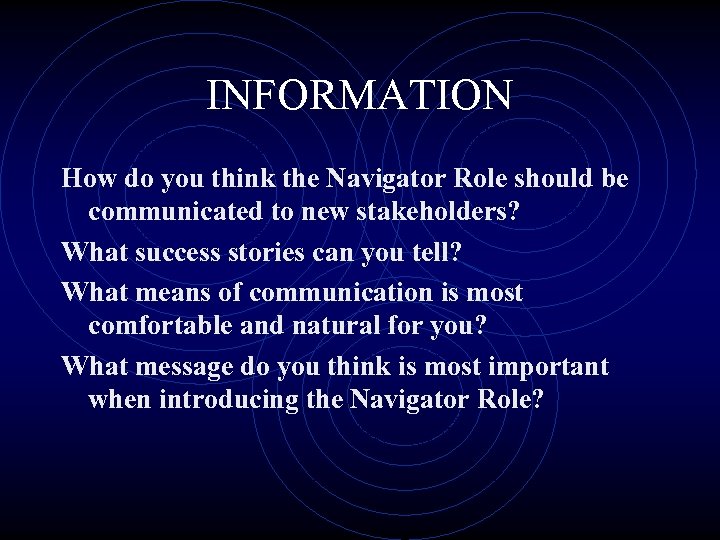
INFORMATION How do you think the Navigator Role should be communicated to new stakeholders? What success stories can you tell? What means of communication is most comfortable and natural for you? What message do you think is most important when introducing the Navigator Role?
CIRCUMSTANCES v What will help you most in adapting to your new work environment? v Are there economic or environmental factors, that will influence your ability to navigate?
TIMING v What factors (environmental and otherwise) do you anticipate that could influence the successful implementation of your role into the workforce system?
OBLIGATION v Have you involved key stakeholders in your purpose and mission? v Is there a significant authority person who endorses your role? v Have you developed buy-in from coworkers about your role?
RESISTANCE v What are the barriers that will set the Navigator Role off course? v What challenges are you most concerned about in this new role? v What information or knowledge do you feel is most critical in helping you navigate successfully?
YIELD v What are your expected job outcomes? v Have you thought about short-term outcomes, and longer term outcomes? v. How will the Navigator Role make a difference? v What are the rewards of being a Navigator?
PRODUCT # 1 “RICH PICTURE” TO DO v Break into State Teams! v Use information from AVICTORY MODEL and all workshops v Design a “rich picture” that charts the course of an imaginary “Navigator Ship, ” over the next three days v Navigator Pictures will be viewed on the last morning of training, and a few states will be asked to highlight their works of art! v Art paper identifying your region and states will be on the wall ready for each state to begin! v These are “works in progress, ” and should be added to over the course of the training.
Product # 2 INDIVIDUAL ACTION PLAN TO DO LIST v I will meet with - v I will learn more about - - v I will build relationships with - Due on last day, morning session.
References • • • Bridges, W. (2003) Managing Transitions. Perseus Publishing. Cambridge, MA. Davis, H. R. (1973). The Administration of Mental Health Services. [S. Feldman ed. ] Change and Innovation. Charles C. Thomas Publisher: Springfield, Illinois. • Davis, H. R. (1978). Management of Innovation and Change in Mental Health Services. Hospital & Community Psychiatry, 29, 10. • Farson, R. , & Keyes, R. (2002). The Innovation Paradox. Free Press/Simon and Schuster. New York. • Gladwell, M. (2000). The Tipping Point. Little Brown and Company. Boston, New York, London. • Hoover, S. J. (2003). IT Professional's Response to Adoption and Implementation of Innovations in the Workplace: Incorporating Accessibility Features Into Information Technology for End Users with Disabilities. Doctoral Dissertation.
Hunter, D. , Bailey, A. & Taylor, B. (1995). The Zen of Groups: The Handbook for People Meeting with a Purpose. Fisher Books: Tucson, AZ Hunter, D. , Bailey, A. & Taylor, B. (1995). The Art of Facilitation: How to Create Group Synergy. Fisher Books. Tucson, AZ. Hunter, D. , Bailey, A. & Taylor, B. (1995). Co-operacy: A new Way of Being at Work. Fischer Books. Tucson, AZ. Johnson, D. W. , & Johnson, F. P. (1997). Joining Together. Group Theory and Group Skills. Allyn and Bacon: Boston, MA. Kotter, J. P. (2002). The Heart of Change. Harvard Business School Press: Boston, MA. Kegan, R. & Lahey, L. (2002). The Real Reason People Won’t Change. The Harvard Business Review on Culture and Change. Harvard Business School Press: Boston, MA.
Rasiel, E. M. (1998). The Mc. Kinsey Way. Mc. Graw-Hill: New York. Rogers, E. M. (1995). Diffusion of Innovations (4 th Ed. ). The Free Press: New York. Wheatly, M. J. (1999). Leadership and the New Science. Berrett-Koehler Publishers: San Francisco.
Скачать презентацию Empowering Navigator Innovation An Emerging Model for Building
3f87f95047cf09bf42a3cf5cdc18354b.ppt