Скачать презентацию Employment of the world population What is
Employment of the world population.pptx
- Количество слайдов: 8
 Employment of the world population
 What is the world employment rate? • Employed persons. All those who, (1) do any work at all as paid employees, work in their own business or profession or on their own farm, or work 15 hours or more as unpaid workers in a familyoperated enterprise; and (2) all those who do not work but had jobs or businesses from which they were temporarily absent due to illness, bad weather, vacation, childcare problems, labor dispute, maternity or paternity leave, or other family or personal obligations — whether or not they were paid by their employers for the time off and whether or not they were seeking other jobs. • Unemployed persons. All those who, (1) have no employment during the reference week; (2) are available for work, except for temporary illness; and (3) have made specific efforts, such as contacting employers, to find employment sometime during the past 4 -week period.
 • Not in the labor force. Included in this group are all persons in the civilian noninstitutional population who are neither employed nor unemployed. Information is collected on their desire for and availability to take a job at the time of the CPS interview, jobsearch activity in the prior year, and reason for not looking for work in past 4 -week period. • Multiple jobholders. These are employed persons who, have two or more jobs as a wage and salary worker, are self-employed and also held a wage and salary job, or work as an unpaid family worker and also hold a wage and salary job.
 Employment-to-population ratio in the world • In general, a high ratio is considered to be above 70 percent of the working-age population whereas a ratio below 50 percent is considered to be low. The economies with low ratios are generally situated in the Middle East and North Africa. • Employment-to-population ratios are typically higher for men than for women. Nevertheless, in the past decades, the ratios tended to fall for men and increase in the case of women, which made the differences between both to be reduced. The ratio is used to evaluate the ability of the economy to create jobs and therefore is used in conjunction with the unemployment rate for a general evaluation of the labour market stance. Having a high ratio means that an important proportion of the population in working age is employed, which in general will have positive effects on the GDP per capita. Nevertheless, the ratio does not give an indication of working conditions, number of hours worked person, earnings or the size of the black market. Therefore, the analysis of the labour market must be done in conjunction with other statistics. • • This measure comes from dividing the civilian noninstitutionalized population who are employed by the total noninstitutionalized population and multiplying by 100
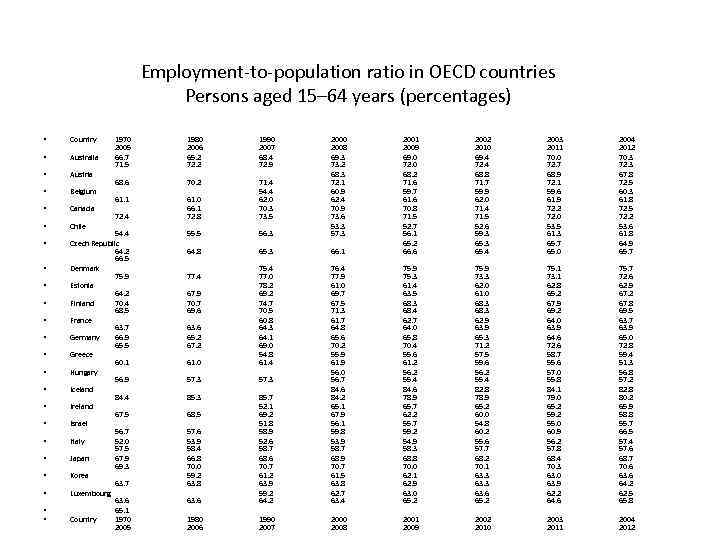 Employment-to-population ratio in OECD countries Persons aged 15– 64 years (percentages) • Country • Australia • Austria • Belgium • Canada • Chile • • • • • 1970 2005 66. 7 71. 5 1980 2006 65. 2 72. 2 1990 2007 68. 4 72. 9 68. 6 70. 2 61. 1 61. 0 66. 1 72. 8 71. 4 54. 4 62. 0 70. 3 73. 5 55. 5 56. 3 2000 2008 69. 3 73. 2 68. 3 72. 1 60. 9 62. 4 70. 9 73. 6 53. 3 57. 3 64. 8 65. 3 61. 0 75. 4 77. 0 78. 2 69. 2 74. 7 70. 5 60. 8 64. 3 64. 1 69. 0 54. 8 61. 4 57. 3 85. 3 72. 4 54. 4 Czech Republic 64. 2 66. 5 Denmark 75. 9 Estonia 64. 2 Finland 70. 4 68. 5 France 63. 7 Germany 66. 9 65. 5 Greece 60. 1 Hungary 56. 9 Iceland 84. 4 Ireland 67. 5 Israel 56. 7 Italy 52. 0 57. 5 Japan 67. 9 69. 3 Korea 63. 7 Luxembourg 63. 6 65. 1 Country 1970 2005 66. 1 2009 69. 0 72. 0 68. 2 71. 6 59. 7 61. 6 70. 8 71. 5 52. 7 56. 1 65. 2 66. 6 2002 2010 69. 4 72. 4 68. 8 71. 7 59. 9 62. 0 71. 4 71. 5 52. 6 59. 3 65. 4 2003 2011 70. 0 72. 7 68. 9 72. 1 59. 6 61. 9 72. 2 72. 0 53. 5 61. 3 65. 7 65. 0 2004 2012 70. 3 72. 3 67. 8 72. 5 60. 3 61. 8 72. 5 72. 2 53. 6 61. 8 64. 9 65. 7 63. 6 85. 7 52. 1 69. 2 51. 8 58. 9 52. 6 58. 7 68. 6 70. 7 61. 2 63. 9 59. 2 64. 2 76. 4 77. 9 61. 0 69. 7 67. 5 71. 3 61. 7 64. 8 65. 6 70. 2 55. 9 61. 9 56. 0 56. 7 84. 6 84. 2 65. 1 67. 9 56. 1 59. 8 53. 9 58. 7 68. 9 70. 7 61. 5 63. 8 62. 7 63. 4 75. 9 75. 3 61. 4 63. 5 68. 3 68. 4 62. 7 64. 0 65. 8 70. 4 55. 6 61. 2 56. 2 55. 4 84. 6 78. 9 65. 7 62. 2 55. 7 59. 2 54. 9 58. 3 68. 8 70. 0 62. 1 62. 9 63. 0 65. 2 75. 9 73. 3 62. 0 61. 0 68. 3 62. 9 63. 9 65. 3 71. 2 57. 5 59. 6 56. 2 55. 4 82. 8 78. 9 65. 2 60. 0 54. 8 60. 2 55. 6 57. 7 68. 2 70. 1 63. 3 63. 6 65. 2 75. 1 73. 1 62. 8 65. 2 67. 9 69. 2 64. 0 63. 9 64. 6 72. 6 58. 7 55. 6 57. 0 55. 8 84. 1 79. 0 65. 2 59. 2 55. 0 60. 9 56. 2 57. 8 68. 4 70. 3 63. 0 63. 9 62. 2 64. 6 75. 7 72. 6 62. 9 67. 2 67. 8 69. 5 63. 7 63. 9 65. 0 72. 8 59. 4 51. 3 56. 8 57. 2 82. 8 80. 2 65. 9 58. 8 55. 7 66. 5 57. 4 57. 6 68. 7 70. 6 63. 6 64. 2 62. 5 65. 8 1980 2006 1990 2007 2000 2008 2001 2009 2002 2010 2003 2011 2004 2012 77. 4 67. 9 70. 7 69. 6 63. 6 65. 2 67. 2 68. 5 57. 6 53. 9 58. 4 66. 8 70. 0 59. 2 63. 8
 List of countries by employment rate • This is a list of countries by employment rate (the proportion of working age adults employed, here with working age between 15 and 64 years old). The information is based on data from the OECD as at 2010 and can be expanded as new data (with sources) is found. Employment data for the European Union countries can be retrieved from Eurostat [1]. • Due to different methods for calculating the unemployment rate, the employment rate can be used as a supplemental method of comparison.
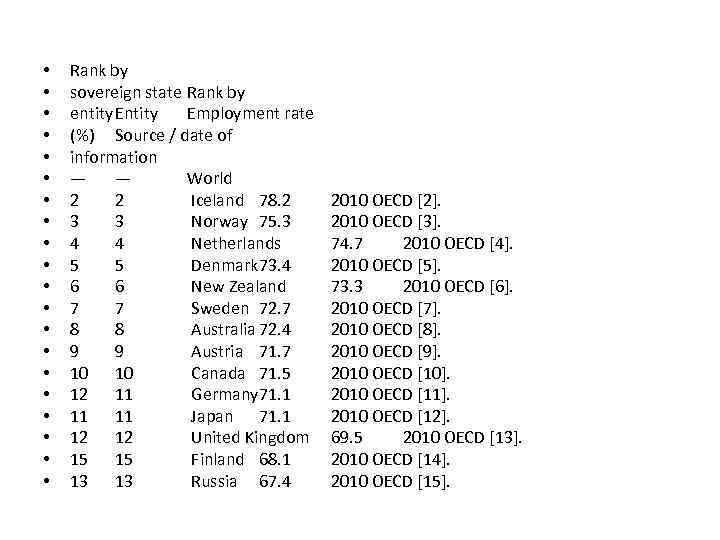 • • • • • Rank by sovereign state Rank by entity Employment rate (%) Source / date of information — — World 2 2 Iceland 78. 2 3 3 Norway 75. 3 4 4 Netherlands 5 5 Denmark 73. 4 6 6 New Zealand 7 7 Sweden 72. 7 8 8 Australia 72. 4 9 9 Austria 71. 7 10 10 Canada 71. 5 12 11 Germany 71. 1 11 11 Japan 71. 1 12 12 United Kingdom 15 15 Finland 68. 1 13 13 Russia 67. 4 2010 OECD [2]. 2010 OECD [3]. 74. 7 2010 OECD [4]. 2010 OECD [5]. 73. 3 2010 OECD [6]. 2010 OECD [7]. 2010 OECD [8]. 2010 OECD [9]. 2010 OECD [10]. 2010 OECD [11]. 2010 OECD [12]. 69. 5 2010 OECD [13]. 2010 OECD [14]. 2010 OECD [15].