 Employment
 1. 2. 3. Choosing the right career Job requirements Resume Plan: 3. 1 How to plan a resume 3. 2 Main steps in planning a resume 3. 3 Content 3. 4 Suggestions 3. 5 Cover letter 4. Interview 4. 1 What we look for in a candidate 4. 2 Preparing for an interview 4. 3 During the interview 5. Work abroad 5. 1 Your chances 5. 2 10 steps to planning your career transition to another country 5. 3 The most popular jobs abroad for Russians
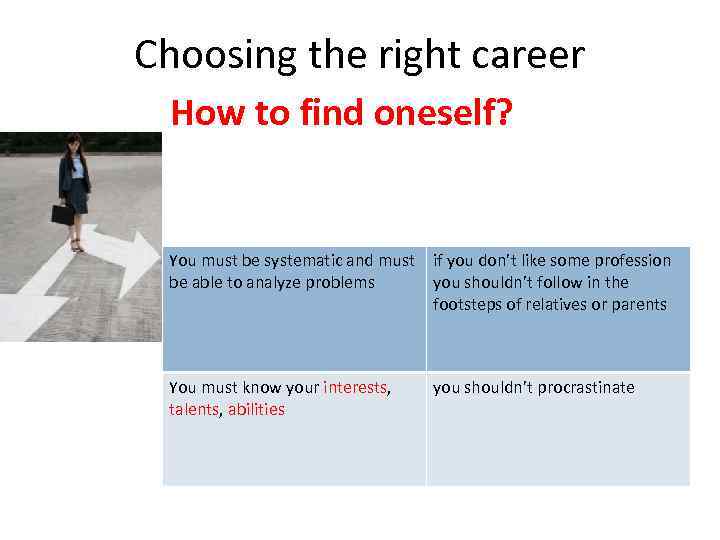 Choosing the right career How to find oneself? You must be systematic and must if you don’t like some profession be able to analyze problems you shouldn’t follow in the footsteps of relatives or parents You must know your interests, talents, abilities you shouldn’t procrastinate
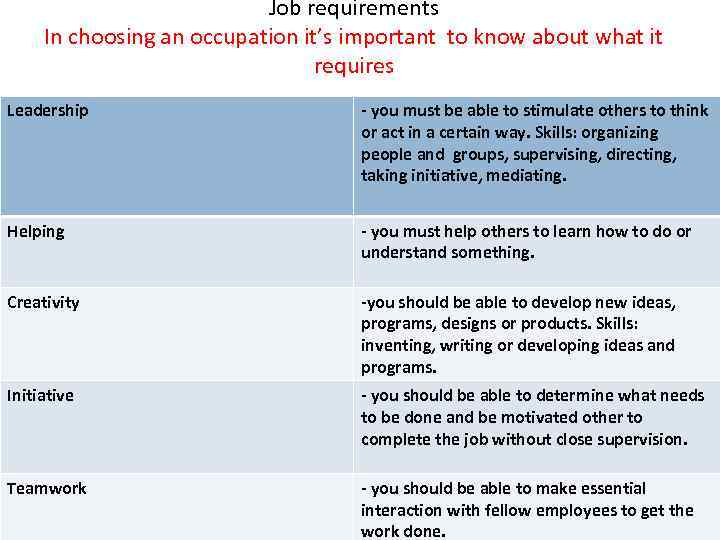 Job requirements In choosing an occupation it’s important to know about what it requires Leadership - you must be able to stimulate others to think or act in a certain way. Skills: organizing people and groups, supervising, directing, taking initiative, mediating. Helping - you must help others to learn how to do or understand something. Creativity -you should be able to develop new ideas, programs, designs or products. Skills: inventing, writing or developing ideas and programs. Initiative - you should be able to determine what needs to be done and be motivated other to complete the job without close supervision. Teamwork - you should be able to make essential interaction with fellow employees to get the work done.
 Resume
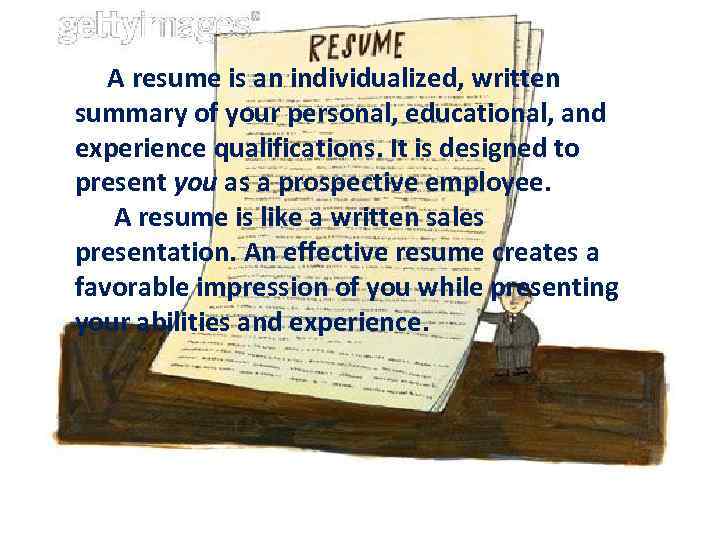 A resume is an individualized, written summary of your personal, educational, and experience qualifications. It is designed to present you as a prospective employee. A resume is like a written sales presentation. An effective resume creates a favorable impression of you while presenting your abilities and experience.
 How to plan resume Remember that your resume is an individualized presentation of your qualifications for a particular job. This means that you might want to prepare several resumes, depending on the types of jobs you are applying for.
 These are the steps to plan an efficient resume. • The first step is to select the information that you want to use. Ask yourself: "Which parts of my training and experience are related to the kind of job I want? " "Which parts, if any, are unrelated? " Give all necessary details about jobs you have had that relate to the job you want. Do not emphasize unrelated jobs. • The second step is to arrange the information you have selected. To catch an employer’s attention, plan to list your best qualifications early in your resume. Ask yourself: "Is my work experience the most important part of my resume? " Or, "Will a prospective employer be more interested in my education and training? "
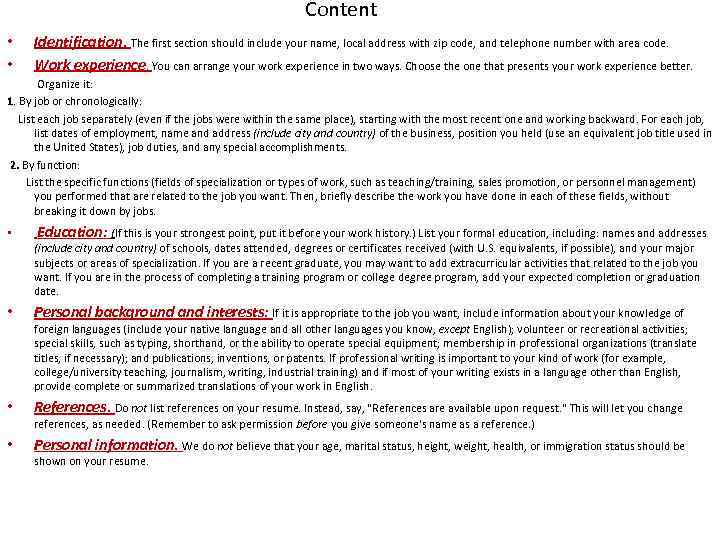 Content • • Identification. The first section should include your name, local address with zip code, and telephone number with area code. Work experience. You can arrange your work experience in two ways. Choose the one that presents your work experience better. Organize it: 1. By job or chronologically: List each job separately (even if the jobs were within the same place), starting with the most recent one and working backward. For each job, list dates of employment, name and address (include city and country) of the business, position you held (use an equivalent job title used in the United States), job duties, and any special accomplishments. 2. By function: List the specific functions (fields of specialization or types of work, such as teaching/training, sales promotion, or personnel management) you performed that are related to the job you want. Then, briefly describe the work you have done in each of these fields, without breaking it down by jobs. • Education: (If this is your strongest point, put it before your work history. ) List your formal education, including: names and addresses (include city and country) of schools, dates attended, degrees or certificates received (with U. S. equivalents, if possible), and your major subjects or areas of specialization. If you are a recent graduate, you may want to add extracurricular activities that related to the job you want. If you are in the process of completing a training program or college degree program, add your expected completion or graduation date. • Personal background and interests: If it is appropriate to the job you want, include information about your knowledge of foreign languages (include your native language and all other languages you know, except English); volunteer or recreational activities; special skills, such as typing, shorthand, or the ability to operate special equipment; membership in professional organizations (translate titles, if necessary); and publications, inventions, or patents. If professional writing is important to your kind of work (for example, college/university teaching, journalism, writing, industrial training) and if most of your writing exists in a language other than English, provide complete or summarized translations of your work in English. • References. Do not list references on your resume. Instead, say, "References are available upon request. " This will let you change references, as needed. (Remember to ask permission before you give someone's name as a reference. ) • Personal information. We do not believe that your age, marital status, height, weight, health, or immigration status should be shown on your resume.
 Suggestions: • make sure your resume is written with perfect grammar, spelling, and punctuation • make short sentences to present your experience and abilities in a positive way • make sure your resume looks attractive and is very easy to read • make a good cover letter
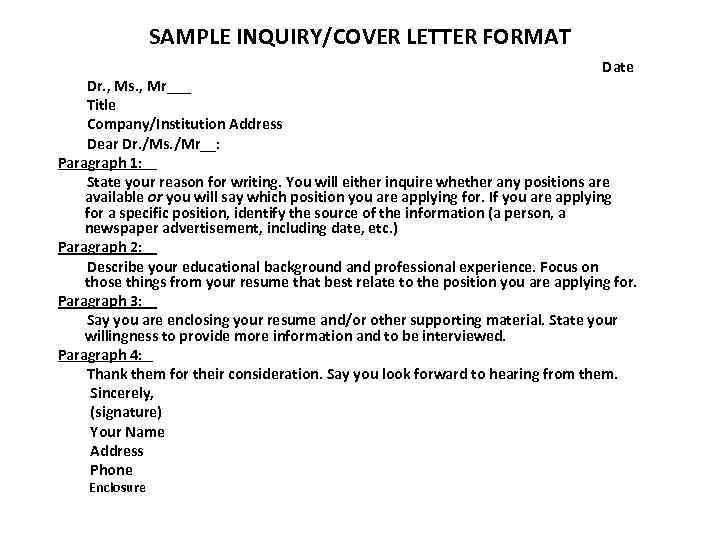 SAMPLE INQUIRY/COVER LETTER FORMAT Date Dr. , Ms. , Mr___ Title Company/Institution Address Dear Dr. /Ms. /Mr__: Paragraph 1: State your reason for writing. You will either inquire whether any positions are available or you will say which position you are applying for. If you are applying for a specific position, identify the source of the information (a person, a newspaper advertisement, including date, etc. ) Paragraph 2: Describe your educational background and professional experience. Focus on those things from your resume that best relate to the position you are applying for. Paragraph 3: Say you are enclosing your resume and/or other supporting material. State your willingness to provide more information and to be interviewed. Paragraph 4: Thank them for their consideration. Say you look forward to hearing from them. Sincerely, (signature) Your Name Address Phone Enclosure
 What We Look for in a Candidate • Courage (the self-assurance to stand up for ideas) • Clear and constructive communication • Entrepreneurial spirit • Efficiency • Emotional intelligence(being emotionally perceptive to the feelings of others)
 The job interview • A job interview is your opportunity to present your talents to a prospective employer. During the interview, an employer judges your qualifications, appearance, and general fitness for the job opening. It’s your opportunity to convince the employer that you can make a real contribution.
 Preparing for Interviews • Be prepared with answers to these questions: – What are my best qualities, and what can I bring to this company? – What have I learned from my successes and failures? – What are some areas I could improve upon? • Do your research: Know the Company, the position being offered, and how you will fit into it. Look into the Company’s history, products, successes, and goals. • Be confident and trust yourself: You are a valuable candidate for the job, and you have a lot to offer.
 Preparing for Interviews • Do not be afraid to ask: Ask in a curious, straightforward way about the Company and the job. • Listen: You are not just here to talk about your experience, you are also here to learn about the Company and the job you are interested in. • Prepare: – Read the job posting carefully to make sure you know what it is about. – Show up early. If something unavoidable causes you to be late, call and let us know. – Bring a few extra copies of your CV, just in case. – Follow up later with a phone call or an email. Let us know you are still interested.
 Keep in mind that in the competitive business world, there are sure to be dozens of other highly qualified candidates going after your job. It’s important to make yourself stand out as someone special.
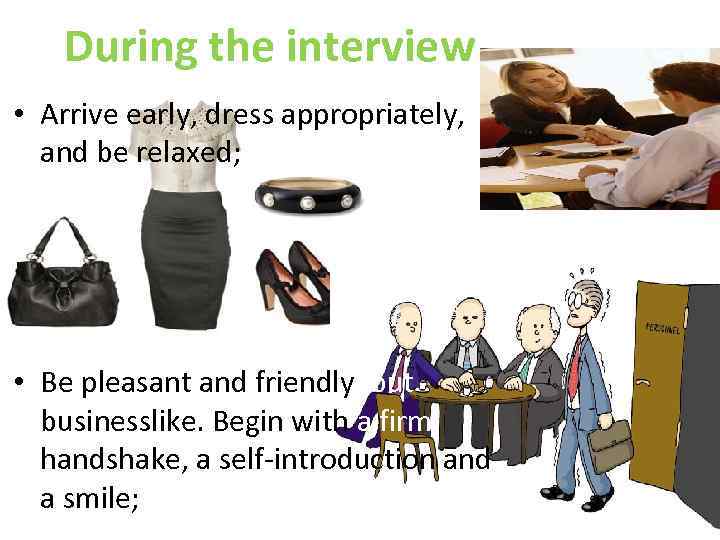 During the interview • Arrive early, dress appropriately, and be relaxed; • Be pleasant and friendly, but businesslike. Begin with a firm handshake, a self-introduction and a smile;
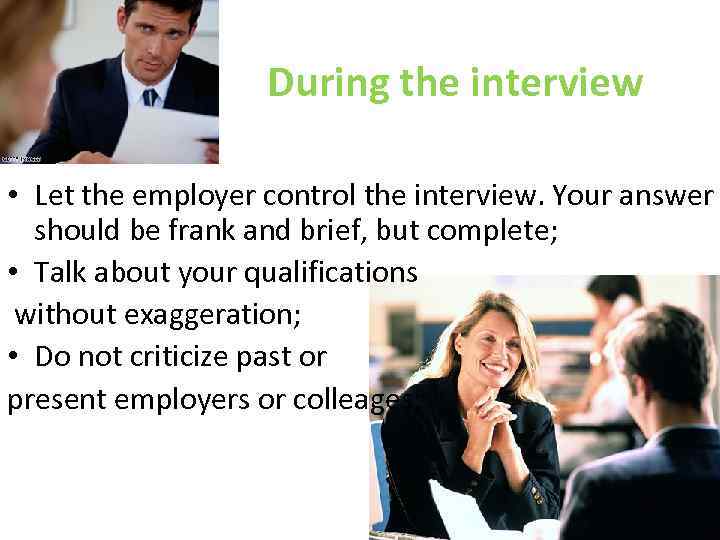 During the interview • Let the employer control the interview. Your answer should be frank and brief, but complete; • Talk about your qualifications without exaggeration; • Do not criticize past or present employers or colleages;
 • Don’t discuss your personal, domestic, or financial problems, unless you are srecifically asked about them; • Be prepared to say the approximate salary you want , but not until the employer has introduced the subject. Be realistic in discussing salary; • If the employer asks you to call or return for another interview, make a written note of the time, date, and place; • Thank the employer for interview; • Follow up.

 WORK ABROAD If you are young, full of energy, openminded, purposeful and well-educated, WORK ABROAD is a good opportunity for you to realize your ambitions
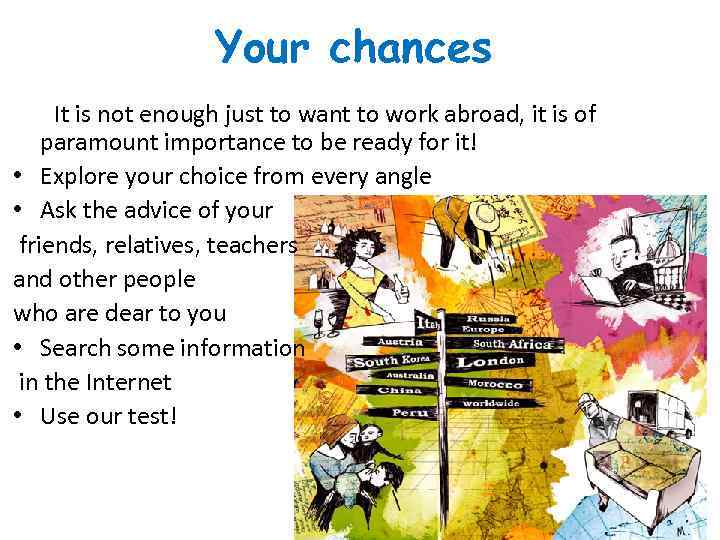 Your chances It is not enough just to want to work abroad, it is of paramount importance to be ready for it! • Explore your choice from every angle • Ask the advice of your friends, relatives, teachers and other people who are dear to you • Search some information in the Internet • Use our test!
 Improve your knowledge It doesn't matter what country you chose to work in, you should have good command of English and communication skills. There a lot of opportunities to make a bee line for success! - MBA programs - Language courses - Find out everything about cultural background of the country you are going to work in, it will help you behave in an appropriate way
 10 steps to planning your career transition to another country 1. Access any formal recourses available to you. 2. Find out your anticipated departurearrival day for your new country 3. Find out the restrictions and permissions for working in the destination country 4. Identify organizations to research for possible job leads 5. Identify contacts within those organizations to network and identify job leads
 6. Ask everybody in your current network if they know somebody working for 7. Develop a networking resume 8. Contact all the people identified for networking to identify the key leads within the country of destination 9. Check out the web sites for your career field 10. Research the business etiquette and communication culture for your country of destination
 The most popular jobs abroad for Russians: - The sphere of service - Social work - Babysitter - Language teacher (for immigrants) - Science work - Hi-tech sphere (programmers etc. )