 Скачать презентацию Employer-driven injury management systems Dr Christine Randall Rehabilitation
5085e548686275801225aa6631066a3b.ppt
- Количество слайдов: 20



Employer-driven injury management systems Dr Christine Randall Rehabilitation Counselling program convenor School of Human Services & SW
Key points: 1. Shift in focus from liability/eligibility to functional goals is needed. 2. Employer driven fully integrated prevention and injury management systems, such as the Disability Management model, are producing better outcomes for large companies. 3. There are many documented examples of companies that have benefited from investing in IM systems. 4. IM systems are most effective when they are tailored to individual organisations. 5. All stakeholders must be involved in the design of the IM system to ensure ownership. School of Human Services & SW
Features of successful IM systems • Employer (rather than insurance) driven • Acknowledge importance of organisational culture • Take a systems approach with a focus on organisational context • Fully integrated into the organisation at all levels • Fully integrated across all aspects of employee wellness, including prevention and rehabilitation • Actively involves all stakeholders at all levels School of Human Services & SW 2
Features of Disability Management • joint labour-management commitment and involvement • early intervention and early return-to-work philosophy • multidisciplinary interventions • case management/case coordination • effective disability prevention strategies » (Shrey, et. al. , 2006, p. 58). School of Human Services & SW 3
Features of DM …. • employee education and involvement • utilisation of employer-based and community resources • supportive policies and procedures to facilitate accommodations and jobsite modifications • system that ensures accountability of all parties • management information system for program evaluation » (Shrey, et. al. , 2006, p. 58). School of Human Services & SW 4
Business case for employer-driven IM • Decrease human costs of illness, injury & disability • Decrease financial costs (direct & indirect) • Decrease absenteeism, presenteeism & turn over • Improve employee satisfaction & productivity • Improve workplace culture & competitive advantage • Optimise recruitment & retention of talented employees • Contribute to corporate strategic plan School of Human Services & SW 5
Automotive Manufacturing • Trial of CM protocol in one plant • Cases selected for review • Emphasis on employee contact during & after intervention • Productivity & job retention critical • Focus on recovery, rehab, RTW & retention » (Mobley, et al. , 2000) School of Human Services & SW 6
Petrochemical company (Skisak, et al. , 2006) • report absence on Day 1 & Day 4 & case manage > 4 days • internet CM tool & training for all stakeholders to promote RTW • process responsibility flow charts • case manager advocates for employee & promotes ownership of health • senior management informed & involved • data to highlight areas for improvement & promote accountability • annual customer satisfaction survey sent to rehabilitated employees School of Human Services & SW 7
Emergency services • Preventive measures for individual & operational stressors • Individual interventions • Organisational measures • Multi-staged & comprehensive approach, including cultural & organisational change • Disease model for intervention » (Reynolds & Wagner, 2007) School of Human Services & SW 8
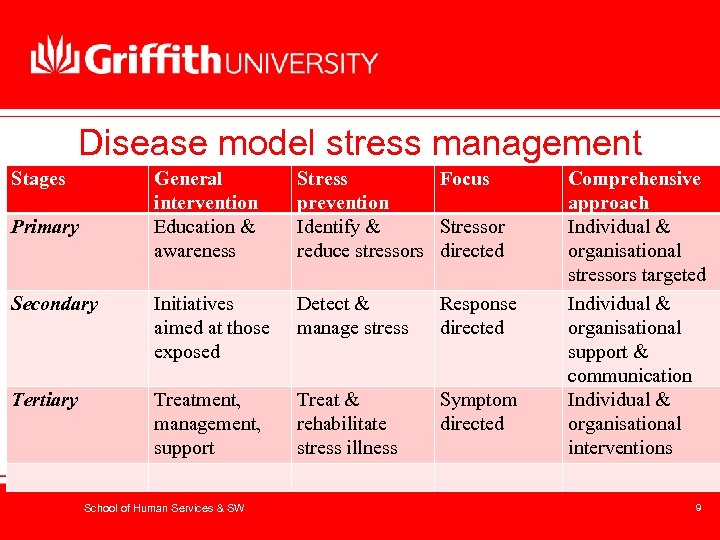
Disease model stress management Stages General intervention Education & awareness Stress Focus prevention Identify & Stressor reduce stressors directed Secondary Initiatives aimed at those exposed Detect & manage stress Response directed Tertiary Treatment, management, support Treat & rehabilitate stress illness Symptom directed Primary School of Human Services & SW Comprehensive approach Individual & organisational stressors targeted Individual & organisational support & communication Individual & organisational interventions 9
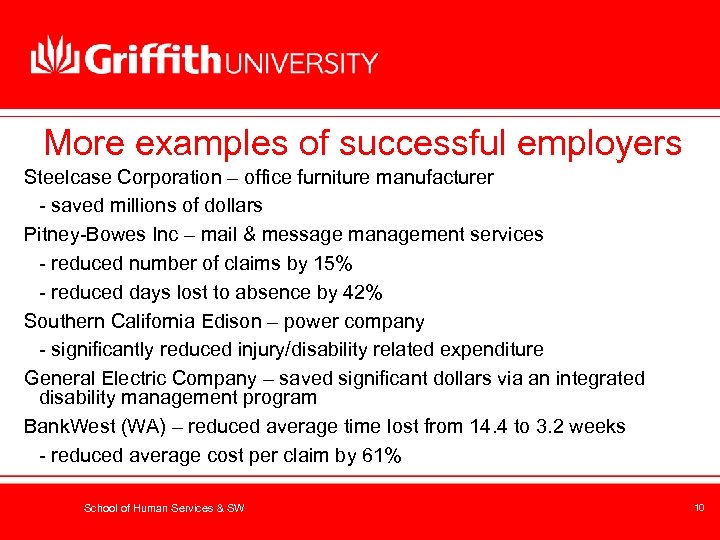
More examples of successful employers Steelcase Corporation – office furniture manufacturer - saved millions of dollars Pitney-Bowes Inc – mail & message management services - reduced number of claims by 15% - reduced days lost to absence by 42% Southern California Edison – power company - significantly reduced injury/disability related expenditure General Electric Company – saved significant dollars via an integrated disability management program Bank. West (WA) – reduced average time lost from 14. 4 to 3. 2 weeks - reduced average cost per claim by 61% School of Human Services & SW 10
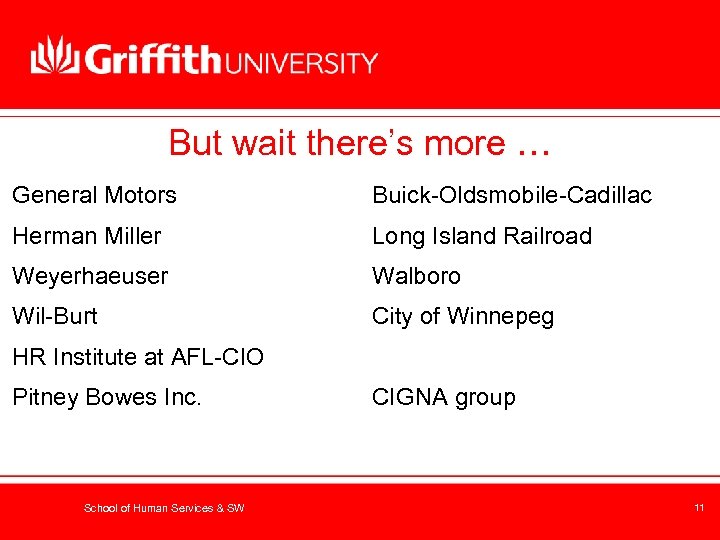
But wait there’s more … General Motors Buick-Oldsmobile-Cadillac Herman Miller Long Island Railroad Weyerhaeuser Walboro Wil-Burt City of Winnepeg HR Institute at AFL-CIO Pitney Bowes Inc. School of Human Services & SW CIGNA group 11
Key messages • Not 1 size fits all, but: • All successful companies have shifted focus from obligations to IM • All have invested in IM systems and report excellent returns • All report benefits beyond successful IM • Unique organizational needs & structures require different programs • Good outcomes achieved, provided stakeholders are involved in design & implementation of programs is specific to organisational needs School of Human Services & SW 12
Bibliography Adam, M. L. , & Flatau, P. (2005). Job insecurity and mental health. Sydney, NSW: Social Policy Research Centre, UNSW. Akabas S. H. , Gates L. B. , & Galvin D. E. (1992). Disability management: A complete system to reduce costs, increase productivity, meet employee needs and ensure legal compliance. New York: AMACOM. Amick, B. , Habeck, R. V. , Hunt, A. , Fossel, A. H. , Chapin, R. B. , Keller, H. , & Katz, J. N. (2000). Measuring the impact of organizational behaviours on work disability prevention and management. Journal of Occupational Rehabilitation 10, 21 -38. ASCC (2007). Compendium of workers’ compensation statistics Australia 2004 -05. Released May 2007 by the Australian Safety and Compensation Council. Buys, N. & Randall, C. (2009). Disability Management: A global response to disability in the workplace. In C. Marshall, E. Kendall, M. Banks & R. Gover (Eds. ) Disabilities: Insights from across fields and around the world. (Vol. 3). School of Human Services & SW 13
Ceniceros, R. (2010). Disability accommodation programs cut costs. Business Insurance, 44(33), 24 -24. Curtis, J. , & Scott, L. R. (2004). Integrating disability management into strategic plans: Creating healthy organizations. AAOHN Journal, 52(7), 298 -302. Dembe, A. E. (2001). The social consequences of occupational injuries and illnesses. American Journal of Industrial Medicine, 403 -417. Harder, H. , Mc. Hugh, G. , Wagner, S. , & Harder, K. (2006). Disability management strategies: A preliminary investigation of perceptions, policies and out return-towork outcomes. International Journal of Disability Management Research, 1(1), 1 -9. Harder, H. G. , & Scott, L. R. (2005). Comprehensive disability management. London: Elsevier. Lifeby. Design (2007). Research & statistics. www. lifebydesign. com. au/engaged/3_Research. Statistics. php. %20 Accessed%2 07%20 January%202008. School of Human Services & SW 14
Lipold, A. G. (2000). Managing the guy who isn't there. Business and Health 18(10), 25 -30. Mc. Ananey, D. , Webster, B. , Lohan, M. , & Wynne, R. (2001). Disability management: A system of response or a response to a system? The Australian Journal of Rehabilitation Counselling, 7(1), 1 -22. Mobley, E. , Linz, D. , Shukla, R. Breslin, R. & Deng, C. (2000). Disability Case Management: An Impact Assessment in an Automotive Manufacturing Organization. Journal of Occupational & Environmental Medicine, 42 (6), 597602. Mc. Donald, C. (2010). Integrated disability management fuels power company's comp claim success. National Underwriter. P & C, 114(29), 12 -13, 27. Muenchberger, H. , Kendall, E. , & Mills, E. (2006). Creating successful rehabilitation partnerships between health professionals and employers. International Journal of Disability Management, 1(1), 10 -20. National Institute of Disability Management and Research (2000). Code of practice for disability management. British Columbia: Author. School of Human Services & SW 15
QComp (2012). Rehabilitation Report. Issue 20 Winter 2012. Randall, C. , Buys, N. , & Kendall, E. (2006). Developing an occupational rehabilitation system for workplace stress. International Journal of Disability Management Research, 1(1), 64 -73. Reynolds, C. & Wagner, S. (2007). Stress and First Responders: The need for a multidimensional approach to stress management. International Journal of Disability Management Research, 2 (2), 27 -36. Rosenthal, D. A. , Hursh, N. , Lui, J. , Isom, R. , & Sasson, J. (2007). A survey of current disability management practice. Rehabilitation Counseling Bulletin, 50, 76 -86. Shamhart, S. , & Growick, B. (1996). Disability management: The case of Techneglas. NARPPS Journal 11(2), 46 -47. Shrey, D. E. (2005). Worksite disability management and industrial rehabilitation. In D. E. Shrey and M. Lacerte, (Eds), Principles and practices of disability management in industry (pps. 3 -54). Winter Park, FL: GR Press. School of Human Services & SW 16
Shrey, D. E. (2006). Disability management and return-to-work coordination. The Rehabilitation Professional, 14(4), 28 -29. Shrey, D. E. , Hursh, N. , Gallina, P. , Slinn, S. , & White A. (2006). Disability management best practices and joint labour-management collaboration. International Journal of Disability Management Research, 1(1), 52 -63. Skisak, C. , Bhojani, F. & Shan, P. (2006). Impact of a Disability Management Program on Employee Productivity in a Petrochemical Company. Journal of Occupational & Environmental Medicine, 48 (5), 497 - 504. Steelcase (2008). Inside Steelcase. Accessed 7 March 2008. www. steelcase. com/ap/inside_steelcase_ourcompany. aspx? f=18568. Szymanski, E. , Parker, R. M. , Ryan, C. , Merz, M. A. , Trevino-Espinoza, B. , & Johnston, -Rodriguez, S. (2003). Work and disability: Basic constructs. In E. Szymanski, & R. M. Parker (Eds), Work and disability: Issues and strategies in career development and job placement (pps. 1 -26). Austin, TX: Pro-Ed. School of Human Services & SW 17
Westmorland, M. & Buys, N. (2002). Disability management in a sample of Australian self-insured companies. Disability and Rehabilitation. Vol. 24 (14). 746– 754. Williams, R. , Westmorland, M. , Lin, C. , Schmuck, G. , & Creen, M. (2006). A systematic review of workplace rehabilitation interventions for workrelated low back pain. International Journal of Disability Management Research, 1(1), 21 -30. Zimmerman, W. (2006). Disability management in a global context. Proceedings of the Getting Better Sooner Conference, Work. Cover SA, Adelaide, September 27, 2006. School of Human Services & SW 18
University programs Graduate Certificate in Case Management (personal injury) • Specific to insurance-based rehabilitation industry • Includes rehabilitation case management, injury management, & interpersonal skills Master of Rehabilitation Counselling – new in 2014 • Includes case management, rehabilitation counselling, vocational evaluation, job development & placement, injury management, applied counselling, disability studies, industry practicum, & research methods. Dr Christine Randall c. randall@griffith. edu. au School of Human Services & SW 07 5552 9343 19
Скачать презентацию Employer-driven injury management systems Dr Christine Randall Rehabilitation
5085e548686275801225aa6631066a3b.ppt