


 Скачать презентацию Employee Counseling Services Chapter 11 HRD 3 e
da519a73da75e317b38ce577db284848.ppt
- Количество слайдов: 69
 Employee Counseling Services Chapter 11 HRD 3 e. CH 11 Contributed by Wells Doty Ed. D. Clemson Univ. 1
 The Need for Employee Counseling Have you ever seen people: n Struggling due to high levels of anxiety? n Refusing treatment for a treatable condition? n Experiencing job burnout? n Involved in efforts to promote good health? HRD 3 e. CH 11 Contributed by Wells Doty Ed. D. Clemson Univ. 2
 The Need for Employee Counseling – 2 n Personal problems are a part of life. n Personal problems affect job performance. n Healthcare costs continue to rise. n n Reducing tardiness, absenteeism, lost time and worker’s compensation saves money. Reducing turnover can improve productivity and the bottom line. HRD 3 e. CH 11 Contributed by Wells Doty Ed. D. Clemson Univ. 3
 Addressing Employee Well. Being n n n Promotes employee morale. Reduces the impact of external factors on work. Promotes productivity. n Cheaper to train, treat, and retain existing workers than to hire new ones. HRD 3 e. CH 11 Contributed by Wells Doty Ed. D. Clemson Univ. 4
 Employee Counseling as an HRD Function n Counseling serves the same goal as other HRD activities. n n n Improving/maintaining worker performance Same techniques are used, especially coaching. Same kinds of analysis and planning needed. HRD 3 e. CH 11 Contributed by Wells Doty Ed. D. Clemson Univ. 5
 Overview of Counseling Programs n n n Problem Identification Education Counseling Referral Treatment Follow-up HRD 3 e. CH 11 Contributed by Wells Doty Ed. D. Clemson Univ. 6
 Problem Identification n n Screening device Absenteeism records Supervisor’s observations Referral Voluntary participation HRD 3 e. CH 11 Contributed by Wells Doty Ed. D. Clemson Univ. 7
 Education n n Pamphlets Videos Lectures Unsolicited n n n Television Radio Other media HRD 3 e. CH 11 Contributed by Wells Doty Ed. D. Clemson Univ. 8
 Counseling n Needs a non-threatening person with whom the worker can discuss problems and seek help. Options include: n n Supervisor/coach Ombudsman HRD Counselor Professional Counselor HRD 3 e. CH 11 Contributed by Wells Doty Ed. D. Clemson Univ. 9
 Referral n Directing employee to appropriate resources for assistance, e. g. , n n n Physician Substance abuse treatment center Marriage counselor Alcoholics Anonymous (AA) Other options (clergy) HRD 3 e. CH 11 Contributed by Wells Doty Ed. D. Clemson Univ. 10
 Treatment n The actual intervention to solve the problem, e. g. , n n Group therapy Medications Individual therapy Psychological therapy HRD 3 e. CH 11 Contributed by Wells Doty Ed. D. Clemson Univ. 11
 Follow-up n Needed to: n n n Ensure the employee is indeed carrying out the treatment. Obtain information on employee progress. Ensure that referrals and treatment are effective. HRD 3 e. CH 11 Contributed by Wells Doty Ed. D. Clemson Univ. 12
 A Caution About Employee Counseling n n All six approaches are not always needed. The following issues drive which approach is taken: n Type of problem identified n Appropriate response n Available resources HRD 3 e. CH 11 Contributed by Wells Doty Ed. D. Clemson Univ. 13
 Who Provides Employee Counseling? n n Depends on the organization and organizational culture. Can be done using: n Corporate resources (In-house). n Outside resources (Out-of-house). HRD 3 e. CH 11 Contributed by Wells Doty Ed. D. Clemson Univ. 14
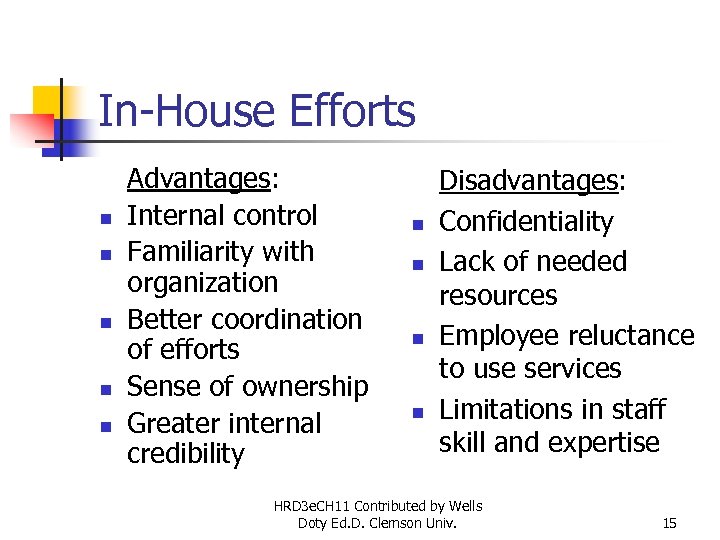 In-House Efforts n n n Advantages: Internal control Familiarity with organization Better coordination of efforts Sense of ownership Greater internal credibility n n Disadvantages: Confidentiality Lack of needed resources Employee reluctance to use services Limitations in staff skill and expertise HRD 3 e. CH 11 Contributed by Wells Doty Ed. D. Clemson Univ. 15
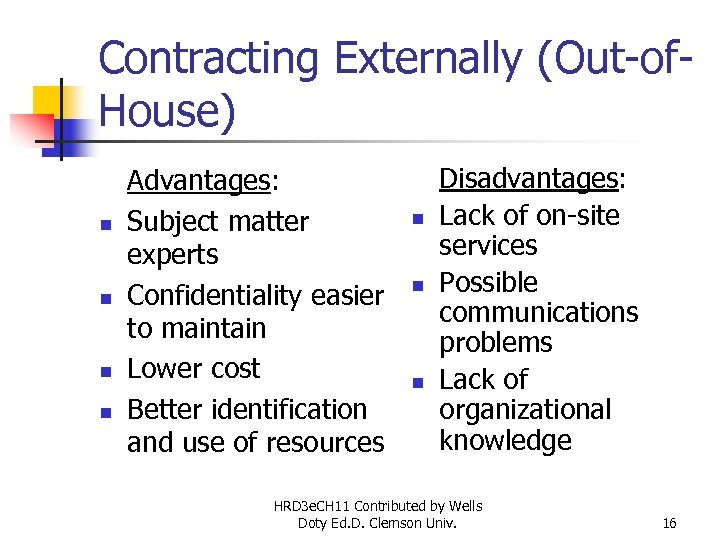 Contracting Externally (Out-of. House) n n Advantages: Subject matter experts Confidentiality easier to maintain Lower cost Better identification and use of resources n n n Disadvantages: Lack of on-site services Possible communications problems Lack of organizational knowledge HRD 3 e. CH 11 Contributed by Wells Doty Ed. D. Clemson Univ. 16
 Characteristics of Effective Programs n n Top management support. Clear policies and procedures. Cooperation with unions and employee groups. A range of care: n n Referral to community resources Follow-up HRD 3 e. CH 11 Contributed by Wells Doty Ed. D. Clemson Univ. 17
 Characteristics of Effective Programs n n Policy of guaranteed confidentiality. Maintenance of records for program evaluation. Health insurance benefit coverage for services. Family education. HRD 3 e. CH 11 Contributed by Wells Doty Ed. D. Clemson Univ. 18
 Employee Assistance Programs (EAPs) n Job-based programs operating within an organization that: n Identify troubled employees. n Motivate them to resolve their problems. n Provide access to counseling and treatment, as appropriate. HRD 3 e. CH 11 Contributed by Wells Doty Ed. D. Clemson Univ. 19
 General Topics that EAPs Might Address n n n Alcoholism Drug abuse Anxiety Depression Eating disorders n n Compulsive gambling Marital problems Financial problems Personal problems HRD 3 e. CH 11 Contributed by Wells Doty Ed. D. Clemson Univ. 20
 Issues/Outcomes Affected by EAPs n n n Productivity Absenteeism Turnover Unemployment costs Substance abuse treatment n n n Accidents Training Replacement costs Insurance benefits Etc. HRD 3 e. CH 11 Contributed by Wells Doty Ed. D. Clemson Univ. 21
 Who Offers EAPs? n n n 62% of medium- and large-sized companies. 33% of companies with 50+ employees. Estimated 82% of large firm employees have access to an employee assistance program. HRD 3 e. CH 11 Contributed by Wells Doty Ed. D. Clemson Univ. 22
 Items of Importance n n n Extent of substance abuse and mental health problems faced by companies. Approaches to employee assistance. Effectiveness of EAPs in treating substance abuse and mental health problems. HRD 3 e. CH 11 Contributed by Wells Doty Ed. D. Clemson Univ. 23
 Substance Abuse - 1 n n Abuse of alcohol and drugs is prevalent. Estimates are: n n n 18 million Americans have a serious drinking problem. Alcohol is involved in 47% of industrial accidents. 10 million employed Americans use illegal drugs. HRD 3 e. CH 11 Contributed by Wells Doty Ed. D. Clemson Univ. 24
 Substance Abuse – 2 n n 6. 5 % - 8. 5% of employees report heavy use of alcohol. 75% of drug users are employed. 24% of workers reported drinking at work. 10% - 12% of prospective Postal employees tested positive for drug use. HRD 3 e. CH 11 Contributed by Wells Doty Ed. D. Clemson Univ. 25
 Substance Abuse – 3 n n n 6. 5% of workers reported going to work while under the influence of drugs or alcohol. 5% - 8% reported being under the influence of marijuana at work. Companies lose over $7000/year for each abuser of alcohol or drugs. HRD 3 e. CH 11 Contributed by Wells Doty Ed. D. Clemson Univ. 26
 Reasons for Immediate Concern n Drug and alcohol users are more prone to accidents, injuries, disciplinary problems, and “involuntary” turnover. Would you want to fly in a plane with a drunken pilot? Do you want to drive a car put together by someone abusing marijuana or cocaine? HRD 3 e. CH 11 Contributed by Wells Doty Ed. D. Clemson Univ. 27
 Drug-Free Workplace Act of 1988 n n Promotes drug-free awareness among Federal contractors and grant recipients. Tells employees about: n Availability of drug counseling n Availability of rehabilitation programs n Employee Assistance Programs HRD 3 e. CH 11 Contributed by Wells Doty Ed. D. Clemson Univ. 28
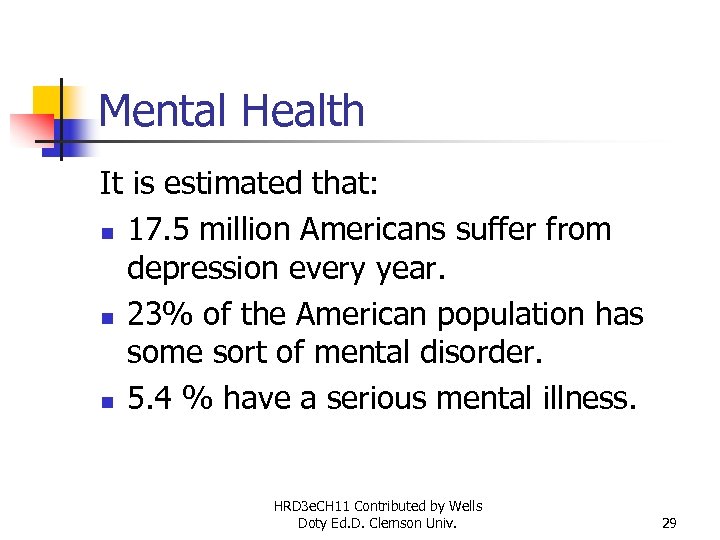 Mental Health It is estimated that: n 17. 5 million Americans suffer from depression every year. n 23% of the American population has some sort of mental disorder. n 5. 4 % have a serious mental illness. HRD 3 e. CH 11 Contributed by Wells Doty Ed. D. Clemson Univ. 29
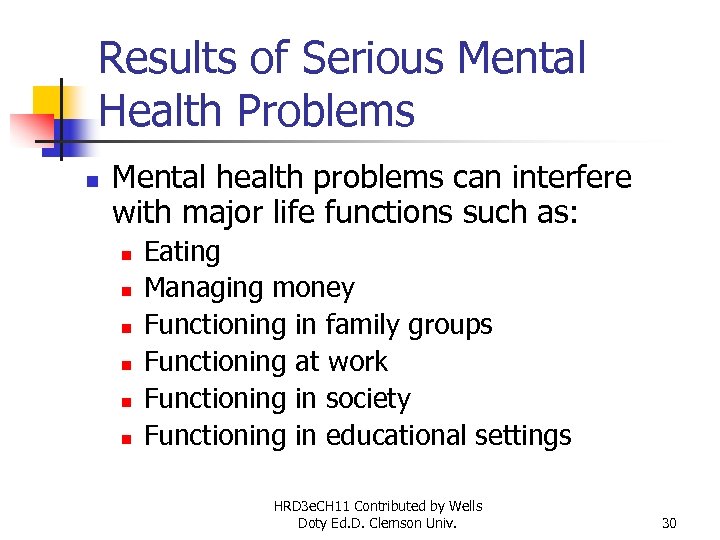 Results of Serious Mental Health Problems n Mental health problems can interfere with major life functions such as: n n n Eating Managing money Functioning in family groups Functioning at work Functioning in society Functioning in educational settings HRD 3 e. CH 11 Contributed by Wells Doty Ed. D. Clemson Univ. 30
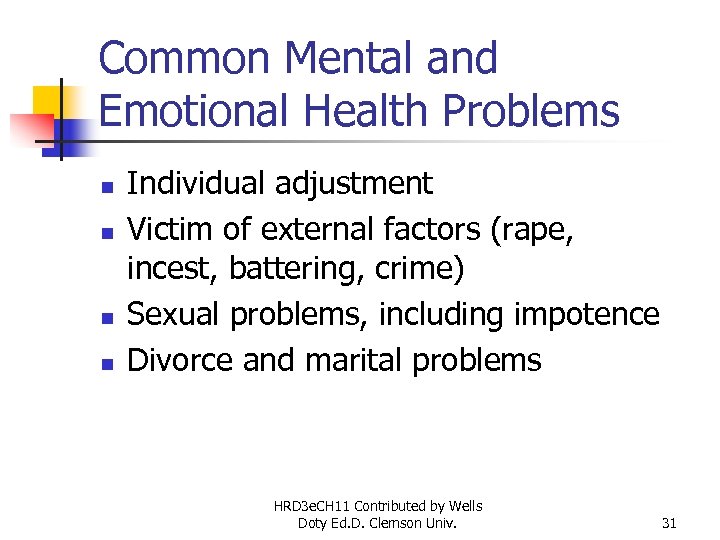 Common Mental and Emotional Health Problems n n Individual adjustment Victim of external factors (rape, incest, battering, crime) Sexual problems, including impotence Divorce and marital problems HRD 3 e. CH 11 Contributed by Wells Doty Ed. D. Clemson Univ. 31
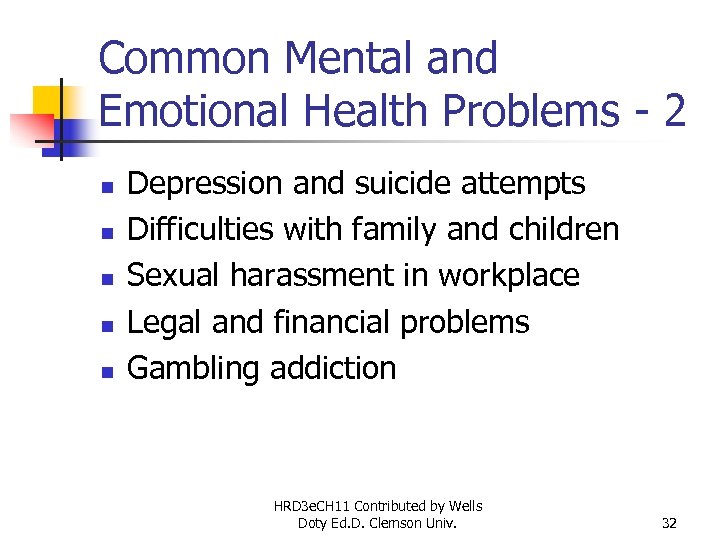 Common Mental and Emotional Health Problems - 2 n n n Depression and suicide attempts Difficulties with family and children Sexual harassment in workplace Legal and financial problems Gambling addiction HRD 3 e. CH 11 Contributed by Wells Doty Ed. D. Clemson Univ. 32
 Why Care About Mental and Emotional Problems? n Problems can cause: n n n Absenteeism Poor performance and work habits Low job satisfaction Indecisiveness Interpersonal conflicts Violence and aggressive behaviors at work HRD 3 e. CH 11 Contributed by Wells Doty Ed. D. Clemson Univ. 33
 Three Federal Regulatory Actions n American Disabilities Act of 1990 n Mental Health Parity Act of 1996 n Executive Directive by President Clinton (effective January 1, 2001) HRD 3 e. CH 11 Contributed by Wells Doty Ed. D. Clemson Univ. 34
 American Disabilities Act (ADA) of 1990 n Who is covered by the ADA? An employee who: n n n Has a physical or mental impairment that substantially limits one or more major life activities, Has a record of such impairment, or Is regarded as having such an impairment, i. e. , an employer’s perception of a disability would be covered. Guarantees equal access to jobs for those with disabilities. Includes mental and emotional disabilities, along with physical disabilities. How to deal with individuals with such disabilities (EEOC Guidelines, May, 1997). HRD 3 e. CH 11 Contributed by Wells Doty Ed. D. Clemson Univ. 35
 Mental Health Parity Act of 1996 n n n Employers with 50+ employees must provide mental health coverage equal to physical coverage. Does NOT include coverage for substance abuse or chemical dependency. Note: This law lapsed after September, 2001. HRD 3 e. CH 11 Contributed by Wells Doty Ed. D. Clemson Univ. 36
 Executive Directive by President Clinton n Requires equal coverage (parity) for mental health benefits for those covered by the Federal Employees Health Benefits Program: n n n Federal employees Their dependents Federal retirees Also covers substance abuse treatment. Took effect on January 1, 2001. Source: http: //www. opm. gov/insure/health/parity/qanda. htm HRD 3 e. CH 11 Contributed by Wells Doty Ed. D. Clemson Univ. 37
 Why These Three Federal Actions? n n To require employers to pay attention to mental health issues. To urge/force employers to carefully manage and address such problems. HRD 3 e. CH 11 Contributed by Wells Doty Ed. D. Clemson Univ. 38
 EAP Approach to Resolving Employee Personal Problems Basis of the EAP approach: n Work is very important to people. n Work performance can help identify an employee’s personal problems. n Employees can be motivated to seek help. HRD 3 e. CH 11 Contributed by Wells Doty Ed. D. Clemson Univ. 39
 Characteristics of the EAP Approach n n Problem is defined in terms of job performance, rather than in clinical terms. Supervisors monitor employees to identify changes in workplace behavior that indicate potential problems. HRD 3 e. CH 11 Contributed by Wells Doty Ed. D. Clemson Univ. 40
 Behavior Problems Indicating Possible Substance Abuse n n n Absenteeism On-the-job absences High accident rate Poor job performance Changes in personal habits Poor relationships with co-workers HRD 3 e. CH 11 Contributed by Wells Doty Ed. D. Clemson Univ. 41
 Constructive Confrontation n In this approach, a supervisor: n n n monitors performance. confronts employee on poor performance. coaches to improve performance. urges use of EAP’s counseling service. Emphasizes the consequences of continued poor performance. HRD 3 e. CH 11 Contributed by Wells Doty Ed. D. Clemson Univ. 42
 The Typical EAP n n n Clear policies, procedures, and responsibilities concerning health and personal problems on the job. Employee education campaigns. Supervisory training program. Clinical services (In- or out-of-house). Follow-up monitoring. HRD 3 e. CH 11 Contributed by Wells Doty Ed. D. Clemson Univ. 43
 Effectiveness of EAPs n n Effectiveness is “generally accepted. ” Estimated 50% - 85% effectiveness rate. Estimated savings of $2 - $20 per dollar invested in EAP. However: Much EAP evaluation is subjective, and strongly criticized. HRD 3 e. CH 11 Contributed by Wells Doty Ed. D. Clemson Univ. 44
 EAPs and the HRD Professional n n EAPs are often housed within the HRD area of the organization. HRD must determine: n n n Costs vs. benefits of the program in dollars. Whether it’s cheaper to replace an individual than to successfully treat that person. Healthcare organizations are increasingly involved in EAPs (behavioral healthcare management). HRD 3 e. CH 11 Contributed by Wells Doty Ed. D. Clemson Univ. 45
 Stress Management Interventions n “Any activity, program, or opportunity initiated by an organization, which focuses on reducing work-related stressors…. ” HRD 3 e. CH 11 Contributed by Wells Doty Ed. D. Clemson Univ. 46
 What is Stress? n n Some environmental force affecting the individual (a stressor). Individual’s response to the stressor. Interaction between individual and the stressor. Individuals react in different ways to stress. HRD 3 e. CH 11 Contributed by Wells Doty Ed. D. Clemson Univ. 47
 Organizational Stressors n n n Factors intrinsic to the job Organizational structure and control Rewards systems Human resource systems Leadership HRD 3 e. CH 11 Contributed by Wells Doty Ed. D. Clemson Univ. 48
 Stress Management Interventions n Educationally-Oriented Interventions n n Sources or stress, how it feels, how to avoid it, how to cope with it. Skill-Acquisition Interventions n Provides new ways to manage stress such as: n n Time management training Assertiveness training HRD 3 e. CH 11 Contributed by Wells Doty Ed. D. Clemson Univ. 49
 A Model of SMIs n n See Figure 11 -1. Focuses on the individual. Helps the individual cope. Perhaps more focus should be placed on stressors from the work environment. HRD 3 e. CH 11 Contributed by Wells Doty Ed. D. Clemson Univ. 50
 Effectiveness of SMIs n n n Research hasn’t been rigorous enough to measure effectiveness accurately. Well-conducted research demonstrates some success. More research is needed. HRD 3 e. CH 11 Contributed by Wells Doty Ed. D. Clemson Univ. 51
 Guidance for SMIs n n Look for specific issues. Assess and analyze apparent problems. Look for specific and focused solutions. Look at strategic intervention: n n Is problem throughout the organization, or is it localized? Ensure evaluation and timely feedback. HRD 3 e. CH 11 Contributed by Wells Doty Ed. D. Clemson Univ. 52
 Employee Wellness and Health Promotion n n Wellness is more than the absence of disease. Promotes physical fitness and other non -stress issues: n n n Obesity Smoking Helps control healthcare costs. HRD 3 e. CH 11 Contributed by Wells Doty Ed. D. Clemson Univ. 53
 Three Levels of Fitness and Wellness Programs n Level 1: Primarily educational without interventions. n Level 2: Seeks to bring about direct change: n n Supervised exercise, fitness centers, etc. Level 3: Institutionalized wellness. HRD 3 e. CH 11 Contributed by Wells Doty Ed. D. Clemson Univ. 54
 Ten Dimensions of Work Site Wellness – 1 • • • Constructive wellness policy Wellness screening Working with community resources Employee referrals to professionals Menu-approach to healthimprovement HRD 3 e. CH 11 Contributed by Wells Doty Ed. D. Clemson Univ. 55
 Ten Dimensions of Work Site Wellness – 2 • • • Outreach and follow-up counseling Plant-wide wellness events Work-site policies and systems On-going evaluation of wellness process Periodic evaluation of cost-benefits of wellness programs HRD 3 e. CH 11 Contributed by Wells Doty Ed. D. Clemson Univ. 56
 Exercise and Fitness Interventions • • Most popular interventions. Even modest exercise helps prevent disease. Research shows effectiveness. Problem: Getting those who would benefit the most to exercise. HRD 3 e. CH 11 Contributed by Wells Doty Ed. D. Clemson Univ. 57
 Smoking Cessation Programs • • • Smoking: Most publicized health risk. Cost per smoking employee: $2, 853 per year more than non-smokers. Measuring effectiveness: • • • Quit rate Percentage of smokers in program Cost Benefit: $8 saved for $1 spent. HRD 3 e. CH 11 Contributed by Wells Doty Ed. D. Clemson Univ. 58
 Nutrition and Weight Control • • Obesity: 20% or more over “ideal” weight. Over 25% of Americans are obese. Obesity causes hypertension, musculoskeletal problems, high blood sugar and cholesterol levels. Competition helps program effectiveness. HRD 3 e. CH 11 Contributed by Wells Doty Ed. D. Clemson Univ. 59
 Control of Hypertension • • Hypertension: Blood pressure greater than 140/90 repeatedly over time. Greater incidence of heart disease and stroke. • • Control through, exercise, weight loss, medication, stress reduction and low salt diet Benefit: $1. 89 - $2. 72 reduction in health claims per dollar spent on program. HRD 3 e. CH 11 Contributed by Wells Doty Ed. D. Clemson Univ. 60
 Issues in Employee Counseling • • • Effectiveness of programs Legal issues Who is responsible for counseling? Ethical issues Unintended negative outcomes HRD 3 e. CH 11 Contributed by Wells Doty Ed. D. Clemson Univ. 61
 Effectiveness of Counseling • • Determine organizational demographics Determine expected participation rates Estimate startup and maintenance costs Implement test and tracking system Measure pre- and post-program Analyze results for users and non-users Do present and future cost-benefit analyses HRD 3 e. CH 11 Contributed by Wells Doty Ed. D. Clemson Univ. 62
 Legal Issues • Using counseling programs to comply with legislation may increase liability to lawsuits: • • • Must be equally available to all Erroneous assessments are made Injuries in wellness/fitness programs can lead to lawsuits. HRD 3 e. CH 11 Contributed by Wells Doty Ed. D. Clemson Univ. 63
 Responsibility for Employee Counseling • • • HRD Professionals? Supervisors? Unions? Management? Individuals? What are your thoughts? HRD 3 e. CH 11 Contributed by Wells Doty Ed. D. Clemson Univ. 64
 Ethical Issues • Confidentiality: • • • Records should be held in strictest confidence, and kept separate from the employee’s regular personnel file. Release only with specific employee permission. Nature of Participation: • Mandatory versus voluntary HRD 3 e. CH 11 Contributed by Wells Doty Ed. D. Clemson Univ. 65
 Question • • Should participation be mandatory or voluntary? Why? HRD 3 e. CH 11 Contributed by Wells Doty Ed. D. Clemson Univ. 66
 Potential Unintended Negative Outcomes • • • Increased worker’s compensation costs. Employee scheduling problems, increased fatigue, lower performance. Increased healthcare unit costs as usage decreases. Reduced turnover reduces promotion opportunities and causes payroll cost increase. Conflicts at work over smoking bans. HRD 3 e. CH 11 Contributed by Wells Doty Ed. D. Clemson Univ. 67
 Closing Thoughts • • • EAPs show that companies care. HRD professionals have the skills and expertise to provide EAP information. Promoting employee health and wellbeing can contributes positively to an organization’s bottom line. HRD 3 e. CH 11 Contributed by Wells Doty Ed. D. Clemson Univ. 68
 Summary 1. 2. 3. Employee well-being affects ability, availability, and readiness to perform a job. Employee counseling encompasses a lot of areas. It is an HRD function that: 1. 2. Ensures that employees are now effective contributors to the organization, and that they will continue to be in the future. Needs professionals who are qualified to deal with the difficult issues involved with this topic. HRD 3 e. CH 11 Contributed by Wells Doty Ed. D. Clemson Univ. 69