


 Скачать презентацию Empirical Studies of Aesthetics in Information Technology Noam
c752202c367c5ba87a6ac99d30589ee1.ppt
- Количество слайдов: 42
 Empirical Studies of Aesthetics in Information Technology Noam Tractinsky Ben-Gurion University of the Negev Nov 2003 Noam Tractinsky 11/2003 Haifa U.
 Contents 1. Background 2. Description of 4 empirical studies on aesthetics and IT 3. Discussion Noam Tractinsky 11/2003 Haifa U. 2
 History: Emergence of the HCI Discipline n Context: Emergence of interactive systems n Roots: cognitive science, ergonomics n Goal: efficient interactions n Criteria: time, errors n Flagship concept: Usability n Aesthetics considered irrelevant if not outright harmful Noam Tractinsky 11/2003 Haifa U. 3
 Future: The User Experience? n Context: universal accessibility, Web-based applications, customization, personalization, IT as consumer commodity n Goal: support the user experience • Affective Computing • Aesthetic Computing “…the theory, practice and application of aesthetics in computing. ” • Funology: From Usability to Enjoyment Noam Tractinsky 11/2003 Haifa U. 4
 Studies of Aesthetics of Information Technology Noam Tractinsky 11/2003 Haifa U. 5
 Study 1 – ATM Layout Design Tractinsky, CHI ‘ 97 n Trigger: Kurosu and Kashimura, 1995 n K&K’s research goal was to find correlation between usability guidelines (“inherent usability”) and “apparent usability” n Finding: high correlations between perceptions of (pre-use) usability and of aesthetics n Interesting … but results are probably tainted by Japanese culture Noam Tractinsky 11/2003 Haifa U. 6
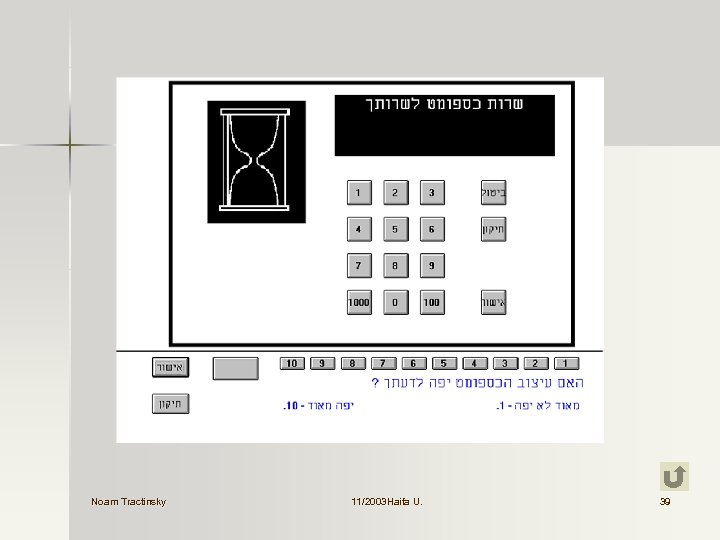
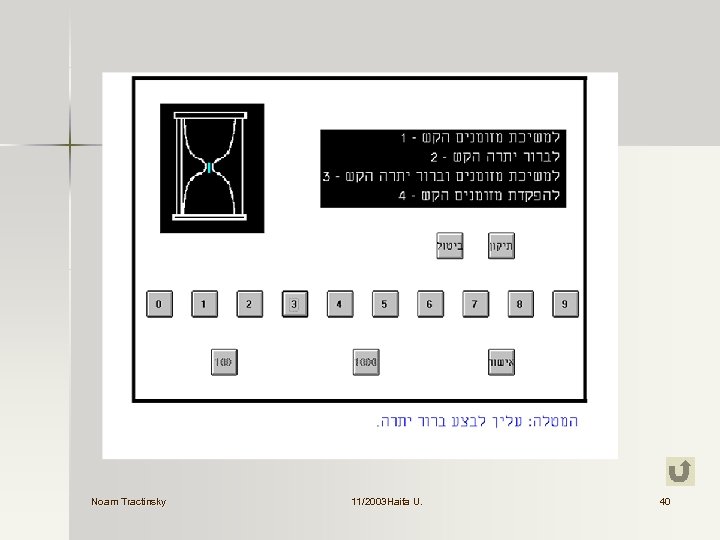
 Study 1 – Cross-Cultural Validation n Repeat the study in Israel n Improve the methodology – three experiments – Exact replication – Separate measurement of aesthetic and usability responses – Computerized, complete randomization Noam Tractinsky 11/2003 Haifa U. 7
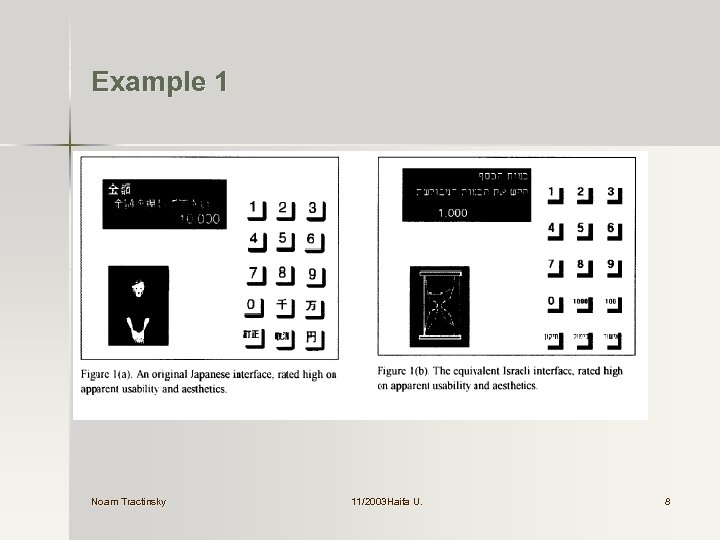 Example 1 Noam Tractinsky 11/2003 Haifa U. 8
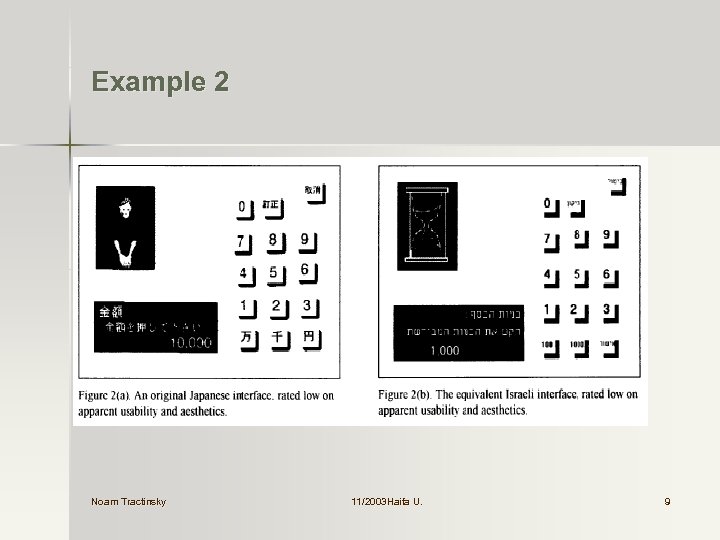 Example 2 Noam Tractinsky 11/2003 Haifa U. 9
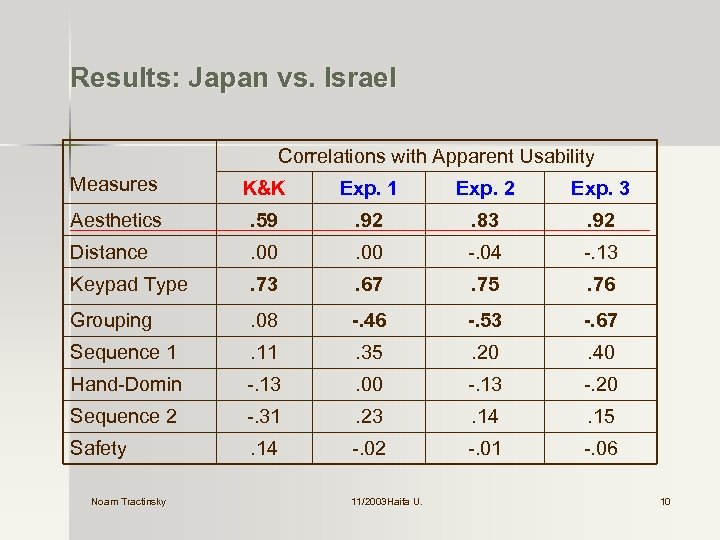 Results: Japan vs. Israel Correlations with Apparent Usability Measures K&K Exp. 1 Exp. 2 Exp. 3 Aesthetics . 59 . 92 . 83 . 92 Distance . 00 -. 04 -. 13 Keypad Type . 73 . 67 . 75 . 76 Grouping . 08 -. 46 -. 53 -. 67 Sequence 1 . 11 . 35 . 20 . 40 Hand-Domin -. 13 . 00 -. 13 -. 20 Sequence 2 -. 31 . 23 . 14 . 15 Safety . 14 -. 02 -. 01 -. 06 Noam Tractinsky 11/2003 Haifa U. 10
 Very interesting … Beautiful = Usable ? Noam Tractinsky 11/2003 Haifa U. 11
 Study 2 – ATM Usage Tractinsky, Shoval-Katz and Ikar, Iw. C, 2000 n What happens to the aesthetics-usability relation after usage? n Evaluation of 9 layouts from the previous studies (randomly displayed) on three attributes: usability, aesthetics, amount of information n Manipulating aesthetics: Assign to experimental groups first; then assign systems based on pre-experimental ratings n Manipulating Usability: Introduction of system delays and other faulty features n Participants completed 11 ATM tasks Noam Tractinsky 11/2003 Haifa U. 12
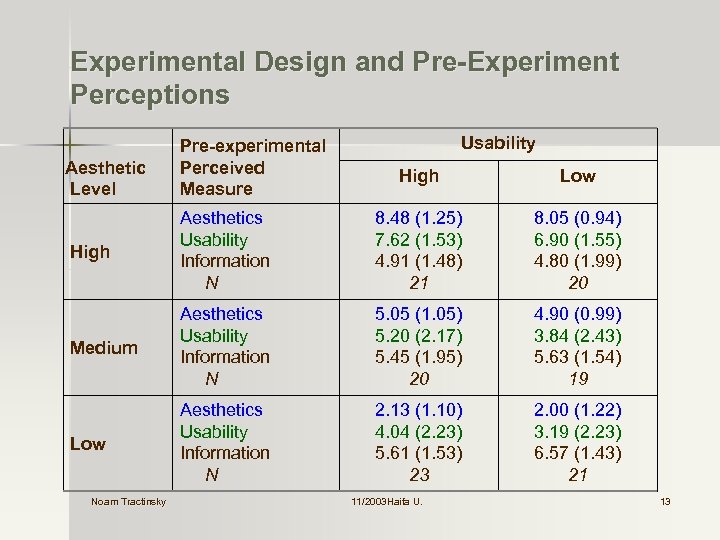 Experimental Design and Pre-Experiment Perceptions Aesthetic Level Pre-experimental Perceived Measure Usability High Low High Aesthetics Usability Information N 8. 48 (1. 25) 7. 62 (1. 53) 4. 91 (1. 48) 21 8. 05 (0. 94) 6. 90 (1. 55) 4. 80 (1. 99) 20 Medium Aesthetics Usability Information N 5. 05 (1. 05) 5. 20 (2. 17) 5. 45 (1. 95) 20 4. 90 (0. 99) 3. 84 (2. 43) 5. 63 (1. 54) 19 Low Aesthetics Usability Information N 2. 13 (1. 10) 4. 04 (2. 23) 5. 61 (1. 53) 23 2. 00 (1. 22) 3. 19 (2. 23) 6. 57 (1. 43) 21 Noam Tractinsky 11/2003 Haifa U. 13
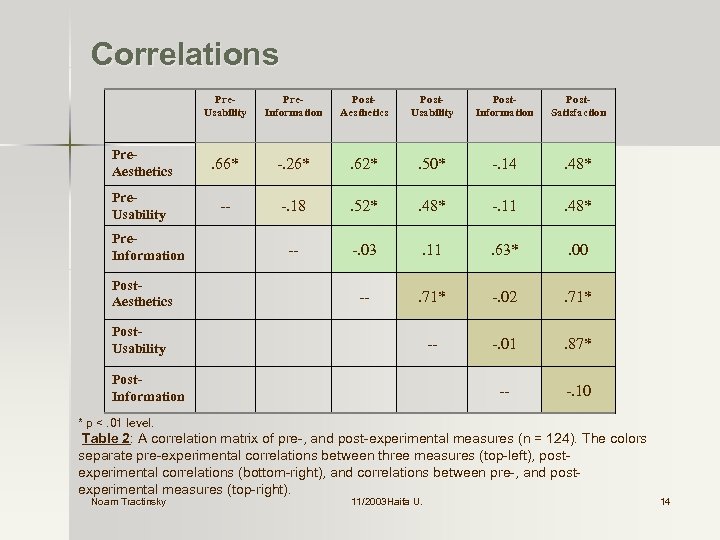 Correlations Pre. Usability Pre. Information Post. Aesthetics Post. Usability Post. Information Post. Satisfaction Pre. Aesthetics . 66* -. 26* . 62* . 50* -. 14 . 48* Pre. Usability -- -. 18 . 52* . 48* -. 11 . 48* -- -. 03 . 11 . 63* . 00 -- . 71* -. 02 . 71* -- -. 01 . 87* -- -. 10 Pre. Information Post. Aesthetics Post. Usability Post. Information * p <. 01 level. Table 2: A correlation matrix of pre-, and post-experimental measures (n = 124). The colors separate pre-experimental correlations between three measures (top-left), postexperimental correlations (bottom-right), and correlations between pre-, and postexperimental measures (top-right). Noam Tractinsky 11/2003 Haifa U. 14
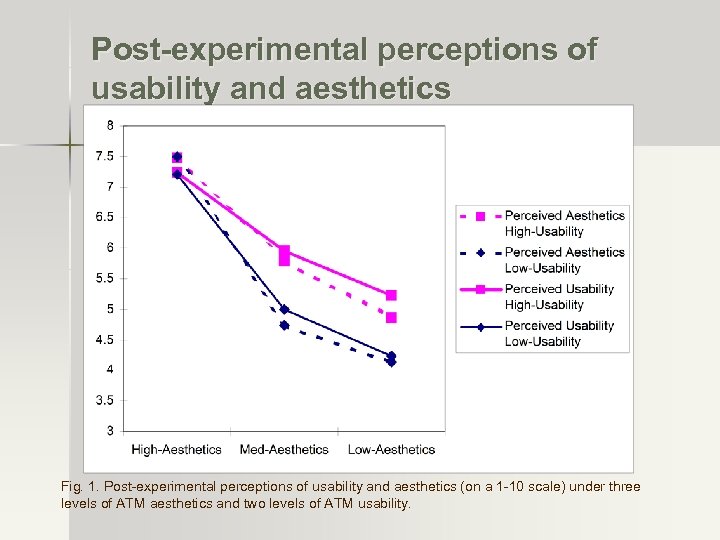 Post-experimental perceptions of usability and aesthetics Fig. 1. Post-experimental perceptions of usability and aesthetics (on a 1 -10 scale) under three levels of ATM aesthetics and two levels of ATM usability.
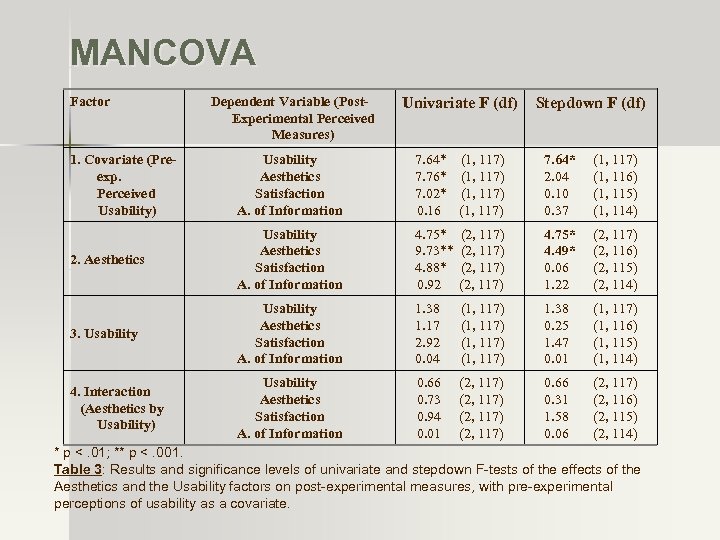 MANCOVA Factor Dependent Variable (Post. Experimental Perceived Measures) Univariate F (df) 1. Covariate (Preexp. Perceived Usability) Usability Aesthetics Satisfaction A. of Information 7. 64* (1, 117) 7. 76* (1, 117) 7. 02* (1, 117) 0. 16 (1, 117) 7. 64* 2. 04 0. 10 0. 37 (1, 117) (1, 116) (1, 115) (1, 114) 2. Aesthetics Usability Aesthetics Satisfaction A. of Information 4. 75* 9. 73** 4. 88* 0. 92 (2, 117) 4. 75* 4. 49* 0. 06 1. 22 (2, 117) (2, 116) (2, 115) (2, 114) 3. Usability Aesthetics Satisfaction A. of Information 1. 38 1. 17 2. 92 0. 04 (1, 117) 1. 38 0. 25 1. 47 0. 01 (1, 117) (1, 116) (1, 115) (1, 114) 4. Interaction (Aesthetics by Usability) Usability Aesthetics Satisfaction A. of Information 0. 66 0. 73 0. 94 0. 01 (2, 117) 0. 66 0. 31 1. 58 0. 06 (2, 117) (2, 116) (2, 115) (2, 114) Stepdown F (df) * p <. 01; ** p <. 001. Table 3: Results and significance levels of univariate and stepdown F-tests of the effects of the Aesthetics and the Usability factors on post-experimental measures, with pre-experimental perceptions of usability as a covariate.
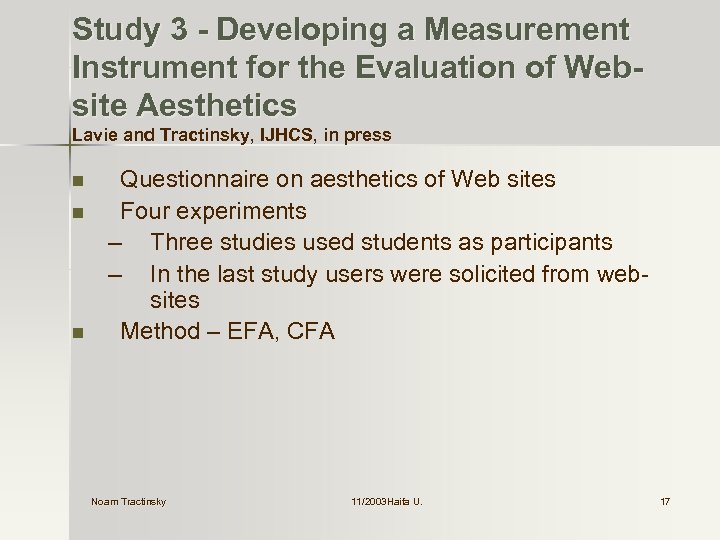 Study 3 - Developing a Measurement Instrument for the Evaluation of Website Aesthetics Lavie and Tractinsky, IJHCS, in press n n n Questionnaire on aesthetics of Web sites Four experiments – Three studies used students as participants – In the last study users were solicited from websites Method – EFA, CFA Noam Tractinsky 11/2003 Haifa U. 17
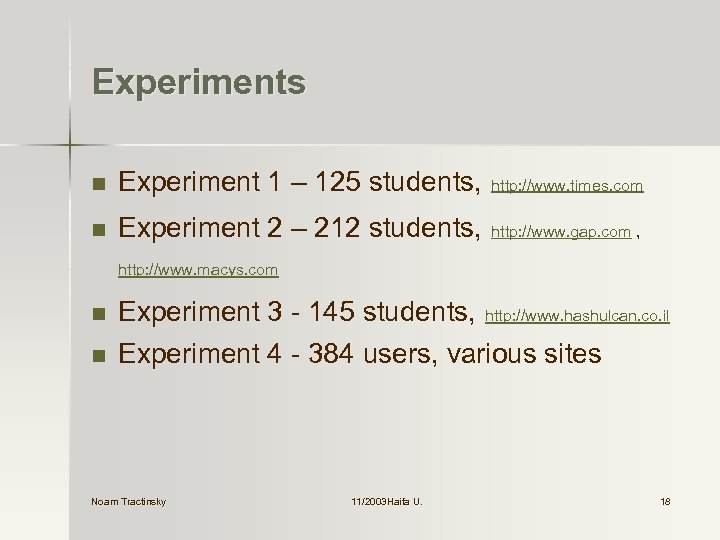 Experiments n Experiment 1 – 125 students, http: //www. times. com n Experiment 2 – 212 students, http: //www. gap. com , http: //www. macys. com n n Experiment 3 - 145 students, http: //www. hashulcan. co. il Experiment 4 - 384 users, various sites Noam Tractinsky 11/2003 Haifa U. 18
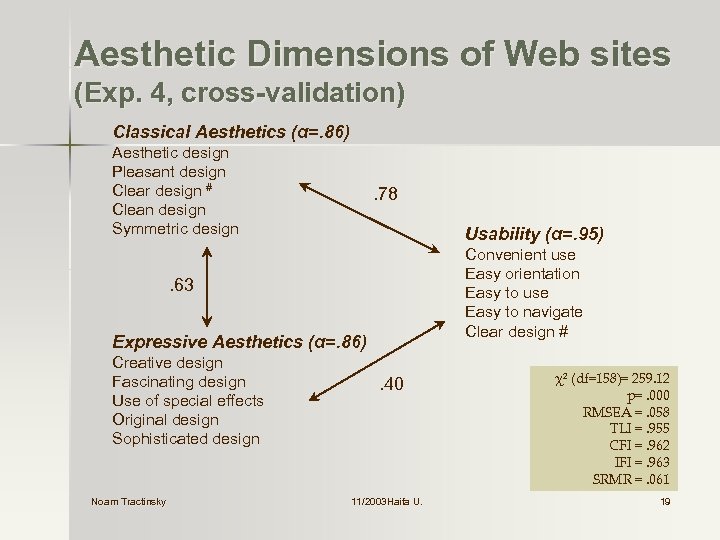 Aesthetic Dimensions of Web sites (Exp. 4, cross-validation) Classical Aesthetics (α=. 86) Aesthetic design Pleasant design Clear design # Clean design Symmetric design . 78 Usability (α=. 95) Convenient use Easy orientation Easy to use Easy to navigate Clear design # . 63 Expressive Aesthetics (α=. 86) Creative design Fascinating design Use of special effects Original design Sophisticated design Noam Tractinsky . 40 11/2003 Haifa U. χ2 (df=158)= 259. 12 p=. 000 RMSEA =. 058 TLI =. 955 CFI =. 962 IFI =. 963 SRMR =. 061 19
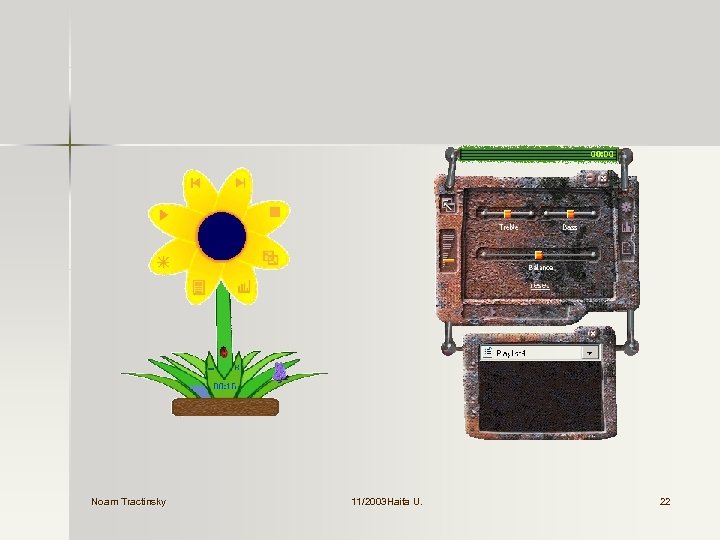
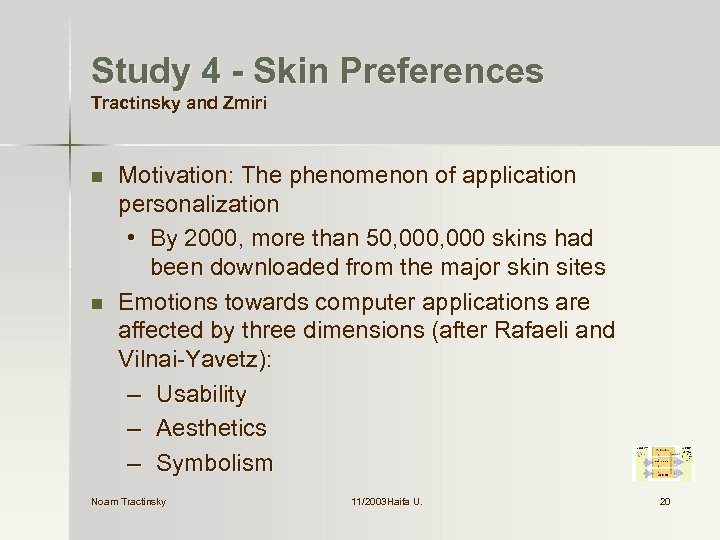 Study 4 - Skin Preferences Tractinsky and Zmiri n n Motivation: The phenomenon of application personalization • By 2000, more than 50, 000 skins had been downloaded from the major skin sites Emotions towards computer applications are affected by three dimensions (after Rafaeli and Vilnai-Yavetz): – Usability – Aesthetics – Symbolism Noam Tractinsky 11/2003 Haifa U. 20
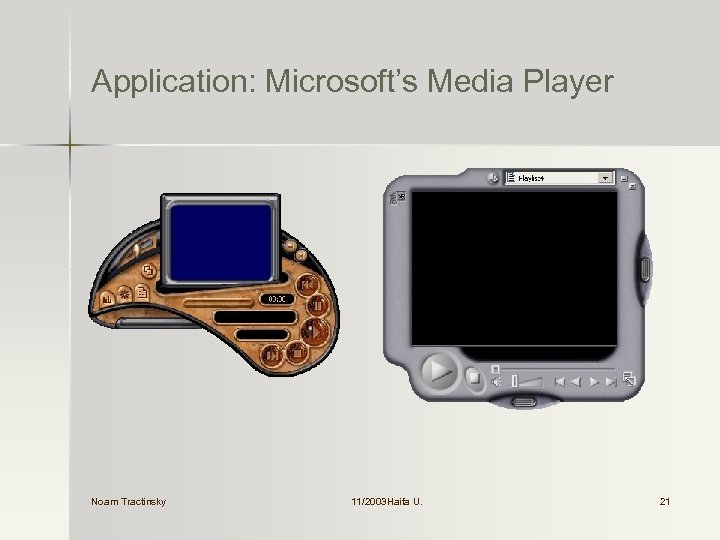 Application: Microsoft’s Media Player Noam Tractinsky 11/2003 Haifa U. 21
 Noam Tractinsky 11/2003 Haifa U. 22
 Procedure n Evaluate the default interface + 11 skins n Compare the default MP to two chosen skins; rate each on 15 items n Make a final choice; state the reasons Noam Tractinsky 11/2003 Haifa U. 23
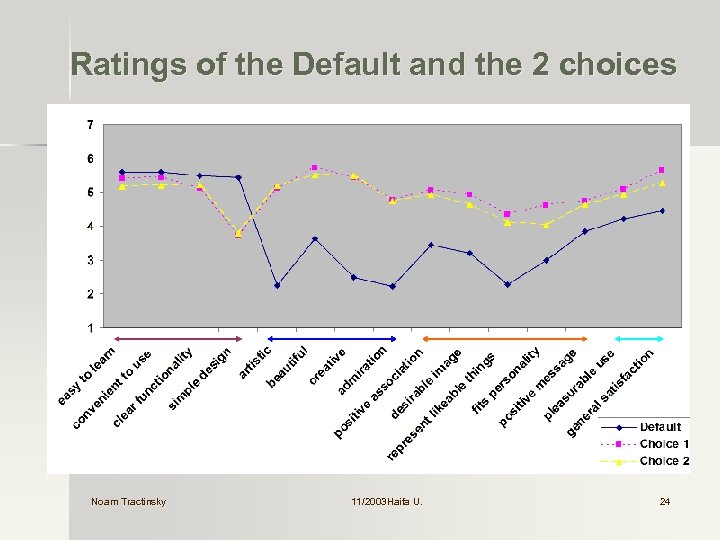 Ratings of the Default and the 2 choices Noam Tractinsky 11/2003 Haifa U. 24
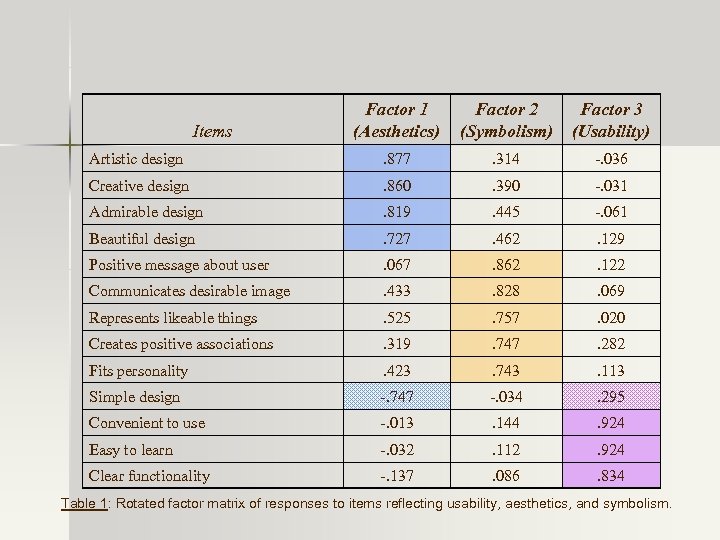 Factor 1 (Aesthetics) Factor 2 (Symbolism) Factor 3 (Usability) Artistic design . 877 . 314 -. 036 Creative design . 860 . 390 -. 031 Admirable design . 819 . 445 -. 061 Beautiful design . 727 . 462 . 129 Positive message about user . 067 . 862 . 122 Communicates desirable image . 433 . 828 . 069 Represents likeable things . 525 . 757 . 020 Creates positive associations . 319 . 747 . 282 Fits personality . 423 . 743 . 113 Simple design -. 747 -. 034 . 295 Convenient to use -. 013 . 144 . 924 Easy to learn -. 032 . 112 . 924 Clear functionality -. 137 . 086 . 834 Items Table 1: Rotated factor matrix of responses to items reflecting usability, aesthetics, and symbolism.
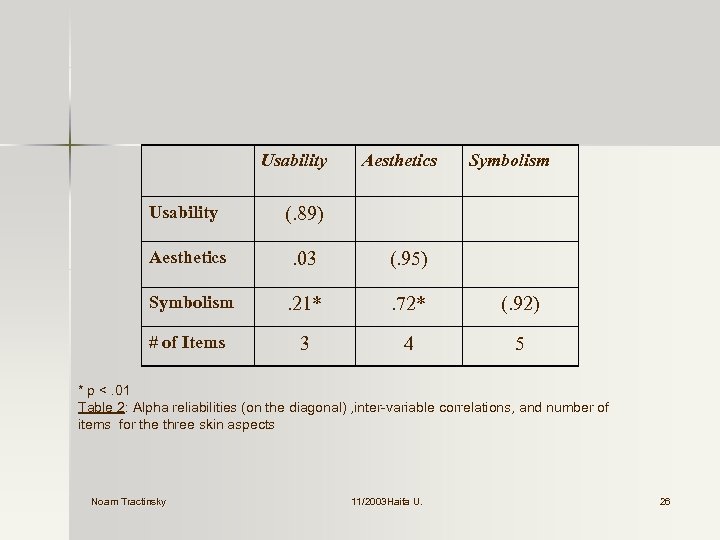 Usability Aesthetics Symbolism Usability (. 89) Aesthetics . 03 (. 95) Symbolism . 21* . 72* (. 92) # of Items 3 4 5 * p <. 01 Table 2: Alpha reliabilities (on the diagonal) , inter-variable correlations, and number of items for the three skin aspects Noam Tractinsky 11/2003 Haifa U. 26
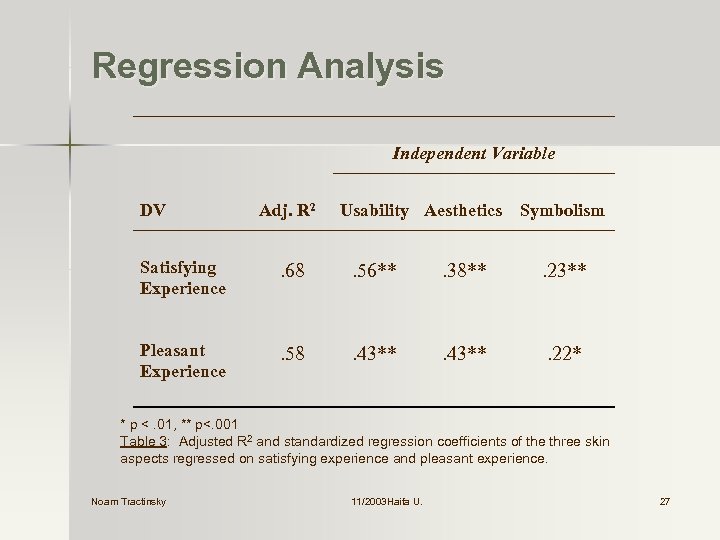 Regression Analysis Independent Variable DV Adj. R 2 Usability Aesthetics Symbolism Satisfying Experience . 68 . 56** . 38** . 23** Pleasant Experience . 58 . 43** . 22* * p <. 01, ** p<. 001 Table 3: Adjusted R 2 and standardized regression coefficients of the three skin aspects regressed on satisfying experience and pleasant experience. Noam Tractinsky 11/2003 Haifa U. 27
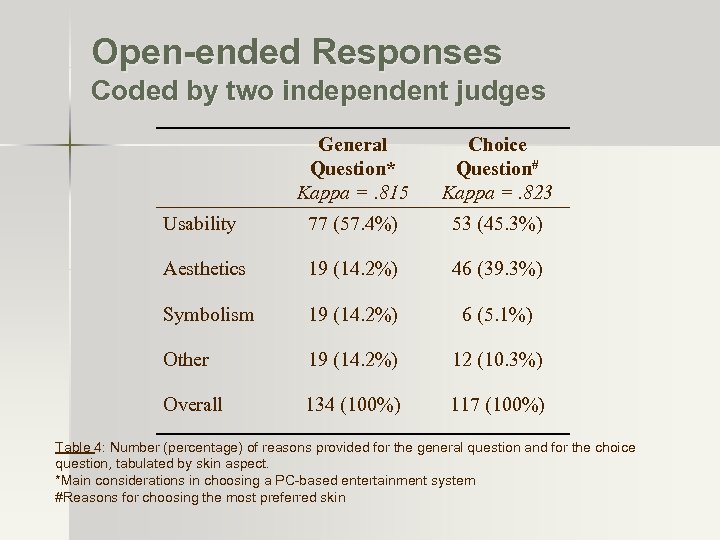 Open-ended Responses Coded by two independent judges General Question* Kappa =. 815 Choice Question# Kappa =. 823 Usability 77 (57. 4%) 53 (45. 3%) Aesthetics 19 (14. 2%) 46 (39. 3%) Symbolism 19 (14. 2%) 6 (5. 1%) Other 19 (14. 2%) 12 (10. 3%) Overall 134 (100%) 117 (100%) Table 4: Number (percentage) of reasons provided for the general question and for the choice question, tabulated by skin aspect. *Main considerations in choosing a PC-based entertainment system #Reasons for choosing the most preferred skin
 Final Choice n 80% chose an alternative skin Noam Tractinsky 11/2003 Haifa U. 29
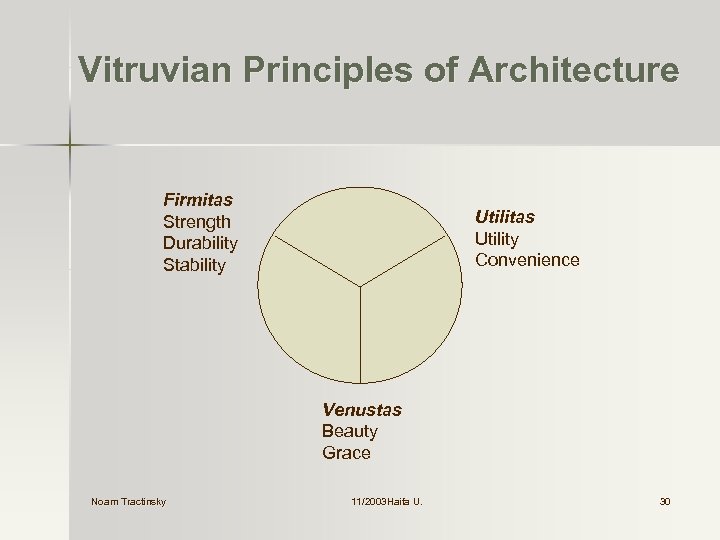 Vitruvian Principles of Architecture Firmitas Strength Durability Stability Utilitas Utility Convenience Venustas Beauty Grace Noam Tractinsky 11/2003 Haifa U. 30
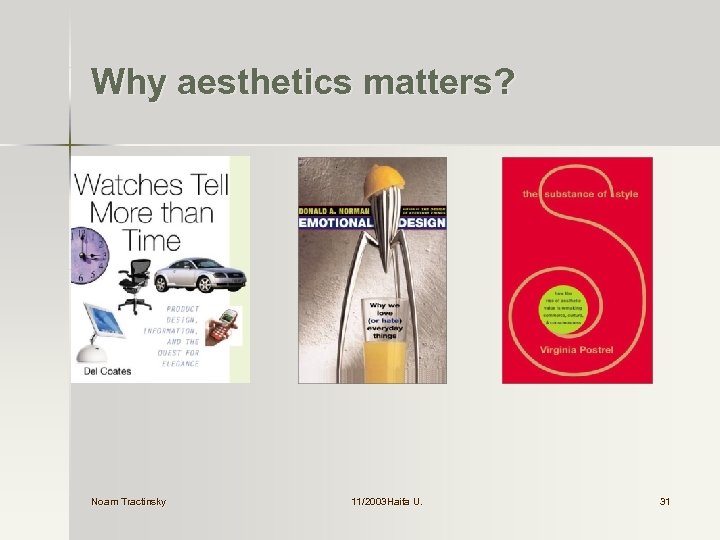 Why aesthetics matters? Noam Tractinsky 11/2003 Haifa U. 31
 Why aesthetics matters? n n Level of performance exceeds most users’ needs Aesthetically-based valuations are immediate and hard to overcome Aesthetics satisfies basic human needs. Like it or not, it’s here to stay … Noam Tractinsky 11/2003 Haifa U. 32
 Conclusions n n n Relevant research area Research is only at the beginning – needs replication and validation Areas of extension Multifaceted research – needs multiple approaches, visions, methodologies More food for thought …. Noam Tractinsky 11/2003 Haifa U. 33
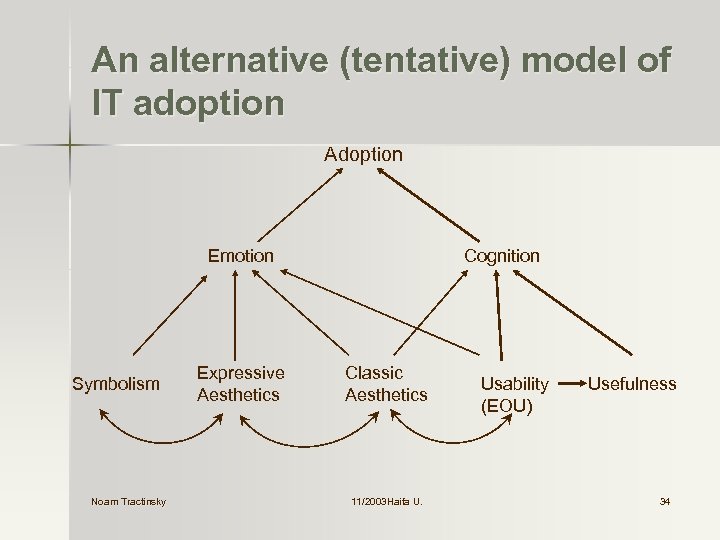 An alternative (tentative) model of IT adoption Adoption Emotion Symbolism Noam Tractinsky Expressive Aesthetics Cognition Classic Aesthetics 11/2003 Haifa U. Usability (EOU) Usefulness 34
 Noam Tractinsky 11/2003 Haifa U. 35
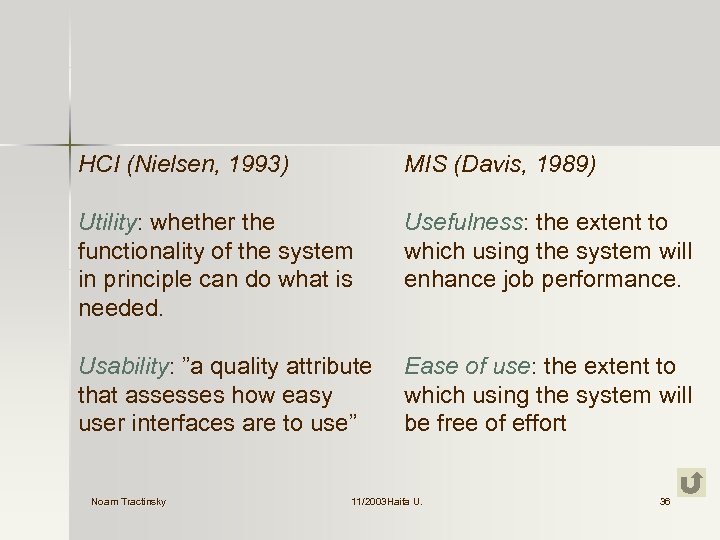 HCI (Nielsen, 1993) MIS (Davis, 1989) Utility: whether the functionality of the system in principle can do what is needed. Usefulness: the extent to which using the system will enhance job performance. Usability: ”a quality attribute that assesses how easy user interfaces are to use” Ease of use: the extent to which using the system will be free of effort Noam Tractinsky 11/2003 Haifa U. 36
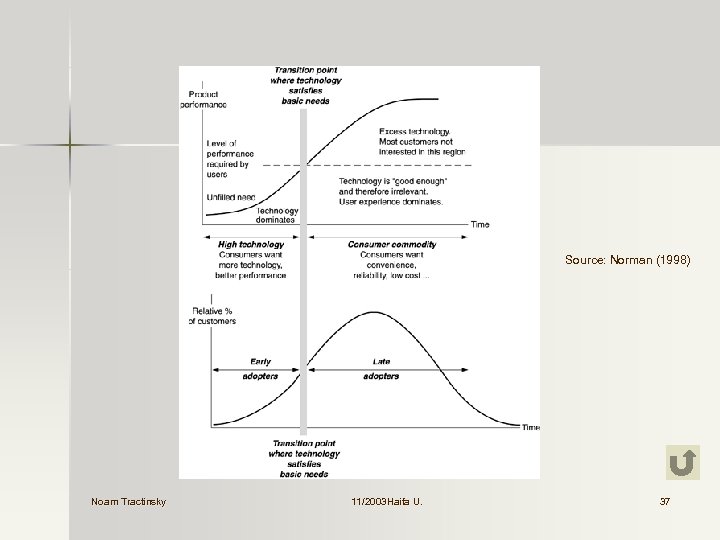 Source: Norman (1998) Noam Tractinsky 11/2003 Haifa U. 37
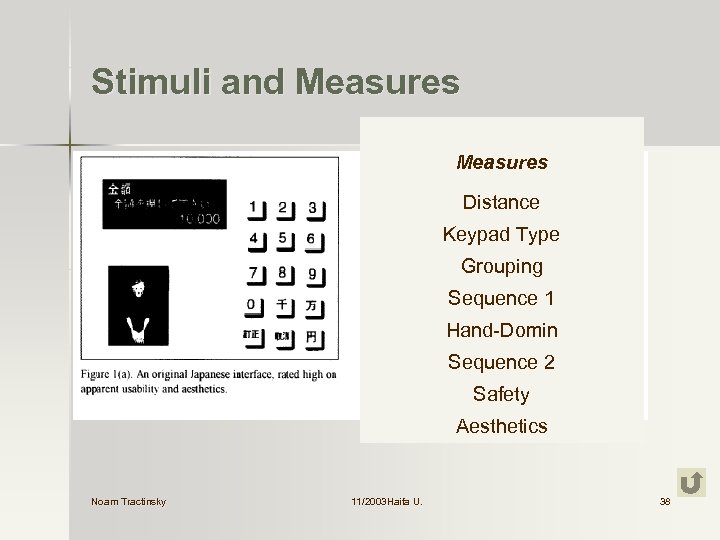 Stimuli and Measures Distance Keypad Type Grouping Sequence 1 Hand-Domin Sequence 2 Safety Aesthetics Noam Tractinsky 11/2003 Haifa U. 38
 Noam Tractinsky 11/2003 Haifa U. 39
 Noam Tractinsky 11/2003 Haifa U. 40
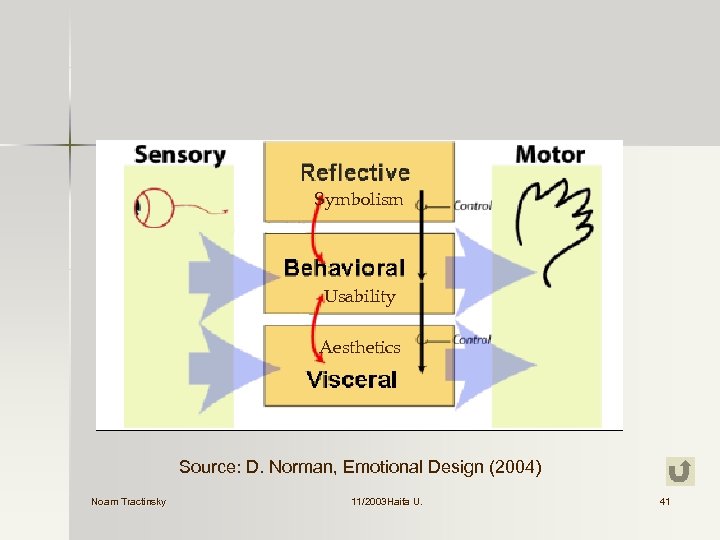 Symbolism Usability Aesthetics Source: D. Norman, Emotional Design (2004) Noam Tractinsky 11/2003 Haifa U. 41
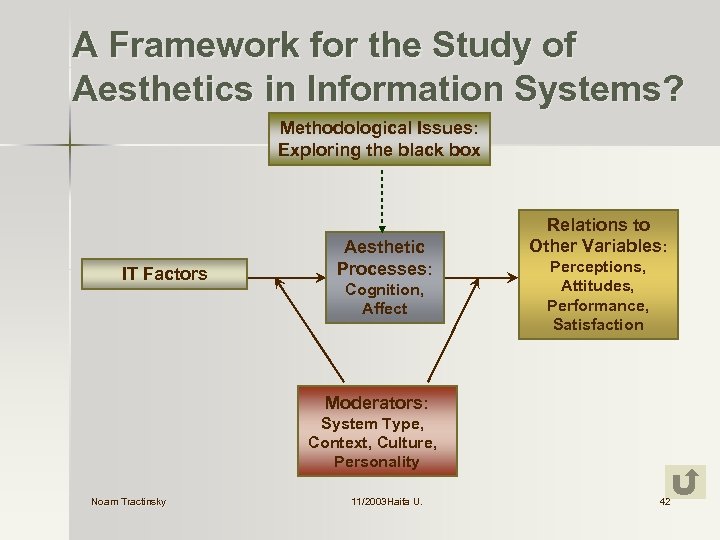 A Framework for the Study of Aesthetics in Information Systems? Methodological Issues: Exploring the black box IT Factors Aesthetic Processes: Cognition, Affect Relations to Other Variables: Perceptions, Attitudes, Performance, Satisfaction Moderators: System Type, Context, Culture, Personality Noam Tractinsky 11/2003 Haifa U. 42