 Скачать презентацию Empirical Search and Library Generators Libraries and
ebe550a067ee2c2d5af34066982a4588.ppt
- Количество слайдов: 64




Empirical Search and Library Generators
Libraries and Productivity • Building libraries is one of the earliest strategies to improve productivity. • Libraries are particularly important for performance – High performance is difficult to attain and not portable.
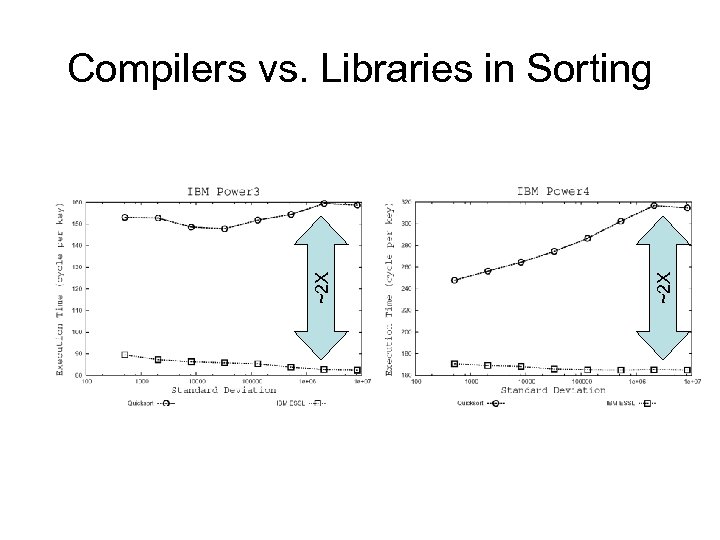
~2 X Compilers vs. Libraries in Sorting
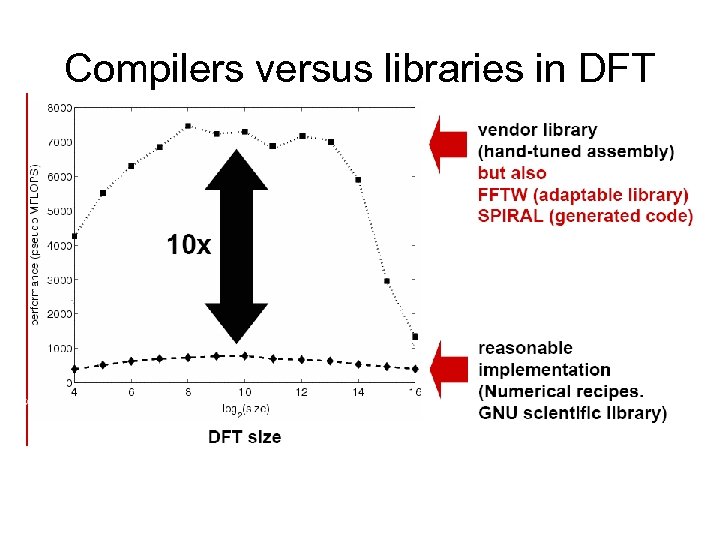
Compilers versus libraries in DFT
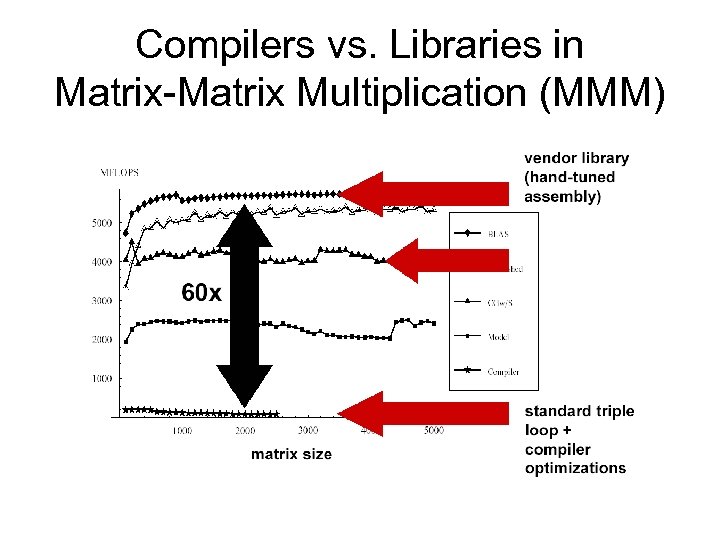
Compilers vs. Libraries in Matrix-Matrix Multiplication (MMM)
Libraries and Productivity • Libraries are not used as often as it is believed. – Not all algorithms implemented. – Not all data structures. • In any case, much effort goes into highly-tuned libraries. • Automatic generation of libraries would – Reduce implementation cost – For a fixed cost, enable a wider range of implementations and thus make libraries more usable.
Library Generators • Automatically generate highly efficient libraries for a class platforms. • No need to manually tune the library to the architectural characteristics of a new machine.
Library Generators (Cont. ) • Examples: – In linear algebra: ATLAS, Phi. PAC – In signal processing: FFTW, SPIRAL • Library generators usually handle a fixed set of algorithms. • Exception: SPIRAL accepts formulas and rewriting rules as input.
Library Generators (Cont. ) • At installation time, LGs conduct an empirical search. – That is, search for the best version in a set of different implementations – Number of versions astronomical. Heuristics are needed.
Library Generators (Cont. ) • LGs must output C code for portability. • Unenven quality of compilers => – Need for source-to-source optimizers – Or incorporate in search space variations introduced by optimizing compilers.
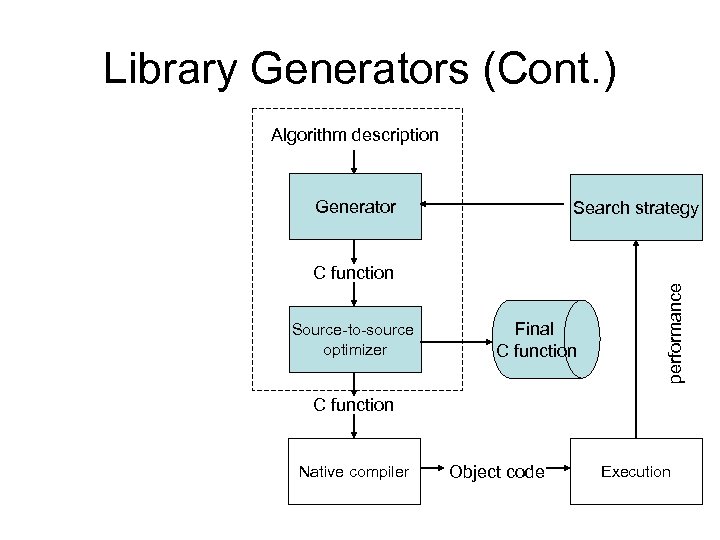
Library Generators (Cont. ) Algorithm description Generator Search strategy Source-to-source optimizer Final C function performance C function Native compiler Object code Execution
Important research issues • Reduction of the search space with minimal impact on performance • Adaptation to the input data (not needed for dense linear algebra) • More flexible of generators – algorithms – data structures – classes of target machines • Tools to build library generators.
Library generators and compilers • Code generated by LGs useful as an absolute measurement of compilers • Library generators use compilers. • Compilers could use library generator techniques to optimize libraries in context. • Search strategies could help design better compilers – Optimization strategy: Most important open problem in compilers.
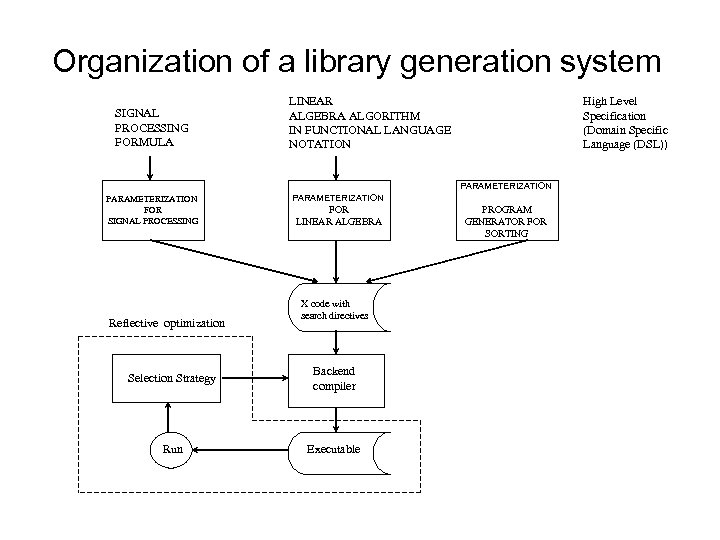
Organization of a library generation system SIGNAL PROCESSING FORMULA LINEAR ALGEBRA ALGORITHM IN FUNCTIONAL LANGUAGE NOTATION High Level Specification (Domain Specific Language (DSL)) PARAMETERIZATION FOR SIGNAL PROCESSING Reflective optimization PARAMETERIZATION FOR LINEAR ALGEBRA X code with search directives Selection Strategy Backend compiler Run Executable PROGRAM GENERATOR FOR SORTING
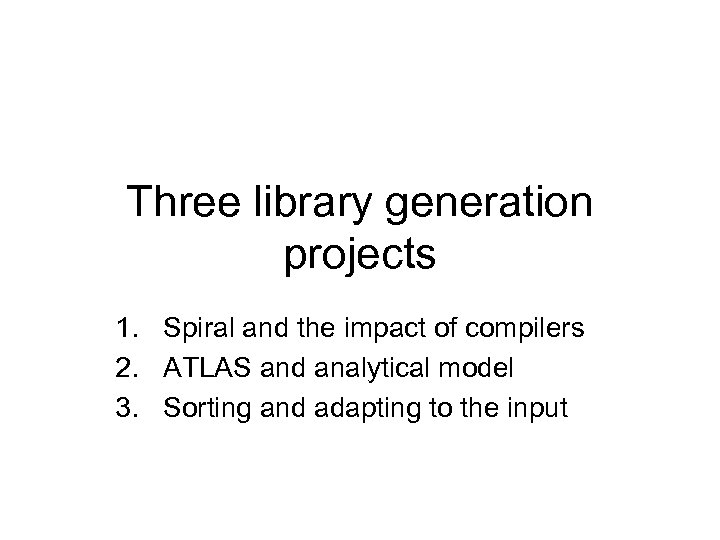
Three library generation projects 1. Spiral and the impact of compilers 2. ATLAS and analytical model 3. Sorting and adapting to the input
Spiral: A code generator for digital signal processing transforms Joint work with: Jose Moura (CMU), Markus Pueschel (CMU), Manuela Veloso (CMU), Jeremy Johnson (Drexel)
SPIRAL • The approach: – Mathematical formulation of signal processing algorithms – Automatically generate multiple formulas using rewriting rules – More flexible than the well-known FFTW
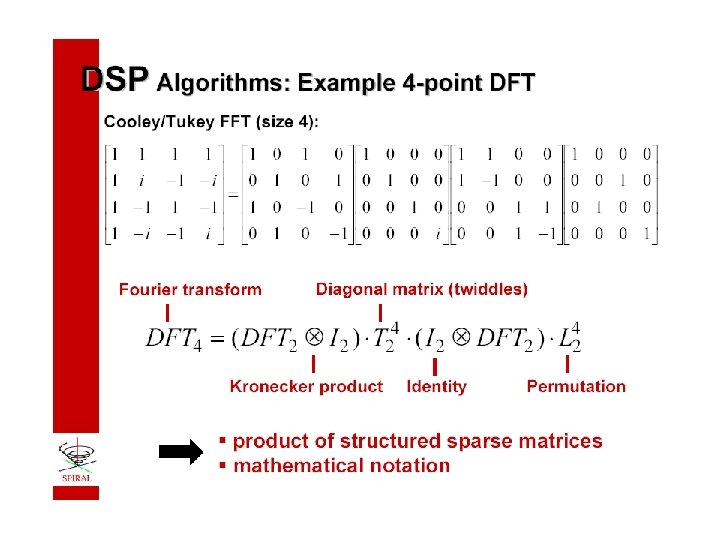
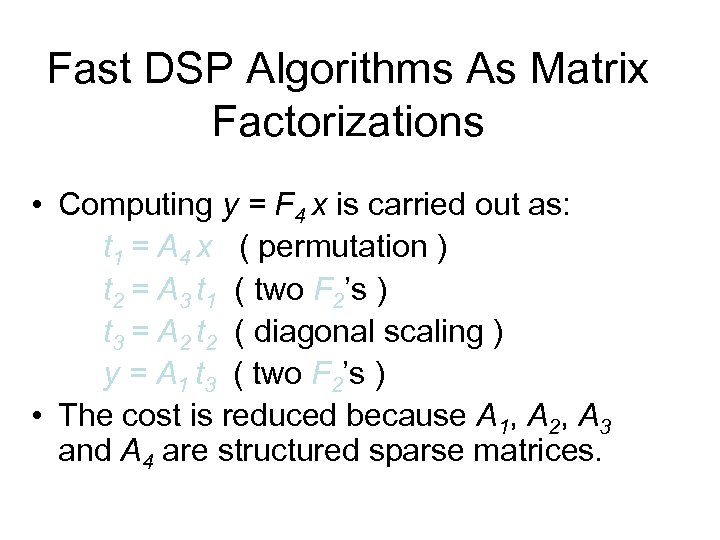
Fast DSP Algorithms As Matrix Factorizations • Computing y = F 4 x is carried out as: t 1 = A 4 x ( permutation ) t 2 = A 3 t 1 ( two F 2’s ) t 3 = A 2 t 2 ( diagonal scaling ) y = A 1 t 3 ( two F 2’s ) • The cost is reduced because A 1, A 2, A 3 and A 4 are structured sparse matrices.
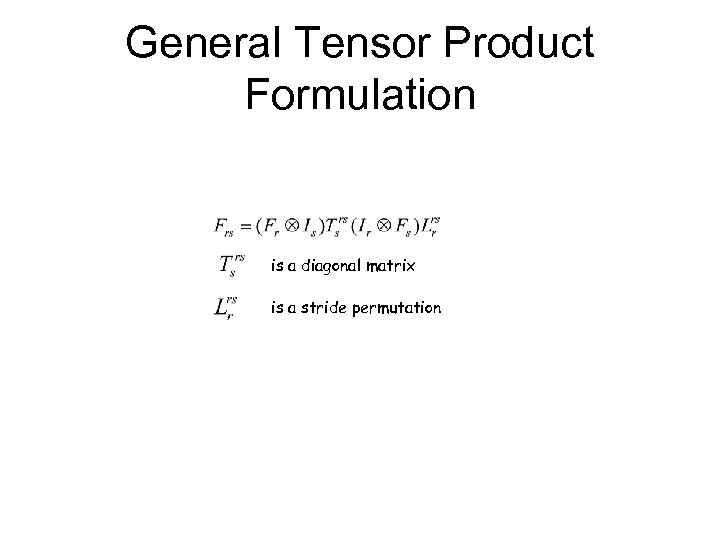
General Tensor Product Formulation is a diagonal matrix is a stride permutation
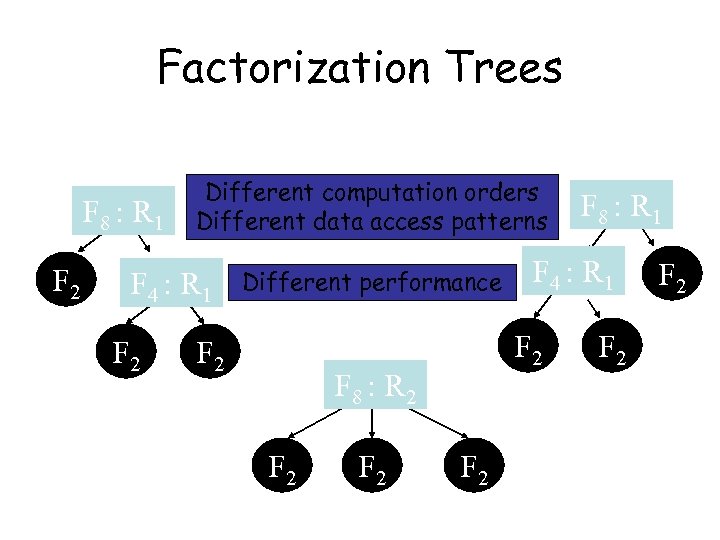
Factorization Trees F 8 : R 1 F 2 Different computation orders Different data access patterns F 4 : R 1 F 2 Different performance F 2 F 2 F 4 : R 1 F 2 F 8 : R 1 F 2
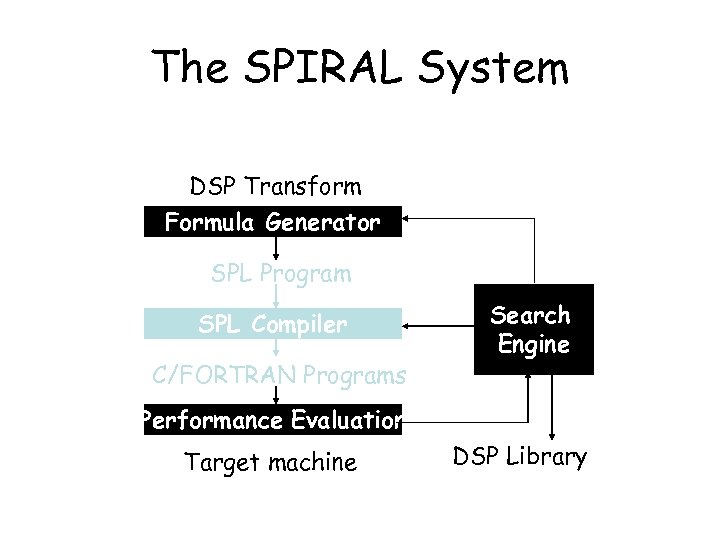
The SPIRAL System DSP Transform Formula Generator SPL Program SPL Compiler C/FORTRAN Programs Search Engine Performance Evaluation Target machine DSP Library
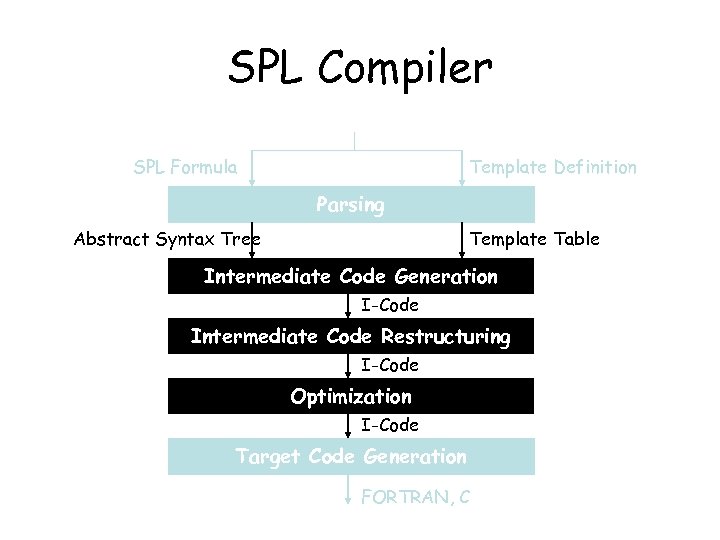
SPL Compiler SPL Formula Template Definition Parsing Template Table Abstract Syntax Tree Intermediate Code Generation I-Code Intermediate Code Restructuring I-Code Optimization I-Code Target Code Generation FORTRAN, C
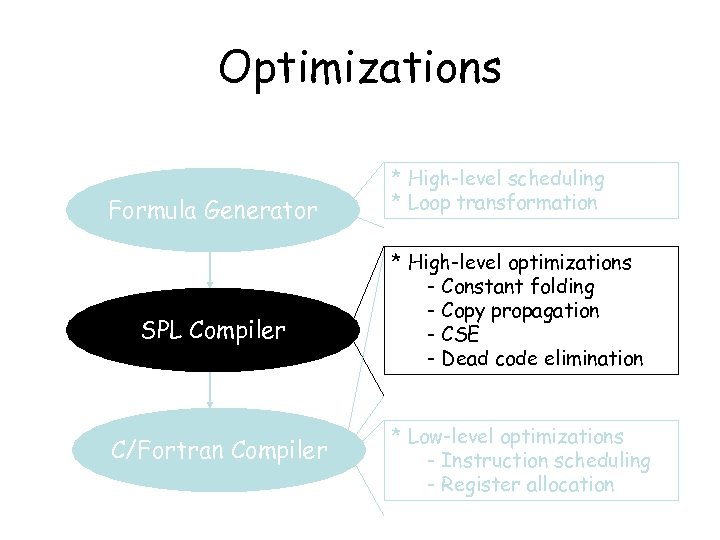
Optimizations Formula Generator SPL Compiler C/Fortran Compiler * High-level scheduling * Loop transformation * High-level optimizations - Constant folding - Copy propagation - CSE - Dead code elimination * Low-level optimizations - Instruction scheduling - Register allocation
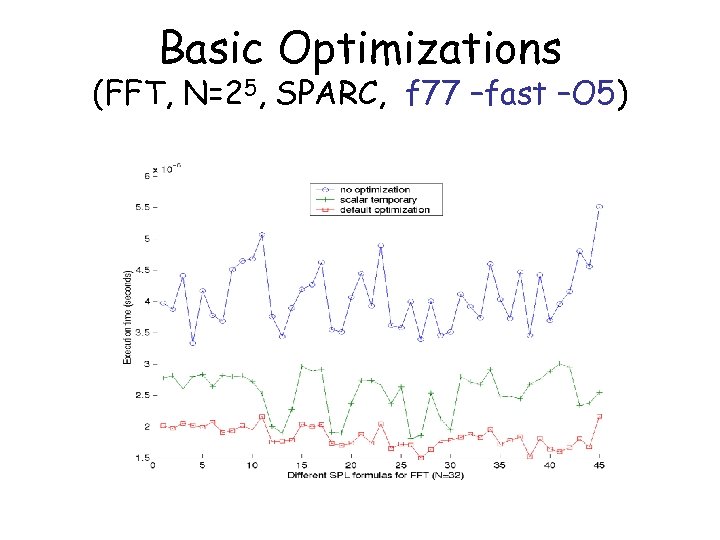
Basic Optimizations (FFT, N=25, SPARC, f 77 –fast –O 5)
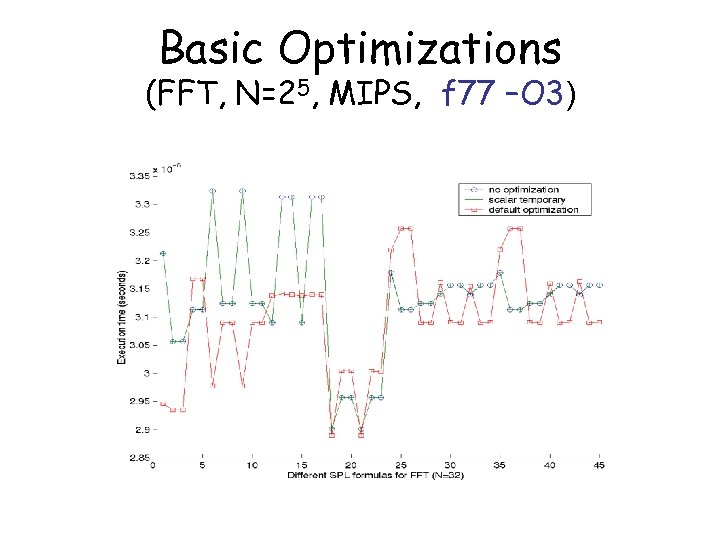
Basic Optimizations (FFT, N=25, MIPS, f 77 –O 3)
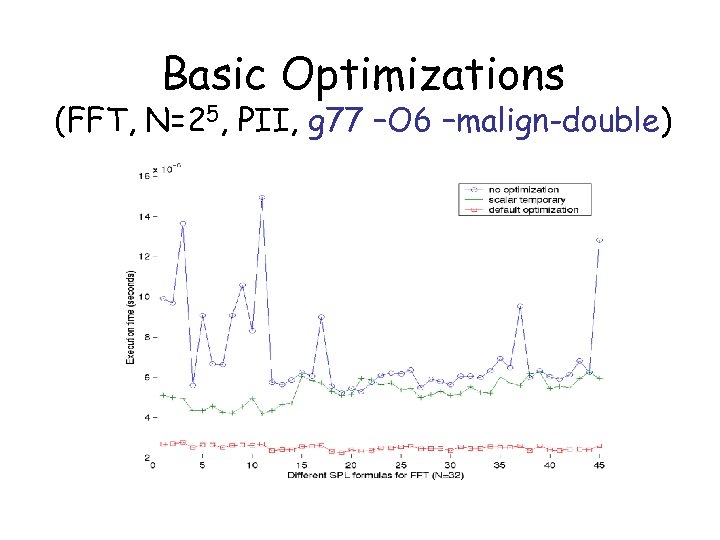
Basic Optimizations (FFT, N=25, PII, g 77 –O 6 –malign-double)
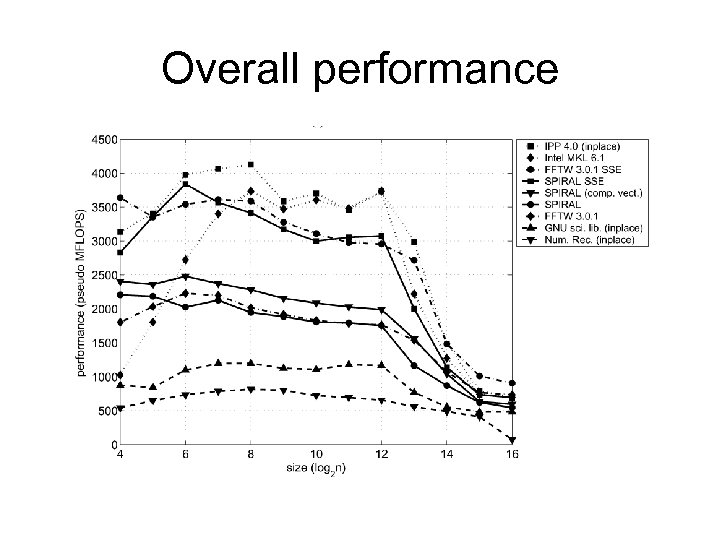
Overall performance
SPIRAL • Relies on the divide and conquer nature of the algorithms it implements. • Compiler techniques are of great importance. • Still room for improvement.
An analytical model for ATLAS Joint work with Keshav Pingali (Cornell) Gerald De. Jong (UIUC)
ATLAS • ATLAS = Automated Tuned Linear Algebra Software, developed by R. Clint Whaley, Antoine Petite and Jack Dongarra, at the University of Tennessee. • ATLAS uses empirical search to automatically generate highly-tuned Basic Linear Algebra Libraries (BLAS). – Use search to adapt to the target machine
ATLAS Infrastructure MFLOPS Detect Hardware Parameters L 1 Size NR Mul. Add Latency ATLAS Search Engine (MMSearch) NB MU, NU, KU x. Fetch Mul. Add Latency ATLAS MM Code Generator (MMCase) Compile, Execute, Measure Mini. MMM Source
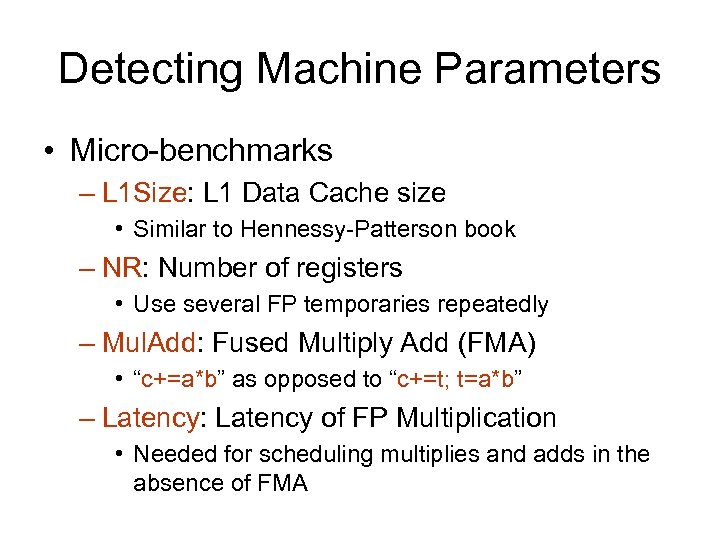
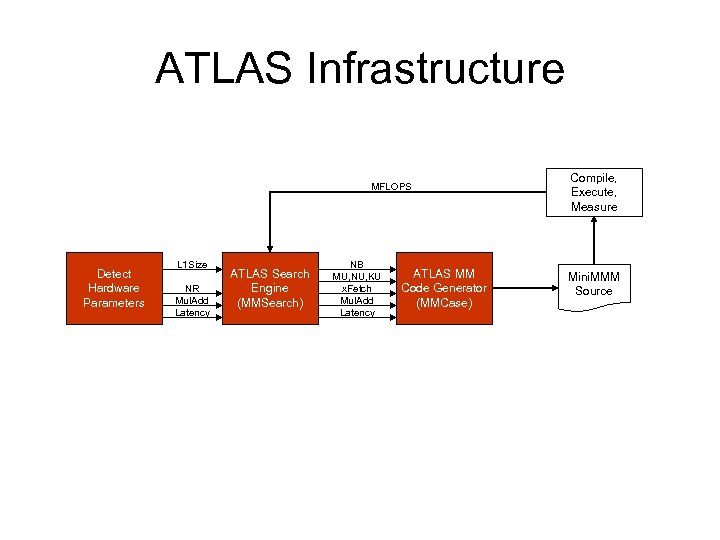
Detecting Machine Parameters • Micro-benchmarks – L 1 Size: L 1 Data Cache size • Similar to Hennessy-Patterson book – NR: Number of registers • Use several FP temporaries repeatedly – Mul. Add: Fused Multiply Add (FMA) • “c+=a*b” as opposed to “c+=t; t=a*b” – Latency: Latency of FP Multiplication • Needed for scheduling multiplies and adds in the absence of FMA
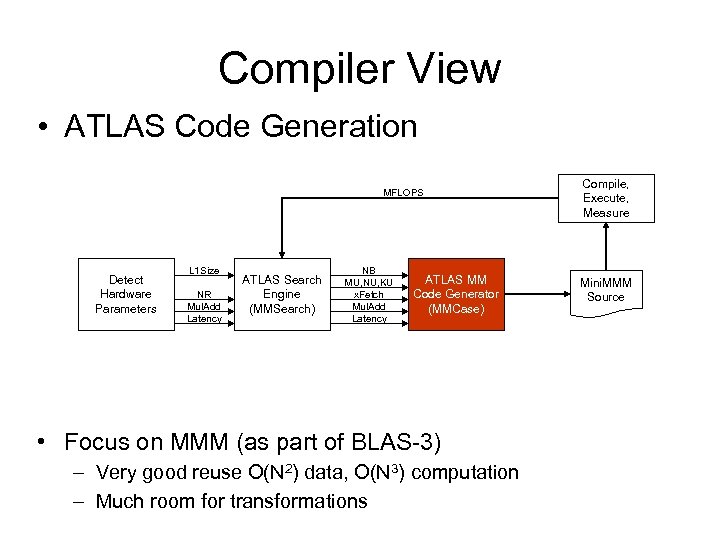
Compiler View • ATLAS Code Generation MFLOPS Detect Hardware Parameters L 1 Size NR Mul. Add Latency ATLAS Search Engine (MMSearch) NB MU, NU, KU x. Fetch Mul. Add Latency ATLAS MM Code Generator (MMCase) • Focus on MMM (as part of BLAS-3) – Very good reuse O(N 2) data, O(N 3) computation – Much room for transformations Compile, Execute, Measure Mini. MMM Source
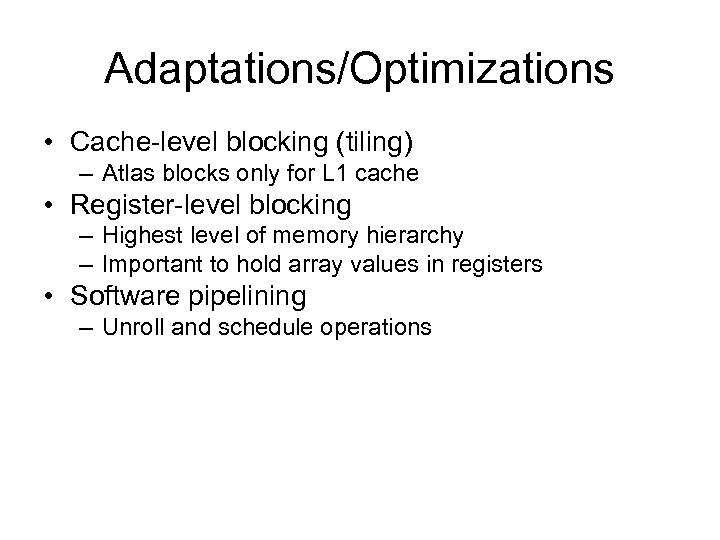
Adaptations/Optimizations • Cache-level blocking (tiling) – Atlas blocks only for L 1 cache • Register-level blocking – Highest level of memory hierarchy – Important to hold array values in registers • Software pipelining – Unroll and schedule operations
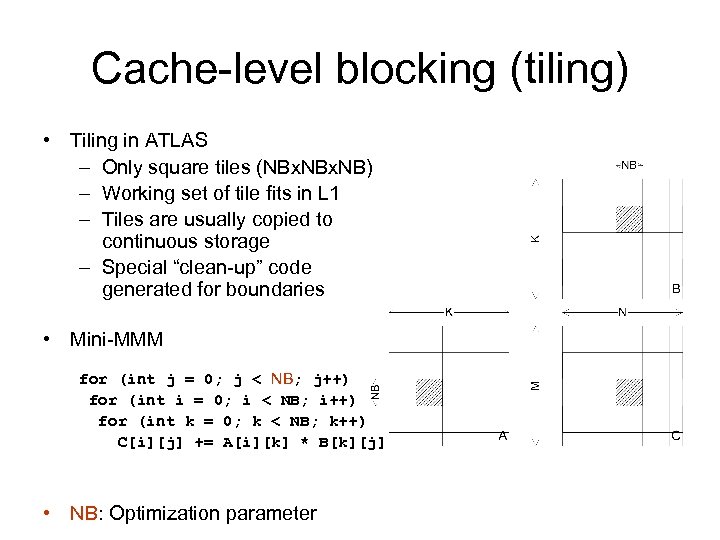
Cache-level blocking (tiling) • Tiling in ATLAS – Only square tiles (NBx. NB) – Working set of tile fits in L 1 – Tiles are usually copied to continuous storage – Special “clean-up” code generated for boundaries • Mini-MMM for (int j = 0; j < NB; j++) for (int i = 0; i < NB; i++) for (int k = 0; k < NB; k++) C[i][j] += A[i][k] * B[k][j] • NB: Optimization parameter
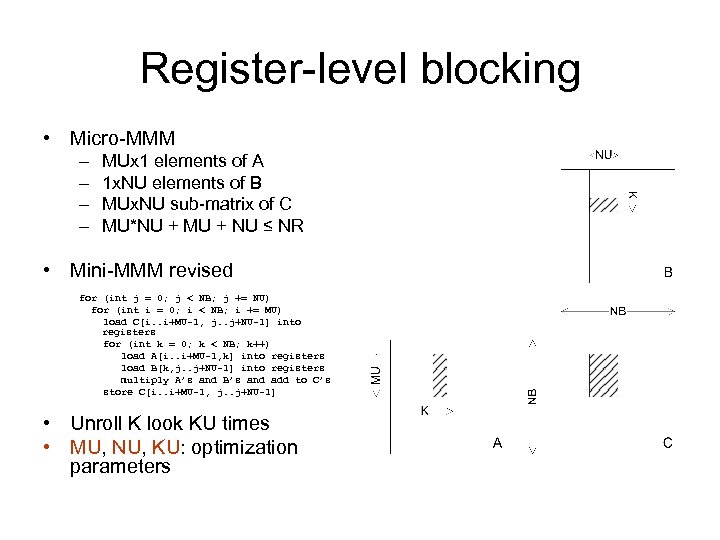
Register-level blocking • Micro-MMM – – MUx 1 elements of A 1 x. NU elements of B MUx. NU sub-matrix of C MU*NU + MU + NU ≤ NR • Mini-MMM revised for (int j = 0; j < NB; j += NU) for (int i = 0; i < NB; i += MU) load C[i. . i+MU-1, j. . j+NU-1] into registers for (int k = 0; k < NB; k++) load A[i. . i+MU-1, k] into registers load B[k, j. . j+NU-1] into registers multiply A’s and B’s and add to C’s store C[i. . i+MU-1, j. . j+NU-1] • Unroll K look KU times • MU, NU, KU: optimization parameters
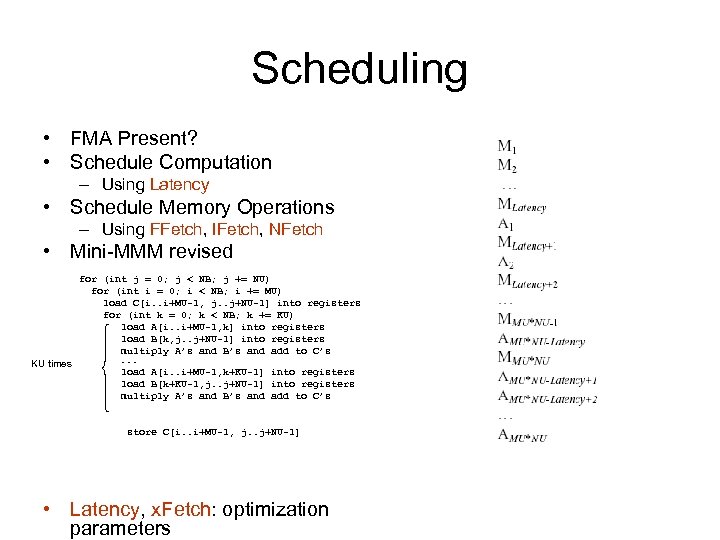
Scheduling M 1 A 1 M 2 A 2 M 3 A 3 L 3 M 4 A 1 A 4 … – Using Latency • Schedule Memory Operations – Using FFetch, IFetch, NFetch • Mini-MMM revised for (int j = 0; j < NB; j += NU) for (int i = 0; i < NB; i += MU) load C[i. . i+MU-1, j. . j+NU-1] into registers for (int k = 0; k < NB; k += KU) load A[i. . i+MU-1, k] into registers load B[k, j. . j+NU-1] into registers multiply A’s and B’s and add to C’s. . . KU times load A[i. . i+MU-1, k+KU-1] into registers load B[k+KU-1, j. . j+NU-1] into registers multiply A’s and B’s and add to C’s store C[i. . i+MU-1, j. . j+NU-1] • Latency, x. Fetch: optimization parameters … A 2 … … MMU*NU AMU*NU Latency=2 • FMA Present? • Schedule Computation L 1 L 2 LMU+NU
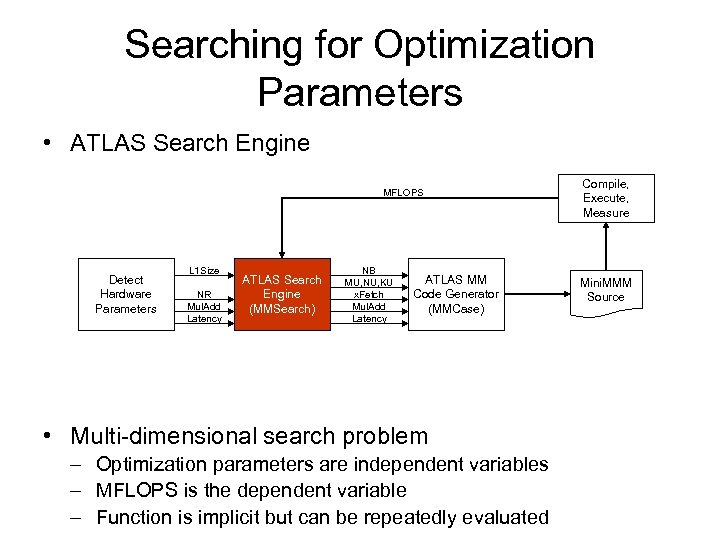
Searching for Optimization Parameters • ATLAS Search Engine MFLOPS Detect Hardware Parameters L 1 Size NR Mul. Add Latency ATLAS Search Engine (MMSearch) NB MU, NU, KU x. Fetch Mul. Add Latency ATLAS MM Code Generator (MMCase) • Multi-dimensional search problem – Optimization parameters are independent variables – MFLOPS is the dependent variable – Function is implicit but can be repeatedly evaluated Compile, Execute, Measure Mini. MMM Source
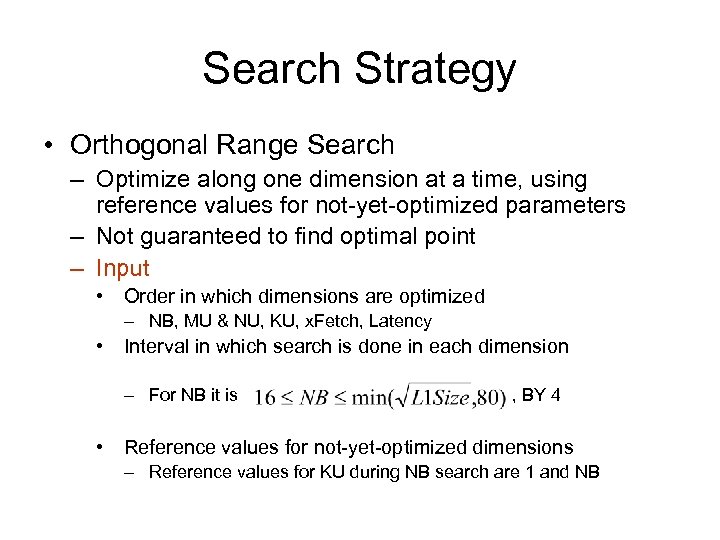
Search Strategy • Orthogonal Range Search – Optimize along one dimension at a time, using reference values for not-yet-optimized parameters – Not guaranteed to find optimal point – Input • Order in which dimensions are optimized – NB, MU & NU, KU, x. Fetch, Latency • Interval in which search is done in each dimension – For NB it is , BY 4 • Reference values for not-yet-optimized dimensions – Reference values for KU during NB search are 1 and NB
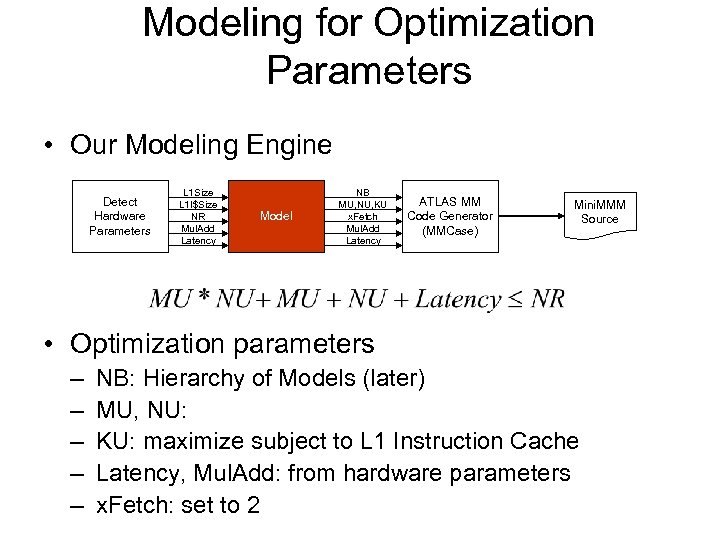
Modeling for Optimization Parameters • Our Modeling Engine Detect Hardware Parameters L 1 Size L 1 I$Size NR Mul. Add Latency ATLAS Search Model Engine (MMSearch) NB MU, NU, KU x. Fetch Mul. Add Latency ATLAS MM Code Generator (MMCase) Mini. MMM Source • Optimization parameters – – – NB: Hierarchy of Models (later) MU, NU: KU: maximize subject to L 1 Instruction Cache Latency, Mul. Add: from hardware parameters x. Fetch: set to 2

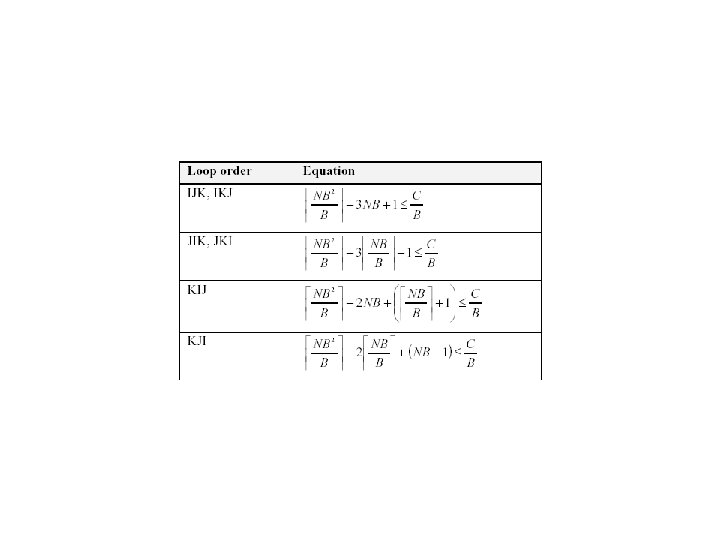
Modeling for Tile Size (NB) • Models of increasing complexity – 3*NB 2 ≤ C • Whole work-set fits in L 1 – NB 2 + NB + 1 ≤ C • • • Fully Associative Optimal Replacement Line Size: 1 word • Line Size > 1 word • LRU Replacement – –
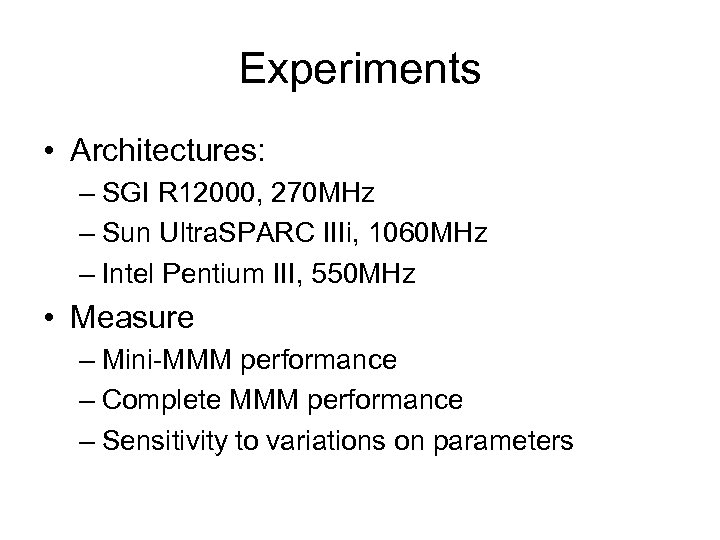
Experiments • Architectures: – SGI R 12000, 270 MHz – Sun Ultra. SPARC IIIi, 1060 MHz – Intel Pentium III, 550 MHz • Measure – Mini-MMM performance – Complete MMM performance – Sensitivity to variations on parameters
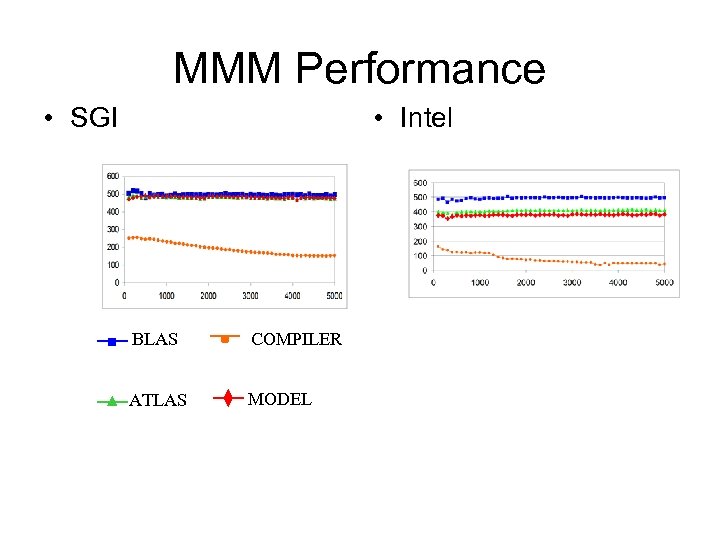
MMM Performance • SGI • Intel BLAS COMPILER ATLAS MODEL
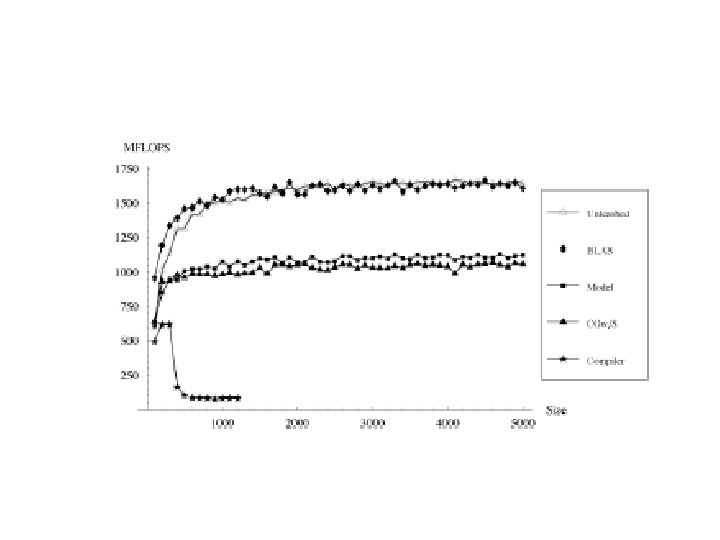
ATLAS Issues • Model worked well in our experiments. • Models avoid the need for search and enables better optimization. • But… developing the model is not easy – Can it be automated ? • However, it is not clear how far pure models would work. – A hybrid approach is probably best.
Sorting Joint work with Xiaoming Li
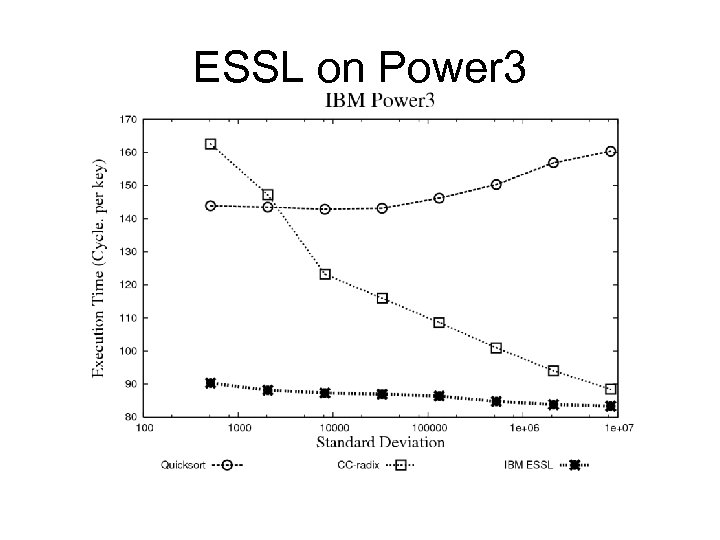
ESSL on Power 3
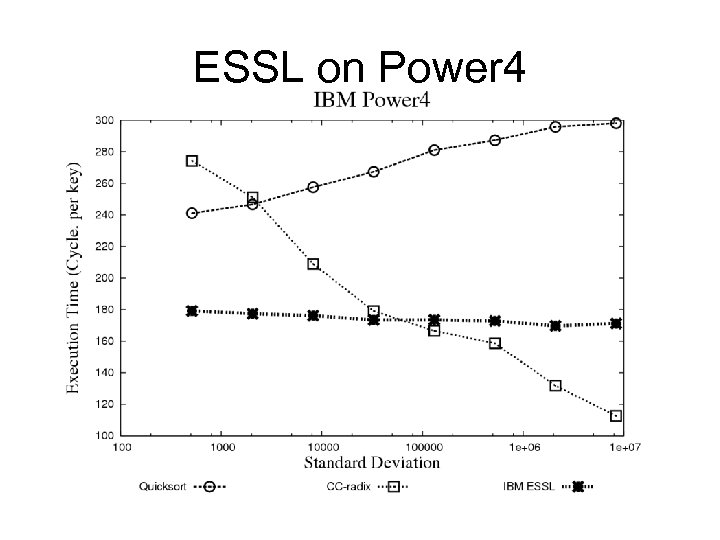
ESSL on Power 4
Motivation • No universally best sorting algorithm • Can we automatically GENERATE and tune sorting algorithms for each platform ? • Performance of sorting depends not only on the platform but also on the input characteristics.
A first strategy: Algorithm Selection • Select the best algorithm from Quicksort, Multiway Merge Sort and CC-radix. • Relevant input characteristics: number of keys, entropy vector.
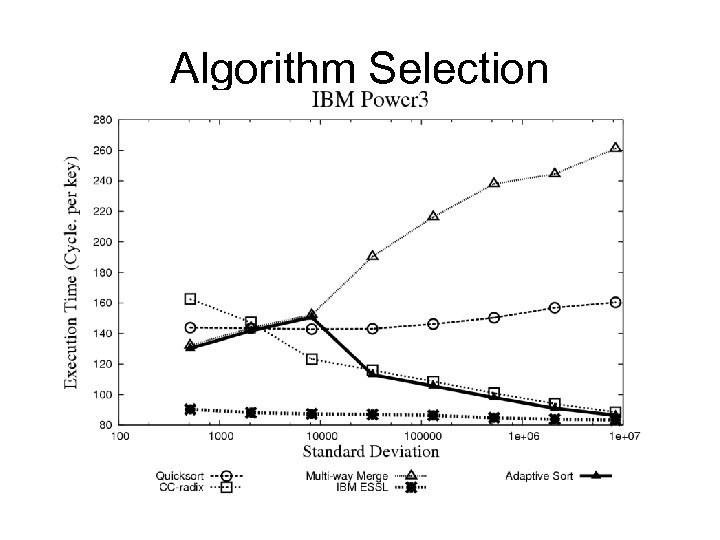
Algorithm Selection
A better Solution • We can use different algorithms for different partitions • Build Composite Sorting algorithms – Identify primitives from the sorting algorithms – Design a general method to select an appropriate sorting primitive at runtime – Design a mechanism to combine the primitives and the selection methods to generate the composite sorting algorithm
Sorting Primitives • Divide-by-Value – A step in Quicksort – Select one or multiple pivots and sort the input array around these pivots – Parameter: number of pivots • Divide-by-Position (DP) – Divide input into same-size sub-partitions – Use heap to merge the multiple sorted sub-partitions – Parameters: size of sub-partitions, fan-out and size of the heap
Sorting Primitives • Divide-by-Radix (DR) – Non-comparison based sorting algorithm – Parameter: radix (r bits)
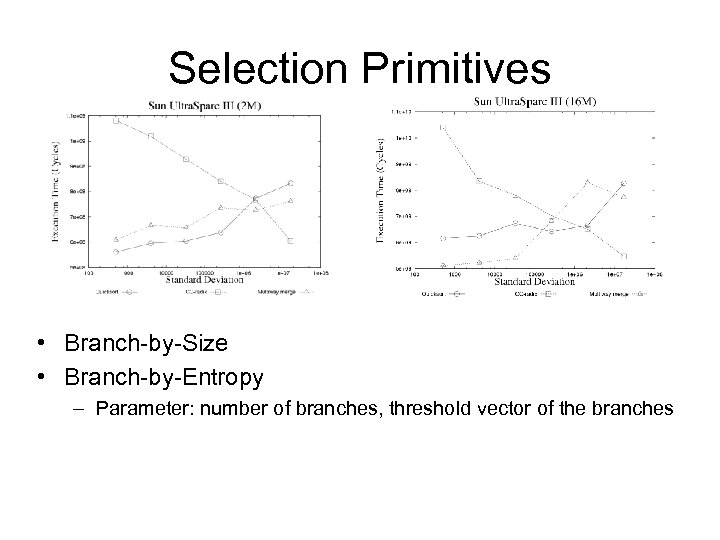
Selection Primitives • Branch-by-Size • Branch-by-Entropy – Parameter: number of branches, threshold vector of the branches
Leaf Primitives • When the size of a partition is small, we stick to one algorithm to sort the partition fully. • Two methods are used in the cleanup operation – Quicksort – CC-Radix
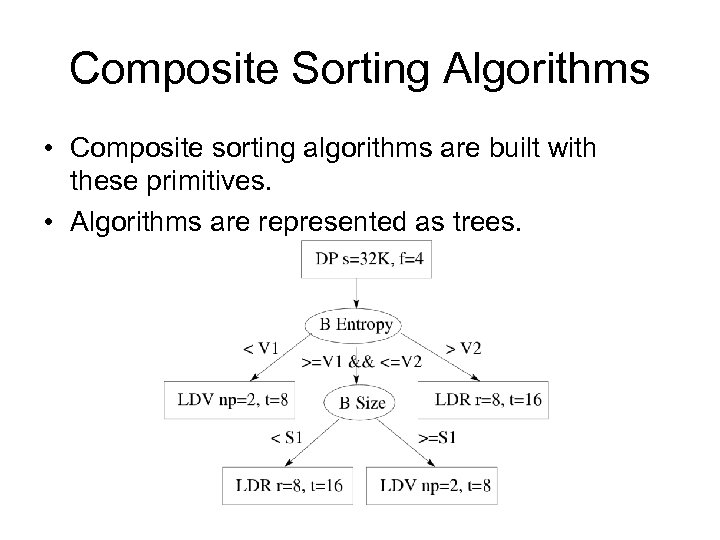
Composite Sorting Algorithms • Composite sorting algorithms are built with these primitives. • Algorithms are represented as trees.
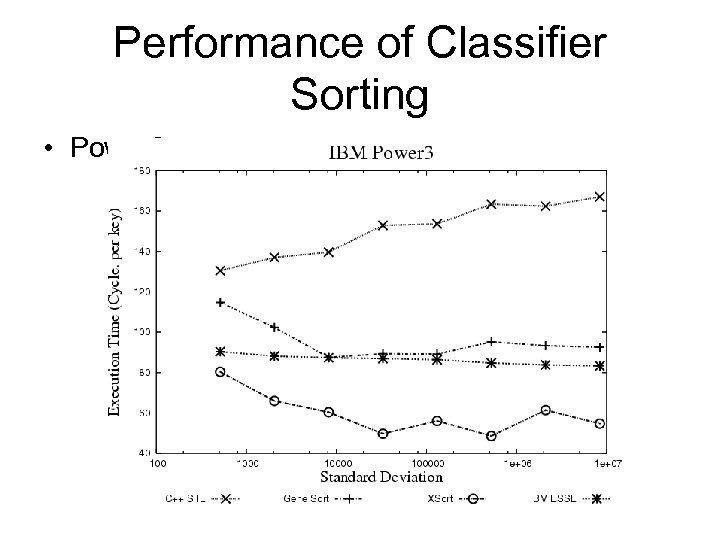
Performance of Classifier Sorting • Power 3
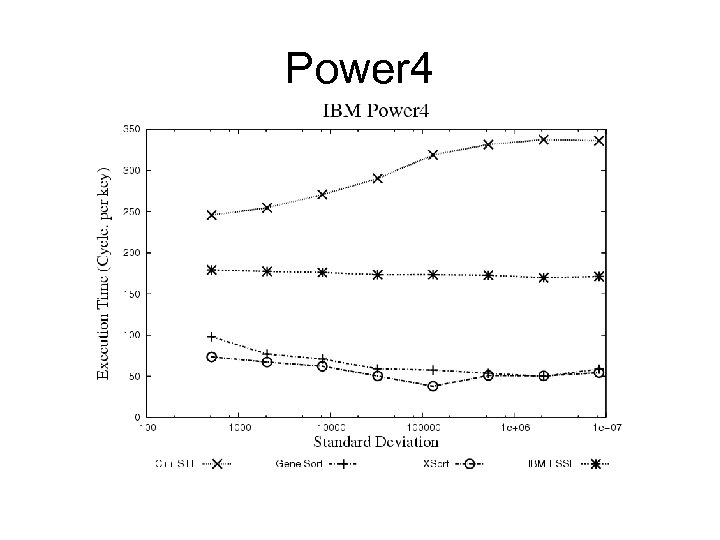
Power 4
Sorting • Again divide-and conquer. • But could not find formulas like Spiral. • Adaptation to input data crucial. – Need to deal with other features of the input data – degree of “sortedness”

Conclusions • Much exploratory work today • General principles are emerging, but much remains to be done. • This new exciting area of research should teach us much about program optimization.
Скачать презентацию Empirical Search and Library Generators Libraries and
ebe550a067ee2c2d5af34066982a4588.ppt