


 Скачать презентацию EMPIRICAL EVIDENCE theme 3 The empirical sciences
EMPIRICAL EVIDENCE 3.pptx
- Количество слайдов: 15
 EMPIRICAL EVIDENCE theme 3
 The empirical sciences • The empirical sciences means that their assertions must ultimately face the test of observation. • An observation that correctly reveals the features—such as size, shape, color, and texture—of what we are observing is called veridical. • Observations that are not veridical are illusory.
 Three kinds of entities • (i) those that can be observed directly with normal unaided human senses; • (ii) those that can be observed only indirectly by using some instrument that extends the normal human senses; • (iii) those that cannot be observed either directly or indirectly, whose existence and nature can be established only by some sort of theoretical inference.
 Terms of two types • An observational vocabulary that contains expressions referring to entities, properties, and relations that we can observe. • A theoretical vocabulary containing expressions referring to entities, properties, and relations that we cannot observe.
 Fundamental moral of scientific knowledge • Scientific knowledge is not confined to what we have observed. Science see the future and the past, other worlds and spaces. • The problem: deductive reasoning is nonampliative, observations plus deduction cannot provide knowledge of the unobserved.
 THE HYPOTHETICO-DEDUCTIVE METHOD • The H-D method is sometimes offered as the method of scientific inference. • The term hypothesis can appropriately be applied to any statement that is intended for evaluation in terms of its consequences. • If the observational consequence turns out to be true, that is said to confirm the hypothesis to some degree. If it turns out to be false, that is said to disconfirm the hypothesis.
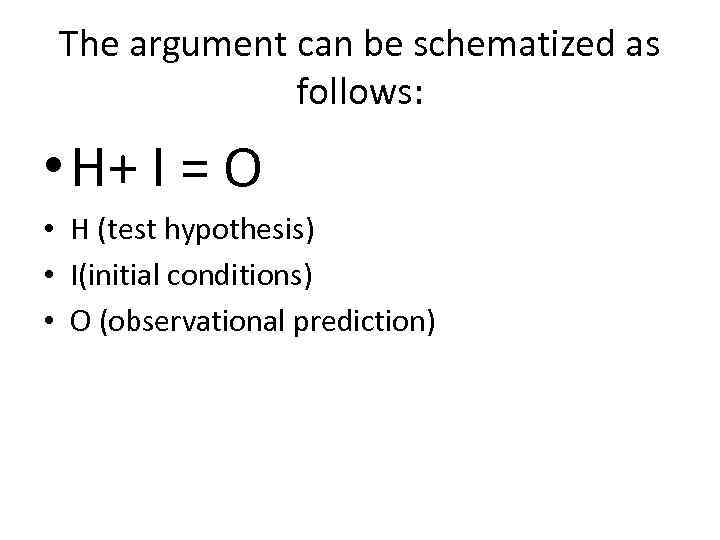 The argument can be schematized as follows: • H+ I = O • H (test hypothesis) • I(initial conditions) • O (observational prediction)
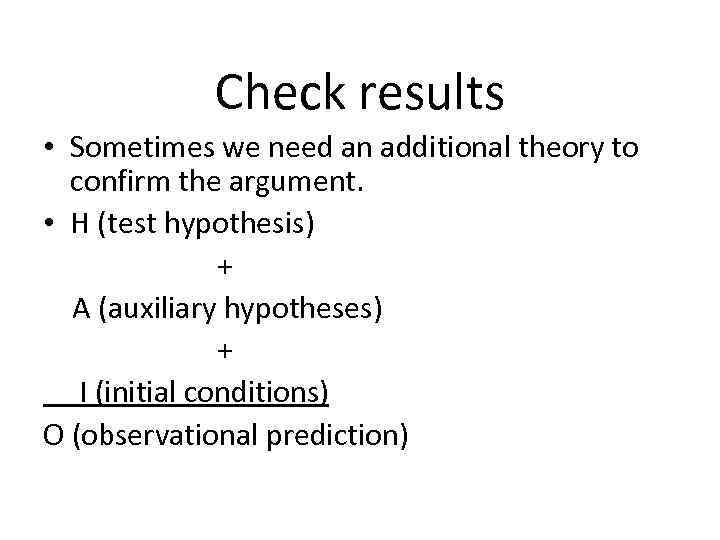 Check results • Sometimes we need an additional theory to confirm the argument. • H (test hypothesis) + A (auxiliary hypotheses) + I (initial conditions) O (observational prediction)
 The conclusion from the argument • Argument is a valid deduction; accordingly, if its premises are true its conclusion must also be true. But if the conclusion is not true. Hence, at least one of the premises must be false.
 H-D Model errors • The moral is that negative outcomes of H-D tests sometimes do, and sometimes do not, result in the refutation of the test hypothesis. Since auxiliary hypotheses are almost always present in H-D tests, we must face the possibility that an auxiliary hypothesis, rather than the test hypothesis, is responsible for the negative outcome.
 THE PROBLEM OF JUSTIFYING INDUCTION • predicate is the part of a sentence that contains the verb and gives information about the subject: In the sentence "We went to the airport", "went to the airport" is the predicate. • Subject is person which make an action We went to the airport", “We" is thesubject.
 • There is, however, a difficulty that is both historically and logically prior. David Hume created thesis that we have any logical or rational basis for any inductive generalizations —that is, for considering any predicate to be projectible. • Hume divided all reasoning into reasoning concerning relations of ideas and reasoning concerning matters of fact and existence. All of the deductive arguments of pure mathematics and logic fall into the first category. They are nonampliative.
 • Not all scientific reasoning belongs to the first category. Whenever we make inferences from observed facts to the unobserved we are clearly reasoning ampliatively—that is, the content of the conclusion goes beyond the content of the premises. • Such reasoning is based upon relations of cause effect. All of our knowledge of causal relations must, Hume argues, be based upon experience.
 A genuine causal connection • If we observe two events in spatiotemporal proximity, one of which follows right after the other, just once, we cannot tell whether it is a mere coincidence or a genuine causal connection.
 Conclusion • We should be clear about the depth and scope of Hume's arguments. Hume is not merely saying that we cannot be certain about the results of science—about scientific predictions, for example. we have no logical basis for placing any confidence in any scientific prediction.