


 Скачать презентацию Emotions Sales Sutton Rafaeli How
90477b7c677a3acd22f64b35a86fa6e9.ppt
- Количество слайдов: 38
 Emotions & Sales Sutton & Rafaeli • How to conduct an observational study • Deductive Study (Study 1) • Inductive Study (Study 2) – Re-analysis of Study 1 data @ store & individual level • Lessons learned
 Theoretical Explanations • Emotions can be used as a “control move” to influence behavior – Positive, neutral vs. negative emotions – Some can be reinforcing • Positive emotions it may encourage customers to buy more, or to re-patronize store
 Preliminary Hypothesis • Amount of positive emotion displayed leads to increased store sales – What is the predictor and criterion variable?
 Study 1 Context • Friendly behavior during transactions encouraged by – Training & incentives for clerks – Incentives for franchise store owners – 25% Bonus over base salary for regional managers of corporate-owned stores
 Participants • 1319 clerks in 576 Convenience stores – 8 stores from each of 72 districts that make up 18 divisions in 2 countries – Primarily urban sample of stores – 44% male clerks – Does not state if the same clerk could have been observed multiple times (implications? )
 Method • Time of measurement – 3 month period • Does not specify how long after training – Each store observed during one day & one swing shift – 25% of stores observed during night shift – 1 -20 transactions per visit – Up to 60 transactions per store – 11805 clerk-customer transactions • 75% male customers
 Procedure • “Mystery shopper” observers – Observed clerks at pre-test stores w/research director before actual data collection period • Compared & clarified behavior coding differences – Corporate HR staff volunteers dressed according to the profile of a typical customer • May not be adequately matched for SES of working class male customers 18 -34 yrs bec. observers had a wide range of jobs
 Procedure • Observers – Only coded clerk at primary cash register from magazine rack/coffee pots – Visited store in pairs – Selected small item, stood in line, paid for item – Spent 4 -12 min per store depending on number of customers in store • 3% of observations excluded due to clerks’ suspicions
 Procedure • Reliability of mystery shoppers’ codings – Director of field research – Sample of 274 stores – Accompanied by second original observer – Allowed for computing inter-rater correlations w/ratings of first original observer (mean=. 82)
 Predictor Variable • Positive emotion display – Rated each transaction on 4 features • Greeting, thanking, smiling, eye-contact • Coded as 1 or 0 depending on display – Transactions aggregated at store level • Score for each of 4 features calculated as proportion of transactions in which behavior was displayed over total number of transactions – Overall store index of emotion composed of mean of 4 aspects (reliability=. 76)
 Criterion Variable • Sales – Total store sales during the year of the observation obtained from company records • Standardized across stores included in sample to preserve confidentiality
 Control Variables • Store gender composition – Proportion of women clerks observed over total number of store clerks observed at each store • Customer gender composition – Proportion of female customers over all customers present during all observations in that store
 Control Variables • Clerk image – 3 items rated on a yes/no scale • Was clerk wearing a smock? • Was smock clean? • Was clerk wearing name tag? • Store stock level – Rated on 5 -point Likert scales as to whether shelves, snack stands & refrigerators were fully stocked
 Control Variables • Average Line length – Largest number of customers in line at primary cash register during each visit • Store ownership – Franchise vs. corporation owned • Store supervision costs – Amount (in dollars) spent on each store • Region – Location of store in one of four geographical region (NOTE Coding method for regression)
 Regression Analyses • Hierarchical method using sales as dv – Step 1 = 8 control variables • Note: Adjusted R 2 accounts for the increased likelihood of finding a large and significant R with a small sample, and/or with a several predictors (I. e. , differences between R 2 and adjusted R 2 are greater in such cases) – Step 2 = Predictor variable i. e. , Display of positive emotions
 Regression Results • Sales are positively related to – Average line length (store pace) – Supervision costs – Clerk gender composition • Sales are negatively related to – Display of positive emotions • contrary to hypothesis
 Study 2 • Explain the negative relationship between store sales and display of positive emotion
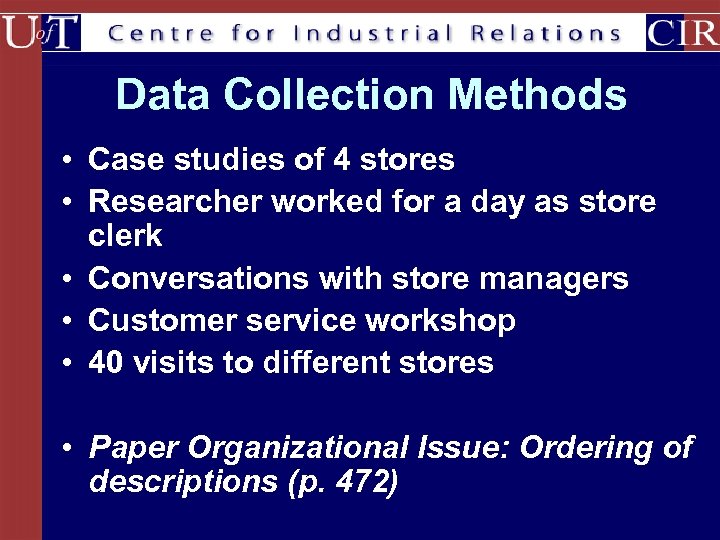 Data Collection Methods • Case studies of 4 stores • Researcher worked for a day as store clerk • Conversations with store managers • Customer service workshop • 40 visits to different stores • Paper Organizational Issue: Ordering of descriptions (p. 472)
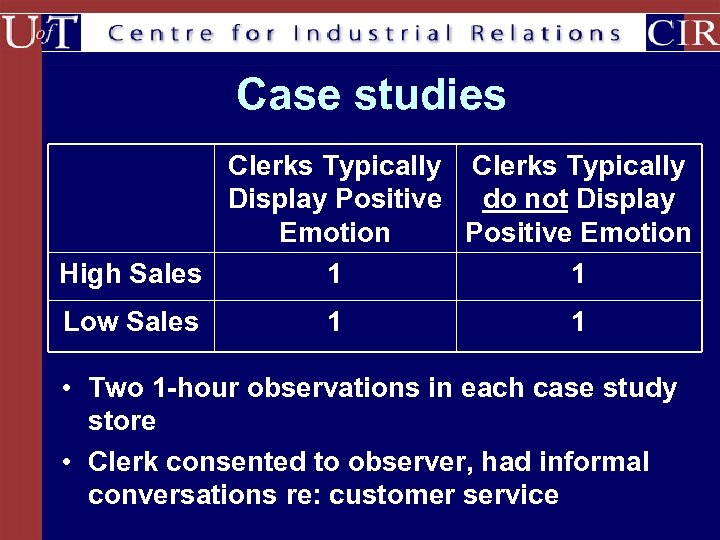 Case studies Clerks Typically Display Positive do not Display Emotion Positive Emotion High Sales 1 1 Low Sales 1 1 • Two 1 -hour observations in each case study store • Clerk consented to observer, had informal conversations re: customer service
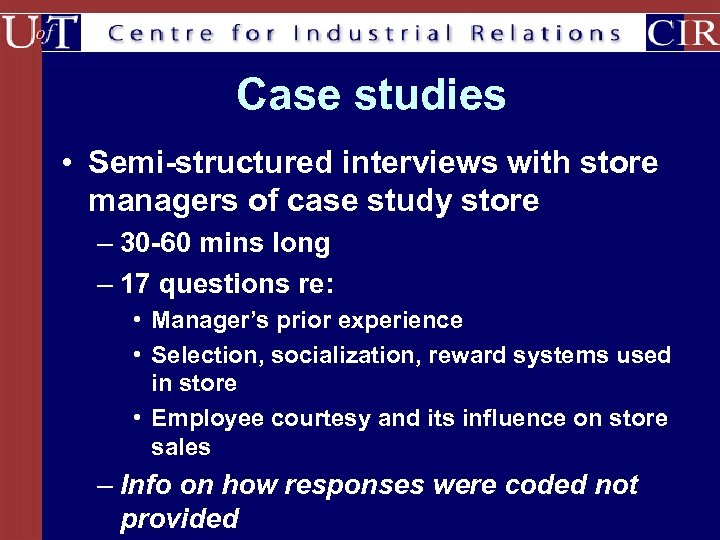 Case studies • Semi-structured interviews with store managers of case study store – 30 -60 mins long – 17 questions re: • Manager’s prior experience • Selection, socialization, reward systems used in store • Employee courtesy and its influence on store sales – Info on how responses were coded not provided
 Data Collection Methods • Researcher works as clerk for a day – In store with low sales but frequent display of positive emotions – Viewed 30 min training video on employee courtesy before working • Conversations w/store managers – 150 hours of informal conversations re: negative relationship b/w positive emotions & sales
 Data Collection Methods • Customer service workshop attendance – 2 hour prg. focusing on methods for coaching and rewarding clerks for courteous behavior – Discussion on the role of expressed emotions in the store • 40 visits to different stores – Qualitative measures of store pace • Not much detail provided
 Theoretical Explanations • Store pace determined norms re: emotional expression that affected emotions displayed – Busy time evoked norms for fewer positive emotions – Slow times evoked norms for more positive emotions
 Norms for Busy Stores • Fewer positive emotions helped maintain store efficiency – Discourage customers from prolonging transactions – Were perceived as more efficient by other customers waiting in line • Evoked feelings of tension among clerks leading to fewer positive emotions
 Norms for Slow Stores • More positive emotions displayed by clerks – Low pressure for speed/efficiency on clerks – Customers have different scripts for slow stores – Clerks regarded customers as a source of entertainment
 Revised Hypothesis • Expression of positive emotion is negatively related to store pace (as measured by store sales & line length)
 Regression Analyses • Hierarchical method with display of positive emotions as dv – Step 1 = 7 of 8 control variables (as in Study 1) – Step 2 = line length & total store sales
 Regression Results • Display of positive emotion is negatively related to – Store sales – Average line length (store pace) – Control variables • Store ownership • Stock level • Display of positive emotions is positively related to store clerk gender composition
 Individual-Level Data Analyses • N=1319 (clerks) • Hierarchical multiple regression – Step 1=Control variables – Step 2= Line length negatively predicted display of positive emotion • Did not use store sales as predictor bec analyses is at individual level, whereas store sales info is at store level
 Typically Busy Stores • Clerks show fewer positive emotions during slow times – Slow times provide ‘opportunities’ to catch up on other tasks, customers are not perceived as source of job variety or entertainment • Measured as large amount of store sales
 Typically Slow Stores • Clerks show fewer positive emotions during busy times – Less experience in coping with pressure of busy times and feel tense – Therefore… • Stronger negative relationship between line length & display of positive emotion for slow stores • Measured as small amount of store sales
 Individual-Level Data Analyses • Hierarchical multiple regression – Step 1 & 2 as previous analyses – Step 3= Interaction b/w line length and total sales negatively predicted amount of positive emotion
 Individual-Level Data Analyses • Classified stores as busy/slow based on store sales being above/below mean – Separate hierarchical multiple regressions for clerks at slow & busy stores – Line length was • Negatively (-19) related to display of positive emotions (for slow stores) • Marginally (06) related to display of positive emotions (for busy stores)
 Discussion • Found negative relation b/w positive emotions and store sales • Why? – Stores sales reflect store pace which causes emotions • Could be different – In diff org’n with different ‘service ideal’ (e. g. , Mcdonalds) – For longer transactions (e. g. , restos)
 Discussion • Emotions as control moves affect things other than sales – Negative/neutral emotions as control moves to increase efficiency – Positive emotions used to achieve individual rather than org’n goals
 Discussion • Relative strength of corporate norms vs. store norms & inner feelings in determining display of emotions – Reduce stress to encourage display of positive emotions
 Discussion • Observational methods – Ethics of secret/unobtrusive observation – Benefits of non-reactive vs. contrived observations – Clerks informed about mystery shoppers – Anonymity of clerks observed • But each store had only 8 -10 clerks!
 Discussion • Presenting the research process – Acceptability of inductive & deductive process in • Organizational behavior research publication process • Corporate environments • Media presentations – Reader friendliness – Student learning