


 Скачать презентацию Emotion and Efficacy Pathways to Normative and Non-normative
b31d46e86117180d6850ae4813ffb1e6.ppt
- Количество слайдов: 38
 Emotion and Efficacy Pathways to Normative and Non-normative Collective Action Nicole Tausch Cardiff University EASP Small Group Meeting on Resolving Societal Conflicts and Building Peace: Socio. Psychological Dynamics, 7 -10 September, 2009, Jerusalem, Israel 1
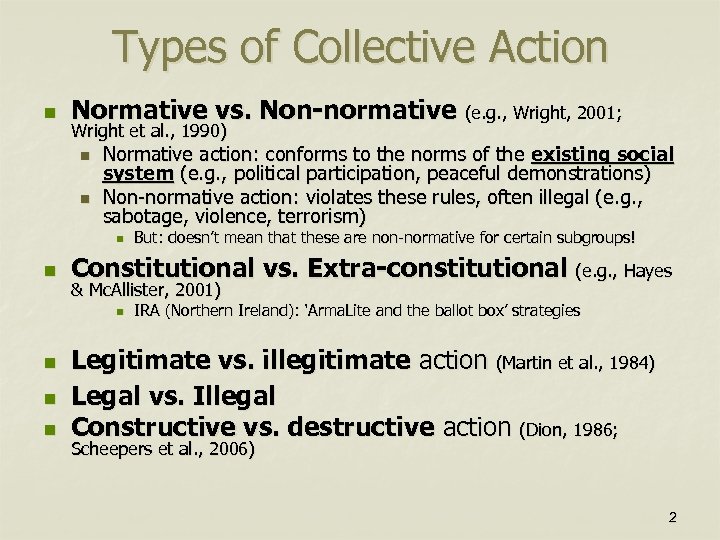 Types of Collective Action n Normative vs. Non-normative (e. g. , Wright, 2001; Wright et al. , 1990) n n Normative action: conforms to the norms of the existing social system (e. g. , political participation, peaceful demonstrations) Non-normative action: violates these rules, often illegal (e. g. , sabotage, violence, terrorism) n n Constitutional vs. Extra-constitutional (e. g. , Hayes & Mc. Allister, 2001) n n But: doesn’t mean that these are non-normative for certain subgroups! IRA (Northern Ireland): ‘Arma. Lite and the ballot box’ strategies Legitimate vs. illegitimate action (Martin et al. , 1984) Legal vs. Illegal Constructive vs. destructive action (Dion, 1986; Scheepers et al. , 2006) 2
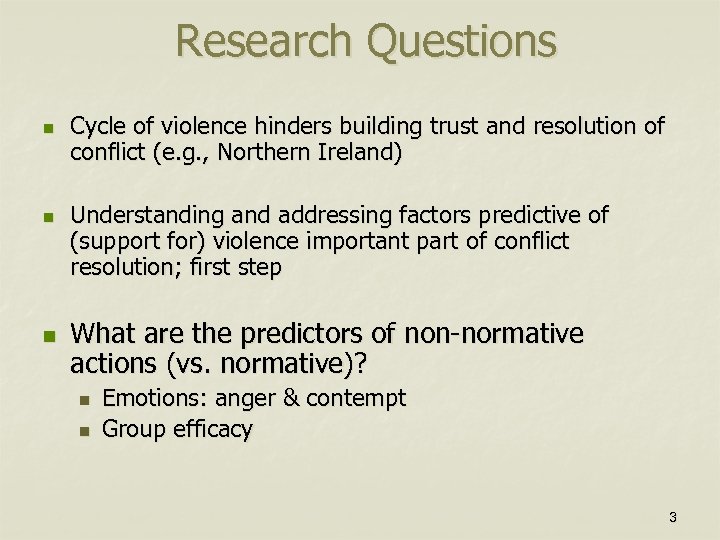 Research Questions n n n Cycle of violence hinders building trust and resolution of conflict (e. g. , Northern Ireland) Understanding and addressing factors predictive of (support for) violence important part of conflict resolution; first step What are the predictors of non-normative actions (vs. normative)? n n Emotions: anger & contempt Group efficacy 3
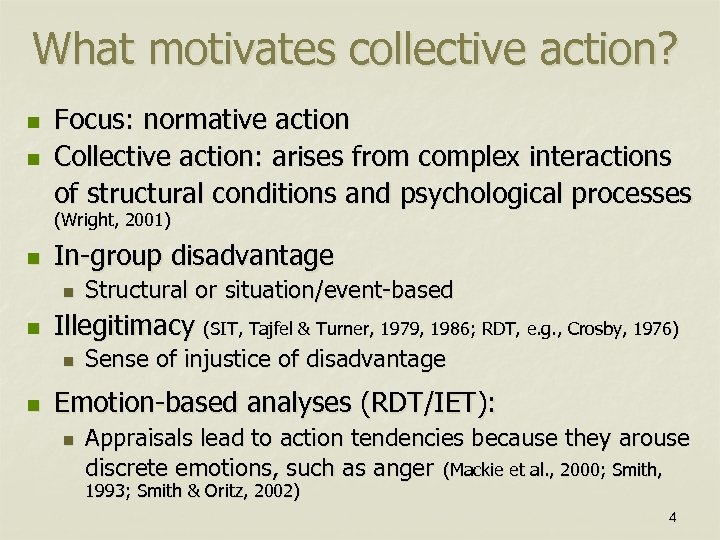 What motivates collective action? n n Focus: normative action Collective action: arises from complex interactions of structural conditions and psychological processes (Wright, 2001) n In-group disadvantage n n Illegitimacy (SIT, Tajfel & Turner, 1979, 1986; RDT, e. g. , Crosby, 1976) n n Structural or situation/event-based Sense of injustice of disadvantage Emotion-based analyses (RDT/IET): n Appraisals lead to action tendencies because they arouse discrete emotions, such as anger (Mackie et al. , 2000; Smith, 1993; Smith & Oritz, 2002) 4
 Group Efficacy n Group efficacy (Mc. Carthy & Zald, 1977; Martin et al. , 1984) n n Belief that group can solve their group-related problem by unified effort (Bandura, 1995) Related to notion of (in)stability of in-group disadvantage in SIT Pragmatic consideration Dual Pathway Model (Van Zomeren, Spears & Leach, 2004) n n n Group-based anger and group efficacy as distinct routes to collective action But only normative actions examined Less clear when group members will resort to nonnormative action 5
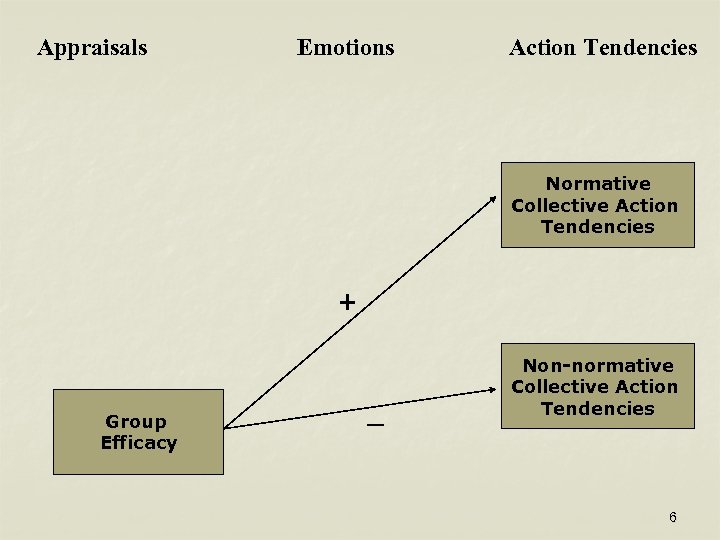 Appraisals Emotions Action Tendencies Normative Collective Action Tendencies + Group Efficacy _ Non-normative Collective Action Tendencies 6
 Group Efficacy and Normative vs. Nonnormative Collective Action n Resort to more extreme measures when situation hopeless Stable low status of the in-group leads to more extreme forms of bias (outgroup derogation) (Scheepers et al. , 2006) Non-normative action when legitimate channels closed (Wright et al. , 1990) 7
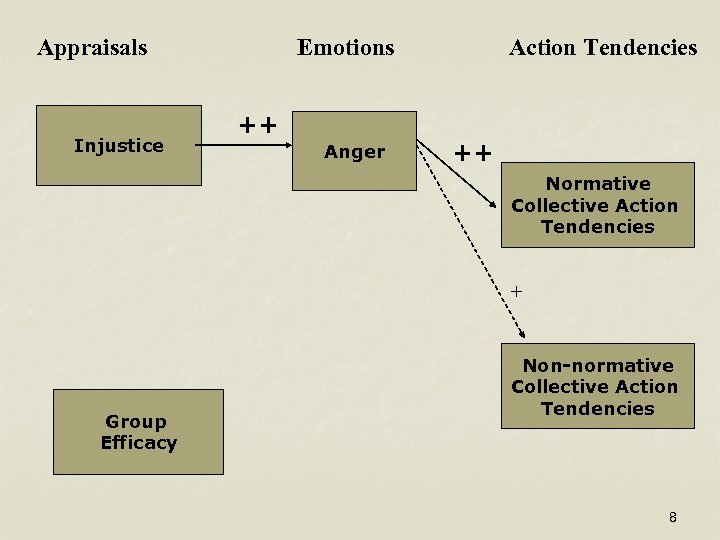 Appraisals Injustice Emotions ++ Anger Action Tendencies ++ Normative Collective Action Tendencies + Group Efficacy Non-normative Collective Action Tendencies 8
 Anger n n Constructive emotion (Fischer & Roseman, 2007) Involves certain amount of control, greater intimacy, less dispositional attributions Positive outcome sought by coercing change in another person’s behaviour Hostile and antagonistic behaviours; but reconciliation in the long term 9
 Contempt n ‘Other-critical’ emotion like anger n Distinct social functions and consequences n (Rozin, Lowery, Imada, & Haidt, 1999) (Fischer & Roseman, 2007) Often arises when anger is recurrent and remains unresolved (develops on top of anger) n Lack of control over the other person, less intimacy When no reconciliation is sought Negative and permanent changes in beliefs about another person (dispositional attributions) Less constructive for social relationships Dehumanization and moral exclusion of others (Leyens et n Feeling (morally) superior to others n n al. , 2000) 10
 Moral Appraisals n Group morality important for in-group evaluation n Intergroup conflict often has symbolic elements (Leach et al. , 2007) n discrepancies in beliefs, values, and moral codes strongly predict hostility towards the out-group (e. g. , Biernat et al. , 1996; Esses et al. , 1993; Sears, 1988) n n Beliefs of the moral superiority of the in-group (‘ingroup virtue’ Reicher, Haslam, & Rath, 2008) and the immorality of the out-group can serve to justify action (e. g. , Tetlock, 2002) Strong link to contempt felt toward an opponent (e. g. , Fischer & Roseman, 2007) 11
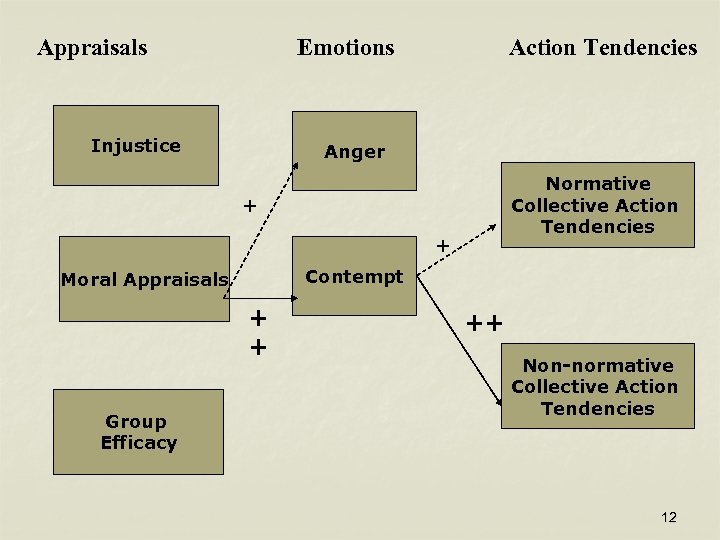 Appraisals Emotions Injustice Action Tendencies Anger Normative Collective Action Tendencies + + Contempt Moral Appraisals + + Group Efficacy ++ Non-normative Collective Action Tendencies 12
 Study 1: British students willingness to engage in solidarity-based collective action for change in treatment of asylum seekers (Basic model) 13
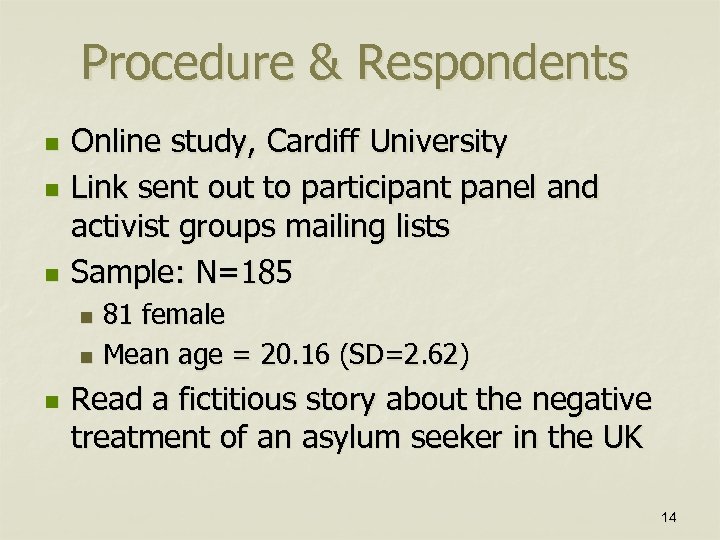 Procedure & Respondents n n n Online study, Cardiff University Link sent out to participant panel and activist groups mailing lists Sample: N=185 81 female n Mean age = 20. 16 (SD=2. 62) n n Read a fictitious story about the negative treatment of an asylum seeker in the UK 14
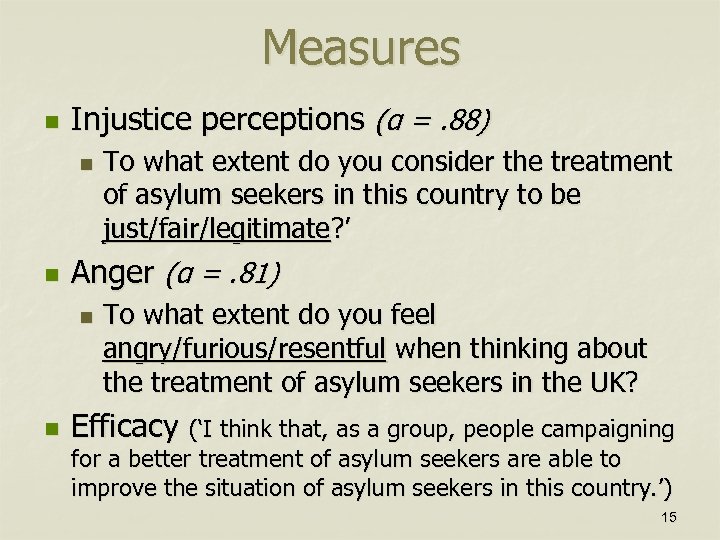 Measures n Injustice perceptions (α =. 88) n n Anger (α =. 81) n n To what extent do you consider the treatment of asylum seekers in this country to be just/fair/legitimate? ’ To what extent do you feel angry/furious/resentful when thinking about the treatment of asylum seekers in the UK? Efficacy (‘I think that, as a group, people campaigning for a better treatment of asylum seekers are able to improve the situation of asylum seekers in this country. ’) 15
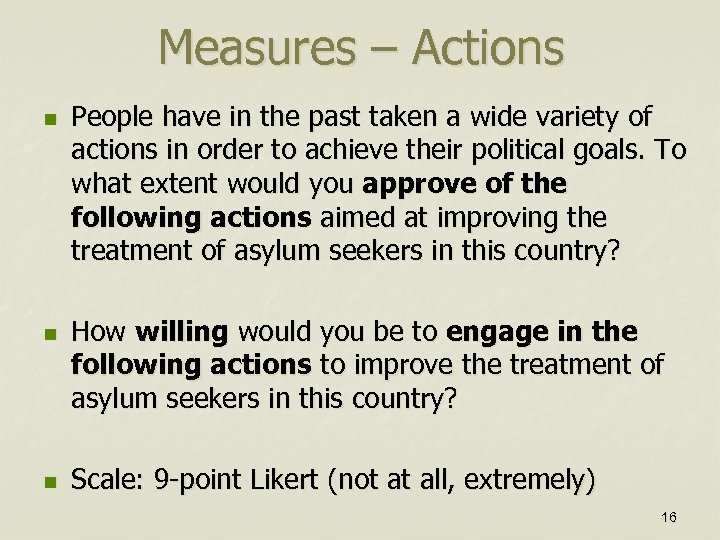 Measures – Actions n n n People have in the past taken a wide variety of actions in order to achieve their political goals. To what extent would you approve of the following actions aimed at improving the treatment of asylum seekers in this country? How willing would you be to engage in the following actions to improve the treatment of asylum seekers in this country? Scale: 9 -point Likert (not at all, extremely) 16
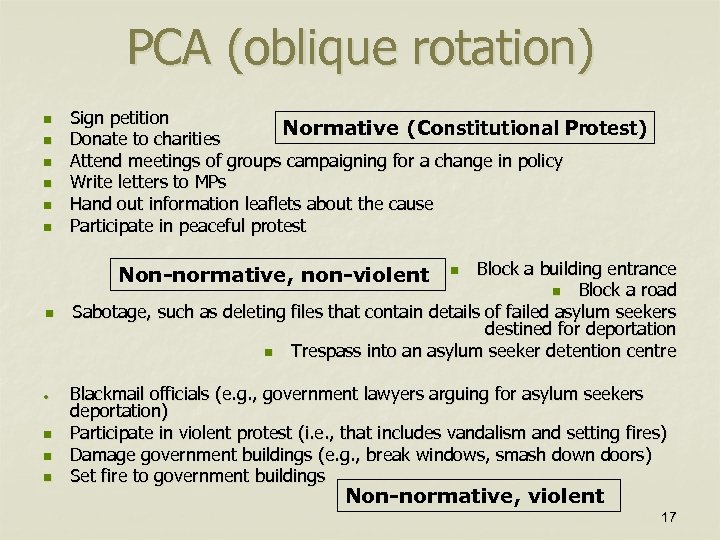 PCA (oblique rotation) n n n Sign petition Normative (Constitutional Protest) Donate to charities Attend meetings of groups campaigning for a change in policy Write letters to MPs Hand out information leaflets about the cause Participate in peaceful protest Block a building entrance n Block a road Sabotage, such as deleting files that contain details of failed asylum seekers destined for deportation n Trespass into an asylum seeker detention centre Non-normative, non-violent n n n Blackmail officials (e. g. , government lawyers arguing for asylum seekers deportation) Participate in violent protest (i. e. , that includes vandalism and setting fires) Damage government buildings (e. g. , break windows, smash down doors) Set fire to government buildings Non-normative, violent 17
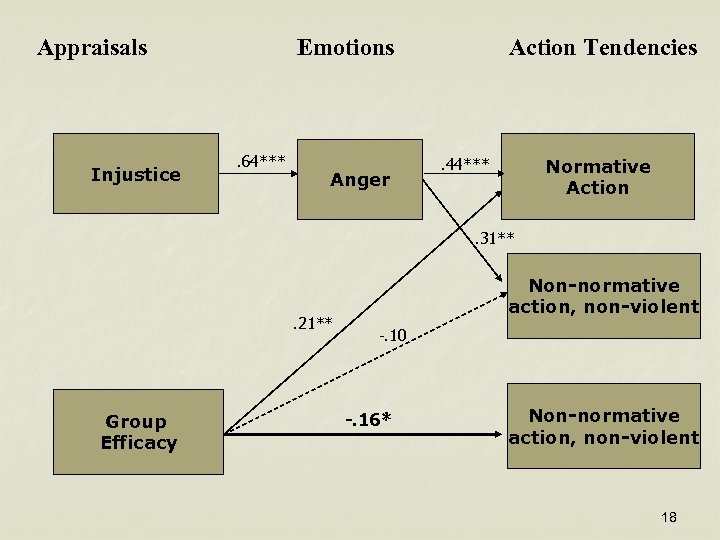 Appraisals Injustice Emotions . 64*** Anger Action Tendencies . 44*** Normative Action . 31** . 21** Group Efficacy Non-normative action, non-violent -. 10 -. 16* Non-normative action, non-violent 18
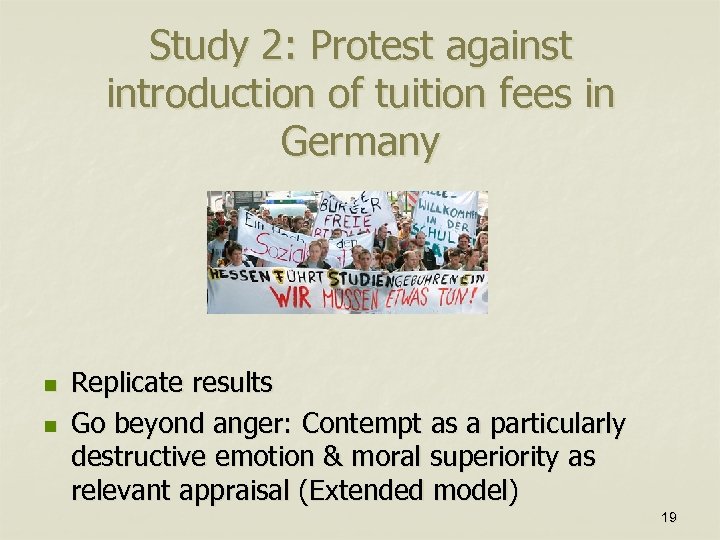 Study 2: Protest against introduction of tuition fees in Germany n n Replicate results Go beyond anger: Contempt as a particularly destructive emotion & moral superiority as relevant appraisal (Extended model) 19
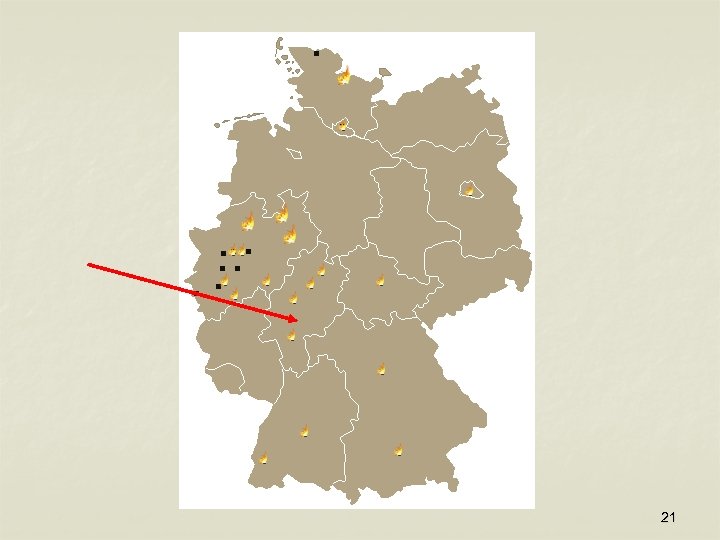
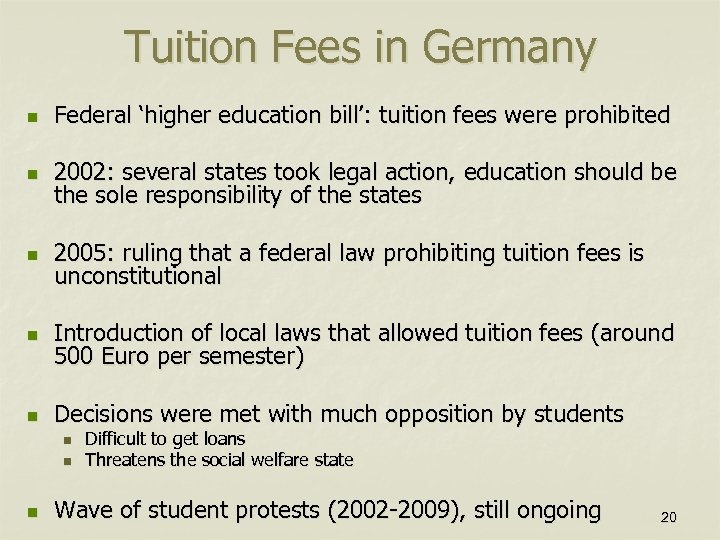 Tuition Fees in Germany n Federal ‘higher education bill’: tuition fees were prohibited n 2002: several states took legal action, education should be the sole responsibility of the states n 2005: ruling that a federal law prohibiting tuition fees is unconstitutional n Introduction of local laws that allowed tuition fees (around 500 Euro per semester) n Decisions were met with much opposition by students n n n Difficult to get loans Threatens the social welfare state Wave of student protests (2002 -2009), still ongoing 20
 21
21
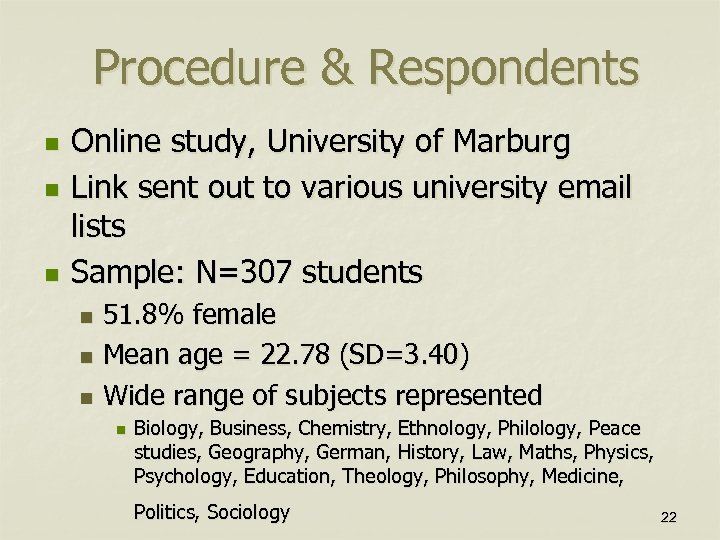 Procedure & Respondents n n n Online study, University of Marburg Link sent out to various university email lists Sample: N=307 students 51. 8% female n Mean age = 22. 78 (SD=3. 40) n Wide range of subjects represented n n Biology, Business, Chemistry, Ethnology, Philology, Peace studies, Geography, German, History, Law, Maths, Physics, Psychology, Education, Theology, Philosophy, Medicine, Politics, Sociology 22
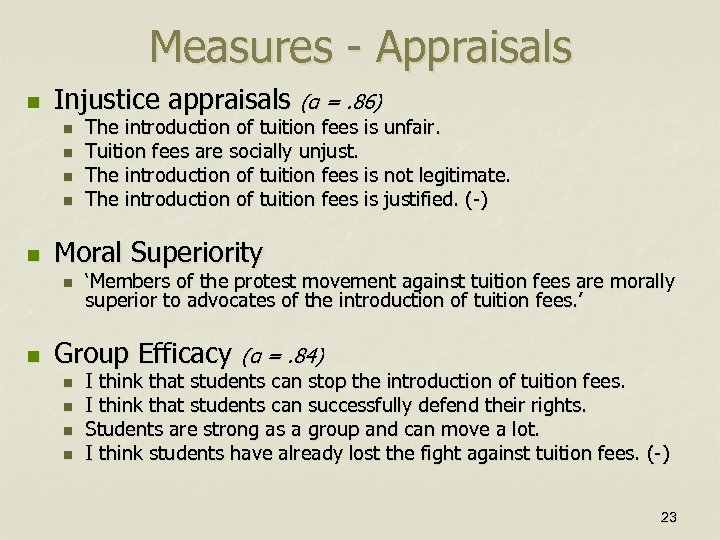 Measures - Appraisals n Injustice appraisals (α =. 86) n n n Moral Superiority n n The introduction of tuition fees is unfair. Tuition fees are socially unjust. The introduction of tuition fees is not legitimate. The introduction of tuition fees is justified. (-) ‘Members of the protest movement against tuition fees are morally superior to advocates of the introduction of tuition fees. ’ Group Efficacy (α =. 84) n n I think that students can stop the introduction of tuition fees. I think that students can successfully defend their rights. Students are strong as a group and can move a lot. I think students have already lost the fight against tuition fees. (-) 23
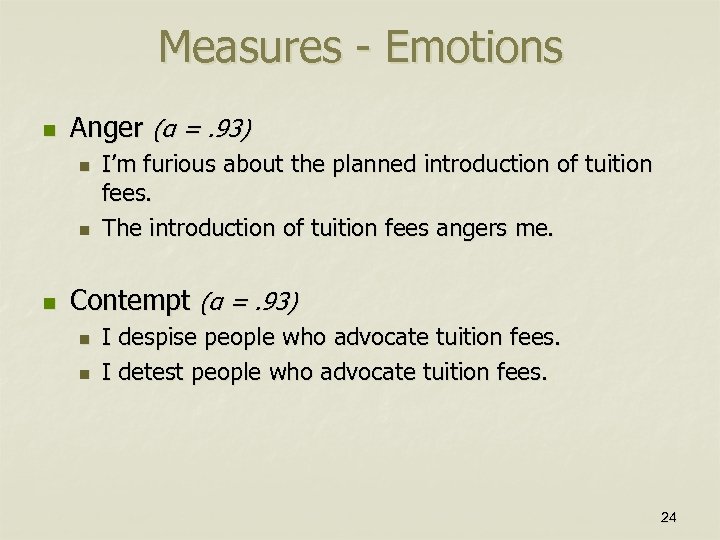 Measures - Emotions n Anger (α =. 93) n n n I’m furious about the planned introduction of tuition fees. The introduction of tuition fees angers me. Contempt (α =. 93) n n I despise people who advocate tuition fees. I detest people who advocate tuition fees. 24
 Measures – Action tendencies n How likely is it that you would participate in the following actions against tuition fees in the future? (1 = very unlikely, 7 = very likely) 25
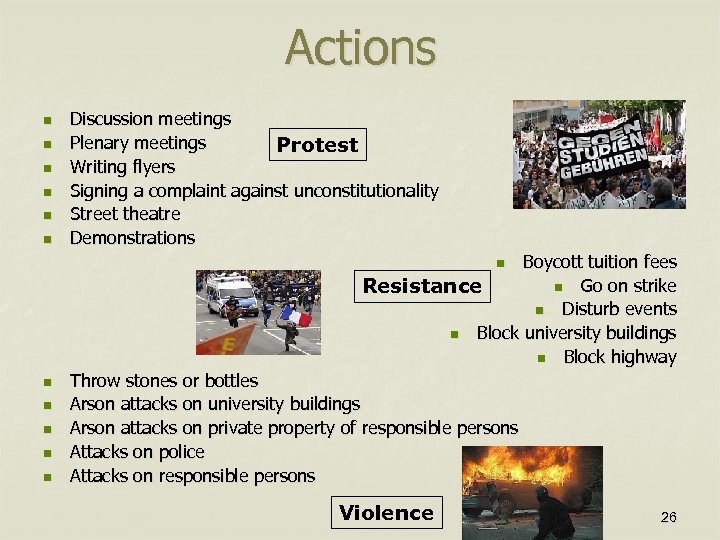 Actions n n n Discussion meetings Plenary meetings Protest Writing flyers Signing a complaint against unconstitutionality Street theatre Demonstrations Boycott tuition fees n Go on strike Resistance n Disturb events n Block university buildings n Block highway n n n Throw stones or bottles Arson attacks on university buildings Arson attacks on private property of responsible persons Attacks on police Attacks on responsible persons Violence 26
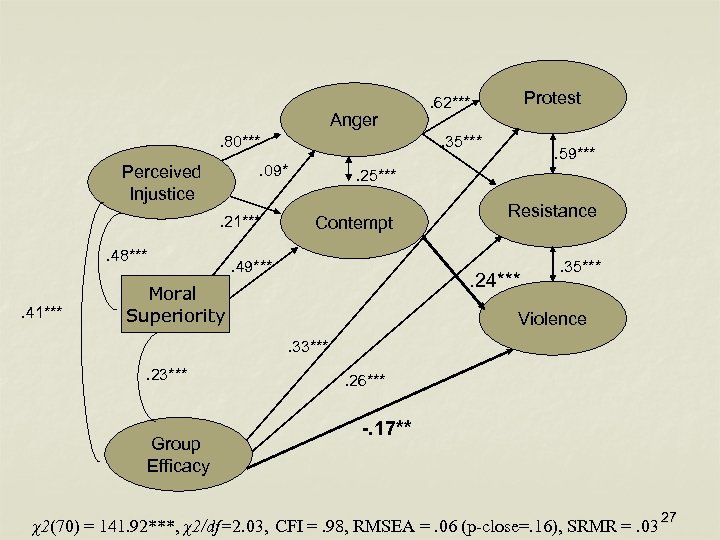 Anger. 80*** . 21***. 48***. 41*** . 35*** . 09* Perceived Injustice Protest . 62*** . 59*** . 25*** Contempt . 49*** Resistance . 24*** Moral Superiority . 35*** Violence. 33*** . 23*** Group Efficacy . 26*** -. 17** χ2(70) = 141. 92***, χ2/df=2. 03, CFI =. 98, RMSEA =. 06 (p-close=. 16), SRMR =. 03 27
 Discussion n Further theoretical development in order! n Two emotional routes to collective action: Injustice appraisals, anger, normative action (like in previous research) n Moral superiority, contempt, non-normative action (chronic ideological route? ) n 28
 Discussion n Group efficacy predicts both normative and nonnormative collective action But nature of effect differs for different types of action n Consistent with previous lab work (Wright et al. , 1991) n Negative relation to violent action (after repeated frustration? ) n Extreme actions in desperate circumstances! n Seems somewhat inconsistent with ‘rational actor model’ n Explore other functions of violence, more intermediate n n Influence third parties Provoke counter-reaction and expose opponent Revenge 29
 Study 3: The role of response efficacy in predicting support for violence among third parties How does the effectiveness of violent and non-violent resistance strategies by Palestinians against Israelis influence the attitudes of third parties toward the use of each strategy? (Reem Saab) 30
 Procedure n n n Participants: Cardiff students (study ongoing) 15 -minute documentary clip about the Israeli occupation of Palestinian territories Contained the manipulation of effectiveness of peaceful and violent action strategies by Palestinians (expert opinions) 2 x 2 design: Effectiveness of armed struggle (high/low) x Effectiveness of non-violent resistance (mass demonstrations, boycott, civil disobedience; high/low). DVs: Perceived legitimacy of attacks on Israeli settlers and attacks on Israeli civilians; Support for attacks on Israeli soldiers, settlers and civilians 31
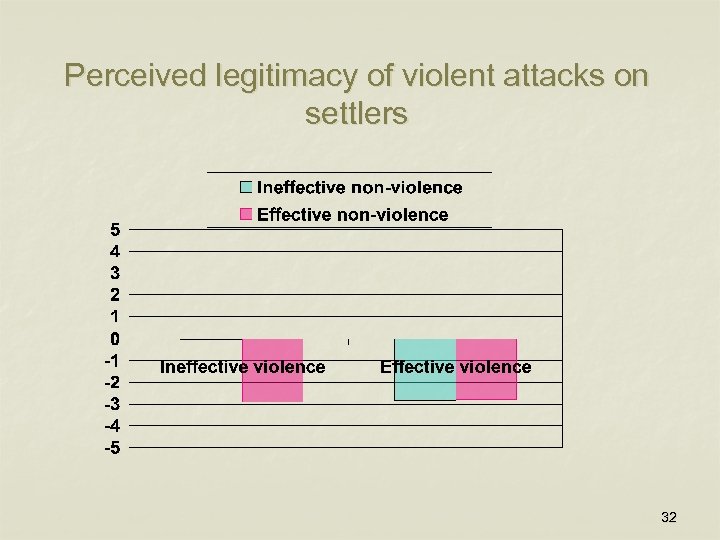 Perceived legitimacy of violent attacks on settlers 32
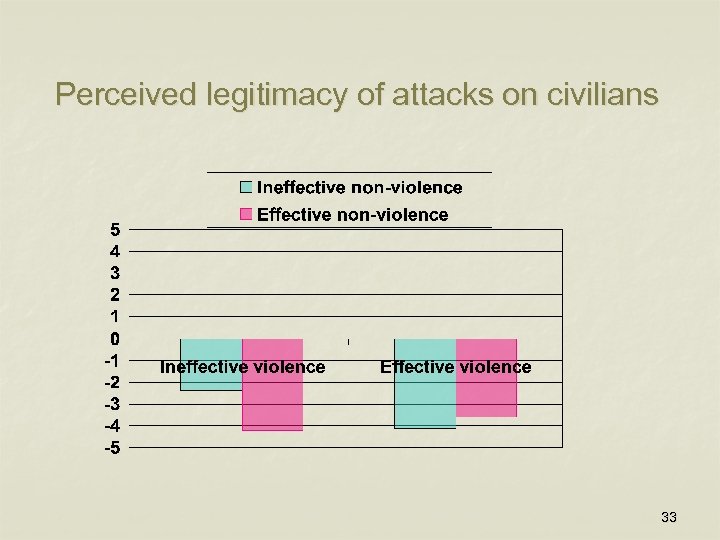 Perceived legitimacy of attacks on civilians 33
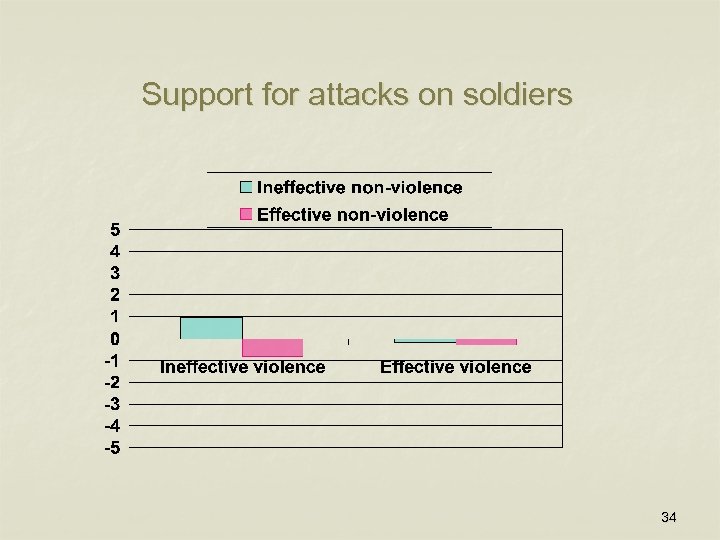 Support for attacks on soldiers 34
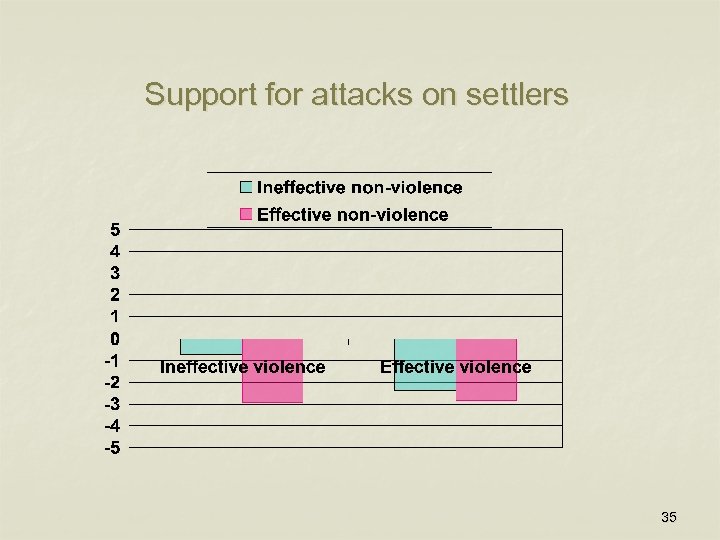 Support for attacks on settlers 35
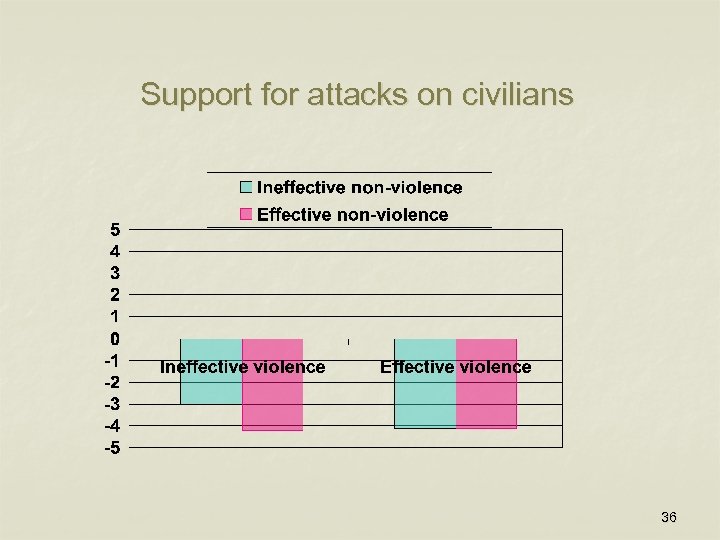 Support for attacks on civilians 36
 Discussion n n When groups are in a desperate circumstances (nothing to lose)… n Low perceived group efficacy n Low perceived response efficacy (of non-violence and even violence) …then more extreme measures favored (or less opposed) ‘Crushing’ resistance won’t necessarily reduce violence, likely to incite even more violence (Pratto et al. , 2009) Increase efficacy n open up legitimate channels for engagement n empowerment of disadvantaged groups Threatening to advantaged groups, reluctant to let go of power 37
 Acknowledgements Julia Becker, University of Marburg Russell Spears, Cardiff University Oliver Christ, University of Marburg Reem Saab, Cardiff University 38