


 Скачать презентацию EMMISION OF VOLATILE ORGANIC COMPOUNDS FROM HOUSEHOLD COMPOSTERS
4877629ff5a7d2f21f4dbcdc497bc8fa.ppt
- Количество слайдов: 1
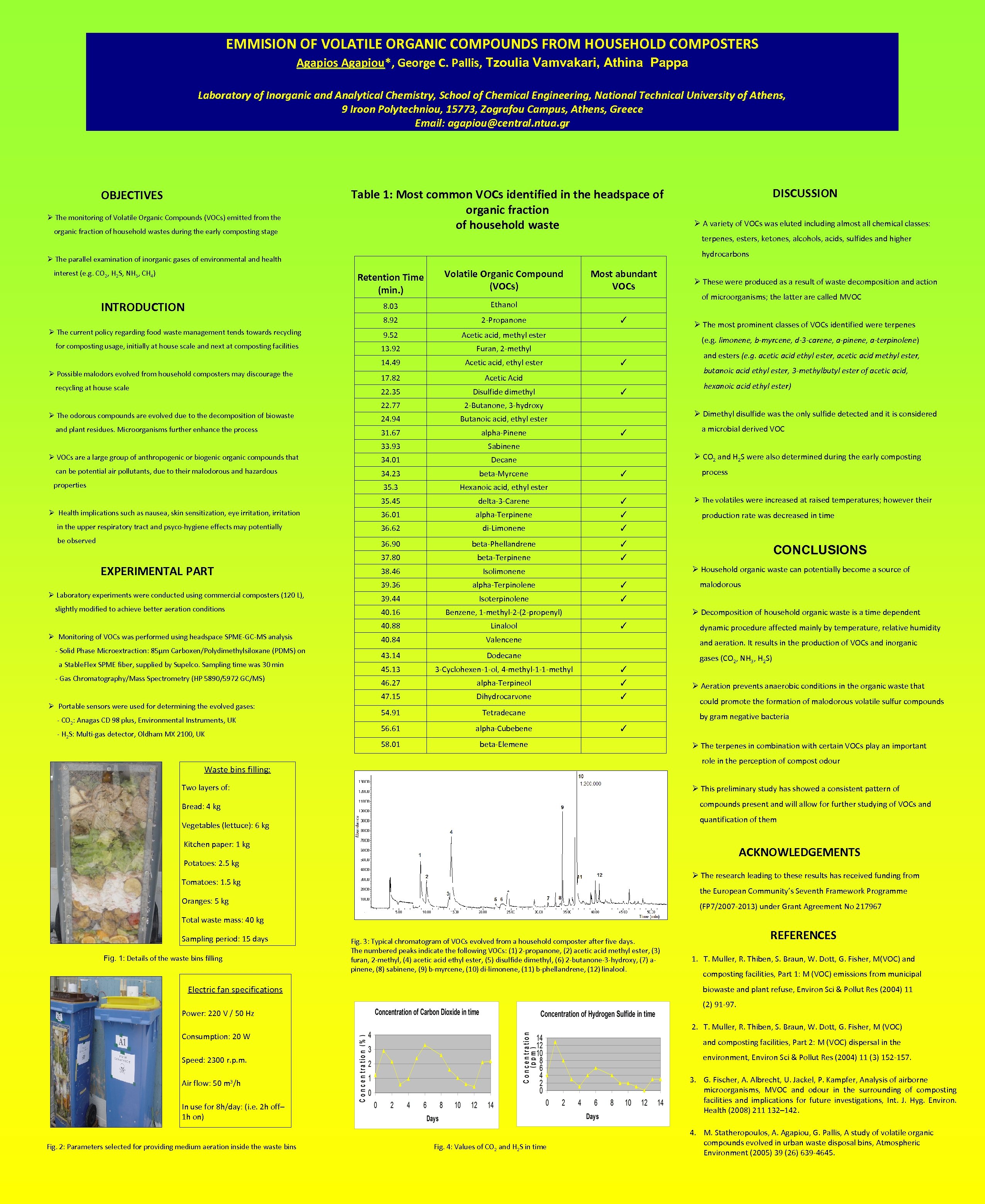 EMMISION OF VOLATILE ORGANIC COMPOUNDS FROM HOUSEHOLD COMPOSTERS Agapios Agapiou*, George C. Pallis, Tzoulia Vamvakari, Athina Pappa Laboratory of Inorganic and Analytical Chemistry, School of Chemical Engineering, National Technical University of Athens, 9 Iroon Polytechniou, 15773, Zografou Campus, Athens, Greece Email: agapiou@central. ntua. gr OBJECTIVES Ø The monitoring of Volatile Organic Compounds (VOCs) emitted from the organic fraction of household wastes during the early composting stage Table 1: Most common VOCs identified in the headspace of organic fraction of household waste DISCUSSION Ø A variety of VOCs was eluted including almost all chemical classes: terpenes, esters, ketones, alcohols, acids, sulfides and higher hydrocarbons Ø The parallel examination of inorganic gases of environmental and health Retention Time (min. ) Volatile Organic Compound (VOCs) 8. 03 Ethanol 8. 92 2 -Propanone Ø The current policy regarding food waste management tends towards recycling 9. 52 Acetic acid, methyl ester for composting usage, initially at house scale and next at composting facilities 13. 92 Furan, 2 -methyl 14. 49 Acetic acid, ethyl ester 17. 82 Acetic Acid 22. 35 Disulfide dimethyl 22. 77 2 -Butanone, 3 -hydroxy 24. 94 Butanoic acid, ethyl ester 31. 67 alpha-Pinene 33. 93 Sabinene 34. 01 Decane can be potential air pollutants, due to their malodorous and hazardous 34. 23 beta-Myrcene properties 35. 3 Hexanoic acid, ethyl ester 35. 45 delta-3 -Carene ✓ 36. 01 alpha-Terpinene ✓ in the upper respiratory tract and psyco-hygiene effects may potentially 36. 62 di-Limonene ✓ be observed 36. 90 beta-Phellandrene ✓ 37. 80 beta-Terpinene ✓ 38. 46 Isolimonene 39. 36 alpha-Terpinolene ✓ 39. 44 Isoterpinolene ✓ 40. 16 Benzene, 1 -methyl-2 -(2 -propenyl) 40. 88 Linalool 40. 84 Valencene and aeration. It results in the production of VOCs and inorganic 43. 14 Dodecane 45. 13 3 -Cyclohexen-1 -ol, 4 -methyl-1 -1 -methyl gases (CO 2, NH 3, H 2 S) ✓ 46. 27 alpha-Terpineol ✓ 47. 15 Dihydrocarvone ✓ 54. 91 Tetradecane 56. 61 alpha-Cubebene 58. 01 beta-Elemene interest (e. g. CO 2, H 2 S, NH 3, CH 4) INTRODUCTION Ø Possible malodors evolved from household composters may discourage the recycling at house scale Ø The odorous compounds are evolved due to the decomposition of biowaste and plant residues. Microorganisms further enhance the process Ø VOCs are a large group of anthropogenic or biogenic organic compounds that Ø Health implications such as nausea, skin sensitization, eye irritation, irritation EXPERIMENTAL PART Ø Laboratory experiments were conducted using commercial composters (120 L), slightly modified to achieve better aeration conditions Ø Monitoring of VOCs was performed using headspace SPME-GC-MS analysis - Solid Phase Microextraction: 85μm Carboxen/Polydimethylsiloxane (PDMS) on a Stable. Flex SPME fiber, supplied by Supelco. Sampling time was 30 min - Gas Chromatography/Mass Spectrometry (HP 5890/5972 GC/MS) Ø Portable sensors were used for determining the evolved gases: - CO 2: Anagas CD 98 plus, Environmental Instruments, UK - H 2 S: Multi-gas detector, Oldham MX 2100, UK Most abundant VOCs ✓ Ø These were produced as a result of waste decomposition and action of microorganisms; the latter are called MVOC Ø The most prominent classes of VOCs identified were terpenes (e. g. limonene, b-myrcene, d-3 -carene, a-pinene, a-terpinolene) ✓ ✓ and esters (e. g. acetic acid ethyl ester, acetic acid methyl ester, butanoic acid ethyl ester, 3 -methylbutyl ester of acetic acid, hexanoic acid ethyl ester) Ø Dimethyl disulfide was the only sulfide detected and it is considered ✓ a microbial derived VOC Ø CO 2 and H 2 S were also determined during the early composting ✓ process Ø The volatiles were increased at raised temperatures; however their production rate was decreased in time CONCLUSIONS Ø Household organic waste can potentially become a source of malodorous Ø Decomposition of household organic waste is a time dependent ✓ dynamic procedure affected mainly by temperature, relative humidity Ø Aeration prevents anaerobic conditions in the organic waste that could promote the formation of malodorous volatile sulfur compounds by gram negative bacteria ✓ Ø The terpenes in combination with certain VOCs play an important role in the perception of compost odour Waste bins filling: Two layers of: Ø This preliminary study has showed a consistent pattern of compounds present and will allow for further studying of VOCs and Bread: 4 kg quantification of them Vegetables (lettuce): 6 kg Kitchen paper: 1 kg ACKNOWLEDGEMENTS Potatoes: 2. 5 kg Ø The research leading to these results has received funding from Tomatoes: 1. 5 kg the European Community’s Seventh Framework Programme Oranges: 5 kg (FP 7/2007 -2013) under Grant Agreement No 217967 Total waste mass: 40 kg Sampling period: 15 days Fig. 1: Details of the waste bins filling Fig. 3: Typical chromatogram of VOCs evolved from a household composter after five days. The numbered peaks indicate the following VOCs: (1) 2 -propanone, (2) acetic acid methyl ester, (3) furan, 2 -methyl, (4) acetic acid ethyl ester, (5) disulfide dimethyl, (6) 2 -butanone-3 -hydroxy, (7) apinene, (8) sabinene, (9) b-myrcene, (10) di-limonene, (11) b-phellandrene, (12) linalool. Electric fan specifications 1. T. Muller, R. Thiben, S. Braun, W. Dott, G. Fisher, M(VOC) and composting facilities, Part 1: M (VOC) emissions from municipal biowaste and plant refuse, Environ Sci & Pollut Res (2004) 11 (2) 91 -97. Power: 220 V / 50 Hz 2. T. Muller, R. Thiben, S. Braun, W. Dott, G. Fisher, M (VOC) Consumption: 20 W and composting facilities, Part 2: M (VOC) dispersal in the environment, Environ Sci & Pollut Res (2004) 11 (3) 152 -157. Speed: 2300 r. p. m. 3. G. Fischer, A. Albrecht, U. Jackel, P. Kampfer, Analysis of airborne microorganisms, MVOC and odour in the surrounding of composting facilities and implications for future investigations, Int. J. Hyg. Environ. Health (2008) 211 132– 142. Air flow: 50 m 3/h In use for 8 h/day: (i. e. 2 h off– 1 h on) Fig. 2: Parameters selected for providing medium aeration inside the waste bins REFERENCES Fig. 4: Values of CO 2 and H 2 S in time 4. M. Statheropoulos, A. Agapiou, G. Pallis, A study of volatile organic compounds evolved in urban waste disposal bins, Atmospheric Environment (2005) 39 (26) 639 -4645.