


 Скачать презентацию Emission of N 2 O as Levels of
4b7a77806051137aba1f473d7c4fed2b.ppt
- Количество слайдов: 1
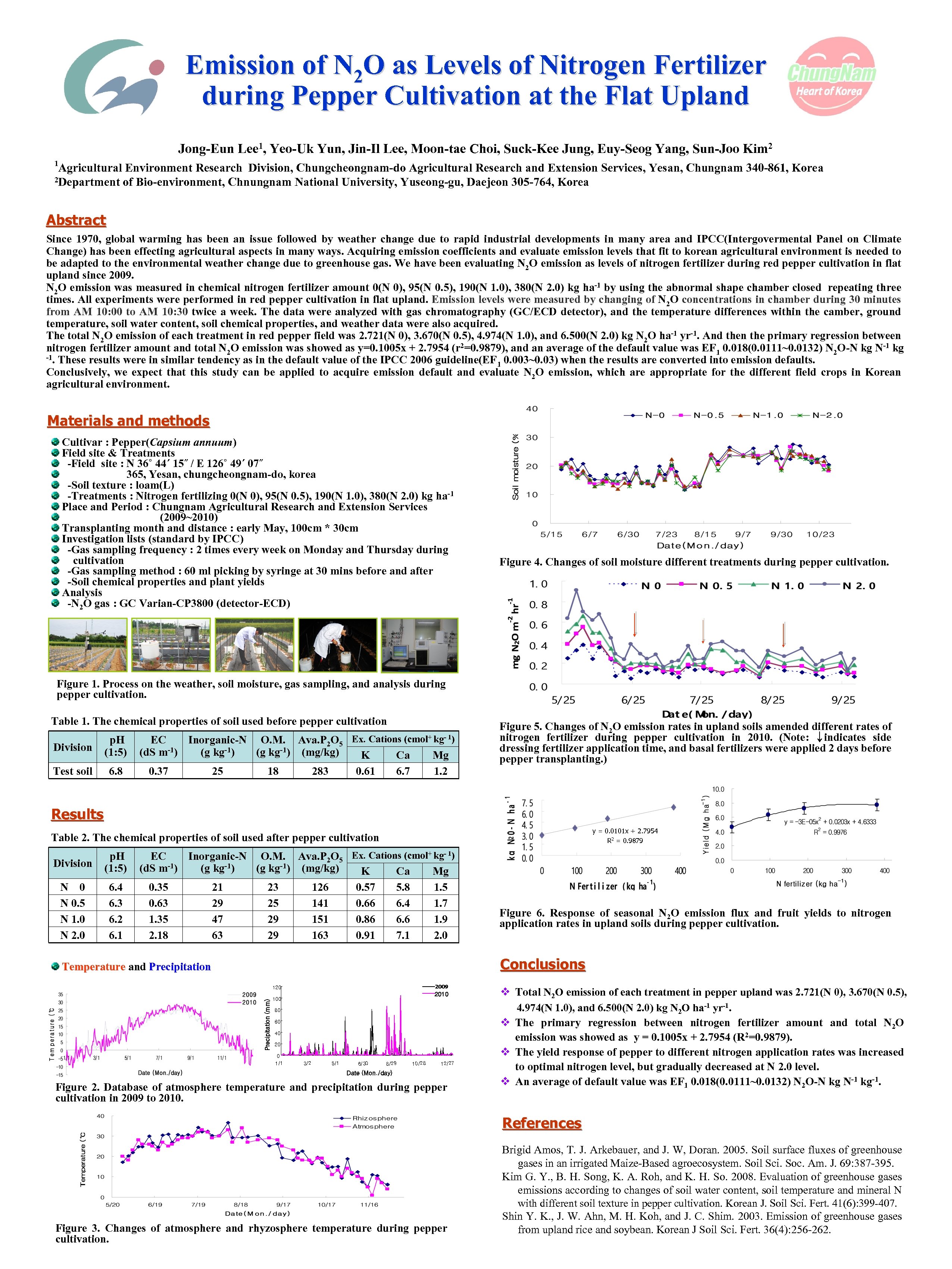 Emission of N 2 O as Levels of Nitrogen Fertilizer during Pepper Cultivation at the Flat Upland Jong-Eun Lee 1, Yeo-Uk Yun, Jin-Il Lee, Moon-tae Choi, Suck-Kee Jung, Euy-Seog Yang, Sun-Joo Kim 2 1 Agricultural Environment Research Division, Chungcheongnam-do Agricultural Research and Extension Services, Yesan, Chungnam 340 -861, Korea 2 Department of Bio-environment, Chnungnam National University, Yuseong-gu, Daejeon 305 -764, Korea Abstract Since 1970, global warming has been an issue followed by weather change due to rapid industrial developments in many area and IPCC(Intergovermental Panel on Climate Change) has been effecting agricultural aspects in many ways. Acquiring emission coefficients and evaluate emission levels that fit to korean agricultural environment is needed to be adapted to the environmental weather change due to greenhouse gas. We have been evaluating N 2 O emission as levels of nitrogen fertilizer during red pepper cultivation in flat upland since 2009. N 2 O emission was measured in chemical nitrogen fertilizer amount 0(N 0), 95(N 0. 5), 190(N 1. 0), 380(N 2. 0) kg ha-1 by using the abnormal shape chamber closed repeating three times. All experiments were performed in red pepper cultivation in flat upland. Emission levels were measured by changing of N 2 O concentrations in chamber during 30 minutes from AM 10: 00 to AM 10: 30 twice a week. The data were analyzed with gas chromatography (GC/ECD detector), and the temperature differences within the camber, ground temperature, soil water content, soil chemical properties, and weather data were also acquired. The total N 2 O emission of each treatment in red pepper field was 2. 721(N 0), 3. 670(N 0. 5), 4. 974(N 1. 0), and 6. 500(N 2. 0) kg N 2 O ha-1 yr-1. And then the primary regression between nitrogen fertilizer amount and total N 2 O emission was showed as y=0. 1005 x + 2. 7954 (r 2=0. 9879), and an average of the default value was EF 1 0. 018(0. 0111~0. 0132) N 2 O-N kg N-1 kg -1. These results were in similar tendency as in the default value of the IPCC 2006 guideline(EF 0. 003~0. 03) when the results are converted into emission defaults. 1 Conclusively, we expect that this study can be applied to acquire emission default and evaluate N 2 O emission, which are appropriate for the different field crops in Korean agricultural environment. Materials and methods Cultivar : Pepper(Capsium annuum) Field site & Treatments -Field site : N 36˚ 44´ 15˝ / E 126˚ 49´ 07˝ 365, Yesan, chungcheongnam-do, korea -Soil texture : loam(L) -Treatments : Nitrogen fertilizing 0(N 0), 95(N 0. 5), 190(N 1. 0), 380(N 2. 0) kg ha-1 Place and Period : Chungnam Agricultural Research and Extension Services (2009~2010) Transplanting month and distance : early May, 100 cm * 30 cm Investigation lists (standard by IPCC) -Gas sampling frequency : 2 times every week on Monday and Thursday during cultivation -Gas sampling method : 60 ml picking by syringe at 30 mins before and after -Soil chemical properties and plant yields Analysis -N 2 O gas : GC Varian-CP 3800 (detector-ECD) Figure 4. Changes of soil moisture different treatments during pepper cultivation. Figure 1. Process on the weather, soil moisture, gas sampling, and analysis during pepper cultivation. Table 1. The chemical properties of soil used before pepper cultivation Division p. H (1: 5) Test soil 6. 8 EC Inorganic-N O. M. Ava. P 2 O 5 Ex. Cations (cmol+ kg- 1) (d. S m-1) (g kg-1) (mg/kg) K Ca Mg 0. 37 25 18 283 0. 61 6. 7 1. 2 Figure 5. Changes of N 2 O emission rates in upland soils amended different rates of nitrogen fertilizer during pepper cultivation in 2010. (Note: ↓indicates side dressing fertilizer application time, and basal fertilizers were applied 2 days before pepper transplanting. ) Results y = 0. 0101 x + 2. 7954 R 2 = 0. 9879 Table 2. The chemical properties of soil used after pepper cultivation Division p. H (1: 5) N 0 N 0. 5 N 1. 0 N 2. 0 6. 4 6. 3 6. 2 6. 1 EC Inorganic-N O. M. Ava. P 2 O 5 Ex. Cations (cmol+ kg- 1) (d. S m-1) (g kg-1) (mg/kg) K Ca Mg 0. 35 21 23 126 0. 57 5. 8 1. 5 0. 63 29 25 141 0. 66 6. 4 1. 7 1. 35 47 29 151 0. 86 6. 6 1. 9 2. 18 63 29 163 0. 91 7. 1 2. 0 Figure 6. Response of seasonal N 2 O emission flux and fruit yields to nitrogen application rates in upland soils during pepper cultivation. Conclusions Temperature and Precipitation 2009 Precipitation (mm) 120 2010 100 80 60 40 20 0 1/1 3/2 5/1 6/30 8/29 10/28 12/27 Date (Mon. /day) Figure 2. Database of atmosphere temperature and precipitation during pepper cultivation in 2009 to 2010. v Total N 2 O emission of each treatment in pepper upland was 2. 721(N 0), 3. 670(N 0. 5), 4. 974(N 1. 0), and 6. 500(N 2. 0) kg N 2 O ha-1 yr-1. v The primary regression between nitrogen fertilizer amount and total N 2 O emission was showed as y = 0. 1005 x + 2. 7954 (R 2=0. 9879). v The yield response of pepper to different nitrogen application rates was increased to optimal nitrogen level, but gradually decreased at N 2. 0 level. v An average of default value was EF 1 0. 018(0. 0111~0. 0132) N 2 O-N kg N-1 kg-1. References Figure 3. Changes of atmosphere and rhyzosphere temperature during pepper cultivation. Brigid Amos, T. J. Arkebauer, and J. W, Doran. 2005. Soil surface fluxes of greenhouse gases in an irrigated Maize-Based agroecosystem. Soil Sci. Soc. Am. J. 69: 387 -395. Kim G. Y. , B. H. Song, K. A. Roh, and K. H. So. 2008. Evaluation of greenhouse gases emissions according to changes of soil water content, soil temperature and mineral N with different soil texture in pepper cultivation. Korean J. Soil Sci. Fert. 41(6): 399 -407. Shin Y. K. , J. W. Ahn, M. H. Koh, and J. C. Shim. 2003. Emission of greenhouse gases from upland rice and soybean. Korean J Soil Sci. Fert. 36(4): 256 -262.