 Скачать презентацию Emily Dickinson Why do birds migrate
6c300ffd2f6d32a662209e0101d4f0a8.ppt
- Количество слайдов: 35




Emily Dickinson
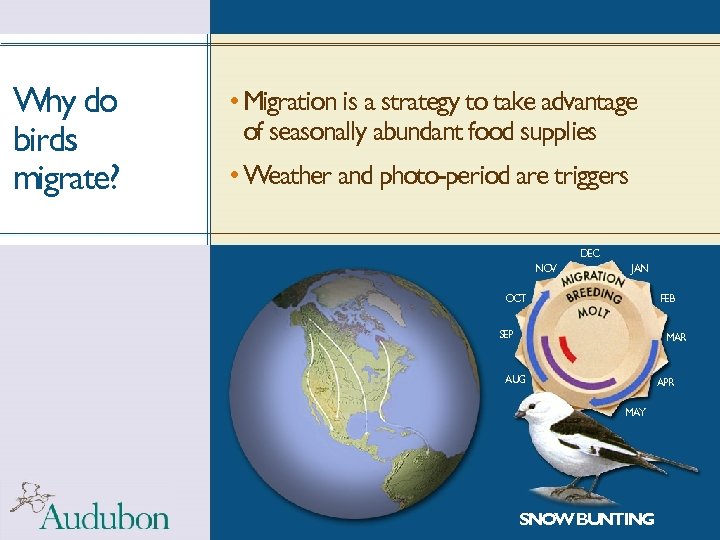
Why do birds migrate? • Migration is a strategy to take advantage of seasonally abundant food supplies • Weather and photo-period are triggers DEC NOV JAN OCT FEB SEP MAR AUG APR MAY SNOW BUNTING
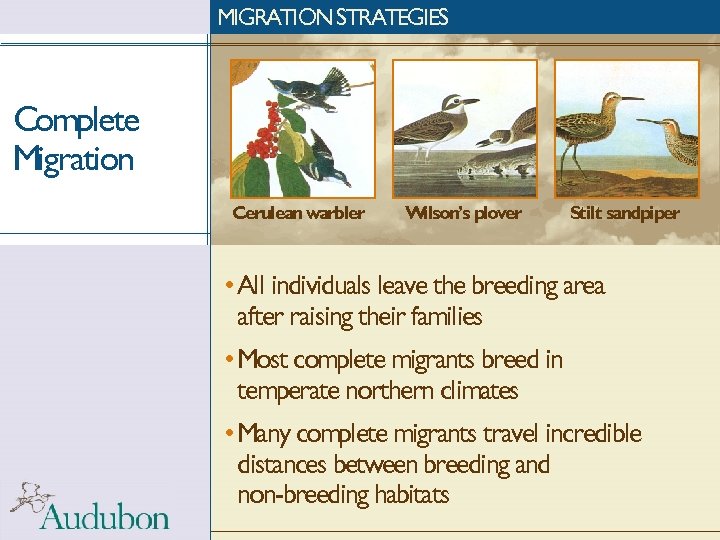
MIGRATION STRATEGIES Complete Migration Cerulean warbler Wilson’s plover Stilt sandpiper • All individuals leave the breeding area after raising their families • Most complete migrants breed in temperate northern climates • Many complete migrants travel incredible distances between breeding and non-breeding habitats
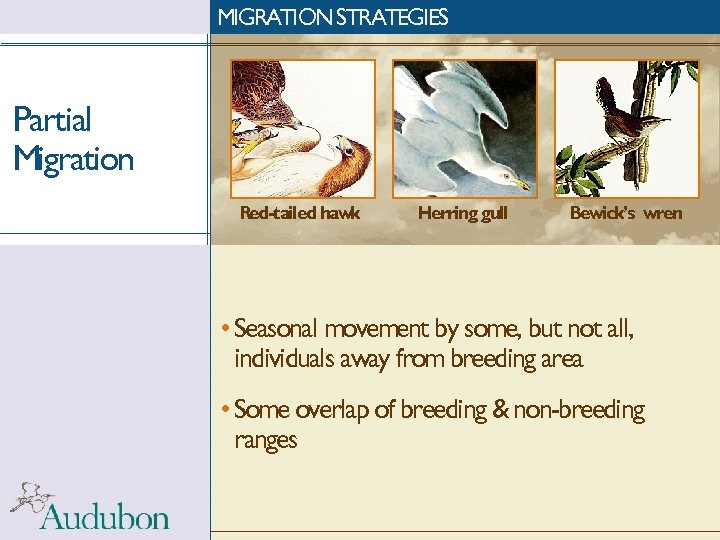
MIGRATION STRATEGIES Partial Migration Red-tailed hawk Herring gull Bewick’s wren • Seasonal movement by some, but not all, individuals away from breeding area • Some overlap of breeding & non-breeding ranges
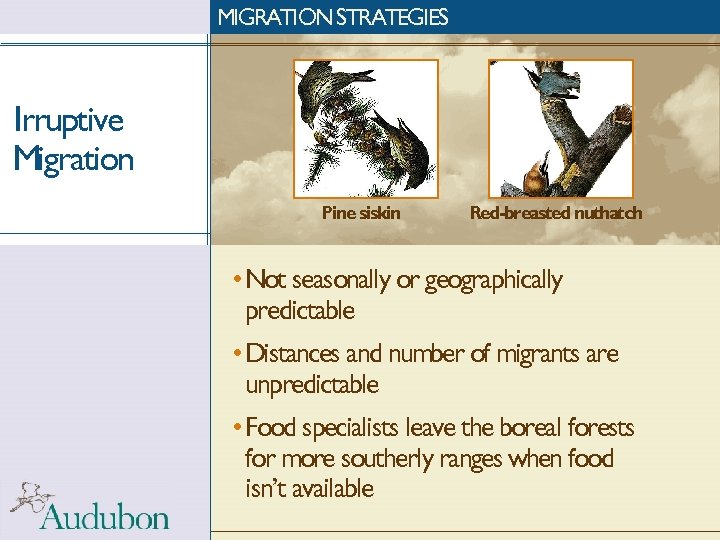
MIGRATION STRATEGIES Irruptive Migration Pine siskin Red-breasted nuthatch • Not seasonally or geographically predictable • Distances and number of migrants are unpredictable • Food specialists leave the boreal forests for more southerly ranges when food isn’t available
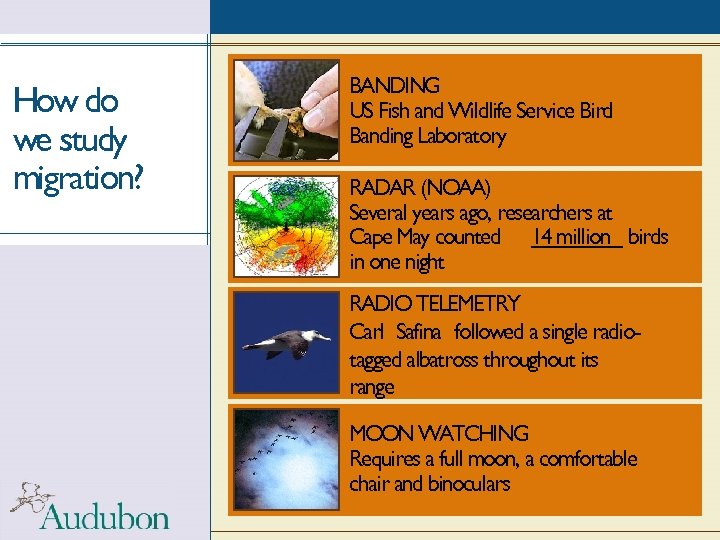
How do we study migration? BANDING US Fish and Wildlife Service Bird Banding Laboratory RADAR (NOAA) Several years ago, researchers at Cape May counted 14 million birds in one night RADIO TELEMETRY Carl Safina followed a single radiotagged albatross throughout its range MOON WATCHING Requires a full moon, a comfortable chair and binoculars
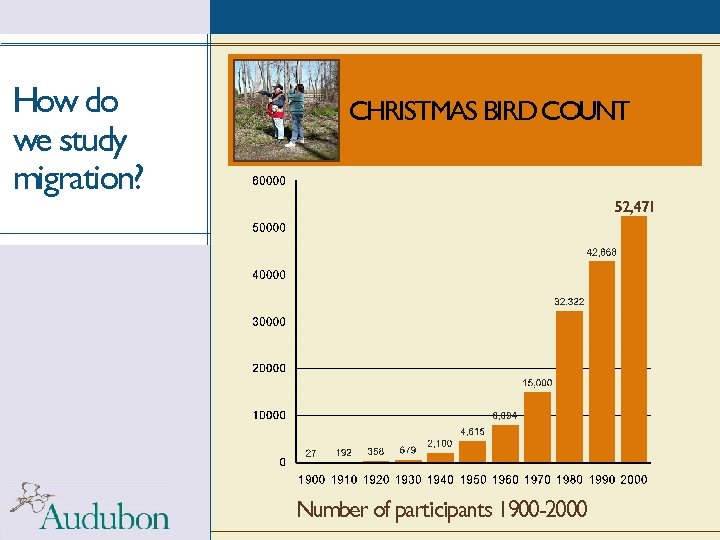
How do we study migration? CHRISTMAS BIRD COUNT 52, 471 Number of participants 1900 -2000
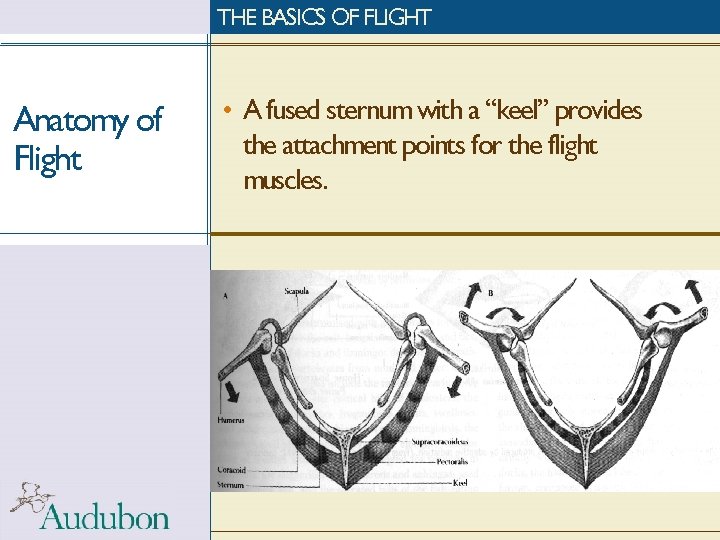
THE BASICS OF FLIGHT Anatomy of Flight • A fused sternum with a “keel” provides the attachment points for the flight muscles.
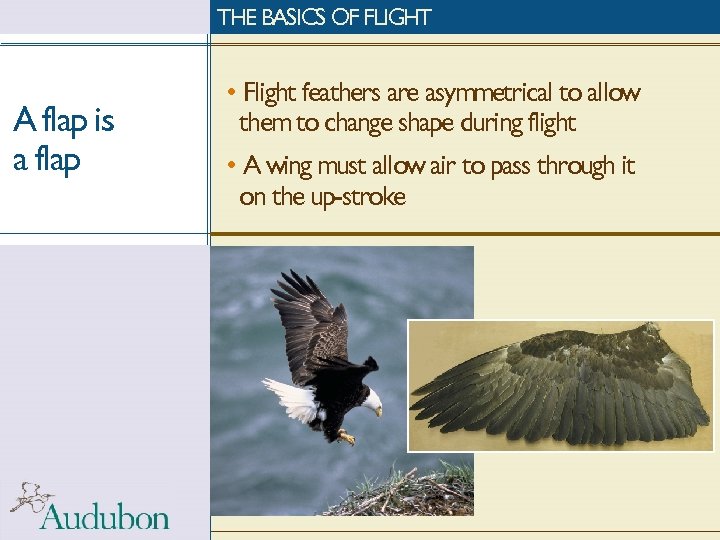
THE BASICS OF FLIGHT A flap is a flap • Flight feathers are asymmetrical to allow them to change shape during flight • A wing must allow air to pass through it on the up-stroke
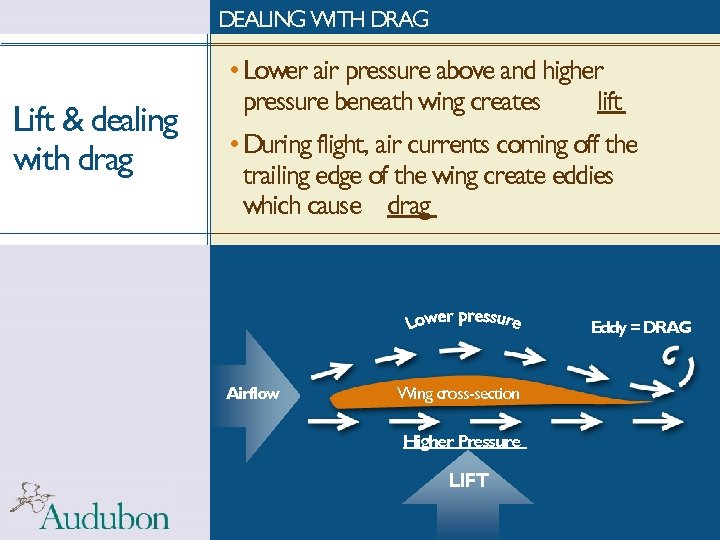
DEALING WITH DRAG Lift & dealing with drag • Lower air pressure above and higher pressure beneath wing creates lift • During flight, air currents coming off the trailing edge of the wing create eddies which cause drag Eddy = DRAG Airflow Wing cross-section Higher Pressure LIFT
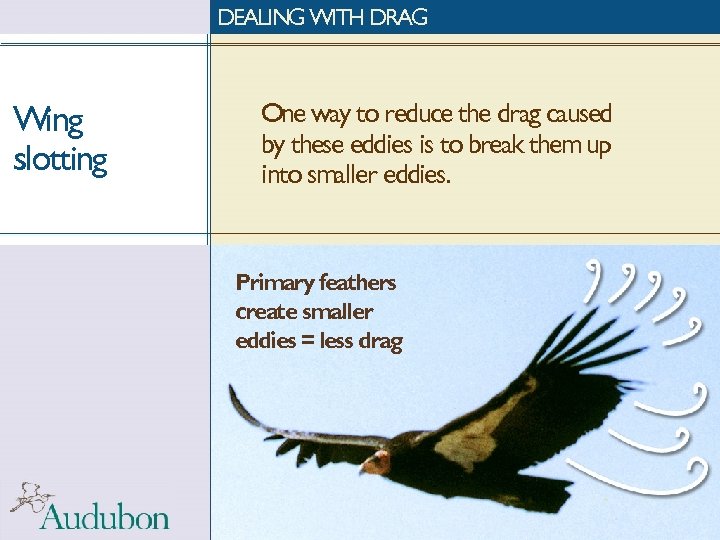
DEALING WITH DRAG Wing slotting One way to reduce the drag caused by these eddies is to break them up into smaller eddies. Primary feathers create smaller eddies = less drag
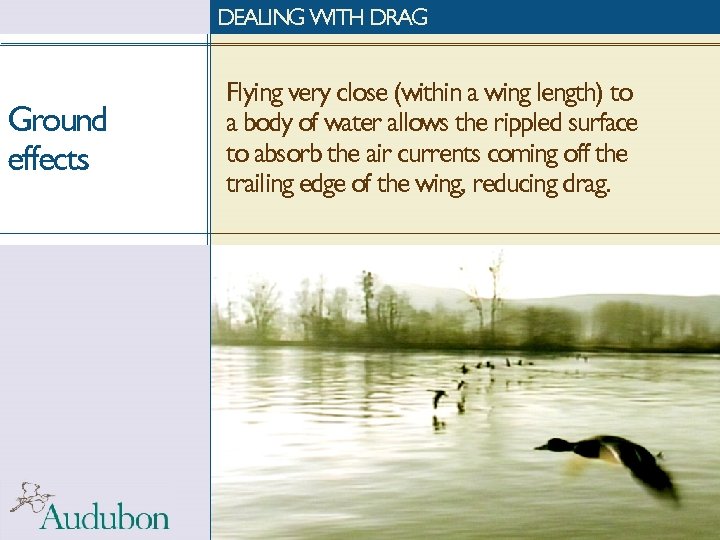
DEALING WITH DRAG Ground effects Flying very close (within a wing length) to a body of water allows the rippled surface to absorb the air currents coming off the trailing edge of the wing, reducing drag.
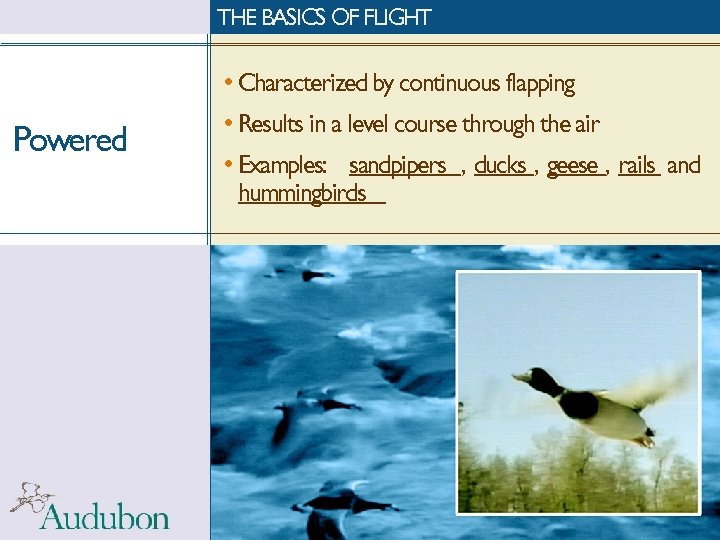
THE BASICS OF FLIGHT • Characterized by continuous flapping Powered • Results in a level course through the air • Examples: sandpipers , ducks , geese , rails and hummingbirds
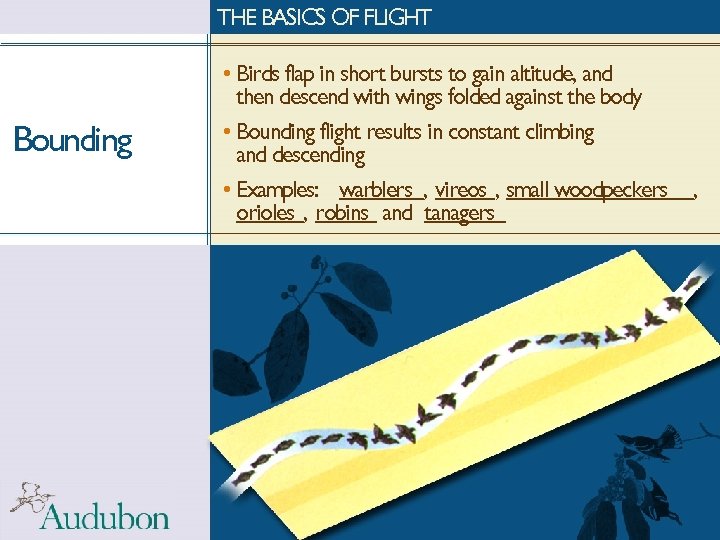
THE BASICS OF FLIGHT Bounding • Birds flap in short bursts to gain altitude, and then descend with wings folded against the body • Bounding flight results in constant climbing and descending • Examples: warblers , vireos , small woodpeckers orioles , robins and tanagers ,
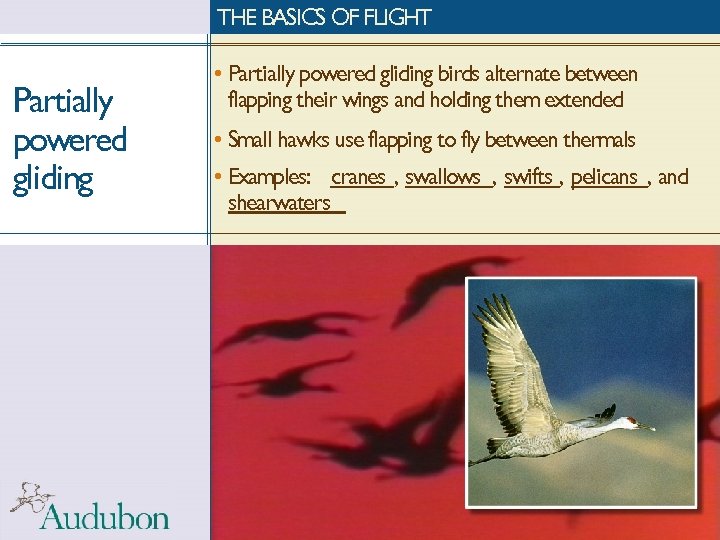
THE BASICS OF FLIGHT Partially powered gliding • Partially powered gliding birds alternate between flapping their wings and holding them extended • Small hawks use flapping to fly between thermals • Examples: cranes , swallows , swifts , pelicans , and shearwaters
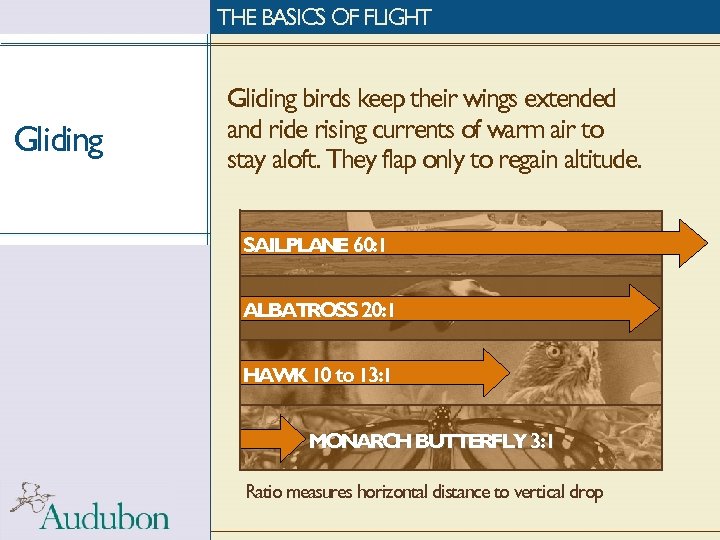
THE BASICS OF FLIGHT Gliding birds keep their wings extended and ride rising currents of warm air to stay aloft. They flap only to regain altitude. SAILPLANE 60: 1 ALBATROSS 20: 1 HAWK 10 to 13: 1 MONARCH BUTTERFLY 3: 1 Ratio measures horizontal distance to vertical drop
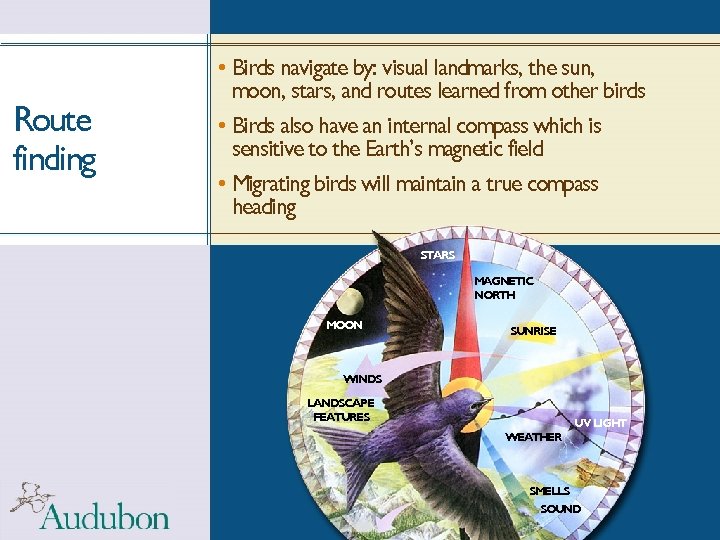
Route finding • Birds navigate by: visual landmarks, the sun, moon, stars, and routes learned from other birds • Birds also have an internal compass which is sensitive to the Earth’s magnetic field • Migrating birds will maintain a true compass heading STARS MAGNETIC NORTH MOON SUNRISE WINDS LANDSCAPE FEATURES UV LIGHT WEATHER SMELLS SOUND
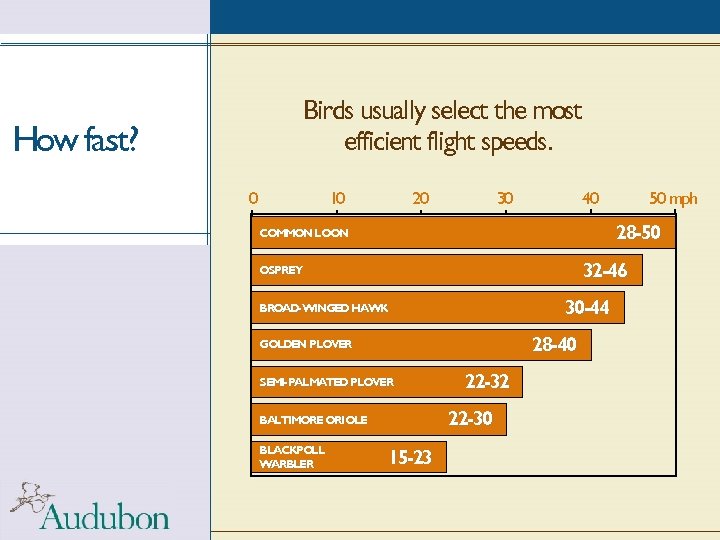
Birds usually select the most efficient flight speeds. How fast? 0 10 20 30 40 28 -50 COMMON LOON 32 -46 OSPREY 30 -44 BROAD-WINGED HAWK 28 -40 GOLDEN PLOVER SEMI-PALMATED PLOVER 22 -32 22 -30 BALTIMORE ORIOLE BLACKPOLL WARBLER 50 mph 15 -23
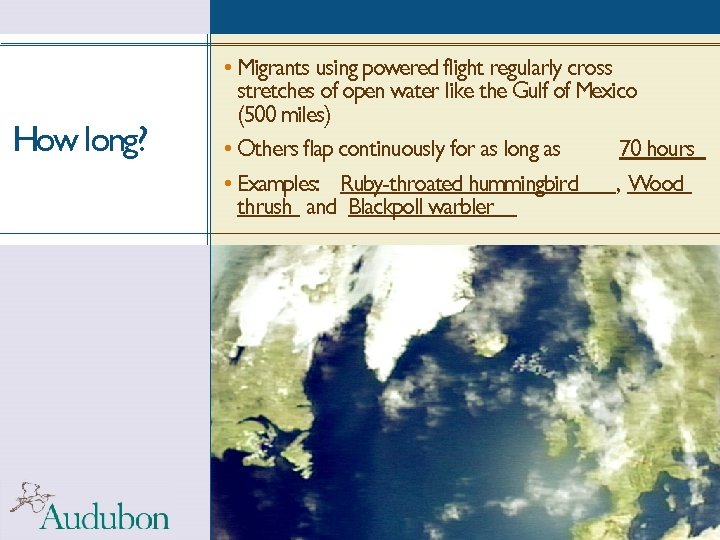
How long? • Migrants using powered flight regularly cross stretches of open water like the Gulf of Mexico (500 miles) • Others flap continuously for as long as 70 hours • Examples: Ruby-throated hummingbird , Wood thrush and Blackpoll warbler
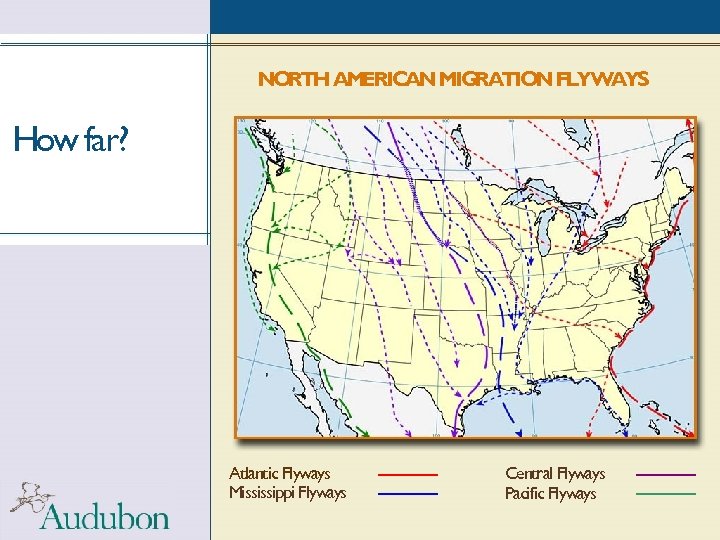
NORTH AMERICAN MIGRATION FLYWAYS How far? Atlantic Flyways Mississippi Flyways Central Flyways Pacific Flyways
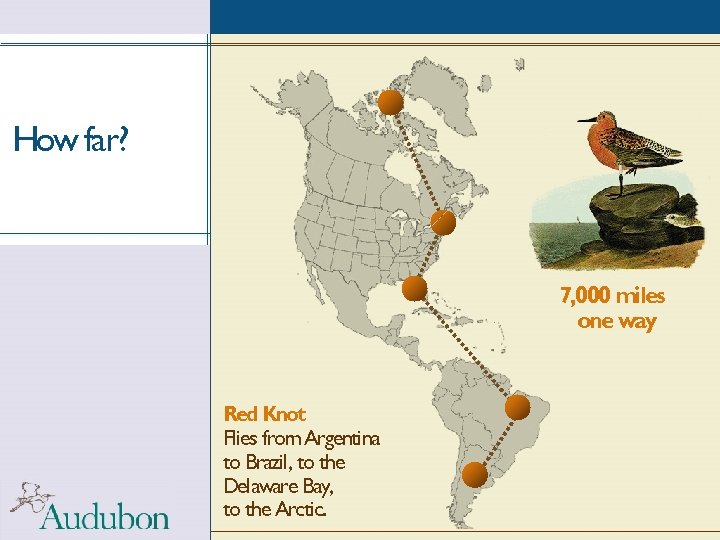
How far? 7, 000 miles one way Red Knot Flies from Argentina to Brazil, to the Delaware Bay, to the Arctic.
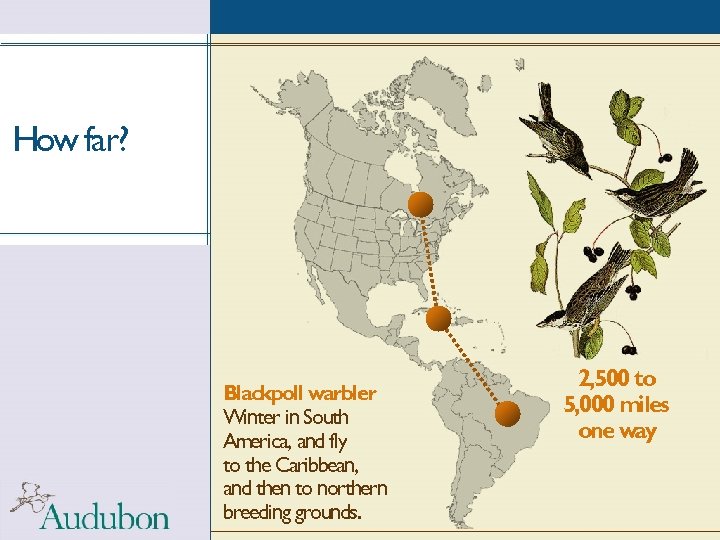
How far? Blackpoll warbler Winter in South America, and fly to the Caribbean, and then to northern breeding grounds. 2, 500 to 5, 000 miles one way
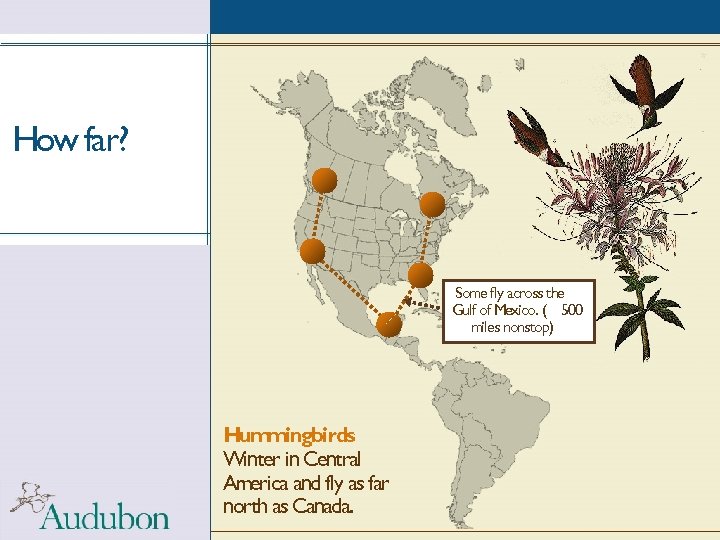
How far? Some fly across the Gulf of Mexico. ( 500 miles nonstop) Hummingbirds Winter in Central America and fly as far north as Canada.
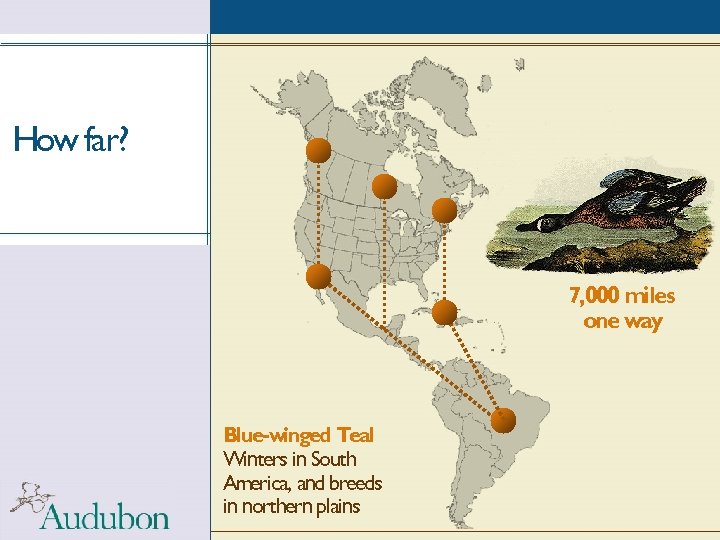
How far? 7, 000 miles one way Blue-winged Teal Winters in South America, and breeds in northern plains
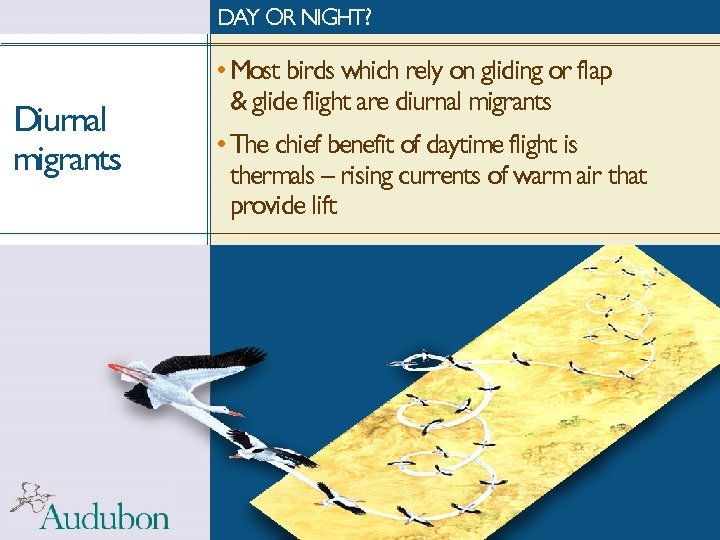
DAY OR NIGHT? Diurnal migrants • Most birds which rely on gliding or flap & glide flight are diurnal migrants • The chief benefit of daytime flight is thermals – rising currents of warm air that provide lift
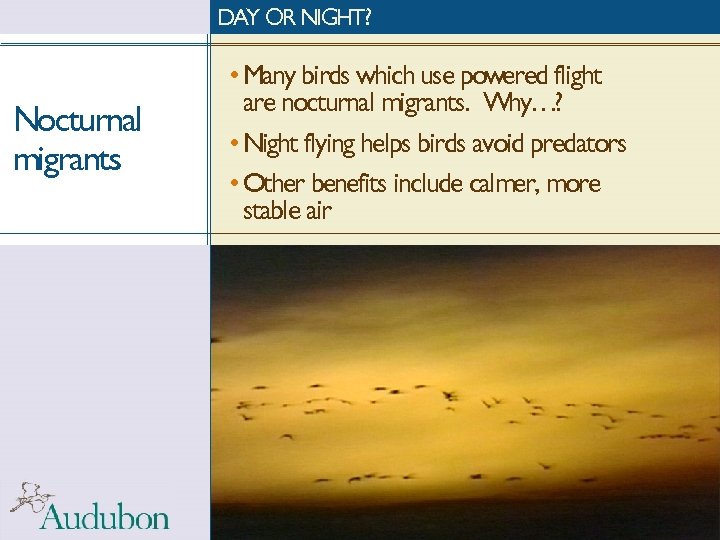
DAY OR NIGHT? Nocturnal migrants • Many birds which use powered flight are nocturnal migrants. Why…? • Night flying helps birds avoid predators • Other benefits include calmer, more stable air
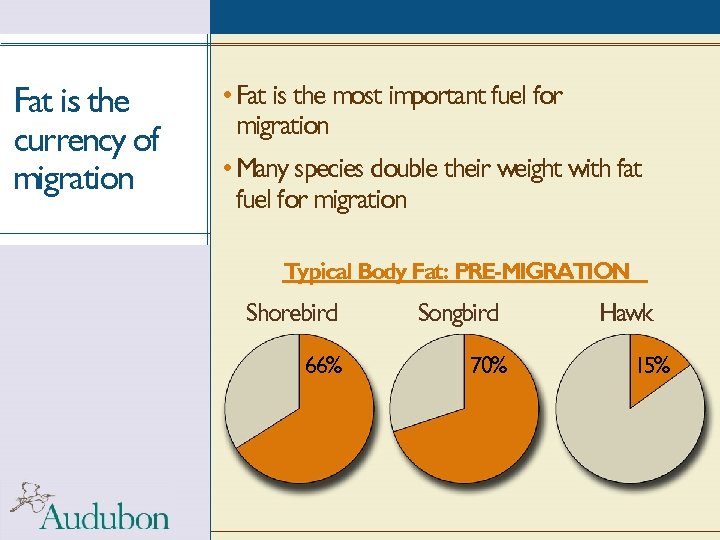
Fat is the currency of migration • Fat is the most important fuel for migration • Many species double their weight with fat fuel for migration Typical Body Fat: PRE-MIGRATION Shorebird 66% Songbird 70% Hawk 15%
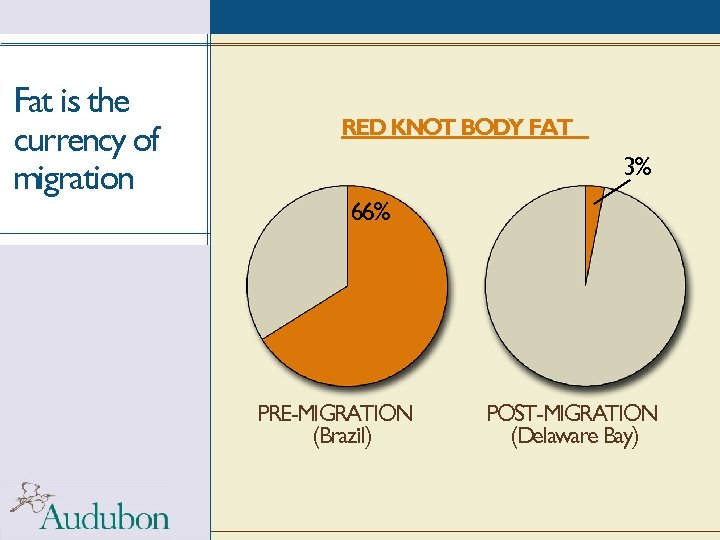
Fat is the currency of migration RED KNOT BODY FAT 3% 66% PRE-MIGRATION (Brazil) POST-MIGRATION (Delaware Bay)
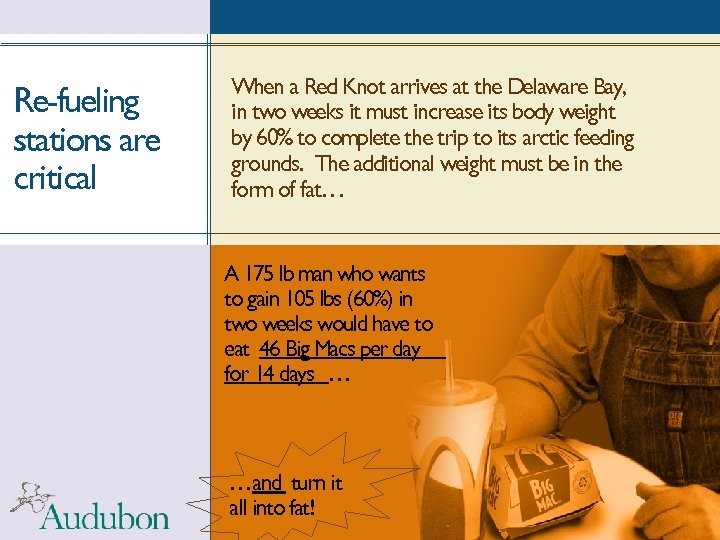
Re-fueling stations are critical When a Red Knot arrives at the Delaware Bay, in two weeks it must increase its body weight by 60% to complete the trip to its arctic feeding grounds. The additional weight must be in the form of fat… A 175 lb man who wants to gain 105 lbs (60%) in two weeks would have to eat 46 Big Macs per day for 14 days … … and turn it all into fat!
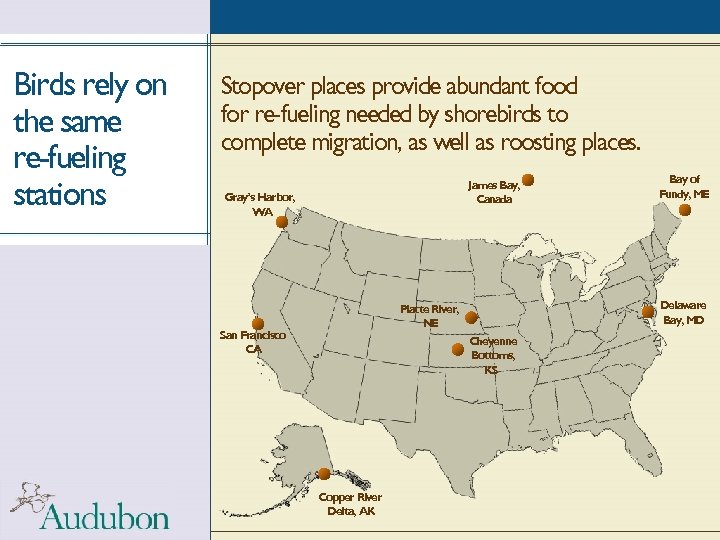
Birds rely on the same re-fueling stations Stopover places provide abundant food for re-fueling needed by shorebirds to complete migration, as well as roosting places. James Bay, Canada Gray’s Harbor, WA Delaware Bay, MD Platte River, NE San Francisco CA Cheyenne Bottoms, KS Copper River Delta, AK Bay of Fundy, ME
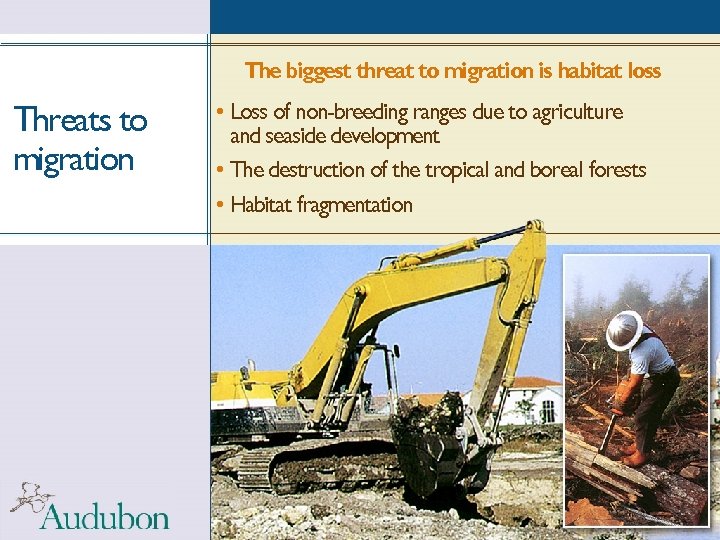
The biggest threat to migration is habitat loss Threats to migration • Loss of non-breeding ranges due to agriculture and seaside development • The destruction of the tropical and boreal forests • Habitat fragmentation
Everything in the world is connected to everything else • Migratory routes are the invisible lines of connection which show us how people, places, and wildlife depend on each other • Migration tells us about our physical and spiritual health
Sources & further reading Ornithology Frank B. Gill, W. H. Freeman & Co, 1995 The Random House Atlas of Bird Migration Jonathan Elphick , ed. , Random House, 1995 The Flight of the Red Knot Brian Harrington, W. W. Norton & Company, 1996 How Birds Migrate Paul Kerlinger , Stackpole Books, 1995 The Audubon Encyclopedia of North American Birds John K. Terres , Alfred A. Knopf, 1982 Living on the Wind Scott Weidensaul , North Point Press, 1999

Connecting People with Nature
Скачать презентацию Emily Dickinson Why do birds migrate
6c300ffd2f6d32a662209e0101d4f0a8.ppt