 Скачать презентацию Emerging Technologies New Developments Walt Dabberdt
7e5d183dfd0dca67ba0e4f7632cdc589.ppt
- Количество слайдов: 20




Emerging Technologies & New Developments Walt Dabberdt & Alan Fried Technological needs based on scientific discussions from this workshop and not new EOL developments (new dev. on EOL Web site)
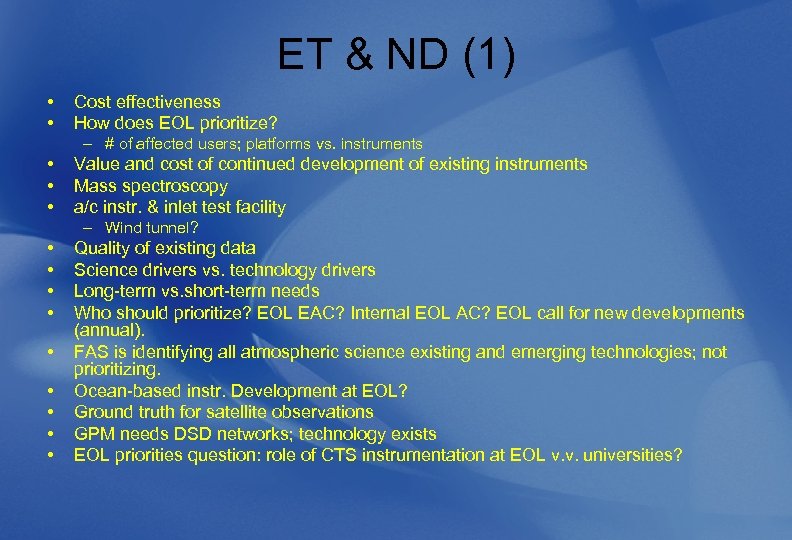
ET & ND (1) • • Cost effectiveness How does EOL prioritize? – # of affected users; platforms vs. instruments • • • Value and cost of continued development of existing instruments Mass spectroscopy a/c instr. & inlet test facility – Wind tunnel? • • • Quality of existing data Science drivers vs. technology drivers Long-term vs. short-term needs Who should prioritize? EOL EAC? Internal EOL AC? EOL call for new developments (annual). FAS is identifying all atmospheric science existing and emerging technologies; not prioritizing. Ocean-based instr. Development at EOL? Ground truth for satellite observations GPM needs DSD networks; technology exists EOL priorities question: role of CTS instrumentation at EOL v. v. universities?
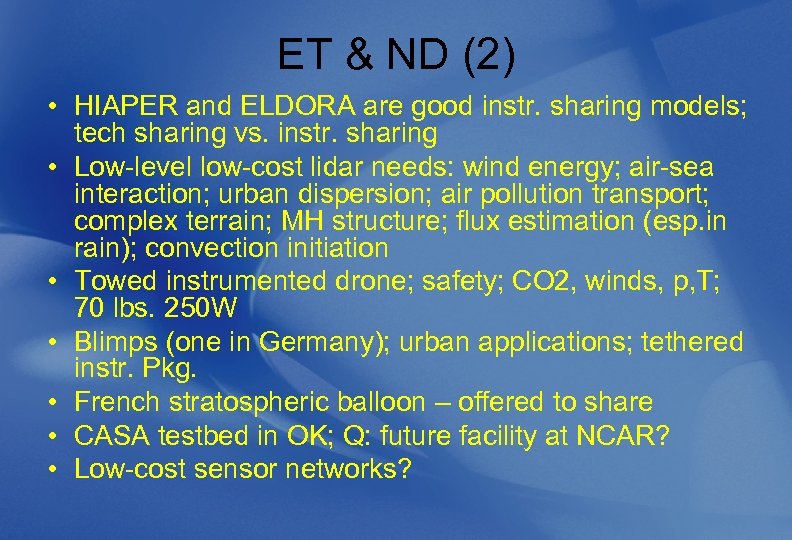
ET & ND (2) • HIAPER and ELDORA are good instr. sharing models; tech sharing vs. instr. sharing • Low-level low-cost lidar needs: wind energy; air-sea interaction; urban dispersion; air pollution transport; complex terrain; MH structure; flux estimation (esp. in rain); convection initiation • Towed instrumented drone; safety; CO 2, winds, p, T; 70 lbs. 250 W • Blimps (one in Germany); urban applications; tethered instr. Pkg. • French stratospheric balloon – offered to share • CASA testbed in OK; Q: future facility at NCAR? • Low-cost sensor networks?
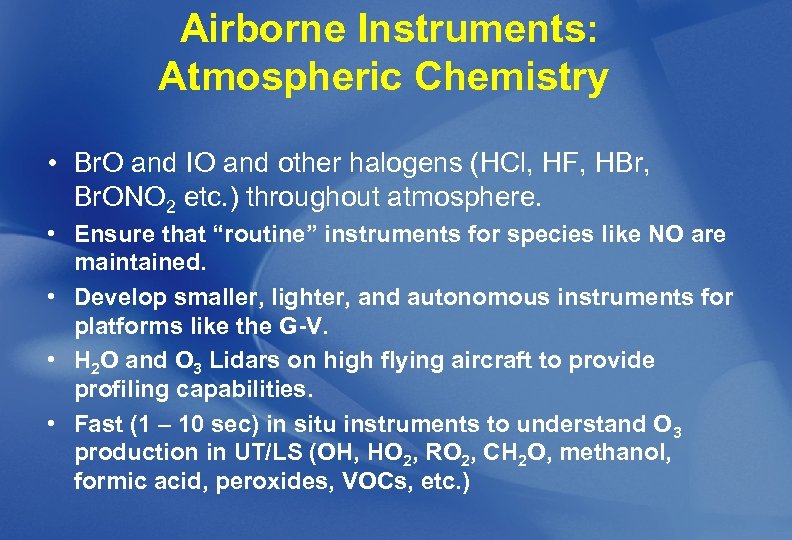
Airborne Instruments: Atmospheric Chemistry • Br. O and IO and other halogens (HCl, HF, HBr, Br. ONO 2 etc. ) throughout atmosphere. • Ensure that “routine” instruments for species like NO are maintained. • Develop smaller, lighter, and autonomous instruments for platforms like the G-V. • H 2 O and O 3 Lidars on high flying aircraft to provide profiling capabilities. • Fast (1 – 10 sec) in situ instruments to understand O 3 production in UT/LS (OH, HO 2, RO 2, CH 2 O, methanol, formic acid, peroxides, VOCs, etc. )
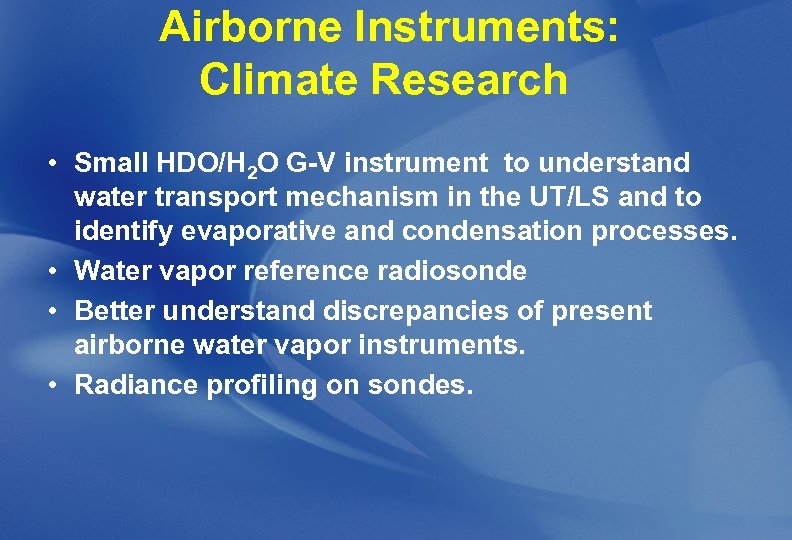
Airborne Instruments: Climate Research • Small HDO/H 2 O G-V instrument to understand water transport mechanism in the UT/LS and to identify evaporative and condensation processes. • Water vapor reference radiosonde • Better understand discrepancies of present airborne water vapor instruments. • Radiance profiling on sondes.
Airborne Instruments: Microphysics & Meteorology • Ice nuclei measurements • CCN measurements (no capabilities in EOL) • New particle size instruments to accurately measure large droplets • In cloud temperature measurements • Cheap in situ sensors on dropsondes to measure T, H 2 O in lowest 5 -km. • Hydrometeor types from radars (improved interpretation of polarimetric radar data). • Investigate and start to deploy new particle probes to replace 30 -year old technology. • Fast temp and humidity probes.
Airborne Instruments: Other Categories • Inlet test facility (joint US & European effort) – Gas species on aerosols and clouds – Aerosols • Explore the use of Zeppelins for Lagrangian studies. • Instrument packages to measure mega city emissions (HCs, CO, particles, NOy, peroxides)
Ground-Based and Airborne Radars & Lidars: Mesascale, Cloud Microphysics & Water Cycle • Need to have requestable resource that is cost effective, multiple mobile ground-based Doppler & polar. Radars. • Need mobile rapidly deployable (mins) groundbased rapid scanning (10 -sec) Radars (X, Wbands) with high spatial resoln. (250 -m or better).
Ground-Based and Airborne Radars & Lidars • Need calibrated Lidars to sort out direct and indirect effects of aerosols. • Remote meas of scaler fluxes in BL (Doppler Lidar and water vapor DIAL) • Need to explore combined Lidar and Radar meas.
Ground-Based and Airborne Radars & Lidars • Continued emphasis on multiple frequencies on same Radar (same antenna or side-by-side), adds new information. • Can we make a deployable (1 day) clear-air Radar system (circumvent tradeoffs). • Engineering study for transportable scanning, dual polariz, Doppler, vertical pointing with comounted Lidar.
Ground-Based and Airborne Radars & Lidars • Exploring network of ground-based scanning micro-radiometers for clear-air meas of T, and winds. • Networked of Radar systems. • Airborne Lidars for clear-air measurements.
Ground-Based/Marine Remote & In. Situ Instruments: Chemistry • New instruments to detect large organic molecules (gas and aerosols) at sub-ppbv levels • Carbon isotope ratio instruments for CO 2 uptake fluxes (different land ecosystems, coastal zones, etc. )
Ground-Based/Marine Remote & In. Situ Instruments: Meteorology • Meteorological test beds, integrated urban observing systems which cover many annual cycles • Measurements that influence flux from the ocean surface.
Ground-Based/Marine Remote & In. Situ Instruments: Fluxes • Autonomous instruments (on UAVs, dropsondes, oil drilling platforms, etc. ) to measure fluxes during and immediately after severe weather events (hurricanes, etc. )
ISF Discussion Group – Q 1 (concluded) • Need for QC of state mesonets (Peggy Le. Mone) • Beasley: how are NSF and EOL priorities established? • ISF’s proposed Modular Profiling Network (MPN)
ISF Discussion Group – Q 1: Adequacy of Existing Facilities? • • Need for low-level wind and turbulence profiling – new fiber optic devices Profiling vs. volumetric sampling Temperature and moisture profiling; constituent profiling (e. g. DIAL) Q: rapid-deployable GPS IWV networks? Air quality measurement needs? Q: how does EOL set priorities? Acquire financial resources? Need for in situ precip measurements? June Wang: is there a need for EOL tethersonde capability? – Alan White: USAF border patrol high-altitude tethered balloon (radar) systems • WFD: single-point, comprehensive measurements/profiles vs. networks (surface vs. profiling)? • ISF facilities need to be deployable • Coop mesonets are being relied on in an increasing manner
ISF Discussion Group – Q 2: What New Measurements are Needed? • Should EOL get more involved in AQ needs (e. g. AQ testbed)? • Bluestein: rapid-scan radars and truly mobile facilities? Should NCAR work on mobile radars? NCAR’s role in rapid-scan developments? • Re mobile profiling – what? Thermodynamic and wind, especially in PBL. Lower half of trop (~10 km) as second priority. (Bluestein) • Clear air vs measurements in precip? Need 100 -200 m vertical resolution (Bluestein) • Q: More use of instrument simulators (model simulations)? • Radiometrics has 20 -sec T and q profiling capability. • Should EOL support operational needs? • Over-water measurement needs? Large % of population lives near coasts. (Parsons) Should EOL focus more on ocean meas. ? • Educational use of EOL facilities? More? Less? Same? • Q: rapid launching of dropsondes and upsondes? • Disdrometer measurements? One is great, but network is better.
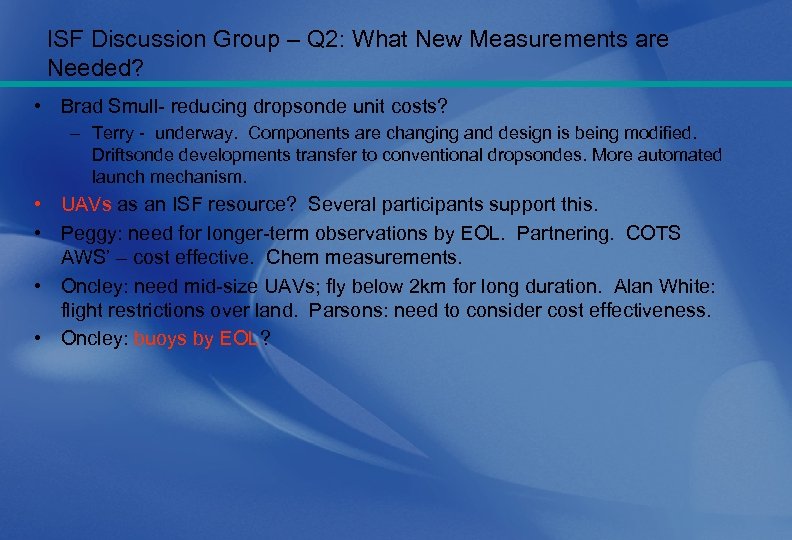
ISF Discussion Group – Q 2: What New Measurements are Needed? • Brad Smull- reducing dropsonde unit costs? – Terry - underway. Components are changing and design is being modified. Driftsonde developments transfer to conventional dropsondes. More automated launch mechanism. • UAVs as an ISF resource? Several participants support this. • Peggy: need for longer-term observations by EOL. Partnering. COTS AWS’ – cost effective. Chem measurements. • Oncley: need mid-size UAVs; fly below 2 km for long duration. Alan White: flight restrictions over land. Parsons: need to consider cost effectiveness. • Oncley: buoys by EOL?
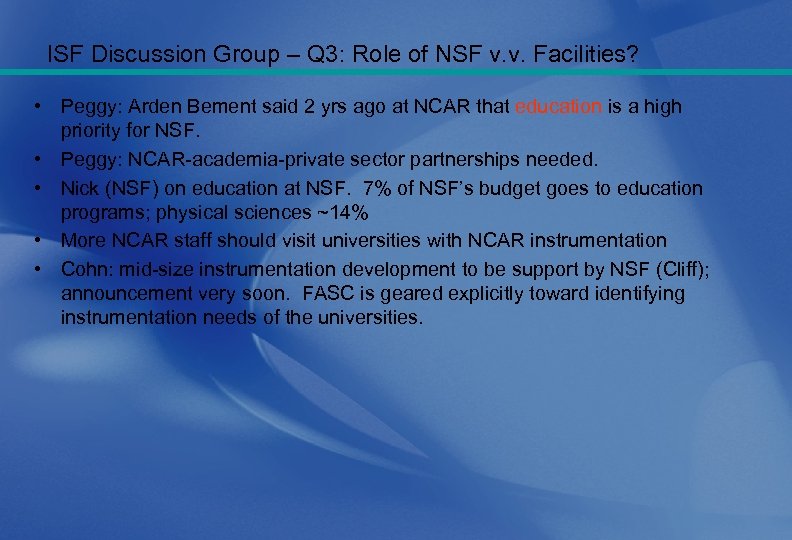
ISF Discussion Group – Q 3: Role of NSF v. v. Facilities? • Peggy: Arden Bement said 2 yrs ago at NCAR that education is a high priority for NSF. • Peggy: NCAR-academia-private sector partnerships needed. • Nick (NSF) on education at NSF. 7% of NSF’s budget goes to education programs; physical sciences ~14% • More NCAR staff should visit universities with NCAR instrumentation • Cohn: mid-size instrumentation development to be support by NSF (Cliff); announcement very soon. FASC is geared explicitly toward identifying instrumentation needs of the universities.
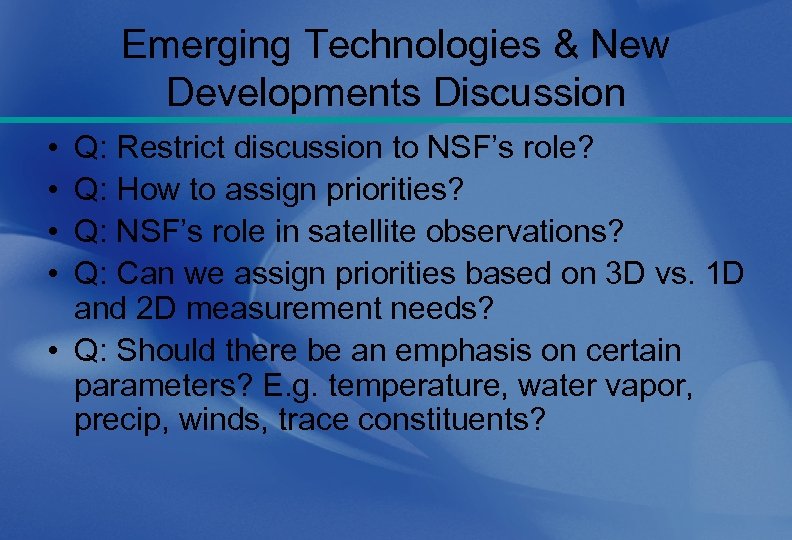
Emerging Technologies & New Developments Discussion • • Q: Restrict discussion to NSF’s role? Q: How to assign priorities? Q: NSF’s role in satellite observations? Q: Can we assign priorities based on 3 D vs. 1 D and 2 D measurement needs? • Q: Should there be an emphasis on certain parameters? E. g. temperature, water vapor, precip, winds, trace constituents?
Скачать презентацию Emerging Technologies New Developments Walt Dabberdt
7e5d183dfd0dca67ba0e4f7632cdc589.ppt