


 Скачать презентацию Emerging Science Technology in Next 15 Years
1fda0d25a03c51069c81df115947012a.ppt
- Количество слайдов: 20
 Emerging Science & Technology in Next 15 Years Workshop on STEM Workforce Needs for US Do. D and US Defense Industrial Base August 1, 2011 Dr. John C. Sommerer Space Sector Head JHU Gilman Scholar john. sommerer@jhuapl. edu
 Status and Future of the Naval R&D Establishment 2010 Summer Study Sponsored by Hon. Sean Stackley Assistant Secretary of the Navy (Research, Development, and Acquisition) See www. nrac. navy. mil/docs/2010_Summer_Study_Report. pdf
 Future Technology Leadership Areas § Integrated C 4 ISR for combined manned/unmanned (mixed) systems § Infrastructure required to support Information Dominance § Electronic Warfare § Counter Anti-access & Area Denial (A 2/AD) and High End Asymmetric Threat (HE/AT) The uniqueness of the maritime physical and operational environment and the impending integration of unmanned vehicles into the battlespace require technical leadership in these areas 3
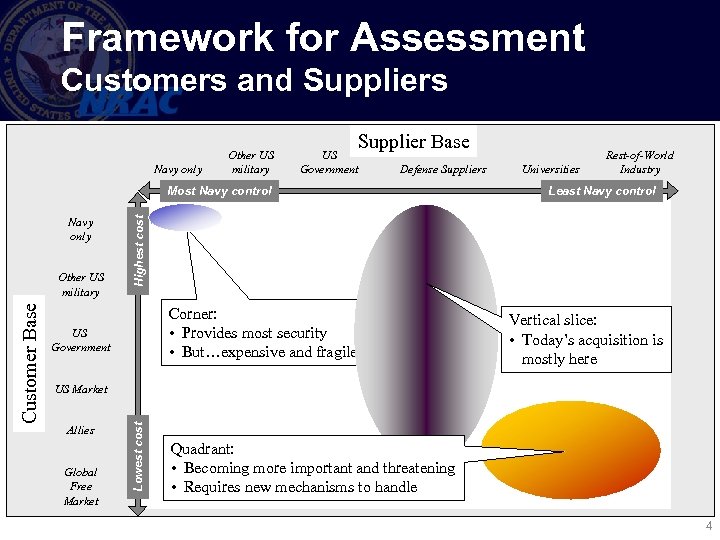 Framework for Assessment Customers and Suppliers Navy only Other US military Supplier Base US Government Defense Suppliers Navy only Corner: • Provides most security • But…expensive and fragile US Government Vertical slice: • Today’s acquisition is mostly here US Market Allies Global Free Market Lowest cost Customer Base Other US military Least Navy control Highest cost Most Navy control Universities Rest-of-World Industry Quadrant: • Becoming more important and threatening • Requires new mechanisms to handle 4
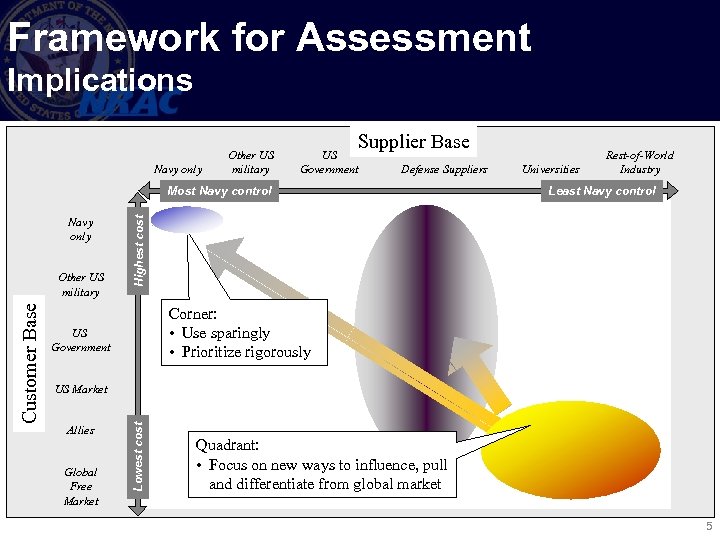 Framework for Assessment Implications Navy only Other US military Supplier Base US Government Defense Suppliers Navy only Corner: • Use sparingly • Prioritize rigorously US Government US Market Allies Global Free Market Lowest cost Customer Base Other US military Least Navy control Highest cost Most Navy control Universities Rest-of-World Industry Quadrant: • Focus on new ways to influence, pull and differentiate from global market 5
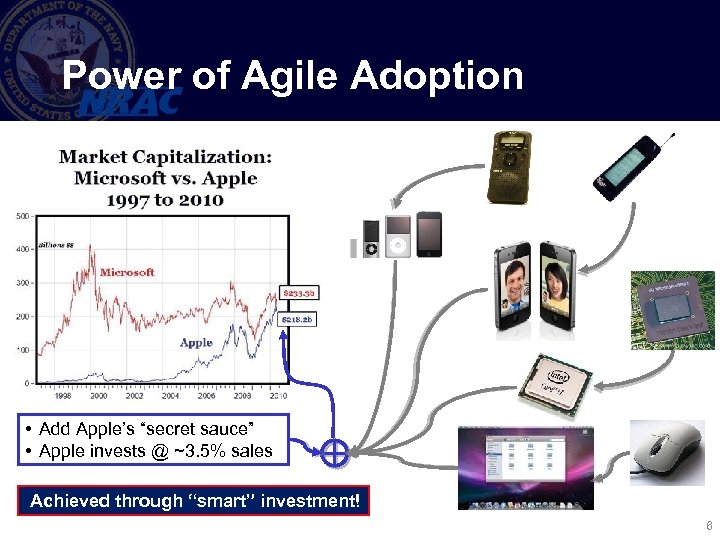 Power of Agile Adoption • Add Apple’s “secret sauce” • Apple invests @ ~3. 5% sales Achieved through “smart” investment! 6
 Emerging Agile Adoption Areas § Mixed decision making systems (manned and agent-based). NRDE must acquire the technical competency to shape, adopt, and adapt this capability for the Naval applications § Commercially-available Enterprise Information Systems. NRDE must develop technical capability to participate in standards and tools development, especially for Naval unique needs § Managing software development. NRDE must develop and implement a comprehensive strategy for revitalizing in-house software engineering competency § Power generation and energy storage. NRDE must be aware of global advances in power generation/control as well as energy efficiency so they can be adapted for Naval-unique uses § Biology-based innovation. NRDE needs sufficient expertise to monitor and exploit new and emerging areas of technology that are based on biological systems 7
 Study Panel § Dr. John C. Sommerer, Chair CTO, JHU Applied Physics Laboratory § VADM Bill Bowes, USN (Ret), Vice Chair Private Consultant § Dr. Amy E. Alving CTO, SAIC § Dr. A. Michael Andrews II VP R&E/CTO, L 3 Communications § Dr. James Bellingham Chief Technologist, MBARI § Dr. Ira M. Blatstein* School of Education, JHU § RADM Daniel R. Bowler, USN (Ret) Private Consultant § RADM Erroll Brown, USCG (Ret) IBM § Prof. Michael S. Bruno Dean of Engineering, Stevens Institute § RADM Walter Cantrell, * USN (Ret) Private Consultant § Dr. Robert S. Carnes, MD IRAD PM, Battelle Consultant for this study * § Lt. Gen John Castellaw, USMC (Ret) Private Consultant § Dr. Frank L. Fernandez Private Consultant § RADM Millard S. Firebaugh, * USN (Ret) Professor, University of Maryland § Maj. Gen Paul Fratarangelo, USMC (Ret) Private Consultant § CAPT R. Robinson Harris, USN (Ret) Director, Adv. Concepts, Lockheed § Dr. Anna D. Johnson-Winegar Private Consultant § Mr. James H. Korris President, Creative Technologies Inc § Dr. Marv Langston* Private Consultant § Dr. Mark G. Mykityshyn Managing Partner, White Oak Group § Prof. Art Ramirez* Dean of Engineering, UCSC § Mr. Gerald Schiefer* Private Consultant § Mr. Bill Schmitt* Private Consultant § Dr. David Tennenhouse Partner, New Venture Partners § RADM John T. Tozzi, USCG (Ret) VP Adv Programs, L 3 Communications § Lt. Gen Joseph F. Weber, USMC (Ret) VP Student Affairs, Texas A&M § Dr. David A. Whelan Chief Scientist, Boeing Defense Syst. § Prof. Patrick H. Winston Computer Science, MIT § RADM Charles B. Young USN (Ret) VP Strategic Planning, Oceaneering Intl. Executive Secretariat § Mr. Adam P. Nave PCDASN (RDA) Staff § Dr. Steve Pappert, S&T Assoc. SPAWAR-SSC-PAC § Dr. Joe Hoeg, Sr. Scientific Advisor, NAWC-AD § Mr. Scott Boyd, DASN Ex. W Staff § Mr. Dave Savillo, NAVSEA UARC Office 8
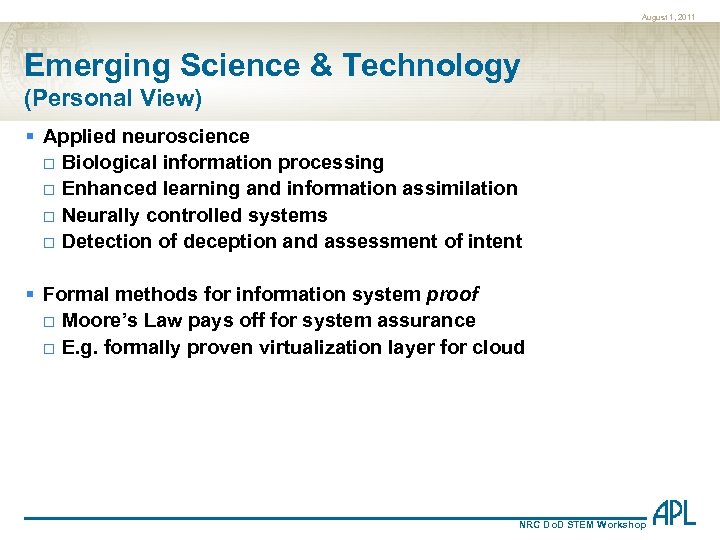 August 1, 2011 Emerging Science & Technology (Personal View) § Applied neuroscience Biological information processing Enhanced learning and information assimilation Neurally controlled systems Detection of deception and assessment of intent § Formal methods for information system proof Moore’s Law pays off for system assurance E. g. formally proven virtualization layer for cloud NRC Do. D STEM Workshop
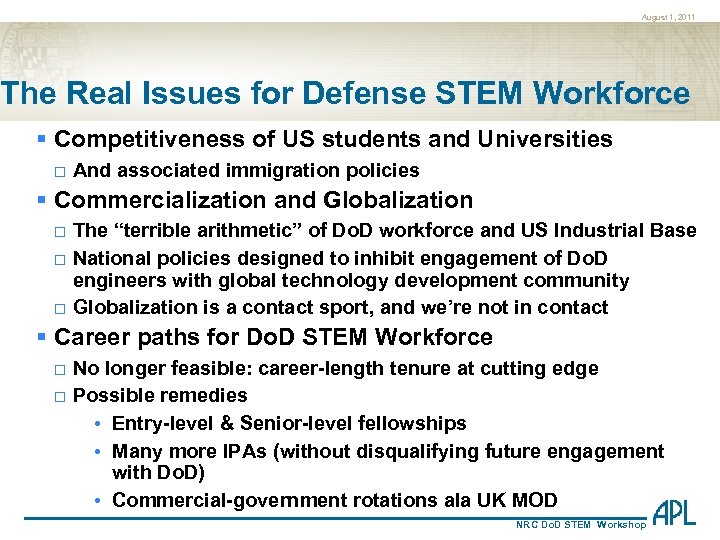 August 1, 2011 The Real Issues for Defense STEM Workforce § Competitiveness of US students and Universities And associated immigration policies § Commercialization and Globalization The “terrible arithmetic” of Do. D workforce and US Industrial Base National policies designed to inhibit engagement of Do. D engineers with global technology development community Globalization is a contact sport, and we’re not in contact § Career paths for Do. D STEM Workforce No longer feasible: career-length tenure at cutting edge Possible remedies • Entry-level & Senior-level fellowships • Many more IPAs (without disqualifying future engagement with Do. D) • Commercial-government rotations ala UK MOD NRC Do. D STEM Workshop
 Backup: Agile Adoption Details 11
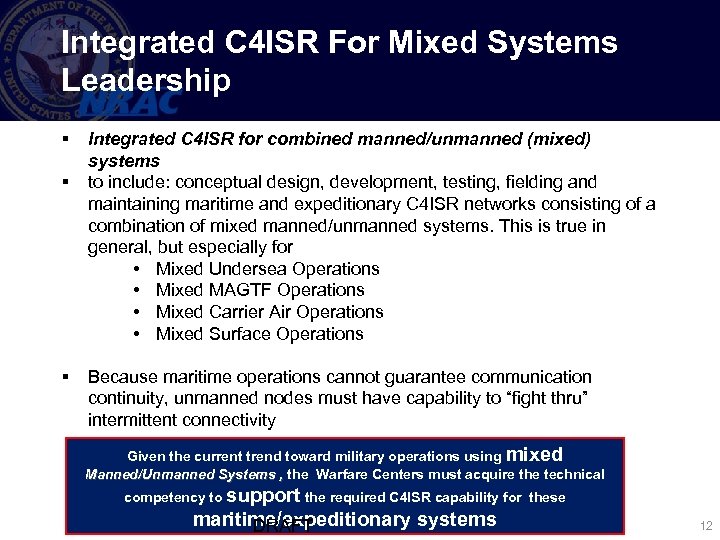 Integrated C 4 ISR For Mixed Systems Leadership § § § Integrated C 4 ISR for combined manned/unmanned (mixed) systems to include: conceptual design, development, testing, fielding and maintaining maritime and expeditionary C 4 ISR networks consisting of a combination of mixed manned/unmanned systems. This is true in general, but especially for • Mixed Undersea Operations • Mixed MAGTF Operations • Mixed Carrier Air Operations • Mixed Surface Operations Because maritime operations cannot guarantee communication continuity, unmanned nodes must have capability to “fight thru” intermittent connectivity Given the current trend toward military operations using mixed Manned/Unmanned Systems , the Warfare Centers must acquire the technical competency to support the required C 4 ISR capability for these maritime/expeditionary systems DRAFT 12
 Infrastructure for Information Dominance Leadership § Support Infrastructure to enable “Information Dominance” Future Navy. o All previous naval transformations have required investment in support infrastructure (e. g. nuclear propulsion, aviation, strategic systems) o Information Dominance will require data movement, storage, access and parsing, fusion to support warfare time lines…radical infrastructure improvements NRDE must develop the technical competency to enable and support this transformation which will use both commercial and Navy-specific technologies DRAFT 13
 Electronic Warfare Leadership § Navy has the lead role in the Department of Defense for Electronic Warfare (EW) Warfare Centers must have the technical competency to maintain Do. D legacy systems and support the design, development and integration of new systems to anticipate and meet evolving threats. These must also be integrated with current and planned C 4 ISR systems. 6 -28 -10@1343 DRAFT 14
 Counter Anti-Access and Area Denial (A 2/AD) and High-end Asymmetric Threat (HE/AT) Leadership § Counter Anti-Access and Area-Denial (A 2/AD) and High-end Asymmetric Threat (HE/AT) technology areas to include air, surface, subsurface, expeditionary and cyber domains. o Do. N A 2/AD and HE/AT technology programs must be integrated and coordinated with Air Force and Army research organizations. Given the global proliferation of Anti-Access and Area Denial systems and capabilities and growing High-end Asymmetric Threats (HE/AT) which pressure the ability of U. S. maritime forces to operate freely, the Warfare Centers must have the technical competencies to support the technology responses to these systems. DRAFT 15
 Commercial Information Technology Agile Adoption § Commercial Information Technology Adoption to include: Understanding all commercial IT, associated standards and implementation best practices, and investigating best ways to augment the areas of technical leadership with commercial technologies (e. g. enterprise architectures, cloud computing) Navy has committed to use of commercially available IT in all of their Enterprise Information Systems. Warfare Centers must develop technical capability to be active participants in standards and tools development, especially with regard to Navy unique needs. DRAFT 16
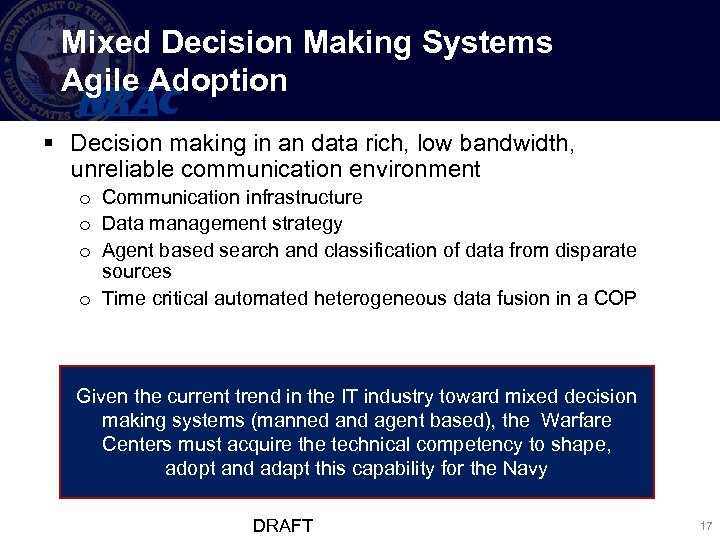 Mixed Decision Making Systems Agile Adoption § Decision making in an data rich, low bandwidth, unreliable communication environment o Communication infrastructure o Data management strategy o Agent based search and classification of data from disparate sources o Time critical automated heterogeneous data fusion in a COP Given the current trend in the IT industry toward mixed decision making systems (manned and agent based), the Warfare Centers must acquire the technical competency to shape, adopt and adapt this capability for the Navy DRAFT 17
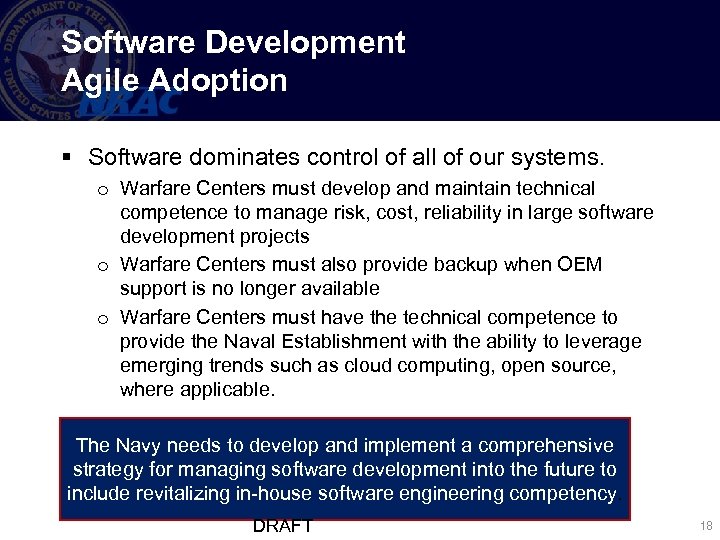 Software Development Agile Adoption § Software dominates control of all of our systems. o Warfare Centers must develop and maintain technical competence to manage risk, cost, reliability in large software development projects o Warfare Centers must also provide backup when OEM support is no longer available o Warfare Centers must have the technical competence to provide the Naval Establishment with the ability to leverage emerging trends such as cloud computing, open source, where applicable. The Navy needs to develop and implement a comprehensive strategy for managing software development into the future to include revitalizing in-house software engineering competency. DRAFT 18
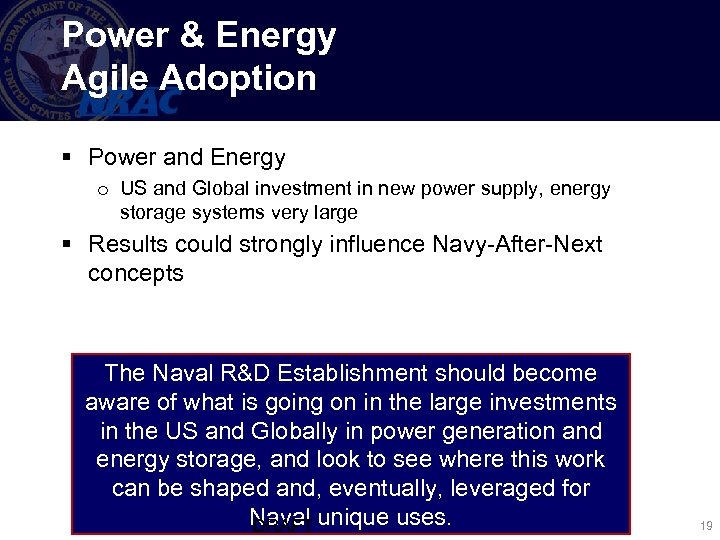 Power & Energy Agile Adoption § Power and Energy o US and Global investment in new power supply, energy storage systems very large § Results could strongly influence Navy-After-Next concepts The Naval R&D Establishment should become aware of what is going on in the large investments in the US and Globally in power generation and energy storage, and look to see where this work can be shaped and, eventually, leveraged for Naval unique uses. DRAFT 19
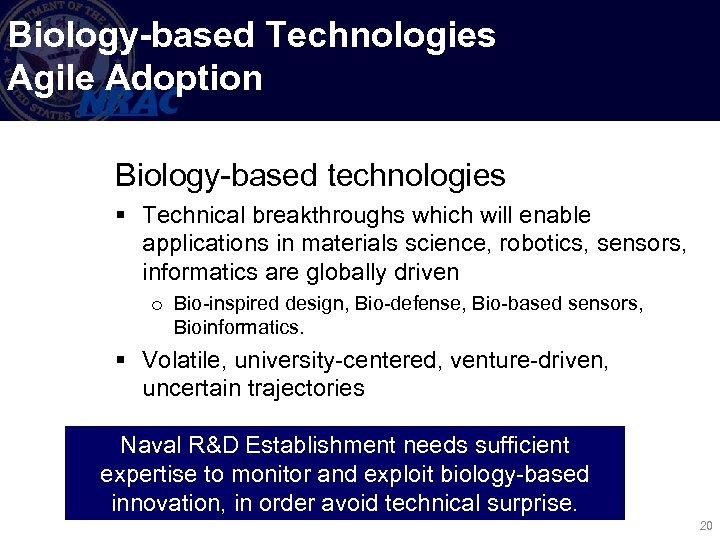 Biology-based Technologies Agile Adoption Biology-based technologies § Technical breakthroughs which will enable applications in materials science, robotics, sensors, informatics are globally driven o Bio-inspired design, Bio-defense, Bio-based sensors, Bioinformatics. § Volatile, university-centered, venture-driven, uncertain trajectories Naval R&D Establishment needs sufficient expertise to monitor and exploit biology-based innovation, in order avoid technical surprise. 20