 Скачать презентацию Emerging Market Countries in the Global Financial Crisis
7e7d906535b2c849676cf262573284d7.ppt
- Количество слайдов: 58




Emerging Market Countries in the Global Financial Crisis Jeffrey Frankel Harpel Professor of Capital Formation & Growth ‘Insights in Development Thinking -- Executive Seminar’ with COMFAMA. Harvard University, May 20, 2010
Outline n The crisis of 2008 -09 & the 2010 outlook n The 3 rd capital inflow boom 2003 -2008: Was it different? n Lessons of 1994 -2002 on avoiding crises: Did they hold up in 2008? n Emerging markets come of age n Decoupling n The new countercyclical fiscal policy 2
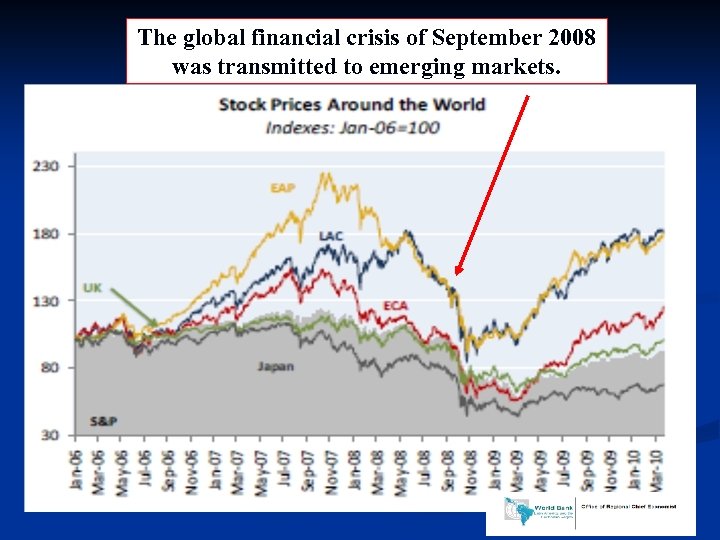
The global financial crisis of September 2008 was transmitted to emerging markets. April 21, 2010 3
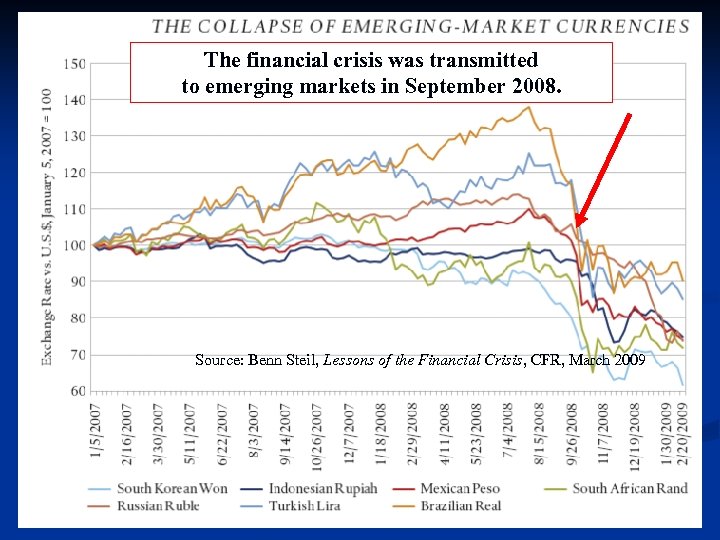
The financial crisis was transmitted to emerging markets in September 2008. Source: Benn Steil, Lessons of the Financial Crisis, CFR, March 2009 4
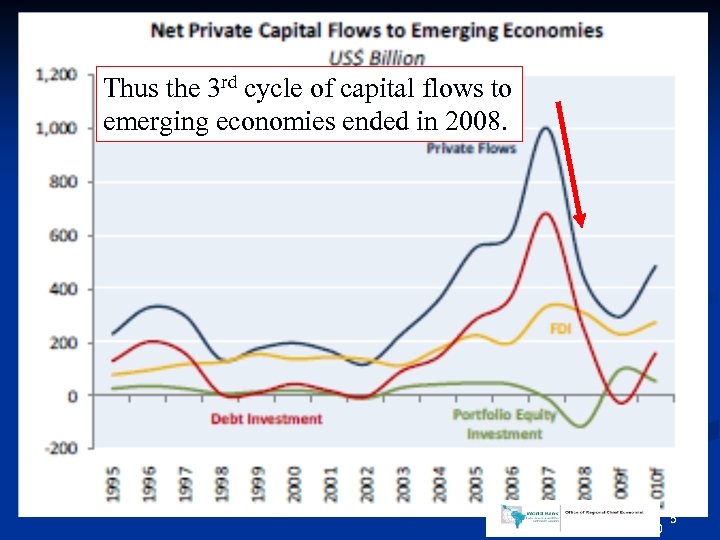
Thus the 3 rd cycle of capital flows to emerging economies ended in 2008. April 21, 2010 5
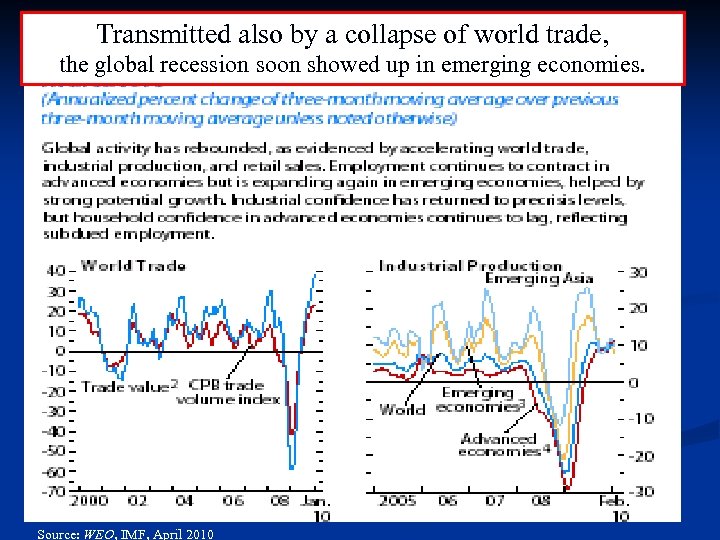
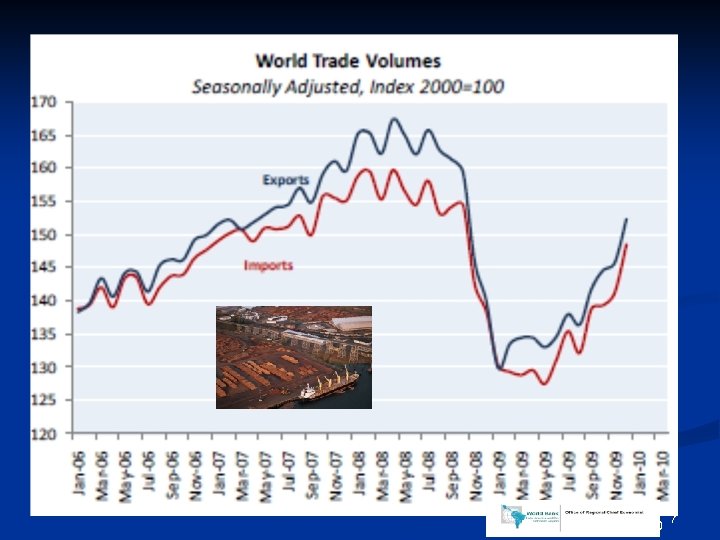
Transmitted also by a collapse of world trade, the global recession soon showed up in emerging economies. Source: WEO, IMF, April 2010
April 21, 2010 7
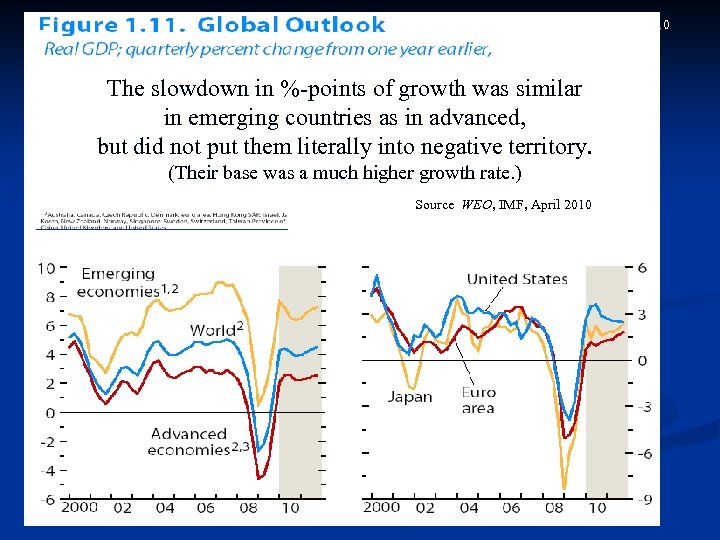
Source: WEO, IMF, April 2010 The slowdown in %-points of growth was similar in emerging countries as in advanced, but did not put them literally into negative territory. (Their base was a much higher growth rate. ) Source: WEO, IMF, April 2010
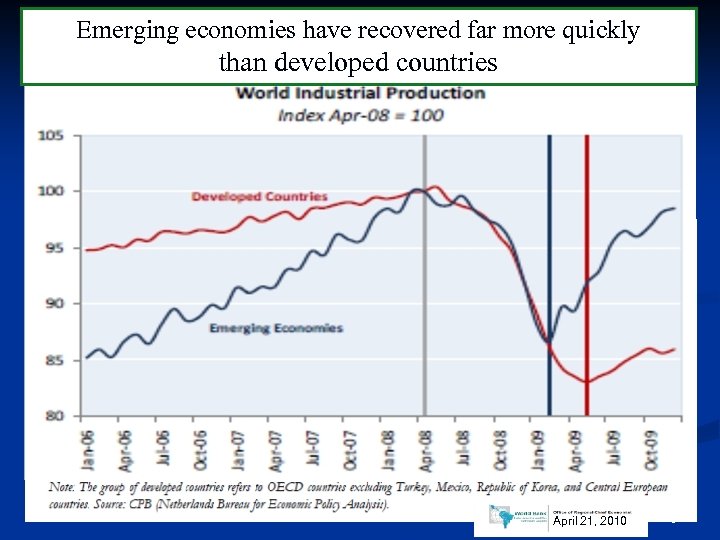
Emerging economies have recovered far more quickly than developed countries April 21, 2010 9
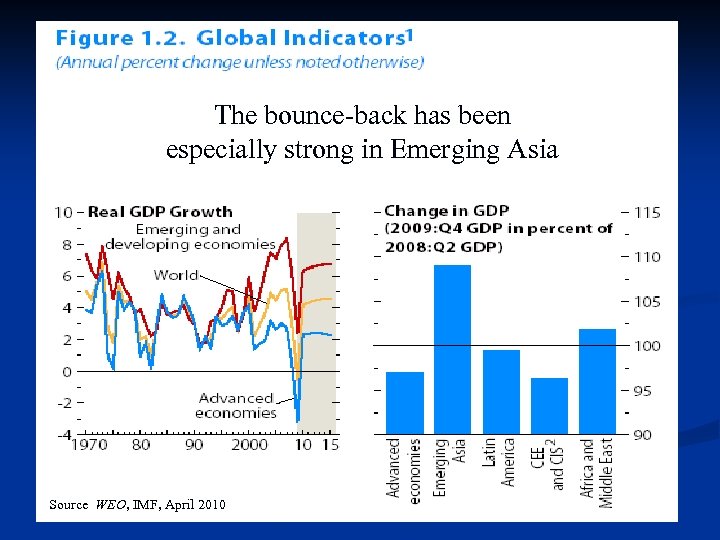
The bounce-back has been especially strong in Emerging Asia Source: WEO, IMF, April 2010
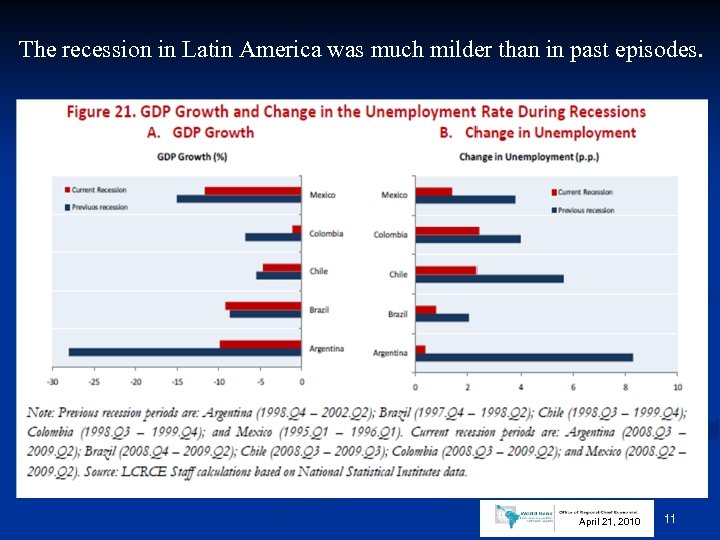
The recession in Latin America was much milder than in past episodes. April 21, 2010 11
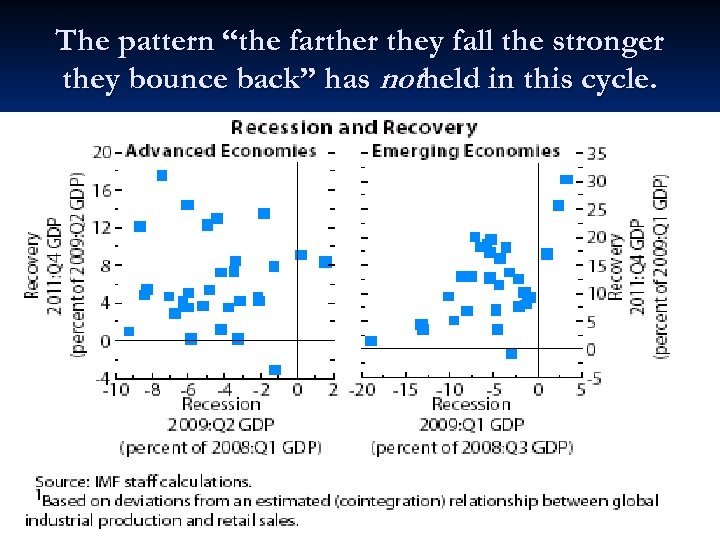
The pattern “the farther they fall the stronger they bounce back” has notheld in this cycle. 12
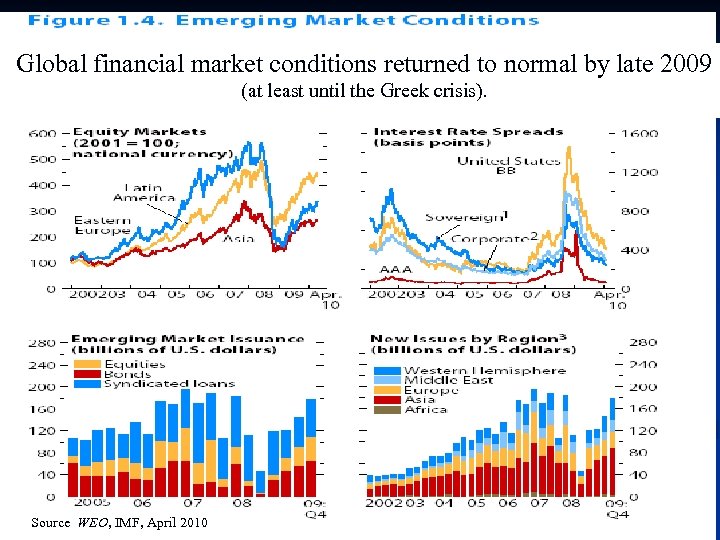
Global financial market conditions returned to normal by late 2009 (at least until the Greek crisis). Source: WEO, IMF, April 2010 13
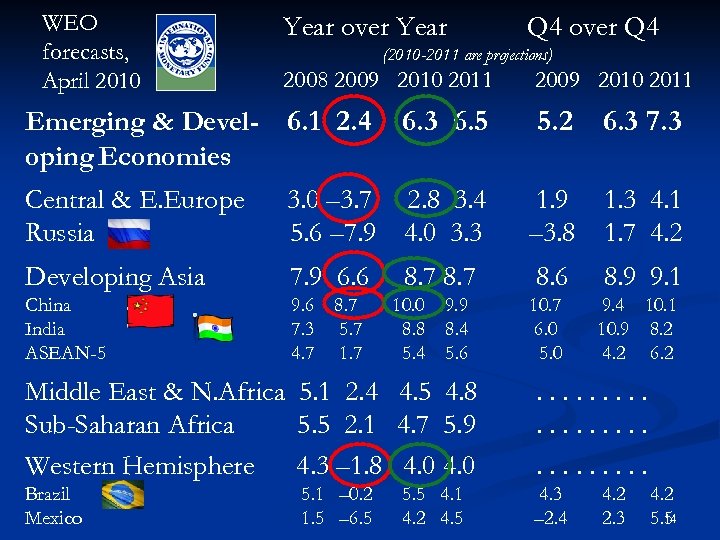
WEO forecasts, April 2010 Year over Year Q 4 over Q 4 (2010 -2011 are projections) 2008 2009 2010 2011 Emerging & Developing Economies 6. 1 2. 4 6. 3 6. 5 5. 2 6. 3 7. 3 Central & E. Europe Russia 3. 0 – 3. 7 5. 6 – 7. 9 2. 8 3. 4 4. 0 3. 3 1. 9 – 3. 8 1. 3 4. 1 1. 7 4. 2 Developing Asia 7. 9 6. 6 8. 7 8. 6 8. 9 9. 1 China India ASEAN-5 9. 6 7. 3 4. 7 8. 7 5. 7 10. 0 9. 9 8. 8 8. 4 5. 6 10. 7 6. 0 5. 0 9. 4 10. 1 10. 9 8. 2 4. 2 6. 2 Middle East & N. Africa 5. 1 2. 4 4. 5 4. 8 Sub-Saharan Africa 5. 5 2. 1 4. 7 5. 9 Western Hemisphere 4. 3 – 1. 8 4. 0 . . . . Brazil Mexico 4. 3 – 2. 4 5. 1 – 0. 2 1. 5 – 6. 5 5. 5 4. 1 4. 2 4. 5 4. 2 2. 3 4. 2 14 5. 5
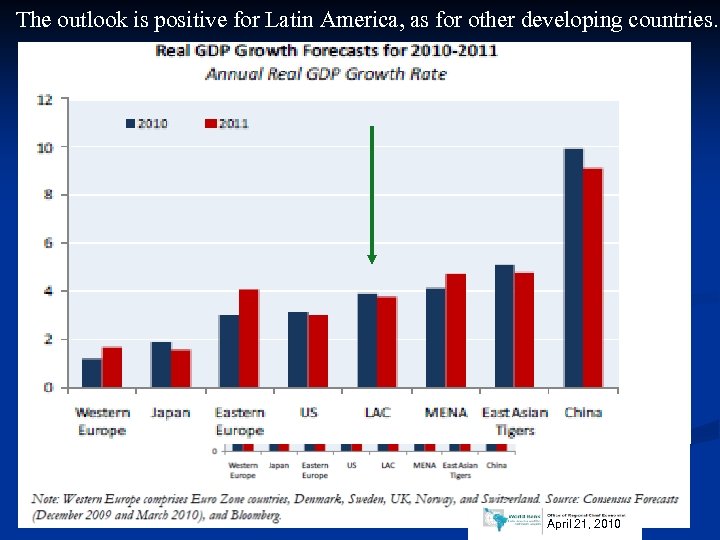
The outlook is positive for Latin America, as for other developing countries. April 21, 2010 15
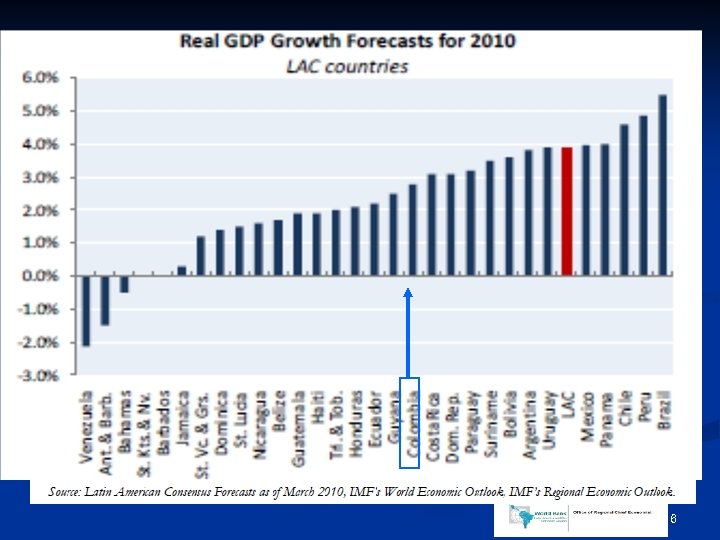
April 21, 2010 16
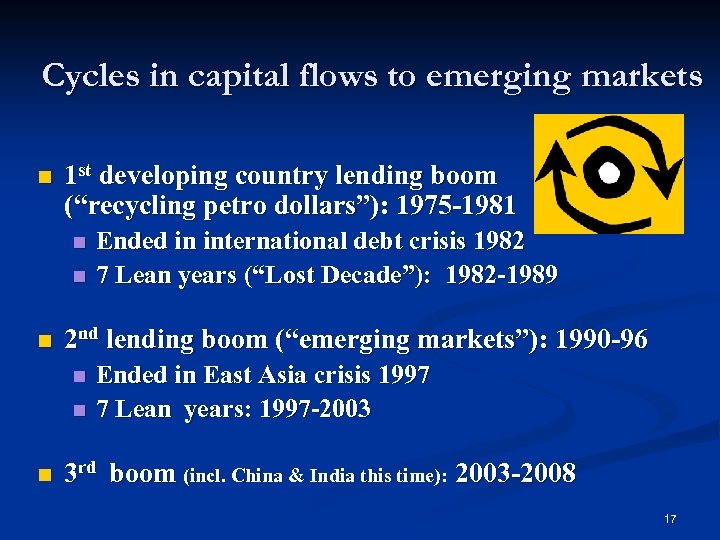
Cycles in capital flows to emerging markets n 1 st developing country lending boom (“recycling petro dollars”): 1975 -1981 n n n 2 nd lending boom (“emerging markets”): 1990 -96 n n n Ended in international debt crisis 1982 7 Lean years (“Lost Decade”): 1982 -1989 Ended in East Asia crisis 1997 7 Lean years: 1997 -2003 3 rd boom (incl. China & India this time): 2003 -2008 17
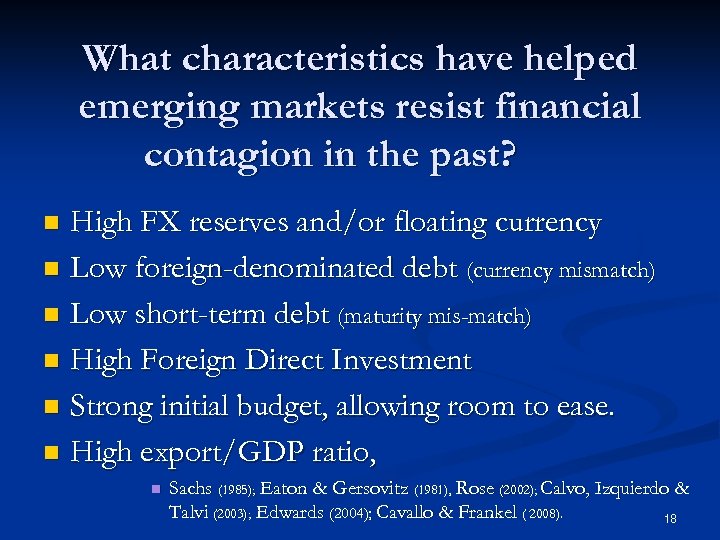
What characteristics have helped emerging markets resist financial contagion in the past? High FX reserves and/or floating currency n Low foreign-denominated debt (currency mismatch) n Low short-term debt (maturity mis-match) n High Foreign Direct Investment n Strong initial budget, allowing room to ease. n High export/GDP ratio, n n Sachs (1985); Eaton & Gersovitz (1981), Rose (2002); Calvo, Izquierdo & Talvi (2003); Edwards (2004); Cavallo & Frankel ( 2008). 18
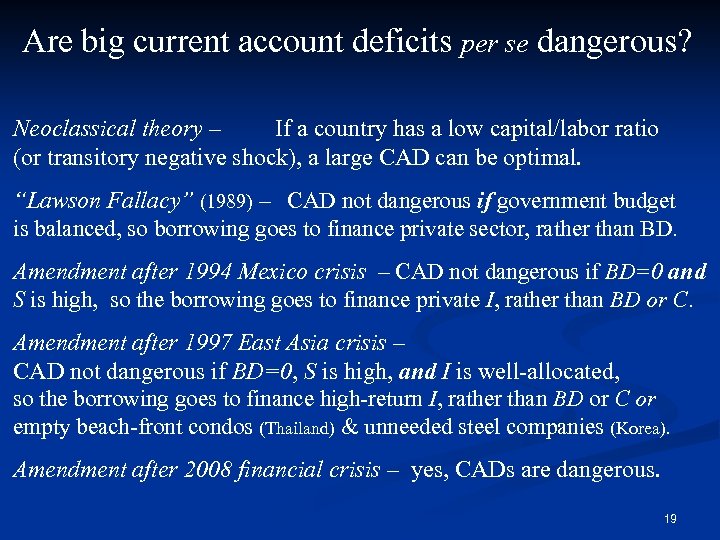
Are big current account deficits per se dangerous? Neoclassical theory – If a country has a low capital/labor ratio (or transitory negative shock), a large CAD can be optimal. “Lawson Fallacy” (1989) – CAD not dangerous if government budget is balanced, so borrowing goes to finance private sector, rather than BD. Amendment after 1994 Mexico crisis – CAD not dangerous if BD=0 and S is high, so the borrowing goes to finance private I, rather than BD or C. Amendment after 1997 East Asia crisis – CAD not dangerous if BD=0, S is high, and I is well-allocated, so the borrowing goes to finance high-return I, rather than BD or C or empty beach-front condos (Thailand) & unneeded steel companies (Korea). Amendment after 2008 financial crisis – yes, CADs are dangerous. 19
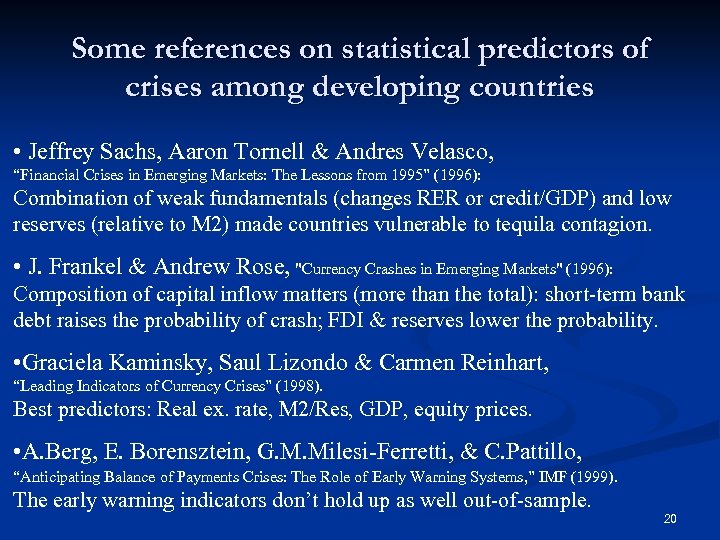
Some references on statistical predictors of crises among developing countries • Jeffrey Sachs, Aaron Tornell & Andres Velasco, “Financial Crises in Emerging Markets: The Lessons from 1995” (1996): Combination of weak fundamentals (changes RER or credit/GDP) and low reserves (relative to M 2) made countries vulnerable to tequila contagion. • J. Frankel & Andrew Rose, "Currency Crashes in Emerging Markets" (1996): Composition of capital inflow matters (more than the total): short-term bank debt raises the probability of crash; FDI & reserves lower the probability. • Graciela Kaminsky, Saul Lizondo & Carmen Reinhart, “Leading Indicators of Currency Crises” (1998). Best predictors: Real ex. rate, M 2/Res, GDP, equity prices. • A. Berg, E. Borensztein, G. M. Milesi-Ferretti, & C. Pattillo, “Anticipating Balance of Payments Crises: The Role of Early Warning Systems, ” IMF (1999). The early warning indicators don’t hold up as well out-of-sample. 20
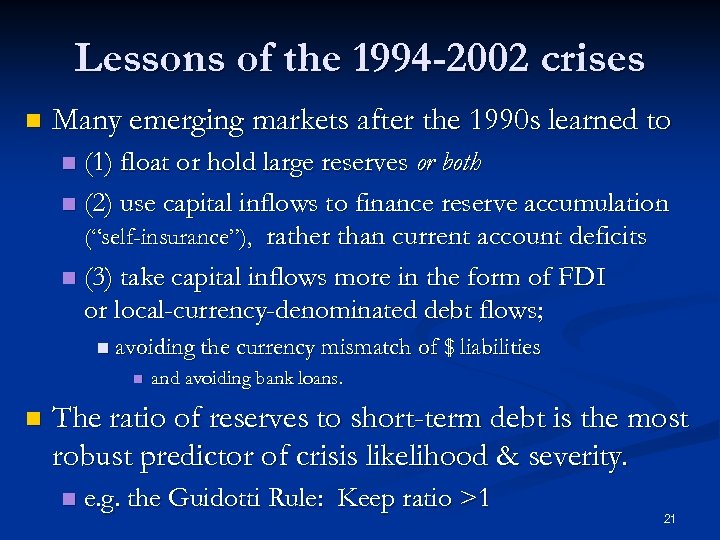
Lessons of the 1994 -2002 crises n Many emerging markets after the 1990 s learned to (1) float or hold large reserves or both n (2) use capital inflows to finance reserve accumulation (“self-insurance”), rather than current account deficits n (3) take capital inflows more in the form of FDI or local-currency-denominated debt flows; n n avoiding the currency mismatch of $ liabilities n n and avoiding bank loans. The ratio of reserves to short-term debt is the most robust predictor of crisis likelihood & severity. n e. g. the Guidotti Rule: Keep ratio >1 21
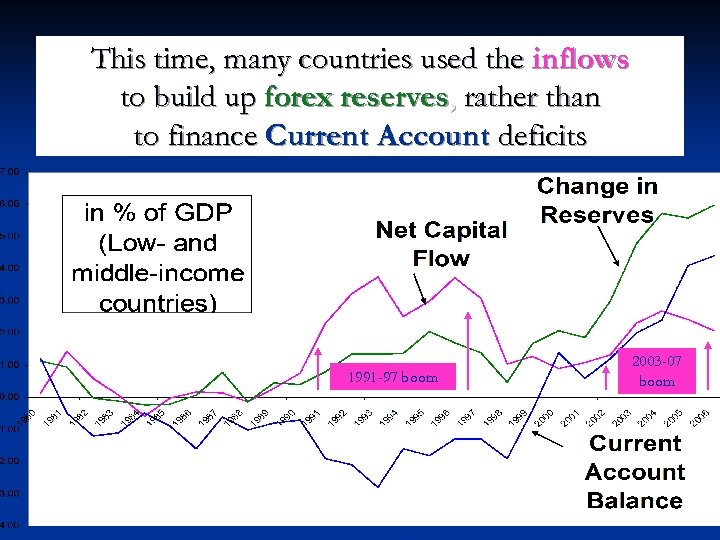
This time, many countries used the inflows to build up forex reserves, rather than to finance Current Account deficits 1991 -97 boom 2003 -07 boom 22
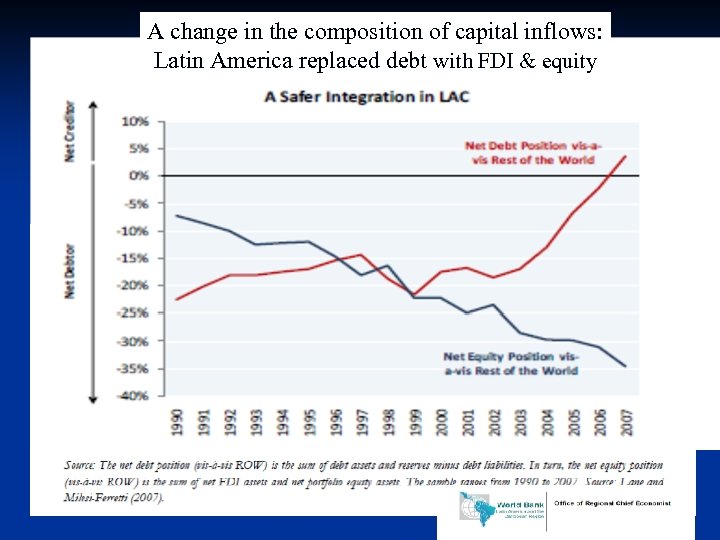
A change in the composition of capital inflows: Latin America replaced debt with FDI & equity April 21, 2010 23
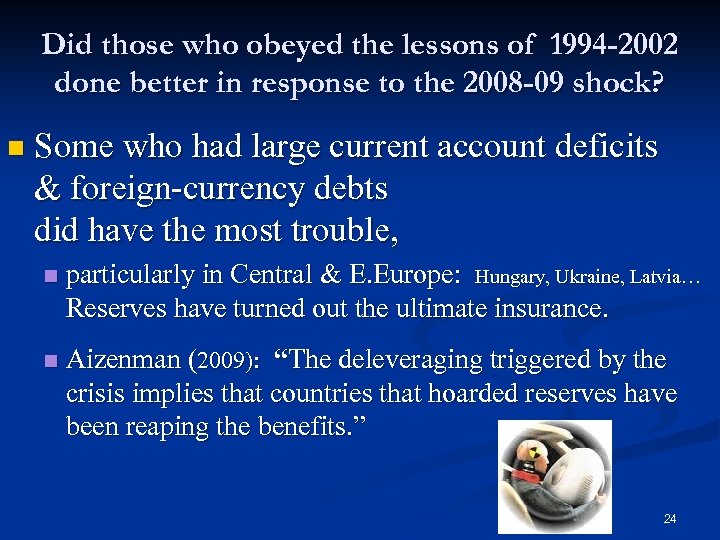
Did those who obeyed the lessons of 1994 -2002 done better in response to the 2008 -09 shock? n Some who had large current account deficits & foreign-currency debts did have the most trouble, n particularly in Central & E. Europe: Hungary, Ukraine, Latvia… Reserves have turned out the ultimate insurance. n Aizenman (2009): “The deleveraging triggered by the crisis implies that countries that hoarded reserves have been reaping the benefits. ” 24
Systematic studies are only starting. n Obstfeld, Shambaugh & Taylor (2009 a, b): n Finding: A particular measure of countries’ reserve holdings just before the current crisis, relative to requirements (M 2), predict 2008 depreciation. n Current account balances & short-term debt levels are not statistically significant predictors, once reserve levels are taken into account. Rose & Spiegel (2009 a, b) and Blanchard (2009) found no role for reserves in predicting who got into trouble. n Frankel & Saravelos (May 2010): We get stronger results, because we consider crisis period to have gone thru March 2009. n 25
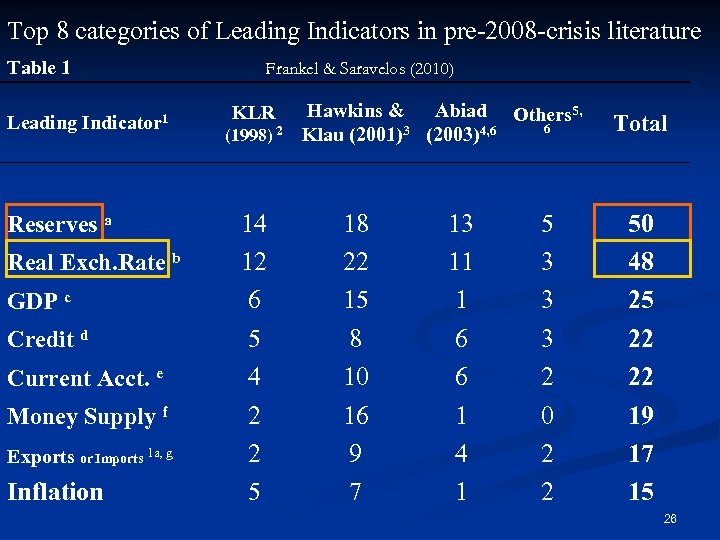
Top 8 categories of Leading Indicators in pre-2008 -crisis literature Table 1 Leading Indicator 1 Reserves a Real Exch. Rate b GDP c Credit d Current Acct. e Money Supply f Exports or Imports 1 a, g Inflation Frankel & Saravelos (2010) KLR (1998) 2 14 12 6 5 4 2 2 5 Hawkins & Abiad Others 5, 6 Klau (2001)3 (2003)4, 6 18 22 15 8 10 16 9 7 13 11 1 6 6 1 4 1 5 3 3 3 2 0 2 2 Total 50 48 25 22 22 19 17 15 26
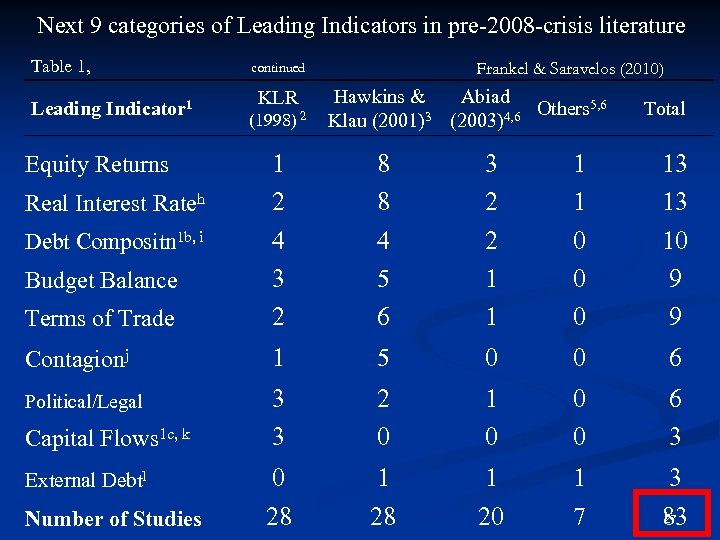
Next 9 categories of Leading Indicators in pre-2008 -crisis literature Table 1, Leading Indicator 1 continued KLR (1998) 2 Frankel & Saravelos (2010) Hawkins & Abiad 5, 6 3 (2003)4, 6 Others Klau (2001) Total Terms of Trade 1 2 4 3 2 8 8 4 5 6 3 2 2 1 1 0 0 0 13 13 10 9 9 Contagionj 1 5 0 0 6 Political/Legal 3 3 2 0 1 0 0 0 6 3 0 28 1 20 1 7 3 27 83 Equity Returns Real Interest Rateh Debt Compositn 1 b, i Budget Balance Capital Flows 1 c, k External Debtl Number of Studies
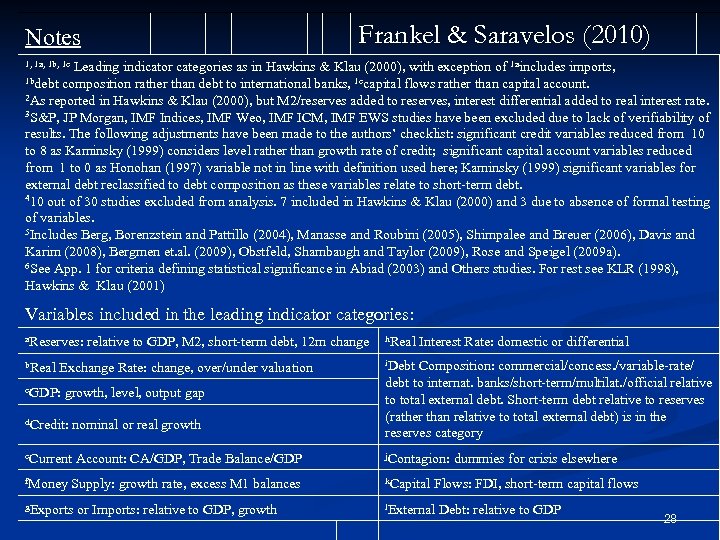
Notes Frankel & Saravelos (2010) 1, 1 a, 1 b, 1 c Leading indicator categories as in Hawkins & Klau (2000), with exception of 1 aincludes imports, 1 bdebt composition rather than debt to international banks, 1 ccapital flows rather than capital account. 2 As reported in Hawkins & Klau (2000), but M 2/reserves added to reserves, interest differential added to real interest rate. 3 S&P, JP Morgan, IMF Indices, IMF Weo, IMF ICM, IMF EWS studies have been excluded due to lack of verifiability of results. The following adjustments have been made to the authors’ checklist: significant credit variables reduced from 10 to 8 as Kaminsky (1999) considers level rather than growth rate of credit; significant capital account variables reduced from 1 to 0 as Honohan (1997) variable not in line with definition used here; Kaminsky (1999) significant variables for external debt reclassified to debt composition as these variables relate to short-term debt. 410 out of 30 studies excluded from analysis. 7 included in Hawkins & Klau (2000) and 3 due to absence of formal testing of variables. 5 Includes Berg, Borenzstein and Pattillo (2004), Manasse and Roubini (2005), Shimpalee and Breuer (2006), Davis and Karim (2008), Bergmen et. al. (2009), Obstfeld, Shambaugh and Taylor (2009), Rose and Speigel (2009 a). 6 See App. 1 for criteria defining statistical significance in Abiad (2003) and Others studies. For rest see KLR (1998), Hawkins & Klau (2001) Variables included in the leading indicator categories: a. Reserves: relative to GDP, M 2, short-term debt, 12 m change h. Real Interest Rate: domestic or differential b. Real Exchange Rate: change, over/under valuation i. Debt Composition: commercial/concess. /variable-rate/ c. GDP: growth, level, output gap d. Credit: nominal or real growth debt to internat. banks/short-term/multilat. /official relative to total external debt. Short-term debt relative to reserves (rather than relative to total external debt) is in the reserves category e. Current Account: CA/GDP, Trade Balance/GDP j. Contagion: dummies for crisis elsewhere f. Money Supply: growth rate, excess M 1 balances k. Capital Flows: FDI, short-term capital flows g. Exports or Imports: relative to GDP, growth l. External Debt: relative to GDP 28
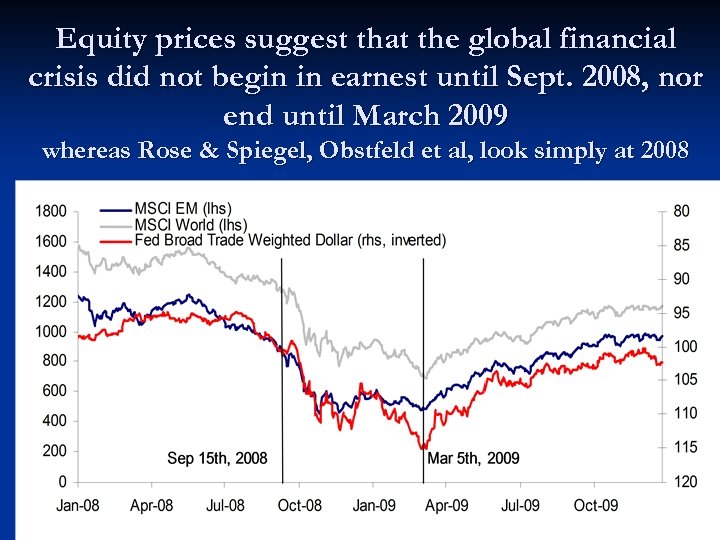
Equity prices suggest that the global financial crisis did not begin in earnest until Sept. 2008, nor end until March 2009 whereas Rose & Spiegel, Obstfeld et al, look simply at 2008 29
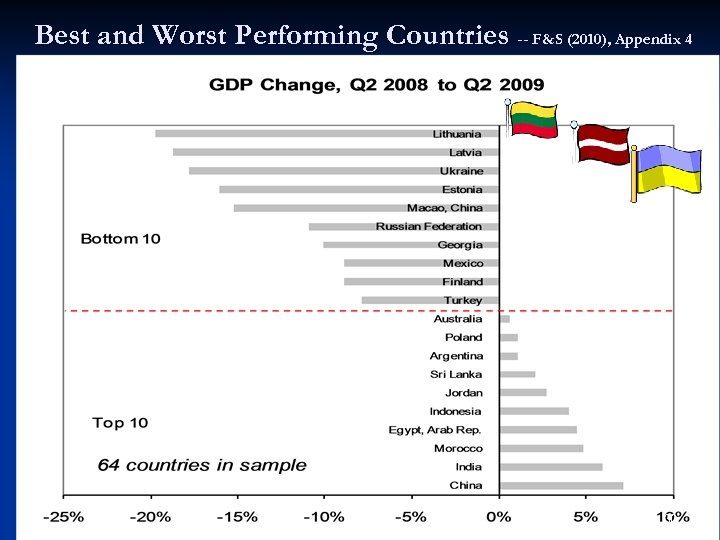
Best and Worst Performing Countries -- F&S (2010), Appendix 4 30
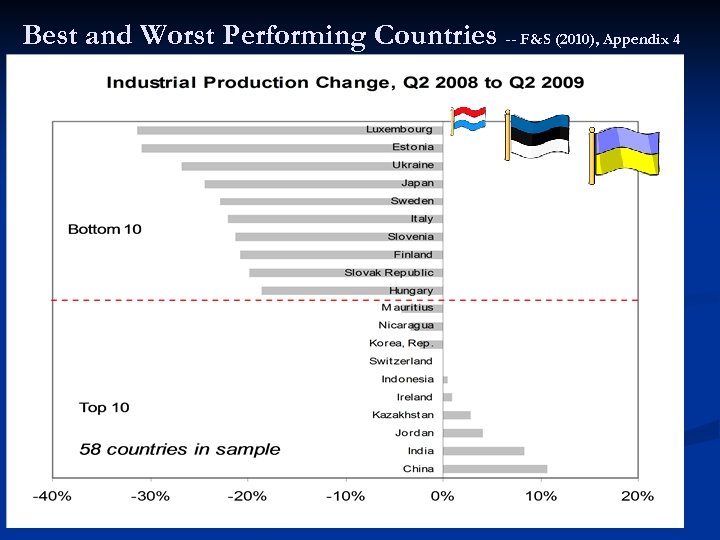
Best and Worst Performing Countries -- F&S (2010), Appendix 4 31
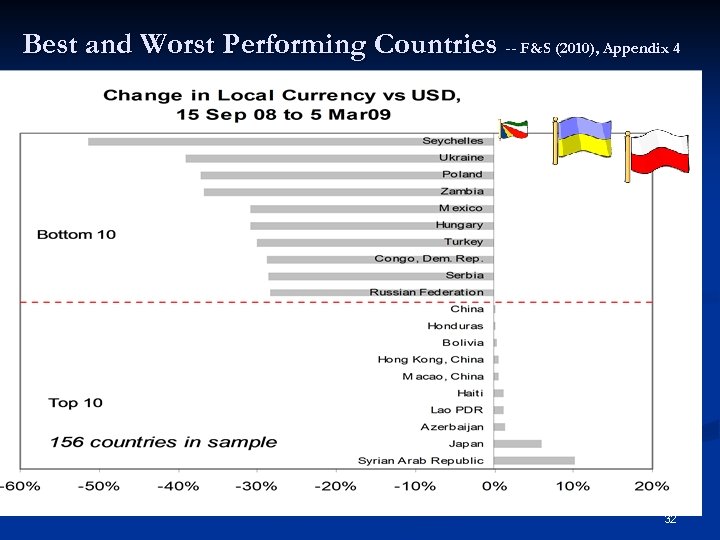
Best and Worst Performing Countries -- F&S (2010), Appendix 4 32
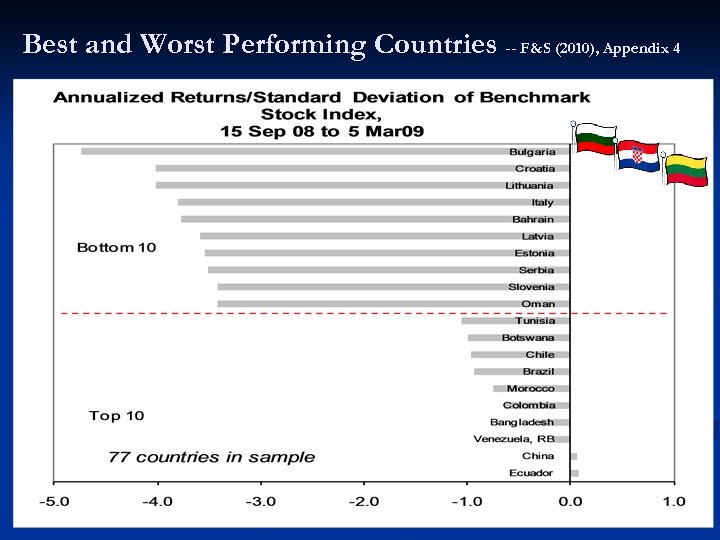
Best and Worst Performing Countries -- F&S (2010), Appendix 4 33
F & Saravelos (2010): Bivariate 34
F & Saravelos (2010): Multivariate 35
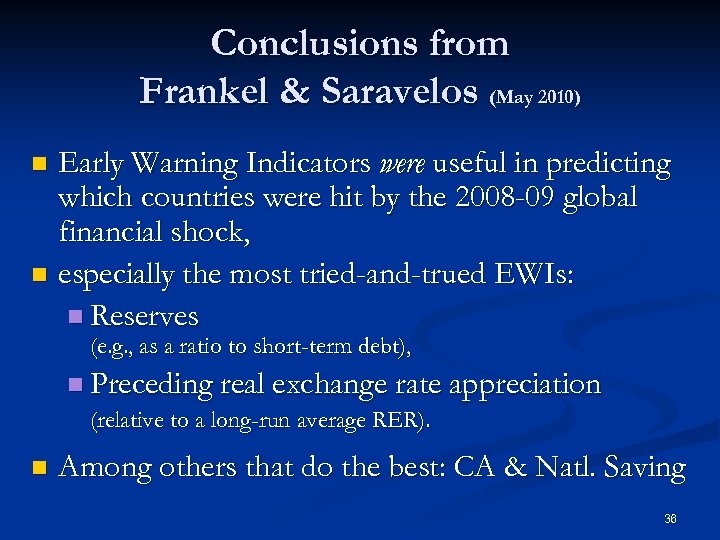
Conclusions from Frankel & Saravelos (May 2010) Early Warning Indicators were useful in predicting which countries were hit by the 2008 -09 global financial shock, n especially the most tried-and-trued EWIs: n Reserves n (e. g. , as a ratio to short-term debt), n Preceding real exchange rate appreciation (relative to a long-run average RER). n Among others that do the best: CA & Natl. Saving 36
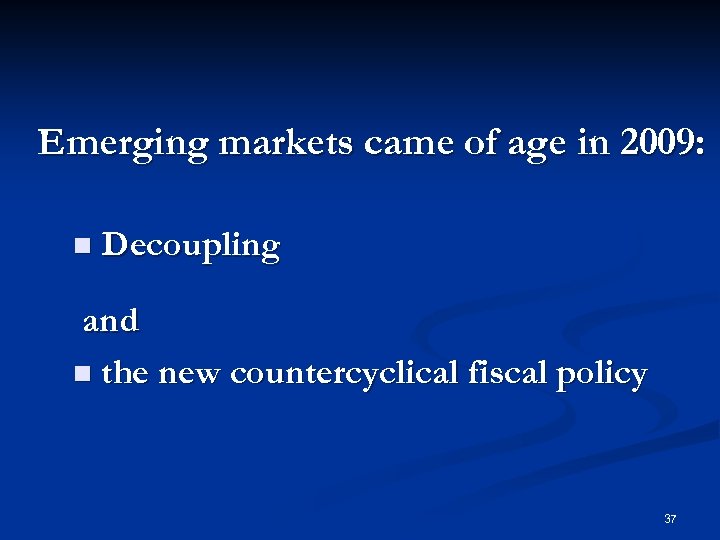
Emerging markets came of age in 2009: n Decoupling and n the new countercyclical fiscal policy 37
De-coupling turned out to be real after all n at least with respect to East Asia, which has rebounded very strongly over the last year, n after a sharp loss of exports over the preceding year, n n from 2008 QI to 2009 Q I. China’s growth has not only returned to its blistering pace of 10% n but by now is a source of global growth n n n because China is now a much larger share of the world economy than in the 1980 s or 90 s. India, Indonesia, & other Asian countries also weathered the global recession well, and are growing strongly. 38
The new countercyclical fiscal policy Fiscal policy used well would be countercyclical -- moderating fluctuations. n In developing countries, unfortunately, fiscal policy has in the past tended to be procyclical -expanding in booms, contracting in recessions. n n n It has been worse in Latin America, and among commodity producers. The US made the same mistake during 2003 -2007: failed to take advantage of the expansion to reduce the structural budget deficit. References for procyclical fiscal policy: n n n E. Mendoza & P. M. Oviedo, NBER SI, 2006 E. Talvi & C. Vegh, JDE, 2005 M. Gavin & R. Perotti, NBER Macro Annual, 1997 Kaminsky, Reinhart & Vegh, “When it Rains, it Pours, ” NBER Macro Annual 2004 A. Alesina & G. Tabellini, 2005 39
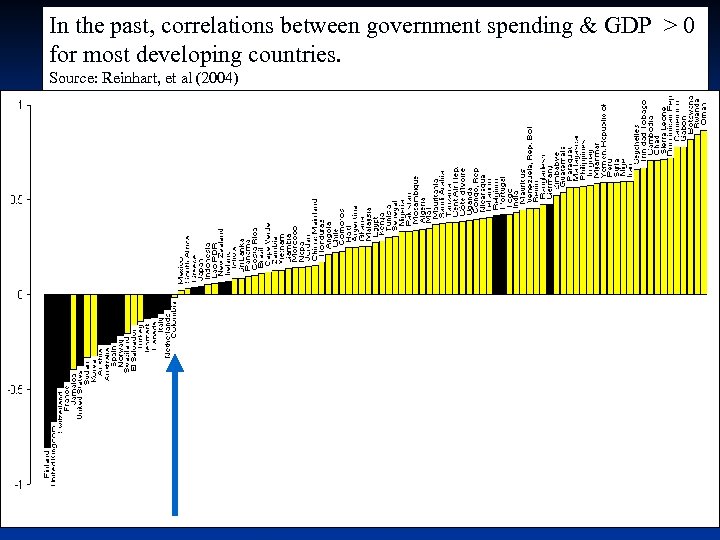
In the past, correlations between government spending & GDP > 0 The problem of procyclical fiscal policy for most developing countries. In developing countries, unfortunately, fiscal policy has tended to be procyclical: expanding in booms, contracting in recessions. n Especially in Latin America & among commodity producers. Source: Reinhart, et al (2004) n The US made the same mistake 2003 -07: failed to take advantage of the expansion to cut structural budget deficit. n References for procyclical fiscal policy: Mendoza & Oviedo (2006), Talvi & Vegh (2005), Gavin & Perotti (1997), Kaminsky, Reinhart & Vegh (2004), Alesina & Tabellini (2005). 40
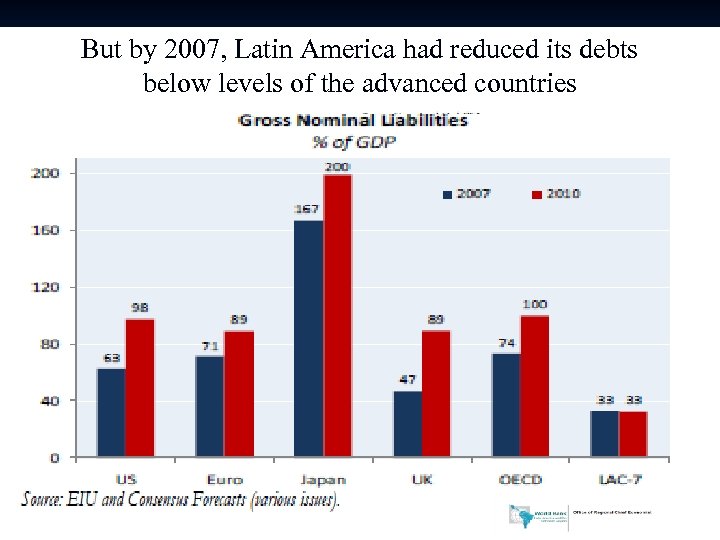
But by 2007, Latin America had reduced its debts below levels of the advanced countries April 21, 2010 41
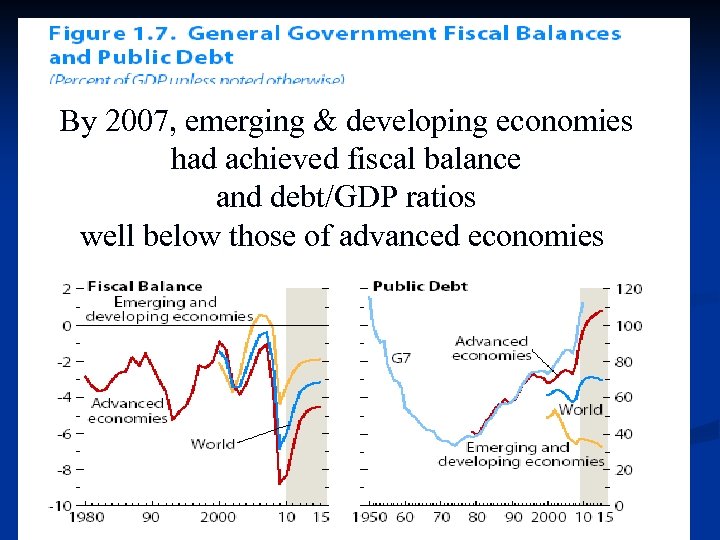
By 2007, emerging & developing economies had achieved fiscal balance and debt/GDP ratios well below those of advanced economies. 42
The fruits of fiscal discipline: n For the first time, Korea has a higher credit rating than Iceland or Greece n Developing countries were able to respond to the 2008 -09 recession with fiscal expansion to moderate the downturn. 43
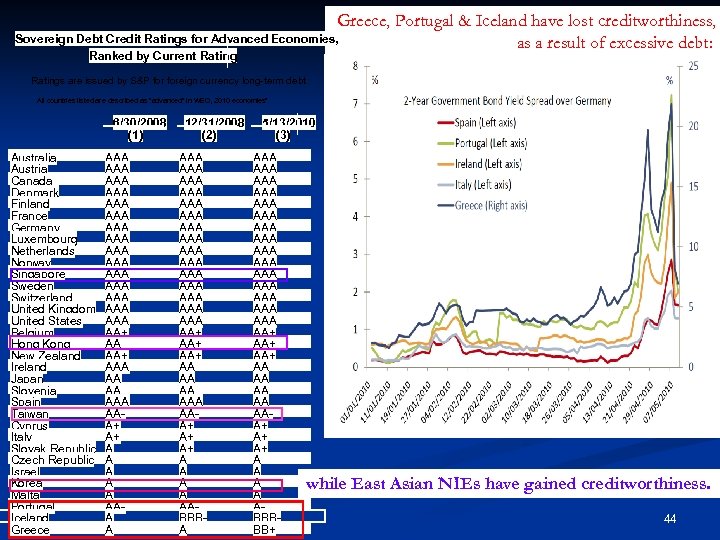
Greece, Portugal & Iceland have lost creditworthiness, Sovereign Debt Credit Ratings for Advanced Economies, as a result of excessive debt: Ranked by Current Ratings are issued by S&P foreign currency long-term debt All countries listed are described as "advanced” in WEO, 2010 economies" 6/30/2008 (1) Australia Austria Canada Denmark Finland France Germany Luxembourg Netherlands Norway Singapore Sweden Switzerland United Kingdom United States Belgium Hong Kong New Zealand Ireland Japan Slovenia Spain Taiwan Cyprus Italy Slovak Republic Czech Republic Israel Korea Malta Portugal Iceland Greece AAA AAA AAA AAA AA+ AAA AAA+ A+ A A AAA A 12/31/2008 (2) AAA AAA AAA AAA AA+ AA+ AA AAA AAA+ A+ A+ A A AABBBA 5/13/2010 (3) AAA AAA AAA AAA AA+ AA+ AA AA AAA+ A+ A+ A A ABBBBB+ while East Asian NIEs have gained creditworthiness. 44
Developing countries in 2009, for the 1 st time, were able to run countercyclical fiscal policies: n those that had wisely saved during the boom, n often in the form of For. Ex reserves or a SWF. On a global scale, China’s fiscal expansion was the most important example. n Chile’s institutional reform could be a model for all: n n Structural surplus of 1% of GDP (reduced to ½ %, then 0) n if economy is at full employment & price of copper at its long-run level. n Estimates of full employment & LR price of copper are made by commissions of experts, not politicians. 45
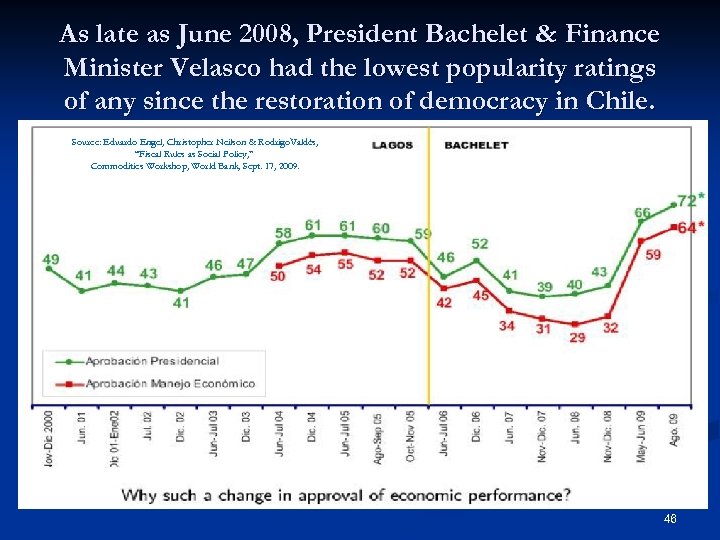
As late as June 2008, President Bachelet & Finance Minister Velasco had the lowest popularity ratings of any since the restoration of democracy in Chile. Source: Eduardo Engel, Christopher Neilson & Rodrigo. Valdés, “Fiscal Rules as Social Policy, ” Commodities Workshop, World Bank, Sept. 17, 2009. 46
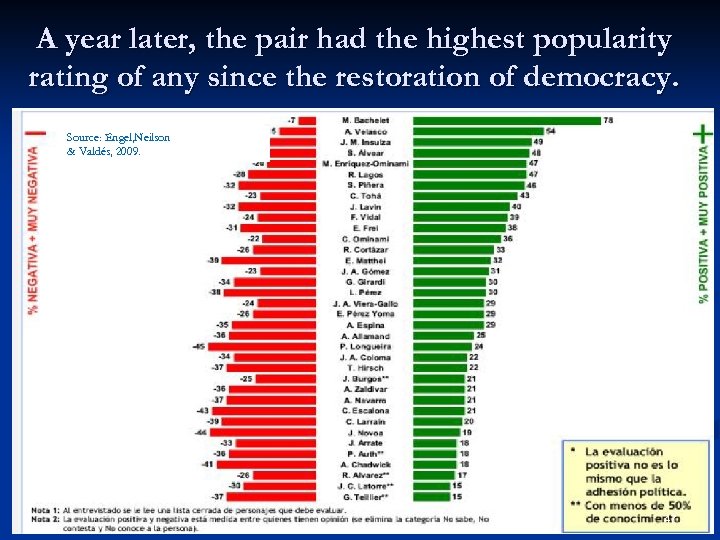
A year later, the pair had the highest popularity rating of any since the restoration of democracy. Source: Engel, Neilson & Valdés, 2009. 47
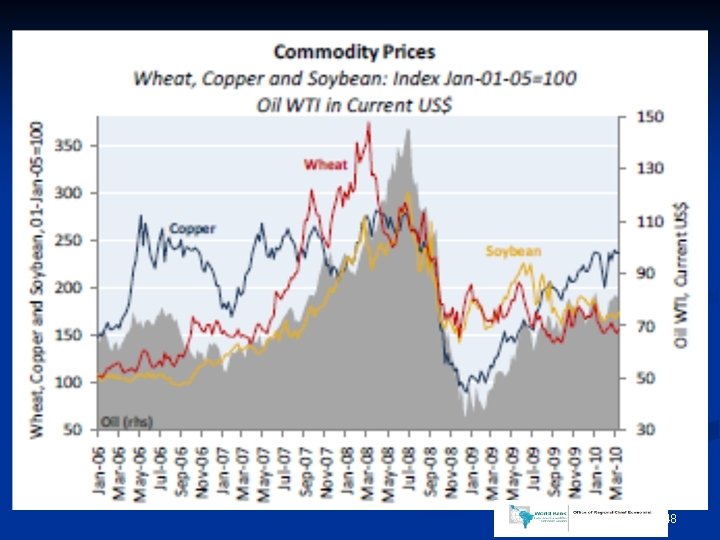
April 21, 2010 48
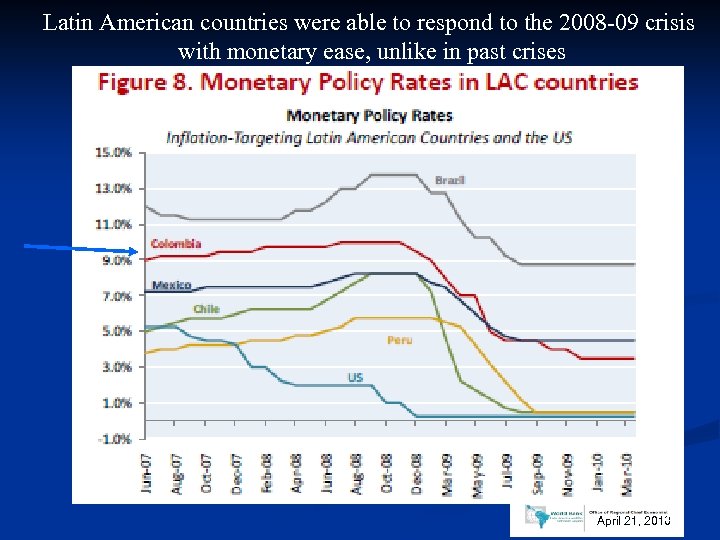
Latin American countries were able to respond to the 2008 -09 crisis with monetary ease, unlike in past crises 49 April 21, 2010
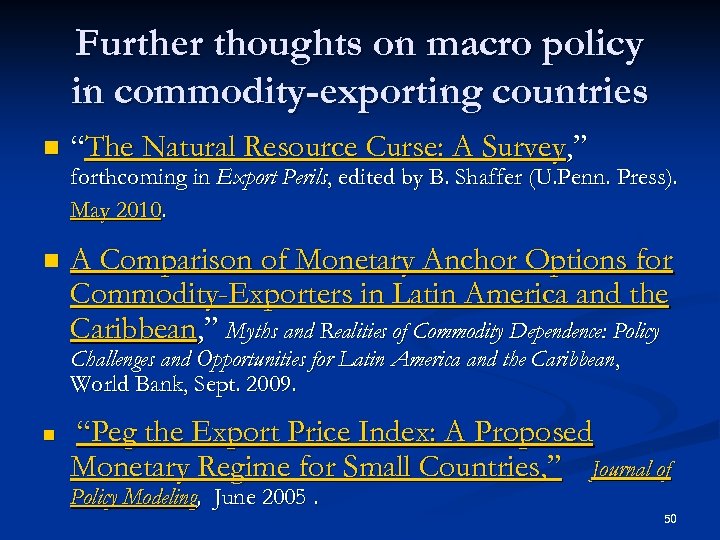
Further thoughts on macro policy in commodity-exporting countries n “The Natural Resource Curse: A Survey, ” forthcoming in Export Perils, edited by B. Shaffer (U. Penn. Press). May 2010. n A Comparison of Monetary Anchor Options for Commodity-Exporters in Latin America and the Caribbean, ” Myths and Realities of Commodity Dependence: Policy Challenges and Opportunities for Latin America and the Caribbean, World Bank, Sept. 2009. n “Peg the Export Price Index: A Proposed Monetary Regime for Small Countries, ” Journal of Policy Modeling, June 2005. 50
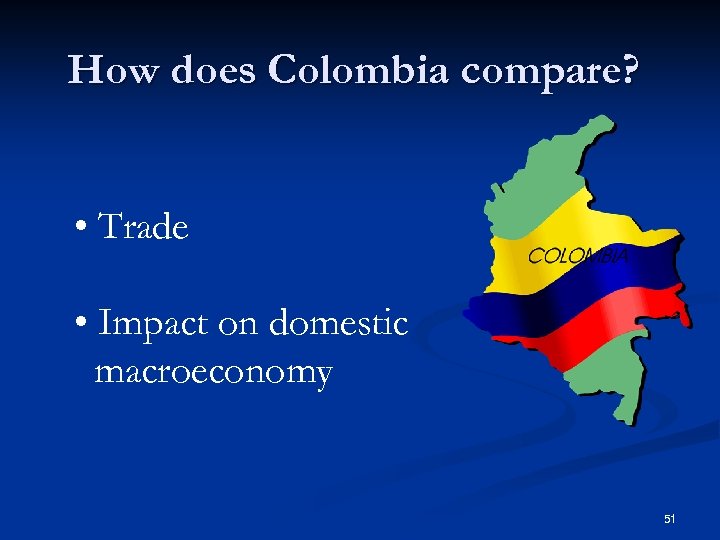
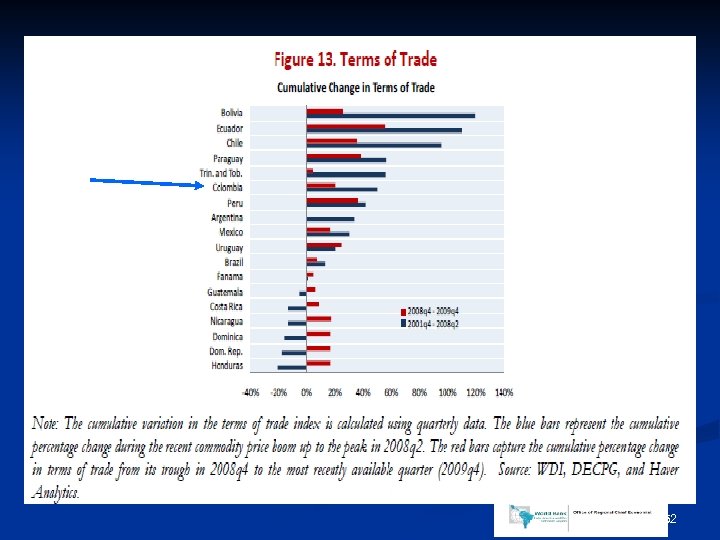
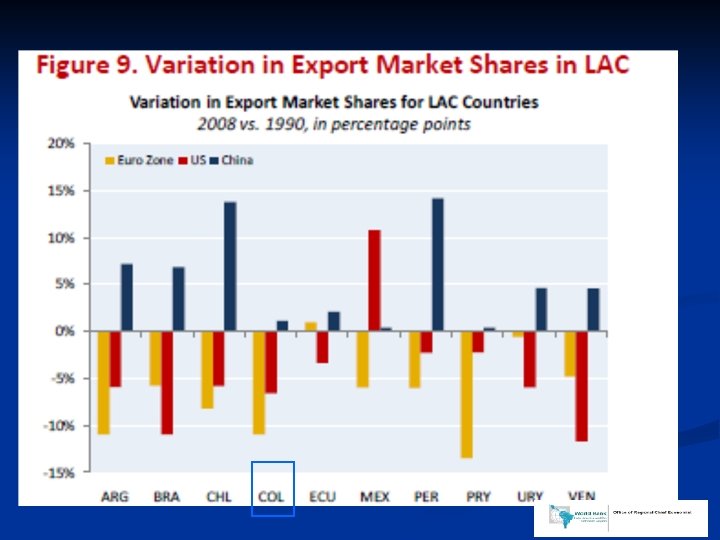
How does Colombia compare? • Trade • Impact on domestic macroeconomy 51
April 21, 2010 52
April 21, 53 2010
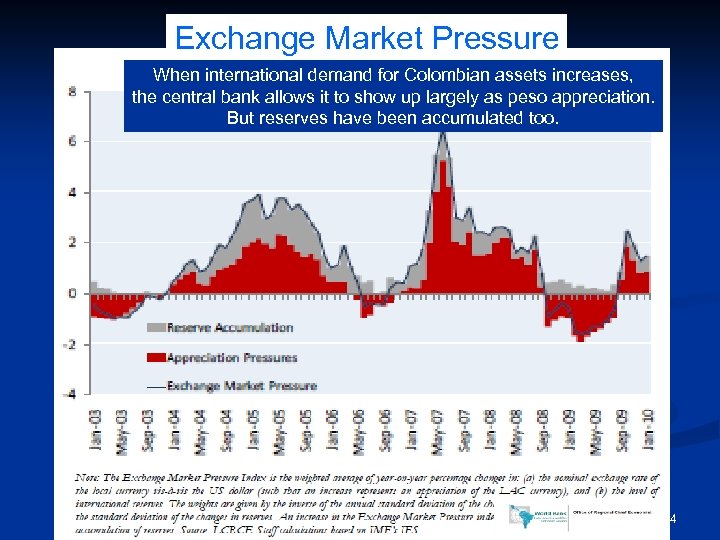
Exchange Market Pressure When international demand for Colombian assets increases, the central bank allows it to show up largely as peso appreciation. But reserves have been accumulated too. April 21, 2010 54
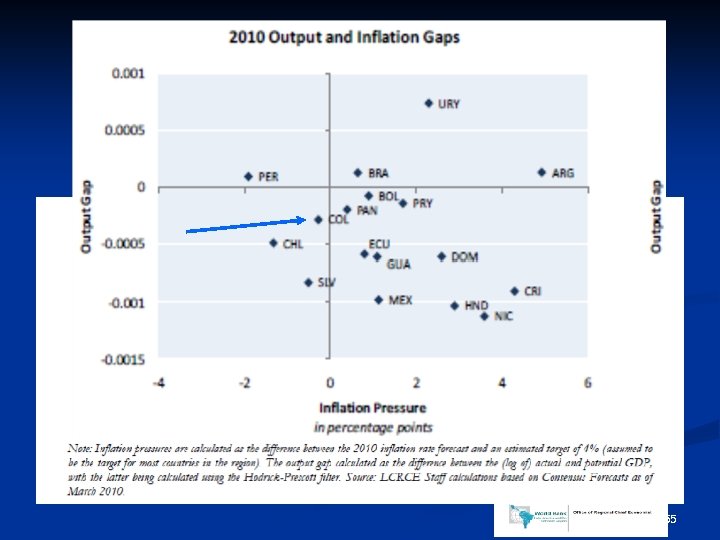
April 21, 2010 55
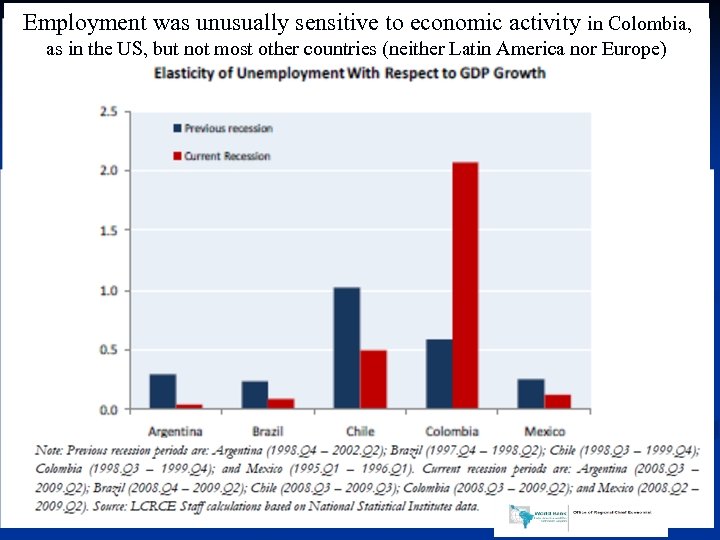
Employment was unusually sensitive to economic activity in Colombia, as in the US, but not most other countries (neither Latin America nor Europe) April 21, 2010 56
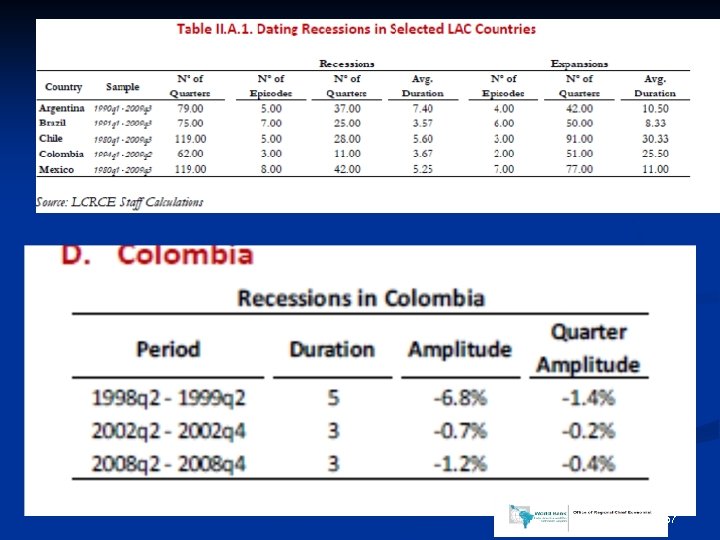
April 21, 2010 57

58
Скачать презентацию Emerging Market Countries in the Global Financial Crisis
7e7d906535b2c849676cf262573284d7.ppt