


 Скачать презентацию Emergency Services and Social Media VGSO client presentation
d5fb7437f44df5bc5c9aaa4b9d914555.ppt
- Количество слайдов: 72
 Emergency Services and Social Media VGSO client presentation Emergency Services Practice Group 19 November 2010
 Speakers • Georgette Apostolopoulos Solicitor, Victorian Government Solicitor’s Office • Sandeep Varma Manager Communities and Media Relations, Office of the Emergency Services Commissioner • Isabel Parsons Special Counsel, Victorian Government Solicitor’s Office • Darren Whitelaw Acting Director, Strategic Communications Branch, Department of Justice • Carolyn Doyle Managing Principal Solicitor, Victorian Government Solicitor’s Office
 Government 2. 0 • Use of existing social media sites – Facebook/Twitter/You. Tube • VPS Innovation Action Plan and Government 2. 0 Action Plan
 Social media in emergencies VGSO Seminar 19 November 2010 Sandeep Varma Twitter: @dizzydeep
 Social media scenario: There’s an emergency. Questions • What do people expect? • What happens in social media? • What is going to happen in the future?
 Giuliani model for emergency communications • What we know • What we don’t know • What we’re doing • What we want you to do
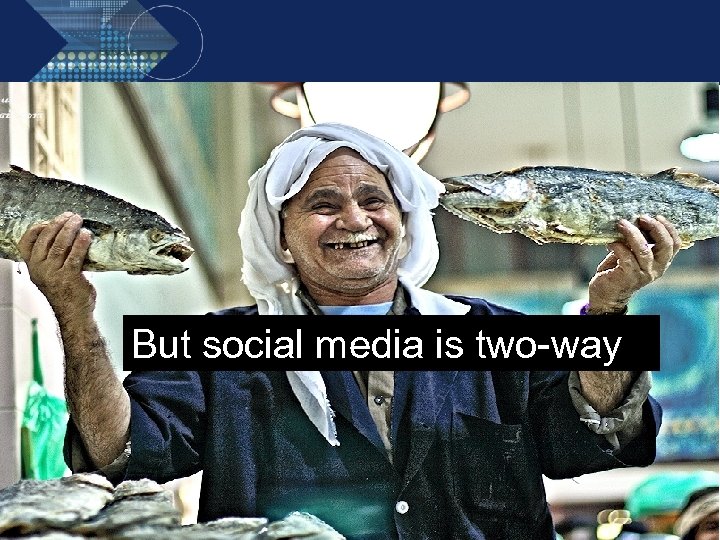 But social media is two-way
 Social media version of the Giuliani model • Here’s what we know AND how to share it with people you know • Here’s what we don’t know. Tell us what you know and help us fill in gaps. • Here’s what we’re doing (verified) AND what you’re doing (unverified) • Here’s what we want you to do AND how to do it (ex. a map for evacuation)
 • What do people expect? – Australian stats – Red Cross research
 Australians are the most prolific users of social media in the world.
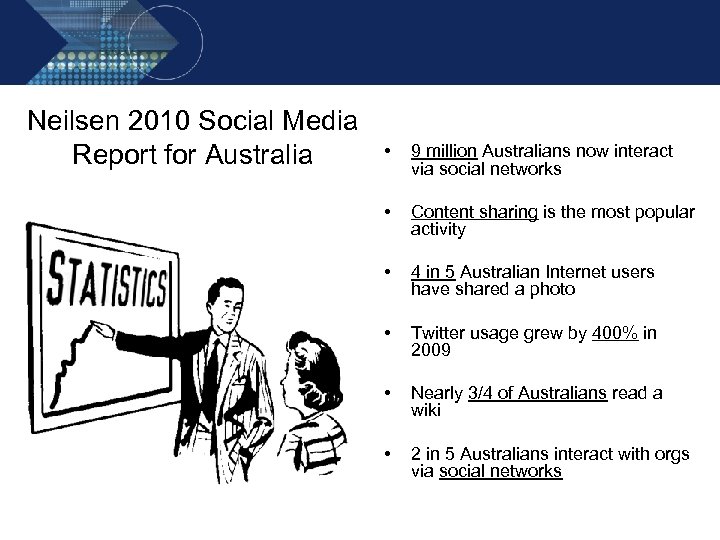 Neilsen 2010 Social Media Report for Australia • 9 million Australians now interact via social networks • Content sharing is the most popular activity • 4 in 5 Australian Internet users have shared a photo • Twitter usage grew by 400% in 2009 • Nearly 3/4 of Australians read a wiki • 2 in 5 Australians interact with orgs via social networks
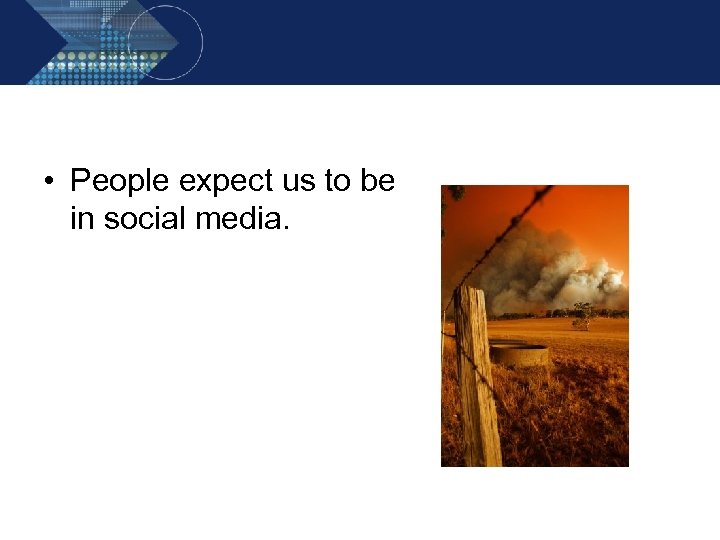 • People expect us to be in social media.
 Red Cross Report (USA) • Survey research into social media in disasters • One in six (16%) have used social media to get information about an emergency
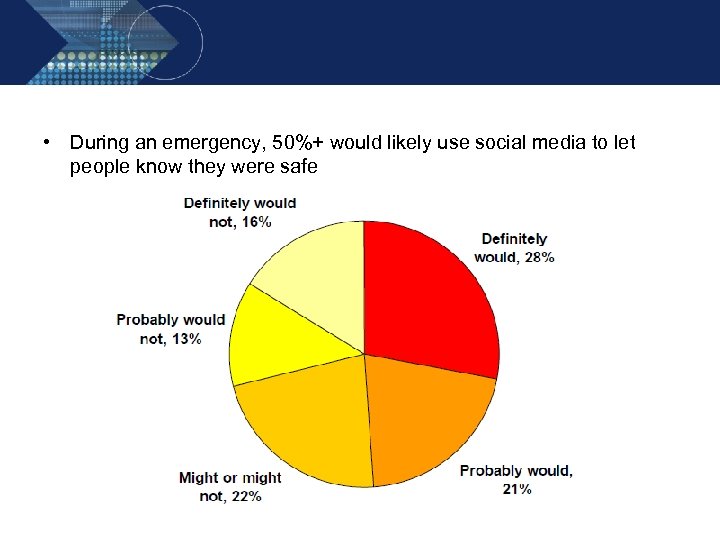 • During an emergency, 50%+ would likely use social media to let people know they were safe
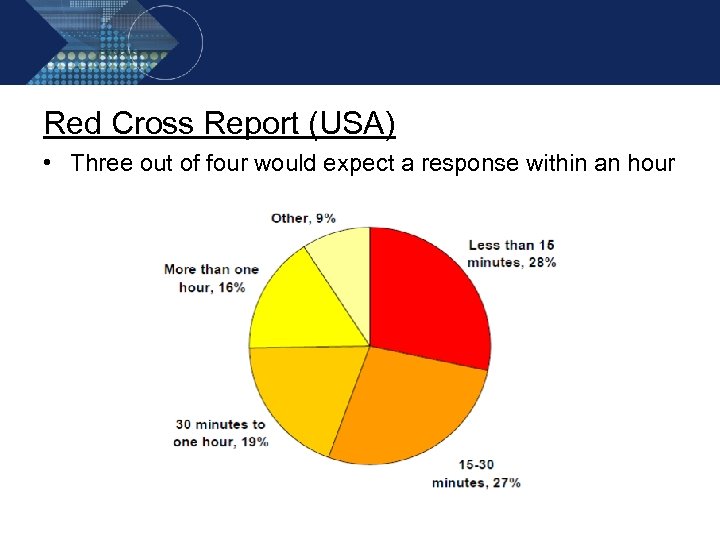 Red Cross Report (USA) • Three out of four would expect a response within an hour
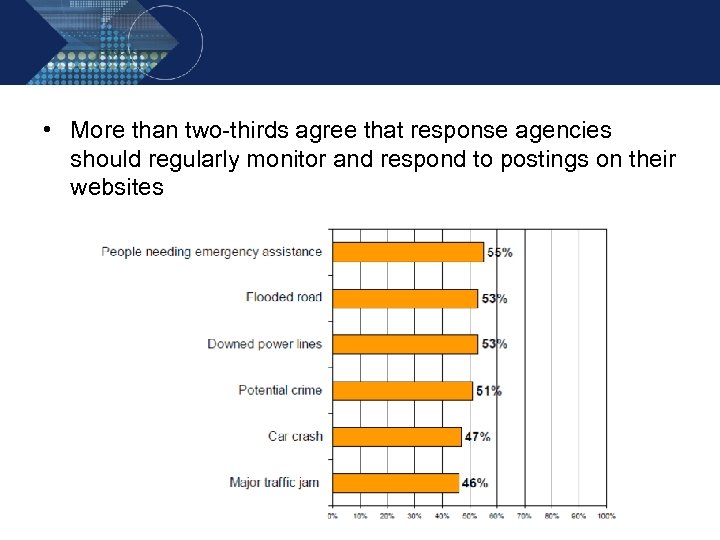 • More than two-thirds agree that response agencies should regularly monitor and respond to postings on their websites
 What are people doing? Summary • The community is using social media • Whether we are in social media or not, during an emergency the community will be • If we don’t provide interactive, real-time information they will find it elsewhere and then wonder loudly, “Why didn’t government provide this information!”
 What happens in social media? • Recent examples – Victoria: Vic. Floods – Melbourne: Building fire
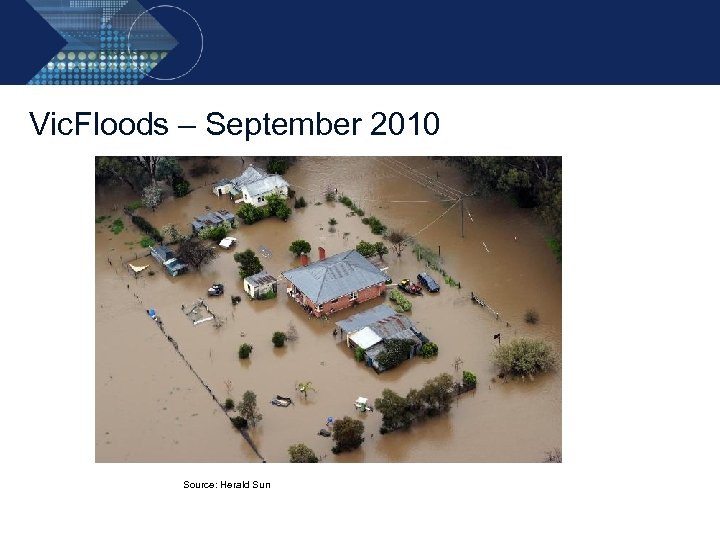 Vic. Floods – September 2010 Source: Herald Sun
 Vic. Floods • • • 500+ tweets recorded Potential reach: 100, 000+ Government presence minimal Regional media outlets in focus Key outlets: ABC/774/3 AW + regional papers
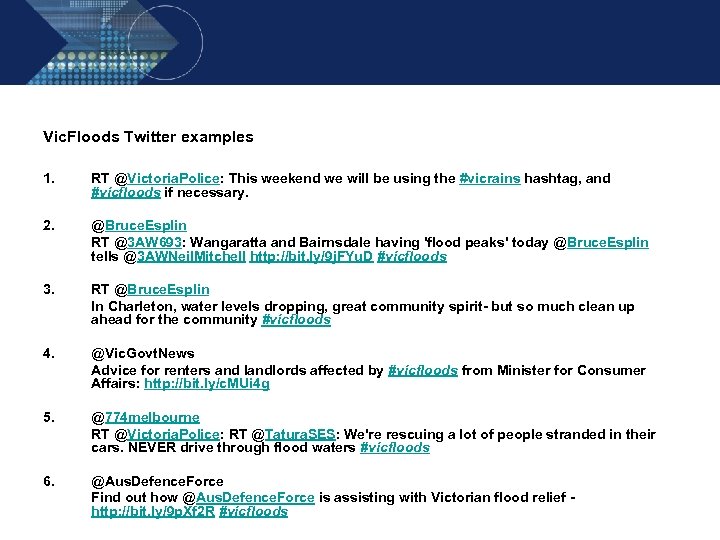 Vic. Floods Twitter examples 1. RT @Victoria. Police: This weekend we will be using the #vicrains hashtag, and #vicfloods if necessary. 2. @Bruce. Esplin RT @3 AW 693: Wangaratta and Bairnsdale having 'flood peaks' today @Bruce. Esplin tells @3 AWNeil. Mitchell http: //bit. ly/9 j. FYu. D #vicfloods 3. RT @Bruce. Esplin In Charleton, water levels dropping, great community spirit- but so much clean up ahead for the community #vicfloods 4. @Vic. Govt. News Advice for renters and landlords affected by #vicfloods from Minister for Consumer Affairs: http: //bit. ly/c. MUi 4 g 5. @774 melbourne RT @Victoria. Police: RT @Tatura. SES: We're rescuing a lot of people stranded in their cars. NEVER drive through flood waters #vicfloods 6. @Aus. Defence. Force Find out how @Aus. Defence. Force is assisting with Victorian flood relief http: //bit. ly/9 p. Xf 2 R #vicfloods
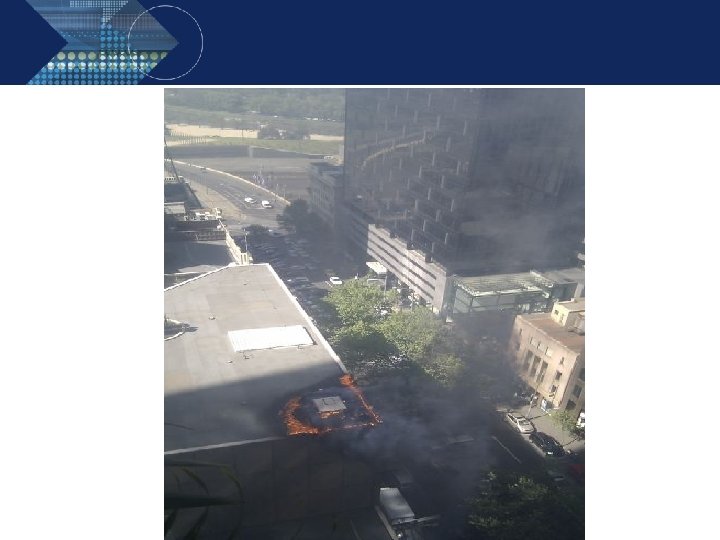
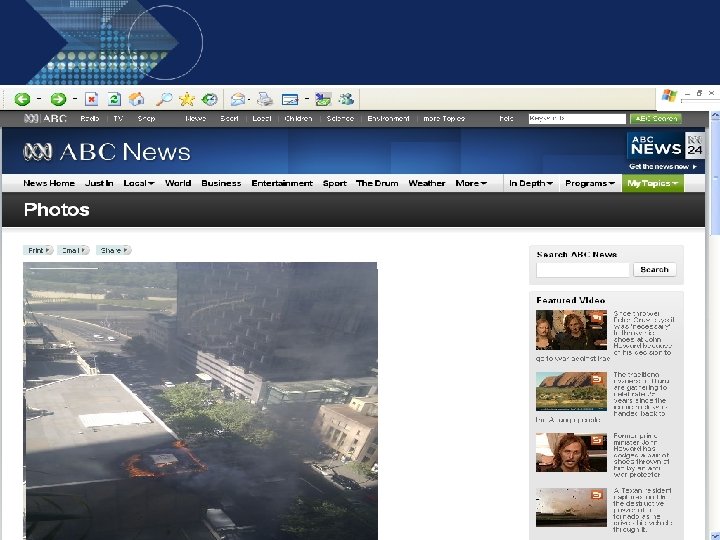
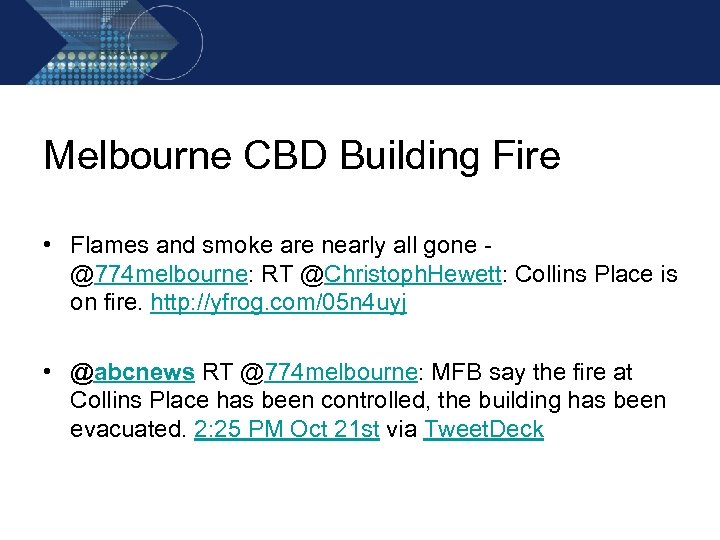 Melbourne CBD Building Fire • Flames and smoke are nearly all gone @774 melbourne: RT @Christoph. Hewett: Collins Place is on fire. http: //yfrog. com/05 n 4 uyj • @abcnews RT @774 melbourne: MFB say the fire at Collins Place has been controlled, the building has been evacuated. 2: 25 PM Oct 21 st via Tweet. Deck
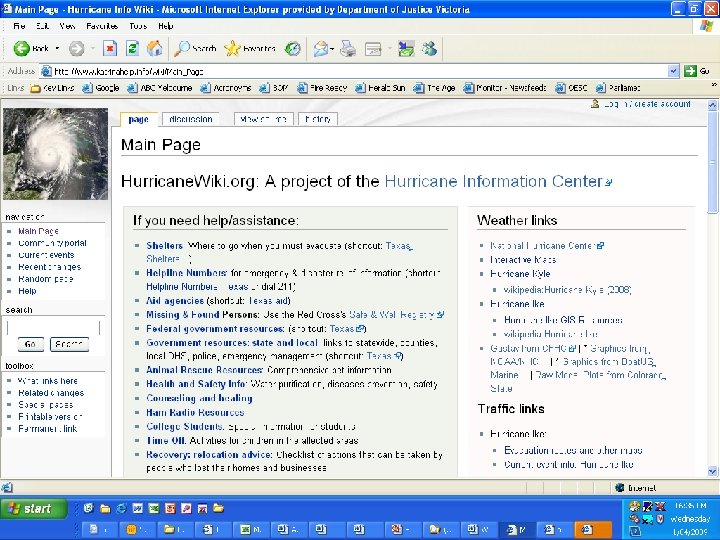
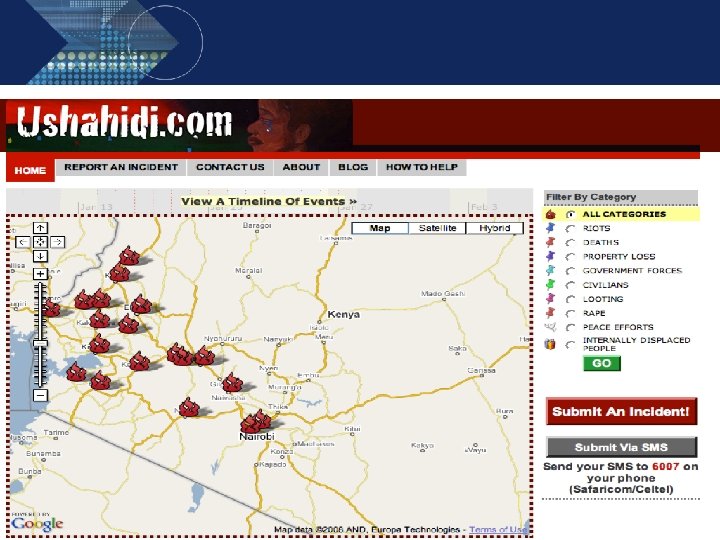
 How do we tap into community? • Research shows people will offer to help and will engage online • Research shows people will use multiple sources to verify information • We need to give people an outlet, in preparedness, response and recovery • We need to partner with the technology community • We need to find the best way to tap into and use community information
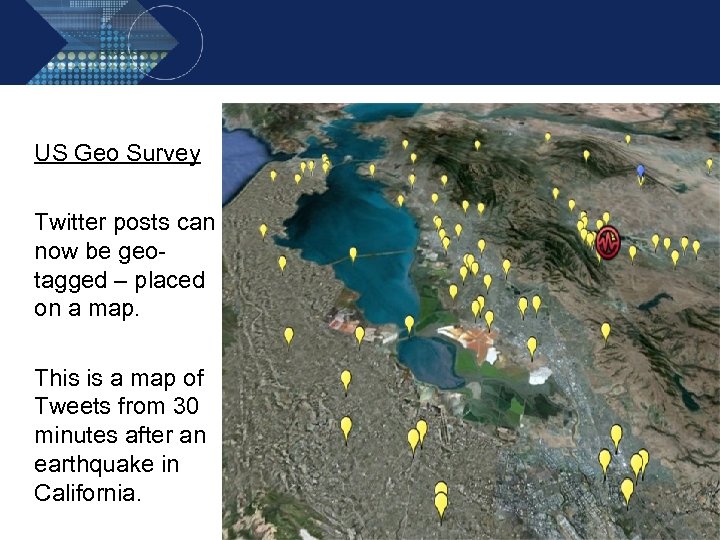 US Geo Survey Twitter posts can now be geotagged – placed on a map. This is a map of Tweets from 30 minutes after an earthquake in California.
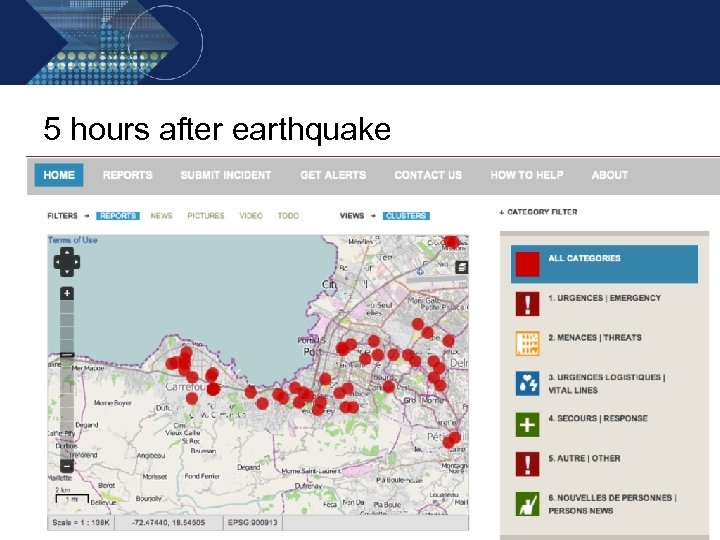 5 hours after earthquake
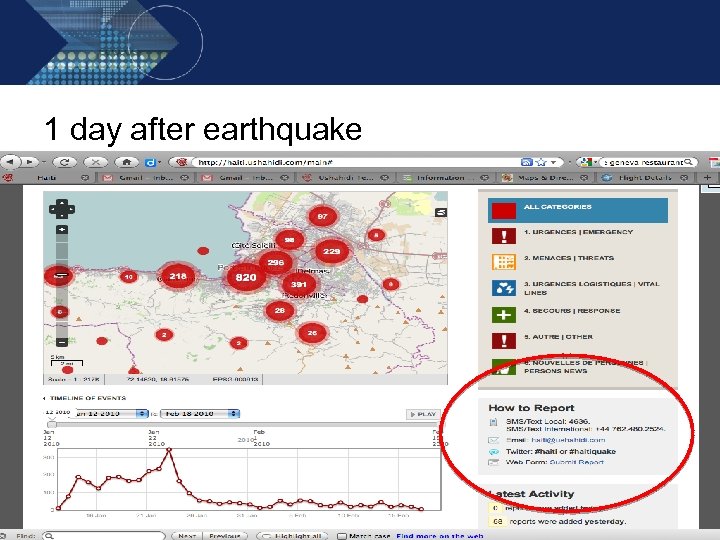 1 day after earthquake
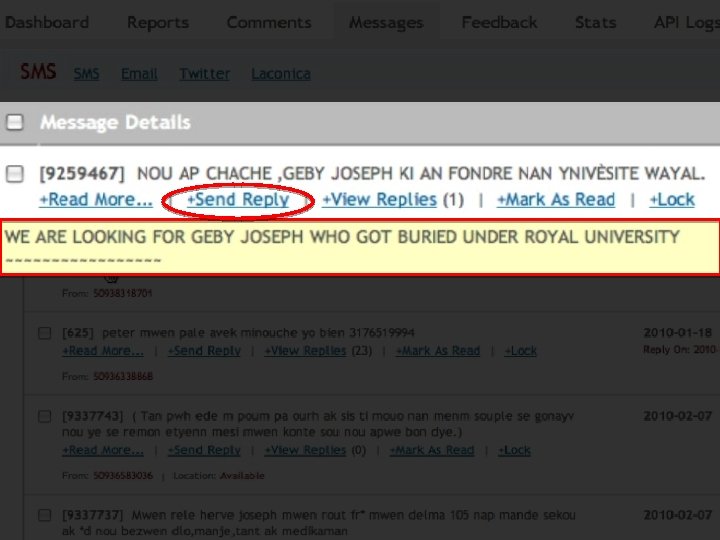
 Verification – the big challenge • Community information verification: how do we tell it’s real? • Triple Zero: recent report says 50% of calls are crank calls • Social media? No Australian research or international best practice verification model yet – but info is much more easily traced on social media, especially with GPS mobile phones

 The Future • • • National Broadband Network Vic. Govt 2. 0 Action Plan One laptop per child in VIC schools More and more smartphones & devices Growing government engagement online Research, strategy development & risk management
 Isabel Parsons Special Counsel Victorian Government Solicitor’s Office Phone: 9947 1405 Email: isabel. parsons@vgso. vic. gov. au
 Legal aspects of using social media • Liability, risk management and compliance
 What are some legal issues • Information quality and timelines • Infringement of third party rights – copyright and defamation • Cyber squatting and unauthorised content
 Legal framework for social media • Terms between service provider and the State • Terms of access by user
 Information quality and timelines • • Liability for negligent misstatement Duty to warn Duty to act Correction of inaccurate data
 Disclaimers • Scope of disclaimer • Drawn to attention of user • Accepted by user?
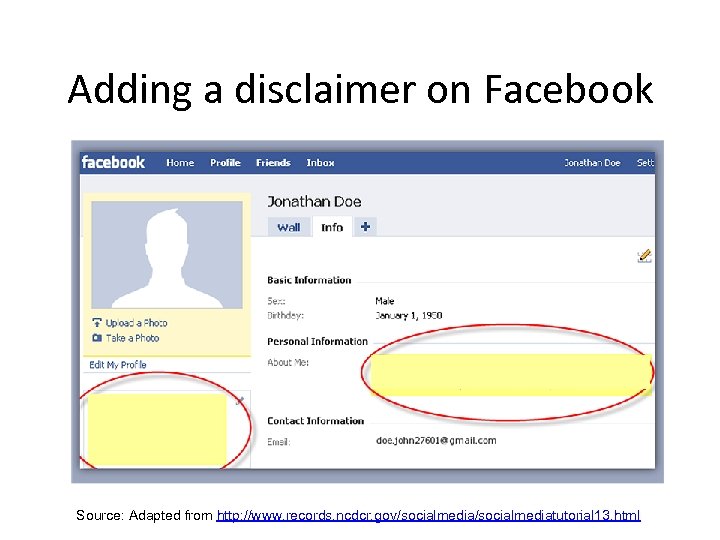 Adding a disclaimer on Facebook Disclaimer can be placed in multiple locations within generic layout of Facebook Source: Adapted from http: //www. records. ncdcr. gov/socialmediatutorial 13. html
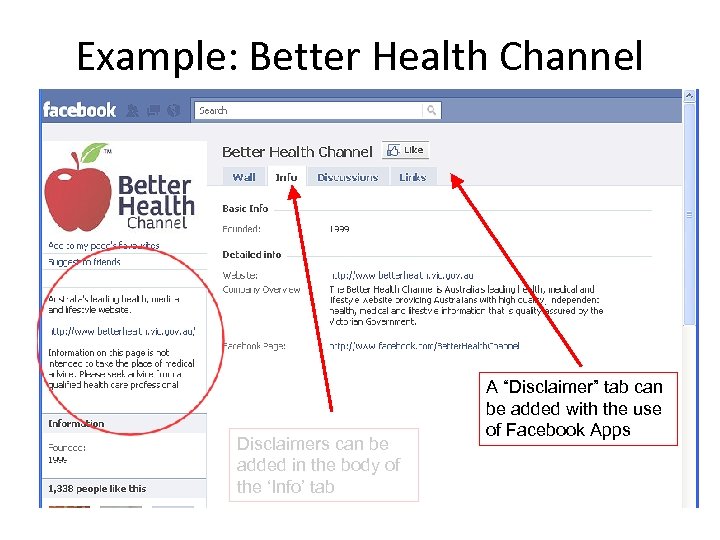 Example: Better Health Channel Disclaimers can be added in the body of the ‘Info’ tab A “Disclaimer” tab can be added with the use of Facebook Apps
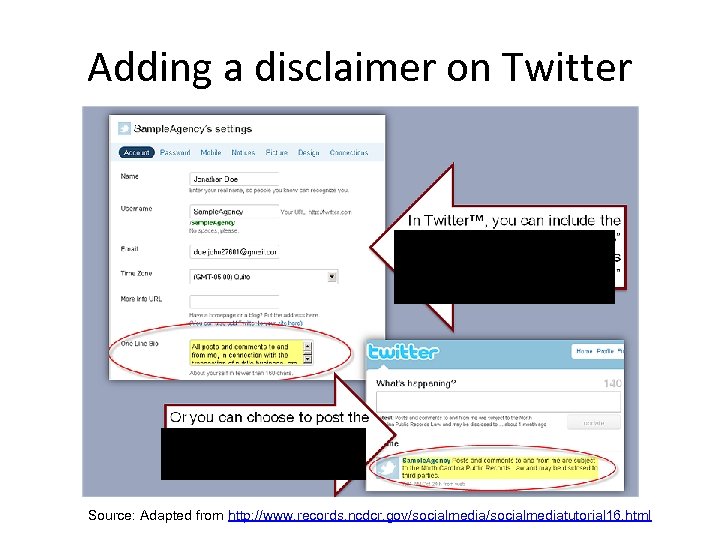 Adding a disclaimer on Twitter Add a disclaimer in the ‘One Line Bio’ section – Limit 160 characters OR: Regularly post the disclaimer Source: Adapted from http: //www. records. ncdcr. gov/socialmediatutorial 16. html
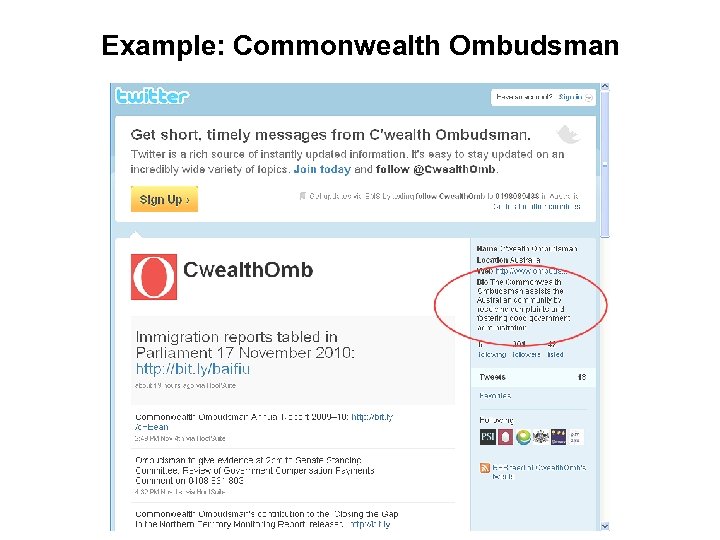 Example: Commonwealth Ombudsman
 Infringement of third party rights defamation • Online content is published where downloaded (Dow Jones v Gutnick 2002) • Range of claims being brought against individuals for online defamation • State may be able to rely on s 32 of Defamation Act 2005 (innocent dissemination)
 Infringement of third party rights copyright • Online use is copyright use – reproduction/publication/communication • Does the statutory licence apply? • Permission/licence of owner of UGC • Infringement – knowledge relevant to damages s 115(3) or other remedies s 116(2)
 Authorisation and infringement of copyright • Authorisation of infringement – ss 36(1 A) and 101(1 A) • Practical steps • Exemption for online infringement – service providers (ss 39 B and 112 E - Safe harbour)
 Terms of contract with social media service provider • Terms are fixed for existing social media sites • Key government requirements and policies • Government or supplier terms? – US General Service Administration amendment to terms of service
 Major issues for contracts with all service providers • • • Scope and duration of content licence Liability of service provider Indemnities by the State Continuity and integrity of service No endorsement
 Member terms and conditions • To cover participation of third parties (creation and licensing of UGC) • Must be drawn to attention of users • Acceptable use/code of conduct and rules for modification/take down
 Moderation and remediation • Depends upon nature of online engagement/controversy • Minimum requirements for automated moderation? • Risk management approach – warnings, communication including complaints and reporting • Legal pitfalls - defamation
 Resources • AGIMO Web Publishing Guide • Project 8 Online Engagement Guideline Government 2. 0 • Government 2. 0 risk register and management plan
 Cyber squatting and unauthorised consent • Addressing cyber squatting • Removal of unauthorised or unlawful content
 Record Keeping • Government 2. 0 Taskforce – records to be kept and guidance developed • Should all records be retained? • Victoria Electronic Records Strategy (VERS) and PROV Advice or guidelines relating records of outsourced activity
 Carolyn Doyle Managing Principal Solicitor Victorian Government Solicitor’s Office Phone: 9947 1406 Email: carolyn. doyle@vgso. vic. gov. au
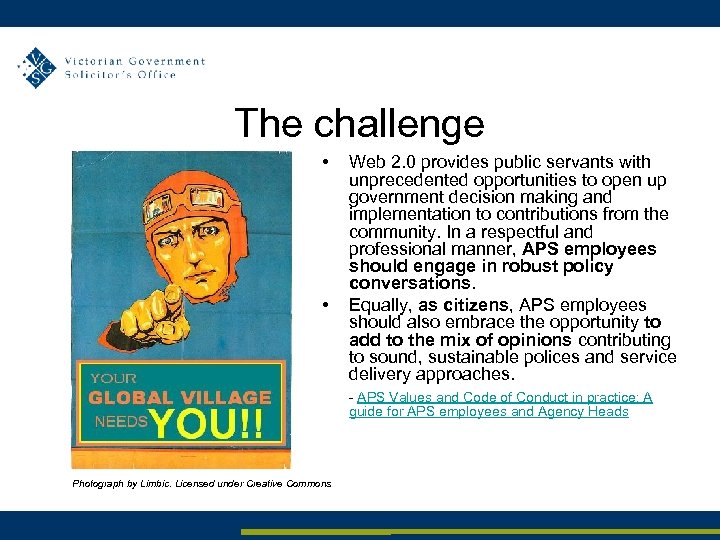 The challenge • • Web 2. 0 provides public servants with unprecedented opportunities to open up government decision making and implementation to contributions from the community. In a respectful and professional manner, APS employees should engage in robust policy conversations. Equally, as citizens, APS employees should also embrace the opportunity to add to the mix of opinions contributing to sound, sustainable polices and service delivery approaches. - APS Values and Code of Conduct in practice: A guide for APS employees and Agency Heads Photograph by Limbic. Licensed under Creative Commons
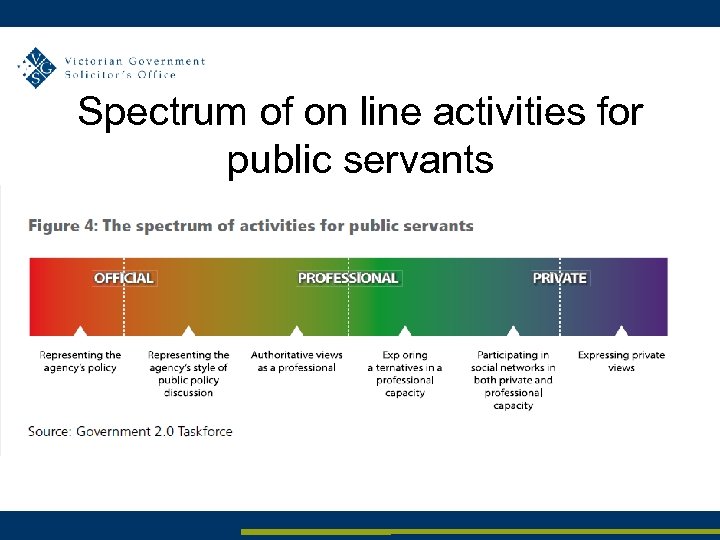 Spectrum of on line activities for public servants
 The generation gap
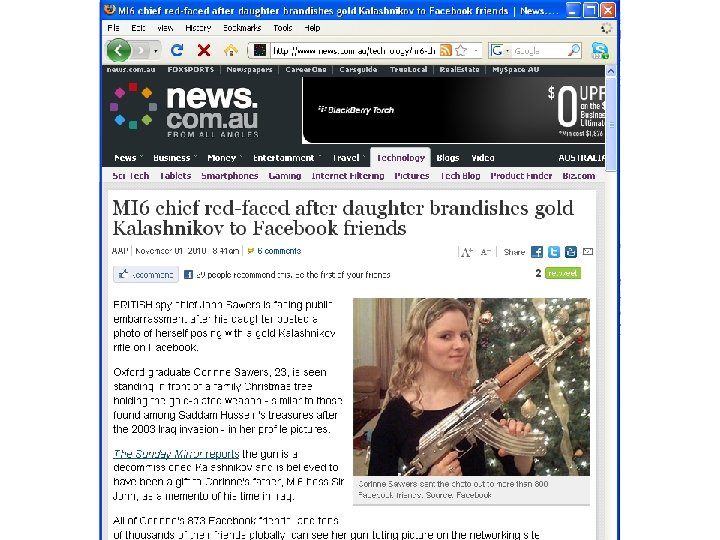
 Private? Public? – negotiating the boundaries • The tribulations of the Sawers
![Hair(y) FWA Case • Fitzgerald v Smith T/A Escape Hair Design [2010] FWA 7358](https://present5.com/presentation/d5fb7437f44df5bc5c9aaa4b9d914555/image-61.jpg "Hair(y) FWA Case • Fitzgerald v Smith T/A Escape Hair Design [2010] FWA 7358") Hair(y) FWA Case • Fitzgerald v Smith T/A Escape Hair Design [2010] FWA 7358
Hair(y) FWA Case • Fitzgerald v Smith T/A Escape Hair Design [2010] FWA 7358
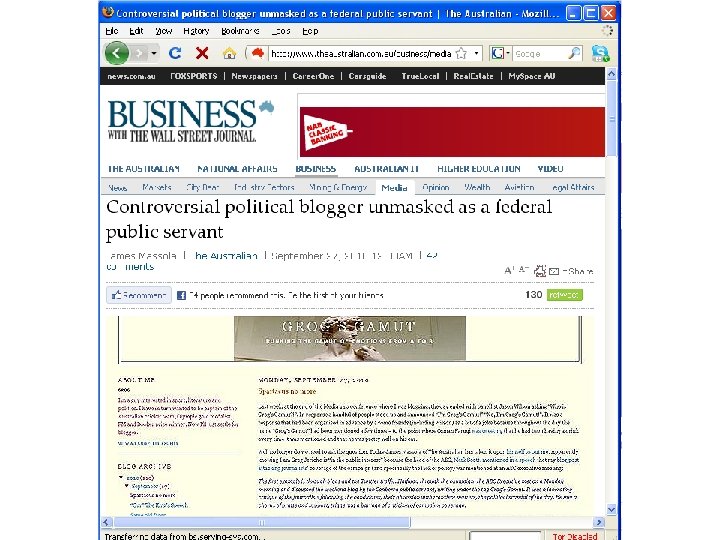
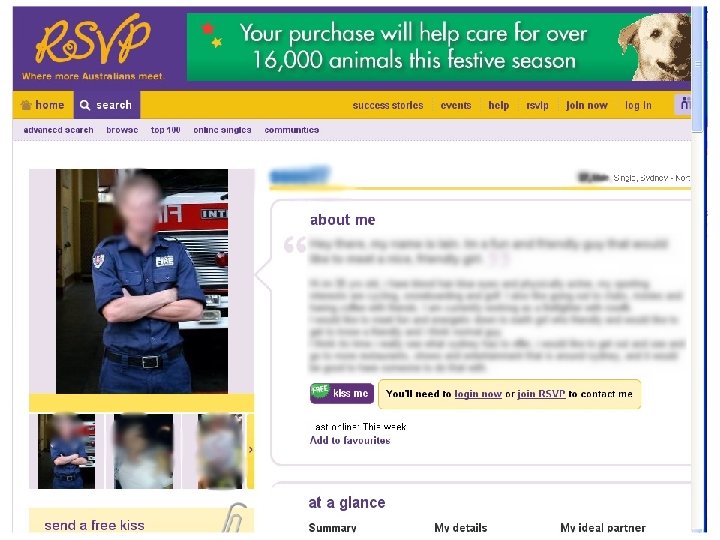
 Current framework for Vic public sector • Constitution Act – s 95 • Public Sector Code of Conduct – 3. 4, 3. 5 and 3. 9 • PSSC Guidance for use of social media in the VPS • Departmental (or agency policies): internet use, email use
 Constitution Act • Constitution Act – s 95(1)(a) - a person employed in any capacity in the service of the State of Victoria shall not …. publicly comment upon the administration of any department of the State of Victoria – s 95(2) any person who contravenes s 95 ‘shall on proof thereof to the satisfaction of body or person to which or whom he is subject in matters of discipline (as the case requires) be liable to a fine not exceeding $100 and in addition to such fine may be reduced in class subdivision grade status or salary or dismissed or have his services dispensed with’.
 Public Sector Code of Conduct – 3. 4. • Public sector employees only disclose official information or documents acquired in the course of their public employment when required to do so by law, in the legitimate course of duty, when called to give evidence in court, or when proper authority has been given. In such cases comments are confined to factual information only.
 Public Sector Code of Conduct – 3. 5 • • Public sector employees only make public comment when specifically authorised to do so in relation to their duties, a public sector body, or government policies and programs. Such comment is restricted to factual information and avoids expression of personal opinion. Public comment includes providing information or comment to any media (electronic or print), the internet and speaking engagements. When making a comment in a private capacity, public sector employees ensure their comments are not related to any government activity that they are involved in or connected with as a public sector employee and make it clear they are expressing their own view. They ensure that personal comments are not seen or perceived to be an official comment.
 Public Sector Code of Conduct – 3. 9 • Public sector employees avoid conduct in their private life that may adversely affect their standing as a public official or which may bring their public sector employer into disrepute.
 PSSC Guidance • High level • Use of social media is subject to the Code of Conduct • needs to be supported by departmental policy; • contains examples in the context of public and private use.
 Victoria Police policies • Police Regulation Act 1958 • Victoria Police Manual – Policy Rules – Procedures and guidelines
 Commonwealth • APS Values and Code of Conduct Ch 3 and 15 APS employees as citizens – ‘in a professional and respectful manner, APS employees should engage in robust policy conversations’ – ‘As citizens, APS employees should embrace the opportunity to add to the mix of opinions…’
 Commonwealth • Department of Finance – Social media 101: A beginner’s guide for Finance employees