


 Скачать презентацию Emergency Management Standards EM- XML Consortium EM
1e1c251e5f43b802a01c1b5476206738.ppt
- Количество слайдов: 18
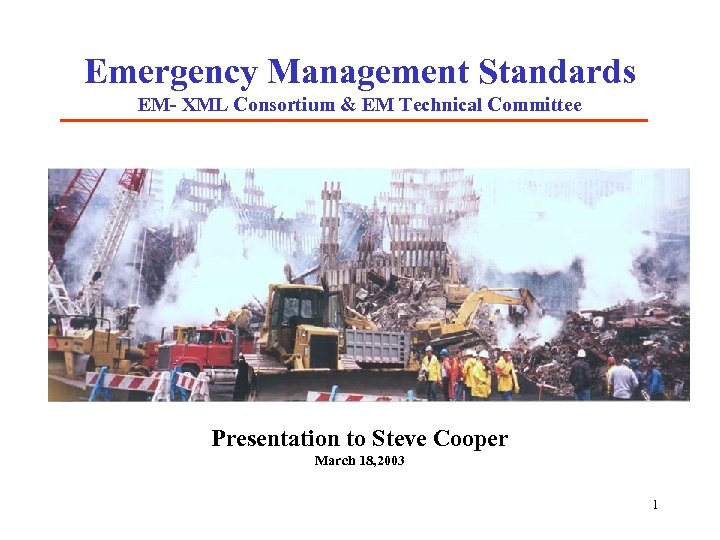 Emergency Management Standards EM- XML Consortium & EM Technical Committee Presentation to Steve Cooper March 18, 2003 1
 The Interoperability Imperative “State-sponsored terrorists and al Qaeda are not going to wait until we have our act together. ” Steve Cooper CIO, DHS 2
 Agenda Ø Ø EM Objectives & HSPD 5 EM XML Consortium EM Technical Committee (TC) EM-XML and DHS 3
 Need for Interoperable EM Standards Ø Interoperability challenge: – Within agencies and corporations – Between agencies and corporations – With existing legacy systems – With the next “new thing” Ø Incorporate best business practices for emergency and incident management Ø 80% of emergency resources come from the private sector 4
 EM-XML Consortium Objectives Ø Industry/Government consortium Ø Rapid XML interoperability standards development Ø Insure every American has appropriate access to the information they require when and how they need it (e. Gov, NRP and NIMS) 5
 HSPD 5 - Interoperability Requirements Ø Paragraph 15 – “To provide for interoperability and compatibility among Federal, State and local capabilities, the NIMS will include a core set of concepts, principles, terminology, and technologies covering the incident command system; multiagency coordination systems; unified command; training; identification and management of resources (including systems for classifying types of resources); qualifications and certification; and the collection, tracking and reporting of incident information and incident resources. ” 6
 EM-XML Consortium Ø Industry initiated in October, 2002 Ø Now includes over 40 entities: § Software vendors § System Integrators § Corporations § Government Agencies § Not-for-Profit Organizations 7
 EM-XML Consortium Ø Comprised of two committees – Executive Committee – Technical Committee 8
 EM-XML Executive Committee Ø “Big Tent” Ø Mission – Facilitate collaboration – Provide guidance and direction – Outreach and education 9
 EM Technical Committee Ø OASIS selected Ø Mission: Define standards that enable vital information exchange between local, state and federal agencies, private and not-forprofit organizations Ø Researched and evaluated existing standards to enhance and fill gaps 10
 Scope of Technical Charter Ø Design, develop and release XML schemabased standards Ø Framework for data exchange, functionality and service accessibility Ø Seamless application and data interoperability 11
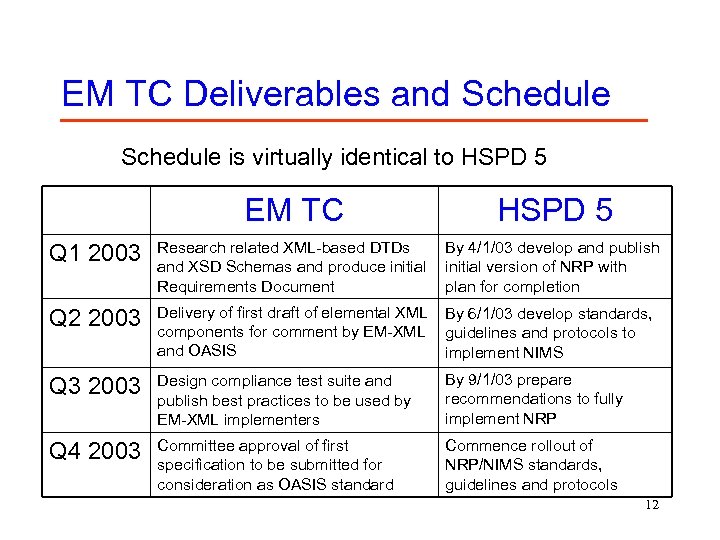 EM TC Deliverables and Schedule is virtually identical to HSPD 5 EM TC HSPD 5 Q 1 2003 Research related XML-based DTDs and XSD Schemas and produce initial Requirements Document By 4/1/03 develop and publish initial version of NRP with plan for completion Q 2 2003 Delivery of first draft of elemental XML components for comment by EM-XML and OASIS By 6/1/03 develop standards, guidelines and protocols to implement NIMS Q 3 2003 Design compliance test suite and publish best practices to be used by EM-XML implementers By 9/1/03 prepare recommendations to fully implement NRP Q 4 2003 Committee approval of first specification to be submitted for consideration as OASIS standard Commence rollout of NRP/NIMS standards, guidelines and protocols 12
 EM TC Work Completed to Date Ø Weekly Meetings starting 2/11/03 Ø 30 active members Ø Draft Requirement Document Ø Formation of Sub-Committees Ø Collection of existing schema, data dictionaries, etc. 13
 Deployment Strategy Ø Interoperability becomes critical buying decision criteria Ø Economic incentive/imperative drives commercial proliferation Ø Metcalf’s Law promotes both adoption and competition within the emerging standard’s framework 14
 EM-XML and The e-Gov Initiative Ø Share a common goal to ensure every American has appropriate access to whatever information they require when and how they need it Ø Need to take a non-traditional approach to solving emergency management interoperability Ø Disaster management not just a portal 15
 EM-XML and The NRP/NIMS Ø HSPD #5 Schedule and the EM TC Schedule are virtually identical Ø Use as basis for common, interoperability standards Ø Insure effective interface with other related disciplines (health, legal, financial, etc. ) Ø Leverage off the work already under way Ø Significantly increase stake-holder buy-in and reduce adoption resistance/complexity 16
 DHS/EM-XML Recommendations Ø Formally incorporate EM-XML as part of the NRP development plan for NIMS Ø Utilize EM-TC output for elements of the NIMS (Requirements, schema, DTD’s, etc. ) Ø Fund and provide oversight for validation/verification exercises Ø Publish and proliferate standards 17
 DHS/EM-XML Collaboration Benefits Ø Accomplish HSPD #5 objectives faster, better and cheaper Ø Truly support “all hazards” mission Ø Leverage value of installed base Ø Foster and benefit from innovation Ø Remove the stove-pipes Ø Accelerate adoption/proliferation 18