


 Скачать презентацию Emergency Management Higher Education Status Report National Academy
ba8baf7a4a187a73b8915ea17745228a.ppt
- Количество слайдов: 24
 Emergency Management Higher Education Status Report National Academy of Sciences Disasters Roundtable The Emergency Manager of the Future June 13, 2003, National Academy of Sciences, Washington, DC B. Wayne Blanchard, Ph. D. , CEM Emergency Management Higher Education Project Manager (301) 447 -1262, wayne. blanchard@dhs. gov http: //www. training. fema. gov/EMIWeb/edu
 EM Higher Education Conference 2003 -- Participation n 111 Participants – Largest Ever -For EM & HS n 79 Colleges and Universities Represented n 7 College Systems, Associations, Centers n 41 States Represented & District of Columbia n 3 Countries Represented 2
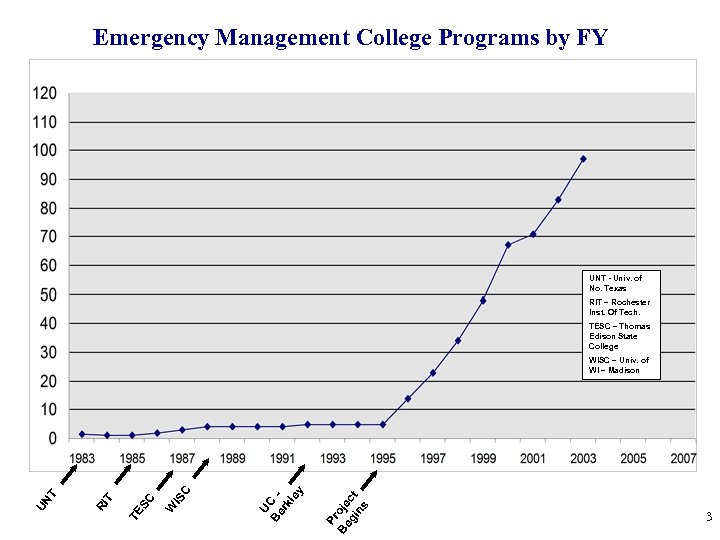 Emergency Management College Programs by FY UNT - Univ. of No. Texas RIT – Rochester Inst. Of Tech. TESC – Thomas Edison State College P Be roje gi ct ns U Be C rk le y W IS C SC TE T RI UN T WISC – Univ. of WI – Madison 3
 Growth of Collegiate “Emergency Management” Programs June 2001 n June 2002 n June 2003 n – 72 – 78 – 96 – 7 Doctoral Programs – 23 Masters Programs – 9 Bachelor Degrees – 15 Associate Degrees – 42 Certificates and Minors 4
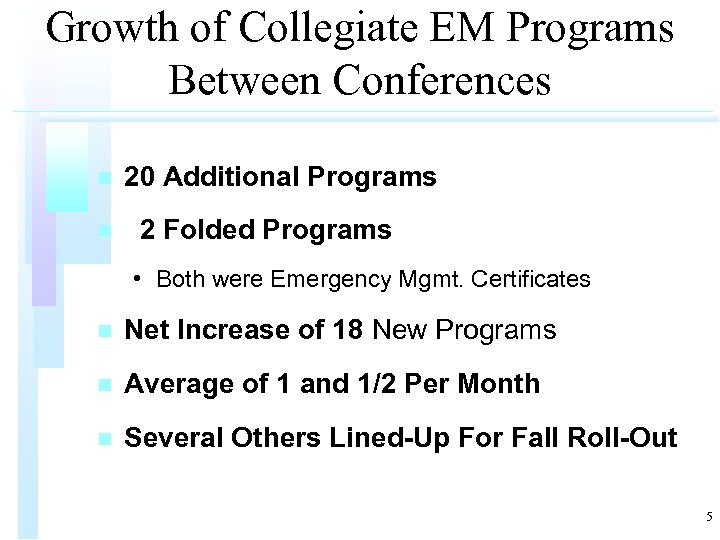 Growth of Collegiate EM Programs Between Conferences n n 20 Additional Programs 2 Folded Programs • Both were Emergency Mgmt. Certificates n Net Increase of 18 New Programs n Average of 1 and 1/2 Per Month n Several Others Lined-Up For Fall Roll-Out 5
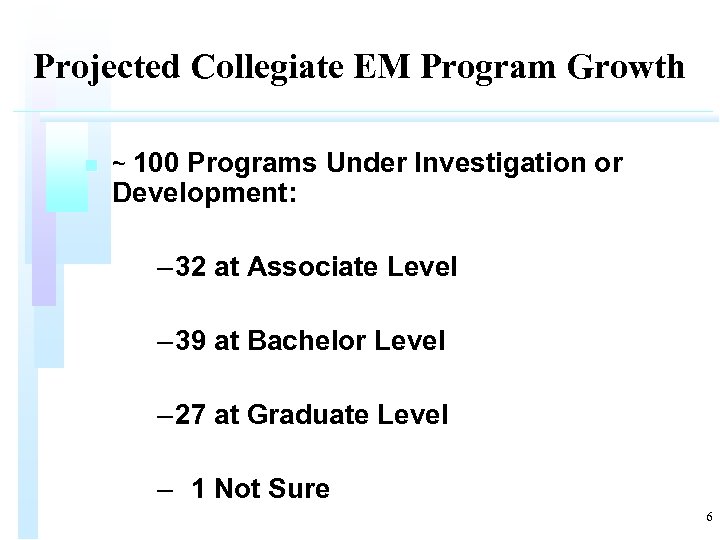 Projected Collegiate EM Program Growth n ~ 100 Programs Under Investigation or Development: – 32 at Associate Level – 39 at Bachelor Level – 27 at Graduate Level – 1 Not Sure 6
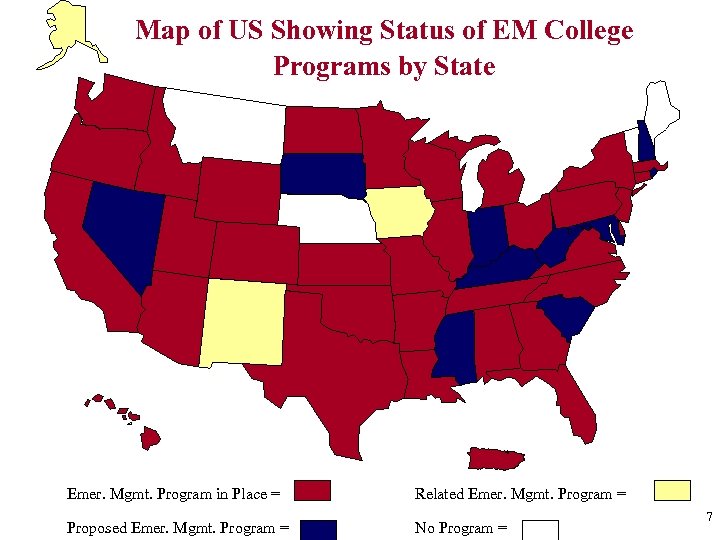 Map of US Showing Status of EM College Programs by State Emer. Mgmt. Program in Place = Related Emer. Mgmt. Program = Proposed Emer. Mgmt. Program = No Program = 7
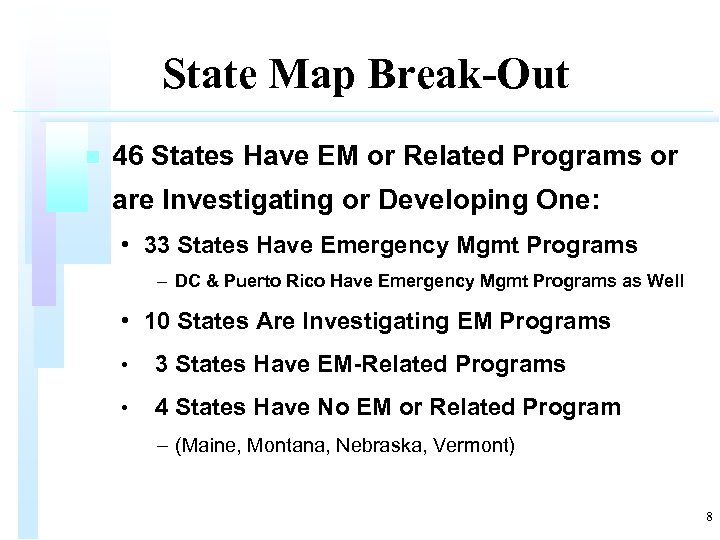 State Map Break-Out n 46 States Have EM or Related Programs or are Investigating or Developing One: • 33 States Have Emergency Mgmt Programs – DC & Puerto Rico Have Emergency Mgmt Programs as Well • 10 States Are Investigating EM Programs • 3 States Have EM-Related Programs • 4 States Have No EM or Related Program – (Maine, Montana, Nebraska, Vermont) 8
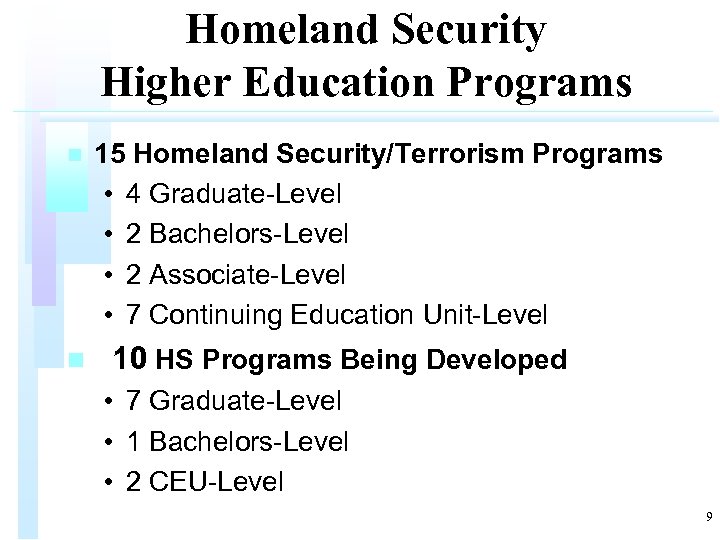 Homeland Security Higher Education Programs n n 15 Homeland Security/Terrorism Programs • 4 Graduate-Level • 2 Bachelors-Level • 2 Associate-Level • 7 Continuing Education Unit-Level 10 HS Programs Being Developed • • • 7 Graduate-Level 1 Bachelors-Level 2 CEU-Level 9
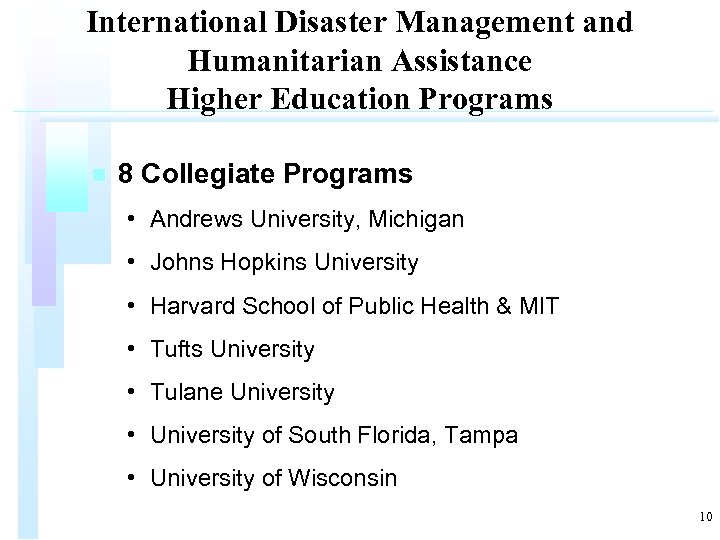 International Disaster Management and Humanitarian Assistance Higher Education Programs n 8 Collegiate Programs • Andrews University, Michigan • Johns Hopkins University • Harvard School of Public Health & MIT • Tufts University • Tulane University • University of South Florida, Tampa • University of Wisconsin 10
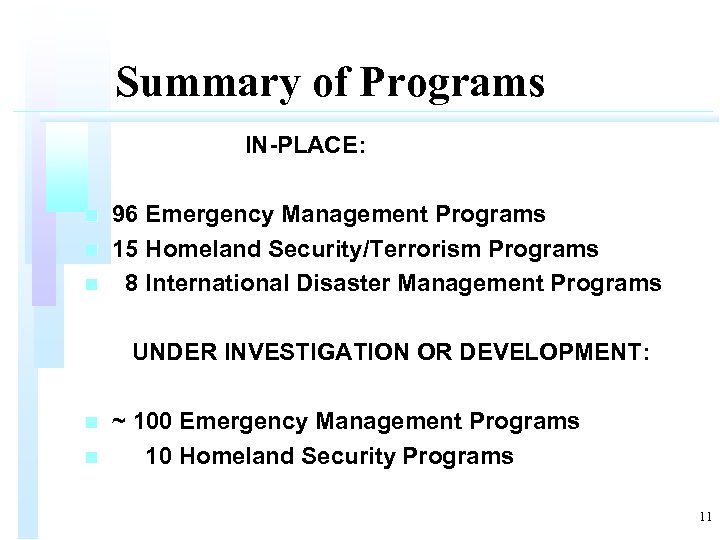 Summary of Programs IN-PLACE: n n n 96 Emergency Management Programs 15 Homeland Security/Terrorism Programs 8 International Disaster Management Programs UNDER INVESTIGATION OR DEVELOPMENT: n n ~ 100 Emergency Management Programs 10 Homeland Security Programs 11
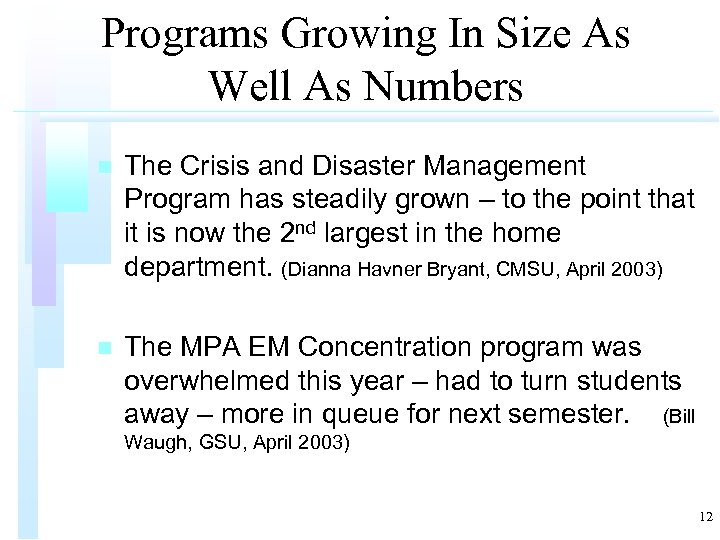 Programs Growing In Size As Well As Numbers n The Crisis and Disaster Management Program has steadily grown – to the point that it is now the 2 nd largest in the home department. (Dianna Havner Bryant, CMSU, April 2003) n The MPA EM Concentration program was overwhelmed this year – had to turn students away – more in queue for next semester. (Bill Waugh, GSU, April 2003) 12
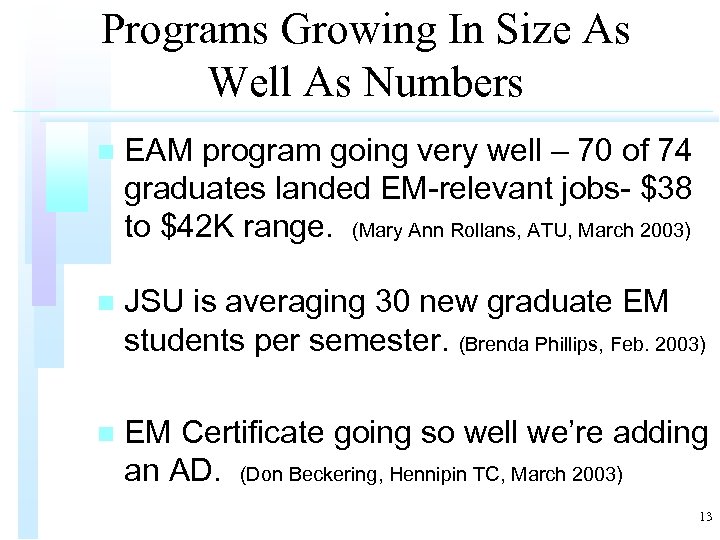 Programs Growing In Size As Well As Numbers n EAM program going very well – 70 of 74 graduates landed EM-relevant jobs- $38 to $42 K range. (Mary Ann Rollans, ATU, March 2003) n JSU is averaging 30 new graduate EM students per semester. (Brenda Phillips, Feb. 2003) n EM Certificate going so well we’re adding an AD. (Don Beckering, Hennipin TC, March 2003) 13
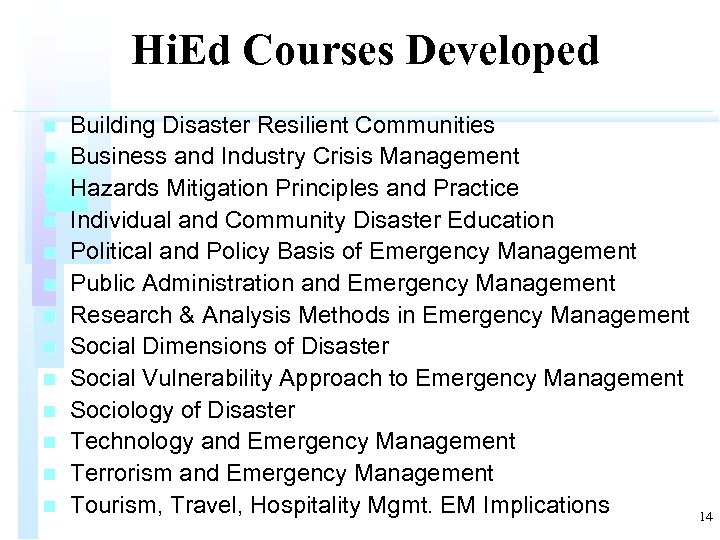 Hi. Ed Courses Developed n n n n Building Disaster Resilient Communities Business and Industry Crisis Management Hazards Mitigation Principles and Practice Individual and Community Disaster Education Political and Policy Basis of Emergency Management Public Administration and Emergency Management Research & Analysis Methods in Emergency Management Social Dimensions of Disaster Social Vulnerability Approach to Emergency Management Sociology of Disaster Technology and Emergency Management Terrorism and Emergency Management Tourism, Travel, Hospitality Mgmt. EM Implications 14
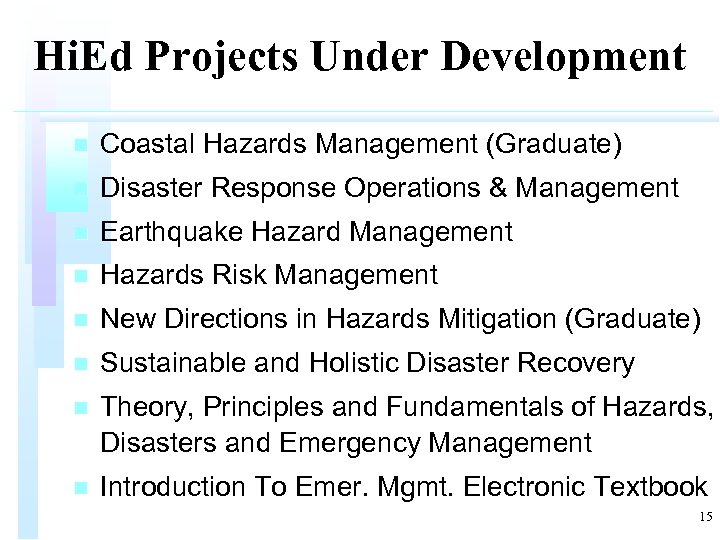 Hi. Ed Projects Under Development n Coastal Hazards Management (Graduate) n Disaster Response Operations & Management n Earthquake Hazard Management n Hazards Risk Management n New Directions in Hazards Mitigation (Graduate) n Sustainable and Holistic Disaster Recovery n Theory, Principles and Fundamentals of Hazards, Disasters and Emergency Management n Introduction To Emer. Mgmt. Electronic Textbook 15
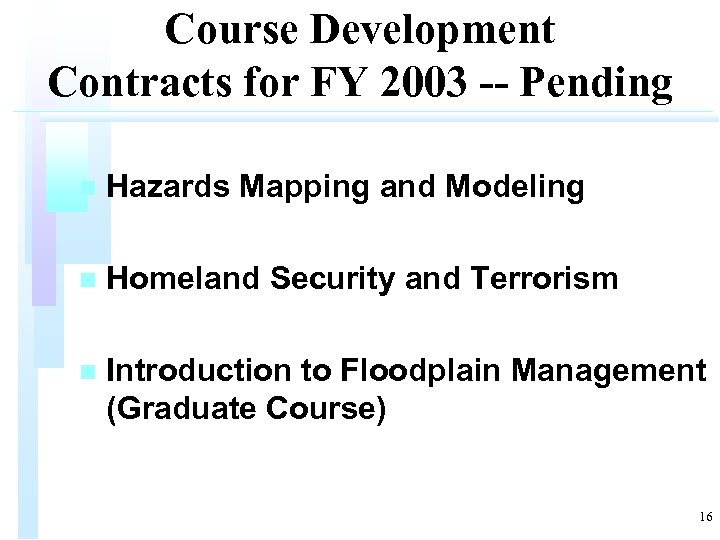 Course Development Contracts for FY 2003 -- Pending n Hazards Mapping and Modeling n Homeland Security and Terrorism n Introduction to Floodplain Management (Graduate Course) 16
 FY 2004 Course Development Options n Hazards Risk Communication n Legal and Ethical Issues in Emergency Mgmt. n Mitigation Loss Reduction Methods of Analysis n Mitigation Planning n Natural Hazards Engineering for Non-Engineers n Politics of Disaster 17
 Partnerships n North Carolina Division of Emer. Mgmt. n Coastal Services Center (DOC/NOAA) n U. S. Army Corps of Engineers (EM Div. ) n Public Entity Risk Institute n National Science Foundation n Association of Floodplain Managers n Colleges and Universities -- Interns 18
 EM Key Attributes/Elements “The Way It Ought To Be” n Elements: • Comprehensive Emergency Mgmt. (All Hazards) • All Four Phases – Not Primarily Response • Integrated Emergency Management n Attributes: • • • Full-Time Paid Professional Executive Manager Facilitator, Networker, Advisor, Partner Broad Scientific and Technical Knowledge Base Life-Long Learner EM Professionals More Reflective of US Pop. Makes Persuasive Articulate Case for Disaster Reduction 19
 21 st Century EM Core Competencies n Interpersonal Skills • • n Communication and Presentation Skills Networking, Partnering, Negotiating Marketing Bureaucratic, Organizational, Political KSAs Management Skills and Principles • People, Programs, Money, Resources • Problem Solving, Critical Thinking, Decision. Making, Flexibility, Planning 20
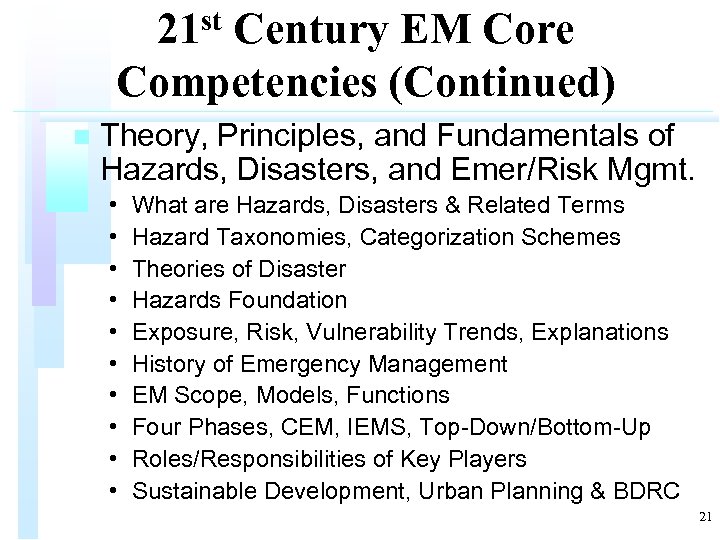 21 st Century EM Core Competencies (Continued) n Theory, Principles, and Fundamentals of Hazards, Disasters, and Emer/Risk Mgmt. • • • What are Hazards, Disasters & Related Terms Hazard Taxonomies, Categorization Schemes Theories of Disaster Hazards Foundation Exposure, Risk, Vulnerability Trends, Explanations History of Emergency Management EM Scope, Models, Functions Four Phases, CEM, IEMS, Top-Down/Bottom-Up Roles/Responsibilities of Key Players Sustainable Development, Urban Planning & BDRC 21
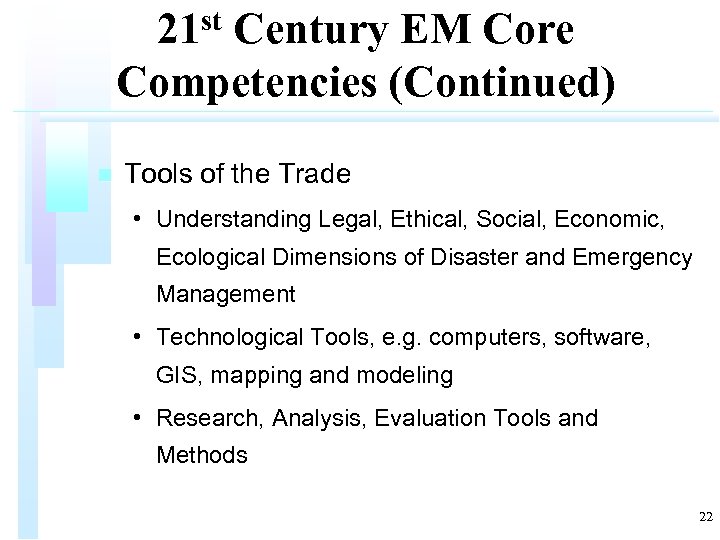 21 st Century EM Core Competencies (Continued) n Tools of the Trade • Understanding Legal, Ethical, Social, Economic, Ecological Dimensions of Disaster and Emergency Management • Technological Tools, e. g. computers, software, GIS, mapping and modeling • Research, Analysis, Evaluation Tools and Methods 22
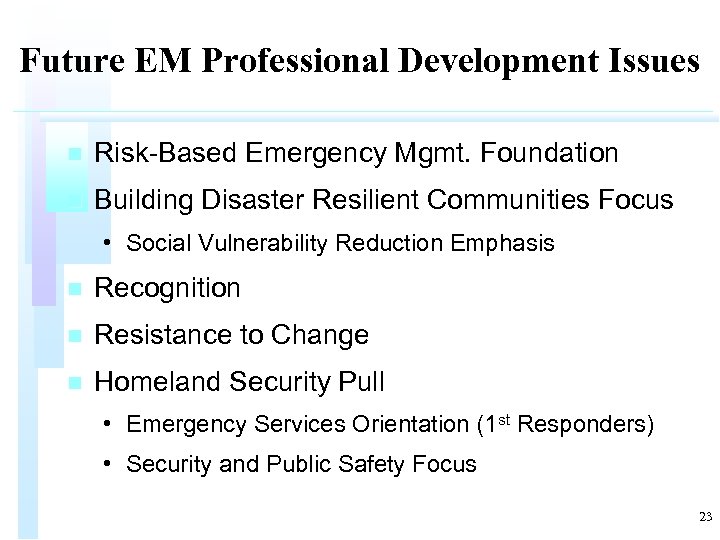 Future EM Professional Development Issues n Risk-Based Emergency Mgmt. Foundation n Building Disaster Resilient Communities Focus • Social Vulnerability Reduction Emphasis n Recognition n Resistance to Change n Homeland Security Pull • Emergency Services Orientation (1 st Responders) • Security and Public Safety Focus 23
 Importance of Education n “…Although knowledge does not guarantee power over natural catastrophe, it is a prime requisite of disaster prevention. ” (Dr. David Alexander, Univ. of Massachusetts, 2000) n “Human History becomes more and more a race between education and catastrophe. ” (H. G. Wells) 24